
| REPORT ATTRIBUTE | DETAILS |
|---|---|
| Historical Period | 2019-2022 |
| Base Year | 2023 |
| Forecast Period | 2024-2032 |
| Neotame Market Size 2023 | USD 16.3 Million |
| Neotame Market, CAGR | 7.60% |
| Neotame Market Size 2032 | USD 31.51 Million |
Market Insights
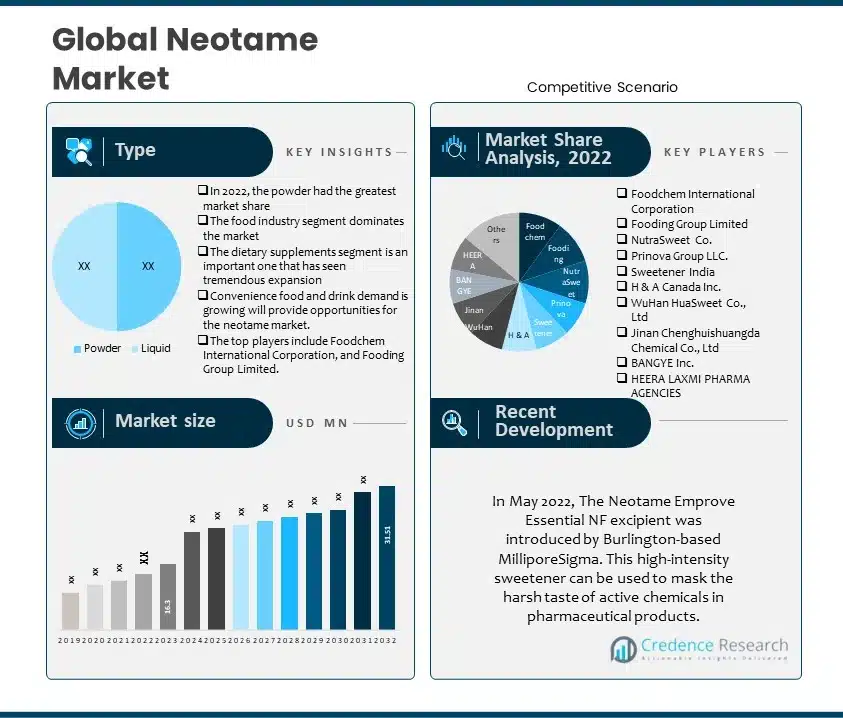
- The global market for Neotame is expected to develop at a compound annual growth rate (CAGR) of 7.60% between 2024 and 2032, from its estimated USD 16.3 million in 2023 to USD 31.51 million in 2032.
- The largest category is powder. Liquid, on the other hand, is expected to grow at a strong CAGR.
- The leading application segment is the food industry.
- The CAGR for dietary supplements is expected to be the highest during the projection period.
- The distributors and wholesalers will have the highest CAGR throughout the prediction period.
- Asia Pacific dominated the neotame market.
- Regarding the market share of Neotame, Europe is expected to come second.
- North America is anticipated to grow fastest in the neotame market.
- Rising obesity prevalence, related health problems, and growing consumer health consciousness are driving growth in the global market.
- The factors creating opportunities for the global sector include the growing knowledge of the health threats associated with excessive sugar consumption and the need for low-calorie and sugar-free alternatives in food and beverages.
Executive Summary
Market Definition
The Neotame market is the industry for the manufacture, sale, and use of Neotame, an artificial sweetener made from aspartame. Because of its extreme sweetness and low-calorie count, Neotame is advertised as a sugar alternative. It's widely used as a sugar substitute in the food and beverage sector for various products, such as candy, baked goods, dairy products, soft drinks, and more.
Market Overview
The neotame sector is estimated to develop at a 7.60% compound annual growth rate (CAGR) between 2024 and 2032, maintaining its current upward trend. The market will continue to develop, rising from its estimated value of USD 16.3 million in 2023 to USD 31.51 million in 2032.
The widespread use of Western dietary practices, such as the consumption of processed foods and beverages, is facilitated by urbanization trends and Westernization in rising economies. The market is predicted to develop as long as these trends persist because of the increased demand for low-calorie sweeteners like Neotame. Even though Neotame is an artificial sweetener, some customers want natural, clean-label goods and ingredients. To reach health-conscious consumers, manufacturers can meet this inclination by combining Neotame with natural sweeteners or flavor enhancers.
Product demand for Neotame-containing items can be increased by launching persuasive marketing and advertising efforts that stress the advantages of Neotame, such as its sweetness potency and zero-calorie nature. Neotame is expected to be in high demand in the European market due to the region's expanding use in the baking sector. Furthermore, because it is a low-calorie sweetener, the region's health-conscious customers are increasingly liking it.
Segmentation by Type
- By type, powder leads the market. The demand for neotame powder is mostly driven by how widely it's used as a sweetener in the food and beverage sector. Neotame powder is used to provide sweetness without adding extra calories to various products, including dairy products, soft drinks, baked goods, snacks, and confections.
- The liquid category will exhibit a sizable CAGR during the projected period. A variety of liquid applications can benefit from the flexible nature of neotame liquid. In order to satisfy changing consumer demands, companies are always coming up with new goods and formulations. The consumer demand for Neotame liquid is characterized by product innovation, as companies aim to create new products or reformulate their current liquid products to provide low-calorie substitutes for those sweetened with sugar.
Segmentation by Application
- The main application is the food industry. Players in the food business are facing pressure to lower the amount of sugar in their goods as customer concerns about wellness and health grow. High-intensity sweetener neotame provides an acceptable substitute for sugar in various culinary products without compromising flavor. The market for Neotame is growing as businesses work to restructure their goods to satisfy sugar reduction goals.
- The beverage industry category will likely register a significant CAGR during forecasting. Neotame can be effectively included in beverage products because of ongoing technological developments in beverage formulation and processing. Producers can use these developments to create novel beverage recipes that satisfy consumer preferences for reduced-calorie alternatives while maintaining the appropriate sweetness profile.
Segmentation by End-Use Sector
- The dietary supplements category is projected to grow faster over the projection period. With no bitter aftertaste like some other high-intensity sweeteners, Neotame has a pure, sweet flavor. This qualifies it for usage in dietary supplements, where palatability and taste play a significant role in consumer approval and supplementation regimen compliance.
- Other end-use sectors, such as the food and beverage industry and pharmaceuticals, influence the need for Neotame.
Segmentation by Distribution Channel
- The distributors and wholesalers category will likely have the highest CAGR during the projection period. Distributors and wholesalers meet consumers' demand for items containing Neotame. Distributors and wholesalers may expect increased demand for Neotame-containing products from retailers and other clients as consumers look for low-calorie and sugar-free options in food, beverage, and dietary supplement items.
- Other distribution channels, such as direct sales (manufacturer to end user), online retailers, and specialty stores, also contribute to the demand for Neotame.
Segmentation by Region
- Asia Pacific leads the neotame industry. The factors expected to drive up demand for Neotame in the Asia-Pacific region during the forecast period are growing awareness of Neotame and its many applications.
- Europe is estimated to rank second in market size for Neotame.
- The neotame industry is predicted to flourish rapidly in North America.
- Regions such as Africa, the Middle East, and Latin America cover the remaining requirement for Neotame.
Due to its wide range of uses, neotame can be utilized in a variety of food and beverage industries. To deliver low-calorie substitutes for options that are full of sugar, manufacturers may experiment by creating new items or repurposing ones that already exist. As customer requirements and preferences change and they become more concerned about obesity and related medical conditions, this innovation accelerates market expansion.
Based on projections, the neotame market is anticipated to be controlled by Asia Pacific. A growing inclination for processed and convenient foods has resulted from China's fast urbanization and subsequent nutritional changes. Due to this trend, various food and beverage products are seeing an increase in demand for low-calorie sweeteners like Neotame. China's government is taking steps to combat the rising obesity rates in the country, such as urging food manufacturers to reformulate their goods with less sugar and promoting healthier dietary choices. This allows Neotame to enter the Chinese market as a sugar alternative.
The neotame market in North America is anticipated to expand fastest throughout the forecast. The market is expected to be driven by the growing usage of Neotame as an effective flavor enhancer and sweetener in the nation's well-established food and beverage industry. In addition, Neotame has a number of advantages over aspartame, such as a high pH stability that makes it suitable for usage in a wide range of food products. High potency and efficacy of Neotame is another important reason driving expansion in the United States.
Key Highlights of the Report
The global neotame market is segmented by type, application, end-use sector, distribution channel, and region. Powder is the market spearhead as far as the product type is concerned. The food industry is the top segment. The dietary supplements category is anticipated to increase at the highest CAGR throughout the projection period. The distributors and wholesalers category will experience the highest CAGR during the forecast period. The neotame market is expanding mostly in Asia Pacific.
Individuals are searching for solutions to control their body mass index and enhance their general health due to increasing recognition of potential risks connected with being overweight. Individuals who want to decrease their calories without compromising flavor are thus boosting the popularity of low-calorie sugar substitutes like Neotame. Overindulgence in calories is a prevalent cause of obesity, and added sugars play a major role in calorie intake. Neotame is a sweetening option for food and beverage items without significantly increasing calorie content. Neotame can be utilized by food and beverage producers to minimize the sugar content of their goods, which is in line with consumer desires for reduced-calorie options.
Asia Pacific is expected to account for the largest neotame market globally. Significant increases in obesity rates in South Korea have raised public awareness of the harmful effects of consuming excessive amounts of sugar. Neotame acts as a low-calorie substitute for sugar in various food and drink items, thereby addressing this concern. The North American region is also assumed to have the market's sharpest growth. This is due to the rising demand for Neotame from North American countries like the United States and Canada.
Which Key Factors Are Driving The Global Neotame Market?
Technological developments in the production and formulation of sweeteners, product development, formulation innovation, and reformulations of products by food and beverage makers to lower sugar content are the primary factors driving the Neotame industry.
What are The Main Challenges Confronting the Neotame Market Globally?
Some obstacles preventing the industry's growth are formulating issues and guaranteeing stability and shelf-life of neotame-containing goods, especially in demanding processing or storage settings.
What Market Opportunities Exist For Neotame Globally?
Some factors that could accelerate the neotame industry are the growing number of people with diabetes globally, government programs to fight obesity and encourage healthy eating, and consumer preferences for natural and clean-label components.
Market Drivers
Multiple factors propel the neotame industry across the globe. The primary factors propelling the global neotame market are as follows:
Growing Interest in Sugar Substitutes with Few Calories
The market for Neotame is expanding due to consumer demand for sugar substitutes with fewer calories. Customers are actively looking for alternatives to cut back on their calorie and sugar intake as they become more aware of the health hazards linked to excessive sugar intake. Because they provide sweetness without adding extra calories, low-calorie sweeteners like Neotame provide a solution that appeals to health-conscious people. People have started eating healthier due to the rise in diabetes and obesity rates around the world. The increasing popularity of low-calorie sweeteners can be attributed to their perception as a means of controlling blood sugar levels and weight. Government organizations from all around the world are putting laws and rules in place to fight obesity and associated health problems. This includes programs aimed at lowering sugar intake and encouraging better eating habits. As a result, in order to comply with regulations and satisfy consumer demand for healthier options, food and beverage manufacturers are reformulating their goods to include low-calorie sweeteners like Neotame.
Market Restraints
There are several obstacles that the global neotame market must overcome to continue growing. Among them are the following:
Supply Chain Breakdowns and a Decline in Disposable Income
Neotame's availability and price may be negatively impacted by supply chain disruptions such as shortages of raw materials, delays in transit, or stops in production. The stability of the Neotame market may be impacted if producers experience difficulties distributing completed goods or locating raw materials due to supply chain disruptions. This could result in product shortages. In addition, these disruptions can raise the operational expenses for producers, which might result in higher prices for goods containing Neotame and discourage buyers from buying them. Customers' ability to make purchases and their discretionary expenditure on food and drink, especially items sweetened with Neotame, may decrease if their disposable income declines. In times of economic instability or downturn, consumers could give priority to necessities above luxury or specialized products. The market expansion of items containing Neotame may be restricted by this change in customer behavior.
Opportunities
There are many potential prospects in the global neotame industry. Among these are the following:
Growing Food and Beverage Sector
Concerns over health and fitness are driving consumers to look for low-calorie substitutes for conventional products sweetened with sugar. This tendency can be used by the growing food and beverage business by adding Neotame to various products, such as dairy products, snacks, baked goods, soft drinks, and more. In response to consumers' desire for healthier options, producers are drawn to Neotame since it offers sweetness without extra calories. Food and beverage manufacturers are reformulating their goods to contain less sugar as health organizations and regulatory bodies push for a decrease in sugar intake. A workable way to lower sugar content without sacrificing the required sweetness and flavor profile is to use Neotame. Manufacturers can use Neotame to create new formulas that appeal to health-conscious consumers or reformulate their current products. Working with food and beverage industries can speed up market adoption by making incorporating Neotame into product formulations easier.
Competitive Landscape
Key Players
Several major competitors exist in the fiercely competitive global neotame market. The following are a few of the leading market participants and their market shares:
- Foodchem International Corporation
- Fooding Group Limited
- NutraSweet Co.
- Prinova Group LLC.
- Sweetener India
- H & A Canada Inc.
- WuHan HuaSweet Co., Ltd
- Jinan Chenghuishuangda Chemical Co., Ltd
- BANGYE Inc.
- HEERA LAXMI PHARMA AGENCIES
- Advance Inorganics
- Rasayan Trading Co.
- Sajm Procart Pvt. Ltd.
- PAT IMPEX
- SCM Pioneering Co., Ltd.
- Others
These companies prioritize product innovation, distribution channel expansion, mergers, and acquisitions to remain competitive.
The largest suppliers in the global neotame market continuously work to stay one step ahead of the competition by developing innovative concepts and products.
In May 2023, Foodchem International Corporation presented various health product components and state-of-the-art sweetener solutions at the Vitafoods Europe 2023, the leading European exposition for nutrition and health food products.
In November 2021, Ingredion, a Leading global supplier of ingredient solutions, announced that it had added the low-calorie sweetener ASTRAEA® Allulose to its lineup.
Summary of Key Findings
- The Neotame Market is expanding due to the baking and confectionery industries' rising need for sugar substitutes.
- The market is segmented by type, application, end-use sector, distribution channel, and region.
- The most popular product type in the market is powder.
- The food industry is the foremost application category.
- Dietary supplements are expected to grow fastest in terms of CAGR during the forecast period.
- The distributors and wholesalers category will likely see the highest CAGR during the anticipated time frame.
- Asia Pacific is leading market development; the market is highly competitive with key players including Foodchem International Corporation, Fooding Group Limited, NutraSweet Co., Prinova Group LLC., Sweetener India, H & A Canada Inc., WuHan HuaSweet Co., Ltd, Jinan Chenghuishuangda Chemical Co., Ltd, BANGYE Inc., HEERA LAXMI PHARMA AGENCIES, Advance Inorganics, Rasayan Trading Co., Sajm Procart Pvt. Ltd., PAT IMPEX, SCM Pioneering Co., Ltd., and Others.
Future Outlook
- The neotame industry is expected to increase significantly in Asia Pacific and has a positive outlook worldwide.
- Convenience food and drink demand is growing, which is propelling industry expansion.
- The competition from natural and other low-calorie sweeteners is expected to be a major obstacle to the growth of the neotame market during the forecast period.
- To stay ahead of the competition, key enterprises must develop new products, expand their market reach, and keep their prices competitive.
How CXOs Can Benefit from the Credence Research Neotame Market Report
CXOs may get a detailed picture of the market in the Credence Research Neotame Market Report, which includes:
- Market size and growth forecast: The report provides detailed estimates of the global neotame market size, segmented by type, application, end-use sector, distribution channel, and region. It also includes forecasts for the market through 2032 based on key trends and drivers.
- Market segmentation: The research report breaks down the market for Neotame into segments based on type, application, end-use sector, distribution channel, and region. This segmentation provides CXOs with a granular understanding of the market and the opportunities in each segment.
- Competitive landscape: The research report offers a detailed analysis of the major companies in the neotame industry, including information on their business plans, product lines, and earnings. CXOs can use this information to evaluate and identify their competitors.
- Key trends and drivers: The research report identifies and evaluates the main trends and factors influencing the Neotame market. CXOs can use this information to make well-informed choices regarding their plans and investments.
CXOs can use the insights from the Credence Research Neotame Market Report to:
- Identify growth opportunities: This analysis may help CXOs identify new growth opportunities in the neotame sector. For example, the report identifies the growing demand for Neotame from the food and beverage industry as a key opportunity.
- Make informed investment decisions: The report helps CXOs choose Neotame wisely. For example, the research study provides information on the critical factors to consider while selecting neotame solutions and evaluating neotame suppliers.
- Develop competitive strategies: CXOs can use the research report to develop competitive strategies for neotame businesses. For example, the research paper outlines the main strategies that neotame suppliers utilize to differentiate themselves from competitors.
- Track market developments: This research report may help CXOs stay ahead of the curve by tracking market developments. For instance, it offers insights into the most recent developments and trends in the Neotame market.
CXOs seeking to expand their industry knowledge and spot growth prospects will find the Credence Research Neotame Market Report useful.
Segmentation
- By Type
- Powder
- Liquid
- By Application
- Food Industry
- Beverages (e.g., soft drinks, flavored water, sports drinks)
- Dairy Products (e.g., yogurt, flavored milk, ice cream)
- Bakery Products (e.g., cakes, cookies, pastries)
- Confectionery (e.g., candies, chewing gum, mints)
- Snacks and Convenience Foods (e.g., cereal bars, granola, snack mixes)
- Pharmaceuticals (e.g., chewable tablets, liquid medications)
- Others
- Beverage Industry
- Carbonated Soft Drinks
- Non-carbonated Soft Drinks
- Sports and Energy Drinks
- Flavored Water
- Alcoholic Beverages (e.g., cocktails, flavored spirits)
- Others
- By End-Use Sector
- Food and Beverage Industry
- Pharmaceuticals
- Dietary Supplements
- Others
- By Distribution Channel
- Direct Sales (Manufacturer to End User)
- Distributors and Wholesalers
- Online Retailers
- Specialty Stores
- By Region
- North America
- The U.S.
- Canada
- Mexico
- Europe
- Germany
- France
- The U.K.
- Italy
- Spain
- Rest of Europe
- Asia Pacific
- China
- Japan
- India
- South Korea
- South-east Asia
- Rest of Asia Pacific
- Latin America
- Brazil
- Argentina
- Rest of Latin America
- Middle East & Africa
- GCC Countries
- South Africa
- Rest of Middle East and Africa
- North America
- Food Industry

Request a Free Sample
Fill in your details and we'll send you a free sample report.
- Sample data tables & charts
- Research methodology
Market Dynamics
Rising Health Consciousness and Obesity Concerns
Increasing awareness of obesity and related health issues is prompting consumers to seek low-calorie alternatives, driving demand for neotame as a sugar substitute in food and beverages.
Regulatory Push for Sugar Reduction
Government initiatives and regulations aimed at reducing sugar consumption are encouraging food and beverage manufacturers to reformulate products with low-calorie sweeteners like neotame.
Expansion of Processed and Convenience Foods
Urbanization and changing dietary habits, especially in Asia Pacific, are boosting the consumption of processed foods and beverages, which frequently use neotame for calorie reduction.
Product Innovation and Reformulation
Manufacturers are leveraging neotame’s high sweetness potency and stability to develop new products and reformulate existing ones, meeting consumer demand for healthier, sugar-free options.
Growth in Dietary Supplements and Pharmaceuticals
Neotame’s clean taste profile and lack of bitter aftertaste make it increasingly popular in dietary supplements and pharmaceutical formulations, expanding its application base.
Need a Custom Version of This Report?
Tailor the scope, geography, or segments to your exact requirements.
- Custom geography or segment scope
- Direct access to our analyst team
Frequently Asked Questions
How much does the global market currently hold for Neotame?
What is the neotame market's projected growth rate between 2024 and 2032?
In terms of type, which market category is leading?
Regarding application, which market category is in the lead?
Which distribution channel segment is estimated to have the highest CAGR throughout the forecast period?
In which region is the market for Neotame expanding?
Who are the main players in the global neotame industry?
Table of Content
Chapter 1 Market Segmentation
- 1.1 Segmentation Framework
- 1.1.1 Product and Service Classification
- 1.1.2 Application and End-Use Classification
- 1.1.3 Technology and Solution Classification
- 1.1.4 Customer and Distribution Channel Classification
- 1.1.5 Geographic Segmentation
- 1.1.6 Market Segment Definitions and Boundaries
- 1.2 By Type
- 1.2.1 Powder
- 1.2.2 Liquid
- 1.3 By Application
- 1.3.1 Food Industry
- 1.3.2 Beverage Industry
- 1.3.3 Pharmaceuticals
- 1.3.4 Dietary Supplements
- 1.3.5 Others
Chapter 2 Introduction
- 2.1 Report Objectives and Scope
- 2.2 Product Definition and Industry Terminology
- 2.3 Market Inclusions and Exclusions
- 2.4 Research Process
- 2.4.1 Primary Research and Expert Interviews
- 2.4.2 Secondary Research and Source Review
- 2.4.3 Top-Down and Bottom-Up Estimation
- 2.4.4 Data Triangulation and Verification
- 2.5 Market Size Measurement Basis
- 2.5.1 2023: USD 16.3 million → 2032: USD 31.51 million
- 2.6 Historical and Forecast Reference Periods
- 2.6.1 Base Year: 2023
- 2.6.2 Forecast Period: 2023-2032
- 2.7 Research Assumptions and Limitations
Chapter 3 Executive Summary
- 3.1 Market Snapshot and Key Findings
- 3.2 Base-Year Market Size, 2023
- 3.3 Forecast Market Size, 2032
- 3.4 Revenue and Volume Growth Outlook
- 3.5 Key Demand and Supply Indicators
- 3.6 Leading Market Segments
- 3.7 Fastest-Growing Market Opportunities
- 3.8 Regional Performance Highlights
- 3.9 Technology and Industry Transformation
- 3.10 Competitive Landscape Summary
- 3.11 Analyst View and Strategic Implications
Chapter 4 Global Neotame Market Trends and Developments
- 4.1 Historical Industry Development
- 4.2 Recent Market Trends and Developments
- 4.3 Demand and Customer Behavior Trends
- 4.4 Technology and Product Innovation
- 4.5 Artificial Intelligence, Automation and Digitalization
- 4.6 Local Manufacturing and Supply Chain Realignment
- 4.7 Industry Partnerships, Mergers and Acquisitions
- 4.8 Sustainability and Circular Economy Developments
- 4.9 Government and Private Sector Investment Trends
- 4.10 Emerging Business Models and Commercialization
- 4.11 Industry Developments and Announcements
Chapter 5 Global Neotame Market Production, Supply and Demand Analysis
- 5.1 Demand Trend and Consumption Analysis
- 5.2 Demand Forecast, 2023-2032
- 5.3 Production and Output Trend
- 5.4 Production and Output Forecast, 2023-2032
- 5.5 Installed Capacity and Capacity Utilization
- 5.6 Company-Wise Production Plants and Statistics
- 5.6.1 Installed Production Capacity
- 5.6.2 Actual Production
- 5.6.3 Planned Capacity and Expansion Targets
- 5.7 Supply Chain Structure and Procurement Trends
- 5.8 Supply-Demand Gap and Bottlenecks
- 5.9 Import Dependence and Sourcing Structure
- 5.10 Contract Manufacturing and Outsourcing
- 5.11 Regional Supply and Demand Concentration
Chapter 6 Global Neotame Market Pricing Analysis
- 6.1 Pricing Structure and Measurement
- 6.2 Historical Pricing Trends
- 6.3 Pricing Outlook, 2023-2032
- 6.4 Average Selling Price and Unit Economics
- 6.5 Pricing by Product and Market Segment
- 6.6 Geographic Pricing Differences
- 6.7 Key Input, Energy, Labor and Logistics Costs
- 6.8 Contract Pricing and Purchasing Models
- 6.9 Pricing Sensitivity and Competitive Positioning
- 6.10 Price, Margin and Profitability Implications
Chapter 7 Global Neotame Market Dynamics
- 7.1 Market Growth Drivers
- 7.1.1 Demand-Side Drivers
- 7.1.2 Technology and Innovation Drivers
- 7.1.3 Infrastructure and Investment Drivers
- 7.1.4 Regulatory and Policy Drivers
- 7.2 Market Restraints
- 7.2.1 Cost and Affordability Constraints
- 7.2.2 Technology and Adoption Barriers
- 7.2.3 Supply Chain and Operational Constraints
- 7.3 Market Challenges
- 7.3.1 Competitive Pressure and Margin Erosion
- 7.3.2 Skills, Infrastructure and Implementation Gaps
- 7.4 Emerging Market Opportunities
- 7.5 Market Dynamics Impact and Time-Horizon Assessment
Chapter 8 Global Neotame Value Chain Analysis
- 8.1 Industry Value Chain Overview
- 8.2 Upstream Suppliers and Critical Inputs
- 8.3 Technology and Component Providers
- 8.4 Manufacturing or Service Delivery
- 8.5 Distribution, Channel Partners and Integrators
- 8.6 Downstream Applications and End Users
- 8.7 Value Addition and Profit Pools
- 8.8 Vertical Integration and Outsourcing
- 8.9 Supplier Concentration and Risk
- 8.10 Supply Chain Localization and Resilience
Chapter 9 Global Neotame Market Regulations and Policies
- 9.1 Relevant Laws, Standards and Compliance Frameworks
- 9.2 Product, Service, Safety and Quality Requirements
- 9.3 Government Policies, Incentives and Subsidies
- 9.4 Imports, Exports and Trade Barriers
- 9.5 Public Procurement and Local Content Requirements
- 9.6 Environmental and Sustainability Compliance
- 9.7 Upcoming Policy Changes and Market Implications
Chapter 10 Global Neotame Market Hotspots and Opportunities
- 10.1 Market Opportunity Mapping and Growth Hotspots
- 10.2 High-Growth Applications and Customer Groups
- 10.3 Underserved Markets and White-Space Opportunities
- 10.4 Emerging Technology and Product Opportunities
- 10.5 New Capacity and Investment Hotspots
- 10.6 Market Entry and Expansion Opportunities
- 10.7 Distribution and Partnership Opportunities
- 10.8 Near-Term and Long-Term Commercial Potential
- 10.9 Opportunity Attractiveness and Execution Risks
Chapter 11 Global Neotame Market Outlook, 2023-2032
- 11.1 Market Size and Analysis
- 11.1.1 Revenue (Market Measurement: 2023: USD 16.3 million → 2032: USD 31.51 million)
- 11.1.2 Market Volume and Quantity Sold
- 11.1.3 Historical Market Size
- 11.1.4 Base-Year Market Size, 2023
- 11.2 Market Forecast, 2023-2032
- 11.2.1 Revenue Forecast to 2032
- 11.2.2 Volume Forecast to 2032
- 11.2.3 CAGR and Year-on-Year Growth
- 11.2.4 Incremental Revenue Opportunity
- 11.3 Forecast Assumptions and Scenario Analysis
- 11.3.1 Base-Case Forecast
- 11.3.2 Optimistic and Conservative Scenarios
- 11.3.3 Technology, Pricing and Policy Sensitivities
- 11.4 Market Attractiveness and Growth Outlook
Chapter 12 Global Neotame Market Segmentation and Outlook
- 12.1 Segmentation Summary and Market Shares, 2023
- 12.2 Largest and Fastest-Growing Segments
- 12.3 By Type - Market Size and Forecast, 2023-2032
- 12.3.1 Segment Definition and Scope
- 12.3.2 Historical Market Size
- 12.3.3 Revenue Forecast, 2023-2032
- 12.3.4 Volume Forecast, 2023-2032
- 12.3.5 Base-Year Market Share, 2023
- 12.3.6 Segment CAGR and Growth Drivers
- 12.3.7 Subsegment Market Size and Forecast
- 12.3.7.1 Powder
- 12.3.7.2 Liquid
- 12.3.8 Subsegment Pricing and Adoption Trends
- 12.3.9 Leading Suppliers and Competition
- 12.3.10 Regional Demand and Opportunities
- 12.4 By Application - Market Size and Forecast, 2023-2032
- 12.4.1 Segment Definition and Scope
- 12.4.2 Historical Market Size
- 12.4.3 Revenue Forecast, 2023-2032
- 12.4.4 Volume Forecast, 2023-2032
- 12.4.5 Base-Year Market Share, 2023
- 12.4.6 Segment CAGR and Growth Drivers
- 12.4.7 Subsegment Market Size and Forecast
- 12.4.7.1 Food Industry
- 12.4.7.2 Beverage Industry
- 12.4.7.3 Pharmaceuticals
- 12.4.7.4 Dietary Supplements
- 12.4.7.5 Others
- 12.4.8 Subsegment Pricing and Adoption Trends
- 12.4.9 Leading Suppliers and Competition
- 12.4.10 Regional Demand and Opportunities
- 12.5 Segment Growth Comparison
- 12.6 Segment Attractiveness and Priority Matrix
Chapter 13 Global Neotame End-Use and Application Market Outlook
- 13.1 End-Use Industry and Customer Demand Structure
- 13.2 Leading Applications and Customer Groups
- 13.3 End-Use Market Size, Share and Forecast
- 13.4 Major End-Use Industry Deep Dives
- 13.4.1 Customer Requirements and Use Cases
- 13.4.2 Demand and Replacement Cycles
- 13.4.3 Technical and Regulatory Considerations
- 13.4.4 Purchasing and Procurement Models
- 13.4.5 Leading Vendors and Distribution Channels
- 13.4.6 Forecast and Commercial Opportunities
- 13.5 Emerging Applications and Cross-Segment Demand
- 13.6 End-Use Industry Investment Priorities
Chapter 14 Global Neotame Geographic Market Outlook, 2023-2032
- 14.1 Regional Market Size and Share, 2023
- 14.2 Regional Market Forecast, 2023-2032
- 14.3 Regional Pricing, Production and Demand Differences
- 14.4 North America
- 14.4.1 United States
- 14.4.2 Canada
- 14.4.3 Mexico
- 14.5 Europe
- 14.5.1 Germany
- 14.5.2 France
- 14.5.3 Italy
- 14.5.4 United Kingdom
- 14.5.5 Spain
- 14.5.6 Poland
- 14.5.7 Russia
- 14.5.8 Netherlands
- 14.5.9 Belgium
- 14.5.10 Sweden
- 14.5.11 Denmark
- 14.5.12 Norway
- 14.5.13 Rest of Europe
- 14.6 Asia Pacific
- 14.6.1 China
- 14.6.2 India
- 14.6.3 Japan
- 14.6.4 South Korea
- 14.6.5 Thailand
- 14.6.6 Indonesia
- 14.6.7 Vietnam
- 14.6.8 Malaysia
- 14.6.9 Australia
- 14.6.10 Rest of Asia Pacific
- 14.7 Latin America
- 14.7.1 Brazil
- 14.7.2 Argentina
- 14.7.3 Colombia
- 14.7.4 Chile
- 14.7.5 Rest of Latin America
- 14.8 Middle East
- 14.8.1 Saudi Arabia
- 14.8.2 United Arab Emirates
- 14.8.3 Turkey
- 14.8.4 Israel
- 14.8.5 Iran
- 14.8.6 Rest of the Middle East
- 14.9 Africa
- 14.9.1 South Africa
- 14.9.2 Egypt
- 14.9.3 Nigeria
- 14.9.4 Morocco
- 14.9.5 Rest of Africa
- 14.10 Regional Investment, Policy and Supply Chain Differences
- 14.11 Regional Competitive Landscape
- 14.12 Geographic Growth Hotspots
Chapter 15 Global Neotame Technology, Innovation and Sustainability Outlook
- 15.1 Technology Landscape and Maturity
- 15.2 Product, Process and Service Innovation
- 15.3 AI, Automation and Digital Tools in the Industry
- 15.4 Technology Adoption and Performance Benchmarking
- 15.5 Innovation Pipeline and R&D Investment
- 15.6 Patent and Intellectual Property Trends
- 15.7 Energy Efficiency and Resource Management
- 15.8 Sustainability, Recycling and Circularity
- 15.9 Technology Roadmap, 2023-2032
- 15.10 Risks of Obsolescence and Technology Substitution
Chapter 16 Global Neotame Market Key Strategic Imperatives
- 16.1 Growth and Market Entry Priorities
- 16.2 High-Return Products and Segments
- 16.3 Pricing, Profitability and Cost Optimization
- 16.4 Technology Investment and Product Differentiation
- 16.5 Supply Chain Localization and Resilience
- 16.6 Distribution and Customer Acquisition
- 16.7 Partnership, Acquisition and Capacity Strategy
- 16.8 Regional Expansion Priorities
- 16.9 Short-, Medium- and Long-Term Actions
Chapter 17 Competition Outlook
- 17.1 Industry Competition Characteristics
- 17.2 Market Structure and Concentration
- 17.3 Market Share and Competitive Positioning, 2023
- 17.4 Company-Wise Revenue and Product Benchmarking
- 17.5 Production and Service Capacity Benchmarking
- 17.6 Technology, Pricing and Differentiation
- 17.7 Regional Footprint and Distribution Strength
- 17.8 Mergers, Acquisitions and Strategic Alliances
- 17.9 New Entrants and Competitive Threats
- 17.10 Porter's Five Forces and Industry Attractiveness
- 17.11 Competitive Outlook, 2023-2032
Chapter 18 Company Profiles
- 18.1 Company Coverage and Selection Criteria
- 18.2 Foodchem International Corporation
- 18.2.1 Business Description
- 18.2.2 Company Ownership and Geographic Presence
- 18.2.3 Product and Service Portfolio
- 18.2.4 Manufacturing and Operating Footprint
- 18.2.5 Production Capacity and Expansion Plans
- 18.2.6 Financial Performance and Investment
- 18.2.7 Market Share and Competitive Position
- 18.2.8 Technology and Innovation Capabilities
- 18.2.9 Strategic Alliances or Partnerships
- 18.2.10 Recent Developments
- 18.2.11 Growth Strategy and Outlook
- 18.3 Fooding Group Limited
- 18.4 NutraSweet Co.
- 18.5 Prinova Group LLC
- 18.6 WuHan HuaSweet Co., Ltd
- 18.7 Sweetener India
- 18.8 Jinan Chenghuishuangda Chemical Co., Ltd
- 18.9 Ingredion Incorporated
- 18.10 BANGYE Inc.
- 18.11 H & A Canada Inc.
- 18.12 Other Relevant Market Participants
Note: Every listed company is profiled on the structure shown under the first company. The company list is preliminary and may change based on research findings, market developments, data availability and client requirements.
Chapter 19 Disclaimer
- 19.1 Research and Forecast Disclaimer
- 19.2 Data Source and Estimation Limitations
Note: The depth of individual sections depends on data availability for this market. Volume, capacity, trade and other unit-based metrics are included where applicable.

