| REPORT ATTRIBUTE | DETAILS |
|---|---|
| Historical Period | 2019-2022 |
| Base Year | 2023 |
| Forecast Period | 2024-2032 |
| Non GMO Yogurt Market Size 2023 | USD 5851.2 Million |
| Non GMO Yogurt Market, CAGR | 16.00% |
| Non GMO Yogurt Market Size 2032 | USD 22251.8 Million |
Market Insights
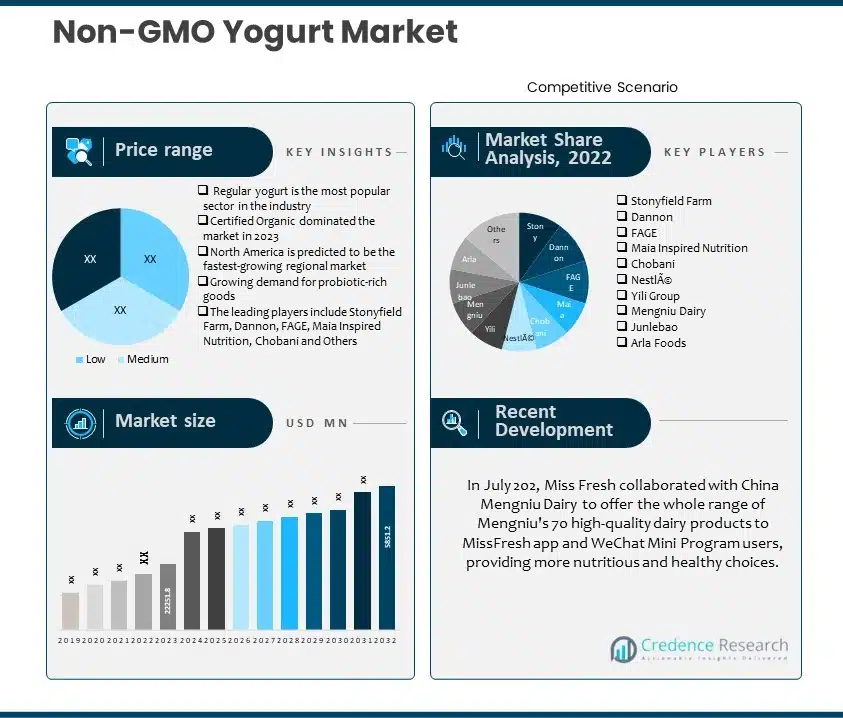
- The global demand for Non-GMO Yogurt was valued at USD 5851.2 million in 2023 and is expected to reach USD 22251.8 million in 2032, growing at a CAGR of 16.00% between 2024 and 2032.
- Regular yogurt is the most popular market segment, followed by Greek yogurt.
- The cups section has a substantial market share, and tubs account for the second-largest market share.
- In 2023, the supermarkets/hypermarkets category is predicted to lead the global market, while the online retail segment is predicted to demonstrate the highest CAGR.
- Strawberry will generate the most revenue, while Plain is another developing area in the yogurt market.
- In 2023, the Certified Organic category dominated the market and is predicted to be the fastest-growing sector. Non-certified Organic is another prominent area.
- Creamy yogurt is a common texture, and another popular market segment is thick.
- Yogurt's most popular section is single-serve.
- Adults are the leading sector in the yogurt market, while children and senior citizens, both age groups, hold a major share of the market.
- Fruits are the most popular category in the Non-GMO Yogurt Market.
- In 2023, the Asia-Pacific region had the biggest revenue share in the global market, accounting for 41.8%, while North America is projected to be the fastest-growing regional market between 2023 and 2032.
- Various flavors of yogurt attract a broad range of consumers, driving market growth.
- Artificial chemicals and lactose intolerance are limiting industry expansion.
Executive Summary
Market Definition
Pasteurized milk is homogenized and fermented to produce yogurt, a soured dairy product that is often sweetened or flavored. It is consumed in a variety of ways, including beverages, snacks, sweets, meal alternatives, and protein-rich sports drinks. Yogurt's health benefits include healthy digestion, a lower risk of developing type 2 diabetes, protection against colon cancer, the prevention and treatment of osteoporosis, increased weight loss and fat loss, an improved immune system, and a reduction in high blood pressure and bad cholesterol.
Market Overview
The global Non-GMO Yogurt Market has witnessed steady growth in recent years and is expected to grow at a CAGR of 16.00% between 2024 and 2032. The market was valued at USD 5851.2 million in 2023 and is expected to reach USD 22251.8 million in 2032.
The global yogurt market is predicted to grow significantly over the forecast period as yogurt consumption increases worldwide. To react to changing consumer tastes, industry participants have recently focused on testing and developing a diverse range of yogurt products. Customers are increasingly interested in organic, allergen-free, and dairy-free yogurt products.
The market's rise can be ascribed to increased consumer awareness of lifestyle problems, which has resulted in a trend towards healthy and probiotic-rich food products. The product is high in nutrients, which promote health and lower the risk of disorders like obesity. According to an article published in the Multidisciplinary Digital Publishing Institute (MDPI) in February 2022, 70% of consumers prefer drinkable yogurt because of its nutritional value.
Segmentation by Type of Yogurt
- Regular yogurt is the most in-demand sector in the industry. Traditionally, this form of yogurt is made with milk and live bacterial cultures.
- Greek yogurt is yet another popular market category. Greek yogurt with a higher protein content and thicker consistency as a result of whey elimination.
Segmentation by Packaging Type
- The cups segment has a considerable market share. Individual plastic or paper cups with single-serve yogurt, perfect for eating on the go.
- Tubs account for the second-largest market share. Larger, multi-sized yogurt tubs are great for sharing among the family.
Segmentation by Distribution Channel
- In 2023, the supermarkets/hypermarkets category led the global market, accounting for 61.5%. Supermarkets and hypermarkets are quite popular due to a higher standard of living caused by a considerable increase in disposable income and the influence of Western culture.
- The online retail segment is expected to exhibit the fastest CAGR during the forecast years.
Segmentation by Flavor Varieties
- The strawberry segment will account for the greatest revenue, contributing to around 35.37% market share in 2023. Strawberry is among the most popular flavors in this market segment. Berry flavored yogurts are becoming increasingly popular among customers due to the inclusion of naturally potent components, and the market for strawberry and blueberry flavors is likely to expand over the forecast period.
- Another growing segment in the yogurt industry is Plain.
Segmentation by Organic Certification
- The Certified Organic category dominated the market in 2023 and is expected to be the fastest-growing sector throughout the forecast period (2023-2032). Organic yogurt products that are free of allergenic components and dairy-free are becoming increasingly popular among customers.
- Non-certified Organic are another major segment of the Non GMO Yogurt Market.
Segmentation by Texture
- Creamy yogurt is popular due to its smooth texture and rich flavor, appealing to many consumers who prefer a velvety and luxurious yogurt experience.
- Another prominent market group is Thick. Thick yogurt is preferred by those who want a more substantial and satisfying yogurt consistency. It offers a hearty and nourishing alternative for people seeking a more substantial snack or meal component.
Segmentation by Pack Size
- The single-serve segment is the most popular in the yogurt market. Single-serve yogurt products are popular because of their convenience and portability, making them an ideal choice for consumers searching for quick and simple snack options.
Segmentation by End-User Preference
- Adults are the dominant segment in the yogurt market. Because of their focus on health and wellness, adults make up a sizable portion of the yogurt product market.
- Children and Senior Citizens, both age group, holds a significant shareholding segment in the market. Everyone loves yogurt.
Segmentation By Ingredients
- Fruits are the most popular section of the Non-GMO Yogurt Market. They improve the taste and texture of yogurt, making it a popular choice among consumers searching for a pleasant and nutritious snack or meal.
Segmentation by Region
- In 2023, the Asia-Pacific region had the highest revenue share in the global market, accounting for 41.8%.
- North America is predicted to be the fastest-growing regional market between 2023 and 2032.
- The rest of the world, including Latin America, the Middle East, and Africa, supplies the remaining demand for non-GMO yogurts.
In 2023, the Asia-Pacific region had the highest revenue share in the global market. This growth was attributed to rising product demand, which resulted from consumers' high awareness of the importance of a healthy dietary pattern. Additionally, consumers' willingness to spend on healthy snacks and beverages has enabled manufacturers to innovate and produce a variety of beverages in the region.
North America is expected to perform well in the global yogurt market due to people's increased consumption of yogurt, particularly Greek yogurt. The introduction of innovative yogurt products, particularly yogurt drinks and flavored yogurt, by important regional market players will accelerate the growth of North America's yogurt industry in the coming years. Per capita yogurt expenditure in European countries is relatively high, which is likely to contribute to the growth and development of the yogurt market.
Key Highlights of the Report
The global Non-GMO Yogurt Market is segmented based on Type of Yogurt, Packaging Type, Distribution Channel, Flavor Varieties, Organic Certification, Pack Size, End-User Preference, Ingredients and region. Certified Organic dominated the market in 2023, with the strawberry segment accounting for the most revenue. Additionally, the online retail segment is predicted to have the quickest CAGR during the projection years, with tubs accounting for the second-largest market share. Also, regular yogurt is the most in-demand industry, with Asia Pacific driving market growth.
The growing health consciousness among consumers, the increasing need for convenient and nutritious snacks, and the expanding diversity of flavors and formulas supplied by producers are the market's primary drivers. Additionally, fluctuating raw material prices, strong competition among market participants, and problems in preserving product quality and freshness during distribution are the main restraints of the market. Also, the expanding trend of plant-based yogurt substitutes, the potential for innovative packaging solutions to boost product shelf life, and the increasing focus on marketing techniques to reach new customer segments are the market's significant opportunities.
In 2023, Asia-Pacific had the largest revenue share in the global market. This expansion was due to rising product demand, which came from customers' increased awareness of the importance of a healthy eating regimen. Furthermore, North America is predicted to do well in the global yogurt industry due to people's increased consumption of yogurt, particularly Greek yogurt.
What Are The Main Drivers Of The Global Non-GMO Yogurt Market?
The growing health consciousness among consumers, the increasing demand for convenient and nutritious snacks, and the expanding diversity of flavors and formulations supplied by producers are the primary market drivers.
What Are The Major Challenges Faced By The Global Non-GMO Yogurt Market?
The significant barriers of the market are fluctuating raw material prices, strong competition among market competitors, and difficulty in preserving product quality and freshness during distribution.
What Are The Growth Opportunities In The Global Non-GMO Yogurt Market?
The expanding trend of plant-based yogurt substitutes, the potential for innovative packaging solutions to boost product shelf life, and the increasing focus on marketing techniques to reach new customer segments are significant opportunities for the industry.
Market Drivers
Several factors drive the global Non-GMO Yogurt Market. The following are the key drivers of the global Non-GMO Yogurt Market:
Various flavors of yogurt attract a wide spectrum of consumers
The yogurt sector is expected to grow due to its versatility and availability in a variety of formats. Yogurt is commonly used in a range of meals, including breakfast, lunch, and dinner. Furthermore, it is available in a range of flavors, including plain, flavored, and with toppings, all of which help to drive the Yogurt Market forward. Furthermore, yogurt consumption is not limited to a specific age group of customers; people of all ages enjoy yogurt. This is another significant factor driving the Yogurt Market's growth throughout the forecast period. The sector is likely to grow as critical components required for yogurt production become more widely available. Fruits, milk, sugars, stabilizers, flavors, and bacterial culture are just a few of the ingredients needed for yogurt manufacture, and they are all widely available in most areas. The ease of procuring ingredients, together with major producers' increasing creation of new types, is likely to boost yogurt demand in the near future.
Market Restraints
The global Non-GMO Yogurt Market faces some challenges that may hinder its growth. These include the following:
Artificial additives and lactose intolerance are hampering industry growth
Artificial additives and components in yogurt, such as gelatin and stabilizers, may negatively impact human health, limiting yogurt consumption and market growth. Furthermore, the growing prevalence of lactose sensitivity is projected to diminish yogurt consumption. People who are lactose-sensitive are more inclined to avoid yogurt. Lactose intolerance causes nausea, bloating, stomach discomfort, and gas in those who cannot digest the proteins contained in milk. As a result, the increasing prevalence of lactose intolerance is projected to limit market growth.
Opportunities
The global Non-GMO Yogurt Market offers significant growth opportunities. These include the following:
Growing Awareness of Dairy Alternatives
As more people seek plant-based alternatives due to dietary preferences, health issues, or environmental concerns, the demand for non-dairy yogurt alternatives is increasing. Manufacturers are capitalizing on this trend by producing unique plant-based yogurt products with components such as almond, coconut, soy, or oat. These dairy substitutes appeal not only to lactose-intolerant people, but also to a larger customer base looking for different and sustainable solutions. Companies may fulfill the changing needs of health-conscious and ecologically sensitive consumers by tapping into the developing dairy-free yogurt market, resulting in development and diversification within the yogurt market.
Competitive Landscape
Key Players
The global Non-GMO Yogurt Market is highly competitive, with several key players. Some of the major players in the market and their market share are as follows:
- Stonyfield Farm
- Dannon
- FAGE
- Maia Inspired Nutrition
- Chobani
- Nestlé
- Yili Group
- Mengniu Dairy
- Junlebao
- Arla Foods
- DSM
- Amul
- CoolBrands International
- Parmalat S.p.A
These organizations prioritize product innovation, Service Provider expansion, and mergers and acquisitions to stay competitive.
The global Non-GMO Yogurt Market's key players continually seek to stay ahead by offering new products and developments.
In July 2022, Amul announced an investment of USD 60 million to establish a new dairy factory in Rajkot to extend its production capacity across milk, yogurt, and buttermilk products.
In June 2022, Danone North America teamed with White Plains, Boulder, and Colorado to launch Activia+ Multi-Benefit Probiotic Yogurt.
Summary of Key Findings
- Growing Awareness of Dairy Alternatives.
- Market segmentation by Type of Yogurt, Packaging Type, Distribution Channel, Flavor Varieties, Organic Certification, Pack Size, End-User Preference, Ingredients, and region.
- Regular yogurt is the most popular sector in the industry
- Certified Organic dominated the market in 2023
- Asia Pacific is leading market growth. The market is highly competitive, with key players including Stonyfield Farm, Dannon, FAGE, Maia Inspired Nutrition, Chobani and Others.
Future Outlook
- Continued growth fueled by health trends
- Increase in plant-based yogurt options
- Packaging innovations to improve sustainability.
- Concentrate on personalized marketing methods.
- Growing demand for probiotic-rich goods.
.How CXOs Can Benefit from the Credence Research Non-GMO Yogurt Market Report
The Credence Research Non-GMO Yogurt Market Report provides CXOs with a comprehensive overview of the market, including:
- Market Type of Yogurt and growth forecast: The report provides detailed estimates of the global Non-GMO Yogurt Market Type of Yogurt, Packaging Type, Distribution Channel, Flavor Varieties, Organic Certification, Pack Size, End-User Preference, Ingredients, and region. It also includes forecasts for the market through 2032 based on key trends and drivers.
- Market segmentation: The report segments the Non-GMO Yogurt Market by Type of Yogurt, Packaging Type, Distribution Channel, Flavor Varieties, Organic Certification, Pack Size, End-User Preference, Ingredients, and region. This segmentation provides CXOs with a granular understanding of the market and the opportunities in each segment.
- Competitive Landscape: The report profiles the key players in the Non-GMO Yogurt Market and provides insights into their strategies, product offerings, and financial performance. This application can help CXOs identify and assess their competition.
- Key trends and drivers: The report identifies and analyzes the key trends and drivers shaping the Non-GMO Yogurt Market. This inApplicationation can help CXOs make inApplicationed decisions about their investments and strategies.
CXOs can use the insights from the Credence Research Non-GMO Yogurt Market Report to:
- Identify growth opportunities: The report can help CXOs identify new growth opportunities in the Non-GMO Yogurt Market by providing insights into market trends, the competitive landscape, and customer preferences.
- Make appropriate investment decisions: The report can help CXOs make appropriate investment decisions about Non-GMO Yogurt. For example, it analyzes market trends, growth potential, and competitive landscape, allowing CXOs to assess the market's attractiveness and identify investment opportunities.
- Develop competitive strategies: The report can help CXOs develop competitive strategies for their Non-GMO Yogurt Market. It provides valuable insights into market dynamics, customer preferences, and key competitors.
- Track market developments: The report can help CXOs track market developments and stay ahead of the curve. For example, it provides insights into the latest trends and innovations in the Non-GMO Yogurt Market.
Overall, the Credence Research Non-GMO Yogurt Market Report is a valuable product for CXOs who want to gain a deeper understanding of the market and identify opportunities for growth.
Segmentation
By Type of Yogurt:- Regular Yogurt
- Greek Yogurt
- Low-fat Yogurt
- Non-fat Yogurt
- Organic Yogurt
- Probiotic Yogurt
- Fruit-flavored Yogurt
- Plain Yogurt
- Others
- Cups
- Tubs
- Bottles
- Pouches
- Others
- Supermarkets and Hypermarkets
- Convenience Stores
- Online Retail
- Specialty Stores
- Others
- Strawberry
- Blueberry
- Peach
- Vanilla
- Raspberry
- Mango
- Plain
- Others
- Certified Organic
- Non-certified Organic
- Creamy
- Thick
- Smooth
- Others
- Single Serve
- Family Pack
- Bulk Packaging
- Others
- Adults
- Children
- Senior Citizens
- Fitness Enthusiasts
- Others
- Milk (e.g., cow's milk, goat's milk, sheep's milk)
- Cultures (e.g., Lactobacillus bulgaricus, Streptococcus thermophilus)
- Fruits
- Natural Sweeteners (e.g., honey, maple syrup)
- Flavorings and Extracts
- Others
- North America
- The U.S.
- Canada
- Mexico
- Europe
- Germany
- France
- The U.K.
- Italy
- Spain
- Rest of Europe
- Asia Pacific
- China
- Japan
- India
- South Korea
- South-east Asia
- Rest of Asia Pacific
- Latin America
- Brazil
- Argentina
- Rest of Latin America
- Middle East & Africa
- GCC Countries
- South Africa
- Rest of the Middle East and Africa

Request a Free Sample
Fill in your details and we'll send you a free sample report.
- Sample data tables & charts
- Research methodology
Market Dynamics
Health Consciousness and Probiotic Benefits
Increasing consumer awareness of the health benefits of yogurt, such as improved digestion and immune support, is driving demand for Non-GMO yogurt products, especially those rich in probiotics.
Preference for Clean Label and Organic Products
Consumers are increasingly seeking products free from genetically modified organisms and artificial additives, boosting the popularity of Non-GMO and certified organic yogurt options.
Expansion of Flavor and Product Variety
Manufacturers are introducing a wide range of flavors and innovative yogurt formats, such as Greek and drinkable yogurts, attracting diverse consumer segments and encouraging repeat purchases.
Growth of Modern Retail and Online Channels
The rise of supermarkets, hypermarkets, and online retail platforms has improved product accessibility and convenience, supporting higher sales volumes and market penetration for Non-GMO yogurt.
Need a Custom Version of This Report?
Tailor the scope, geography, or segments to your exact requirements.
- Custom geography or segment scope
- Direct access to our analyst team
Frequently Asked Questions
What is the current Type of Yogurt of the global Non-GMO Yogurt Market?
What is the expected growth rate of the Non-GMO Yogurt Market between 2024 and 2032?
Which segment is leading the market share in terms of Distribution Channel?
Which Ingredients segment governs the demand for rapid pharmaceutical microbiology testing in the world?
Who are the major players in the global Non-GMO Yogurt Market?
Table of Content
Chapter 1 Market Segmentation
- 1.1 Segmentation Framework
- 1.1.1 Product and Service Classification
- 1.1.2 Application and End-Use Classification
- 1.1.3 Technology and Solution Classification
- 1.1.4 Customer and Distribution Channel Classification
- 1.1.5 Geographic Segmentation
- 1.1.6 Market Segment Definitions and Boundaries
- 1.2 By Packaging Type
- 1.2.1 Cups
- 1.2.2 Tubs
- 1.2.3 Bottles
- 1.2.4 Pouches
- 1.3 By Type of Yogurt
- 1.3.1 Regular Yogurt
- 1.3.2 Greek Yogurt
- 1.3.3 Probiotic Yogurt
- 1.3.4 Fruit-flavored Yogurt
- 1.3.5 Plain Yogurt
- 1.4 By Flavor Varieties
- 1.4.1 Strawberry
- 1.4.2 Blueberry
- 1.4.3 Vanilla
- 1.4.4 Plain
- 1.4.5 Mango
Chapter 2 Introduction
- 2.1 Report Objectives and Scope
- 2.2 Product Definition and Industry Terminology
- 2.3 Market Inclusions and Exclusions
- 2.4 Research Process
- 2.4.1 Primary Research and Expert Interviews
- 2.4.2 Secondary Research and Source Review
- 2.4.3 Top-Down and Bottom-Up Estimation
- 2.4.4 Data Triangulation and Verification
- 2.5 Market Size Measurement Basis
- 2.5.1 2023: USD 5851.2 million → 2032: USD 22,251.8 million
- 2.6 Historical and Forecast Reference Periods
- 2.6.1 Base Year: 2023
- 2.6.2 Forecast Period: 2023-2032
- 2.7 Research Assumptions and Limitations
Chapter 3 Executive Summary
- 3.1 Market Snapshot and Key Findings
- 3.2 Base-Year Market Size, 2023
- 3.3 Forecast Market Size, 2032
- 3.4 Revenue and Volume Growth Outlook
- 3.5 Key Demand and Supply Indicators
- 3.6 Leading Market Segments
- 3.7 Fastest-Growing Market Opportunities
- 3.8 Regional Performance Highlights
- 3.9 Technology and Industry Transformation
- 3.10 Competitive Landscape Summary
- 3.11 Analyst View and Strategic Implications
Chapter 4 Global Non GMO Yogurt Market Trends and Developments
- 4.1 Historical Industry Development
- 4.2 Recent Market Trends and Developments
- 4.3 Demand and Customer Behavior Trends
- 4.4 Technology and Product Innovation
- 4.5 Artificial Intelligence, Automation and Digitalization
- 4.6 Local Manufacturing and Supply Chain Realignment
- 4.7 Industry Partnerships, Mergers and Acquisitions
- 4.8 Sustainability and Circular Economy Developments
- 4.9 Government and Private Sector Investment Trends
- 4.10 Emerging Business Models and Commercialization
- 4.11 Industry Developments and Announcements
Chapter 5 Global Non GMO Yogurt Market Production, Supply and Demand Analysis
- 5.1 Demand Trend and Consumption Analysis
- 5.2 Demand Forecast, 2023-2032
- 5.3 Production and Output Trend
- 5.4 Production and Output Forecast, 2023-2032
- 5.5 Installed Capacity and Capacity Utilization
- 5.6 Company-Wise Production Plants and Statistics
- 5.6.1 Installed Production Capacity
- 5.6.2 Actual Production
- 5.6.3 Planned Capacity and Expansion Targets
- 5.7 Supply Chain Structure and Procurement Trends
- 5.8 Supply-Demand Gap and Bottlenecks
- 5.9 Import Dependence and Sourcing Structure
- 5.10 Contract Manufacturing and Outsourcing
- 5.11 Regional Supply and Demand Concentration
Chapter 6 Global Non GMO Yogurt Market Pricing Analysis
- 6.1 Pricing Structure and Measurement
- 6.2 Historical Pricing Trends
- 6.3 Pricing Outlook, 2023-2032
- 6.4 Average Selling Price and Unit Economics
- 6.5 Pricing by Product and Market Segment
- 6.6 Geographic Pricing Differences
- 6.7 Key Input, Energy, Labor and Logistics Costs
- 6.8 Contract Pricing and Purchasing Models
- 6.9 Pricing Sensitivity and Competitive Positioning
- 6.10 Price, Margin and Profitability Implications
Chapter 7 Global Non GMO Yogurt Market Dynamics
- 7.1 Market Growth Drivers
- 7.1.1 Demand-Side Drivers
- 7.1.2 Technology and Innovation Drivers
- 7.1.3 Infrastructure and Investment Drivers
- 7.1.4 Regulatory and Policy Drivers
- 7.2 Market Restraints
- 7.2.1 Cost and Affordability Constraints
- 7.2.2 Technology and Adoption Barriers
- 7.2.3 Supply Chain and Operational Constraints
- 7.3 Market Challenges
- 7.3.1 Competitive Pressure and Margin Erosion
- 7.3.2 Skills, Infrastructure and Implementation Gaps
- 7.4 Emerging Market Opportunities
- 7.5 Market Dynamics Impact and Time-Horizon Assessment
Chapter 8 Global Non GMO Yogurt Value Chain Analysis
- 8.1 Industry Value Chain Overview
- 8.2 Upstream Suppliers and Critical Inputs
- 8.3 Technology and Component Providers
- 8.4 Manufacturing or Service Delivery
- 8.5 Distribution, Channel Partners and Integrators
- 8.6 Downstream Applications and End Users
- 8.7 Value Addition and Profit Pools
- 8.8 Vertical Integration and Outsourcing
- 8.9 Supplier Concentration and Risk
- 8.10 Supply Chain Localization and Resilience
Chapter 9 Global Non GMO Yogurt Market Regulations and Policies
- 9.1 Relevant Laws, Standards and Compliance Frameworks
- 9.2 Product, Service, Safety and Quality Requirements
- 9.3 Government Policies, Incentives and Subsidies
- 9.4 Imports, Exports and Trade Barriers
- 9.5 Public Procurement and Local Content Requirements
- 9.6 Environmental and Sustainability Compliance
- 9.7 Upcoming Policy Changes and Market Implications
Chapter 10 Global Non GMO Yogurt Market Hotspots and Opportunities
- 10.1 Market Opportunity Mapping and Growth Hotspots
- 10.2 High-Growth Applications and Customer Groups
- 10.3 Underserved Markets and White-Space Opportunities
- 10.4 Emerging Technology and Product Opportunities
- 10.5 New Capacity and Investment Hotspots
- 10.6 Market Entry and Expansion Opportunities
- 10.7 Distribution and Partnership Opportunities
- 10.8 Near-Term and Long-Term Commercial Potential
- 10.9 Opportunity Attractiveness and Execution Risks
Chapter 11 Global Non GMO Yogurt Market Outlook, 2023-2032
- 11.1 Market Size and Analysis
- 11.1.1 Revenue (Market Measurement: 2023: USD 5851.2 million → 2032: USD 22,251.8 million)
- 11.1.2 Market Volume and Quantity Sold
- 11.1.3 Historical Market Size
- 11.1.4 Base-Year Market Size, 2023
- 11.2 Market Forecast, 2023-2032
- 11.2.1 Revenue Forecast to 2032
- 11.2.2 Volume Forecast to 2032
- 11.2.3 CAGR and Year-on-Year Growth
- 11.2.4 Incremental Revenue Opportunity
- 11.3 Forecast Assumptions and Scenario Analysis
- 11.3.1 Base-Case Forecast
- 11.3.2 Optimistic and Conservative Scenarios
- 11.3.3 Technology, Pricing and Policy Sensitivities
- 11.4 Market Attractiveness and Growth Outlook
Chapter 12 Global Non GMO Yogurt Market Segmentation and Outlook
- 12.1 Segmentation Summary and Market Shares, 2023
- 12.2 Largest and Fastest-Growing Segments
- 12.3 By Packaging Type - Market Size and Forecast, 2023-2032
- 12.3.1 Segment Definition and Scope
- 12.3.2 Historical Market Size
- 12.3.3 Revenue Forecast, 2023-2032
- 12.3.4 Volume Forecast, 2023-2032
- 12.3.5 Base-Year Market Share, 2023
- 12.3.6 Segment CAGR and Growth Drivers
- 12.3.7 Subsegment Market Size and Forecast
- 12.3.7.1 Cups
- 12.3.7.2 Tubs
- 12.3.7.3 Bottles
- 12.3.7.4 Pouches
- 12.3.8 Subsegment Pricing and Adoption Trends
- 12.3.9 Leading Suppliers and Competition
- 12.3.10 Regional Demand and Opportunities
- 12.4 By Type of Yogurt - Market Size and Forecast, 2023-2032
- 12.4.1 Segment Definition and Scope
- 12.4.2 Historical Market Size
- 12.4.3 Revenue Forecast, 2023-2032
- 12.4.4 Volume Forecast, 2023-2032
- 12.4.5 Base-Year Market Share, 2023
- 12.4.6 Segment CAGR and Growth Drivers
- 12.4.7 Subsegment Market Size and Forecast
- 12.4.7.1 Regular Yogurt
- 12.4.7.2 Greek Yogurt
- 12.4.7.3 Probiotic Yogurt
- 12.4.7.4 Fruit-flavored Yogurt
- 12.4.7.5 Plain Yogurt
- 12.4.8 Subsegment Pricing and Adoption Trends
- 12.4.9 Leading Suppliers and Competition
- 12.4.10 Regional Demand and Opportunities
- 12.5 By Flavor Varieties - Market Size and Forecast, 2023-2032
- 12.5.1 Segment Definition and Scope
- 12.5.2 Historical Market Size
- 12.5.3 Revenue Forecast, 2023-2032
- 12.5.4 Volume Forecast, 2023-2032
- 12.5.5 Base-Year Market Share, 2023
- 12.5.6 Segment CAGR and Growth Drivers
- 12.5.7 Subsegment Market Size and Forecast
- 12.5.7.1 Strawberry
- 12.5.7.2 Blueberry
- 12.5.7.3 Vanilla
- 12.5.7.4 Plain
- 12.5.7.5 Mango
- 12.5.8 Subsegment Pricing and Adoption Trends
- 12.5.9 Leading Suppliers and Competition
- 12.5.10 Regional Demand and Opportunities
- 12.6 Segment Growth Comparison
- 12.7 Segment Attractiveness and Priority Matrix
Chapter 13 Global Non GMO Yogurt Geographic Market Outlook, 2023-2032
- 13.1 Regional Market Size and Share, 2023
- 13.2 Regional Market Forecast, 2023-2032
- 13.3 Regional Pricing, Production and Demand Differences
- 13.4 North America
- 13.4.1 United States
- 13.4.2 Canada
- 13.4.3 Mexico
- 13.5 Europe
- 13.5.1 Germany
- 13.5.2 France
- 13.5.3 Italy
- 13.5.4 United Kingdom
- 13.5.5 Spain
- 13.5.6 Poland
- 13.5.7 Russia
- 13.5.8 Netherlands
- 13.5.9 Belgium
- 13.5.10 Sweden
- 13.5.11 Denmark
- 13.5.12 Norway
- 13.5.13 Rest of Europe
- 13.6 Asia Pacific
- 13.6.1 China
- 13.6.2 India
- 13.6.3 Japan
- 13.6.4 South Korea
- 13.6.5 Thailand
- 13.6.6 Indonesia
- 13.6.7 Vietnam
- 13.6.8 Malaysia
- 13.6.9 Australia
- 13.6.10 Rest of Asia Pacific
- 13.7 Latin America
- 13.7.1 Brazil
- 13.7.2 Argentina
- 13.7.3 Colombia
- 13.7.4 Chile
- 13.7.5 Rest of Latin America
- 13.8 Middle East
- 13.8.1 Saudi Arabia
- 13.8.2 United Arab Emirates
- 13.8.3 Turkey
- 13.8.4 Israel
- 13.8.5 Iran
- 13.8.6 Rest of the Middle East
- 13.9 Africa
- 13.9.1 South Africa
- 13.9.2 Egypt
- 13.9.3 Nigeria
- 13.9.4 Morocco
- 13.9.5 Rest of Africa
- 13.10 Regional Investment, Policy and Supply Chain Differences
- 13.11 Regional Competitive Landscape
- 13.12 Geographic Growth Hotspots
Chapter 14 Global Non GMO Yogurt Technology, Innovation and Sustainability Outlook
- 14.1 Technology Landscape and Maturity
- 14.2 Product, Process and Service Innovation
- 14.3 AI, Automation and Digital Tools in the Industry
- 14.4 Technology Adoption and Performance Benchmarking
- 14.5 Innovation Pipeline and R&D Investment
- 14.6 Patent and Intellectual Property Trends
- 14.7 Energy Efficiency and Resource Management
- 14.8 Sustainability, Recycling and Circularity
- 14.9 Technology Roadmap, 2023-2032
- 14.10 Risks of Obsolescence and Technology Substitution
Chapter 15 Global Non GMO Yogurt Market Key Strategic Imperatives
- 15.1 Growth and Market Entry Priorities
- 15.2 High-Return Products and Segments
- 15.3 Pricing, Profitability and Cost Optimization
- 15.4 Technology Investment and Product Differentiation
- 15.5 Supply Chain Localization and Resilience
- 15.6 Distribution and Customer Acquisition
- 15.7 Partnership, Acquisition and Capacity Strategy
- 15.8 Regional Expansion Priorities
- 15.9 Short-, Medium- and Long-Term Actions
Chapter 16 Competition Outlook
- 16.1 Industry Competition Characteristics
- 16.2 Market Structure and Concentration
- 16.3 Market Share and Competitive Positioning, 2023
- 16.4 Company-Wise Revenue and Product Benchmarking
- 16.5 Production and Service Capacity Benchmarking
- 16.6 Technology, Pricing and Differentiation
- 16.7 Regional Footprint and Distribution Strength
- 16.8 Mergers, Acquisitions and Strategic Alliances
- 16.9 New Entrants and Competitive Threats
- 16.10 Porter's Five Forces and Industry Attractiveness
- 16.11 Competitive Outlook, 2023-2032
Chapter 17 Company Profiles
- 17.1 Company Coverage and Selection Criteria
- 17.2 Stonyfield Farm
- 17.2.1 Business Description
- 17.2.2 Company Ownership and Geographic Presence
- 17.2.3 Product and Service Portfolio
- 17.2.4 Manufacturing and Operating Footprint
- 17.2.5 Production Capacity and Expansion Plans
- 17.2.6 Financial Performance and Investment
- 17.2.7 Market Share and Competitive Position
- 17.2.8 Technology and Innovation Capabilities
- 17.2.9 Strategic Alliances or Partnerships
- 17.2.10 Recent Developments
- 17.2.11 Growth Strategy and Outlook
- 17.3 Dannon
- 17.4 FAGE
- 17.5 Chobani
- 17.6 Nestlé
- 17.7 Yili Group
- 17.8 Mengniu Dairy
- 17.9 Arla Foods
- 17.10 Amul
- 17.11 Parmalat S.p.A
- 17.12 Other Relevant Market Participants
Note: Every listed company is profiled on the structure shown under the first company. The company list is preliminary and may change based on research findings, market developments, data availability and client requirements.
Chapter 18 Disclaimer
- 18.1 Research and Forecast Disclaimer
- 18.2 Data Source and Estimation Limitations
Note: The depth of individual sections depends on data availability for this market. Volume, capacity, trade and other unit-based metrics are included where applicable.