
| REPORT ATTRIBUTE | DETAILS |
|---|---|
| Historical Period | 2019-2022 |
| Base Year | 2023 |
| Forecast Period | 2024-2032 |
| Photonic Integrated Circuits Market Size 2023 | USD 12,548.50 Million |
| Photonic Integrated Circuits Market, CAGR | 21.50% |
| Photonic Integrated Circuits Market Size 2032 | USD 72,406.62 Million |
Market Insights
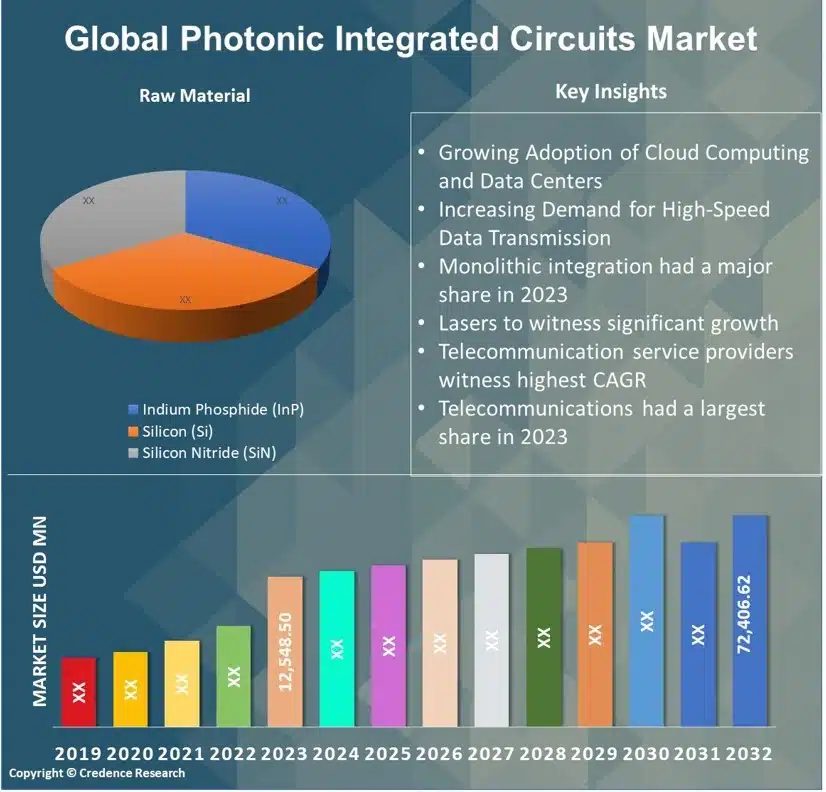
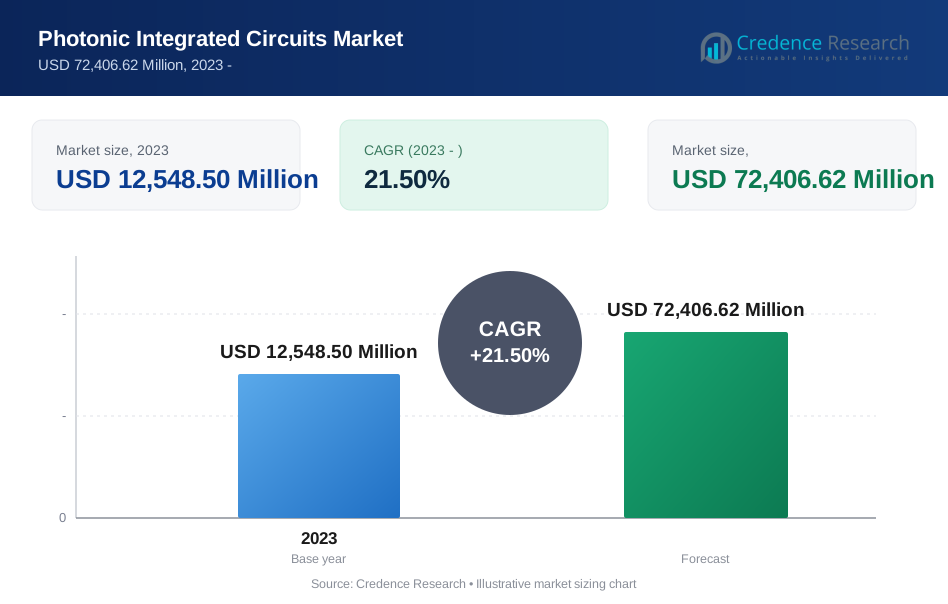
- The global demand for Photonic Integrated Circuits was valued at USD 12,548.50 Million in 2023 and is expected to reach USD 72,406.62 Million in 2032, growing at a CAGR of 21.50% between 2024 and 2032.
- The Monolithic Integration sector is the market leader by integration type, accounting for more than 53% of total value in 2023, while the Hybrid Integration segment is expected to grow rapidly throughout the forecast period.
- The Indium Phosphide (InP) raw material dominates the global need for Photonic Integrated Circuits, accounting for more than 40% in 2023 and is predicted to expand at a high CAGR.
- The Lasers component sector is predicted to grow fastest over the projection period, while the Detectors segment will have a market share of more than 25% in 2023.
- Over the projection period, the telecommunications category is expected to expand at the highest rate, while the Sensing category will dominate the market in 2023 with a 35% share.
- The healthcare category is expected to expand quickly over the forecast period, while the Telecommunication Service Providers segment will have the greatest market share in 2023.
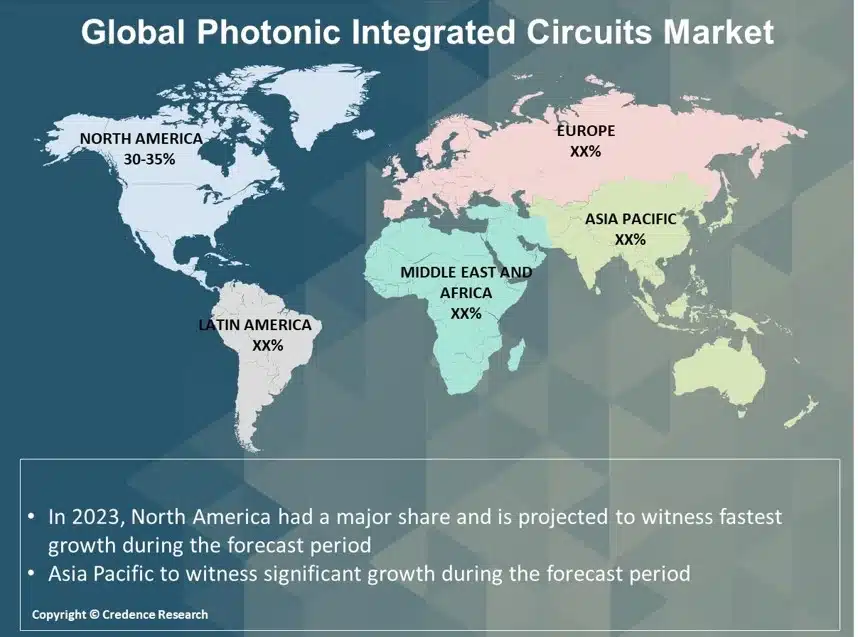
- North America is fueling the growth of the Photonic Integrated Circuits industry with over one-third share in 2023, while Asia Pacific and Europe collectively account for just under 55% share in 2023. Europe held over 20% share in 2023.
- Due to increasing demand for high-speed data transmission and growing adoption of cloud computing and data centers, the market for Photonic Integrated Circuits is growing in the current scenario.
- The market's primary possibilities include the significant growth potential in North America, owing to the advancements in telecommunications and optical communication.
Executive Summary
Market Definition
Photonic Integrated Circuits (PICs) are tiny but powerful devices that use light (photons) instead of traditional electrical signals to transmit and process information. Think of them as super-efficient light-based circuits. These circuits integrate various optical components, such as lasers, modulators, and detectors, onto a single chip, enabling them to perform tasks like data transmission and processing at incredibly high speeds. PICs play a crucial role in modern technologies like high-speed internet, telecommunications, and sensors, making data transfer faster, more reliable, and energy-efficient. Essentially, they're like the traffic controllers of information, using light to guide and manage data flow in our interconnected world.
Market Overview
The global Photonic Integrated Circuits market has witnessed steady growth in recent years and is expected to grow at a CAGR of 21.50% between 2024 and 2032. The market was valued at USD 12,548.50 million in 2023 and is expected to reach USD 72,406.62 million in 2032.
The market for Photonic Integrated Circuits (PICs) is experiencing significant growth due to several key factors such as the increasing demand for high-speed data transmission. As people and businesses rely more on fast and reliable internet connections, the need for technologies that can transmit data at high speeds becomes crucial. PICs, using light instead of traditional electrical signals, play a pivotal role in meeting this demand by facilitating rapid and efficient data transfer.
Another contributing factor is the growing adoption of cloud computing and data centers. With more data being stored and processed in the cloud, there is a heightened requirement for efficient communication between servers and devices. Photonic Integrated Circuits are instrumental in enabling high-bandwidth connections, supporting the seamless flow of information within cloud-based infrastructures and data centers.
Additionally, the rise in Internet of Things (IoT) applications is fueling the demand for PICs. As more devices become interconnected, there is a need for technologies that can handle the increased data traffic. PICs excel in this aspect, offering the capability to process and transmit data efficiently. Moreover, the surge in 5G network deployments, advancements in telecommunications, and the integration of photonics in sensing and imaging technologies further contribute to the growth of the Photonic Integrated Circuits market by addressing the evolving needs of our connected and data-driven world.
Segmentation by Integration Type
- Monolithic Integration is the leading segment by interface type and held over 54% share in value in 2023, attributable to its ability to combine various components seamlessly on a single chip, enhancing efficiency and reducing the complexity of manufacturing processes.
- The Hybrid Integration segment will likely exhibit a significant CAGR during the forecast period. Due to its flexibility in combining different materials and technologies, providing a versatile solution to meet specific application requirements in photonics.
Segmentation by Raw Material
- The Indium Phosphide (InP) segment governs the demand for Photonic Integrated Circuits in the world, holding a massive share of over 20% in 2023, and InP's growth is fueled by its suitability for high-performance applications, such as in lasers and detectors, making it a preferred choice for segments requiring advanced functionalities.
- The Silicon (Si) material segment is driven by its compatibility with existing semiconductor processes, facilitating cost-effective production, particularly in large-scale applications like data centers.
Segmentation by Components
- The laser segment is expected to post the highest CAGR during the forecast period. This is primarily due to their crucial role in providing the light source for photonic circuits, enabling efficient data transmission in applications ranging from telecommunications to sensing.
- The detectors segment is leading the market share with over 19% share in 2023.
Segmentation by Application
- The telecommunication segment is anticipated to register the highest CAGR during the projection period.
- With a market share of nearly 25% in 2023, the sensing category is currently in the lead.
Segmentation by End User
- The Telecommunication Service Providers dominate the global need for Photonic Integrated Circuits, accounting for more than 27% in 2023 and healthcare sector are predicted to expand at a high CAGR.
- Telecom providers drive the growth as they seek advanced technologies, like photonic integrated circuits, to upgrade networks, increase data speeds, and deliver improved services to consumers.
Segmentation by Region
- North America is fueling the growth of the Photonic Integrated Circuits industry with over one-third share in 2023 due to the region's expanding telecommunication & data centers and consumer electronics industries.
- Asia Pacific and Europe collectively account for just under 55% share in 2023, with Europe holding over 20% share in the same year.
- The rest of the world, including Latin America, the Middle East, and Africa, supplies the remaining demand for Photonic Integrated Circuits.
The market for Photonic Integrated Circuits is driven by more data being stored and processed in the cloud, there is a heightened requirement for efficient communication between servers and devices.
North America is a leader in embracing new technologies and a hub for technical innovation.
North America:
In North America, the Photonic Integrated Circuits (PICs) market is experiencing robust growth driven by the region's strong emphasis on technological innovation. The presence of major technology hubs, research institutions, and a high demand for advanced communication technologies contribute to the flourishing market. North America is at the forefront of deploying PICs in applications such as telecommunications, data centers, and sensing technologies. Cloudscene reports that the United States boasts the largest number of global data centers, totaling nearly 2,700, representing approximately 33% of the total worldwide count. In December 2022, OpenLight introduced an 800 G DR8 photonic integrated circuit to improve the global data center interconnect industry. OpenLight created and tested these wafers using the open silicon photonics foundry platform, which includes integrated lasers provided by Tower Semiconductor.
The Asia Pacific is expected to be the fastest-growing region over the forecast period. In Asia-Pacific, particularly in countries including China, Japan, and South Korea, there is a surge in demand for PICs fueled by extensive research and development activities, along with the rapid expansion of telecommunication networks and data centers. In addition, Europe, boasts a strong semiconductor industry and is witnessing increasing adoption of photonic integrated circuits in various applications, including healthcare and industrial sectors. The collaborative efforts between academia and industry in both regions contribute to technological advancements and market growth.
The primary factor driving the growing adoption of cloud computing and data centers. With more data being stored and processed in the cloud, there is a heightened requirement for efficient communication between servers and devices. Photonic Integrated Circuits are instrumental in enabling high-bandwidth connections, supporting the seamless flow of information within cloud-based infrastructures and data centers.
Additionally, the rise in Internet of Things (IoT) applications is fueling the demand for PICs. As more devices become interconnected, there is a need for technologies that can handle the increased data traffic. PICs excel in this aspect, offering the capability to process and transmit data efficiently. Moreover, the surge in 5G network deployments, advancements in telecommunications, and the integration of photonics in sensing and imaging technologies further contribute to the growth of the photonic integrated circuits market by addressing the evolving needs of its connected and data-driven world.
Key Highlights of the Report
The global Photonic Integrated Circuits market is segmented by interface integration type, raw material, components, application, end user, and region. Monolithic Integration based Photonic Integrated Circuits are the most popular, while telecommunication and data centers are the primary segments. In addition, indium phosphide (InP) and hybrid integration are the most commonly integration type. However, lasers and telecommunications dominate the market, with North America leading the market growth.
The increasing demand for high-speed data transmission. As people and businesses rely more on fast and reliable internet connections, the need for technologies that can transmit data at high speeds becomes crucial. PICs, using light instead of traditional electrical signals, play a pivotal role in meeting this demand by facilitating rapid and efficient data transfer.
Nonetheless, North America is anticipated to have the greatest share of the worldwide Photonic Integrated Circuits market because of the increasing number of developments to improve Photonic Integrated Circuits technology and the region's growing infrastructure development. Furthermore, the market is anticipated to expand at the highest rate in the Asia-Pacific (APAC) region due to the abundance of electronics manufacturing firms and the growing demand for data transferability.
What Are The Main Drivers Of The Global Photonic Integrated Circuits Market?
The primary forces propelling the global Photonic Integrated Circuits (PICs) market are the increasing need for high-speed data transmission, the widespread adoption of cloud computing and data centers, and the rise in Internet of Things (IoT) applications. Additionally, the surge in 5G network deployments, advancements in telecommunications, and the escalating demand for high-bandwidth and low-latency solutions contribute significantly to the market's growth. These factors collectively drive the adoption of PICs across various industries, playing a pivotal role in shaping the market landscape.
What Are The Major Challenges Faced By The Global Photonic Integrated Circuits Market?
The global Photonic Integrated Circuits market encounters challenges, such as the complexity of integrating different technologies, high initial costs, and the need for standardized regulations. Additionally, addressing issues related to miniaturization and power efficiency in electronic devices poses a substantial hurdle. Balancing the demand for advanced functionalities with cost-effective solutions and overcoming potential manufacturing complexities are critical challenges that industry players must navigate to ensure the sustained growth of the market.
What Are The Growth Opportunities In The Global Photonic Integrated Circuits Market?
The global Photonic Integrated Circuits market presents significant growth opportunities, driven by the expanding applications in telecommunications, data centers, sensing technologies, and more. The continuous advancements in technology, including the integration of photonics in sensing and imaging, offer avenues for innovation. Moreover, the increasing interest in LiDAR technologies for autonomous vehicles and the rising demand for photonics in healthcare and defense sectors open new horizons for market expansion. Strategic collaborations, investments in research and development, and the evolution of edge computing further contribute to the growth prospects of the Photonic Integrated Circuits market.
Market Drivers
The global Photonic Integrated Circuits market is driven by several factors. The following are the key drivers of the global Photonic Integrated Circuits market:
Increasing Demand for High-Speed Data Transmission
The primary driver propelling the growth of the Photonic Integrated Circuits (PICs) market is the increasing demand for high-speed data transmission. As modern applications and technologies demand faster and more efficient data transfer, PICs, with their ability to use light for communication, are crucial in meeting this growing need. Their implementation enhances data transmission speed and efficiency, making them indispensable in various industries.
Market Restraints
The global Photonic Integrated Circuits market faces some challenges that may hinder its growth. These include the following:
Complexity of integrating different technologies
One significant restraint faced by the Photonic Integrated Circuits market is the complexity of integrating different technologies. As PICs involve the combination of various optical components onto a single chip, the integration process can be intricate and challenging. This complexity may lead to higher manufacturing costs and potential difficulties in achieving seamless compatibility between different technologies, posing a hurdle to the widespread adoption of PICs.
Opportunities
The global Photonic Integrated Circuits market offers significant growth opportunities. These include the following:
Advancements in Telecommunications and Optical Communication
The opportunities in the Photonic Integrated Circuits market lie in the advancements in telecommunications and optical communication. As technology continues to evolve, the demand for improved communication systems grows. PICs play a pivotal role in advancing these technologies, offering opportunities for innovation in telecommunications and optical communication. The ongoing developments in these fields create a favorable environment for the growth and expansion of the Photonic Integrated Circuits market, presenting opportunities for industry players to contribute to technological advancements.
Competitive Landscape
Key Players
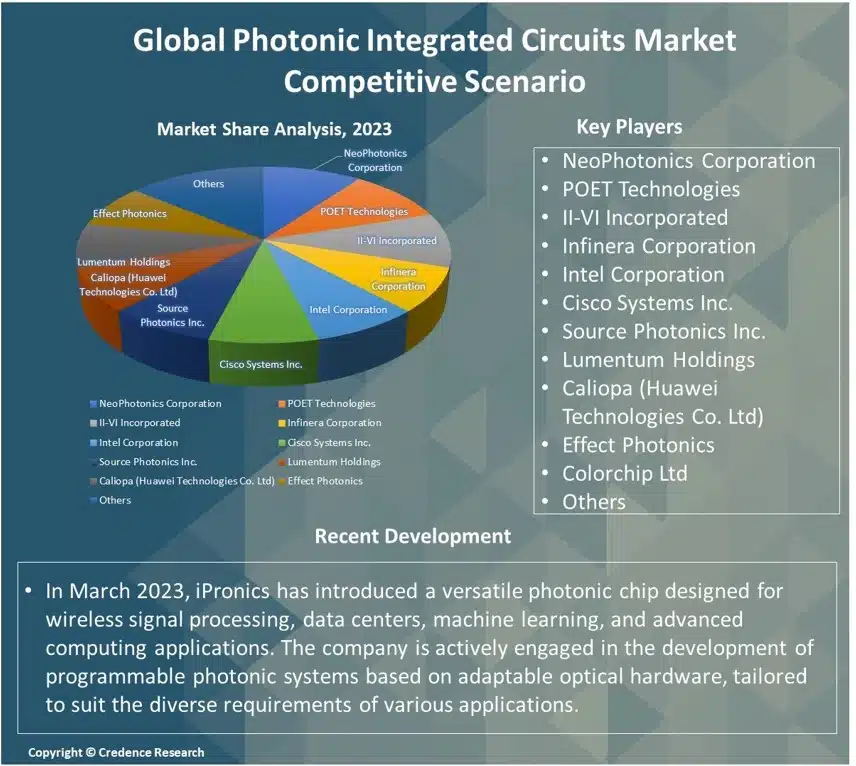
The global Photonic Integrated Circuits market is highly competitive, with several key players. Some of the major players in the market and their market share are as follows:
- NeoPhotonics Corporation
- POET Technologies
- II-VI Incorporated
- Infinera Corporation
- Intel Corporation
- Cisco Systems Inc.
- Source Photonics Inc.
- Lumentum Holdings
- Caliopa (Huawei Technologies Co. Ltd)
- Effect Photonics
- Colorchip Ltd
- Others
These organizations prioritize product innovation, distribution channel expansion, and mergers and acquisitions to stay competitive.
The global Photonic Integrated Circuits market's key players continually seek to stay ahead by offering new products and developments.
In March 2023, iPronics has introduced a versatile photonic chip designed for wireless signal processing, data centers, machine learning, and advanced computing applications. The company is actively engaged in the development of programmable photonic systems based on adaptable optical hardware, tailored to suit the diverse requirements of various applications.
In March 2022, In a collaborative effort, EFFECT Photonics and Jabil Photonics have joined forces to create a new generation of coherent optical modules. These modules present a distinctive solution for network operators and hyper-scalers seeking to leverage the high performance of QSFP-high DD, coupled with advantages such as a compact footprint, low power consumption, cost-effectiveness, field replaceability, and vendor interoperability for cloud Data Center Interconnects (DCIs). The next-generation coherent optical modules address the growing demands for increased data flow, service continuity, enhanced security measures, global expansion, and sustainability concerns.
Summary of Key Findings
- The demand for photonnics integrated circuits is increasing demand for high-speed data transmission, growing adoption of cloud computing and data centers, rise in internet of things (iot) applications, and surge in 5G network deployments, which is boosting the growth of the Photonic Integrated Circuits market.
- Market segmented by integration type, raw material, components, application, end users, and region.
- Monolithic Integration based Photonic Integrated Circuits are the most popular, with IT and telecom sectors as primary user segments.
- Telecommunications and data centers are most commonly used Photonic Integrated Circuits.
- North America is leading market growth; the market is highly competitive with key players including Texas Instruments, NXP Semiconductors N.V., Japan Aviation Electronics Industry, Ltd., Amphenol Corporation, Molex Inc., TE Connectivity Ltd., Microchip Technology Inc, Rohm Co., Ltd., Cypress Semiconductor Corp., STMicroelectronics N.V. and Others.
Future Outlook
- Positive outlook for the global Photonic Integrated Circuits market with significant growth potential in the North American region
- One of the main factors promoting the market's expansion is the telecommunications and data centers current reliance on Photonic Integrated Circuits.
- During the forecast period, the complexity of integrating different technologies, high initial costs, and the need for standardized regulations significant factors projected to restrain the growth of the Photonic Integrated Circuits market.
- Key firms must focus on product innovation, growing market reach, and maintaining competitive pricing to keep ahead of the competition.
How CXOs Can Benefit from the Credence Research Photonic Integrated Circuits Market Report
The Credence Research Photonic Integrated Circuits Market Report provides CXOs with a comprehensive overview of the market, including:
- Market size and growth forecast: The report provides detailed estimates of the global Photonic Integrated Circuits market size, segmented by integration type, raw material, components, application, end users, and region. It also includes forecasts for the market through 2032, based on key trends and drivers.
- Market segmentation: The report segments the Photonic Integrated Circuits market by integration type, raw material, components, application, end users, and region. This segmentation provides CXOs with a granular understanding of the market and the opportunities in each segment.
- Competitive landscape: The report profiles the key players in the Photonic Integrated Circuits market and provides insights into their strategies, product offerings, and financial performance. This information can help CXOs to identify and assess their competition.
- Key trends and drivers: The report identifies and analyzes the key trends and drivers that are shaping the Photonic Integrated Circuits This information can help CXOs to make informed decisions about their investments and strategies.
CXOs can use the insights from the Credence Research Photonic Integrated Circuits Market Report to:
- Identify growth opportunities: The report can help CXOs to identify new growth opportunities in the Photonic Integrated Circuits For example, the report identifies the growing demand for Photonic Integrated Circuits with telecommunication and data center companies as a key opportunity.
- Make informed investment decisions: The report can help CXOs to make informed investment decisions about Photonic Integrated Circuits. For example, the report provides insights into the key factors to consider when evaluating photonic integrated circuit
- Develop competitive strategies: The report can help CXOs to develop competitive strategies for their Photonic Integrated Circuits For example, the report identifies the key strategies that photonic integrated circuit providers are using to differentiate themselves from their competitors.
- Track market developments: The report can help CXOs to track market developments and stay ahead of the curve. For example, the report provides insights into the latest trends and innovations in the Photonic Integrated Circuits
Overall, the Credence Research Photonic Integrated Circuits Market Report is a valuable resource for CXOs who are looking to gain a deeper understanding of the market and identify opportunities for growth.
Segmentation
- By Integration Type
- Monolithic Integration
- Hybrid Integration
- By Raw Material
- Indium Phosphide (InP)
- Silicon (Si)
- Silicon Nitride (SiN)
- By Components
- Lasers
- Modulators
- Detectors
- Waveguides
- Multiplexers/Demultiplexers
- By Application
- Telecommunications
- Data Centers
- Sensing
- By End User
- Telecommunication Service Providers
- Data Center Operators
- Healthcare
- Defense and Aerospace
- Manufacturing and Industrial
- By Region
- North America
- The U.S.
- Canada
- Mexico
- Europe
- Germany
- France
- The U.K.
- Italy
- Spain
- Rest of Europe
- Asia Pacific
- China
- Japan
- India
- South Korea
- South-east Asia
- Rest of Asia Pacific
- Latin America
- Brazil
- Argentina
- Rest of Latin America
- Middle East & Africa
- GCC Countries
- South Africa
- Rest of Middle East and Africa
- North America
Request a Free Sample
Fill in your details and we'll send you a free sample report.
- Sample data tables & charts
- Research methodology
Need a Custom Version of This Report?
Tailor the scope, geography, or segments to your exact requirements.
- Custom geography or segment scope
- Direct access to our analyst team
Frequently Asked Questions
What is the current size of the global Photonic Integrated Circuits market?
What is the expected growth rate of the Photonic Integrated Circuits market between 2024 and 2032?
Which segment is leading the market share in terms of integration type?
What is the base year considered for Photonic Integrated Circuits Market?
Which end users segment governs the demand for Photonic Integrated Circuits in the world?
Who are the major players in the global Photonic Integrated Circuits market?
Table of Content
Chapter 1. Report Introduction
- 1.1 Report Description & Purpose
- 1.1.1 Report Title & Market Definition
- 1.1.2 Unique Selling Propositions (USP) & Key Differentiators
- 1.1.3 Value Proposition for Stakeholders
- 1.2 Research Objectives
- 1.2.1 Market Sizing Objectives (Volume & Revenue)
- 1.2.2 Segmentation Objectives
- 1.2.3 Competitive Intelligence Objectives
- 1.2.4 Forecast & Scenario Objectives
- 1.3 Report Scope
- 1.3.1 Photonic Integrated Circuits Scope – Types & Subtypes Covered
- 1.3.2 Geographic Scope – Regions & Countries Covered
- 1.3.3 Historical Period, Base Year & Forecast Period (2023; forecast to the forecast period)
- 1.3.4 Inclusions & Exclusions
- 1.4 HS Code & Classification Framework
- 1.5 Currency, Units & Pricing Basis
- 1.6 Target Stakeholders
- 1.7 Limitations & Assumptions
Chapter 2. Executive Summary
- 2.1 Global Photonic Integrated Circuits Market Snapshot
- 2.1.1 Market Size – Historical (2023) & Forecast (the forecast period) (2023: USD 12,548.50 Million → forecast year: USD 72,406.62 Million)
- 2.1.2 Volume & Revenue – Global Totals
- 2.1.3 Key Market Highlights – Top Five Facts
- 2.2 Photonic Integrated Circuits Market Segmentation Snapshot
- 2.2.1 Market Split by Region – 2023 vs.
- 2.3 Competitive Snapshot
- 2.3.1 Top 10 Players by Revenue Share – 2023
- 2.3.2 Top 10 Players by Volume Share – 2023
- 2.3.3 Recent Strategic Developments (18-Month Summary)
- 2.4 Key Investment Highlights & Strategic Conclusions
Chapter 3. Photonic Integrated Circuits Market Dynamics & Industry Analysis
- 3.1 Market Overview & Context
- 3.1.1 Photonic Integrated Circuits Market Position in the Broader Automotive Value Chain
- 3.1.2 OEM vs. Replacement Market Dynamics
- 3.1.3 Market Maturity & Development Stage by Region
- 3.2 Photonic Integrated Circuits Market Drivers
- 3.3 Photonic Integrated Circuits Market Restraints & Challenges
- 3.4 Photonic Integrated Circuits Market Opportunities
- 3.5 Porter's Five Forces Analysis
- 3.5.1 Threat of New Entrants
- 3.5.2 Bargaining Power of Suppliers
- 3.5.3 Bargaining Power of Buyers
- 3.5.4 Threat of Substitutes
- 3.5.5 Competitive Rivalry – Intensity Assessment
- 3.6 Photonic Integrated Circuits Value Chain Analysis
- 3.6.1 Upstream – Raw Material/Input Suppliers
- 3.6.1.1 Raw Material/Input 1
- 3.6.1.2 Raw Material/Input 2
- 3.6.1.3 Raw Material/Input 3
- 3.6.2 Midstream – Production/Manufacturing/Service Delivery
- 3.6.2.1 Production/Process Overview
- 3.6.2.2 Key Facility Locations & Capacity by Manufacturer
- 3.6.3 Downstream – Distribution & End Consumer
- 3.6.3.1 Primary Channel – B2B/OEM
- 3.6.3.2 Secondary Channels – Dealer, Retail, Online, Direct
- 3.6.4 Value Chain Profitability Analysis
- 3.6.1 Upstream – Raw Material/Input Suppliers
- 3.7 PESTEL Analysis
- 3.7.1 Political Factors
- 3.7.2 Economic Factors
- 3.7.3 Social Factors
- 3.7.4 Technological Factors
- 3.7.5 Environmental Factors
- 3.7.6 Legal Factors
- 3.8 Photonic Integrated Circuits Supply Chain Analysis
- 3.8.1 Raw Material/Input Supply Risk Assessment
- 3.8.2 Manufacturing Concentration Risk (Geographic Exposure)
- 3.8.3 Trade Disruption Impact Analysis
- 3.9 Regulatory & Policy Landscape
Note: The regulatory and policy landscape section covers regulations based on their applicability to the market, Photonic Integrated Circuits category, geography, and scope of the study. Only regulatory frameworks with a material impact on operations, compliance, trade, sustainability, or market access are analyzed in detail.
Chapter 4. Key Investment Pockets & Opportunity Analysis
- 4.1 Photonic Integrated Circuits Market Attractiveness Analysis
- 4.1.1 By Region – Investment Attractiveness Matrix (Volume × CAGR)
- 4.2 Absolute Revenue Growth Opportunity
- 4.2.1 By Region – Absolute USD Growth Through the forecast period
- 4.3 Incremental Volume Opportunity
- 4.3.1 By Region – Incremental Volume Through the forecast period
- 4.3.2 Segment – Incremental Volume
- 4.4 Emerging Submarket Opportunity Deep Dive (Subject to Applicability)
- 4.5 Emerging Market Opportunity Scorecards
- 4.5.1 United States
- 4.5.2 Europe
- 4.5.3 Asia
- 4.5.4 Middle East & Africa
Note: Emerging Market Opportunity Scorecards will be included based on relevance and strategic importance. Regions listed are indicative and may vary depending on data availability and market dynamics.
Chapter 5. Photonic Integrated Circuits Import-Export Analysis & Trade Flows
- 5.1 Global Trade Overview
- 5.1.1 Global Export Value by Country (2023)
- 5.1.2 Global Export Volume by Country (2023)
- 5.1.3 Global Import Value by Country (2023)
- 5.1.4 Global Import Volume by Country (2023)
- 5.1.5 Net Trade Balance by Country (2023)
- 5.2 Export Analysis – Segment
- 5.2.1 Type 1 (HS Code)
- 5.2.2 Type 2 (HS Code)
- 5.2.3 Type 3 (HS Code)
- 5.2.4 Type 4 (HS Code)
- 5.2.5 Type 5 (HS Code)
- 5.3 Import Analysis – Segment
- 5.3.1 Type 1 (HS Code)
- 5.3.2 Type 2 (HS Code)
- 5.3.3 Type 3 (HS Code)
- 5.3.4 Type 4 (HS Code)
- 5.3.5 Type 5 (HS Code)
- 5.4 Average Unit Trade Prices
- 5.4.1 Average Export Price – Segment & Country
- 5.4.2 Average Import Price – Segment & Source Country
- 5.4.3 Price Trends (2023)
- 5.5 Key Trade Route Analysis
- 5.5.1 Trade Route 1
- 5.5.2 Trade Route 2
- 5.5.3 Trade Route 3
- 5.5.4 Trade Route 4
- 5.5.5 Trade Route 5
- 5.6 Trade Policy Impact Assessment
- 5.6.1 US Anti-Dumping & Section 301 Tariffs
- 5.6.2 EU Customs Union Impact
- 5.6.3 Major Free Trade Agreements
- 5.6.4 USMCA Rules of Origin
Note: Trade policy analysis will be included only where relevant to the Photonic Integrated Circuits market.
Chapter 6. Competitive Landscape & Company Benchmarking
- 6.1 Photonic Integrated Circuits Market Concentration & Structure
- 6.1.1 Herfindahl-Hirschman Index (HHI) – vs. 2023
- 6.1.2 Tier 1, Tier 2 & Tier 3 Market Structure
- 6.1.3 Global, Regional & Local Player Dynamics
- 6.2 Photonic Integrated Circuits Market Share Analysis – 2023
- 6.2.1 Global Revenue Share by Company
- 6.2.2 Global Volume Share by Company
- 6.2.3 Regional Revenue Share
- 6.2.4 Market Share Evolution ( vs. 2023)
- 6.2.5 OEM Segment Share by Company
- 6.2.6 Replacement Segment Share by Company
- 6.3 Production/Delivery Capacity & Facility Analysis
- 6.3.1 Global Installed Capacity
- 6.3.2 Capacity Utilization Rates
- 6.3.3 Production/Output Volume
- 6.3.4 Facility Locations & Capacity Map
- 6.3.5 Planned Capacity Additions
- 6.4 Photonic Integrated Circuits Competitive Benchmarking Matrix
- 6.4.1 Revenue, Volume, CAGR & Profitability Comparison
- 6.4.2 Channel Revenue Mix
- 6.4.3 Geographic Revenue Exposure
- 6.4.4 R&D Intensity
- 6.4.5 Sustainability Maturity
- 6.5 Strategic Developments in Photonic Integrated Circuits (Last 24 Months)
- 6.5.1 Mergers, Acquisitions & Divestments
- 6.5.2 New Photonic Integrated Circuits Launches
- 6.5.3 Facility Expansions
- 6.5.4 Strategic Alliances, Joint Ventures & Partnerships
- 6.5.5 Distribution Expansion & Market Entry
- 6.5.6 Sustainability & ESG Initiatives
- 6.6 Competitive Strategy Mapping
- 6.6.1 Leader, Challenger, Follower & Niche Classification
- 6.6.2 Pricing Strategy Comparison
- 6.6.3 Channel Strategy Matrix
Note: Strategic developments are included based on their materiality and the availability of reliable information.
Chapter 7. Global Photonic Integrated Circuits Market – By Distribution Channel
- 7.1 Segment Overview
- 7.1.1 Volume & Revenue Split by Channel (2023 & )
- 7.1.2 Channel Mix Evolution (the forecast period)
Chapter 8. Regional Market Analysis – Global Overview
- 8.1 Global Regional Overview
- 8.1.1 Regional Volume Share
- 8.1.2 Regional Revenue Share
- 8.1.3 Regional Volume by Region
- 8.1.4 Regional Revenue by Region
- 8.1.5 Regional Forecast Through the forecast period
- 8.2 Cross-Regional Segment Analysis
- 8.2.1 By Distribution Channel
- 8.2.2 By Brand/Price Tier
Chapter 9. North America Photonic Integrated Circuits Market
- 9.1 United States
- 9.2 Canada
- 9.3 Mexico
Chapter 10. Europe Photonic Integrated Circuits Market
- 10.1 Germany
- 10.2 France
- 10.3 Italy
- 10.4 United Kingdom
- 10.5 Spain
- 10.6 Poland
- 10.7 Russia
- 10.8 Netherlands
- 10.9 Belgium
- 10.10 Sweden
- 10.11 Denmark
- 10.12 Norway
- 10.13 Rest of Europe
Chapter 11. Asia Pacific Photonic Integrated Circuits Market
- 11.1 China
- 11.2 India
- 11.3 Japan
- 11.4 South Korea
- 11.5 Thailand
- 11.6 Indonesia
- 11.7 Vietnam
- 11.8 Malaysia
- 11.9 Australia
- 11.10 Rest of Asia Pacific
Chapter 12. Latin America Photonic Integrated Circuits Market
- 12.1 Brazil
- 12.2 Argentina
- 12.3 Colombia
- 12.4 Chile
- 12.5 Rest of Latin America
Chapter 13. Middle East Photonic Integrated Circuits Market
- 13.1 Saudi Arabia
- 13.2 United Arab Emirates
- 13.3 Turkey
- 13.4 Israel
- 13.5 Iran
- 13.6 Rest of the Middle East
Chapter 14. Africa Photonic Integrated Circuits Market
- 14.1 South Africa
- 14.2 Egypt
- 14.3 Nigeria
- 14.4 Morocco
- 14.5 Rest of Africa
Chapter 15. Photonic Integrated Circuits Company Profiles
- 15.1 [Company 01]
- 15.1.1 Company Overview
- 15.1.2 Key Management Personnel
- 15.1.3 Products & Services Portfolio
- 15.1.4 Financial Performance
- 15.1.5 Key Market Focus & Geographic Presence
- 15.1.6 Recent Developments & Strategic Initiatives
Note: The company profile list is preliminary and may change based on research findings, market developments, data availability, and client requirements.
Chapter 16. Appendices
- Appendix A – List of Abbreviations & Acronyms
- Appendix B – Industry Classification Code Reference – Full Series
- Appendix C – Production & Capacity Data Tables
- Appendix D – End-Use & Demand Base Tables
- Appendix E – Consumption & Replacement Rate Assumptions
- Appendix F – ASP Reference Tables
- Appendix G – Manufacturing & Facility Database
- Appendix H – Import-Export Data Tables
- Appendix I – Regulatory Summary Tables
- Appendix J – Primary Research Participant List (Anonymized)
- Appendix K – Primary Research Questionnaire Framework
- Appendix L – Data Sources & Bibliography
- Appendix M – Market Size Divergence & Source Comparison
Chapter 17. Research Methodology
- 17.1 Research Framework & Philosophy
- 17.2 Secondary Research – Sources, Hierarchy & Data Extraction
- 17.3 Data Modeling – Bottom-Up & Top-Down Market Sizing
- 17.4 Primary Research – Stakeholder Framework, LOI & Sample Sizes
- 17.5 Forecast Methodology – Regression, Scenario & Sensitivity Analysis
- 17.6 Quality Control – Four-Layer Validation Framework
- 17.7 Limitations & Standard Assumptions
- 17.8 Disclaimer
