
Market Overview
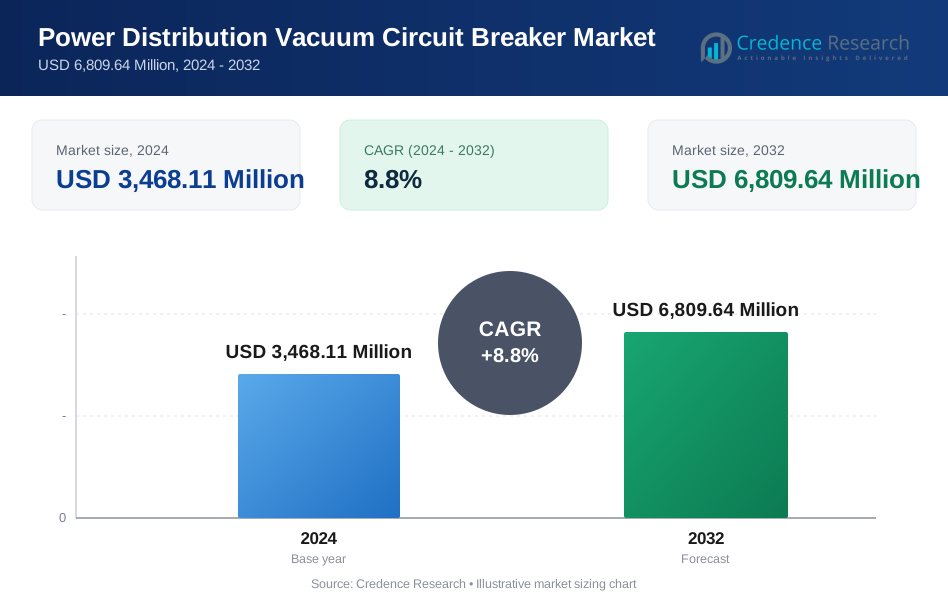
Power Distribution Vacuum Circuit Breaker Market size was valued at USD 3,468.11 Million in 2024 and is anticipated to reach USD 6,809.64 Million by 2032, at a CAGR of 8.8% during the forecast period.
| REPORT ATTRIBUTE | DETAILS |
|---|---|
| Historical Period | 2020-2023 |
| Base Year | 2024 |
| Forecast Period | 2025-2032 |
| Power Distribution Vacuum Circuit Breaker Market Size 2024 | USD 3,468.11 Million |
| Power Distribution Vacuum Circuit Breaker Market, CAGR | 8.8% |
| Power Distribution Vacuum Circuit Breaker Market Size 2032 | USD 6,809.64 Million |
Power Distribution Vacuum Circuit Breaker Market features leading players such as ABB, General Electric Company, Eaton Corporation, CHINT, Fuji Electric, Alstom S.A., Hager Group, CG Power & Industrial Solutions Ltd., G&W Electric Company, and Kirloskar Electric Company, all focusing on advanced vacuum interruption technologies, digital switchgear integration, and eco-efficient designs. These companies strengthen their presence through product innovation, utility partnerships, and expansion across high-growth regions. Asia-Pacific leads the market with a 36.7% share, driven by large-scale grid expansions and industrial growth, followed by North America at 28.6% and Europe at 26.4%, supported by modernization programs and strong renewable energy adoption.
Market Insights
- Power Distribution Vacuum Circuit Breaker Market is valued at USD 3,468.11 Million in 2024 and will reach USD 6,809.64 Million by 2032 at a CAGR of 8.8%.
- Market growth is driven by rising grid modernization, increased renewable energy integration, and strong adoption of digital substations; the 1,500 to 2,500 A segment leads with a 39.4% share due to high suitability for medium-voltage networks.
- Key trends include rapid transition toward SF₆-free, eco-efficient switchgear technologies and expansion of automation-led industrial systems requiring stable high-performance vacuum breakers.
- Leading players such as ABB, GE, Eaton, CHINT, Fuji Electric, and Hager Group invest in advanced designs, digital monitoring, and global expansion to strengthen presence across high-growth utility and industrial sectors.
- Asia-Pacific dominates with a 36.7% share, followed by North America at 28.6% and Europe at 26.4%; indoor VCBs hold a 57.2% share, while utilities account for 41.8% of total end-use demand.
Market Segmentation Analysis:
By Rated Current:
The Power Distribution Vacuum Circuit Breaker Market is led by the 1,500 to 2,500 A segment, holding a 39.4% share in 2024, driven by its strong suitability for medium-voltage distribution networks, industrial feeders, and utility substations requiring stable load management. Its high interrupting capacity, reliable arc-quenching performance, and compatibility with automated grid systems support widespread adoption. The increasing deployment of smart substations, renewable-integrated grids, and modernized distribution infrastructure further strengthens demand for vacuum circuit breakers within this current range, positioning it as the dominant category across industrial and utility applications.
- For instance, Eaton supplies its VCP-W range of vacuum circuit breakers (available in ratings up to 2,000 A and higher) to Indian utilities and industries, leveraging their robust arc-quenching performance and compatibility with modern digital grid management systems to support grid modernization efforts
By Voltage:
The Indoor segment dominates the Power Distribution Vacuum Circuit Breaker Market with a 57.2% share in 2024, supported by rising installations in commercial buildings, industrial plants, and compact urban substations. Indoor VCBs benefit from enhanced safety, reduced maintenance, and long operational life in controlled environments. Their adoption is further driven by the need for space-efficient switchgear solutions and dependable short-circuit protection in densely populated regions. Growing investment in smart buildings, urban grid upgrades, and digital substations continues to accelerate the preference for indoor configurations over outdoor designs.
- For instance, ABB’s VD4 indoor vacuum circuit breaker family, with more than 2 million units installed globally for primary distribution up to 46 kV, is widely used in data centers and industrial plants to enhance reliability and lower the risk of power interruptions.
By End Use:
The Utility segment holds the largest share of 41.8% in 2024 in the Power Distribution Vacuum Circuit Breaker Market, driven by extensive grid modernization initiatives and increasing integration of renewable power sources. Utilities rely on VCBs for high reliability, minimal maintenance, and superior operational endurance across transmission and distribution networks. Increasing deployment of automated substations, rising electricity demand, and the need for fault-tolerant switching systems further elevate adoption. Large-scale infrastructure expansions and reinforcement of aging power networks firmly position utilities as the dominant end-use sector.

Key Growth Drivers
Grid Modernization and Infrastructure Upgrades
Grid modernization initiatives remain a central growth catalyst for the Power Distribution Vacuum Circuit Breaker Market as utilities worldwide strengthen outdated transmission and distribution networks. Governments accelerate investment in advanced substation automation, fault-tolerant switching equipment, and high-efficiency protection systems to support rising power demand and renewable energy interconnections. Vacuum circuit breakers gain traction for their long operational life, high interrupting performance, and reduced maintenance requirements. The shift toward resilient, technology-enabled grid architectures significantly boosts installation across medium- and high-voltage networks.
- For instance, Siemens Energy tested a 420 kV vacuum technology circuit breaker prototype with SINTEF, passing initial tests for SF6-free operation to replace legacy switchgear in transmission systems operated by Statnett in Norway and RTE in France by late 2026.
Rising Renewable Energy Integration
Growing deployment of solar, wind, and hybrid power systems fuels the need for reliable switching and fault-clearing devices, positioning vacuum circuit breakers as a preferred choice for modern sustainable grids. Their ability to handle fluctuating loads, high switching frequencies, and harsh operating conditions enhances system stability in renewable-rich environments. Utilities adopt VCBs to ensure safe grid synchronization, minimize downtime, and support decentralized power generation. Expansion of renewable energy corridors and utility-scale storage facilities continues to reinforce the demand for advanced VCB-based protection systems.
- For instance, P&B Switchgear supplied VOR-M vacuum circuit breakers to Essex and Suffolk Water as retrofits for frequently operated units, leveraging a low-energy magnetic actuator rated for tens of thousands of operations.
Increasing Adoption of Smart Substations
The rapid shift toward digital substations amplifies the demand for intelligent, communication-enabled vacuum circuit breakers. Utilities prioritize remote monitoring, predictive maintenance, and automated grid operations, requiring switchgear equipped with advanced sensors and control technologies. VCBs integrate seamlessly into SCADA and IoT-based architectures, improving reliability, operational visibility, and fault isolation. The push for efficient asset management and real-time grid diagnostics strengthens adoption, particularly in urban centers and industrial hubs undergoing digital transformation.
Key Trends & Opportunities
Advancement of Eco-Efficient Switchgear Technologies
A major trend shaping the market is the transition from SF₆-based switchgear to eco-efficient and environmentally friendly vacuum-based systems. Manufacturers introduce compact, energy-efficient VCB designs incorporating sustainable insulating materials and digital monitoring tools. This shift aligns with global decarbonization goals and emission-reduction policies. Growing regulatory pressure and utility commitments to green infrastructure create opportunities for VCB producers to innovate next-generation switchgear platforms that deliver superior safety, reduced lifecycle costs, and improved environmental performance.
- For instance, Siemens Energy launched its Blue GIS portfolio, which uses clean air as an insulating medium and integrates sensor-based digital monitoring to support utilities’ carbon-neutral targets.
Expansion Across Industrial Automation and Smart Manufacturing
The rise of Industry 4.0 and automation-led manufacturing presents significant opportunities for vacuum circuit breaker adoption. Modern production facilities require precise power control, high fault-handling capability, and uninterrupted operations. VCBs enable stable energy distribution across robotics, high-load machinery, and automated assembly lines. Increased installation of digital power management systems enhances equipment health monitoring and operational efficiency. As industries expand capacity and deploy energy-intensive processes, demand for advanced VCB-based protection systems strengthens across heavy manufacturing, mining, and processing sectors.
- For instance, ABB's VD4 evo vacuum circuit breaker integrates sensors for real-time monitoring of thermal, mechanical, and electrical parameters. This supports remote asset management in automated facilities, enabling predictive maintenance through data transmitted via IEC 61850 protocols.
Key Challenges
High Initial Investment and Integration Costs
Despite their operational benefits, vacuum circuit breakers involve higher upfront costs compared to conventional switching technologies, posing adoption barriers for small utilities and emerging industries. Installation expenses increase further when integrating VCBs into digital substations requiring communication modules, sensors, and automation infrastructure. Budget-constrained operators may prioritize legacy equipment over technologically advanced solutions. These financial hurdles slow modernization efforts, particularly in developing regions where capital allocation for infrastructure upgrades remains limited.
Shortage of Skilled Technical Workforce
A lack of skilled professionals capable of maintaining, installing, and managing advanced vacuum circuit breaker systems presents a notable market challenge. As substations and industrial facilities adopt sophisticated digital switchgear, demand for technicians proficient in smart diagnostics, IoT-enabled controls, and predictive maintenance rises sharply. Skill gaps lead to operational inefficiencies, longer downtime, and delays in large-scale deployments. The slow pace of technical training programs and limited workforce readiness hinder smooth transition toward modern grid protection systems across utilities and industries.
Regional Analysis
North America
North America holds a 28.6% share of the Power Distribution Vacuum Circuit Breaker Market in 2024, driven by large-scale grid modernization programs and increasing adoption of digital substations across the U.S. and Canada. Utilities prioritize VCB installations to replace aging oil and SF₆-based breakers with environmentally responsible, maintenance-efficient solutions. The region benefits from strong investments in renewable integration, particularly in wind and solar corridors requiring high-reliability switching systems. Industrial automation, expanding commercial infrastructure, and stringent electrical safety standards further enhance VCB deployment across medium- and high-voltage networks.
Europe
Europe accounts for a 26.4% share in 2024, supported by strict environmental regulations, rapid transition to SF₆-free switchgear technologies, and robust electrification initiatives. Countries such as Germany, France, and the U.K. accelerate adoption of vacuum circuit breakers to strengthen grid resilience and meet decarbonization targets. Growth in offshore wind, EV charging infrastructure, and industrial electrification amplifies VCB demand. Modernization of aging transmission and distribution networks, combined with strong governmental focus on sustainable energy systems, reinforces Europe’s position as a leading region for advanced VCB installations.
Asia-Pacific
Asia-Pacific leads the global market with a 36.7% share in 2024, driven by massive power infrastructure expansion in China, India, Japan, and Southeast Asia. Rapid industrialization, rising electricity consumption, and large-scale renewable deployment fuel significant demand for vacuum circuit breakers across utilities and industrial facilities. Government-led smart grid programs and investment in high-voltage distribution systems strengthen adoption. The region’s manufacturing strength also supports cost-effective production and rapid technological innovation, positioning Asia-Pacific as the fastest-growing hub for VCB deployment across residential, commercial, industrial, and utility applications.
Latin America
Latin America holds a 4.2% share of the Power Distribution Vacuum Circuit Breaker Market in 2024, supported by ongoing upgrades to aging grid infrastructure and increasing renewable energy installations in Brazil, Mexico, and Chile. Utilities adopt VCBs to enhance network reliability and reduce maintenance costs in regions facing frequent load fluctuations and transmission losses. Industrial expansion in mining, oil and gas, and manufacturing sectors drives further deployment. Government-backed electrification projects and rural grid extensions create additional opportunities for vacuum circuit breaker adoption across medium-voltage distribution systems.
Middle East & Africa
The Middle East & Africa region captures a 4.1% share in 2024, driven by rising investments in power infrastructure to support urbanization, industrial growth, and energy diversification. Gulf countries expand smart grid deployments and integrate renewable projects such as solar and wind farms, increasing the need for reliable VCB-based protection systems. In Africa, electrification programs and utility reforms stimulate installations in developing transmission networks. Industrial activities in oil and gas, mining, and heavy manufacturing further enhance demand, positioning the region as an emerging market for advanced vacuum circuit breakers.
Market Segmentations:
By Rated Current
- 500 to 1,500 A
- 1,500 to 2,500 A
- 2,500 to 4,500 A
- > 4,500 A
By Voltage
- Indoor
- Outdoor
By End Use
- Residential
- Commercial
- Industrial
- Utility
By Geography
- North America
- U.S.
- Canada
- Mexico
- Europe
- Germany
- France
- U.K.
- Italy
- Spain
- Rest of Europe
- Asia Pacific
- China
- Japan
- India
- South Korea
- South-east Asia
- Rest of Asia Pacific
- Latin America
- Brazil
- Argentina
- Rest of Latin America
- Middle East & Africa
- GCC Countries
- South Africa
- Rest of the Middle East and Africa
Competitive Landscape
The competitive landscape of the Power Distribution Vacuum Circuit Breaker Market is shaped by leading players such as ABB, General Electric Company, Eaton Corporation, CHINT, Alstom S.A., Fuji Electric, Hager Group, CG Power & Industrial Solutions Ltd., G&W Electric Company, and Kirloskar Electric Company. These companies focus on technological innovation, eco-efficient switchgear development, and expansion of digital monitoring capabilities to strengthen market presence. Manufacturers increasingly invest in advanced vacuum interruption technology, compact modular designs, and communication-enabled circuit breakers supporting smart grid integration. Strategic initiatives including product launches, capacity expansions, and partnerships with utilities enhance their global reach. Many players emphasize sustainability by reducing reliance on SF₆-based systems and offering environmentally friendly vacuum-based alternatives. Regional expansion, especially across Asia-Pacific and the Middle East, remains a priority as infrastructure modernization accelerates. Continuous R&D efforts, competitive pricing strategies, and long-term utility contracts remain central to maintaining leadership in this technologically evolving market.
Key Player Analysis
- G&W Electric Company
- CHINT
- Fuji Electric
- Kirloskar Electric Company
- Eaton Corporation
- General Electric Company
- Hager Group
- CG Power & Industrial Solutions Ltd.
- ABB
- Alstom S.A.
Recent Developments
- In April 2025, Sécheron SA acquired the LoPro high-voltage circuit breaker technology from TE Connectivity to expand its high-voltage product range for rail and industrial markets.
- In 2025, CNC Electric launched the VS1i-12 Intelligent Vacuum Circuit Breaker, integrating vacuum technology with advanced monitoring for enhanced safety and efficiency in medium-voltage networks.
- In January 2024, ABB launched its new VD4-W vacuum circuit breaker series designed for wind-power applications up to 40.5 kV, reinforcing its renewable-energy product portfolio.
Report Coverage
The research report offers an in-depth analysis based on Rated Current, Voltage, End Use and Geography. It details leading market players, providing an overview of their business, product offerings, investments, revenue streams, and key applications. Additionally, the report includes insights into the competitive environment, SWOT analysis, current market trends, as well as the primary drivers and constraints. Furthermore, it discusses various factors that have driven market expansion in recent years. The report also explores market dynamics, regulatory scenarios, and technological advancements that are shaping the industry. It assesses the impact of external factors and global economic changes on market growth. Lastly, it provides strategic recommendations for new entrants and established companies to navigate the complexities of the market.
Future Outlook
- The Power Distribution Vacuum Circuit Breaker Market will experience strong demand as utilities accelerate grid modernization and digital substation deployment.
- Rising renewable energy integration will increase the need for reliable vacuum switching solutions across solar, wind, and hybrid power networks.
- Adoption of eco-efficient and SF₆-free switchgear technologies will expand as sustainability regulations become more stringent.
- Industrial automation growth will drive increased installation of VCBs in manufacturing, processing, and heavy industrial facilities.
- Smart monitoring and IoT-enabled VCB designs will gain traction to support predictive maintenance and real-time operational visibility.
- Investments in urban grid reinforcement will boost indoor VCB installations in commercial and residential infrastructure.
- Emerging economies will witness rapid adoption as governments invest heavily in electrification and power distribution upgrades.
- Utility companies will expand procurement of high-performance VCBs to improve fault management and reduce operational downtime.
- Technological advancements in vacuum interrupters will enhance switching efficiency and extend equipment life cycles.
- Increasing focus on resilience and energy security will strengthen long-term demand for advanced VCB-based protection systems.
Request a Free Sample
Fill in your details and we'll send you a free sample report.
- Sample data tables & charts
- Research methodology
Need a Custom Version of This Report?
Tailor the scope, geography, or segments to your exact requirements.
- Custom geography or segment scope
- Direct access to our analyst team
Frequently Asked Questions
What is the current market size for Power Distribution Vacuum Circuit Breaker Market, and what is its projected size in 2032?
At what Compound Annual Growth Rate is the Power Distribution Vacuum Circuit Breaker Market projected to grow between 2025 and 2032?
Which Power Distribution Vacuum Circuit Breaker Market segment held the largest share in 2024?
What are the primary factors fueling the growth of the Power Distribution Vacuum Circuit Breaker Market?
Who are the leading companies in the Power Distribution Vacuum Circuit Breaker Market?
Which region commanded the largest share of the Power Distribution Vacuum Circuit Breaker Market in 2024?
Table of Content
Chapter 1. Report Introduction
- 1.1 Report Description & Purpose
- 1.1.1 Report Title & Market Definition
- 1.1.2 Unique Selling Propositions (USP) & Key Differentiators
- 1.1.3 Value Proposition for Stakeholders
- 1.2 Research Objectives
- 1.2.1 Market Sizing Objectives (Volume & Revenue)
- 1.2.2 Segmentation Objectives
- 1.2.3 Competitive Intelligence Objectives
- 1.2.4 Forecast & Scenario Objectives
- 1.3 Report Scope
- 1.3.1 Power Distribution Vacuum Circuit Breaker Scope – Types & Subtypes Covered
- 1.3.2 Geographic Scope – Regions & Countries Covered
- 1.3.3 Historical Period, Base Year & Forecast Period (2024; forecast to 2032)
- 1.3.4 Inclusions & Exclusions
- 1.4 HS Code & Classification Framework
- 1.5 Currency, Units & Pricing Basis
- 1.6 Target Stakeholders
- 1.7 Limitations & Assumptions
Chapter 2. Executive Summary
- 2.1 Global Power Distribution Vacuum Circuit Breaker Market Snapshot
- 2.1.1 Market Size – Historical (2024) & Forecast (2024-2032) (2024: USD 3,468.11 Million → 2032: USD 6,809.64 Million)
- 2.1.2 Volume & Revenue – Global Totals
- 2.1.3 Key Market Highlights – Top Five Facts
- 2.2 Power Distribution Vacuum Circuit Breaker Market Segmentation Snapshot
- 2.2.1 Market Split by Region – 2024 vs. 2032
- 2.3 Competitive Snapshot
- 2.3.1 Top 10 Players by Revenue Share – 2024
- 2.3.2 Top 10 Players by Volume Share – 2024
- 2.3.3 Recent Strategic Developments (18-Month Summary)
- 2.4 Key Investment Highlights & Strategic Conclusions
Chapter 3. Power Distribution Vacuum Circuit Breaker Market Dynamics & Industry Analysis
- 3.1 Market Overview & Context
- 3.1.1 Power Distribution Vacuum Circuit Breaker Market Position in the Broader Automotive Value Chain
- 3.1.2 OEM vs. Replacement Market Dynamics
- 3.1.3 Market Maturity & Development Stage by Region
- 3.2 Power Distribution Vacuum Circuit Breaker Market Drivers
- 3.3 Power Distribution Vacuum Circuit Breaker Market Restraints & Challenges
- 3.4 Power Distribution Vacuum Circuit Breaker Market Opportunities
- 3.5 Porter's Five Forces Analysis
- 3.5.1 Threat of New Entrants
- 3.5.2 Bargaining Power of Suppliers
- 3.5.3 Bargaining Power of Buyers
- 3.5.4 Threat of Substitutes
- 3.5.5 Competitive Rivalry – Intensity Assessment
- 3.6 Power Distribution Vacuum Circuit Breaker Value Chain Analysis
- 3.6.1 Upstream – Raw Material/Input Suppliers
- 3.6.1.1 Raw Material/Input 1
- 3.6.1.2 Raw Material/Input 2
- 3.6.1.3 Raw Material/Input 3
- 3.6.2 Midstream – Production/Manufacturing/Service Delivery
- 3.6.2.1 Production/Process Overview
- 3.6.2.2 Key Facility Locations & Capacity by Manufacturer
- 3.6.3 Downstream – Distribution & End Consumer
- 3.6.3.1 Primary Channel – B2B/OEM
- 3.6.3.2 Secondary Channels – Dealer, Retail, Online, Direct
- 3.6.4 Value Chain Profitability Analysis
- 3.6.1 Upstream – Raw Material/Input Suppliers
- 3.7 PESTEL Analysis
- 3.7.1 Political Factors
- 3.7.2 Economic Factors
- 3.7.3 Social Factors
- 3.7.4 Technological Factors
- 3.7.5 Environmental Factors
- 3.7.6 Legal Factors
- 3.8 Power Distribution Vacuum Circuit Breaker Supply Chain Analysis
- 3.8.1 Raw Material/Input Supply Risk Assessment
- 3.8.2 Manufacturing Concentration Risk (Geographic Exposure)
- 3.8.3 Trade Disruption Impact Analysis
- 3.9 Regulatory & Policy Landscape
Note: The regulatory and policy landscape section covers regulations based on their applicability to the market, Power Distribution Vacuum Circuit Breaker category, geography, and scope of the study. Only regulatory frameworks with a material impact on operations, compliance, trade, sustainability, or market access are analyzed in detail.
Chapter 4. Key Investment Pockets & Opportunity Analysis
- 4.1 Power Distribution Vacuum Circuit Breaker Market Attractiveness Analysis
- 4.1.1 By Region – Investment Attractiveness Matrix (Volume × CAGR)
- 4.2 Absolute Revenue Growth Opportunity
- 4.2.1 By Region – Absolute USD Growth Through 2032
- 4.3 Incremental Volume Opportunity
- 4.3.1 By Region – Incremental Volume Through 2032
- 4.3.2 Segment – Incremental Volume
- 4.4 Emerging Submarket Opportunity Deep Dive (Subject to Applicability)
- 4.5 Emerging Market Opportunity Scorecards
- 4.5.1 United States
- 4.5.2 Europe
- 4.5.3 Asia
- 4.5.4 Middle East & Africa
Note: Emerging Market Opportunity Scorecards will be included based on relevance and strategic importance. Regions listed are indicative and may vary depending on data availability and market dynamics.
Chapter 5. Power Distribution Vacuum Circuit Breaker Import-Export Analysis & Trade Flows
- 5.1 Global Trade Overview
- 5.1.1 Global Export Value by Country (2024)
- 5.1.2 Global Export Volume by Country (2024)
- 5.1.3 Global Import Value by Country (2024)
- 5.1.4 Global Import Volume by Country (2024)
- 5.1.5 Net Trade Balance by Country (2024)
- 5.2 Export Analysis – Segment
- 5.2.1 Type 1 (HS Code)
- 5.2.2 Type 2 (HS Code)
- 5.2.3 Type 3 (HS Code)
- 5.2.4 Type 4 (HS Code)
- 5.2.5 Type 5 (HS Code)
- 5.3 Import Analysis – Segment
- 5.3.1 Type 1 (HS Code)
- 5.3.2 Type 2 (HS Code)
- 5.3.3 Type 3 (HS Code)
- 5.3.4 Type 4 (HS Code)
- 5.3.5 Type 5 (HS Code)
- 5.4 Average Unit Trade Prices
- 5.4.1 Average Export Price – Segment & Country
- 5.4.2 Average Import Price – Segment & Source Country
- 5.4.3 Price Trends (2024)
- 5.5 Key Trade Route Analysis
- 5.5.1 Trade Route 1
- 5.5.2 Trade Route 2
- 5.5.3 Trade Route 3
- 5.5.4 Trade Route 4
- 5.5.5 Trade Route 5
- 5.6 Trade Policy Impact Assessment
- 5.6.1 US Anti-Dumping & Section 301 Tariffs
- 5.6.2 EU Customs Union Impact
- 5.6.3 Major Free Trade Agreements
- 5.6.4 USMCA Rules of Origin
Note: Trade policy analysis will be included only where relevant to the Power Distribution Vacuum Circuit Breaker market.
Chapter 6. Competitive Landscape & Company Benchmarking
- 6.1 Power Distribution Vacuum Circuit Breaker Market Concentration & Structure
- 6.1.1 Herfindahl-Hirschman Index (HHI) – vs. 2024
- 6.1.2 Tier 1, Tier 2 & Tier 3 Market Structure
- 6.1.3 Global, Regional & Local Player Dynamics
- 6.2 Power Distribution Vacuum Circuit Breaker Market Share Analysis – 2024
- 6.2.1 Global Revenue Share by Company
- 6.2.2 Global Volume Share by Company
- 6.2.3 Regional Revenue Share
- 6.2.4 Market Share Evolution ( vs. 2024)
- 6.2.5 OEM Segment Share by Company
- 6.2.6 Replacement Segment Share by Company
- 6.3 Production/Delivery Capacity & Facility Analysis
- 6.3.1 Global Installed Capacity
- 6.3.2 Capacity Utilization Rates
- 6.3.3 Production/Output Volume
- 6.3.4 Facility Locations & Capacity Map
- 6.3.5 Planned Capacity Additions
- 6.4 Power Distribution Vacuum Circuit Breaker Competitive Benchmarking Matrix
- 6.4.1 Revenue, Volume, CAGR & Profitability Comparison
- 6.4.2 Channel Revenue Mix
- 6.4.3 Geographic Revenue Exposure
- 6.4.4 R&D Intensity
- 6.4.5 Sustainability Maturity
- 6.5 Strategic Developments in Power Distribution Vacuum Circuit Breaker (Last 24 Months)
- 6.5.1 Mergers, Acquisitions & Divestments
- 6.5.2 New Power Distribution Vacuum Circuit Breaker Launches
- 6.5.3 Facility Expansions
- 6.5.4 Strategic Alliances, Joint Ventures & Partnerships
- 6.5.5 Distribution Expansion & Market Entry
- 6.5.6 Sustainability & ESG Initiatives
- 6.6 Competitive Strategy Mapping
- 6.6.1 Leader, Challenger, Follower & Niche Classification
- 6.6.2 Pricing Strategy Comparison
- 6.6.3 Channel Strategy Matrix
Note: Strategic developments are included based on their materiality and the availability of reliable information.
Chapter 7. Global Power Distribution Vacuum Circuit Breaker Market – By Distribution Channel
- 7.1 Segment Overview
- 7.1.1 Volume & Revenue Split by Channel (2024 & 2032)
- 7.1.2 Channel Mix Evolution (2024-2032)
Chapter 8. Regional Market Analysis – Global Overview
- 8.1 Global Regional Overview
- 8.1.1 Regional Volume Share
- 8.1.2 Regional Revenue Share
- 8.1.3 Regional Volume by Region
- 8.1.4 Regional Revenue by Region
- 8.1.5 Regional Forecast Through 2032
- 8.2 Cross-Regional Segment Analysis
- 8.2.1 By Distribution Channel
- 8.2.2 By Brand/Price Tier
Chapter 9. North America Power Distribution Vacuum Circuit Breaker Market
- 9.1 United States
- 9.2 Canada
- 9.3 Mexico
Chapter 10. Europe Power Distribution Vacuum Circuit Breaker Market
- 10.1 Germany
- 10.2 France
- 10.3 Italy
- 10.4 United Kingdom
- 10.5 Spain
- 10.6 Poland
- 10.7 Russia
- 10.8 Netherlands
- 10.9 Belgium
- 10.10 Sweden
- 10.11 Denmark
- 10.12 Norway
- 10.13 Rest of Europe
Chapter 11. Asia Pacific Power Distribution Vacuum Circuit Breaker Market
- 11.1 China
- 11.2 India
- 11.3 Japan
- 11.4 South Korea
- 11.5 Thailand
- 11.6 Indonesia
- 11.7 Vietnam
- 11.8 Malaysia
- 11.9 Australia
- 11.10 Rest of Asia Pacific
Chapter 12. Latin America Power Distribution Vacuum Circuit Breaker Market
- 12.1 Brazil
- 12.2 Argentina
- 12.3 Colombia
- 12.4 Chile
- 12.5 Rest of Latin America
Chapter 13. Middle East Power Distribution Vacuum Circuit Breaker Market
- 13.1 Saudi Arabia
- 13.2 United Arab Emirates
- 13.3 Turkey
- 13.4 Israel
- 13.5 Iran
- 13.6 Rest of the Middle East
Chapter 14. Africa Power Distribution Vacuum Circuit Breaker Market
- 14.1 South Africa
- 14.2 Egypt
- 14.3 Nigeria
- 14.4 Morocco
- 14.5 Rest of Africa
Chapter 15. Power Distribution Vacuum Circuit Breaker Company Profiles
- 15.1 [Company 01]
- 15.1.1 Company Overview
- 15.1.2 Key Management Personnel
- 15.1.3 Products & Services Portfolio
- 15.1.4 Financial Performance
- 15.1.5 Key Market Focus & Geographic Presence
- 15.1.6 Recent Developments & Strategic Initiatives
Note: The company profile list is preliminary and may change based on research findings, market developments, data availability, and client requirements.
Chapter 16. Appendices
- Appendix A – List of Abbreviations & Acronyms
- Appendix B – Industry Classification Code Reference – Full Series
- Appendix C – Production & Capacity Data Tables
- Appendix D – End-Use & Demand Base Tables
- Appendix E – Consumption & Replacement Rate Assumptions
- Appendix F – ASP Reference Tables
- Appendix G – Manufacturing & Facility Database
- Appendix H – Import-Export Data Tables
- Appendix I – Regulatory Summary Tables
- Appendix J – Primary Research Participant List (Anonymized)
- Appendix K – Primary Research Questionnaire Framework
- Appendix L – Data Sources & Bibliography
- Appendix M – Market Size Divergence & Source Comparison
Chapter 17. Research Methodology
- 17.1 Research Framework & Philosophy
- 17.2 Secondary Research – Sources, Hierarchy & Data Extraction
- 17.3 Data Modeling – Bottom-Up & Top-Down Market Sizing
- 17.4 Primary Research – Stakeholder Framework, LOI & Sample Sizes
- 17.5 Forecast Methodology – Regression, Scenario & Sensitivity Analysis
- 17.6 Quality Control – Four-Layer Validation Framework
- 17.7 Limitations & Standard Assumptions
- 17.8 Disclaimer
