
| REPORT ATTRIBUTE | DETAILS |
|---|---|
| Historical Period | 2019-2022 |
| Base Year | 2023 |
| Forecast Period | 2024-2032 |
| Soy Protein Ingredients Market Size 2023 | USD 8458.2 Million |
| Soy Protein Ingredients Market, CAGR | 3.00% |
| Soy Protein Ingredients Market Size 2032 | USD 11036.0 Million |
Market Insights
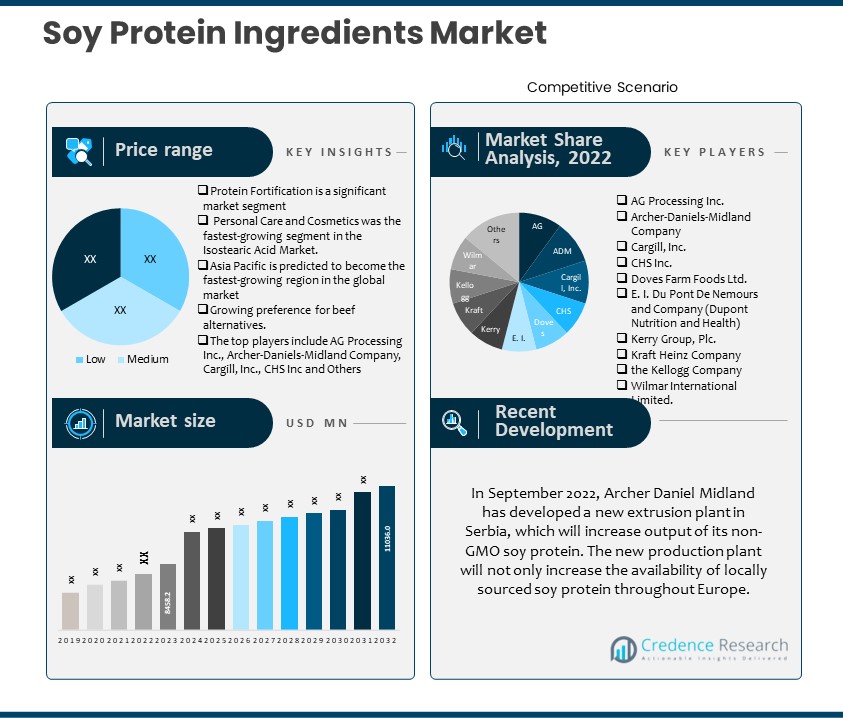
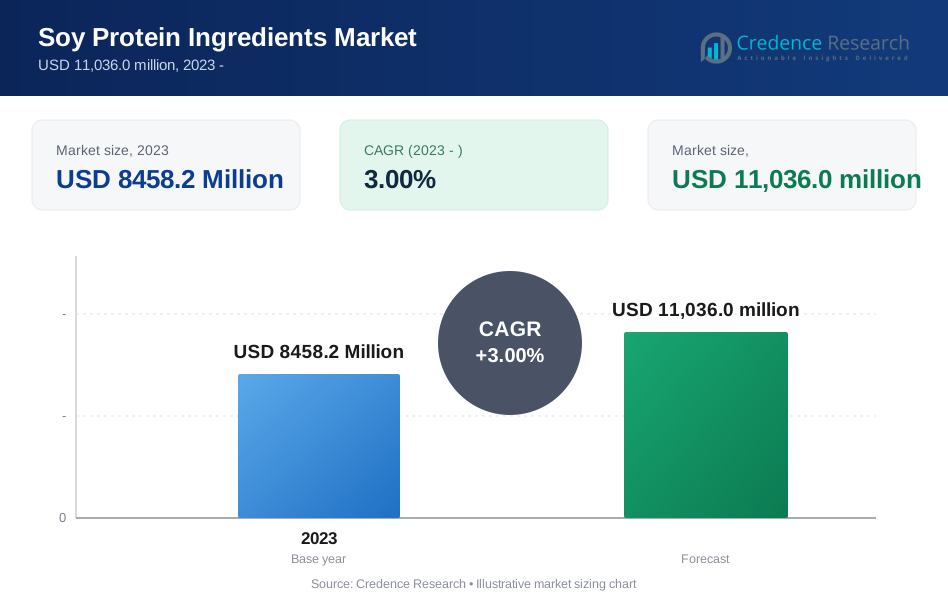
- The global demand for Soy Protein Ingredients was valued at USD 8458.2 million in 2023 and is expected to reach USD 11036.0 million in 2032, growing at a CAGR of 3.00% between 2024 and 2032.
- The Soy Protein Isolates category is predicted to lead the market in 2023, while the Soy Protein Concentrates category is also expected to rise significantly. The textured soy protein market is expected to grow rapidly.
- The Meat Alternatives sector has the biggest market share, while Dairy Alternatives is the fastest-growing area in the Soy Protein Ingredients Market.
- Protein Fortification is a significant market segment in the Soy Protein Ingredients Market. Another prominent component is texture enhancement.
- In 2023, North America dominated the global market, accounting for 43.0% of total revenue. Over the next several years, Asia Pacific is predicted to become the fastest-expanding region in the global market.
- The expanding vegan population increases demand for soy protein, boosting industry growth.
- Price changes for soybeans impede market growth.
Executive Summary
Market Definition
Soy protein ingredients are typically used to make Soy Protein Foods. They are an excellent source of dietary proteins, depending on both the quality and quantity of the food. Soy protein, which is high in cholesterol-free, lean, and lactose-free protein, supports all health demands throughout the lifespan. Soy protein is a complete protein containing all of the essential amino acids necessary for children's optimal growth and development. Because they are low in fat and free of saturated fat and cholesterol, this is thought to be a great protein source for increasing nutrient density in food. Soy protein is most commonly made from three ingredients: soy flour, soy protein concentrate, and soy protein isolate.
Market Overview
The global Soy Protein Ingredients Market has witnessed steady growth in recent years and is expected to grow at a CAGR of 3.00% between 2024 and 2032. The market was valued at USD 8458.2 million in 2023 and is expected to reach USD 11036.0 million in 2032.
The functional and nutritional properties of soy protein have made it suitable for a variety of applications, including bakery, confectionery, emulsion-type sausages, dairy replacers, functional beverages and nutritional bars, and breakfast cereals, which are driving the growth of the Soy Protein Ingredients Market. Soy protein is utilized as an alternative to meat and dairy products, which helps producers control costs and increase product profitability. Furthermore, an increasing vegan population, particularly in wealthy countries, and a developing trend of benefits associated with vegan diets, combined with rising demand for plant-based proteins, have resulted in high demand for soy protein.
This is another element driving the growth of the Soy Protein Ingredients Market. Furthermore, benefits connected with a vegan diet include lower cholesterol and blood pressure levels, reduced risk of heart disease, and a low body mass index as a result of vegan diet adoption. As a result, rising consumer knowledge of product benefits is driving the growth of the Soy Protein Ingredients Market.
Segmentation By Type of Soy Protein Ingredients
- In terms of revenue, the Soy Protein Isolates category is expected to dominate the market in 2023. Isolates are considered the purest type of soy protein since they contain at least 90% protein and are made by removing the soybean's lipids, carbohydrates, and other non-protein components. Because of their high protein content and low allergenicity, these isolates are widely used in a range of applications, including infant formulas, sports nutrition, and meat substitutes.
- The Soy Protein Concentrates category is also expected to see significant growth. The non-protein components of soybeans are removed to produce soy protein concentrates, which contain 70-90% protein. These concentrations are widely utilized in meat products, beverages, bread, and confectionery.
- Throughout the projection period, the textured soy protein market is expected to grow rapidly.
Segmentation by Formulation and Application
- The Meat Alternatives segment has the largest market share and is projected to increase at a CAGR of 3.29% over the forecast period. As health consciousness grows, consumers are shifting away from animal protein and toward plant-based goods. Consumers continue to choose soy protein above all other plant-based proteins.
- On the other hand, Dairy Alternatives is the fastest-growing segment in the Soy Protein Ingredients Market.
Segmentation by Functionality
- Protein Fortification is an important market sector in the Soy Protein Ingredients Market since it is necessary to increase the protein content of various food products.
- Another popular component is Texture Enhancement, which is commonly used to improve the texture and general quality of food products.
Segmentation by Region
- In 2023, North America dominated the global market, accounting for 43.0% of total revenues.
- Over the next several years, Asia Pacific is expected to become the fastest-growing region in the global market.
- The rest of the world, including Latin America, the Middle East, and Africa, supplies the remaining demand for Soy Protein Ingredients.
In 2023, North America dominated the global market, and this dominance is likely to continue during the forecast period. The regional market's rise can be ascribed in large part to increased consumer knowledge of the availability and benefits of plant-based products, as well as ongoing research efforts to introduce more improved soy protein-enriched products. Furthermore, the increasing entry of new market players and start-ups into the regional market, as well as the exponential growth of the nutraceuticals industry, particularly in nations such as the United States, Canada, and Mexico, are driving market growth.
Moreover, Over the next several years, Asia Pacific is predicted to become the fastest-growing region in the global market. One of the key factors driving demand and growth for soy protein ingredients in the region is the emerging vegan trend and the shift in consumer preferences from meat-based products to plant-based products due to their wide range of health and environmental benefits, particularly in countries such as India, China, and Indonesia.
Key Highlights of the Report
Type of Soy Protein Ingredients, Formulation and Application, Functionality, and Region segment the global Soy Protein Ingredients Market. In 2023, the Soy Protein Isolates category is anticipated to have a dominant market share, with the Dairy Alternatives segment experiencing the highest growth. Moreover, Texture Enhancement is a popular component and Protein Fortification is a significant market segment and North America leading the market growth.
The market's main drivers are growing consumer preference for plant-based proteins, increased awareness of soy protein's health benefits, and rising demand for meat substitutes and vegan goods. In addition, allergenic issues associated with soy protein, price volatility of soybeans affecting manufacturing costs, and competition from alternative plant-based protein sources are the primary limitations of the market.
North America dominated the global market in 2023, and this trend is expected to continue during the forecast period. The regional market's growth can be attributed in large part to increased consumer awareness of the availability and benefits of plant-based products, as well as ongoing research efforts to introduce more advanced soy protein-enriched products. Furthermore, Asia Pacific is expected to be the fastest-growing region in the global market.
What Are The Main Drivers Of The Global Soy Protein Ingredients Market?
The primary market drivers are growing consumer preference for plant-based proteins, increased awareness of the health benefits of soy protein, and rising demand for meat substitutes and vegan goods.
What Are The Major Challenges Faced By The Global Soy Protein Ingredients Market?
The primary limitations of the market are allergenic concerns about soy protein, price volatility of soybeans affecting manufacturing costs, and competition from other plant-based protein sources.
What Are The Growth Opportunities In The Global Soy Protein Ingredients Market?
The market's significant opportunities include expanding the use of soy protein ingredients in functional food and beverages, creating innovative soy protein-based products, and focusing on research and development for new applications and formulations.
Market Drivers
Several factors drive the global Soy Protein Ingredients Market. The following are the key drivers of the global Soy Protein Ingredients Market:
Growing Vegan Population
A vegan diet does not allow animal products like fish, dairy, meat, and eggs. Vegan and flexitarian diets are becoming increasingly popular as the plant-based industry grows and people become more aware of the challenges associated with animal production. With the rise of the vegan community, there is an increa se in demand for soy protein as people want to add it to their diets to maintain protein balance.
For instance, according to the Good Food Institute, a non-profit organization based in the United States that promotes plant-based and cell-based alternatives to animal products, sales of plant-based foods increased three times faster than those of non-plant-based meals in 2021 in the United States. As a result, the increasing vegan population is likely to drive the growth of the soy protein market in the future years.
Market Restraints
The global Soy Protein Ingredients Market faces some challenges that may hinder its growth. These include the following:
Price Fluctuations For Soybeans
Seasonality, production fluctuations, field losses, waste, and contamination during storage are all unpredictable factors that might have an impact on agricultural goods utilized for protein extraction. This may have an influence on the supply chain of soy protein ingredients, resulting in dramatically higher soybean costs in the food and beverage industry. Because of these price variations, the cost of soy protein ingredients in final goods is expected to climb. The soybean market's price volatility has an impact on producers' profitability and exports, which can sometimes limit exports. The unsure halt and export embargo affect commodity prices and the worldwide consumer market. As a result, soybean prices are unstable, limiting market expansion.
Opportunities
The global Soy Protein Ingredients Market offers significant growth opportunities. These include the following:
Government Initiatives Promote The Adoption Of Soy Protein In Public Health Programs And Nutrition Schemes
The rise of the soy protein market is being fueled by government initiatives that recognize the nutritional need for adequate alternatives to animal-based meals in public health programs. Soy protein food provides vegan children with the best care, including a balanced diet. For instance, in June 2021, the Indian government, in collaboration with The Good Food Institute (GFI) India, launched the India Smart Protein Innovation Challenge to promote innovation in plant-based and cultivated foods. The challenge is open to all students, researchers, and entrepreneurs, and participants will have the opportunity to receive support, investment, or promotion from industry leaders.
In addition, in June 2021, the Japanese government advocated using beef alternatives to minimize carbon emissions and work toward a decarbonized civilization by 2050. Furthermore, the United States Food and Drug Administration (FDA) has established that 25 grams of soy protein per day will cut blood cholesterol levels by approximately 12%, and as part of a low-saturated fat and cholesterol diet, may lower the risk of heart disease. These activities are likely to increase demand for soy protein over the forecast period.
Competitive Landscape
Key Players
The global Soy Protein Ingredients Market is highly competitive, with several key players. Some of the major players in the market and their market share are as follows:
- AG Processing Inc.
- Archer-Daniels-Midland Company
- Cargill, Inc.
- CHS Inc.
- Doves Farm Foods Ltd.
- E. I. Du Pont De Nemours and Company (Dupont Nutrition and Health)
- Kerry Group, Plc.
- Kraft Heinz Company
- the Kellogg Company
- Wilmar International Limited.
These organizations prioritize product innovation, distribution channel expansion, and mergers and acquisitions to stay competitive.
The global Soy Protein Ingredients Market's key players continually seek to stay ahead by offering new products and developments.
In April 2021, Fuji Oil Holdings Inc., a Dutch company, invested in UNOVI's NCAP II Fund, a large fund focused on food technology. The company intends to contribute to a sustainable society by addressing global consumer challenges using plant-based food processing technologies.
In September. 2022, Kerry presents Shere Supreme, a texturing technology that reduces the cost of hard-pack ice cream by up to 50%. Kerry, the world's leading flavor and nutrition brand, has unveiled Shere Supreme, a novel texture system that mimics the qualities of locust bean gum (LBG) in hard-packed ice cream.
In February 2022, Benson Hill, a prominent food technology firm in the United States, has created TruVail, a new line of plant-based protein components that are domestically sourced and non-GMO, with various distinct benefits. The new product line will contain high-protein soy flour, soy protein concentrate, and texturized proteins for usage in a wide range of soy protein applications.
Summary of Key Findings
- Government initiatives encourage the use of soy protein in public health programs and nutrition plans.
- Market Segmented By Type of Soy Protein Ingredients, Formulation and Application, Functionality, and region.
- Protein Fortification is an important industry segment in the Soy Protein Ingredients industry
- North America is leading in market growth; the market is highly competitive with key players, including AG Processing Inc., Archer-Daniels-Midland Company, Cargill, Inc., CHS Inc and Others.
Future Outlook
- Increasing need for plant-based proteins.
- Increased awareness of health and wellness
- Expanding applications in the food and beverage industries.
- Technological developments in production processes
- Growing preference for beef alternatives.
How CXOs Can Benefit from the Credence Research Soy Protein Ingredients Market Report
The Credence Research Soy Protein Ingredients Market Report provides CXOs with a comprehensive overview of the market, including:
- Market size and growth forecast: The report provides detailed estimates of the global Soy Protein Ingredients Market size, segmented by Type of Soy Protein Ingredients, Formulation and Application, Functionality, and region. It also includes forecasts for the market through 2032 based on key trends and drivers.
- Market segmentation: The report segments the Soy Protein Ingredients Market By Type, Formulation and Application, Functionality, and region. This segmentation provides CXOs with a granular understanding of the market and the opportunities in each segment.
- Competitive Landscape: The report profiles the key players in the Soy Protein Ingredients Market and provides insights into their strategies, product offerings, and financial performance. This information can help CXOs to identify and assess their competition.
- Key trends and drivers: The report identifies and analyzes the key trends and drivers that are shaping the Soy Protein Ingredients Market. This information can help CXOs to make informed decisions about their investments and strategies.
CXOs can use the insights from the Credence Research Soy Protein Ingredients Market Report to:
- Identify growth opportunities: The report can help CXOs to identify new growth opportunities in the Soy Protein Ingredients Market. For example, it can pinpoint emerging trends in industries like aerospace and automotive, helping executives make informed decisions on expanding their product lines or entering new market segments where Soy Protein Ingredients's properties can be leveraged for success.
- Make informed investment decisions: The report can help CXOs make informed investment decisions about Soy Protein Ingredients. For example, it can provide crucial insights into market trends, competitive landscape, and potential growth areas, empowering executives to allocate resources strategically and seize opportunities for maximizing returns on investments in the Soy Protein Ingredients sector.
- Develop competitive strategies: The report can help CXOs develop competitive strategies for their Soy Protein Ingredients businesses. For example, it can offer valuable insights into market trends, competitor analysis, and innovative Functionality's of Soy Protein Ingredients, enabling executives to stay ahead of the competition and drive business growth in this dynamic industry.
- Track market developments: The report can help CXOs monitor market developments and stay ahead of the curve. For example, it provides insights into the latest trends and innovations in the Soy Protein Ingredients Market.
Overall, the Credence Research Soy Protein Ingredients Market Report is a valuable resource for CXOs who are looking to gain a deeper understanding of the market and identify opportunities for growth.
Segmentation
- By Type of Soy Protein Ingredients:
- Soy Protein Isolates (SPI)
- Soy Protein Concentrates (SPC)
- Textured Soy Protein (TSP)
- Soy Protein Hydrolysates
- Soy Protein Flours
- By Formulation and Application:
- Bakery and Confectionery
- Dairy Alternatives
- Meat Alternatives
- Beverages
- Nutritional Supplements
- Infant Formula and Baby Food
- Cereals and Snacks
- Processed Foods
- By Functionality:
- Protein Fortification
- Texture Enhancement
- Emulsification
- Foaming and Gelling
- Water and Fat Binding
- By Region
- North America
- The U.S.
- Canada
- Mexico
- Europe
- Germany
- France
- The U.K.
- Italy
- Spain
- Rest of Europe
- Asia Pacific
- China
- Japan
- India
- South Korea
- South-east Asia
- Rest of Asia Pacific
- Latin America
- Brazil
- Argentina
- Rest of Latin America
- Middle East & Africa
- GCC Countries
- South Africa
- Rest of the Middle East and Africa
- North America
Request a Free Sample
Fill in your details and we'll send you a free sample report.
- Sample data tables & charts
- Research methodology
Need a Custom Version of This Report?
Tailor the scope, geography, or segments to your exact requirements.
- Custom geography or segment scope
- Direct access to our analyst team
Frequently Asked Questions
What is the current size of the global Soy Protein Ingredients Market?
What is the expected growth rate of the Soy Protein Ingredients Market between 2024 and 2032?
Which segment is leading the market share in terms of Type of Soy Protein Ingredients?
Which Functionality segment governs the demand for Soy Protein Ingredients in the world?
Who are the major players in the global Soy Protein Ingredients Market?
Table of Content
Chapter 1. Report Introduction
- 1.1 Report Description & Purpose
- 1.1.1 Report Title & Market Definition
- 1.1.2 Unique Selling Propositions (USP) & Key Differentiators
- 1.1.3 Value Proposition for Stakeholders
- 1.2 Research Objectives
- 1.2.1 Market Sizing Objectives (Volume & Revenue)
- 1.2.2 Segmentation Objectives
- 1.2.3 Competitive Intelligence Objectives
- 1.2.4 Forecast & Scenario Objectives
- 1.3 Report Scope
- 1.3.1 Soy Protein Ingredients Scope – Types & Subtypes Covered
- 1.3.2 Geographic Scope – Regions & Countries Covered
- 1.3.3 Historical Period, Base Year & Forecast Period (2023; forecast to the forecast period)
- 1.3.4 Inclusions & Exclusions
- 1.4 HS Code & Classification Framework
- 1.5 Currency, Units & Pricing Basis
- 1.6 Target Stakeholders
- 1.7 Limitations & Assumptions
Chapter 2. Executive Summary
- 2.1 Global Soy Protein Ingredients Market Snapshot
- 2.1.1 Market Size – Historical (2023) & Forecast (the forecast period) (2023: USD 8458.2 Million → forecast year: USD 11,036.0 million)
- 2.1.2 Volume & Revenue – Global Totals
- 2.1.3 Key Market Highlights – Top Five Facts
- 2.2 Soy Protein Ingredients Market Segmentation Snapshot
- 2.2.1 Market Split by Region – 2023 vs.
- 2.3 Competitive Snapshot
- 2.3.1 Top 10 Players by Revenue Share – 2023
- 2.3.2 Top 10 Players by Volume Share – 2023
- 2.3.3 Recent Strategic Developments (18-Month Summary)
- 2.4 Key Investment Highlights & Strategic Conclusions
Chapter 3. Soy Protein Ingredients Market Dynamics & Industry Analysis
- 3.1 Market Overview & Context
- 3.1.1 Soy Protein Ingredients Market Position in the Broader Automotive Value Chain
- 3.1.2 OEM vs. Replacement Market Dynamics
- 3.1.3 Market Maturity & Development Stage by Region
- 3.2 Soy Protein Ingredients Market Drivers
- 3.3 Soy Protein Ingredients Market Restraints & Challenges
- 3.4 Soy Protein Ingredients Market Opportunities
- 3.5 Porter's Five Forces Analysis
- 3.5.1 Threat of New Entrants
- 3.5.2 Bargaining Power of Suppliers
- 3.5.3 Bargaining Power of Buyers
- 3.5.4 Threat of Substitutes
- 3.5.5 Competitive Rivalry – Intensity Assessment
- 3.6 Soy Protein Ingredients Value Chain Analysis
- 3.6.1 Upstream – Raw Material/Input Suppliers
- 3.6.1.1 Raw Material/Input 1
- 3.6.1.2 Raw Material/Input 2
- 3.6.1.3 Raw Material/Input 3
- 3.6.2 Midstream – Production/Manufacturing/Service Delivery
- 3.6.2.1 Production/Process Overview
- 3.6.2.2 Key Facility Locations & Capacity by Manufacturer
- 3.6.3 Downstream – Distribution & End Consumer
- 3.6.3.1 Primary Channel – B2B/OEM
- 3.6.3.2 Secondary Channels – Dealer, Retail, Online, Direct
- 3.6.4 Value Chain Profitability Analysis
- 3.6.1 Upstream – Raw Material/Input Suppliers
- 3.7 PESTEL Analysis
- 3.7.1 Political Factors
- 3.7.2 Economic Factors
- 3.7.3 Social Factors
- 3.7.4 Technological Factors
- 3.7.5 Environmental Factors
- 3.7.6 Legal Factors
- 3.8 Soy Protein Ingredients Supply Chain Analysis
- 3.8.1 Raw Material/Input Supply Risk Assessment
- 3.8.2 Manufacturing Concentration Risk (Geographic Exposure)
- 3.8.3 Trade Disruption Impact Analysis
- 3.9 Regulatory & Policy Landscape
Note: The regulatory and policy landscape section covers regulations based on their applicability to the market, Soy Protein Ingredients category, geography, and scope of the study. Only regulatory frameworks with a material impact on operations, compliance, trade, sustainability, or market access are analyzed in detail.
Chapter 4. Key Investment Pockets & Opportunity Analysis
- 4.1 Soy Protein Ingredients Market Attractiveness Analysis
- 4.1.1 By Region – Investment Attractiveness Matrix (Volume × CAGR)
- 4.2 Absolute Revenue Growth Opportunity
- 4.2.1 By Region – Absolute USD Growth Through the forecast period
- 4.3 Incremental Volume Opportunity
- 4.3.1 By Region – Incremental Volume Through the forecast period
- 4.3.2 Segment – Incremental Volume
- 4.4 Emerging Submarket Opportunity Deep Dive (Subject to Applicability)
- 4.5 Emerging Market Opportunity Scorecards
- 4.5.1 United States
- 4.5.2 Europe
- 4.5.3 Asia
- 4.5.4 Middle East & Africa
Note: Emerging Market Opportunity Scorecards will be included based on relevance and strategic importance. Regions listed are indicative and may vary depending on data availability and market dynamics.
Chapter 5. Soy Protein Ingredients Import-Export Analysis & Trade Flows
- 5.1 Global Trade Overview
- 5.1.1 Global Export Value by Country (2023)
- 5.1.2 Global Export Volume by Country (2023)
- 5.1.3 Global Import Value by Country (2023)
- 5.1.4 Global Import Volume by Country (2023)
- 5.1.5 Net Trade Balance by Country (2023)
- 5.2 Export Analysis – Segment
- 5.2.1 Type 1 (HS Code)
- 5.2.2 Type 2 (HS Code)
- 5.2.3 Type 3 (HS Code)
- 5.2.4 Type 4 (HS Code)
- 5.2.5 Type 5 (HS Code)
- 5.3 Import Analysis – Segment
- 5.3.1 Type 1 (HS Code)
- 5.3.2 Type 2 (HS Code)
- 5.3.3 Type 3 (HS Code)
- 5.3.4 Type 4 (HS Code)
- 5.3.5 Type 5 (HS Code)
- 5.4 Average Unit Trade Prices
- 5.4.1 Average Export Price – Segment & Country
- 5.4.2 Average Import Price – Segment & Source Country
- 5.4.3 Price Trends (2023)
- 5.5 Key Trade Route Analysis
- 5.5.1 Trade Route 1
- 5.5.2 Trade Route 2
- 5.5.3 Trade Route 3
- 5.5.4 Trade Route 4
- 5.5.5 Trade Route 5
- 5.6 Trade Policy Impact Assessment
- 5.6.1 US Anti-Dumping & Section 301 Tariffs
- 5.6.2 EU Customs Union Impact
- 5.6.3 Major Free Trade Agreements
- 5.6.4 USMCA Rules of Origin
Note: Trade policy analysis will be included only where relevant to the Soy Protein Ingredients market.
Chapter 6. Competitive Landscape & Company Benchmarking
- 6.1 Soy Protein Ingredients Market Concentration & Structure
- 6.1.1 Herfindahl-Hirschman Index (HHI) – vs. 2023
- 6.1.2 Tier 1, Tier 2 & Tier 3 Market Structure
- 6.1.3 Global, Regional & Local Player Dynamics
- 6.2 Soy Protein Ingredients Market Share Analysis – 2023
- 6.2.1 Global Revenue Share by Company
- 6.2.2 Global Volume Share by Company
- 6.2.3 Regional Revenue Share
- 6.2.4 Market Share Evolution ( vs. 2023)
- 6.2.5 OEM Segment Share by Company
- 6.2.6 Replacement Segment Share by Company
- 6.3 Production/Delivery Capacity & Facility Analysis
- 6.3.1 Global Installed Capacity
- 6.3.2 Capacity Utilization Rates
- 6.3.3 Production/Output Volume
- 6.3.4 Facility Locations & Capacity Map
- 6.3.5 Planned Capacity Additions
- 6.4 Soy Protein Ingredients Competitive Benchmarking Matrix
- 6.4.1 Revenue, Volume, CAGR & Profitability Comparison
- 6.4.2 Channel Revenue Mix
- 6.4.3 Geographic Revenue Exposure
- 6.4.4 R&D Intensity
- 6.4.5 Sustainability Maturity
- 6.5 Strategic Developments in Soy Protein Ingredients (Last 24 Months)
- 6.5.1 Mergers, Acquisitions & Divestments
- 6.5.2 New Soy Protein Ingredients Launches
- 6.5.3 Facility Expansions
- 6.5.4 Strategic Alliances, Joint Ventures & Partnerships
- 6.5.5 Distribution Expansion & Market Entry
- 6.5.6 Sustainability & ESG Initiatives
- 6.6 Competitive Strategy Mapping
- 6.6.1 Leader, Challenger, Follower & Niche Classification
- 6.6.2 Pricing Strategy Comparison
- 6.6.3 Channel Strategy Matrix
Note: Strategic developments are included based on their materiality and the availability of reliable information.
Chapter 7. Global Soy Protein Ingredients Market – By Distribution Channel
- 7.1 Segment Overview
- 7.1.1 Volume & Revenue Split by Channel (2023 & )
- 7.1.2 Channel Mix Evolution (the forecast period)
Chapter 8. Regional Market Analysis – Global Overview
- 8.1 Global Regional Overview
- 8.1.1 Regional Volume Share
- 8.1.2 Regional Revenue Share
- 8.1.3 Regional Volume by Region
- 8.1.4 Regional Revenue by Region
- 8.1.5 Regional Forecast Through the forecast period
- 8.2 Cross-Regional Segment Analysis
- 8.2.1 By Distribution Channel
- 8.2.2 By Brand/Price Tier
Chapter 9. North America Soy Protein Ingredients Market
- 9.1 United States
- 9.2 Canada
- 9.3 Mexico
Chapter 10. Europe Soy Protein Ingredients Market
- 10.1 Germany
- 10.2 France
- 10.3 Italy
- 10.4 United Kingdom
- 10.5 Spain
- 10.6 Poland
- 10.7 Russia
- 10.8 Netherlands
- 10.9 Belgium
- 10.10 Sweden
- 10.11 Denmark
- 10.12 Norway
- 10.13 Rest of Europe
Chapter 11. Asia Pacific Soy Protein Ingredients Market
- 11.1 China
- 11.2 India
- 11.3 Japan
- 11.4 South Korea
- 11.5 Thailand
- 11.6 Indonesia
- 11.7 Vietnam
- 11.8 Malaysia
- 11.9 Australia
- 11.10 Rest of Asia Pacific
Chapter 12. Latin America Soy Protein Ingredients Market
- 12.1 Brazil
- 12.2 Argentina
- 12.3 Colombia
- 12.4 Chile
- 12.5 Rest of Latin America
Chapter 13. Middle East Soy Protein Ingredients Market
- 13.1 Saudi Arabia
- 13.2 United Arab Emirates
- 13.3 Turkey
- 13.4 Israel
- 13.5 Iran
- 13.6 Rest of the Middle East
Chapter 14. Africa Soy Protein Ingredients Market
- 14.1 South Africa
- 14.2 Egypt
- 14.3 Nigeria
- 14.4 Morocco
- 14.5 Rest of Africa
Chapter 15. Soy Protein Ingredients Company Profiles
- 15.1 [Company 01]
- 15.1.1 Company Overview
- 15.1.2 Key Management Personnel
- 15.1.3 Products & Services Portfolio
- 15.1.4 Financial Performance
- 15.1.5 Key Market Focus & Geographic Presence
- 15.1.6 Recent Developments & Strategic Initiatives
Note: The company profile list is preliminary and may change based on research findings, market developments, data availability, and client requirements.
Chapter 16. Appendices
- Appendix A – List of Abbreviations & Acronyms
- Appendix B – Industry Classification Code Reference – Full Series
- Appendix C – Production & Capacity Data Tables
- Appendix D – End-Use & Demand Base Tables
- Appendix E – Consumption & Replacement Rate Assumptions
- Appendix F – ASP Reference Tables
- Appendix G – Manufacturing & Facility Database
- Appendix H – Import-Export Data Tables
- Appendix I – Regulatory Summary Tables
- Appendix J – Primary Research Participant List (Anonymized)
- Appendix K – Primary Research Questionnaire Framework
- Appendix L – Data Sources & Bibliography
- Appendix M – Market Size Divergence & Source Comparison
Chapter 17. Research Methodology
- 17.1 Research Framework & Philosophy
- 17.2 Secondary Research – Sources, Hierarchy & Data Extraction
- 17.3 Data Modeling – Bottom-Up & Top-Down Market Sizing
- 17.4 Primary Research – Stakeholder Framework, LOI & Sample Sizes
- 17.5 Forecast Methodology – Regression, Scenario & Sensitivity Analysis
- 17.6 Quality Control – Four-Layer Validation Framework
- 17.7 Limitations & Standard Assumptions
- 17.8 Disclaimer
