
| REPORT ATTRIBUTE | DETAILS |
|---|---|
| Historical Period | 2019-2022 |
| Base Year | 2023 |
| Forecast Period | 2024-2032 |
| Specialty Milk Formula Market 2023 | USD 40251.2 Million |
| Specialty Milk Formula Market, CAGR | 5.20% |
| Specialty Milk Formula Market Size 2032 | USD 63521.4 Million |
Market Insights
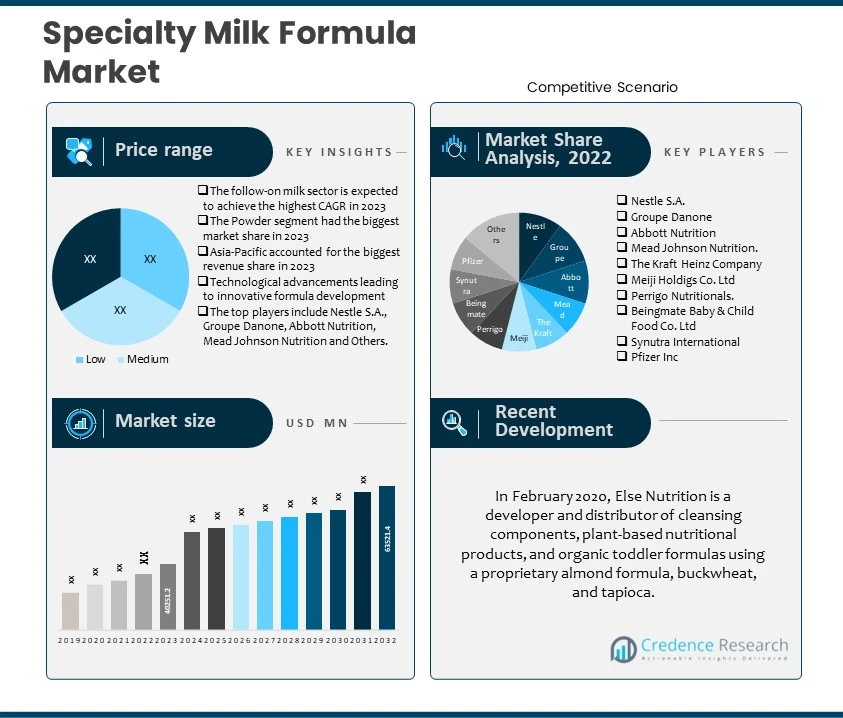
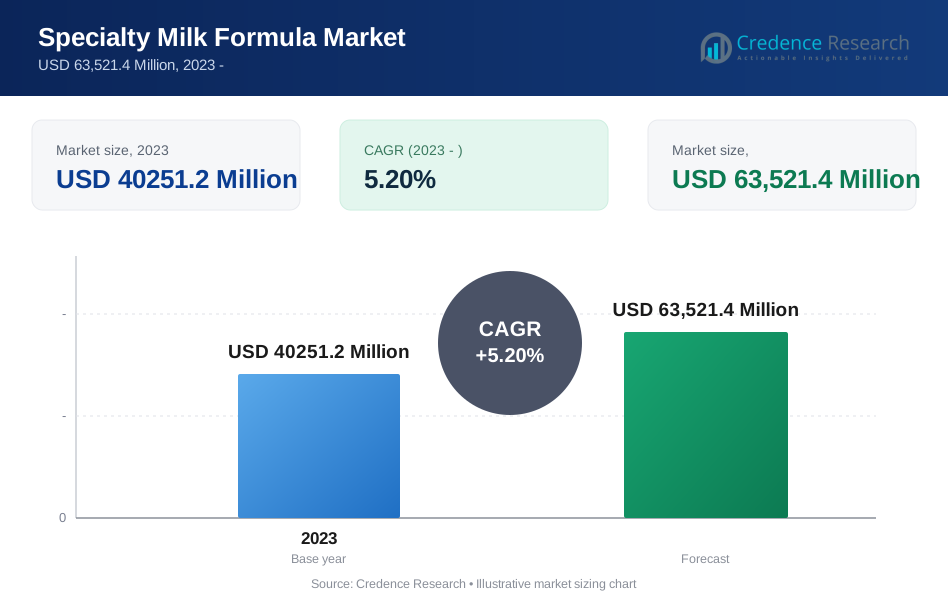
- The global demand for Specialty Milk Formula was valued at USD 40251.2 Million in 2023 and is expected to reach USD 63521.4 Million in 2032, growing at a CAGR of 5.20% between 2024 and 2032.
- In 2023, the infant milk formula sector had the biggest revenue share, while the follow-on-milk sector is expected to have the highest CAGR.
- In 2023, the Cow's Milk-Based Formulas segment stood for the most share, while the Soy-Based Formulas market is predicted to rise the fastest, at a CAGR of 7.9% between 2023 and 2032.
- Supermarkets and hypermarkets had the highest revenue share of 41% in 2023, while the specialty store segment is expected to expand the fastest throughout the projected period.
- The Powder segment had the largest market share in 2023, and the Ready-to-Drink (RTD) Liquid segment is predicted to grow the quickest with a CAGR of 7.7% over the forecast period.
- Asia-Pacific accounted for the biggest revenue share in 2023, accounting for 39%, while North American infant formula consumption is expected to expand during the projection period consistently.
- Hectic lifestyles, along with product improvements, have driven market expansion.
- Stringent laws and regulations, as well as safety concerns for new items, may limit market expansion.
Executive Summary
Market Definition
Specialty Milk Formula Market refers to the segment of the market that focuses on specialized milk formula products tailored for specific dietary needs or health conditions, such as lactose intolerance, allergies, or specific nutritional requirements. These formulas are designed to provide alternative options for individuals who cannot consume regular cow's milk or traditional formula due to various reasons. The market for specialty milk formula caters to a niche consumer base seeking specialized and tailored nutrition options.
Market Overview
The global Specialty Milk Formula Market has witnessed steady growth in recent years and is expected to grow at a CAGR of 5.20% between 2024 and 2032. The market was valued at USD 40251.2 million in 2023 and is expected to reach USD 63521.4 million in 2032.
The Specialty Milk Formula Market. It's all about the specialized nutrition products that people are so interested in, you know? The market is driven by rising demand for lactose-free and hypoallergenic formulas, indicating a growing customer preference for these distinct products. However, there are still hurdles ahead. Factors such as rigorous laws, high production costs, and restricted availability in particular countries might slow market growth and make it difficult to address the needs of all customer segments successfully. Despite these challenges, the sector offers a lot of opportunity and excitement to individuals active in the industry. It's a dynamic industry that is constantly evolving to satisfy the different needs of consumers seeking specific milk formulas.
Additionally, a rising number of working mothers around the world have urged infant milk manufacturers to provide nutrient-dense supplements to meet the need for convenient nutrition. At the same time, businesses are using environmentally friendly packaging materials, which has enhanced the growth prospects of major companies.
Nestlé SA, Danone, and Abbott Nutrition are among the leading firms attempting to provide animal-free baby feeds with the same nutrients as breast milk. Stunting, malnutrition, and an increasing number of mothers unable to breastfeed have all contributed to an increase in global demand for infant formula.
Segmentation By Type of Formula
- The infant milk formula sector had the highest revenue share in 2023 and is predicted to dominate during the forecast period. The demand for infant formula is steadily increasing because it is one of the most important categories when there are no acceptable alternatives on the market. The restricted supply of convenient and nutrient-rich food has led to the development of novel items in the market. The expanding prosperity of customers for their infants is reflected in the broad selection of baby formulae available on the market.
- The follow-on-milk sector is predicted to see the highest CAGR in the global market in additional milk processing to replicate the nutritional function of breast milk partly because of its high protein, calcium, and iron content, as well as the rising infant formula market.
Segmentation By Ingredient Type
- In 2023, the Cow's Milk-Based Formulas segment accounted for the biggest share. It is due to the widespread acceptance of cow's milk, which provides everything nutritionally and is regarded by the FDA as the "gold standard." Furthermore, cow's milk nutritional components have become more similar to breast milk. Furthermore, the production process has been fairly simple, with few change inline assembly. Finally, cow's milk is now being marketed as having been derived from pasture-raised cows, which are GMO-free.
- However, the Soy-Based Formulas market is expected to expand the fastest, at a CAGR of 7.9% from 2023 to 2032. Cow's milk has mostly been associated with the development of lactose intolerance in babies.
Segmentation by Distribution Channel
- The supermarkets and hypermarkets segment had the biggest revenue share of 41% in 2023. The market has seen rapid demand through supermarket and hypermarket channels. Separate sections for babies, product bundles, programs, discounts, offers, and pleasant shopping experiences for shoppers under one roof have increased the footfall for infant formula, which is contributing to the growth of the total market. In terms of value sales.
- However, the specialty shop segment is predicted to grow the fastest during the forecast period. This is because the store provides a diverse selection of baby replacements and other infant care products on a single platform, as well as a convenient way for customers to purchase from specialty retailers.
Segmentation by Packaging Type
- The Powder segment had the biggest market share in 2023. It is due to the age-old supremacy and ease with which the formula is manufactured. It is inexpensive and environmentally friendly because it is served in reusable boxes and takes up little space.
- However, the Ready-to-Drink (RTD) Liquid segment is expected to expand the fastest, with a CAGR of 7.7% over the forecast period of 2023-2032. It is due to the convenience with which the formula may be supplied and is also regarded the most sanitary method.
Segmentation by Region
- Asia-Pacific area accounted for the greatest revenue share in 2023, accounting for 39% in 2023.
- North American infant formula demand is predicted to increase steadily over the forecast period.
- The rest of the world, including Latin America, the Middle East, and Africa, supplies the remaining demand for Specialty Milk Formula.
In 2023, Asia-Pacific accounted for the biggest revenue share. The APAC market is primarily driven by increasing demand resulting from growing birth rates in countries like China and India. Furthermore, domestic industry and a larger reliance on imports are being driven by rising demand for growth, quality, and higher premiums. The presence of China, the world's largest consumer of baby and infant food products, contributes to market growth. Furthermore, China's intention to eliminate the "one-child" policy and expand the birth rate is projected to boost market growth.
Moreover, during the projection period, demand for North American infant formula is expected to increase steadily. Additionally, the United States is predicted to contribute the majority of infant formula sales in this region. The rising demand for organic baby formula has prompted large corporations to increase production, facilitating an increase in demand across the country. The increase in the number of women joining the workforce, as well as the demand for nutritious infant food, are driving growth in this region.
Key Highlights of the Report
Type of Formula, Ingredient Type, Distribution Channel, Packaging Type and region segment the global Specialty Milk Formula Market. The infant milk formula sector had the largest revenue share in 2023, while the follow-on milk sector is expected to have the highest CAGR in the global market. Furthermore, the specialty shop sector is anticipated to develop the fastest during the forecast period, while the Powder segment held the largest market share and Asia Pacific leading the market growth.
The Specialty Milk Formula Market is being driven by rising consumer awareness and interest for specialized nutrition products, indicating a growing trend toward tailored dietary options. Furthermore, technological developments in formula creation and the expansion of product offerings specialized to certain health problems are critical drivers driving the market's growth. In addition, regulatory constraints, high production costs, and limited market access in particular locations are the market barriers.
In 2023, Asia-Pacific had the highest revenue share. The APAC market is primarily driven by increased demand as birth rates rise in countries like as China and India. Furthermore, during the forecast period, demand for North American infant formula is predicted to rise continuously. Additionally, the United States is expected to contribute the majority of infant formula sales in this region.
What Are The Main Drivers Of The Global Specialty Milk Formula Market?
The Specialty Milk Formula Market is being propelled by the increasing demand for lactose-free and hypoallergenic formulas, reflecting a growing consumer preference for specialized nutrition products. Additionally, the expansion of product offerings to meet diverse dietary needs and technological advancements leading to innovative formula development are driving market growth.
What Are The Major Challenges Faced By The Global Specialty Milk Formula Market?
Despite its growth potential, the Specialty Milk Formula Market faces challenges such as stringent regulations, high production costs, and limited availability in certain regions. These factors may hinder the market's expansion and pose obstacles to meeting the needs of all consumer segments effectively.
What Are The Growth Opportunities In The Global Specialty Milk Formula Market?
Amidst these challenges, there are significant opportunities for the Specialty Milk Formula Market. These include the potential for market players to capitalize on the rising focus on infant health and nutrition, as well as to develop new formulations to address emerging dietary trends. Moreover, the increasing consumer awareness and demand for specialized nutrition products present a promising opportunity for market growth and innovation in the coming years.
Market Drivers
Several factors drive the global Specialty Milk Formula Market. The following are the key drivers of the global Specialty Milk Formula Market:
Hectic lifestyles combined with product innovations to drive market growth.
Various variables, such as changing consumer lifestyles, rising spending power, and an increase in female employment, have all had a favorable impact on the market during the last few decades. Many urban residents are unable to manage or monitor their children's dietary needs accurately. A busy lifestyle is a primary contributor to individuals failing to care for their newborns, which has a negative long-term impact on the babies' health. As a result, many millennial consumers seek easy choices for meeting their baby's nutritional needs. The product's convenience appeals to parents, driving product demand. Danone S.A., a French multinational food-products manufacturing corporation, will develop a dairy and plant blend baby formula in August 2022 to address parents' demand for vegetarian and flexitarian options for their babies. The formula provides 60% plant-based protein and 40% dairy-based protein, which combines nutrients present in both plants and breast milk.
Growing investment by top players in R&D for novel goods is projected to have a beneficial impact on worldwide market growth. For instance, in October 2022, Abbott Laboratories, an American nutrition food manufacturing corporation, spent USD 500 million to build a new manufacturing plant in the United States to create baby and toddler formula.
Market Restraints
The global Specialty Milk Formula Market faces some challenges that may hinder its growth. These include the following:
Stringent rules and regulations and safety concerns related to new products may impede market growth
The rigorous laws and regulations governing the launch of new items, as well as the complicated procedure of registering new products, are expected to impede market growth. Reckitt Benckiser released a press release in February 2023 announcing the recall of 145,000 cans of Enfamil ProSobee Based Infant Formula due to the risk of cross-contamination with Cronobacter sakazakii. This lethal infection caused the baby formula crisis last year, in 2022.
Dozens of news outlets covered this as a breaking story, advising parents and caregivers to discard the products or return them for a refund. Thus, safety concerns about formulation are projected to impede market expansion.
Opportunities
The global Specialty Milk Formula Market offers significant growth opportunities. These include the following:
Rising awareness of the need of early nutrition for newborns' appropriate growth and development
The increased understanding of the need of early nutrition for newborns' healthy growth and development bodes well for market expansion. Adequate nutrition during infancy and early childhood is critical to ensuring children's optimal growth, health, and development. Furthermore, inadequate nutrition in children can result in vitamin A deficiency, weakened immune systems, and an increased risk of blindness.
As a result, parents prioritize better diet and health-promoting goods for their children. Furthermore, because plant items have a higher nutritional value, young parents prefer them. Furthermore, the flourishing e-commerce business is driving up sales of such products through online channels.
Bobbie Labs, the R&D center for the formula brand Bobbie, released a new infant formula in March 2023: Bobbie Organic Gentle, an American-made, EU-style organic product with 100% lactose, a major carbohydrate found in breast milk that gives energy to stimulate growth.
Competitive Landscape
Key Players
The global Specialty Milk Formula Market is highly competitive, with several key players. Some of the major players in the market and their market share are as follows:
- Nestle S.A.
- Groupe Danone
- Abbott Nutrition
- Mead Johnson Nutrition.
- The Kraft Heinz Company
- Meiji Holdigs Co. Ltd
- Perrigo Nutritionals.
- Beingmate Baby & Child Food Co. Ltd
- Synutra International
- Pfizer Inc
These organizations prioritize product innovation, distribution channel expansion, and mergers and acquisitions to stay competitive.
The global Specialty Milk Formula Market's key players continually seek to stay ahead by offering new products and developments.
In October 2022, Else Nutrition Holdings Inc. opened its flagship Chinese store on Tmall Global in September and is now offering Else Nutrition Toddler Formula and Baby Cereal directly to Chinese consumers. Else's entry into the Chinese market marks the company's third foreign market.
In September 2022, Nestlé discovered a nutritious blend of components found in breast milk called myelin and introduced Nutrilearn Connect, an infant formula containing the breakthrough ingredient, in Hong Kong before spreading into other markets.
In August, 2019, Danone Nutricia, a Danone SA brand, has developed Karicare Toddler using New Zealand sheep's milk in New Zealand.
In January 2019, Arla Foods Elements, a subsidiary of Arla Foods amba, has launched a safe food for infants.
Summary of Key Findings
- Growing awareness of the need of early feeding for neonates' proper growth and development.
- Market segmented By Type of Formula, Ingredient Type, Distribution Channel, Packaging Type and region.
- The Soy-Based Formulas market is the fastest, CAGR.
- The Powder segment had the largest market share in 2023
- Asia Pacific is leading in market growth; the market is highly competitive with key players, including Nestle S.A., Groupe Danone, Abbott Nutrition, Mead Johnson Nutrition and Others.
Future Outlook
- Increased demand for lactose-free and hypoallergenic formulas
- Growing consumer awareness and preference for specialized nutrition products
- Expansion of product offerings to cater to diverse dietary needs
- Technological advancements leading to innovative formula development
- Rising focus on infant health and nutrition driving market growth
How CXOs Can Benefit from the Credence Research Specialty Milk Formula Market Report
The Credence Research Specialty Milk Formula Market Report provides CXOs with a comprehensive overview of the market, including:
- Market size and growth forecast: The report provides detailed estimates of the global Specialty Milk Formula Market size, segmented By Type of Formula, Ingredient Type, Distribution Channel, Packaging Type and region. It also includes forecasts for the market through 2032 based on key trends and drivers.
- Market segmentation: The report segments the Specialty Milk Formula Market By Type of Formula, Ingredient Type, Distribution Channel, Packaging Type and region. This segmentation provides CXOs with a granular understanding of the market and the opportunities in each segment.
- Competitive Landscape: The report profiles the key players in the Specialty Milk Formula Market and provides insights into their strategies, product offerings, and financial performance. This information can help CXOs to identify and assess their competition.
- Key trends and drivers: The report identifies and analyzes the key trends and drivers that are shaping the Specialty Milk Formula Market. This information can help CXOs to make informed decisions about their investments and strategies.
CXOs can use the insights from the Credence Research Specialty Milk Formula Market Report to:
- Identify growth opportunities: The report can help CXOs to identify new growth opportunities in the Specialty Milk Formula Market. For example, by analyzing the data and trends in the report, they can make informed decisions on where to invest and expand their business.
- Make informed investment decisions: The report can help CXOs make informed investment decisions about Specialty Milk Formula. For example, by diving into the insights and trends within the report, they can strategically allocate resources and capitalize on the right opportunities in the market.
- Develop competitive strategies: The report can help CXOs develop competitive strategies for their Specialty Milk Formula businesses. For example, by delving into the insights and trends within the report, they can strategically position themselves in the market and stay ahead of the competition..
- Track market developments: The report can help CXOs monitor market developments and stay ahead of the curve. For example, it provides insights into the latest trends and innovations in the Specialty Milk Formula Market.
Overall, the Credence Research Specialty Milk Formula Market Report is a valuable resource for CXOs who are looking to gain a deeper understanding of the market and identify opportunities for growth.
Segmentation
- By Type of Formula:
- Infant Formula
- Follow-On Formula
- Toddler Formula
- Specialty Formula
- By Ingredient Type:
- Cow's Milk-Based Formulas
- Soy-Based Formulas
- Hydrolyzed Protein Formulas
- Specialized Nutrient Formulas
- By Distribution Channel:
- Supermarkets and Hypermarkets
- Pharmacies and Drugstores
- Online Retailers
- Specialty Stores
- Others
- By Packaging Type:
- Powder
- Liquid Concentrate
- Ready-to-Drink (RTD) Liquid
- By Region
- North America
- The U.S.
- Canada
- Mexico
- Europe
- Germany
- France
- The U.K.
- Italy
- Spain
- Rest of Europe
- Asia Pacific
- China
- Japan
- India
- South Korea
- South-east Asia
- Rest of Asia Pacific
- Latin America
- Brazil
- Argentina
- Rest of Latin America
- Middle East & Africa
- GCC Countries
- South Africa
- Rest of the Middle East and Africa
- North America
Request a Free Sample
Fill in your details and we'll send you a free sample report.
- Sample data tables & charts
- Research methodology
Need a Custom Version of This Report?
Tailor the scope, geography, or segments to your exact requirements.
- Custom geography or segment scope
- Direct access to our analyst team
Frequently Asked Questions
What is the current size of the global Specialty Milk Formula Market?
What is the expected growth rate of the Specialty Milk Formula Market between 2024 and 2032?
What is the Forecast period considered for Specialty Milk Formula Market ?
Which Ingredient Type segment governs the demand for Specialty Milk Formulas in the world?
Who are the major players in the global Specialty Milk Formula Market?
Table of Content
Chapter 1. Report Introduction
- 1.1 Report Description & Purpose
- 1.1.1 Report Title & Market Definition
- 1.1.2 Unique Selling Propositions (USP) & Key Differentiators
- 1.1.3 Value Proposition for Stakeholders
- 1.2 Research Objectives
- 1.2.1 Market Sizing Objectives (Volume & Revenue)
- 1.2.2 Segmentation Objectives
- 1.2.3 Competitive Intelligence Objectives
- 1.2.4 Forecast & Scenario Objectives
- 1.3 Report Scope
- 1.3.1 Specialty Milk Formula Scope – Types & Subtypes Covered
- 1.3.2 Geographic Scope – Regions & Countries Covered
- 1.3.3 Historical Period, Base Year & Forecast Period (2023; forecast to the forecast period)
- 1.3.4 Inclusions & Exclusions
- 1.4 HS Code & Classification Framework
- 1.5 Currency, Units & Pricing Basis
- 1.6 Target Stakeholders
- 1.7 Limitations & Assumptions
Chapter 2. Executive Summary
- 2.1 Global Specialty Milk Formula Market Snapshot
- 2.1.1 Market Size – Historical (2023) & Forecast (the forecast period) (2023: USD 40251.2 Million → forecast year: USD 63,521.4 Million)
- 2.1.2 Volume & Revenue – Global Totals
- 2.1.3 Key Market Highlights – Top Five Facts
- 2.2 Specialty Milk Formula Market Segmentation Snapshot
- 2.2.1 Market Split by Region – 2023 vs.
- 2.3 Competitive Snapshot
- 2.3.1 Top 10 Players by Revenue Share – 2023
- 2.3.2 Top 10 Players by Volume Share – 2023
- 2.3.3 Recent Strategic Developments (18-Month Summary)
- 2.4 Key Investment Highlights & Strategic Conclusions
Chapter 3. Specialty Milk Formula Market Dynamics & Industry Analysis
- 3.1 Market Overview & Context
- 3.1.1 Specialty Milk Formula Market Position in the Broader Automotive Value Chain
- 3.1.2 OEM vs. Replacement Market Dynamics
- 3.1.3 Market Maturity & Development Stage by Region
- 3.2 Specialty Milk Formula Market Drivers
- 3.3 Specialty Milk Formula Market Restraints & Challenges
- 3.4 Specialty Milk Formula Market Opportunities
- 3.5 Porter's Five Forces Analysis
- 3.5.1 Threat of New Entrants
- 3.5.2 Bargaining Power of Suppliers
- 3.5.3 Bargaining Power of Buyers
- 3.5.4 Threat of Substitutes
- 3.5.5 Competitive Rivalry – Intensity Assessment
- 3.6 Specialty Milk Formula Value Chain Analysis
- 3.6.1 Upstream – Raw Material/Input Suppliers
- 3.6.1.1 Raw Material/Input 1
- 3.6.1.2 Raw Material/Input 2
- 3.6.1.3 Raw Material/Input 3
- 3.6.2 Midstream – Production/Manufacturing/Service Delivery
- 3.6.2.1 Production/Process Overview
- 3.6.2.2 Key Facility Locations & Capacity by Manufacturer
- 3.6.3 Downstream – Distribution & End Consumer
- 3.6.3.1 Primary Channel – B2B/OEM
- 3.6.3.2 Secondary Channels – Dealer, Retail, Online, Direct
- 3.6.4 Value Chain Profitability Analysis
- 3.6.1 Upstream – Raw Material/Input Suppliers
- 3.7 PESTEL Analysis
- 3.7.1 Political Factors
- 3.7.2 Economic Factors
- 3.7.3 Social Factors
- 3.7.4 Technological Factors
- 3.7.5 Environmental Factors
- 3.7.6 Legal Factors
- 3.8 Specialty Milk Formula Supply Chain Analysis
- 3.8.1 Raw Material/Input Supply Risk Assessment
- 3.8.2 Manufacturing Concentration Risk (Geographic Exposure)
- 3.8.3 Trade Disruption Impact Analysis
- 3.9 Regulatory & Policy Landscape
Note: The regulatory and policy landscape section covers regulations based on their applicability to the market, Specialty Milk Formula category, geography, and scope of the study. Only regulatory frameworks with a material impact on operations, compliance, trade, sustainability, or market access are analyzed in detail.
Chapter 4. Key Investment Pockets & Opportunity Analysis
- 4.1 Specialty Milk Formula Market Attractiveness Analysis
- 4.1.1 By Region – Investment Attractiveness Matrix (Volume × CAGR)
- 4.2 Absolute Revenue Growth Opportunity
- 4.2.1 By Region – Absolute USD Growth Through the forecast period
- 4.3 Incremental Volume Opportunity
- 4.3.1 By Region – Incremental Volume Through the forecast period
- 4.3.2 Segment – Incremental Volume
- 4.4 Emerging Submarket Opportunity Deep Dive (Subject to Applicability)
- 4.5 Emerging Market Opportunity Scorecards
- 4.5.1 United States
- 4.5.2 Europe
- 4.5.3 Asia
- 4.5.4 Middle East & Africa
Note: Emerging Market Opportunity Scorecards will be included based on relevance and strategic importance. Regions listed are indicative and may vary depending on data availability and market dynamics.
Chapter 5. Specialty Milk Formula Import-Export Analysis & Trade Flows
- 5.1 Global Trade Overview
- 5.1.1 Global Export Value by Country (2023)
- 5.1.2 Global Export Volume by Country (2023)
- 5.1.3 Global Import Value by Country (2023)
- 5.1.4 Global Import Volume by Country (2023)
- 5.1.5 Net Trade Balance by Country (2023)
- 5.2 Export Analysis – Segment
- 5.2.1 Type 1 (HS Code)
- 5.2.2 Type 2 (HS Code)
- 5.2.3 Type 3 (HS Code)
- 5.2.4 Type 4 (HS Code)
- 5.2.5 Type 5 (HS Code)
- 5.3 Import Analysis – Segment
- 5.3.1 Type 1 (HS Code)
- 5.3.2 Type 2 (HS Code)
- 5.3.3 Type 3 (HS Code)
- 5.3.4 Type 4 (HS Code)
- 5.3.5 Type 5 (HS Code)
- 5.4 Average Unit Trade Prices
- 5.4.1 Average Export Price – Segment & Country
- 5.4.2 Average Import Price – Segment & Source Country
- 5.4.3 Price Trends (2023)
- 5.5 Key Trade Route Analysis
- 5.5.1 Trade Route 1
- 5.5.2 Trade Route 2
- 5.5.3 Trade Route 3
- 5.5.4 Trade Route 4
- 5.5.5 Trade Route 5
- 5.6 Trade Policy Impact Assessment
- 5.6.1 US Anti-Dumping & Section 301 Tariffs
- 5.6.2 EU Customs Union Impact
- 5.6.3 Major Free Trade Agreements
- 5.6.4 USMCA Rules of Origin
Note: Trade policy analysis will be included only where relevant to the Specialty Milk Formula market.
Chapter 6. Competitive Landscape & Company Benchmarking
- 6.1 Specialty Milk Formula Market Concentration & Structure
- 6.1.1 Herfindahl-Hirschman Index (HHI) – vs. 2023
- 6.1.2 Tier 1, Tier 2 & Tier 3 Market Structure
- 6.1.3 Global, Regional & Local Player Dynamics
- 6.2 Specialty Milk Formula Market Share Analysis – 2023
- 6.2.1 Global Revenue Share by Company
- 6.2.2 Global Volume Share by Company
- 6.2.3 Regional Revenue Share
- 6.2.4 Market Share Evolution ( vs. 2023)
- 6.2.5 OEM Segment Share by Company
- 6.2.6 Replacement Segment Share by Company
- 6.3 Production/Delivery Capacity & Facility Analysis
- 6.3.1 Global Installed Capacity
- 6.3.2 Capacity Utilization Rates
- 6.3.3 Production/Output Volume
- 6.3.4 Facility Locations & Capacity Map
- 6.3.5 Planned Capacity Additions
- 6.4 Specialty Milk Formula Competitive Benchmarking Matrix
- 6.4.1 Revenue, Volume, CAGR & Profitability Comparison
- 6.4.2 Channel Revenue Mix
- 6.4.3 Geographic Revenue Exposure
- 6.4.4 R&D Intensity
- 6.4.5 Sustainability Maturity
- 6.5 Strategic Developments in Specialty Milk Formula (Last 24 Months)
- 6.5.1 Mergers, Acquisitions & Divestments
- 6.5.2 New Specialty Milk Formula Launches
- 6.5.3 Facility Expansions
- 6.5.4 Strategic Alliances, Joint Ventures & Partnerships
- 6.5.5 Distribution Expansion & Market Entry
- 6.5.6 Sustainability & ESG Initiatives
- 6.6 Competitive Strategy Mapping
- 6.6.1 Leader, Challenger, Follower & Niche Classification
- 6.6.2 Pricing Strategy Comparison
- 6.6.3 Channel Strategy Matrix
Note: Strategic developments are included based on their materiality and the availability of reliable information.
Chapter 7. Global Specialty Milk Formula Market – By Distribution Channel
- 7.1 Segment Overview
- 7.1.1 Volume & Revenue Split by Channel (2023 & )
- 7.1.2 Channel Mix Evolution (the forecast period)
Chapter 8. Regional Market Analysis – Global Overview
- 8.1 Global Regional Overview
- 8.1.1 Regional Volume Share
- 8.1.2 Regional Revenue Share
- 8.1.3 Regional Volume by Region
- 8.1.4 Regional Revenue by Region
- 8.1.5 Regional Forecast Through the forecast period
- 8.2 Cross-Regional Segment Analysis
- 8.2.1 By Distribution Channel
- 8.2.2 By Brand/Price Tier
Chapter 9. North America Specialty Milk Formula Market
- 9.1 United States
- 9.2 Canada
- 9.3 Mexico
Chapter 10. Europe Specialty Milk Formula Market
- 10.1 Germany
- 10.2 France
- 10.3 Italy
- 10.4 United Kingdom
- 10.5 Spain
- 10.6 Poland
- 10.7 Russia
- 10.8 Netherlands
- 10.9 Belgium
- 10.10 Sweden
- 10.11 Denmark
- 10.12 Norway
- 10.13 Rest of Europe
Chapter 11. Asia Pacific Specialty Milk Formula Market
- 11.1 China
- 11.2 India
- 11.3 Japan
- 11.4 South Korea
- 11.5 Thailand
- 11.6 Indonesia
- 11.7 Vietnam
- 11.8 Malaysia
- 11.9 Australia
- 11.10 Rest of Asia Pacific
Chapter 12. Latin America Specialty Milk Formula Market
- 12.1 Brazil
- 12.2 Argentina
- 12.3 Colombia
- 12.4 Chile
- 12.5 Rest of Latin America
Chapter 13. Middle East Specialty Milk Formula Market
- 13.1 Saudi Arabia
- 13.2 United Arab Emirates
- 13.3 Turkey
- 13.4 Israel
- 13.5 Iran
- 13.6 Rest of the Middle East
Chapter 14. Africa Specialty Milk Formula Market
- 14.1 South Africa
- 14.2 Egypt
- 14.3 Nigeria
- 14.4 Morocco
- 14.5 Rest of Africa
Chapter 15. Specialty Milk Formula Company Profiles
- 15.1 [Company 01]
- 15.1.1 Company Overview
- 15.1.2 Key Management Personnel
- 15.1.3 Products & Services Portfolio
- 15.1.4 Financial Performance
- 15.1.5 Key Market Focus & Geographic Presence
- 15.1.6 Recent Developments & Strategic Initiatives
Note: The company profile list is preliminary and may change based on research findings, market developments, data availability, and client requirements.
Chapter 16. Appendices
- Appendix A – List of Abbreviations & Acronyms
- Appendix B – Industry Classification Code Reference – Full Series
- Appendix C – Production & Capacity Data Tables
- Appendix D – End-Use & Demand Base Tables
- Appendix E – Consumption & Replacement Rate Assumptions
- Appendix F – ASP Reference Tables
- Appendix G – Manufacturing & Facility Database
- Appendix H – Import-Export Data Tables
- Appendix I – Regulatory Summary Tables
- Appendix J – Primary Research Participant List (Anonymized)
- Appendix K – Primary Research Questionnaire Framework
- Appendix L – Data Sources & Bibliography
- Appendix M – Market Size Divergence & Source Comparison
Chapter 17. Research Methodology
- 17.1 Research Framework & Philosophy
- 17.2 Secondary Research – Sources, Hierarchy & Data Extraction
- 17.3 Data Modeling – Bottom-Up & Top-Down Market Sizing
- 17.4 Primary Research – Stakeholder Framework, LOI & Sample Sizes
- 17.5 Forecast Methodology – Regression, Scenario & Sensitivity Analysis
- 17.6 Quality Control – Four-Layer Validation Framework
- 17.7 Limitations & Standard Assumptions
- 17.8 Disclaimer
