| REPORT ATTRIBUTE | DETAILS |
|---|---|
| Historical Period | 2019-2022 |
| Base Year | 2023 |
| Forecast Period | 2024-2032 |
| Spirulina Extract Market Size 2023 | USD 525.2 Million |
| Spirulina Extract Market, CAGR | 10.60% |
| Spirulina Extract Market Size 2032 | USD 1300.5 Million |
Market Insights
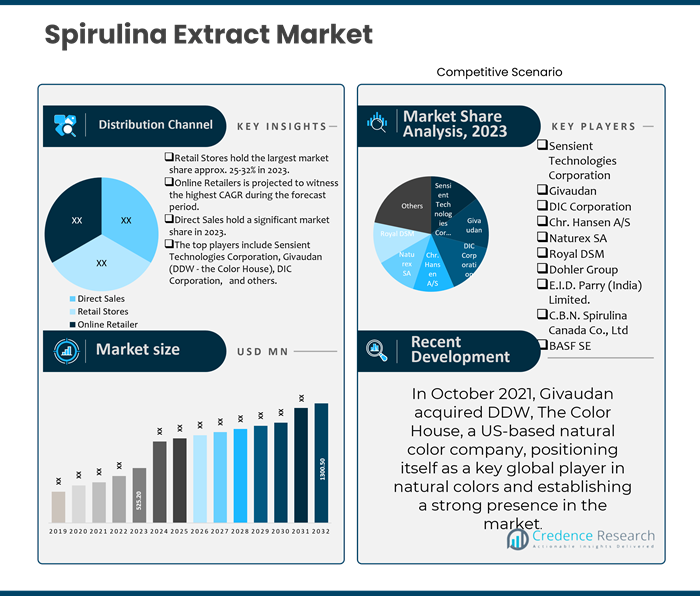
- The Spirulina Extract Market attained a valuation of USD 525.2 Million in 2023 and is anticipated to escalate to USD 1300.5 Million by 2032, exhibiting a robust CAGR of 10.60% during the forecast period from 2024 to 2032.
- Among the key segments, the powder segment currently holds the largest market share by product type, approximately 60-62% in 2023, owing to its use in various applications like nutritional dietary supplements, meals, and liquids. Liquid spirulina extract is projected to witness the highest CAGR during the forecast period due to its growing popularity, specifically in the cosmetics and personal care industries.
- Food and Beverages currently dominate the market by end-use industry, holding approximately 30-35% market share in 2023, driven by the rich nutritional profile of spirulina. Cosmetics and Personal Care is projected to witness the highest CAGR during the forecast period due to its antimicrobial, antioxidant, and anti-inflammatory properties.
- Spirulina Extracts hold the largest market share by formulation, approximately 50-55% in 2023, due to their wider applicability in diverse industries. Blends and Formulations are projected to witness the highest CAGR during the forecast period due to simplified production processes and consistent quality control.
- Retail Stores hold the largest market share by distribution channel, approximately 25-32% in 2023, driven by pharmacies, grocery chains, health meal stores, and departmental outlets. Online Retailers are projected to witness the highest CAGR during the forecast period due to ease of buying, price transparency, a wide range of choices, and doorstep delivery services.
- Asia Pacific held the largest market share, around 38-42% in 2023, driven by cutting-edge technology, large-scale cultivation, increasing domestic consumption, and the presence of key market players. North America and Europe collectively accounted for just under 55% share in 2023, with Asia Pacific holding over 20% share in the same year.
- Technological advancements in the manufacturing process, stringent regulatory frameworks encouraging the adoption of herbal and organically extracted elements in numerous industrial verticals, and the increasing demand for dietary supplements and cosmetic industries are primary drivers of market growth.
Executive Summary
Market Definition
The global spirulina extract market encompasses the commercial production, distribution, and utilization of extracts derived from spirulina, a sort of blue-green algae recognized for its rich nutritional profile and health advantages. Spirulina extract is commonly used as a herbal colorant in meals and liquids, owing to its colorful blue pigment, phycocyanin. The marketplace is driven by increasing customer demand for natural and smooth-label merchandise, heightened consciousness of the health benefits related to spirulina, and its programs in numerous sectors, together with dietary supplements, prescription drugs, and cosmetics. Major challenges include high manufacturing charges, stringent regulatory requirements, and the need for sustainable cultivation practices. Leading gamers in the market are investing in research and improvement to decorate extraction approaches and enlarge software regions, further fueling the market boom. Overall, the global spirulina extract market is poised for steady expansion, pushed by tendencies favoring natural and fitness-oriented products.
Market Overview
The Spirulina Extract Market has exhibited steady growth and is anticipated to maintain a robust Compound Annual Growth Rate (CAGR) of 10.60% from 2024 to 2032. Valued at USD 525.2 million in 2023, this market is forecasted to reach USD 1300.5 million by 2032.
The key driver boosting the growth rate of the Spirulina Extract Market is the increasing awareness of health and wellness among consumers, coupled with the rising demand for natural and clean-label products. Spirulina extract, known for its rich nutritional profile and health benefits, is utilized in various sectors such as dietary supplements, pharmaceuticals, and cosmetics, driving market expansion.
Furthermore, the expansion of the Spirulina Extract Market is actively driven by government initiatives promoting sustainable cultivation practices and the growing demand for eco-friendly ingredients. The market is expected to grow significantly during the forecast period due to technological advancements in extraction processes and the increasing popularity of plant-based products.
In addition, the Spirulina Extract Market is poised for growth due to the adoption of various strategies among market players, including research and development investments, mergers, acquisitions, and partnerships, to enhance extraction techniques and expand application areas. These factors create numerous opportunities for the Spirulina Extract Market to expand during the forecast period.
Segmentation by Product Type:
- The powder segment currently holds the largest market share approx. 60-62% in 2023 owing to its use in various applications like nutritional dietary supplements, meals, and liquids.
- Liquid is projected to witness the highest CAGR during the forecast period due to its growing popularity, specifically in the cosmetics and personal care industries. Liquid spirulina extract may additionally offer better absorption and easier incorporation into formulations, making it appealing for producers trying to create revolutionary products.
Segmentation by End-Use Industry
- Food and Beverages currently hold the largest market share approx. 30-35% in 2023. Spirulina is widely known for its wealthy dietary profile containing proteins, vitamins, minerals, carotenoids, and antioxidants. Adding spirulina extract to practical meals and drinks enhances their standard nutrition content material and appeals to increasingly health-conscious clients who are trying to find clean-label, plant-based totally, and sustainable options.
- Cosmetics and Personal Care is projected to witness the highest CAGR during the forecast period. Its antimicrobial, antioxidant, and anti-inflammatory houses make it appropriate for application in diverse beauty and private care merchandise, from lotions and creams to shampoos and conditioners.
Segmentation by Formulation
- Spirulina Extracts hold the largest market share approx. 50-55% in 2023 owing to wider applicability in diverse industries.
- Blends and Formulations is projected to witness the highest CAGR during the forecast period. Blends and formulations make production processes simpler than earlier as they guarantee steady quality control throughout manufacturing.
Segmentation by Distribution Channel
- Retail Stores hold the largest market share approx. 25-32% in 2023. Retail shops include pharmacies, grocery chains, health meal stores, and departmental outlets dealing with both branded and unbranded spirulina extracts.
- Online Retailers are projected to witness the highest CAGR during the forecast period owing to its ease of buying, more rate transparency, full-size range of choices, and doorstep shipping services.
Segmentation by Region
- Asia Pacific held the largest share around 38-42% of the market in 2023. Cutting-edge technology, large-scale cultivation, increasing domestic consumption, and the presence of key market players are key factors driving the growth of the spirulina Extract market in Asia Pacific.
- North America and Europe collectively account for just under 55% share in 2023, with Asia Pacific holding over 20% share in the same year.
- The rest of the world, including Latin America, the Middle East, and Africa, supplies the remaining demand for Spirulina Extract.
Technological advancements in the manufacturing process, and stringent regulatory frameworks encouraging the adoption of herbal and organically extracted elements in numerous industrial verticals are also contributing to the market growth.
The Asia Pacific region holds the largest market share in the Spirulina Extract market. The first reason is that countries in Asia such as China and India have large amounts of spirulina extracts grown which provide a cheap source of raw materials for its production hence lower prices for consumers. The increasing demand for dietary supplements and cosmetic industries in the region also facilitates market growth. Furthermore, compared with developed countries, labor is cheaper for producers located within the APAC region. Moreover, rising personal incomes and increased expenditure on healthcare have provided the Asia Pacific with the resources necessary to opt for comprehensive life approaches focusing on health and diet, hence making it possible for spirulina extracts to blend well into human diets.
The Europe region witnesses significant growth in the Spirulina Extract market. This growth can be attributed to several key factors such as rapid advancements in pharmaceuticals, cosmetics, and personal care industry and and technology adoption driven the regional growth. Moreover, countries like France and the United Kingdom stand out as the major markets for spirulina. Therefore, minimally processed foods with an improved aesthetic look are gaining more favor among customers, and spirulina, alongside other clean-label ingredients, has taken advantage of such developments to record a positive market performance.
Key Highlights of the Report
The Spirulina Extract Market is segmented by product type, end-use industry, formulation, distribution channel, and region. The powder segment holds the largest market share by product type, particularly in applications like nutritional dietary supplements, meals, and liquids, while Retail Stores dominate in terms of distribution channels. Food and Beverages hold the largest market share by end-use industry, driven by the rich nutritional profile of spirulina, while Asia Pacific holds the largest regional share, attributed to large-scale cultivation and increasing domestic consumption.
One of the main factors driving the Spirulina Extract Market is the increasing awareness of health and wellness among consumers, coupled with the rising demand for natural and clean-label products. The versatility of spirulina extract, extending beyond dietary supplements to pharmaceuticals, cosmetics, and personal care products, also contributes significantly to market expansion. Additionally, technological advancements in the manufacturing process and stringent regulatory frameworks encouraging the adoption of herbal and organically extracted elements further drive market growth.
Nonetheless, Asia Pacific is expected to hold the largest share of the Spirulina Extract Market due to large-scale cultivation, increasing domestic consumption, and government initiatives promoting health and diet. Furthermore, the market is projected to witness the highest growth rate in Europe, driven by advancements in pharmaceuticals, cosmetics, and personal care industries, and technological adoption.
Key players such as Sensient Technologies Corporation, Givaudan (DDW - the Color House), DIC Corporation- Earthrise Nutritionals, and others focus on product innovation and strategic collaborations to maintain their market position and competitiveness in the Spirulina Extract industry.
What Are The Main Drivers Of The Global Spirulina Extract Market?
The global spirulina extract market is driven by various factors such as increasing awareness of health and wellness among consumers, demand for natural and clean-label products, and rising popularity of plant-based products. Moreover, spirulina extract's versatility extends its packages past dietary supplements and practical ingredients to prescription drugs, cosmetics, and personal care products further driving the market growth.
What Are The Major Challenges Faced By The Global Spirulina Extract Market?
The global spirulina extract market is mainly challenged by fierce competition among key players, high production costs such as cultivating and processing of spirulina are limiting its affordability and great use. Along with this, regulatory hurdles such as strict policies on meals and dietary supplements can complicate marketplace entry and compliance. Moreover, maintaining constant excellence and purity in spirulina merchandise is tough because of environmental factors, and competition from synthetic alternatives hindered the market growth.
What Are The Growth Opportunities In The Global Spirulina Extract Market?
The global spirulina extract market presents numerous growth opportunities such as innovations in product development such as developing new formulations and delivery methods, along with ready-to-drink liquids and fortified snacks drive the market growth. Sustainability and environmental benefits highlighting the eco-friendly factors of spirulina cultivation can attract environmentally conscious customers and buyers. In addition, the adoption of various strategies among market players creates significant opportunities for the market.
Market Drivers
Rising Popularity Of Plant-Based Products
The rising popularity of plant-based products drives the global Spirulina Extract market. Spirulina is rich in protein, vitamins, antioxidants, and minerals, making it an attractive alternative for non-meat-eaters, such as vegetarians, vegans, or flexitarians. Various companies use spirulina extract’s natural properties to produce sustainable items free from allergens and with clean labels for every conscientious shopper. Making use of spirulina extract’s potential, interested parties introduce themselves to the contemporary plant-based movement to further drive market growth.
Market Restraints
High Production Costs Such As Cultivating And Processing Spirulina
The Spirulina Extract market is primarily constrained by high production costs such as cultivating and processing of spirulina. The reason is that the cultivation of spirulina demands specific nutrients, controlled environments, and accurate conditions to be maintained which results in costly affairs and thus can only attract high-end consumers. As a result, its processing into extract goes through complicated procedures with tight quality restrictions hence making the prices high due to the use of expensive methods. Moreover, maintaining consistent quality and regulatory hurdles increases the overall prices.
Opportunities
Adoption Of Various Strategies Among Market Players
The adoption of various strategies among market players creates significant opportunities for the market. The major companies serving the global Spirulina Extract Market are Sensient Technologies Corporation, Dohler Group, GNT, and Naturex SA., among others. The market players are considerably contributing to the market growth by the adoption of various strategies including mergers & acquisitions, collaborations, funding, and new product launches, approvals to stay competitive in the market. For instance, in November 2022, GNT, a color supplier, obtained FDA approval for the use of spirulina extract in beverages, allowing manufacturers to achieve vibrant blue shades while maintaining a clean label. This approval is significant in meeting the rising consumer interest in spirulina, which has grown substantially over the past decade.
Competitive Landscape
Key Players
The global Spirulina Extract market is highly competitive, with several key players. Some of the major players in the market and their market share are as follows:
- Sensient Technologies Corporation
- Givaudan (DDW - the Color House)
- DIC Corporation- Earthrise Nutritionals
- Chr. Hansen A/S
- Naturex SA
- Royal DSM
- Dohler Group
- E.I.D. Parry (India) Limited.
- C.B.N. Spirulina Canada Co., Ltd
- BASF SE
- Others
These organizations prioritize product innovation, distribution channel expansion, and mergers and acquisitions to stay competitive.
The global Spirulina Extract market's key players continually seek to stay ahead by offering new products and developments.
In October 2021, Givaudan acquired DDW, The Color House, a US-based natural color company, positioning itself as a key global player in natural colors and establishing a strong presence in the market. This strategic move aligns with Givaudan's 2025 strategy to enhance its portfolio within the Taste & Wellbeing sector, emphasizing its commitment to natural color solutions and multi-sensorial food experiences consumers love.
In June 2019, Naturex significantly expanded its production capacity of spirulina and introduced the Ultimate Spirulina collection, extracted in France, to meet the increasing global demand for clean label blue and green food colorings.
Summary of Key Findings
- The Spirulina Extract Market is experiencing significant growth, driven by the increasing awareness of health and wellness among consumers and the rising demand for natural and clean-label products. This growth is further fueled by technological advancements in extraction processes and the expanding application areas of spirulina extract.
- Market segmentation within the Spirulina Extract Market encompasses product type, end-use industry, formulation, distribution channel, and region, reflecting the diverse applications of spirulina extract across various industries and regions.
- Powder emerges as the dominant segment in product type, offering versatile applications in nutritional dietary supplements, meals, and liquids, while Retail Stores lead the distribution channel segment, providing accessibility to consumers.
- Food and Beverages hold the largest market share by end-use industry, driven by the rich nutritional profile of spirulina, while Asia Pacific leads the market in terms of region, attributed to large-scale cultivation and increasing domestic consumption.
- Asia Pacific held the largest market share, around 38-42% in 2023, driven by cutting-edge technology, large-scale cultivation, and increasing domestic consumption.
Future Outlook
- The future outlook for the Spirulina Extract Market indicates promising growth opportunities, particularly within blends and formulations and online retail distribution, driven by innovations in product development and increasing consumer demand for sustainable and eco-friendly products.
- Anticipated challenges include fierce competition among key players, stringent regulatory frameworks, and the need for sustainable cultivation practices. To maintain market competitiveness, industry players should focus on continuous innovation, strategic collaborations, and regulatory compliance.
- Companies need to prioritize research and development efforts to meet evolving consumer preferences and technological advancements. Additionally, exploring opportunities in emerging markets and leveraging advanced technologies, such as sustainable extraction methods, will be crucial for sustained growth in the Spirulina Extract Market.
How CXOs Can Benefit from the Credence Research Spirulina Extract Market Report
The Credence Research Spirulina Extract Market Report provides CXOs with a comprehensive overview of the market, including:
- Market size and growth forecast:The report provides detailed estimates of the global Spirulina Extract market size, segmented by product type, end-use industry, formulation, distribution channel, and region. It also includes forecasts for the market through 2032, based on key trends and drivers.
- Market segmentation:The report segments the Spirulina Extract market product type, end-use industry, formulation, distribution channel, and region. The increasing demand for advanced solutions is driven. This segmentation provides CXOs with a granular understanding of the market and the opportunities in each segment.
- Competitive Landscape:The report profiles the key players in the Spirulina Extract market and provides insights into their strategies, product offerings, and financial performance. This information can help CXOs to identify and assess their competition.
- Key trends and drivers:The report identifies and analyzes the key trends and drivers that are shaping the Spirulina Extract market. This information can help CXOs to make informed decisions about their investments and strategies.
CXOs can use the insights from the Credence Research Spirulina Extract Market Report to:
- Identify growth opportunities:The report can help CXOs identify new growth opportunities in the Spirulina Extract market. For example, the report identifies the growing demand for Patient Infotainment terminal networks from cloud computing providers and telecom companies as a key opportunity.
- Make informed investment decisions:The report can help CXOs make informed investment decisions about Patient Infotainment terminal networks. For example, the report provides insights into the key factors to consider when evaluating Spirulina Extract providers and selecting Spirulina Extract solutions.
- Develop competitive strategies:The report can help CXOs to develop competitive strategies for their Spirulina Extract businesses. For example, the report identifies the key strategies that Patient Infotainment terminal providers are using to differentiate themselves from their competitors.
- Track market developments:The report can help CXOs track market developments and stay ahead of the curve. For example, the report provides insights into the latest trends and innovations in the Spirulina Extract market.
Overall, the Credence Research Spirulina Extract Market Report is a valuable resource for CXOs who are looking to gain a deeper understanding of the market and identify growth opportunities.
Segmentation
-
Product Type:
- Powder
- Liquid
-
End-Use Industry:
- Food and Beverages:
- Functional Foods
- Beverages
- Nutraceuticals
- Pharmaceuticals
- Cosmetics and Personal Care
- Animal Feed
- Food and Beverages:
-
Formulation:
- Spirulina Extracts
- Blends and Formulations
-
Distribution Channel:
- Direct Sales
- Retail Stores
- Online Retailers
-
By Region
- North America
- US
- Canada
- Mexico
- Europe
- Germany
- France
- UK.
- Italy
- Spain
- Rest of Europe
- Asia Pacific
- China
- Japan
- India
- South Korea
- South-east Asia
- Rest of Asia Pacific
- Latin America
- Brazil
- Argentina
- Rest of Latin America
- Middle East & Africa
- GCC Countries
- South Africa
- Rest of Middle East and Africa
- North America
Adjacent Markets
In the Spirulina Extract market, several adjacent markets have high revenue growth opportunities. The key adjacent markets for the Spirulina Extract market -
Adjacent Markets |
||
| Functional Foods and Beverages Market | Cosmetics and Personal Care Market | Animal Feed Market |
| Dietary Supplements Market | Pharmaceuticals Market | Aquaculture Market |
| Natural Colorants Market | Plant-Based Protein Market | Nutraceuticals Market |

Request a Free Sample
Fill in your details and we'll send you a free sample report.
- Sample data tables & charts
- Research methodology
Market Dynamics
Rising Popularity of Plant-Based Products
Spirulina extract is rich in protein, vitamins, and minerals, making it highly attractive for plant-based diets. Its use as a natural, allergen-free ingredient supports the growing consumer shift toward vegetarian, vegan, and flexitarian lifestyles.
Demand for Natural and Clean-Label Ingredients
Consumers are increasingly seeking products with natural colorants and clean-label claims. Spirulina extract, especially its phycocyanin pigment, is favored as a natural alternative to synthetic additives in foods, beverages, and cosmetics.
Expansion in Functional Foods and Nutraceuticals
The health benefits of spirulina, including antioxidant and anti-inflammatory properties, are driving its adoption in functional foods, dietary supplements, and nutraceuticals, supporting market growth.
Technological Advancements in Extraction and Cultivation
Innovations in spirulina cultivation and extraction processes are improving yield, quality, and cost-effectiveness, making spirulina extract more accessible for diverse industrial applications.
Government Initiatives and Regulatory Support
Policies promoting sustainable agriculture and the use of herbal, organically extracted ingredients are encouraging manufacturers to adopt spirulina extract, especially in Asia Pacific where large-scale cultivation is supported.
Need a Custom Version of This Report?
Tailor the scope, geography, or segments to your exact requirements.
- Custom geography or segment scope
- Direct access to our analyst team
Frequently Asked Questions
What is the current size of the global Spirulina Extract market?
What is the expected growth rate of the Spirulina Extract market between 2024 and 2032?
Which segment is leading the market share in terms of Product Type?
Which End-user Industry segments govern the demand for Spirulina Extract in the world?
Which Formulation segment is expected to post the highest CAGR during the forecast period?
Which region is fueling the growth of the Spirulina Extract industry?
Who are the major players in the global Spirulina Extract market?
What are the major market drivers of the Spirulina Extract industry?
What are the major market restraints of the Spirulina Extract industry?
What are the major market opportunities of the Spirulina Extract industry?
Table of Content
Chapter 1 Market Segmentation
- 1.1 Segmentation Framework
- 1.1.1 Product and Service Classification
- 1.1.2 Application and End-Use Classification
- 1.1.3 Technology and Solution Classification
- 1.1.4 Customer and Distribution Channel Classification
- 1.1.5 Geographic Segmentation
- 1.1.6 Market Segment Definitions and Boundaries
- 1.2 By Formulation
- 1.2.1 Spirulina Extracts
- 1.2.2 Blends and Formulations
- 1.3 By Product Type
- 1.3.1 Powder
- 1.3.2 Liquid
- 1.4 By End-Use Industry
- 1.4.1 Food and Beverages
- 1.4.2 Nutraceuticals
- 1.4.3 Pharmaceuticals
- 1.4.4 Cosmetics and Personal Care
- 1.4.5 Animal Feed
Chapter 2 Introduction
- 2.1 Report Objectives and Scope
- 2.2 Product Definition and Industry Terminology
- 2.3 Market Inclusions and Exclusions
- 2.4 Research Process
- 2.4.1 Primary Research and Expert Interviews
- 2.4.2 Secondary Research and Source Review
- 2.4.3 Top-Down and Bottom-Up Estimation
- 2.4.4 Data Triangulation and Verification
- 2.5 Market Size Measurement Basis
- 2.5.1 2023: USD 525.2 Million → 2032: USD 1,300.5 Million
- 2.6 Historical and Forecast Reference Periods
- 2.6.1 Base Year: 2023
- 2.6.2 Forecast Period: 2023-2032
- 2.7 Research Assumptions and Limitations
Chapter 3 Executive Summary
- 3.1 Market Snapshot and Key Findings
- 3.2 Base-Year Market Size, 2023
- 3.3 Forecast Market Size, 2032
- 3.4 Revenue and Volume Growth Outlook
- 3.5 Key Demand and Supply Indicators
- 3.6 Leading Market Segments
- 3.7 Fastest-Growing Market Opportunities
- 3.8 Regional Performance Highlights
- 3.9 Technology and Industry Transformation
- 3.10 Competitive Landscape Summary
- 3.11 Analyst View and Strategic Implications
Chapter 4 Global Spirulina Extract Market Trends and Developments
- 4.1 Historical Industry Development
- 4.2 Recent Market Trends and Developments
- 4.3 Demand and Customer Behavior Trends
- 4.4 Technology and Product Innovation
- 4.5 Artificial Intelligence, Automation and Digitalization
- 4.6 Local Manufacturing and Supply Chain Realignment
- 4.7 Industry Partnerships, Mergers and Acquisitions
- 4.8 Sustainability and Circular Economy Developments
- 4.9 Government and Private Sector Investment Trends
- 4.10 Emerging Business Models and Commercialization
- 4.11 Industry Developments and Announcements
Chapter 5 Global Spirulina Extract Market Production, Supply and Demand Analysis
- 5.1 Demand Trend and Consumption Analysis
- 5.2 Demand Forecast, 2023-2032
- 5.3 Production and Output Trend
- 5.4 Production and Output Forecast, 2023-2032
- 5.5 Installed Capacity and Capacity Utilization
- 5.6 Company-Wise Production Plants and Statistics
- 5.6.1 Installed Production Capacity
- 5.6.2 Actual Production
- 5.6.3 Planned Capacity and Expansion Targets
- 5.7 Supply Chain Structure and Procurement Trends
- 5.8 Supply-Demand Gap and Bottlenecks
- 5.9 Import Dependence and Sourcing Structure
- 5.10 Contract Manufacturing and Outsourcing
- 5.11 Regional Supply and Demand Concentration
Chapter 6 Global Spirulina Extract Market Pricing Analysis
- 6.1 Pricing Structure and Measurement
- 6.2 Historical Pricing Trends
- 6.3 Pricing Outlook, 2023-2032
- 6.4 Average Selling Price and Unit Economics
- 6.5 Pricing by Product and Market Segment
- 6.6 Geographic Pricing Differences
- 6.7 Key Input, Energy, Labor and Logistics Costs
- 6.8 Contract Pricing and Purchasing Models
- 6.9 Pricing Sensitivity and Competitive Positioning
- 6.10 Price, Margin and Profitability Implications
Chapter 7 Global Spirulina Extract Market Dynamics
- 7.1 Market Growth Drivers
- 7.1.1 Demand-Side Drivers
- 7.1.2 Technology and Innovation Drivers
- 7.1.3 Infrastructure and Investment Drivers
- 7.1.4 Regulatory and Policy Drivers
- 7.2 Market Restraints
- 7.2.1 Cost and Affordability Constraints
- 7.2.2 Technology and Adoption Barriers
- 7.2.3 Supply Chain and Operational Constraints
- 7.3 Market Challenges
- 7.3.1 Competitive Pressure and Margin Erosion
- 7.3.2 Skills, Infrastructure and Implementation Gaps
- 7.4 Emerging Market Opportunities
- 7.5 Market Dynamics Impact and Time-Horizon Assessment
Chapter 8 Global Spirulina Extract Value Chain Analysis
- 8.1 Industry Value Chain Overview
- 8.2 Upstream Suppliers and Critical Inputs
- 8.3 Technology and Component Providers
- 8.4 Manufacturing or Service Delivery
- 8.5 Distribution, Channel Partners and Integrators
- 8.6 Downstream Applications and End Users
- 8.7 Value Addition and Profit Pools
- 8.8 Vertical Integration and Outsourcing
- 8.9 Supplier Concentration and Risk
- 8.10 Supply Chain Localization and Resilience
Chapter 9 Global Spirulina Extract Market Regulations and Policies
- 9.1 Relevant Laws, Standards and Compliance Frameworks
- 9.2 Product, Service, Safety and Quality Requirements
- 9.3 Government Policies, Incentives and Subsidies
- 9.4 Imports, Exports and Trade Barriers
- 9.5 Public Procurement and Local Content Requirements
- 9.6 Environmental and Sustainability Compliance
- 9.7 Upcoming Policy Changes and Market Implications
Chapter 10 Global Spirulina Extract Market Hotspots and Opportunities
- 10.1 Market Opportunity Mapping and Growth Hotspots
- 10.2 High-Growth Applications and Customer Groups
- 10.3 Underserved Markets and White-Space Opportunities
- 10.4 Emerging Technology and Product Opportunities
- 10.5 New Capacity and Investment Hotspots
- 10.6 Market Entry and Expansion Opportunities
- 10.7 Distribution and Partnership Opportunities
- 10.8 Near-Term and Long-Term Commercial Potential
- 10.9 Opportunity Attractiveness and Execution Risks
Chapter 11 Global Spirulina Extract Market Outlook, 2023-2032
- 11.1 Market Size and Analysis
- 11.1.1 Revenue (Market Measurement: 2023: USD 525.2 Million → 2032: USD 1,300.5 Million)
- 11.1.2 Market Volume and Quantity Sold
- 11.1.3 Historical Market Size
- 11.1.4 Base-Year Market Size, 2023
- 11.2 Market Forecast, 2023-2032
- 11.2.1 Revenue Forecast to 2032
- 11.2.2 Volume Forecast to 2032
- 11.2.3 CAGR and Year-on-Year Growth
- 11.2.4 Incremental Revenue Opportunity
- 11.3 Forecast Assumptions and Scenario Analysis
- 11.3.1 Base-Case Forecast
- 11.3.2 Optimistic and Conservative Scenarios
- 11.3.3 Technology, Pricing and Policy Sensitivities
- 11.4 Market Attractiveness and Growth Outlook
Chapter 12 Global Spirulina Extract Market Segmentation and Outlook
- 12.1 Segmentation Summary and Market Shares, 2023
- 12.2 Largest and Fastest-Growing Segments
- 12.3 By Formulation - Market Size and Forecast, 2023-2032
- 12.3.1 Segment Definition and Scope
- 12.3.2 Historical Market Size
- 12.3.3 Revenue Forecast, 2023-2032
- 12.3.4 Volume Forecast, 2023-2032
- 12.3.5 Base-Year Market Share, 2023
- 12.3.6 Segment CAGR and Growth Drivers
- 12.3.7 Subsegment Market Size and Forecast
- 12.3.7.1 Spirulina Extracts
- 12.3.7.2 Blends and Formulations
- 12.3.8 Subsegment Pricing and Adoption Trends
- 12.3.9 Leading Suppliers and Competition
- 12.3.10 Regional Demand and Opportunities
- 12.4 By Product Type - Market Size and Forecast, 2023-2032
- 12.4.1 Segment Definition and Scope
- 12.4.2 Historical Market Size
- 12.4.3 Revenue Forecast, 2023-2032
- 12.4.4 Volume Forecast, 2023-2032
- 12.4.5 Base-Year Market Share, 2023
- 12.4.6 Segment CAGR and Growth Drivers
- 12.4.7 Subsegment Market Size and Forecast
- 12.4.7.1 Powder
- 12.4.7.2 Liquid
- 12.4.8 Subsegment Pricing and Adoption Trends
- 12.4.9 Leading Suppliers and Competition
- 12.4.10 Regional Demand and Opportunities
- 12.5 By End-Use Industry - Market Size and Forecast, 2023-2032
- 12.5.1 Segment Definition and Scope
- 12.5.2 Historical Market Size
- 12.5.3 Revenue Forecast, 2023-2032
- 12.5.4 Volume Forecast, 2023-2032
- 12.5.5 Base-Year Market Share, 2023
- 12.5.6 Segment CAGR and Growth Drivers
- 12.5.7 Subsegment Market Size and Forecast
- 12.5.7.1 Food and Beverages
- 12.5.7.2 Nutraceuticals
- 12.5.7.3 Pharmaceuticals
- 12.5.7.4 Cosmetics and Personal Care
- 12.5.7.5 Animal Feed
- 12.5.8 Subsegment Pricing and Adoption Trends
- 12.5.9 Leading Suppliers and Competition
- 12.5.10 Regional Demand and Opportunities
- 12.6 Segment Growth Comparison
- 12.7 Segment Attractiveness and Priority Matrix
Chapter 13 Global Spirulina Extract End-Use and Application Market Outlook
- 13.1 End-Use Industry and Customer Demand Structure
- 13.2 Leading Applications and Customer Groups
- 13.3 End-Use Market Size, Share and Forecast
- 13.4 Major End-Use Industry Deep Dives
- 13.4.1 Customer Requirements and Use Cases
- 13.4.2 Demand and Replacement Cycles
- 13.4.3 Technical and Regulatory Considerations
- 13.4.4 Purchasing and Procurement Models
- 13.4.5 Leading Vendors and Distribution Channels
- 13.4.6 Forecast and Commercial Opportunities
- 13.5 Emerging Applications and Cross-Segment Demand
- 13.6 End-Use Industry Investment Priorities
Chapter 14 Global Spirulina Extract Geographic Market Outlook, 2023-2032
- 14.1 Regional Market Size and Share, 2023
- 14.2 Regional Market Forecast, 2023-2032
- 14.3 Regional Pricing, Production and Demand Differences
- 14.4 North America
- 14.4.1 United States
- 14.4.2 Canada
- 14.4.3 Mexico
- 14.5 Europe
- 14.5.1 Germany
- 14.5.2 France
- 14.5.3 Italy
- 14.5.4 United Kingdom
- 14.5.5 Spain
- 14.5.6 Poland
- 14.5.7 Russia
- 14.5.8 Netherlands
- 14.5.9 Belgium
- 14.5.10 Sweden
- 14.5.11 Denmark
- 14.5.12 Norway
- 14.5.13 Rest of Europe
- 14.6 Asia Pacific
- 14.6.1 China
- 14.6.2 India
- 14.6.3 Japan
- 14.6.4 South Korea
- 14.6.5 Thailand
- 14.6.6 Indonesia
- 14.6.7 Vietnam
- 14.6.8 Malaysia
- 14.6.9 Australia
- 14.6.10 Rest of Asia Pacific
- 14.7 Latin America
- 14.7.1 Brazil
- 14.7.2 Argentina
- 14.7.3 Colombia
- 14.7.4 Chile
- 14.7.5 Rest of Latin America
- 14.8 Middle East
- 14.8.1 Saudi Arabia
- 14.8.2 United Arab Emirates
- 14.8.3 Turkey
- 14.8.4 Israel
- 14.8.5 Iran
- 14.8.6 Rest of the Middle East
- 14.9 Africa
- 14.9.1 South Africa
- 14.9.2 Egypt
- 14.9.3 Nigeria
- 14.9.4 Morocco
- 14.9.5 Rest of Africa
- 14.10 Regional Investment, Policy and Supply Chain Differences
- 14.11 Regional Competitive Landscape
- 14.12 Geographic Growth Hotspots
Chapter 15 Global Spirulina Extract Technology, Innovation and Sustainability Outlook
- 15.1 Technology Landscape and Maturity
- 15.2 Product, Process and Service Innovation
- 15.3 AI, Automation and Digital Tools in the Industry
- 15.4 Technology Adoption and Performance Benchmarking
- 15.5 Innovation Pipeline and R&D Investment
- 15.6 Patent and Intellectual Property Trends
- 15.7 Energy Efficiency and Resource Management
- 15.8 Sustainability, Recycling and Circularity
- 15.9 Technology Roadmap, 2023-2032
- 15.10 Risks of Obsolescence and Technology Substitution
Chapter 16 Global Spirulina Extract Market Key Strategic Imperatives
- 16.1 Growth and Market Entry Priorities
- 16.2 High-Return Products and Segments
- 16.3 Pricing, Profitability and Cost Optimization
- 16.4 Technology Investment and Product Differentiation
- 16.5 Supply Chain Localization and Resilience
- 16.6 Distribution and Customer Acquisition
- 16.7 Partnership, Acquisition and Capacity Strategy
- 16.8 Regional Expansion Priorities
- 16.9 Short-, Medium- and Long-Term Actions
Chapter 17 Competition Outlook
- 17.1 Industry Competition Characteristics
- 17.2 Market Structure and Concentration
- 17.3 Market Share and Competitive Positioning, 2023
- 17.4 Company-Wise Revenue and Product Benchmarking
- 17.5 Production and Service Capacity Benchmarking
- 17.6 Technology, Pricing and Differentiation
- 17.7 Regional Footprint and Distribution Strength
- 17.8 Mergers, Acquisitions and Strategic Alliances
- 17.9 New Entrants and Competitive Threats
- 17.10 Porter's Five Forces and Industry Attractiveness
- 17.11 Competitive Outlook, 2023-2032
Chapter 18 Company Profiles
- 18.1 Company Coverage and Selection Criteria
- 18.2 Sensient Technologies Corporation
- 18.2.1 Business Description
- 18.2.2 Company Ownership and Geographic Presence
- 18.2.3 Product and Service Portfolio
- 18.2.4 Manufacturing and Operating Footprint
- 18.2.5 Production Capacity and Expansion Plans
- 18.2.6 Financial Performance and Investment
- 18.2.7 Market Share and Competitive Position
- 18.2.8 Technology and Innovation Capabilities
- 18.2.9 Strategic Alliances or Partnerships
- 18.2.10 Recent Developments
- 18.2.11 Growth Strategy and Outlook
- 18.3 Givaudan (DDW - the Color House)
- 18.4 DIC Corporation - Earthrise Nutritionals
- 18.5 Chr. Hansen A/S
- 18.6 Naturex SA
- 18.7 Royal DSM
- 18.8 Dohler Group
- 18.9 E.I.D. Parry (India) Limited
- 18.10 C.B.N. Spirulina Canada Co., Ltd
- 18.11 BASF SE
- 18.12 Other Relevant Market Participants
Note: Every listed company is profiled on the structure shown under the first company. The company list is preliminary and may change based on research findings, market developments, data availability and client requirements.
Chapter 19 Disclaimer
- 19.1 Research and Forecast Disclaimer
- 19.2 Data Source and Estimation Limitations
Note: The depth of individual sections depends on data availability for this market. Volume, capacity, trade and other unit-based metrics are included where applicable.