
| REPORT ATTRIBUTE | DETAILS |
|---|---|
| Historical Period | 2019-2022 |
| Base Year | 2023 |
| Forecast Period | 2024-2032 |
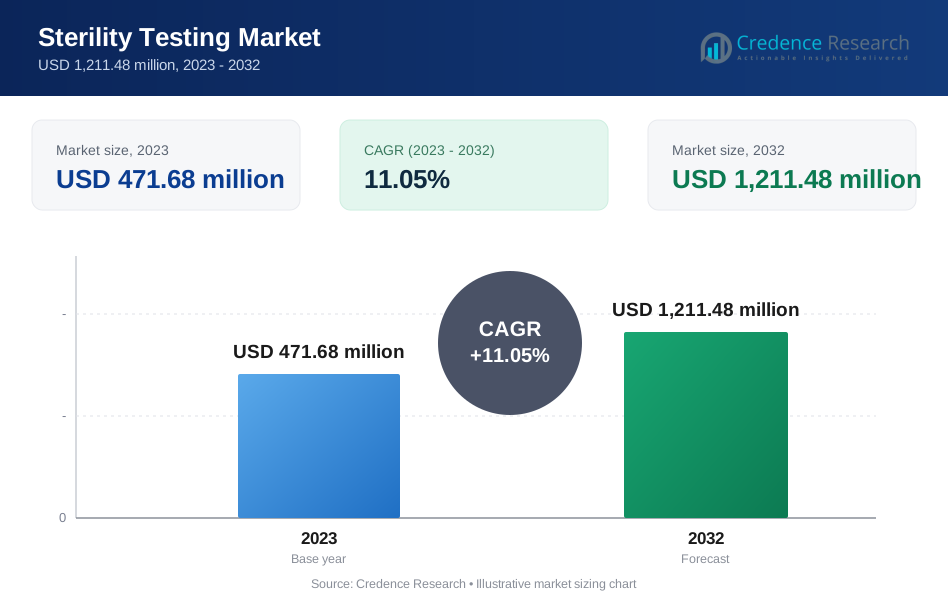
| Sterility Testing Market Size 2023 | USD 471.68 Million |
| Sterility Testing Market, CAGR | 11.05% |
| Sterility Testing Market Size 2032 | USD 1,211.48 Million |
Market Overview
The Sterility Testing Market is projected to grow from USD 471.68 million in 2023 to an estimated USD 1,211.48 million by 2032, reflecting a compound annual growth rate (CAGR) of 11.05% from 2024 to 2032. This robust growth trajectory is primarily driven by the increasing demand for sterility testing across pharmaceutical and biotechnology sectors due to stringent regulations and quality standards.
Market drivers include the growing demand for biopharmaceuticals, heightened focus on product safety, and rigorous regulatory requirements to maintain sterility standards. Innovations and trends in rapid microbial testing methods and advanced technologies to detect contaminants have further propelled market expansion. Continuous investments in research and development, alongside a strong inclination towards automation, are transforming sterility testing practices, offering accuracy and time efficiency for end-users.
Geographically, North America holds a prominent market share due to a well-established healthcare infrastructure, strong R&D spending, and a high concentration of key market players. Europe follows closely, driven by stringent regulatory guidelines and a growing emphasis on drug safety. The Asia-Pacific region is expected to witness the highest growth due to expanding pharmaceutical manufacturing capabilities and rising healthcare investments. Key players driving the market include Charles River Laboratories, Merck KGaA, bioMérieux SA, Sartorius AG, and Thermo Fisher Scientific, among others, who are focused on innovation and strategic partnerships to strengthen their market presence.
Market Drivers
Rising Demand for Biopharmaceuticals and Sterile Products
The exponential growth in the demand for biopharmaceuticals, including vaccines, cell and gene therapies, and biologics, has created a need for stringent sterility testing to ensure patient safety and therapeutic efficacy. Biopharmaceutical products require robust sterility measures due to their complex production processes and heightened susceptibility to contamination. With increasing R&D activities and investments in these fields, pharmaceutical companies are placing greater emphasis on ensuring the sterility and safety of their products. Moreover, the surge in the global demand for sterile drugs and injectable formulations—particularly during and post the COVID-19 pandemic—has further driven the growth of sterility testing protocols to meet international regulatory standards, thereby significantly boosting the market. For instance, there are currently over 5,000 biopharmaceutical products in the development pipeline, with more than 1,500 of these being follow-on biopharmaceuticals such as biosimilars and biogenerics. This vast pipeline underscores the growing need for stringent sterility testing to ensure product safety.
Stringent Regulatory Requirements and Quality Control Standards
The sterility testing market is heavily driven by strict regulatory mandates from bodies such as the U.S. Food and Drug Administration (FDA), European Medicines Agency (EMA), and other regional regulatory authorities. These organizations enforce stringent standards and guidelines for sterility testing to ensure that pharmaceuticals, biologics, and medical devices meet uncompromised safety and efficacy requirements before reaching patients. As part of Good Manufacturing Practices (GMP), manufacturers must ensure rigorous sterility testing protocols are applied at different production stages to detect microbial contamination. The demand to comply with these guidelines not only underscores the necessity of robust sterility testing solutions but also fuels the development and adoption of rapid microbial testing techniques and advanced sterility testing technologies, thereby propelling market growth.
Technological Advancements and Innovations in Sterility Testing
The sterility testing market has experienced significant growth due to continuous technological advancements and the introduction of automated and rapid sterility testing solutions. Traditional sterility testing methods often involve lengthy and labor-intensive processes, whereas the emergence of automation, advanced microbial detection technologies, and real-time monitoring tools has drastically reduced testing time and increased precision and reliability. Innovations such as membrane filtration, direct inoculation methods, and rapid microbial detection systems, including ATP bioluminescence and PCR-based assays, are being increasingly integrated into testing workflows. These innovations enable faster release of safe products, which is critical for pharmaceutical and biopharmaceutical manufacturers, thereby contributing to market expansion and driving competition among industry players.
Growing Biologics Production and Expanding Pharmaceutical R&D Investments
The global rise in the production of biologics, including monoclonal antibodies, vaccines, and cell therapies, has augmented the demand for precise sterility testing to ensure safety, compliance, and effectiveness. Biologics production involves intricate processes and sensitive ingredients, making sterility testing indispensable. Furthermore, expanding investments in pharmaceutical research and development (R&D) across emerging markets have also led to a surge in drug discovery and manufacturing, thereby intensifying the need for sterility testing. Many pharmaceutical and biotech firms are channeling significant funds towards innovative product development, which requires stringent sterility testing protocols to meet regulatory standards. The increasing number of clinical trials, the introduction of new therapies, and the need to ensure compliance with global regulations further emphasize the role of sterility testing as a critical step in the drug development process, driving market demand on a global scale.
Market Trends
Shift Toward Rapid Microbial Testing Methods
A notable trend in the sterility testing market is the transition from traditional testing methods to rapid microbial testing technologies. Traditional methods often involve prolonged incubation times, which can delay product release. To address this challenge, companies are adopting rapid microbial testing solutions such as PCR-based assays, bioluminescence, fluorescence-based methods, and other real-time detection technologies. These rapid methods significantly reduce the time needed to detect microbial contamination and enhance overall process efficiency. Such technological advancements cater to the rising demand for fast, accurate, and automated sterility testing solutions across pharmaceutical and biotechnology industries. In addition to accelerating product release times, rapid microbial methods provide greater sensitivity and reliability in detecting contaminants. This shift reflects a broader industry trend toward automation and real-time monitoring in sterility testing processes, driven by the need for higher productivity, reduced labor costs, and compliance with stringent regulatory standards.For instance, the Growth Direct® Rapid Sterility System can deliver time-to-detect results in as little as 12 hours, compared to the traditional 14-day incubation period, and provides final results within 1-3 days. This significantly accelerates the sterility testing process, allowing for faster product release and reducing potential bottlenecks in manufacturing. Similarly, Novartis implemented a rapid microbiological method that reduced incubation time to 5 days, which was validated and approved by regulatory bodies such as the FDA and EMA, further showcasing the industry's shift toward faster and more efficient sterility testing solutions.
Integration of Automation and AI-Driven Solutions
The integration of automation and artificial intelligence (AI) is gaining traction in the sterility testing market. Automation minimizes human error, ensures consistent testing results, and offers high throughput. Companies are increasingly utilizing automated systems, such as robotic arms and automated sampling instruments, to streamline sterility testing protocols and increase testing efficiency. AI-driven solutions are being explored for predictive analytics and real-time decision-making in sterility testing processes, enabling precise microbial identification and risk assessment. This trend is propelled by the growing complexity of pharmaceutical manufacturing and the need for stringent quality assurance to ensure product safety. As AI-driven automation solutions become more sophisticated, manufacturers can expect to see enhanced data-driven insights, optimized resource utilization, and improved compliance with regulatory standards. These innovations underscore the industry's focus on embracing cutting-edge technologies to achieve better accuracy, efficiency, and operational excellence in sterility testing.For instance, automated sterility testing systems like Becton Dickinson's BD Kiestra InoqulA+ have been shown to reduce manual intervention by up to 70%, increasing throughput while minimizing human error. Furthermore, AI-driven systems are being employed for real-time microbial identification with high accuracy rates, allowing manufacturers to make faster decisions based on predictive analytics.
Market Restraints and Challenges
High Costs and Complexity of Sterility Testing Procedures
One significant challenge for the sterility testing market is the high cost and complexity associated with advanced testing procedures. While innovative technologies like automated sterility testing systems, rapid microbial detection methods, and AI-driven solutions offer faster and more reliable results, they often require significant upfront investment. This cost barrier can be particularly challenging for small to mid-sized pharmaceutical and biotechnology companies with limited budgets. Furthermore, the complexity of integrating these sophisticated systems into existing manufacturing and quality assurance processes can be resource-intensive and require specialized expertise. The need for skilled personnel to operate advanced equipment and interpret complex data can further escalate operational costs, presenting a substantial restraint to market growth, particularly in emerging economies with limited access to such resources.
Stringent Regulatory Requirements and Compliance Challenges
Another major restraint in the sterility testing market stems from the stringent and evolving regulatory requirements imposed by global regulatory bodies, such as the U.S. Food and Drug Administration (FDA), European Medicines Agency (EMA), and other regional authorities. While these regulations are essential to ensure patient safety and product efficacy, compliance can be challenging for manufacturers due to the varying standards and expectations across different regions. Meeting these stringent requirements often entails rigorous testing, thorough documentation, and adherence to strict quality control measures, which can slow down product approvals and market entry. Any non-compliance or deviations during the sterility testing process can lead to product recalls, regulatory sanctions, or delayed launches, posing both reputational and financial risks for manufacturers. The need to keep up with changing regulatory landscapes while ensuring compliance adds complexity to the sterility testing process, creating a challenging environment for industry players to navigate.
Market Segmentation Analysis
By Type
The sterility testing market is segmented into in-house and outsourcing solutions, with the in-house segment dominating due to large pharmaceutical and biotechnology companies' preference for maintaining internal control over testing processes to ensure stringent compliance and quality standards. Meanwhile, the outsourcing segment is steadily growing as smaller and mid-sized companies turn to third-party providers to reduce infrastructure and operational costs. This trend is further driven by the availability of specialized contract research organizations (CROs) that offer expert services and faster testing turnaround times.
By Product
The sterility testing market is segmented by products into kits & reagents, instruments, and services. Kits & reagents hold a significant market share due to their extensive application in various testing methods such as membrane filtration and direct inoculation, with growing demand for ready-to-use, high-precision kits driving their expansion. Instruments are witnessing increasing adoption due to the demand for advanced, automated, and accurate testing solutions, supported by innovations in sterility testing technologies. Meanwhile, services, including contract testing and consulting, are growing rapidly as manufacturers opt for cost-effective, regulatory-compliant solutions, with outsourcing driven by the need for specialized expertise and quick turnaround times.
Segments
Based on type
- In-House
- Outsourcing
Based on product
- Kits & Reagents
- Instruments
- Services
Based on end user
- Pharmaceutical Companies
- Hospitals & clinics
- Academic
- Research Laboratories
- Others
Based on test
- Membrane filtration
- Direct transfer
Based on region
- North America
- U.S.
- Canada
- Mexico
- Europe
- Germany
- France
- U.K.
- Italy
- Spain
- Rest of Europe
- Asia Pacific
- China
- Japan
- India
- South Korea
- South-east Asia
- Rest of Asia Pacific
- Latin America
- Brazil
- Argentina
- Rest of Latin America
- Middle East & Africa
- GCC Countries
- South Africa
- Rest of the Middle East and Africa
Regional Analysis
North America (35%)
North America dominates the sterility testing market, accounting for approximately 35% of the global share. The region's leadership is driven by a well-established pharmaceutical industry, significant investments in biotechnology, and stringent regulatory standards set by agencies such as the U.S. Food and Drug Administration (FDA). These regulations mandate rigorous sterility testing procedures for pharmaceutical products, medical devices, and biologics, propelling demand for advanced sterility testing solutions. The presence of key market players, ongoing research and development, and a high rate of adoption of innovative testing technologies contribute to the region's robust market performance. Canada, in particular, is experiencing growth in its biotechnology sector, further boosting demand for sterility testing.
Europe (28%)
Europe holds a significant share of the sterility testing market, capturing approximately 28% of the total market. The region’s growth is attributed to stringent regulatory requirements enforced by the European Medicines Agency (EMA) and other regulatory bodies that mandate sterility testing for all pharmaceutical and medical device products. Countries such as Germany, the United Kingdom, and France are major contributors due to their strong pharmaceutical industries, substantial R&D investments, and a focus on ensuring high-quality standards. Increasing demand for biologics, coupled with advancements in sterility testing technologies, further fuels market expansion in Europe. Additionally, the presence of key market players and active collaboration between academia and industry supports growth.
Key players
- SA of France
- Thermo Fisher Scientific
- Merck KGaA
- Sartorius AG
- WuXi AppTec
- Astell Scientific
- Bio Labs Inc
- Bioquel
Competitive Analysis
The sterility testing market is highly competitive, with key players focusing on innovation, strategic partnerships, and expanding their product portfolios to maintain a strong market position. Companies such as Thermo Fisher Scientific and Merck KGaA lead the market with their extensive range of products, innovative technologies, and strong global presence. Sartorius AG and WuXi AppTec emphasize providing cutting-edge sterility testing solutions tailored to customer needs and market demands, particularly in the biopharmaceutical sector. Astell Scientific and Bio Labs Inc. focus on providing specialized instruments and services for sterility testing, leveraging niche expertise. Bioquel adds competitive value with its emphasis on quality and compliance solutions. The competitive landscape is shaped by technological advancements, service expansions, and increased emphasis on regulatory compliance, fostering continuous growth and heightened competition among major players.
Recent Developments
- In October 2024, Thermo Fisher opened a new sterile drug facility in Singapore, designed to provide rapid vaccine fill-finish capabilities and support end-to-end pharmaceutical manufacturing in the Asia-Pacific region.
- In September 2024, Merck opened a new €290 million biosafety testing facility in Rockville, Maryland, USA. This facility consolidates biosafety testing, analytical development, and cell bank manufacturing services into one building and introduces rapid testing methods to reduce sterility testing timelines.
- In 2023, Sartorius launched the 4th generation Sterisart® Universal pump, a significant innovation in sterility testing. This new pump offers advanced connectivity options, remote operation capabilities, and compliance with regulatory standards like 21 CFR Part 11, enhancing sterility testing workflows.
Market Concentration and Characteristics
The Sterility Testing Market is moderately concentrated, characterized by the presence of both well-established global players and emerging regional companies. Key market participants such as Thermo Fisher Scientific, Merck KGaA, Sartorius AG, and WuXi AppTec hold significant shares due to their extensive product offerings, innovative testing technologies, and strong distribution networks. The market is distinguished by rapid technological advancements, stringent regulatory compliance requirements, and increasing adoption of automation and rapid testing methods. Competitive dynamics are driven by continuous innovation, strategic collaborations, mergers and acquisitions, and a growing focus on providing customized solutions for pharmaceutical, biopharmaceutical, and medical device companies. Smaller players and niche providers often focus on specialized offerings and cost-effective solutions to cater to specific market needs, creating a diverse and dynamic market landscape.
Report Coverage
The research report offers an in-depth analysis based on type, product, end user, test and Region. It details leading market players, providing an overview of their business, product offerings, investments, revenue streams, and key applications. Additionally, the report includes insights into the competitive environment, SWOT analysis, current market trends, as well as the primary drivers and constraints. Furthermore, it discusses various factors that have driven market expansion in recent years. The report also explores market dynamics, regulatory scenarios, and technological advancements that are shaping the industry. It assesses the impact of external factors and global economic changes on market growth. Lastly, it provides strategic recommendations for new entrants and established companies to navigate the complexities of the market.
Future Outlook
- The growth in biologics and biosimilars will continue driving demand for precise and reliable sterility testing to ensure patient safety and product efficacy.
- Adoption of rapid microbial testing methods will accelerate, reducing testing times and increasing the efficiency of pharmaceutical manufacturing processes.
- The integration of AI-driven analytics and automation into sterility testing workflows will enhance testing accuracy, reduce errors, and streamline operations.
- Outsourcing to contract research organizations (CROs) will increase as small and medium-sized companies seek cost-effective and specialized testing solutions.
- Evolving regulatory standards will push manufacturers to continuously upgrade their sterility testing methods to maintain compliance and ensure high-quality standards.
- Rapid growth in Asia-Pacific, Latin America, and the Middle East & Africa will create new opportunities as local pharmaceutical industries and healthcare investments expand.
- Demand for affordable sterility testing kits and services will rise, particularly in emerging markets, driven by cost pressures and the need for efficient testing.
- Continued innovation will lead to the development of novel sterility testing methods, offering greater sensitivity, shorter detection times, and higher reliability.
- Increasing R&D investments in drug discovery, biologics, and novel therapies will fuel demand for advanced sterility testing across various development stages.
- Companies will focus on strategic alliances, mergers, and acquisitions to expand their product portfolios, gain market share, and access innovative testing technologies.
Request a Free Sample
Fill in your details and we'll send you a free sample report.
- Sample data tables & charts
- Research methodology
Need a Custom Version of This Report?
Tailor the scope, geography, or segments to your exact requirements.
- Custom geography or segment scope
- Direct access to our analyst team
Frequently Asked Questions
What is the market size of the sterility testing market in 2023 and 2032, and what is its CAGR?
What are the key drivers of growth in the sterility testing market?
Which region dominates the sterility testing market?
How is automation impacting the sterility testing market?
Why is the demand for sterility testing rising in the Asia-Pacific region?
What role do key players like Merck KGaA and Thermo Fisher Scientific play in the market?
Table of Content
Chapter 1. Report Introduction
- 1.1 Report Description & Purpose
- 1.1.1 Report Title & Market Definition
- 1.1.2 Unique Selling Propositions (USP) & Key Differentiators
- 1.1.3 Value Proposition for Stakeholders
- 1.2 Research Objectives
- 1.2.1 Market Sizing Objectives (Volume & Revenue)
- 1.2.2 Segmentation Objectives
- 1.2.3 Competitive Intelligence Objectives
- 1.2.4 Forecast & Scenario Objectives
- 1.3 Report Scope
- 1.3.1 Sterility Testing Scope – Types & Subtypes Covered
- 1.3.2 Geographic Scope – Regions & Countries Covered
- 1.3.3 Historical Period, Base Year & Forecast Period (2023; forecast to 2032)
- 1.3.4 Inclusions & Exclusions
- 1.4 HS Code & Classification Framework
- 1.5 Currency, Units & Pricing Basis
- 1.6 Target Stakeholders
- 1.7 Limitations & Assumptions
Chapter 2. Executive Summary
- 2.1 Global Sterility Testing Market Snapshot
- 2.1.1 Market Size – Historical (2023) & Forecast (2023-2032) (2023: USD 471.68 million → 2032: USD 1,211.48 million)
- 2.1.2 Volume & Revenue – Global Totals
- 2.1.3 Key Market Highlights – Top Five Facts
- 2.2 Sterility Testing Market Segmentation Snapshot
- 2.2.1 Market Split by Region – 2023 vs. 2032
- 2.3 Competitive Snapshot
- 2.3.1 Top 10 Players by Revenue Share – 2023
- 2.3.2 Top 10 Players by Volume Share – 2023
- 2.3.3 Recent Strategic Developments (18-Month Summary)
- 2.4 Key Investment Highlights & Strategic Conclusions
Chapter 3. Sterility Testing Market Dynamics & Industry Analysis
- 3.1 Market Overview & Context
- 3.1.1 Sterility Testing Market Position in the Broader Automotive Value Chain
- 3.1.2 OEM vs. Replacement Market Dynamics
- 3.1.3 Market Maturity & Development Stage by Region
- 3.2 Sterility Testing Market Drivers
- 3.3 Sterility Testing Market Restraints & Challenges
- 3.4 Sterility Testing Market Opportunities
- 3.5 Porter's Five Forces Analysis
- 3.5.1 Threat of New Entrants
- 3.5.2 Bargaining Power of Suppliers
- 3.5.3 Bargaining Power of Buyers
- 3.5.4 Threat of Substitutes
- 3.5.5 Competitive Rivalry – Intensity Assessment
- 3.6 Sterility Testing Value Chain Analysis
- 3.6.1 Upstream – Raw Material/Input Suppliers
- 3.6.1.1 Raw Material/Input 1
- 3.6.1.2 Raw Material/Input 2
- 3.6.1.3 Raw Material/Input 3
- 3.6.2 Midstream – Production/Manufacturing/Service Delivery
- 3.6.2.1 Production/Process Overview
- 3.6.2.2 Key Facility Locations & Capacity by Manufacturer
- 3.6.3 Downstream – Distribution & End Consumer
- 3.6.3.1 Primary Channel – B2B/OEM
- 3.6.3.2 Secondary Channels – Dealer, Retail, Online, Direct
- 3.6.4 Value Chain Profitability Analysis
- 3.6.1 Upstream – Raw Material/Input Suppliers
- 3.7 PESTEL Analysis
- 3.7.1 Political Factors
- 3.7.2 Economic Factors
- 3.7.3 Social Factors
- 3.7.4 Technological Factors
- 3.7.5 Environmental Factors
- 3.7.6 Legal Factors
- 3.8 Sterility Testing Supply Chain Analysis
- 3.8.1 Raw Material/Input Supply Risk Assessment
- 3.8.2 Manufacturing Concentration Risk (Geographic Exposure)
- 3.8.3 Trade Disruption Impact Analysis
- 3.9 Regulatory & Policy Landscape
Note: The regulatory and policy landscape section covers regulations based on their applicability to the market, Sterility Testing category, geography, and scope of the study. Only regulatory frameworks with a material impact on operations, compliance, trade, sustainability, or market access are analyzed in detail.
Chapter 4. Key Investment Pockets & Opportunity Analysis
- 4.1 Sterility Testing Market Attractiveness Analysis
- 4.1.1 By Region – Investment Attractiveness Matrix (Volume × CAGR)
- 4.2 Absolute Revenue Growth Opportunity
- 4.2.1 By Region – Absolute USD Growth Through 2032
- 4.3 Incremental Volume Opportunity
- 4.3.1 By Region – Incremental Volume Through 2032
- 4.3.2 Segment – Incremental Volume
- 4.4 Emerging Submarket Opportunity Deep Dive (Subject to Applicability)
- 4.5 Emerging Market Opportunity Scorecards
- 4.5.1 United States
- 4.5.2 Europe
- 4.5.3 Asia
- 4.5.4 Middle East & Africa
Note: Emerging Market Opportunity Scorecards will be included based on relevance and strategic importance. Regions listed are indicative and may vary depending on data availability and market dynamics.
Chapter 5. Sterility Testing Import-Export Analysis & Trade Flows
- 5.1 Global Trade Overview
- 5.1.1 Global Export Value by Country (2023)
- 5.1.2 Global Export Volume by Country (2023)
- 5.1.3 Global Import Value by Country (2023)
- 5.1.4 Global Import Volume by Country (2023)
- 5.1.5 Net Trade Balance by Country (2023)
- 5.2 Export Analysis – Segment
- 5.2.1 Type 1 (HS Code)
- 5.2.2 Type 2 (HS Code)
- 5.2.3 Type 3 (HS Code)
- 5.2.4 Type 4 (HS Code)
- 5.2.5 Type 5 (HS Code)
- 5.3 Import Analysis – Segment
- 5.3.1 Type 1 (HS Code)
- 5.3.2 Type 2 (HS Code)
- 5.3.3 Type 3 (HS Code)
- 5.3.4 Type 4 (HS Code)
- 5.3.5 Type 5 (HS Code)
- 5.4 Average Unit Trade Prices
- 5.4.1 Average Export Price – Segment & Country
- 5.4.2 Average Import Price – Segment & Source Country
- 5.4.3 Price Trends (2023)
- 5.5 Key Trade Route Analysis
- 5.5.1 Trade Route 1
- 5.5.2 Trade Route 2
- 5.5.3 Trade Route 3
- 5.5.4 Trade Route 4
- 5.5.5 Trade Route 5
- 5.6 Trade Policy Impact Assessment
- 5.6.1 US Anti-Dumping & Section 301 Tariffs
- 5.6.2 EU Customs Union Impact
- 5.6.3 Major Free Trade Agreements
- 5.6.4 USMCA Rules of Origin
Note: Trade policy analysis will be included only where relevant to the Sterility Testing market.
Chapter 6. Competitive Landscape & Company Benchmarking
- 6.1 Sterility Testing Market Concentration & Structure
- 6.1.1 Herfindahl-Hirschman Index (HHI) – vs. 2023
- 6.1.2 Tier 1, Tier 2 & Tier 3 Market Structure
- 6.1.3 Global, Regional & Local Player Dynamics
- 6.2 Sterility Testing Market Share Analysis – 2023
- 6.2.1 Global Revenue Share by Company
- 6.2.2 Global Volume Share by Company
- 6.2.3 Regional Revenue Share
- 6.2.4 Market Share Evolution ( vs. 2023)
- 6.2.5 OEM Segment Share by Company
- 6.2.6 Replacement Segment Share by Company
- 6.3 Production/Delivery Capacity & Facility Analysis
- 6.3.1 Global Installed Capacity
- 6.3.2 Capacity Utilization Rates
- 6.3.3 Production/Output Volume
- 6.3.4 Facility Locations & Capacity Map
- 6.3.5 Planned Capacity Additions
- 6.4 Sterility Testing Competitive Benchmarking Matrix
- 6.4.1 Revenue, Volume, CAGR & Profitability Comparison
- 6.4.2 Channel Revenue Mix
- 6.4.3 Geographic Revenue Exposure
- 6.4.4 R&D Intensity
- 6.4.5 Sustainability Maturity
- 6.5 Strategic Developments in Sterility Testing (Last 24 Months)
- 6.5.1 Mergers, Acquisitions & Divestments
- 6.5.2 New Sterility Testing Launches
- 6.5.3 Facility Expansions
- 6.5.4 Strategic Alliances, Joint Ventures & Partnerships
- 6.5.5 Distribution Expansion & Market Entry
- 6.5.6 Sustainability & ESG Initiatives
- 6.6 Competitive Strategy Mapping
- 6.6.1 Leader, Challenger, Follower & Niche Classification
- 6.6.2 Pricing Strategy Comparison
- 6.6.3 Channel Strategy Matrix
Note: Strategic developments are included based on their materiality and the availability of reliable information.
Chapter 7. Global Sterility Testing Market – By Distribution Channel
- 7.1 Segment Overview
- 7.1.1 Volume & Revenue Split by Channel (2023 & 2032)
- 7.1.2 Channel Mix Evolution (2023-2032)
Chapter 8. Regional Market Analysis – Global Overview
- 8.1 Global Regional Overview
- 8.1.1 Regional Volume Share
- 8.1.2 Regional Revenue Share
- 8.1.3 Regional Volume by Region
- 8.1.4 Regional Revenue by Region
- 8.1.5 Regional Forecast Through 2032
- 8.2 Cross-Regional Segment Analysis
- 8.2.1 By Distribution Channel
- 8.2.2 By Brand/Price Tier
Chapter 9. North America Sterility Testing Market
- 9.1 United States
- 9.2 Canada
- 9.3 Mexico
Chapter 10. Europe Sterility Testing Market
- 10.1 Germany
- 10.2 France
- 10.3 Italy
- 10.4 United Kingdom
- 10.5 Spain
- 10.6 Poland
- 10.7 Russia
- 10.8 Netherlands
- 10.9 Belgium
- 10.10 Sweden
- 10.11 Denmark
- 10.12 Norway
- 10.13 Rest of Europe
Chapter 11. Asia Pacific Sterility Testing Market
- 11.1 China
- 11.2 India
- 11.3 Japan
- 11.4 South Korea
- 11.5 Thailand
- 11.6 Indonesia
- 11.7 Vietnam
- 11.8 Malaysia
- 11.9 Australia
- 11.10 Rest of Asia Pacific
Chapter 12. Latin America Sterility Testing Market
- 12.1 Brazil
- 12.2 Argentina
- 12.3 Colombia
- 12.4 Chile
- 12.5 Rest of Latin America
Chapter 13. Middle East Sterility Testing Market
- 13.1 Saudi Arabia
- 13.2 United Arab Emirates
- 13.3 Turkey
- 13.4 Israel
- 13.5 Iran
- 13.6 Rest of the Middle East
Chapter 14. Africa Sterility Testing Market
- 14.1 South Africa
- 14.2 Egypt
- 14.3 Nigeria
- 14.4 Morocco
- 14.5 Rest of Africa
Chapter 15. Sterility Testing Company Profiles
- 15.1 [Company 01]
- 15.1.1 Company Overview
- 15.1.2 Key Management Personnel
- 15.1.3 Products & Services Portfolio
- 15.1.4 Financial Performance
- 15.1.5 Key Market Focus & Geographic Presence
- 15.1.6 Recent Developments & Strategic Initiatives
Note: The company profile list is preliminary and may change based on research findings, market developments, data availability, and client requirements.
Chapter 16. Appendices
- Appendix A – List of Abbreviations & Acronyms
- Appendix B – Industry Classification Code Reference – Full Series
- Appendix C – Production & Capacity Data Tables
- Appendix D – End-Use & Demand Base Tables
- Appendix E – Consumption & Replacement Rate Assumptions
- Appendix F – ASP Reference Tables
- Appendix G – Manufacturing & Facility Database
- Appendix H – Import-Export Data Tables
- Appendix I – Regulatory Summary Tables
- Appendix J – Primary Research Participant List (Anonymized)
- Appendix K – Primary Research Questionnaire Framework
- Appendix L – Data Sources & Bibliography
- Appendix M – Market Size Divergence & Source Comparison
Chapter 17. Research Methodology
- 17.1 Research Framework & Philosophy
- 17.2 Secondary Research – Sources, Hierarchy & Data Extraction
- 17.3 Data Modeling – Bottom-Up & Top-Down Market Sizing
- 17.4 Primary Research – Stakeholder Framework, LOI & Sample Sizes
- 17.5 Forecast Methodology – Regression, Scenario & Sensitivity Analysis
- 17.6 Quality Control – Four-Layer Validation Framework
- 17.7 Limitations & Standard Assumptions
- 17.8 Disclaimer
