
Market Overview:
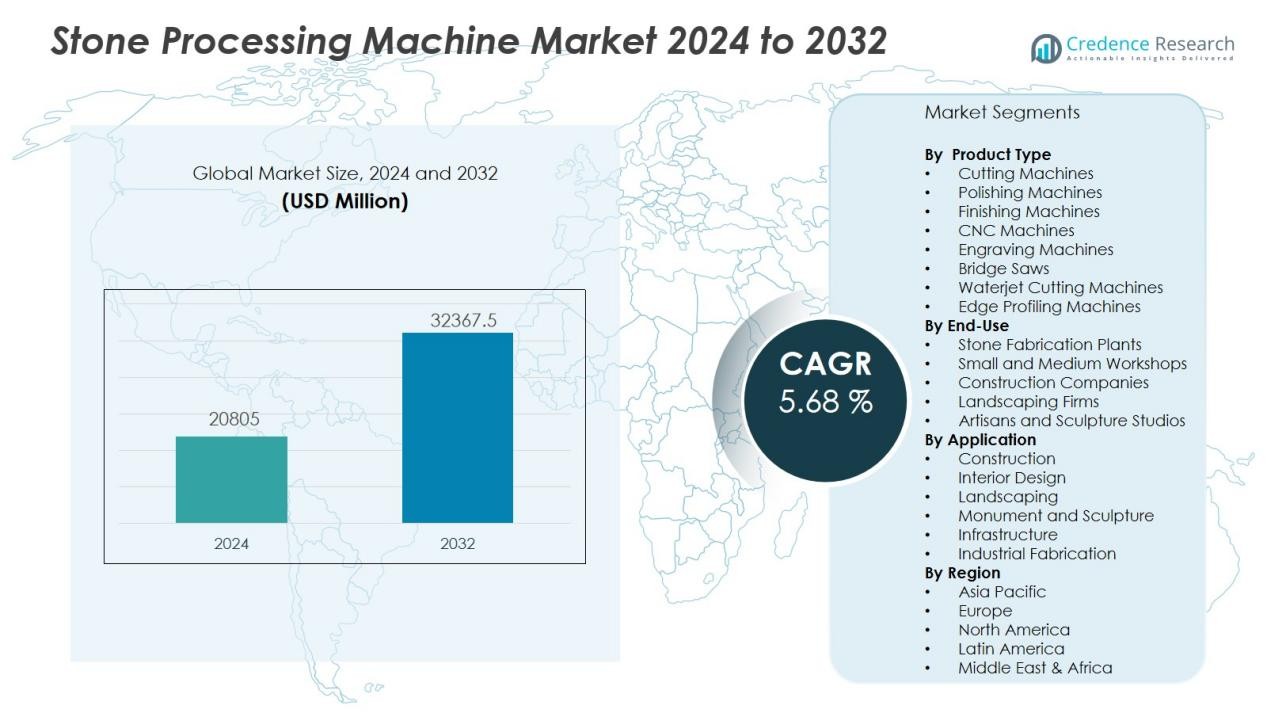
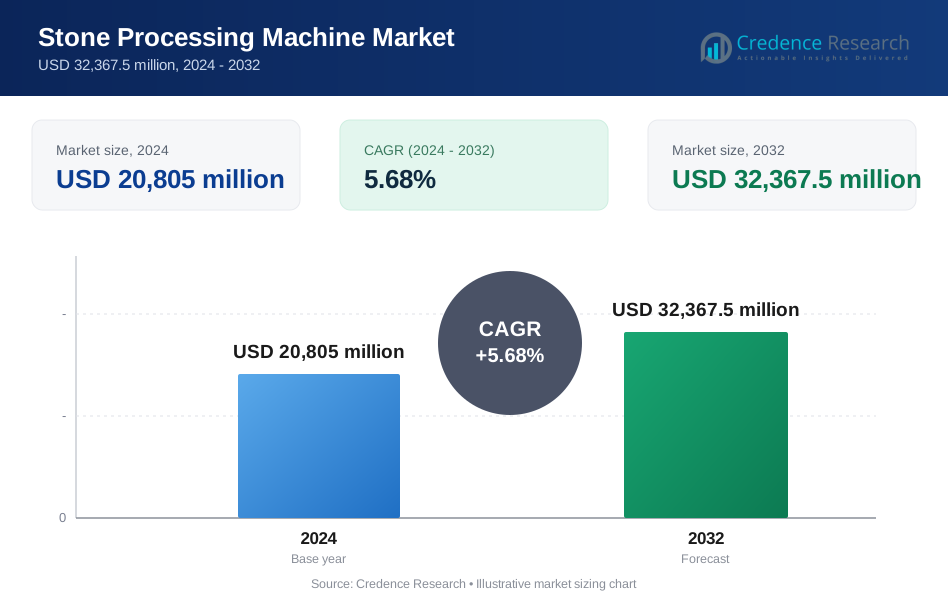
The Stone processing machine market size was valued at USD 20805 million in 2024 and is anticipated to reach USD 32367.5 million by 2032, at a CAGR of 5.68 % during the forecast period (2024-2032).
| REPORT ATTRIBUTE | DETAILS |
|---|---|
| Historical Period | 2020-2024 |
| Base Year | 2024 |
| Forecast Period | 2025-2032 |
| Stone Processing Machine Market Size 2024 | USD 20805 Million |
| Stone Processing Machine Market, CAGR | 5.68 % |
| Stone Processing Machine Market Size 2032 | USD 32367.5 Million |
Key drivers supporting the expansion of the stone processing machine market include rapid urbanization, a surge in commercial and residential construction, and the growing popularity of luxury interiors and high-end architectural applications. Technological advancements, such as automation, CNC (computer numerical control) integration, and energy-efficient systems, further enhance productivity and operational cost savings for manufacturers and fabricators. Additionally, the trend towards customized and intricate stone designs has fueled the adoption of advanced machines capable of complex processing tasks.
Regionally, Asia-Pacific leads the global market, propelled by massive infrastructure development, urban housing initiatives, and expanding stone export activities in countries such as China and India. Europe and North America also maintain significant market shares, benefiting from ongoing renovation projects and demand for premium quality stone finishes in both commercial and residential sectors.
Market Insights:
- The stone processing machine market reached USD 20,805 million in 2024 and is projected to hit USD 32,367.5 million by 2032, driven by a CAGR of 5.68%.
- Rapid urbanization and ongoing construction in both residential and commercial sectors strongly boost demand for advanced stone processing machinery.
- Automation, CNC integration, and energy-efficient technologies continue to enhance productivity and lower operational costs for manufacturers and fabricators.
- Growing preference for luxury interiors and intricate stone designs fuels adoption of machines capable of delivering customized and high-precision finishes.
- Asia-Pacific leads the market with 45% share, supported by large-scale infrastructure projects and strong manufacturing bases in China and India.
- Europe, holding a 27% share, benefits from consistent renovation activity, strict environmental regulations, and a preference for sustainable and high-quality materials.
- North America, with an 18% share, focuses on digital solutions, luxury construction, and high-value renovation, ensuring steady demand for advanced equipment and custom applications.
Market Drivers:
Growing Construction and Infrastructure Investments Stimulate Market Demand:
Rapid expansion in global construction and infrastructure projects directly increases the need for advanced stone processing equipment. Governments and private developers prioritize new commercial complexes, residential towers, and large-scale public infrastructure, boosting the consumption of finished stone products. The stone processing machine market benefits from this trend, as stakeholders invest in technologies that deliver high output and consistent quality. Rising urbanization and the shift toward modern architectural styles further drive the use of sophisticated machinery.
- For instance, Caterpillar's collaboration with Luck Stone at their Bull Run Quarry in Virginia demonstrates this technological advancement, where their autonomous Cat 777 off-highway trucks successfully hauled 1 million tons of material autonomously in 2025.
Technological Advancements and Automation Enhance Productivity:
Manufacturers consistently introduce innovations such as CNC integration, automation, and energy-efficient systems to meet evolving industry standards. These advancements allow companies to achieve higher precision and throughput, while reducing manual labor and operational costs. The stone processing machine market grows as fabricators seek machinery that can handle complex designs and customized requirements. New features also improve safety and reliability, encouraging wider adoption across stone processing facilities.
Rising Demand for Premium and Customized Stone Products:
Architects and designers increasingly specify intricate stone finishes for luxury interiors, façades, and landscaping projects. It drives demand for stone processing machines capable of producing detailed cuts, patterns, and high-quality surfaces. The market expands as end users pursue unique designs that elevate both commercial and residential spaces. Machine manufacturers respond by offering solutions that support creativity and precision in stone fabrication.
- For instance, Tru-Stone Technologies provides calibrated precision granite machine bases with ISO/IEC 17025 accreditation, guaranteeing flatness accuracy up to 2μm over 1,000mm for semiconductor and metrology equipment manufacturers.
Focus on Sustainability and Operational Efficiency Gains Traction:
Sustainability concerns and rising energy costs influence investment decisions in the stone processing industry. Companies look for machines that minimize waste, optimize material usage, and consume less power during operation. The stone processing machine market experiences growth from the adoption of eco-friendly and efficient technologies. Regulatory pressures and client expectations around sustainable practices reinforce the need for such advanced solutions.
Market Trends:
Integration of Smart Technologies and Automation Shapes Industry Landscape:
Digitalization and automation continue to transform the stone processing machine market, with manufacturers incorporating smart controls, IoT-enabled sensors, and advanced software platforms. It allows operators to monitor equipment performance in real time, schedule predictive maintenance, and optimize production processes for greater efficiency. CNC machines and robotic systems have gained traction in both large-scale and small-scale fabrication shops, enabling precision cutting and intricate detailing with minimal human intervention. Data-driven decision-making enhances productivity and helps companies respond quickly to custom project demands. Integration of cloud-based systems supports remote diagnostics and process control, improving machine uptime and service delivery. This ongoing trend drives adoption among forward-thinking stone processors seeking to maximize operational output.
- For instance, the 2025 Hualong CNC Waterjet Cutting Machine achieves a cutting accuracy of ±0.1mm for both straight and angled cuts, meeting the advanced demands of bespoke architectural and artistic projects.
Sustainable Manufacturing and Circular Economy Practices Influence Purchasing Decisions:
The shift toward sustainability has become a defining trend in the stone processing machine market, with end users prioritizing energy-efficient equipment and environmentally responsible manufacturing practices. Machine developers have focused on technologies that reduce water and power consumption, minimize dust and material waste, and support recycling of stone remnants. Companies increasingly factor lifecycle costs, emissions, and material efficiency into procurement strategies. Demand for eco-friendly stone processing aligns with global green building initiatives and regulatory mandates on environmental performance. This trend encourages continuous innovation in machine design, with equipment manufacturers introducing new models that help clients achieve both economic and sustainability objectives. It reinforces the market’s evolution toward responsible production and resource optimization.
- For instance, Faccin’s 4EDL electric‐drive plate roll achieves a 35 percent reduction in energy consumption on total running costs compared to its full‐hydraulic counterpart.
Market Challenges Analysis:
High Capital Investment and Maintenance Costs Restrict Widespread Adoption:
The stone processing machine market faces barriers due to significant upfront costs and ongoing maintenance requirements. Small and mid-sized enterprises often struggle to justify investment in advanced machines, especially with fluctuating demand in the construction sector. Complex machinery requires skilled operators and regular servicing, which increases operational expenses. Price sensitivity among buyers can slow the transition to modern, automated equipment. It challenges manufacturers to balance innovation with affordability and long-term value. This dynamic often leads to slower market penetration in emerging economies.
Volatile Raw Material Supply and Skilled Labor Shortages Impact Production Efficiency:
Irregular supply of high-quality stone and fluctuations in raw material prices create uncertainty for machine operators and manufacturers. The stone processing machine market must also contend with a global shortage of skilled technicians capable of handling advanced equipment. Training and retaining a qualified workforce adds to operational burdens, particularly as machines become more sophisticated. It forces companies to invest in workforce development and adapt workflows to changing labor dynamics. Unpredictable logistics and transportation costs further complicate efficient market operations. These challenges place pressure on profitability and consistent project delivery.
Market Opportunities:
Expanding Infrastructure Projects and Urbanization Create New Growth Prospects:
Global investment in infrastructure and rapid urbanization open substantial opportunities for the stone processing machine market. Large-scale commercial, residential, and public projects require significant volumes of precision-cut stone, driving demand for high-performance machinery. Emerging economies invest heavily in transportation, smart cities, and industrial parks, accelerating equipment adoption. It creates new sales channels for manufacturers and distributors seeking to expand their geographic reach. Strategic partnerships with construction firms and developers can further strengthen market presence. This dynamic supports both product innovation and customized solutions to meet evolving project needs.
Rising Demand for Customization and Value-Added Services Spurs Market Expansion:
Architects and designers increasingly specify intricate and customized stone elements for premium projects. The stone processing machine market responds with solutions that enable complex cutting, shaping, and finishing with high accuracy. Machine suppliers can leverage value-added services such as automation upgrades, training, and after-sales support to differentiate their offerings. It enhances customer loyalty and creates recurring revenue streams. Growing interest in sustainable, aesthetically unique stone applications provides further opportunity for specialized equipment and advanced technology adoption. This evolving landscape encourages continued investment in R&D and long-term market growth.
Market Segmentation Analysis:
By Product Type:
Cutting machines represent the dominant product segment in the stone processing machine market, driven by high demand for precision and speed in shaping stone slabs and tiles. Polishing and finishing machines also hold a significant share, catering to architectural and decorative applications that require superior surface quality. CNC-controlled machines continue to gain traction, offering advanced automation and the ability to handle complex designs.
- For instance, the GenCut GL350 precision cutting machine from NextGen can cut circular workpieces with a diameter of up to 100mm and achieves spindle speeds ranging from 300 to 3,000rpm, allowing ultra-fast, precise sectioning for industrial applications.
By Application:
The construction sector accounts for the largest application share, reflecting strong demand for processed stone in residential, commercial, and infrastructure projects. Interior design and landscaping segments show steady growth, supported by the rising popularity of customized stone features in luxury and high-end projects. Monument and sculpture applications contribute to niche demand, benefiting from machines capable of detailed engraving and unique finishes.
- For instance, Advanced Architectural Stone provided over 12,000 linear feet of architectural stone banding for every window in the Christus Spohn Shoreline Hospital pavilion, delivering precision and aesthetic consistency through custom manufacturing techniques.
By End-Use:
Fabrication facilities and large-scale stone processing plants form the primary end-use segment, leveraging high-capacity machines to achieve productivity and consistency. Small and mid-sized workshops follow, investing in versatile and cost-effective equipment to meet local and project-specific needs. The stone processing machine market responds to diverse end-user requirements by offering tailored solutions for both high-volume and specialized operations.
Segmentations:
By Product Type:
- Cutting Machines
- Polishing Machines
- Finishing Machines
- CNC Machines
- Engraving Machines
- Bridge Saws
- Waterjet Cutting Machines
- Edge Profiling Machines
By Application:
- Construction
- Interior Design
- Landscaping
- Monument and Sculpture
- Infrastructure
- Industrial Fabrication
By End-Use:
- Stone Fabrication Plants
- Small and Medium Workshops
- Construction Companies
- Landscaping Firms
- Artisans and Sculpture Studios
By Region:
- North America
- U.S.
- Canada
- Mexico
- Europe
- Germany
- France
- U.K.
- Italy
- Spain
- Rest of Europe
- Asia Pacific
- China
- Japan
- India
- South Korea
- South-east Asia
- Rest of Asia Pacific
- Latin America
- Brazil
- Argentina
- Rest of Latin America
- Middle East & Africa
- GCC Countries
- South Africa
- Rest of the Middle East and Africa
Regional Analysis:
Asia-Pacific :
Asia-Pacific holds the largest share in the stone processing machine market, accounting for nearly 45% in 2024. It benefits from massive infrastructure investments, rapid urbanization, and a strong presence of stone quarries and fabrication facilities. China and India drive demand through ongoing residential, commercial, and industrial construction projects. Government initiatives promoting smart cities and export-oriented manufacturing also contribute to high equipment adoption. Manufacturers in the region focus on cost-effective and technologically advanced machines to capture both domestic and international clients. Expanding middle-class populations and rising standards of living further fuel market expansion.
Europe :
Europe represents a significant share, estimated at 27% in 2024, supported by consistent renovation activities and a preference for high-quality, sustainable materials. The region’s architectural heritage and regulatory focus on eco-friendly construction strengthen the need for advanced stone processing machinery. Countries such as Italy, Germany, and Spain remain leading consumers due to active stone fabrication and export industries. European manufacturers emphasize energy efficiency, automation, and precision in their machine offerings. Stringent labor and environmental regulations encourage ongoing innovation. This competitive environment ensures sustained demand and regular technology upgrades across the continent.
North America :
North America captures a market share of 18% in 2024, driven by increasing adoption of automated and digital stone processing solutions. The United States and Canada prioritize luxury real estate, commercial complexes, and institutional buildings, which require precise and customized stone finishes. It benefits from robust investment in technology, workforce training, and supply chain optimization. The market experiences steady demand from both new construction and high-value renovation projects. Regional players focus on delivering advanced solutions that address quality, efficiency, and client customization needs. Favorable economic conditions and an emphasis on modern architectural design continue to support market growth.
Key Player Analysis:
- Gimec S.r.l.
- Hydromech
- Cadinox Industrie
- IMCOS
- Bridgeport Machines Inc.
- Hommel Hercules Group
- Foshan Nanhai Kehao Machinery Co. Ltd.
- Wuhan Fenghua Automation Machinery Co., Ltd.
Competitive Analysis:
The stone processing machine market features strong competition among global and regional manufacturers. Key players include JET Machinery Ltd., Gimec S.r.l., Hydromech, Cadinox Industrie, IMCOS, DDM Technologies, Bridgeport Machines Inc., and Hommel Hercules Group. Leading companies differentiate themselves through continuous innovation, advanced automation, and a focus on energy efficiency to meet evolving customer demands. The market values strong distribution networks, comprehensive after-sales support, and the ability to deliver customized solutions for both large-scale and specialized applications. Intense competition encourages regular upgrades in technology and the development of integrated machines that enhance productivity and precision. It also fosters partnerships with construction and fabrication firms, supporting expansion into new regions and industry segments.
Recent Developments:
- In July 2024, JET Tools introduced the SkyHyker industrial material lift, which offers high lifting capacity, improved safety features, and enhanced mobility, aiming to set a new standard for jobsite lifts.
- In April 2025, HİDROMEK (Hydromech) is presenting its first telehandler product group featuring the HMK 40-18 TH model at Bauma 2025 in Munich, Germany, targeting the construction sector with high reach and lifting capacity.
- In May 2025, IMCO Group advanced its strategic partnerships by establishing long-term cooperation throughout Europe and the Balkans during and after the DEFEA 2025 event.
Market Concentration & Characteristics:
The stone processing machine market maintains moderate concentration, led by a mix of established global manufacturers and competitive regional players. Leading companies prioritize innovation, automation, and energy-efficient solutions to strengthen their market positions. High capital investment and technical expertise create barriers to entry, allowing experienced firms to dominate key segments. It values robust distribution networks and reliable after-sales service, which influence purchasing decisions across both developed and emerging regions. Strong emphasis on customization and rapid response to changing project requirements defines the competitive landscape in the stone processing machine market. Intense rivalry drives ongoing technological advancement and strategic partnerships throughout the industry.
Report Coverage:
The research report offers an in-depth analysis based on Segment 1, Segment 2, Segment 3, and Segment 3. It details leading Market players, providing an overview of their business, product offerings, investments, revenue streams, and key applications. Additionally, the report includes insights into the competitive environment, SWOT analysis, current Market trends, as well as the primary drivers and constraints. Furthermore, it discusses various factors that have driven Market expansion in recent years. The report also explores Market dynamics, regulatory scenarios, and technological advancements that are shaping the industry. It assesses the impact of external factors and global economic changes on Market growth. Lastly, it provides strategic recommendations for new entrants and established companies to navigate the complexities of the Market.
Future Outlook:
- Demand for advanced stone processing machines will rise as construction and infrastructure projects expand globally.
- Manufacturers will focus on automation and digital integration to improve operational efficiency and precision.
- Energy-efficient and eco-friendly machines will see increased adoption due to stricter sustainability regulations.
- Customization capabilities will become a key differentiator, supporting unique architectural and design requirements.
- Asia-Pacific will remain the dominant market, driven by rapid urbanization and high construction activity in China and India.
- Europe and North America will sustain demand through renovation projects and preference for high-quality finishes.
- Integration of IoT, remote monitoring, and predictive maintenance will enhance machine reliability and reduce downtime.
- Small and mid-sized workshops will increase investments in versatile machines to address project-specific needs.
- Supply chain optimization and strong after-sales support will become critical for market leaders to retain clients.
- Partnerships between machine manufacturers and construction firms will drive innovation, streamline project delivery, and open new growth channels.
Request a Free Sample
Fill in your details and we'll send you a free sample report.
- Sample data tables & charts
- Research methodology
Need a Custom Version of This Report?
Tailor the scope, geography, or segments to your exact requirements.
- Custom geography or segment scope
- Direct access to our analyst team
Frequently Asked Questions
What is the current market size of the Stone Processing Machine Market and its projected value by 2032?
What is the expected CAGR for the Stone Processing Machine Market from 2024 to 2032?
Which segment held the largest share in the Stone Processing Machine Market in 2024?
What are the primary factors driving the growth of the Stone Processing Machine Market?
Who are the leading companies in the Stone Processing Machine Market?
Which region held the largest share of the Stone Processing Machine Market in 2024?
Table of Content
Chapter 1. Report Introduction
- 1.1 Report Description & Purpose
- 1.1.1 Report Title & Market Definition
- 1.1.2 Unique Selling Propositions (USP) & Key Differentiators
- 1.1.3 Value Proposition for Stakeholders
- 1.2 Research Objectives
- 1.2.1 Market Sizing Objectives (Volume & Revenue)
- 1.2.2 Segmentation Objectives
- 1.2.3 Competitive Intelligence Objectives
- 1.2.4 Forecast & Scenario Objectives
- 1.3 Report Scope
- 1.3.1 Stone Processing Machine Scope – Types & Subtypes Covered
- 1.3.2 Geographic Scope – Regions & Countries Covered
- 1.3.3 Historical Period, Base Year & Forecast Period (2024; forecast to 2032)
- 1.3.4 Inclusions & Exclusions
- 1.4 HS Code & Classification Framework
- 1.5 Currency, Units & Pricing Basis
- 1.6 Target Stakeholders
- 1.7 Limitations & Assumptions
Chapter 2. Executive Summary
- 2.1 Global Stone Processing Machine Market Snapshot
- 2.1.1 Market Size – Historical (2024) & Forecast (2024-2032) (2024: USD 20,805 million → 2032: USD 32,367.5 million)
- 2.1.2 Volume & Revenue – Global Totals
- 2.1.3 Key Market Highlights – Top Five Facts
- 2.2 Stone Processing Machine Market Segmentation Snapshot
- 2.2.1 Market Split by Region – 2024 vs. 2032
- 2.3 Competitive Snapshot
- 2.3.1 Top 10 Players by Revenue Share – 2024
- 2.3.2 Top 10 Players by Volume Share – 2024
- 2.3.3 Recent Strategic Developments (18-Month Summary)
- 2.4 Key Investment Highlights & Strategic Conclusions
Chapter 3. Stone Processing Machine Market Dynamics & Industry Analysis
- 3.1 Market Overview & Context
- 3.1.1 Stone Processing Machine Market Position in the Broader Automotive Value Chain
- 3.1.2 OEM vs. Replacement Market Dynamics
- 3.1.3 Market Maturity & Development Stage by Region
- 3.2 Stone Processing Machine Market Drivers
- 3.3 Stone Processing Machine Market Restraints & Challenges
- 3.4 Stone Processing Machine Market Opportunities
- 3.5 Porter's Five Forces Analysis
- 3.5.1 Threat of New Entrants
- 3.5.2 Bargaining Power of Suppliers
- 3.5.3 Bargaining Power of Buyers
- 3.5.4 Threat of Substitutes
- 3.5.5 Competitive Rivalry – Intensity Assessment
- 3.6 Stone Processing Machine Value Chain Analysis
- 3.6.1 Upstream – Raw Material/Input Suppliers
- 3.6.1.1 Raw Material/Input 1
- 3.6.1.2 Raw Material/Input 2
- 3.6.1.3 Raw Material/Input 3
- 3.6.2 Midstream – Production/Manufacturing/Service Delivery
- 3.6.2.1 Production/Process Overview
- 3.6.2.2 Key Facility Locations & Capacity by Manufacturer
- 3.6.3 Downstream – Distribution & End Consumer
- 3.6.3.1 Primary Channel – B2B/OEM
- 3.6.3.2 Secondary Channels – Dealer, Retail, Online, Direct
- 3.6.4 Value Chain Profitability Analysis
- 3.6.1 Upstream – Raw Material/Input Suppliers
- 3.7 PESTEL Analysis
- 3.7.1 Political Factors
- 3.7.2 Economic Factors
- 3.7.3 Social Factors
- 3.7.4 Technological Factors
- 3.7.5 Environmental Factors
- 3.7.6 Legal Factors
- 3.8 Stone Processing Machine Supply Chain Analysis
- 3.8.1 Raw Material/Input Supply Risk Assessment
- 3.8.2 Manufacturing Concentration Risk (Geographic Exposure)
- 3.8.3 Trade Disruption Impact Analysis
- 3.9 Regulatory & Policy Landscape
Note: The regulatory and policy landscape section covers regulations based on their applicability to the market, Stone Processing Machine category, geography, and scope of the study. Only regulatory frameworks with a material impact on operations, compliance, trade, sustainability, or market access are analyzed in detail.
Chapter 4. Key Investment Pockets & Opportunity Analysis
- 4.1 Stone Processing Machine Market Attractiveness Analysis
- 4.1.1 By Region – Investment Attractiveness Matrix (Volume × CAGR)
- 4.2 Absolute Revenue Growth Opportunity
- 4.2.1 By Region – Absolute USD Growth Through 2032
- 4.3 Incremental Volume Opportunity
- 4.3.1 By Region – Incremental Volume Through 2032
- 4.3.2 Segment – Incremental Volume
- 4.4 Emerging Submarket Opportunity Deep Dive (Subject to Applicability)
- 4.5 Emerging Market Opportunity Scorecards
- 4.5.1 United States
- 4.5.2 Europe
- 4.5.3 Asia
- 4.5.4 Middle East & Africa
Note: Emerging Market Opportunity Scorecards will be included based on relevance and strategic importance. Regions listed are indicative and may vary depending on data availability and market dynamics.
Chapter 5. Stone Processing Machine Import-Export Analysis & Trade Flows
- 5.1 Global Trade Overview
- 5.1.1 Global Export Value by Country (2024)
- 5.1.2 Global Export Volume by Country (2024)
- 5.1.3 Global Import Value by Country (2024)
- 5.1.4 Global Import Volume by Country (2024)
- 5.1.5 Net Trade Balance by Country (2024)
- 5.2 Export Analysis – Segment
- 5.2.1 Type 1 (HS Code)
- 5.2.2 Type 2 (HS Code)
- 5.2.3 Type 3 (HS Code)
- 5.2.4 Type 4 (HS Code)
- 5.2.5 Type 5 (HS Code)
- 5.3 Import Analysis – Segment
- 5.3.1 Type 1 (HS Code)
- 5.3.2 Type 2 (HS Code)
- 5.3.3 Type 3 (HS Code)
- 5.3.4 Type 4 (HS Code)
- 5.3.5 Type 5 (HS Code)
- 5.4 Average Unit Trade Prices
- 5.4.1 Average Export Price – Segment & Country
- 5.4.2 Average Import Price – Segment & Source Country
- 5.4.3 Price Trends (2024)
- 5.5 Key Trade Route Analysis
- 5.5.1 Trade Route 1
- 5.5.2 Trade Route 2
- 5.5.3 Trade Route 3
- 5.5.4 Trade Route 4
- 5.5.5 Trade Route 5
- 5.6 Trade Policy Impact Assessment
- 5.6.1 US Anti-Dumping & Section 301 Tariffs
- 5.6.2 EU Customs Union Impact
- 5.6.3 Major Free Trade Agreements
- 5.6.4 USMCA Rules of Origin
Note: Trade policy analysis will be included only where relevant to the Stone Processing Machine market.
Chapter 6. Competitive Landscape & Company Benchmarking
- 6.1 Stone Processing Machine Market Concentration & Structure
- 6.1.1 Herfindahl-Hirschman Index (HHI) – vs. 2024
- 6.1.2 Tier 1, Tier 2 & Tier 3 Market Structure
- 6.1.3 Global, Regional & Local Player Dynamics
- 6.2 Stone Processing Machine Market Share Analysis – 2024
- 6.2.1 Global Revenue Share by Company
- 6.2.2 Global Volume Share by Company
- 6.2.3 Regional Revenue Share
- 6.2.4 Market Share Evolution ( vs. 2024)
- 6.2.5 OEM Segment Share by Company
- 6.2.6 Replacement Segment Share by Company
- 6.3 Production/Delivery Capacity & Facility Analysis
- 6.3.1 Global Installed Capacity
- 6.3.2 Capacity Utilization Rates
- 6.3.3 Production/Output Volume
- 6.3.4 Facility Locations & Capacity Map
- 6.3.5 Planned Capacity Additions
- 6.4 Stone Processing Machine Competitive Benchmarking Matrix
- 6.4.1 Revenue, Volume, CAGR & Profitability Comparison
- 6.4.2 Channel Revenue Mix
- 6.4.3 Geographic Revenue Exposure
- 6.4.4 R&D Intensity
- 6.4.5 Sustainability Maturity
- 6.5 Strategic Developments in Stone Processing Machine (Last 24 Months)
- 6.5.1 Mergers, Acquisitions & Divestments
- 6.5.2 New Stone Processing Machine Launches
- 6.5.3 Facility Expansions
- 6.5.4 Strategic Alliances, Joint Ventures & Partnerships
- 6.5.5 Distribution Expansion & Market Entry
- 6.5.6 Sustainability & ESG Initiatives
- 6.6 Competitive Strategy Mapping
- 6.6.1 Leader, Challenger, Follower & Niche Classification
- 6.6.2 Pricing Strategy Comparison
- 6.6.3 Channel Strategy Matrix
Note: Strategic developments are included based on their materiality and the availability of reliable information.
Chapter 7. Global Stone Processing Machine Market – By Distribution Channel
- 7.1 Segment Overview
- 7.1.1 Volume & Revenue Split by Channel (2024 & 2032)
- 7.1.2 Channel Mix Evolution (2024-2032)
Chapter 8. Regional Market Analysis – Global Overview
- 8.1 Global Regional Overview
- 8.1.1 Regional Volume Share
- 8.1.2 Regional Revenue Share
- 8.1.3 Regional Volume by Region
- 8.1.4 Regional Revenue by Region
- 8.1.5 Regional Forecast Through 2032
- 8.2 Cross-Regional Segment Analysis
- 8.2.1 By Distribution Channel
- 8.2.2 By Brand/Price Tier
Chapter 9. North America Stone Processing Machine Market
- 9.1 United States
- 9.2 Canada
- 9.3 Mexico
Chapter 10. Europe Stone Processing Machine Market
- 10.1 Germany
- 10.2 France
- 10.3 Italy
- 10.4 United Kingdom
- 10.5 Spain
- 10.6 Poland
- 10.7 Russia
- 10.8 Netherlands
- 10.9 Belgium
- 10.10 Sweden
- 10.11 Denmark
- 10.12 Norway
- 10.13 Rest of Europe
Chapter 11. Asia Pacific Stone Processing Machine Market
- 11.1 China
- 11.2 India
- 11.3 Japan
- 11.4 South Korea
- 11.5 Thailand
- 11.6 Indonesia
- 11.7 Vietnam
- 11.8 Malaysia
- 11.9 Australia
- 11.10 Rest of Asia Pacific
Chapter 12. Latin America Stone Processing Machine Market
- 12.1 Brazil
- 12.2 Argentina
- 12.3 Colombia
- 12.4 Chile
- 12.5 Rest of Latin America
Chapter 13. Middle East Stone Processing Machine Market
- 13.1 Saudi Arabia
- 13.2 United Arab Emirates
- 13.3 Turkey
- 13.4 Israel
- 13.5 Iran
- 13.6 Rest of the Middle East
Chapter 14. Africa Stone Processing Machine Market
- 14.1 South Africa
- 14.2 Egypt
- 14.3 Nigeria
- 14.4 Morocco
- 14.5 Rest of Africa
Chapter 15. Stone Processing Machine Company Profiles
- 15.1 [Company 01]
- 15.1.1 Company Overview
- 15.1.2 Key Management Personnel
- 15.1.3 Products & Services Portfolio
- 15.1.4 Financial Performance
- 15.1.5 Key Market Focus & Geographic Presence
- 15.1.6 Recent Developments & Strategic Initiatives
Note: The company profile list is preliminary and may change based on research findings, market developments, data availability, and client requirements.
Chapter 16. Appendices
- Appendix A – List of Abbreviations & Acronyms
- Appendix B – Industry Classification Code Reference – Full Series
- Appendix C – Production & Capacity Data Tables
- Appendix D – End-Use & Demand Base Tables
- Appendix E – Consumption & Replacement Rate Assumptions
- Appendix F – ASP Reference Tables
- Appendix G – Manufacturing & Facility Database
- Appendix H – Import-Export Data Tables
- Appendix I – Regulatory Summary Tables
- Appendix J – Primary Research Participant List (Anonymized)
- Appendix K – Primary Research Questionnaire Framework
- Appendix L – Data Sources & Bibliography
- Appendix M – Market Size Divergence & Source Comparison
Chapter 17. Research Methodology
- 17.1 Research Framework & Philosophy
- 17.2 Secondary Research – Sources, Hierarchy & Data Extraction
- 17.3 Data Modeling – Bottom-Up & Top-Down Market Sizing
- 17.4 Primary Research – Stakeholder Framework, LOI & Sample Sizes
- 17.5 Forecast Methodology – Regression, Scenario & Sensitivity Analysis
- 17.6 Quality Control – Four-Layer Validation Framework
- 17.7 Limitations & Standard Assumptions
- 17.8 Disclaimer
