
Market Overview:
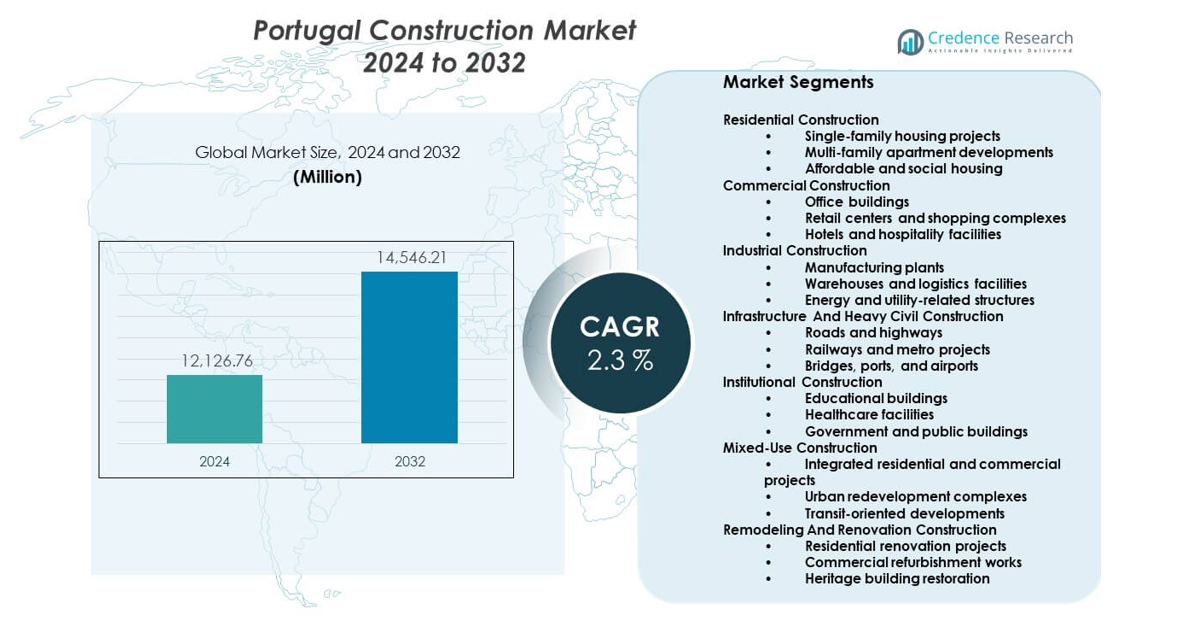
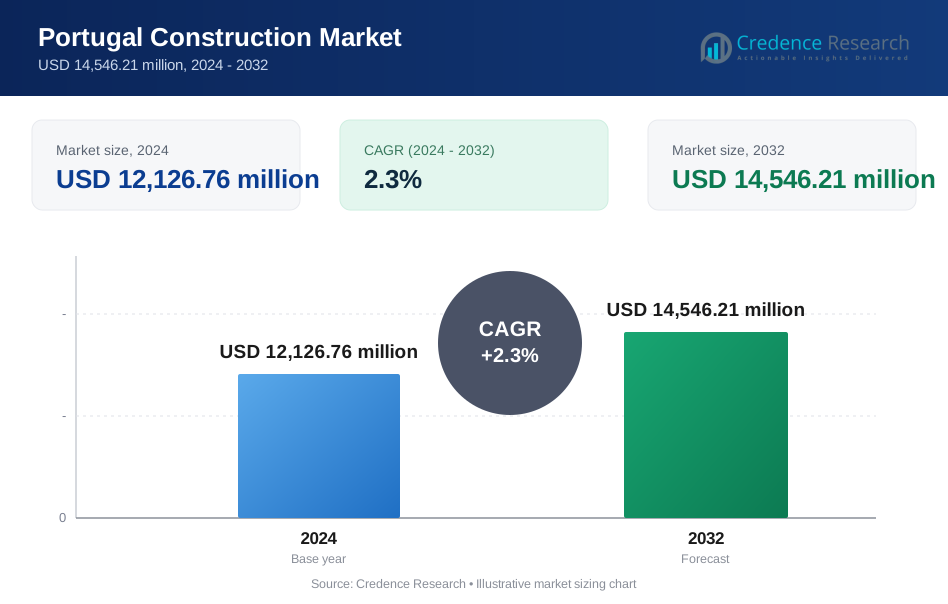
The Portugal Construction Market is projected to grow from USD 12,126.76 million in 2024 to USD 14,546.21 million by 2032, with a CAGR of 2.3% from 2024 to 2032.
| REPORT ATTRIBUTE | DETAILS |
|---|---|
| Historical Period | 2020-2023 |
| Base Year | 2024 |
| Forecast Period | 2025-2032 |
| Portugal Construction Market Size 2024 | USD 12,126.76 million |
| Portugal Construction Market, CAGR | 2.3% |
| Portugal Construction Market Size 2032 | USD 14,546.21 million |
Market drivers include housing demand, infrastructure upgrades, and sustainability goals. Urban population growth supports new residential developments. Government programs encourage energy-efficient buildings and seismic retrofitting. Infrastructure projects focus on roads, rail, and ports to improve logistics. Tourism recovery supports hotels, resorts, and public facilities. Foreign investment supports commercial and logistics construction. Digital tools improve project planning and cost control. Skilled labor shortages raise productivity focus. These factors support stable construction activity across segments.
Regional activity concentrates around major economic hubs. Lisbon leads due to urban redevelopment and housing demand. Porto follows with commercial growth and transport upgrades. Coastal regions benefit from tourism-driven construction. The Algarve shows steady demand for hospitality and residential projects. Interior regions remain emerging markets with infrastructure-led growth. Cross-border trade supports logistics assets near Spain. Regional funding programs help balance development gaps. These patterns shape construction demand across Portugal.
Market Insights:
- The Portugal Construction Market stood at USD 12,126.76 million in 2024 and will reach USD 14,546.21 million by 2032, with a 2.3% CAGR, supported by steady public and private investment.
- Lisbon Metropolitan Area leads with 38% share due to dense urban demand, followed by Norte at 27% from industrial and logistics growth, and Centro at 20% from infrastructure and institutional projects.
- Algarve is the fastest-growing region with a 15% share, driven by tourism-led hospitality projects and coastal residential development.
- Infrastructure and heavy civil construction holds about 34% share, led by roads, railways, ports, and long-term public funding pipelines.
- Residential construction accounts for nearly 28% share, supported by urban housing demand, renovation activity, and affordable housing programs.
Market Drivers:
Sustained Public Infrastructure Spending And Urban Redevelopment Focus
Government investment supports transport, utilities, and public facilities nationwide. Urban renewal programs target aging districts and city centers. These projects improve mobility and service access. Public housing upgrades strengthen social infrastructure. Municipal spending ensures steady contractor demand. Policy stability supports long-term planning confidence. The Portugal Construction Market benefits from predictable infrastructure pipelines. It supports balanced growth across civil works and buildings.
- For instance, Infraestruturas de Portugal completed modernization of the Northern Line rail corridor covering over 100 km, increasing line capacity and reducing travel times through upgraded signaling and track systems.
Residential Housing Demand Driven By Urbanization And Demographic Shifts
Urban population growth increases housing demand. Affordable housing programs support large residential projects. Renovation activity rises due to old building stock. Energy upgrades improve safety and efficiency. Developers focus on mixed-use housing formats. Mortgage access supports buyer confidence. Population concentration sustains urban construction volumes. It maintains consistent residential project flow.
- For instance, Casais Group delivered more than 1,200 residential units in Lisbon and Porto between 2021 and 2024, including high-efficiency buildings certified under Class A energy standards.
Tourism Recovery Supporting Commercial And Hospitality Construction Activity
Tourism growth supports hotels, resorts, and leisure assets. Hospitality operators invest in capacity upgrades. Mixed-use projects meet retail and leisure needs. Coastal regions attract strong private investment. Public amenities near tourist areas expand. Seasonal demand shapes phased project delivery. The Portugal Construction Market gains from tourism-linked demand. It supports long-term commercial development.
Environmental Policies And Energy Efficiency Compliance Requirements
Green building rules shape construction standards. Energy mandates support retrofit activity. Public incentives encourage low-carbon materials. Developers adopt sustainable design practices. Renewable systems integrate into new projects. Compliance improves asset durability and value. Environmental goals influence project approvals. It strengthens demand for compliant construction solutions.
Market Trends:
Growing Use Of Modular Construction And Prefabricated Building Systems
Builders adopt modular methods to reduce timelines. Prefabrication improves site quality control. Labor shortages support off-site production. Cost certainty improves budget planning. Residential projects adopt modular formats faster. Hospitality assets favor rapid installation. The Portugal Construction Market shows steady modular uptake. It improves efficiency in dense urban areas.
Digitalization Of Construction Planning And Project Management Practices
Construction firms adopt digital design tools. BIM improves coordination among stakeholders. Cost tracking systems support financial control. Digital scheduling reduces delay risks. Data use improves resource allocation. Cloud tools gain adoption among small firms. The Portugal Construction Market advances digital maturity. It supports transparent project execution.
- For instance, Mota-Engil applies BIM Level 2 workflows across major infrastructure projects, coordinating over 15 disciplines per project and reducing rework through fully federated digital models.
Preference For Compact Mixed-Use Urban Developments
Developers favor integrated residential and commercial assets. Land scarcity drives vertical construction formats. Walkable designs align with city planning goals. Retail integrates with housing and offices. Transit access guides site selection. Compact layouts improve land efficiency. The Portugal Construction Market reflects urban lifestyle shifts. It supports higher-density developments.
Rising Emphasis On Renovation And Adaptive Reuse Projects
Renovation demand exceeds new builds in cities. Historic assets require structural upgrades. Energy retrofits gain priority in approvals. Adaptive reuse supports commercial redevelopment. Regulations favor preservation-led projects. Urban character shapes design scope. The Portugal Construction Market adapts to renewal demand. It balances heritage and modernization needs.
Market Challenges Analysis:
Skilled Labor Shortages And Workforce Capacity Constraints
Skilled labor supply remains limited across regions. An aging workforce affects site productivity. Training gaps impact build quality. Labor costs rise steadily. Smaller contractors face hiring pressure. Project schedules face workforce risks. The Portugal Construction Market experiences capacity strain. It increases reliance on subcontracting models.
Material Cost Volatility And Complex Regulatory Processes
Construction material prices fluctuate frequently. Supply chain disruption raises procurement risk. Permit approvals delay project starts. Local regulations vary across municipalities. Compliance adds administrative workload. Financing delays affect private developments. The Portugal Construction Market faces execution uncertainty. It requires stronger cost and risk management.
Market Opportunities:
Expansion Of Green Retrofit And Energy Upgrade Construction Projects
Building owners seek energy efficiency improvements. Retrofit demand grows across residential assets. Public incentives support upgrade programs. Contractors gain recurring project opportunities. Energy compliance improves asset competitiveness. Technology improves retrofit execution quality. The Portugal Construction Market benefits from sustainability focus. It supports long-term renovation growth.
Infrastructure Modernization And Regional Development Initiatives
Transport upgrades create new construction demand. Port and logistics projects support trade growth. Interior regions gain infrastructure-led development. Public funding improves regional connectivity. Contractors expand beyond urban centers. Local economies attract private projects. The Portugal Construction Market gains regional depth. It supports balanced national construction activity.
Market Segmentation Analysis:
Residential Construction
Residential construction covers single-family housing, multi-family apartments, and affordable housing projects. Urban demand supports apartment developments in major cities. Social housing programs sustain public and private participation. Renovation and energy upgrades improve housing quality. This segment shows stable demand across income groups.
- For instance, Teixeira Duarte Engenharia has completed various construction and rehabilitation projects in the Lisbon metropolitan area, such as the rehabilitation of the 1,654 m² Corte Real building for tourist apartments and significant infrastructure reinforcement work on the Lisbon riverfront. The company actively participates in research and development initiatives regarding sustainable solutions and energy efficiency in construction, aligning with Portuguese energy regulations and industry best practices.
Commercial Construction
Commercial construction includes offices, retail centers, and hospitality assets. Office projects focus on flexible and energy-efficient spaces. Retail development aligns with mixed-use formats. Hotels and resorts benefit from tourism demand. The segment supports steady private investment.
- For instance, VINCI Energies' local network in Portugal, including business units like Sotécnica and Longo Plano, applies high-efficiency solutions in its projects, such as recovering water from the heating and air-conditioning systems at Faro airport for reuse in cleaning operations, thereby reducing the extraction of water resources. The broader VINCI Construction group is involved in various large-scale building projects globally, including hotel complexes and urban developments, and consistently aims for high energy efficiency and sustainability across its operations.
Industrial Construction
Industrial construction serves manufacturing plants, logistics warehouses, and utility structures. Growth in logistics supports warehouse expansion. Industrial upgrades improve automation and efficiency. Energy-related facilities support national supply needs. This segment links closely with trade and exports.
Infrastructure And Heavy Civil Construction
Infrastructure covers roads, railways, bridges, ports, and airports. Public funding supports transport modernization. Rail and metro projects improve urban mobility. Port upgrades support trade flows. The segment provides long-term project visibility.
Institutional Construction
Institutional projects include schools, hospitals, and public buildings. Government spending supports healthcare and education assets. Modern designs improve safety and capacity. This segment ensures steady public sector demand.
Mixed-Use Construction
Mixed-use projects integrate housing, offices, and retail. Urban redevelopment favors compact designs. Transit-oriented projects improve land use. This segment aligns with city planning goals.
Remodeling And Renovation Construction
Renovation includes residential upgrades, commercial refurbishments, and heritage restoration. Aging buildings drive retrofit demand. Preservation rules support careful restoration. This segment grows faster in urban areas.
Specialized And Environmental Construction
Specialized work covers structural repairs, MEP systems, and fit-outs. Environmental construction includes water treatment, waste facilities, and renewable support. Sustainability goals support this segment. The Portugal Construction Market gains resilience through diversified segment demand.
Segmentation:
Residential Construction
- Single-family housing projects
- Multi-family apartment developments
- Affordable and social housing
Commercial Construction
- Office buildings
- Retail centers and shopping complexes
- Hotels and hospitality facilities
Industrial Construction
- Manufacturing plants
- Warehouses and logistics facilities
- Energy and utility-related structures
Infrastructure And Heavy Civil Construction
- Roads and highways
- Railways and metro projects
- Bridges, ports, and airports
Institutional Construction
- Educational buildings
- Healthcare facilities
- Government and public buildings
Mixed-Use Construction
- Integrated residential and commercial projects
- Urban redevelopment complexes
- Transit-oriented developments
Remodeling And Renovation Construction
- Residential renovation projects
- Commercial refurbishment works
- Heritage building restoration
Specialized Construction
- Structural repair services
- Mechanical and electrical works
- Fit-out and finishing services
Environmental Construction
- Water treatment facilities
- Waste management infrastructure
- Renewable energy support structures
Regional Analysis:
Lisbon Metropolitan Area
The Lisbon Metropolitan Area holds the largest share of the Portugal Construction Market, accounting for about 38% of total activity. Strong housing demand supports residential and mixed-use projects. Office development benefits from business services and foreign investment. Transport upgrades improve urban mobility and logistics access. Public buildings and social infrastructure receive steady funding. Tourism supports hotel and refurbishment projects. It remains the primary construction hub due to economic concentration.
Norte (North) Region
The Norte region represents nearly 27% of the market share. Porto drives commercial, residential, and infrastructure development. Industrial construction supports manufacturing and export-oriented activities. Logistics facilities expand near ports and highways. Urban renewal projects improve older districts. Public transport and road projects strengthen regional connectivity. It shows balanced growth across public and private segments.
Centro And Algarve Regions
The Centro region accounts for around 20% of construction activity. Infrastructure projects and institutional buildings support regional development. Industrial parks and logistics assets gain gradual investment. The Algarve holds close to 15% market share, driven by tourism-led construction. Hospitality, leisure, and residential projects dominate local demand. Public infrastructure upgrades support seasonal population growth. It reflects region-specific construction patterns within the Portugal Construction Market.
Key Player Analysis:
- Mota-Engil
- Teixeira Duarte
- Martifer
- Casais Group
- Zagope
- Vinci
- Ferrovial
- Sacyr
- ACCIONA
Competitive Analysis:
The Portugal Construction Market features strong competition among domestic and international contractors. Leading players compete through diversified project portfolios, technical expertise, and long-term public contracts. Large firms focus on infrastructure, energy, and transport projects, while mid-sized companies strengthen positions in residential and commercial construction. Strategic partnerships help firms manage complex projects and risk exposure. Cost control, execution speed, and regulatory compliance remain key differentiators. Digital tools support planning accuracy and transparency. It shows moderate consolidation, with established players holding advantage in large-scale and public-sector works.
Recent Developments:
- In December 2025, Grupo Casais announced the acquisition of Terratest's productive unit in Spain, a landmark transaction enhancing the group's capacity across the Iberian Peninsula. The acquisition includes an industrial park, advanced machinery, two factories, and a highly skilled team of 300 employees concentrated in Madrid, Cartagena, and Seville. This strategic move strengthens Casais' capabilities in specialized construction and geotechnics, with integration plans for Terratest with Casais' existing subsidiary Ancorpor to establish an Iberian Geotechnics Hub. The transaction demonstrates Casais' strategy of specialization and internationalization, with plans for significant investment in modernizing the Seville factory and upgrading equipment using advanced SAP systems and digital tools. Earlier in March 2025, Casais Entirez, a partnership between Grupo Casais and Nahaz Investment Group, was featured as a strategic collaboration bringing Casais' 60 years of sustainable construction expertise to Saudi Arabia's market. This joint venture aims to introduce cutting-edge building technologies to Saudi Arabia and support the country's Vision 2030 objectives.
- In August 2025, Visabeira Indústria announced a mandatory public takeover bid for all shares of Martifer not already controlled by itself, the I'M group (owned by brothers Carlos and Jorge Martins), and Mota-Engil, which together held 87.4% of the capital. The takeover bid was launched at €2.057 per share, following an earlier shareholders' agreement that defined the terms of control. The offer resulted from a tripartite agreement between the three companies with modifications to the original terms of their shareholders' agreement. Martifer closed 2024 with a net profit of €23 million, representing a 16.8% increase compared to €19.7 million in 2023, marking the company's best result since 2009. The company's strong performance was bolstered by major contracts signed in December 2023, including a €300 million agreement with the Portuguese State to construct six Ocean Patrol Vessels, and €103 million contract with Japanese shipowner Ryobi Holdings for luxury cruise ship construction.
- In July 2025, the consortium named LusoLav was officially awarded the concession contract for the first phase of the Porto–Lisbon High Speed Railway project. The consortium established a specific company, Avan Norte – Gestão da Ferrovia de Alta Velocidade, which signed the 30-year concession contract with Infraestruturas de Portugal on July 29, 2025.
Report Coverage:
The research report offers an in-depth analysis based on residential construction, commercial construction, industrial construction, infrastructure and heavy civil construction, institutional construction, mixed-use construction, remodeling and renovation construction, specialized construction, and environmental construction. It details leading market players, providing an overview of their business, product offerings, investments, revenue streams, and key applications. Additionally, the report includes insights into the competitive environment, SWOT analysis, current market trends, as well as the primary drivers and constraints. Furthermore, it discusses various factors that have driven market expansion in recent years. The report also explores market dynamics, regulatory scenarios, and technological advancements that are shaping the industry. It assesses the impact of external factors and global economic changes on market growth. Lastly, it provides strategic recommendations for new entrants and established companies to navigate the complexities of the market.
Future Outlook:
- Infrastructure modernization will remain a key growth pillar.
- Residential demand will stay steady in urban centers.
- Renovation projects will outpace new builds in cities.
- Sustainability rules will shape material and design choices.
- Digital tools will improve project efficiency and control.
- Mixed-use developments will gain wider acceptance.
- Tourism recovery will support hospitality construction.
- Regional development will expand beyond major metros.
- Skilled labor shortages will drive productivity focus.
- Public-private collaboration will support long-term stability.
Request a Free Sample
Fill in your details and we'll send you a free sample report.
- Sample data tables & charts
- Research methodology
Need a Custom Version of This Report?
Tailor the scope, geography, or segments to your exact requirements.
- Custom geography or segment scope
- Direct access to our analyst team
Frequently Asked Questions
What is the current market size for Portugal Construction Market, and what is its projected size in 2032?
At what Compound Annual Growth Rate is the Portugal Construction Market projected to grow between 2025 and 2032?
Which Portugal Construction Market segment held the largest share in 2024?
What are the primary factors fueling the growth of the Portugal Construction Market?
Who are the leading companies in the Portugal Construction Market?
Table of Content
Chapter 1. Report Introduction
- 1.1 Report Description & Purpose
- 1.1.1 Report Title & Market Definition
- 1.1.2 Unique Selling Propositions (USP) & Key Differentiators
- 1.1.3 Value Proposition for Stakeholders
- 1.2 Research Objectives
- 1.2.1 Market Sizing Objectives (Volume & Revenue) (Volume Where Applicable)
- 1.2.2 Segmentation Objectives
- 1.2.3 Competitive Intelligence Objectives
- 1.2.4 Forecast & Scenario Objectives
- 1.3 Report Scope
- 1.3.1 Portugal Construction Scope – Segments & Subsegments Covered
- 1.3.2 Geographic Scope – Selected Country & Subnational Markets Covered
- 1.3.3 Historical Period, Base Year & Forecast Period (2024; forecast to 2032)
- 1.3.4 Inclusions & Exclusions
- 1.4 Industry Classification & Applicable Codes
- 1.5 Currency, Measurement Units & Valuation Basis
- 1.6 Target Stakeholders
- 1.7 Limitations & Assumptions
Chapter 2. Executive Summary
- 2.1 Portugal Construction Snapshot
- 2.1.1 Market Size – Historical (2024) & Forecast (2024-2032) (2024: USD 12,126.76 million → 2032: USD 14,546.21 million)
- 2.1.2 Volume & Revenue – National Totals (Volume Where Applicable)
- 2.1.3 Key Market Highlights – Top Five Facts
- 2.2 Portugal Construction Segmentation Snapshot
- 2.2.1 Market Split by Subnational Area – 2024 vs. 2032
- 2.3 Competitive Snapshot
- 2.3.1 Top 10 Players by Revenue Share – 2024
- 2.3.2 Top 10 Players by Volume Share – 2024 (Volume Where Applicable)
- 2.3.3 Recent Strategic Developments (18-Month Summary)
- 2.4 Key Investment Highlights & Strategic Conclusions
Chapter 3. Portugal Construction Dynamics & Industry Analysis
- 3.1 Market Overview & Context
- 3.1.1 Portugal Construction Position in the Broader Industry Value Chain
- 3.1.2 Demand Structure & Purchasing Dynamics
- 3.1.3 Market Maturity & Development Stage Across Domestic Markets
- 3.2 Portugal Construction Drivers
- 3.3 Portugal Construction Restraints & Challenges
- 3.4 Portugal Construction Opportunities
- 3.5 Porter's Five Forces Analysis
- 3.5.1 Threat of New Entrants
- 3.5.2 Bargaining Power of Suppliers
- 3.5.3 Bargaining Power of Buyers
- 3.5.4 Threat of Substitutes
- 3.5.5 Competitive Rivalry – Intensity Assessment
- 3.6 Portugal Construction Value Chain Analysis
- 3.6.1 Upstream – Key Inputs, Resources & Suppliers
- 3.6.1.1 Key Input/Resource 1
- 3.6.1.2 Key Input/Resource 2
- 3.6.1.3 Key Input/Resource 3
- 3.6.2 Midstream – Core Operations & Value Creation
- 3.6.2.1 Operating Model & Process Overview
- 3.6.2.2 Key Operating Locations & Capabilities by Company
- 3.6.3 Downstream – Market Channels & End Users
- 3.6.3.1 Direct Sales & Customer Engagement Channels
- 3.6.3.2 Indirect Sales, Intermediaries & Partner Channels
- 3.6.4 Value Chain Profitability Analysis
- 3.6.1 Upstream – Key Inputs, Resources & Suppliers
- 3.7 PESTEL Analysis
- 3.7.1 Political Factors
- 3.7.2 Economic Factors
- 3.7.3 Social Factors
- 3.7.4 Technological Factors
- 3.7.5 Environmental Factors
- 3.7.6 Legal Factors
- 3.8 Portugal Construction Supply Chain Analysis
- 3.8.1 Critical Input & Resource Availability Risk Assessment
- 3.8.2 Supplier & Operational Concentration Risk (Geographic Exposure)
- 3.8.3 Supply & Service Disruption Impact Analysis
- 3.9 National & Subnational Regulatory Landscape
Note: The regulatory and policy landscape section covers regulations based on their applicability to the market, Portugal Construction category, geography, and scope of the study. Only regulatory frameworks with a material impact on operations, compliance, trade, sustainability, or market access are analyzed in detail.
Chapter 4. Key Investment Pockets & Opportunity Analysis
- 4.1 Portugal Construction Attractiveness Analysis
- 4.1.1 By Subnational Area – Investment Attractiveness Matrix (Market Size × CAGR)
- 4.2 Absolute Revenue Growth Opportunity
- 4.2.1 By Subnational Area – Absolute Revenue Growth Through 2032
- 4.3 Incremental Demand Opportunity
- 4.3.1 By Subnational Area – Incremental Demand Through 2032
- 4.3.2 Segment – Incremental Demand
- 4.4 Emerging Submarket Opportunity Deep Dive (Subject to Applicability)
- 4.5 Priority Domestic Market Opportunity Scorecards
- 4.5.1 Priority Domestic Market 1
- 4.5.2 Priority Domestic Market 2
- 4.5.3 Priority Domestic Market 3
- 4.5.4 Priority Domestic Market 4
Note: Domestic market scorecards cover relevant states, provinces, territories, cities, or economic zones within the selected country. Numbered entries are populated with market names suited to the national administrative structure and research scope. Geographic share tables use one consistent, nonoverlapping set of areas.
Chapter 5. Portugal Construction Cross-Border Trade & Market Access Analysis
- 5.1 National Trade & International Partner Overview
- 5.1.1 Export Value by Destination Country (2024)
- 5.1.2 Export Volume by Destination Country (2024) (Where Applicable)
- 5.1.3 Import Value by Source Country (2024)
- 5.1.4 Import Volume by Source Country (2024) (Where Applicable)
- 5.1.5 National & Partner-Country Trade Balances (2024)
- 5.2 Export Analysis – Segment
- 5.2.1 Category 1 (Applicable Classification Code)
- 5.2.2 Category 2 (Applicable Classification Code)
- 5.2.3 Category 3 (Applicable Classification Code)
- 5.2.4 Category 4 (Applicable Classification Code)
- 5.2.5 Category 5 (Applicable Classification Code)
- 5.3 Import Analysis – Segment
- 5.3.1 Category 1 (Applicable Classification Code)
- 5.3.2 Category 2 (Applicable Classification Code)
- 5.3.3 Category 3 (Applicable Classification Code)
- 5.3.4 Category 4 (Applicable Classification Code)
- 5.3.5 Category 5 (Applicable Classification Code)
- 5.4 Cross-Border Pricing & Transaction Benchmarks
- 5.4.1 Export Pricing – Segment & Destination Country
- 5.4.2 Import Pricing – Segment & Source Country
- 5.4.3 Price Trends (2024)
- 5.5 Key Cross-Border Trade & Delivery Routes
- 5.5.1 Cross-Border Trade/Delivery Route 1
- 5.5.2 Cross-Border Trade/Delivery Route 2
- 5.5.3 Cross-Border Trade/Delivery Route 3
- 5.5.4 Cross-Border Trade/Delivery Route 4
- 5.5.5 Cross-Border Trade/Delivery Route 5
- 5.6 Trade Policy & Market Access Impact Assessment
- 5.6.1 Tariff & Non-Tariff Barriers
- 5.6.2 National Participation in Regional Trade & Economic Frameworks
- 5.6.3 Bilateral & Multilateral Trade Agreements
- 5.6.4 Cross-Border Operating, Licensing & Localization Requirements
Note: This chapter covers international trade relevant to Portugal Construction in the selected country. Exports are analyzed by destination and imports by source. Domestic interregional flows are excluded from international trade totals. Goods, services, and digital offerings use applicable classifications; volume and route analyses apply only where meaningful.
Chapter 6. Competitive Landscape & Company Benchmarking
- 6.1 Portugal Construction Concentration & Structure
- 6.1.1 Herfindahl-Hirschman Index (HHI) – vs. 2024
- 6.1.2 Leading, Mid-Sized & Emerging Player Structure
- 6.1.3 Multinational, National & Local Player Dynamics
- 6.2 Portugal Construction Share Analysis – 2024
- 6.2.1 National Revenue Share by Company
- 6.2.2 National Volume Share by Company (Volume Where Applicable)
- 6.2.3 Company Revenue Share by Subnational Area
- 6.2.4 Market Share Evolution ( vs. 2024)
- 6.2.5 Company Market Share by Key Segment
- 6.2.6 Company Market Share by Customer Group
- 6.3 Operating Scale, Capacity & Infrastructure Analysis
- 6.3.1 National Operating Scale & Supply Capacity
- 6.3.2 Resource Utilization & Operating Efficiency
- 6.3.3 Output, Service Delivery & Activity Metrics
- 6.3.4 Operating Footprint & Infrastructure Map
- 6.3.5 Planned Operational & Capacity Expansion
- 6.4 Portugal Construction Competitive Benchmarking Matrix
- 6.4.1 Revenue, Growth, Profitability & Operating Metric Comparison
- 6.4.2 Channel Revenue Mix
- 6.4.3 Revenue Exposure Across Domestic Markets
- 6.4.4 R&D Intensity
- 6.4.5 Sustainability Maturity
- 6.5 Strategic Developments in Portugal Construction (Last 24 Months)
- 6.5.1 Mergers, Acquisitions & Divestments
- 6.5.2 New Products, Services & Solutions in Portugal Construction
- 6.5.3 Operational & Infrastructure Expansions
- 6.5.4 Strategic Alliances, Joint Ventures & Partnerships
- 6.5.5 Distribution Expansion & Market Entry
- 6.5.6 Sustainability & ESG Initiatives
- 6.6 Competitive Strategy Mapping
- 6.6.1 Leader, Challenger, Follower & Niche Classification
- 6.6.2 Pricing Strategy Comparison
- 6.6.3 Channel Strategy Matrix
Note: Strategic developments are included based on their materiality and the availability of reliable information.
Chapter 7. Portugal Construction – By Sales & Delivery Channel
- 7.1 Segment Overview
- 7.1.1 Volume & Revenue Split by Channel (2024 & 2032) (Volume Where Applicable)
- 7.1.2 Channel Mix Evolution (2024-2032)
Chapter 8. Subnational Market Analysis – Country Overview
- 8.1 Domestic Geographic Market Overview
- 8.1.1 Subnational Volume Share (Where Applicable)
- 8.1.2 Subnational Revenue Share
- 8.1.3 Market Volume by Subnational Area (Where Applicable)
- 8.1.4 Market Revenue by Subnational Area
- 8.1.5 Subnational Forecasts Through 2032
- 8.2 Cross-Area Segment Analysis Within the Country
- 8.2.1 By Sales & Delivery Channel
- 8.2.2 By Competitive Positioning & Price Tier
Chapter 9. Portugal Construction – Priority Domestic Market 1
Chapter 10. Portugal Construction – Priority Domestic Market 2
Chapter 11. Portugal Construction – Priority Domestic Market 3
Chapter 12. Portugal Construction – Priority Domestic Market 4
Chapter 13. Portugal Construction Company Profiles
- 13.1 [Company 01]
- 13.1.1 Company Overview
- 13.1.2 Key Management Personnel
- 13.1.3 Products & Services Portfolio
- 13.1.4 Financial Performance
- 13.1.5 Domestic Market Focus & Local Operating Presence
- 13.1.6 Recent Developments & Strategic Initiatives
Note: The company profile list is preliminary and may change based on research findings, market developments, data availability, and client requirements.
Chapter 14. Appendices
- Appendix A – List of Abbreviations & Acronyms
- Appendix B – Industry Classification Code Reference – Full Series
- Appendix C – Supply, Output & Operating Capacity Data Tables
- Appendix D – End-Use & Demand Base Tables
- Appendix E – Demand, Adoption & Usage Assumptions
- Appendix F – Pricing & Revenue Metric Reference Tables
- Appendix G – Company Operations & Infrastructure Database
- Appendix H – Cross-Border Trade & Activity Data Tables (Where Applicable)
- Appendix I – Regulatory Summary Tables
- Appendix J – Primary Research Participant List (Anonymized)
- Appendix K – Primary Research Questionnaire Framework
- Appendix L – Data Sources & Bibliography
- Appendix M – Market Size Divergence & Source Comparison
Chapter 15. Research Methodology
- 15.1 Research Framework & Philosophy
- 15.2 Secondary Research – Sources, Hierarchy & Data Extraction
- 15.3 Data Modeling – National Market Sizing & Subnational Allocation
- 15.4 Primary Research – Stakeholder Framework, LOI & Sample Sizes
- 15.5 Forecast Methodology – Regression, Scenario & Sensitivity Analysis
- 15.6 Quality Control – Four-Layer Validation Framework
- 15.7 Limitations & Standard Assumptions
- 15.8 Disclaimer
