
Market Overview
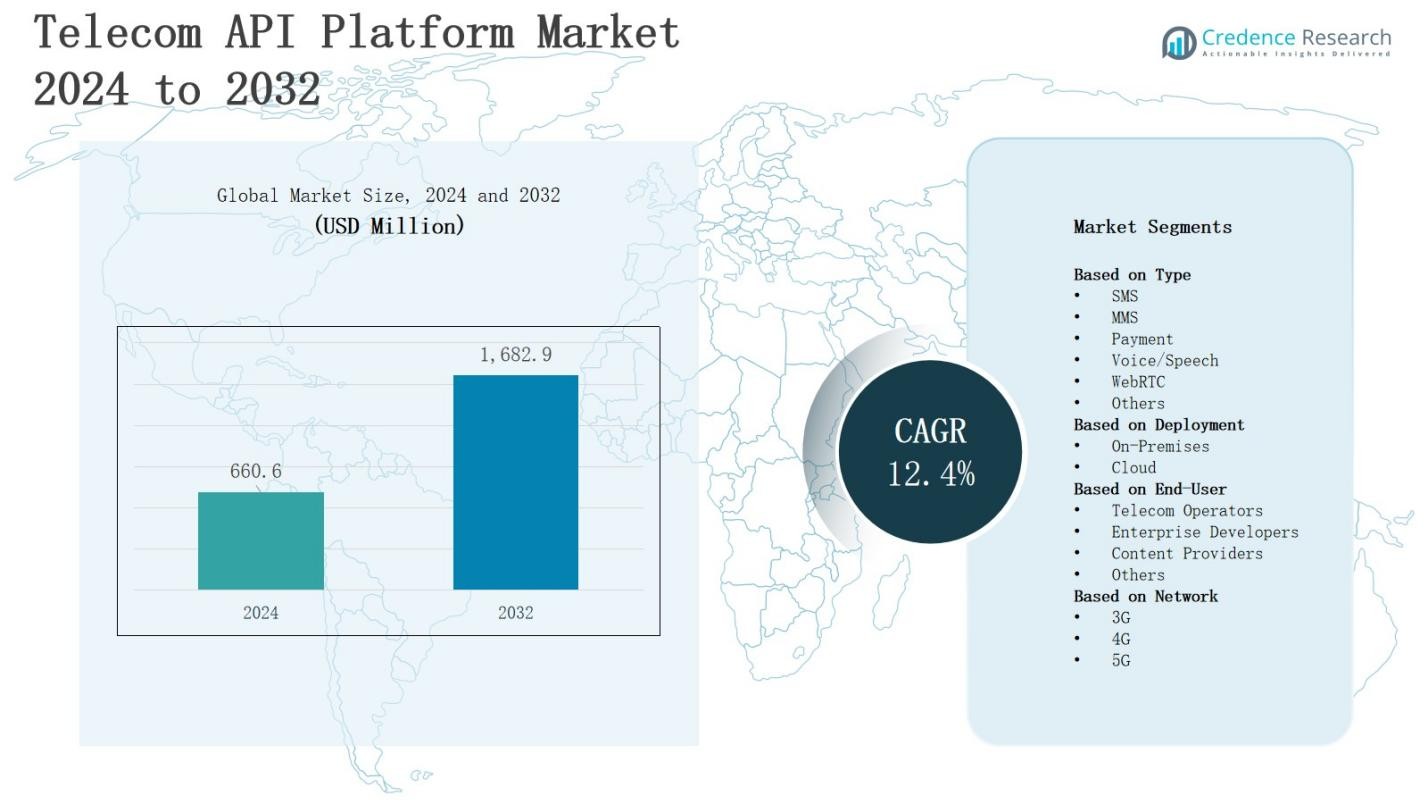
The global Telecom API market is projected to grow from USD 660.6 million in 2024 to USD 1,682.9 million by 2032, registering a CAGR of 12.4% during the forecast period.
| REPORT ATTRIBUTE | DETAILS |
|---|---|
| Historical Period | 2020-2024 |
| Base Year | 2024 |
| Forecast Period | 2025-2032 |
| Telecom API Market Size 2024 | USD 660.6 Million |
| Telecom API Market, CAGR | 12.4% |
| Telecom API Market Size 2032 | USD 1,682.9 Million |
The Telecom API market grows due to increasing demand for seamless communication, rising adoption of cloud-based services, and the expansion of mobile applications across industries. Businesses leverage APIs to enhance customer engagement, enable real-time data exchange, and integrate advanced features like VoIP, messaging, and location services. The surge in IoT devices and 5G deployment accelerates API utilization for high-speed, low-latency connectivity. Trends include the integration of AI-driven analytics, API monetization models, and greater emphasis on security and compliance. Strategic partnerships between telecom operators and developers further drive innovation and expand service offerings in the competitive digital ecosystem.
The Telecom API market spans North America, Europe, Asia-Pacific, and the Rest of the World, each contributing to global growth through diverse adoption drivers and infrastructure advancements. North America leads with advanced telecom networks and strong developer ecosystems, followed by Europe’s regulatory-driven secure API integration. Asia-Pacific benefits from rapid digital transformation and 5G expansion, while the Rest of the World gains momentum from improving connectivity and mobile service adoption. Key players include Twilio Inc., Nexmo (Vonage API Platform), Plivo Inc., Sinch AB, MessageBird, and Bandwidth Inc.
Market Insights
- The global Telecom API market is projected to grow from USD 660.6 million in 2024 to USD 1,682.9 million by 2032, at a CAGR of 12.4%, driven by rising demand for seamless communication and integration across digital services.
- Expanding mobile applications and cloud-based services boost API adoption, enabling real-time connectivity, location-based services, and in-app communication with scalable deployment models.
- IoT proliferation and 5G rollout accelerate API utilization, supporting high-speed, low-latency connectivity for industries like healthcare, automotive, and manufacturing.
- AI-driven analytics and API monetization models enhance revenue potential, enabling intelligent routing, predictive insights, and secure, compliance-ready service delivery.
- Integration complexity and interoperability challenges hinder adoption, with legacy infrastructure, diverse protocols, and standards creating deployment delays.
- Security risks and compliance pressures require robust authentication, encryption, and governance to address threats and meet stringent regulatory requirements.
- Regionally, North America leads with 38% share, followed by Europe at 27%, Asia-Pacific at 24%, and the Rest of the World at 11%, each benefiting from unique adoption drivers and connectivity advancements.
Market Drivers
Growing Demand for Seamless Communication and Integration
The Telecom API market benefits from rising demand for seamless communication solutions that integrate voice, messaging, and video into digital services. Enterprises use APIs to enhance customer engagement, streamline workflows, and provide consistent user experiences across devices. It supports businesses in delivering omnichannel communication by enabling quick integration with mobile and web applications. The growth of e-commerce, online services, and remote work accelerates adoption. Organizations seek faster deployment and flexible communication capabilities.
- For instance, Sendbird offers a communication API platform enabling developers to add in-app messaging, voice, and video call capabilities to web and mobile apps. It supports millions of users simultaneously, ensuring smooth, real-time communication with features like media sharing, typing indicators, and push notifications, driving high user engagement.
Expansion of Mobile Applications and Cloud-Based Services
The Telecom API market experiences strong growth due to the rapid expansion of mobile applications and cloud-based services. Developers rely on APIs to integrate advanced telecom functions without complex infrastructure investments. It enables real-time connectivity, location-based services, and in-app communication features. The scalability of cloud platforms supports widespread deployment. Increasing smartphone penetration and mobile internet usage drive API integration. Service providers innovate to meet diverse industry-specific needs efficiently.
- For instance, Saudi Telecommunication Company (STC) implemented a direct-carrier billing API enabling customers to pay for partner services like Netflix, Apple, and Microsoft through their STC bills, reducing the need for unique integrations for each partner.
Rising Impact of IoT and 5G Deployment
The Telecom API market gains momentum from the rising adoption of IoT devices and the global rollout of 5G networks. APIs facilitate high-speed, low-latency connections critical for IoT applications in sectors like healthcare, automotive, and manufacturing. It supports real-time monitoring, remote control, and predictive analytics through connected devices. The improved bandwidth and network reliability of 5G enhance API performance. Industry players invest in advanced API solutions to meet evolving connectivity requirements.
Shift Toward AI-Driven Analytics and Monetization Models
The Telecom API market evolves with the integration of AI-driven analytics and innovative monetization strategies. APIs now support intelligent routing, automated responses, and predictive customer insights. It empowers telecom operators to create new revenue streams by offering premium API services to enterprises. API marketplaces simplify access for developers. Enhanced security measures address compliance needs. The combination of AI, analytics, and monetization fuels continuous innovation in telecom services delivery.
Market Trends
Integration of Telecom APIs with Emerging Technologies
The Telecom API market witnesses a strong trend of integration with emerging technologies such as artificial intelligence, blockchain, and edge computing. APIs enable telecom operators to deliver advanced capabilities, including intelligent call routing, secure identity verification, and real-time data processing at the network edge. It strengthens operational efficiency and supports innovative service delivery models. This convergence allows businesses to create differentiated digital experiences, enhancing competitiveness in increasingly tech-driven markets.
- For instance, TOMIA collaborated with Infosys to transform the telecom settlement process using blockchain technology. This solution improved automation and dispute management across roaming and interconnect partner ecosystems, reducing disputes among communication service providers.
Growth of API Monetization and Marketplace Models
The Telecom API market sees a shift toward monetization through API marketplaces, enabling telecom operators to package and sell API-based services to third-party developers. It allows operators to diversify revenue streams while fostering innovation across industries. API marketplaces simplify discovery, access, and integration, encouraging broader adoption. Telecom companies focus on tiered pricing, usage-based billing, and premium feature offerings. These models increase API visibility and encourage ecosystem collaboration for long-term growth.
- For instance, Twilio monetizes its cloud communications platform by charging developers based on API calls for SMS, voice, and video services.
Rising Focus on Security and Regulatory Compliance
The Telecom API market trends toward heightened security and compliance measures in response to growing cyber threats and stringent data protection regulations. APIs incorporate advanced authentication protocols, encryption, and traffic monitoring to ensure safe data exchange. It addresses the critical need for trust in digital communication services. Telecom operators implement governance frameworks for API usage, protecting sensitive customer data. This emphasis on security fosters reliability and strengthens customer relationships.
Adoption of Low-Code and No-Code Development Tools
The Telecom API market embraces low-code and no-code tools to enable faster API integration for developers and non-technical teams. These tools simplify the process of embedding telecom functionalities into applications without deep coding expertise. It accelerates innovation cycles, reduces deployment timelines, and lowers development costs. Telecom providers invest in intuitive API design interfaces. This trend supports rapid service customization and empowers enterprises to scale communication solutions efficiently.
Market Challenges Analysis
Complex Integration and Interoperability Issues
The Telecom API market faces significant challenges related to integration and interoperability across diverse systems and technologies. Businesses often operate on legacy infrastructure that is difficult to align with modern API frameworks. It creates delays in deployment and increases operational complexity for service providers and developers. Differences in standards, protocols, and network configurations further hinder seamless API adoption. Telecom operators must invest in adaptable, cross-platform solutions to overcome these technical barriers and ensure consistent performance across various environments.
Security Risks and Compliance Pressures
The Telecom API market encounters persistent concerns over security vulnerabilities and regulatory compliance. APIs are susceptible to cyberattacks, data breaches, and unauthorized access if not properly secured. It requires robust authentication, encryption, and monitoring mechanisms to safeguard sensitive information. Increasingly strict data protection regulations demand continuous updates to API governance policies. Failure to meet compliance standards can result in reputational damage and financial penalties. Telecom providers must prioritize secure API design to maintain trust and meet evolving legal requirements.
Market Opportunities
Expansion into Emerging Digital Services and IoT Ecosystems
The Telecom API market holds strong growth potential through expansion into emerging digital services and IoT ecosystems. APIs enable telecom operators to deliver value-added services such as smart home solutions, connected healthcare, and industrial automation. It supports seamless integration between devices, networks, and applications, creating new revenue streams for service providers. The rapid deployment of 5G enhances the capabilities of APIs for high-speed, low-latency communication. This opportunity positions telecom operators as essential enablers in advanced connectivity solutions.
Growth Potential in AI-Driven Personalization and Analytics
The Telecom API market can leverage AI-driven personalization and analytics to enhance customer engagement and operational efficiency. APIs equipped with AI capabilities allow real-time data analysis, predictive service recommendations, and automated customer interactions. It helps telecom providers deliver tailored solutions for diverse industries, from finance to retail. The demand for data-driven decision-making creates opportunities for premium API services. Telecom operators investing in AI-integrated APIs can differentiate their offerings and capture a competitive edge in the digital economy.
Market Segmentation Analysis:
By Type
The Telecom API market is segmented into SMS, MMS, Payment, Voice/Speech, WebRTC, and Others. SMS and Voice/Speech APIs hold significant adoption due to their role in customer engagement and authentication services. Payment APIs gain traction with the rise of digital transactions and mobile wallets. It enables real-time communication and secure financial interactions. WebRTC supports browser-based video and audio calls without plugins, enhancing user experience. MMS and other APIs serve niche multimedia and application-specific needs.
- For instance, WebRTC powers browser-based video and audio calls for platforms like Google Meet and Zoom, enabling plugin-free, high-quality communication for millions of users worldwide.
By Deployment
The Telecom API market is categorized into On-Premises and Cloud deployments. Cloud deployment dominates due to its scalability, cost-efficiency, and faster integration capabilities. It allows enterprises and developers to access telecom functionalities without heavy infrastructure investment. On-premises deployment appeals to organizations requiring strict control over data and network security. The growing preference for hybrid solutions offers flexibility in managing resources and compliance requirements across various industries.
- For instance, Oracle’s API Platform Cloud Service provides hybrid deployment where management is in the cloud, but gateways can be deployed on-premises or elsewhere, offering flexibility and efficient API management.
By End-User
The Telecom API market serves Telecom Operators, Enterprise Developers, Content Providers, and Others. Telecom operators utilize APIs to expand service offerings and monetize network capabilities. Enterprise developers integrate APIs into business applications to improve communication and workflow automation. It supports content providers in delivering multimedia services and interactive experiences. The Others category includes startups and niche service providers leveraging APIs for innovative, market-specific solutions.
Segments:
Based on Type
- SMS
- MMS
- Payment
- Voice/Speech
- WebRTC
- Others
Based on Deployment
- On-Premises
- Cloud
Based on End-User
- Telecom Operators
- Enterprise Developers
- Content Providers
- Others
Based on Network
- 3G
- 4G
- 5G
Based on the Geography:
- North America
- U.S.
- Canada
- Mexico
- Europe
- Germany
- France
- U.K.
- Italy
- Spain
- Rest of Europe
- Asia Pacific
- China
- Japan
- India
- South Korea
- South-east Asia
- Rest of Asia Pacific
- Latin America
- Brazil
- Argentina
- Rest of Latin America
- Middle East & Africa
- GCC Countries
- South Africa
- Rest of the Middle East and Africa
Regional Analysis
North America
North America holds the largest share of the Telecom API market at 38%, driven by advanced telecom infrastructure, high smartphone penetration, and strong adoption of cloud-based communication services. Telecom operators in the United States and Canada leverage APIs to monetize network capabilities and support innovative digital solutions. It benefits from a mature developer ecosystem that integrates APIs into diverse applications. The region also leads in early adoption of 5G and IoT, boosting demand for real-time, low-latency connectivity. Regulatory frameworks encourage secure and compliant API deployment across sectors such as finance, healthcare, and retail. Strategic partnerships between telecom providers and technology companies enhance the region’s market position.
Europe
Europe accounts for 27% of the Telecom API market, supported by widespread mobile connectivity, stringent data protection regulations, and strong enterprise adoption. Countries like Germany, the United Kingdom, and France focus on API integration to enhance digital services, particularly in finance, manufacturing, and e-commerce. It benefits from cross-border standardization efforts that promote interoperability. Telecom operators invest in API marketplaces to engage developers and diversify revenue streams. The region’s emphasis on secure communication aligns with GDPR requirements, driving demand for encrypted API solutions. Expanding 5G coverage further accelerates API adoption for advanced communication applications.
Asia-Pacific
Asia-Pacific represents 24% of the Telecom API market, fueled by rapid digital transformation, increasing smartphone usage, and expanding internet connectivity. Major economies such as China, India, Japan, and South Korea drive market growth through high demand for mobile applications and digital payment services. It leverages the scalability of cloud deployments to support diverse communication needs. The rollout of 5G across the region enables faster API-based service delivery. Local telecom providers collaborate with global technology firms to offer enhanced voice, messaging, and payment solutions. Government-led digitalization initiatives further strengthen the adoption of telecom APIs across industries.
Rest of the World
The Rest of the World holds 11% of the Telecom API market, with growth driven by improving telecom infrastructure and rising adoption of mobile services in Latin America, the Middle East, and Africa. It gains momentum from expanding e-commerce activities, mobile banking penetration, and cross-border digital trade. Telecom operators in these regions adopt APIs to improve customer engagement and operational efficiency. Investments in 4G and 5G networks increase the scope for API integration. The demand for cost-effective, scalable communication solutions positions these regions as emerging opportunities for global telecom API providers.
Key Player Analysis
- Apidaze
- Zang (Avaya)
- MessageBird
- Ribbon Communications
- Mitel Networks Corporation
- Plivo Inc.
- Telestax Inc.
- Sinch AB
- Alcatel-Lucent Enterprise
- Bandwidth Inc.
- Tropo (Cisco)
- Twilio Inc.
- Nexmo (Vonage API Platform)
Competitive Analysis
The Telecom API market is highly competitive, with global and regional players focusing on innovation, scalability, and service diversification to strengthen their market position. It is characterized by rapid technological advancements, increasing API monetization strategies, and growing collaboration between telecom operators and developers. Leading companies such as Twilio Inc., Nexmo (Vonage API Platform), Plivo Inc., Tropo (Cisco), Bandwidth Inc., Sinch AB, MessageBird, Telestax Inc., Apidaze, Zang (Avaya), Ribbon Communications, Alcatel-Lucent Enterprise, and Mitel Networks Corporation compete by offering a wide range of APIs for messaging, voice, payment, and WebRTC services. These players invest in AI-driven analytics, low-code development tools, and secure API frameworks to address evolving customer demands. Strategic partnerships, acquisitions, and API marketplace expansions are central to competitive growth, enabling companies to capture emerging opportunities across industries such as finance, healthcare, retail, and IoT-driven sectors. The market favors vendors that deliver high performance, seamless integration, and compliance-ready solutions while adapting to regional connectivity requirements and advancing network capabilities like 5G.
Recent Developments
- In August 2023, IBM finalized its acquisition of Apptio Inc. and earlier in February 2023, IBM acquired StepZen Inc., which improves API development with GraphQL technology.
- In September 2023, Ericsson entered a commercial partnership with Deutsche Telekom to launch new API-based telecom services leveraging 5G advancements.
- On August 4, 2025, Bharti Airtel’s digital arm, Xtelify, rolled out a new sovereign cloud platform named Airtel Cloud coupled with AI-powered software tools aimed at telecom operators and businesses.
- On November 13, 2024, Nokia completed the acquisition of the world’s largest API hub and marketplace from U.S.-based Rapid. This move strengthens Nokia’s ability to support 4G and 5G network offerings by providing clients with standardized API integration, network management, and developer collaboration tools.
Market Concentration & Characteristics
The Telecom API market is moderately concentrated, with a mix of global leaders and regional players competing through innovation, scalability, and service diversity. It features a dynamic competitive environment where companies differentiate through advanced API functionalities, AI integration, and secure communication solutions. Key vendors focus on API monetization, developer engagement, and ecosystem expansion to capture a broader customer base. Strategic partnerships between telecom operators, technology firms, and enterprises drive product innovation and market reach. The market benefits from high growth potential driven by mobile application proliferation, IoT expansion, and 5G deployment. Vendors compete on performance, interoperability, and compliance readiness to meet evolving enterprise and consumer needs. The ability to deliver cost-effective, scalable, and high-quality APIs across diverse industries defines competitive strength, while regulatory alignment and security capabilities remain critical for sustaining market position in an increasingly digital and connected global environment.
Report Coverage
The research report offers an in-depth analysis based on Type, Deployment, End-User, Network and Geography. It details leading market players, providing an overview of their business, product offerings, investments, revenue streams, and key applications. Additionally, the report includes insights into the competitive environment, SWOT analysis, current market trends, as well as the primary drivers and constraints. Furthermore, it discusses various factors that have driven market expansion in recent years. The report also explores market dynamics, regulatory scenarios, and technological advancements that are shaping the industry. It assesses the impact of external factors and global economic changes on market growth. Lastly, it provides strategic recommendations for new entrants and established companies to navigate the complexities of the market.
Future Outlook
- Demand for telecom APIs will rise with the expansion of 5G networks and advanced connectivity services.
- AI and machine learning integration will enhance API capabilities for predictive analytics and automation.
- IoT adoption across industries will drive the need for real-time, low-latency API solutions.
- API marketplaces will expand, enabling faster access and monetization opportunities for telecom operators.
- Security-focused API designs will become a priority to address increasing cyber threats.
- Low-code and no-code tools will make API integration more accessible to non-technical users.
- Cloud-based deployment will dominate due to its scalability and cost efficiency.
- Partnerships between telecom providers and tech companies will accelerate service innovation.
- Industry-specific API solutions will emerge to meet unique sector requirements.
- Regulatory compliance will shape API development strategies across global markets.

Request a Free Sample
Fill in your details and we'll send you a free sample report.
- Sample data tables & charts
- Research methodology
Market Dynamics
Expansion of Mobile Applications and Cloud-Based Services
The rapid growth of mobile applications and cloud-based platforms is driving demand for telecom APIs, as developers and enterprises seek scalable, real-time communication features without heavy infrastructure investments.
IoT Proliferation and 5G Rollout
The increasing adoption of IoT devices and the deployment of 5G networks require high-speed, low-latency connectivity, which telecom APIs enable by facilitating seamless integration and real-time data exchange across devices and applications.
Integration of AI-Driven Analytics and Monetization Models
Telecom APIs are increasingly incorporating AI-driven analytics and supporting new monetization strategies, allowing operators to offer premium, intelligent services such as predictive insights, automated routing, and usage-based billing.
Rising Security and Compliance Requirements
Growing concerns over data privacy, cyber threats, and regulatory compliance are pushing telecom operators to adopt robust, secure API frameworks, which in turn drives market growth as enterprises prioritize trusted, compliant communication solutions.
Strategic Partnerships and Ecosystem Expansion
Collaboration between telecom operators, technology firms, and developers is accelerating innovation and expanding the range of API-enabled services, helping providers reach new markets and address diverse industry needs.
Need a Custom Version of This Report?
Tailor the scope, geography, or segments to your exact requirements.
- Custom geography or segment scope
- Direct access to our analyst team
Frequently Asked Questions
What is the current market size for the Telecom API market, and what is its projected valuation by the end of the forecast period in 2032?
At what Compound Annual Growth Rate is the Telecom API market projected to expand throughout the forecast period between 2025 and 2032?
Which segment of the Telecom API market accounted for the highest revenue share in 2024 among all identified market segments?
What are the primary demand-driving factors contributing to the rapid expansion of the Telecom API market globally across various application areas?
Who are the top key players operating in the Telecom API market with significant market presence and competitive product portfolios?
Table of Content
Chapter 1 Market Segmentation
- 1.1 Segmentation Framework
- 1.1.1 Product and Service Classification
- 1.1.2 Application and End-Use Classification
- 1.1.3 Technology and Solution Classification
- 1.1.4 Customer and Distribution Channel Classification
- 1.1.5 Geographic Segmentation
- 1.1.6 Market Segment Definitions and Boundaries
- 1.2 By Type
- 1.2.1 SMS
- 1.2.2 MMS
- 1.2.3 Payment
- 1.2.4 Voice/Speech
- 1.2.5 WebRTC
- 1.2.6 Others
- 1.3 By Network
- 1.3.1 3G
- 1.3.2 4G
- 1.3.3 5G
- 1.4 By End-User
- 1.4.1 Telecom Operators
- 1.4.2 Enterprise Developers
- 1.4.3 Content Providers
- 1.4.4 Others
- 1.5 By Deployment
- 1.5.1 On-Premises
- 1.5.2 Cloud
Chapter 2 Introduction
- 2.1 Report Objectives and Scope
- 2.2 Product Definition and Industry Terminology
- 2.3 Market Inclusions and Exclusions
- 2.4 Research Process
- 2.4.1 Primary Research and Expert Interviews
- 2.4.2 Secondary Research and Source Review
- 2.4.3 Top-Down and Bottom-Up Estimation
- 2.4.4 Data Triangulation and Verification
- 2.5 Market Size Measurement Basis
- 2.5.1 2024: USD 660.6 million → 2032: USD 1,682.9 million
- 2.6 Historical and Forecast Reference Periods
- 2.6.1 Base Year: 2024
- 2.6.2 Forecast Period: 2024-2032
- 2.7 Research Assumptions and Limitations
Chapter 3 Executive Summary
- 3.1 Market Snapshot and Key Findings
- 3.2 Base-Year Market Size, 2024
- 3.3 Forecast Market Size, 2032
- 3.4 Revenue and Volume Growth Outlook
- 3.5 Key Demand and Supply Indicators
- 3.6 Leading Market Segments
- 3.7 Fastest-Growing Market Opportunities
- 3.8 Regional Performance Highlights
- 3.9 Technology and Industry Transformation
- 3.10 Competitive Landscape Summary
- 3.11 Analyst View and Strategic Implications
Chapter 4 Global Telecom API Market Trends and Developments
- 4.1 Historical Industry Development
- 4.2 Recent Market Trends and Developments
- 4.3 Demand and Customer Behavior Trends
- 4.4 Technology and Product Innovation
- 4.5 Artificial Intelligence, Automation and Digitalization
- 4.6 Local Manufacturing and Supply Chain Realignment
- 4.7 Industry Partnerships, Mergers and Acquisitions
- 4.8 Sustainability and Circular Economy Developments
- 4.9 Government and Private Sector Investment Trends
- 4.10 Emerging Business Models and Commercialization
- 4.11 Industry Developments and Announcements
Chapter 5 Global Telecom API Market Production, Supply and Demand Analysis
- 5.1 Demand Trend and Consumption Analysis
- 5.2 Demand Forecast, 2024-2032
- 5.3 Production and Output Trend
- 5.4 Production and Output Forecast, 2024-2032
- 5.5 Installed Capacity and Capacity Utilization
- 5.6 Company-Wise Production Plants and Statistics
- 5.6.1 Installed Production Capacity
- 5.6.2 Actual Production
- 5.6.3 Planned Capacity and Expansion Targets
- 5.7 Supply Chain Structure and Procurement Trends
- 5.8 Supply-Demand Gap and Bottlenecks
- 5.9 Import Dependence and Sourcing Structure
- 5.10 Contract Manufacturing and Outsourcing
- 5.11 Regional Supply and Demand Concentration
Chapter 6 Global Telecom API Market Pricing Analysis
- 6.1 Pricing Structure and Measurement
- 6.2 Historical Pricing Trends
- 6.3 Pricing Outlook, 2024-2032
- 6.4 Average Selling Price and Unit Economics
- 6.5 Pricing by Product and Market Segment
- 6.6 Geographic Pricing Differences
- 6.7 Key Input, Energy, Labor and Logistics Costs
- 6.8 Contract Pricing and Purchasing Models
- 6.9 Pricing Sensitivity and Competitive Positioning
- 6.10 Price, Margin and Profitability Implications
Chapter 7 Global Telecom API Market Dynamics
- 7.1 Market Growth Drivers
- 7.1.1 Demand-Side Drivers
- 7.1.2 Technology and Innovation Drivers
- 7.1.3 Infrastructure and Investment Drivers
- 7.1.4 Regulatory and Policy Drivers
- 7.2 Market Restraints
- 7.2.1 Cost and Affordability Constraints
- 7.2.2 Technology and Adoption Barriers
- 7.2.3 Supply Chain and Operational Constraints
- 7.3 Market Challenges
- 7.3.1 Competitive Pressure and Margin Erosion
- 7.3.2 Skills, Infrastructure and Implementation Gaps
- 7.4 Emerging Market Opportunities
- 7.5 Market Dynamics Impact and Time-Horizon Assessment
Chapter 8 Global Telecom API Value Chain Analysis
- 8.1 Industry Value Chain Overview
- 8.2 Upstream Suppliers and Critical Inputs
- 8.3 Technology and Component Providers
- 8.4 Manufacturing or Service Delivery
- 8.5 Distribution, Channel Partners and Integrators
- 8.6 Downstream Applications and End Users
- 8.7 Value Addition and Profit Pools
- 8.8 Vertical Integration and Outsourcing
- 8.9 Supplier Concentration and Risk
- 8.10 Supply Chain Localization and Resilience
Chapter 9 Global Telecom API Market Regulations and Policies
- 9.1 Relevant Laws, Standards and Compliance Frameworks
- 9.2 Product, Service, Safety and Quality Requirements
- 9.3 Government Policies, Incentives and Subsidies
- 9.4 Imports, Exports and Trade Barriers
- 9.5 Public Procurement and Local Content Requirements
- 9.6 Environmental and Sustainability Compliance
- 9.7 Data Protection, AI and Cybersecurity Compliance
- 9.8 Upcoming Policy Changes and Market Implications
Chapter 10 Global Telecom API Market Hotspots and Opportunities
- 10.1 Market Opportunity Mapping and Growth Hotspots
- 10.2 High-Growth Applications and Customer Groups
- 10.3 Underserved Markets and White-Space Opportunities
- 10.4 Emerging Technology and Product Opportunities
- 10.5 New Capacity and Investment Hotspots
- 10.6 Market Entry and Expansion Opportunities
- 10.7 Distribution and Partnership Opportunities
- 10.8 Near-Term and Long-Term Commercial Potential
- 10.9 Opportunity Attractiveness and Execution Risks
Chapter 11 Global Telecom API Market Outlook, 2024-2032
- 11.1 Market Size and Analysis
- 11.1.1 Revenue (Market Measurement: 2024: USD 660.6 million → 2032: USD 1,682.9 million)
- 11.1.2 Market Volume and Quantity Sold
- 11.1.3 Historical Market Size
- 11.1.4 Base-Year Market Size, 2024
- 11.2 Market Forecast, 2024-2032
- 11.2.1 Revenue Forecast to 2032
- 11.2.2 Volume Forecast to 2032
- 11.2.3 CAGR and Year-on-Year Growth
- 11.2.4 Incremental Revenue Opportunity
- 11.3 Forecast Assumptions and Scenario Analysis
- 11.3.1 Base-Case Forecast
- 11.3.2 Optimistic and Conservative Scenarios
- 11.3.3 Technology, Pricing and Policy Sensitivities
- 11.4 Market Attractiveness and Growth Outlook
Chapter 12 Global Telecom API Market Segmentation and Outlook
- 12.1 Segmentation Summary and Market Shares, 2024
- 12.2 Largest and Fastest-Growing Segments
- 12.3 By Type - Market Size and Forecast, 2024-2032
- 12.3.1 Segment Definition and Scope
- 12.3.2 Historical Market Size
- 12.3.3 Revenue Forecast, 2024-2032
- 12.3.4 Volume Forecast, 2024-2032
- 12.3.5 Base-Year Market Share, 2024
- 12.3.6 Segment CAGR and Growth Drivers
- 12.3.7 Subsegment Market Size and Forecast
- 12.3.7.1 SMS
- 12.3.7.2 MMS
- 12.3.7.3 Payment
- 12.3.7.4 Voice/Speech
- 12.3.7.5 WebRTC
- 12.3.7.6 Others
- 12.3.8 Subsegment Pricing and Adoption Trends
- 12.3.9 Leading Suppliers and Competition
- 12.3.10 Regional Demand and Opportunities
- 12.4 By Network - Market Size and Forecast, 2024-2032
- 12.4.1 Segment Definition and Scope
- 12.4.2 Historical Market Size
- 12.4.3 Revenue Forecast, 2024-2032
- 12.4.4 Volume Forecast, 2024-2032
- 12.4.5 Base-Year Market Share, 2024
- 12.4.6 Segment CAGR and Growth Drivers
- 12.4.7 Subsegment Market Size and Forecast
- 12.4.7.1 3G
- 12.4.7.2 4G
- 12.4.7.3 5G
- 12.4.8 Subsegment Pricing and Adoption Trends
- 12.4.9 Leading Suppliers and Competition
- 12.4.10 Regional Demand and Opportunities
- 12.5 By End-User - Market Size and Forecast, 2024-2032
- 12.5.1 Segment Definition and Scope
- 12.5.2 Historical Market Size
- 12.5.3 Revenue Forecast, 2024-2032
- 12.5.4 Volume Forecast, 2024-2032
- 12.5.5 Base-Year Market Share, 2024
- 12.5.6 Segment CAGR and Growth Drivers
- 12.5.7 Subsegment Market Size and Forecast
- 12.5.7.1 Telecom Operators
- 12.5.7.2 Enterprise Developers
- 12.5.7.3 Content Providers
- 12.5.7.4 Others
- 12.5.8 Subsegment Pricing and Adoption Trends
- 12.5.9 Leading Suppliers and Competition
- 12.5.10 Regional Demand and Opportunities
- 12.6 By Deployment - Market Size and Forecast, 2024-2032
- 12.6.1 Segment Definition and Scope
- 12.6.2 Historical Market Size
- 12.6.3 Revenue Forecast, 2024-2032
- 12.6.4 Volume Forecast, 2024-2032
- 12.6.5 Base-Year Market Share, 2024
- 12.6.6 Segment CAGR and Growth Drivers
- 12.6.7 Subsegment Market Size and Forecast
- 12.6.7.1 On-Premises
- 12.6.7.2 Cloud
- 12.6.8 Subsegment Pricing and Adoption Trends
- 12.6.9 Leading Suppliers and Competition
- 12.6.10 Regional Demand and Opportunities
- 12.7 Segment Growth Comparison
- 12.8 Segment Attractiveness and Priority Matrix
Chapter 13 Global Telecom API End-Use and Application Market Outlook
- 13.1 End-Use Industry and Customer Demand Structure
- 13.2 Leading Applications and Customer Groups
- 13.3 End-Use Market Size, Share and Forecast
- 13.4 Major End-Use Industry Deep Dives
- 13.4.1 Customer Requirements and Use Cases
- 13.4.2 Demand and Replacement Cycles
- 13.4.3 Technical and Regulatory Considerations
- 13.4.4 Purchasing and Procurement Models
- 13.4.5 Leading Vendors and Distribution Channels
- 13.4.6 Forecast and Commercial Opportunities
- 13.5 Emerging Applications and Cross-Segment Demand
- 13.6 End-Use Industry Investment Priorities
Chapter 14 Global Telecom API Geographic Market Outlook, 2024-2032
- 14.1 Regional Market Size and Share, 2024
- 14.2 Regional Market Forecast, 2024-2032
- 14.3 Regional Pricing, Production and Demand Differences
- 14.4 North America
- 14.4.1 United States
- 14.4.2 Canada
- 14.4.3 Mexico
- 14.5 Europe
- 14.5.1 Germany
- 14.5.2 France
- 14.5.3 Italy
- 14.5.4 United Kingdom
- 14.5.5 Spain
- 14.5.6 Poland
- 14.5.7 Russia
- 14.5.8 Netherlands
- 14.5.9 Belgium
- 14.5.10 Sweden
- 14.5.11 Denmark
- 14.5.12 Norway
- 14.5.13 Rest of Europe
- 14.6 Asia Pacific
- 14.6.1 China
- 14.6.2 India
- 14.6.3 Japan
- 14.6.4 South Korea
- 14.6.5 Thailand
- 14.6.6 Indonesia
- 14.6.7 Vietnam
- 14.6.8 Malaysia
- 14.6.9 Australia
- 14.6.10 Rest of Asia Pacific
- 14.7 Latin America
- 14.7.1 Brazil
- 14.7.2 Argentina
- 14.7.3 Colombia
- 14.7.4 Chile
- 14.7.5 Rest of Latin America
- 14.8 Middle East
- 14.8.1 Saudi Arabia
- 14.8.2 United Arab Emirates
- 14.8.3 Turkey
- 14.8.4 Israel
- 14.8.5 Iran
- 14.8.6 Rest of the Middle East
- 14.9 Africa
- 14.9.1 South Africa
- 14.9.2 Egypt
- 14.9.3 Nigeria
- 14.9.4 Morocco
- 14.9.5 Rest of Africa
- 14.10 Regional Investment, Policy and Supply Chain Differences
- 14.11 Regional Competitive Landscape
- 14.12 Geographic Growth Hotspots
Chapter 15 Global Telecom API Technology, Innovation and Sustainability Outlook
- 15.1 Technology Landscape and Maturity
- 15.2 Product, Process and Service Innovation
- 15.3 AI, Automation and Digital Tools in the Industry
- 15.4 Technology Adoption and Performance Benchmarking
- 15.5 Innovation Pipeline and R&D Investment
- 15.6 Patent and Intellectual Property Trends
- 15.7 Energy Efficiency and Resource Management
- 15.8 Sustainability, Recycling and Circularity
- 15.9 Technology Roadmap, 2024-2032
- 15.10 Risks of Obsolescence and Technology Substitution
Chapter 16 Global Telecom API Market Key Strategic Imperatives
- 16.1 Growth and Market Entry Priorities
- 16.2 High-Return Products and Segments
- 16.3 Pricing, Profitability and Cost Optimization
- 16.4 Technology Investment and Product Differentiation
- 16.5 Supply Chain Localization and Resilience
- 16.6 Distribution and Customer Acquisition
- 16.7 Partnership, Acquisition and Capacity Strategy
- 16.8 Regional Expansion Priorities
- 16.9 Short-, Medium- and Long-Term Actions
Chapter 17 Competition Outlook
- 17.1 Industry Competition Characteristics
- 17.2 Market Structure and Concentration
- 17.3 Market Share and Competitive Positioning, 2024
- 17.4 Company-Wise Revenue and Product Benchmarking
- 17.5 Production and Service Capacity Benchmarking
- 17.6 Technology, Pricing and Differentiation
- 17.7 Regional Footprint and Distribution Strength
- 17.8 Mergers, Acquisitions and Strategic Alliances
- 17.9 New Entrants and Competitive Threats
- 17.10 Porter's Five Forces and Industry Attractiveness
- 17.11 Competitive Outlook, 2024-2032
Chapter 18 Company Profiles
- 18.1 Company Coverage and Selection Criteria
- 18.2 Twilio Inc.
- 18.2.1 Business Description
- 18.2.2 Company Ownership and Geographic Presence
- 18.2.3 Product and Service Portfolio
- 18.2.4 Manufacturing and Operating Footprint
- 18.2.5 Production Capacity and Expansion Plans
- 18.2.6 Financial Performance and Investment
- 18.2.7 Market Share and Competitive Position
- 18.2.8 Technology and Innovation Capabilities
- 18.2.9 Strategic Alliances or Partnerships
- 18.2.10 Recent Developments
- 18.2.11 Growth Strategy and Outlook
- 18.3 Nexmo (Vonage API Platform)
- 18.4 Plivo Inc.
- 18.5 Sinch AB
- 18.6 MessageBird
- 18.7 Bandwidth Inc.
- 18.8 Tropo (Cisco)
- 18.9 Telestax Inc.
- 18.10 Mitel Networks Corporation
- 18.11 Alcatel-Lucent Enterprise
- 18.12 Other Relevant Market Participants
Note: Every listed company is profiled on the structure shown under the first company. The company list is preliminary and may change based on research findings, market developments, data availability and client requirements.
Chapter 19 Disclaimer
- 19.1 Research and Forecast Disclaimer
- 19.2 Data Source and Estimation Limitations
Note: The depth of individual sections depends on data availability for this market. Volume, capacity, trade and other unit-based metrics are included where applicable.

