Market Overview:
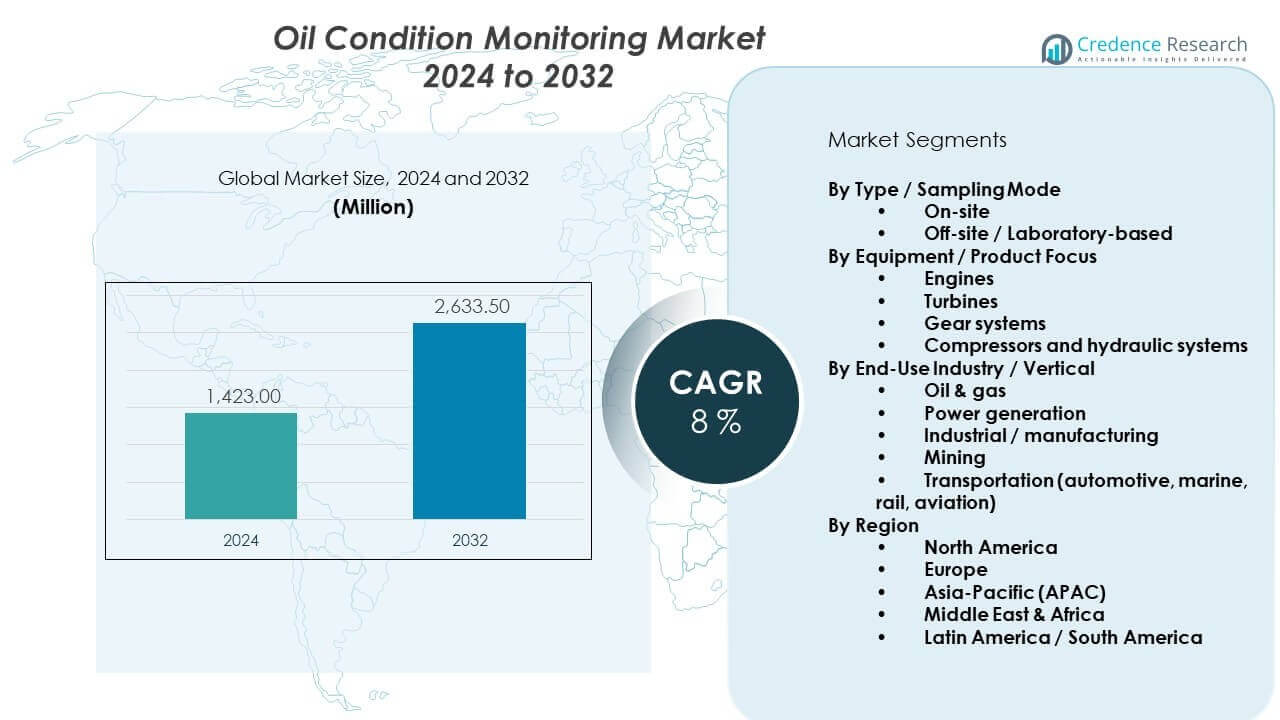
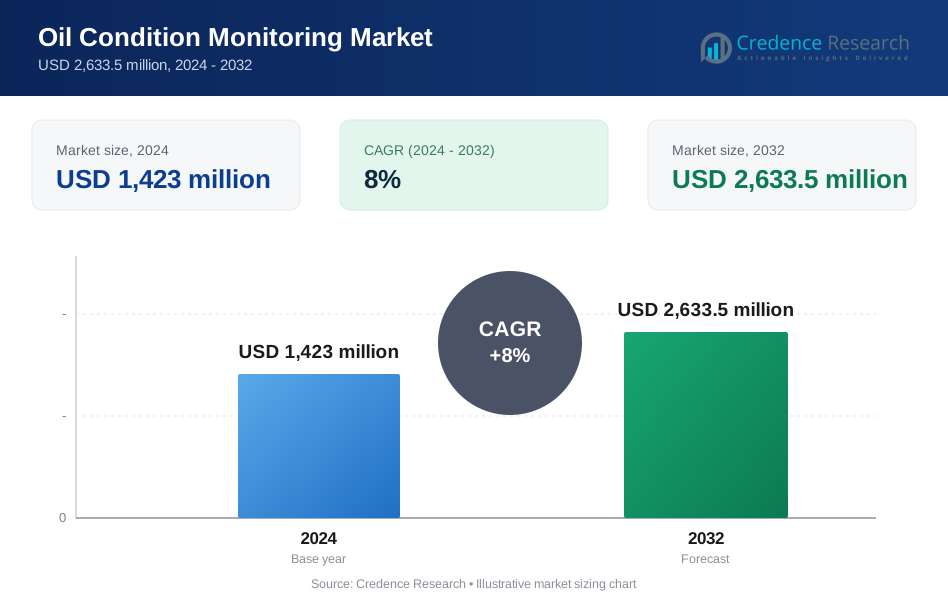
The Oil condition monitoring market is projected to grow from USD 1,423 million in 2024 to USD 2,633.5 million by 2032. The market is expected to expand at a CAGR of 8% during the forecast period.
| REPORT ATTRIBUTE | DETAILS |
|---|---|
| Historical Period | 2020-2023 |
| Base Year | 2024 |
| Forecast Period | 2025-2032 |
| Oil Condition Monitoring Market Size 2024 | USD 1,423 million |
| Oil Condition Monitoring Market, CAGR | 8% |
| Oil Condition Monitoring Market Size 2032 | USD 2,633.5 million |
The Oil condition monitoring market grows due to rising demand for predictive maintenance across industries. Asset owners aim to reduce downtime and repair costs. Condition-based monitoring helps detect wear before failure. Industrial automation increases reliance on critical machinery. Power generation plants seek longer equipment life. Manufacturing units focus on operational efficiency and uptime. Mining operators monitor heavy equipment health. Transportation fleets adopt oil analysis to prevent breakdowns. Digital sensors improve test accuracy. Data analytics supports faster maintenance decisions. Safety compliance needs also drive wider adoption.
North America leads the Oil condition monitoring market due to strong industrial automation adoption. The United States shows high usage across manufacturing and power sectors. Europe follows with strict maintenance and safety standards. Germany and the United Kingdom invest in predictive technologies. Asia Pacific emerges as a fast-growing region. China and India expand industrial output rapidly. Infrastructure development boosts machinery deployment. Oil and gas activity supports monitoring demand. Latin America shows gradual uptake in mining sectors. Middle East adoption grows with energy asset management needs.
Market Insights:
- The Oil condition monitoring market was valued at USD 1,423 million in 2024 and is expected to reach USD 2,633.5 million by 2032, growing at a CAGR of 8%.
- North America leads with about 35% share due to advanced maintenance practices, followed by Europe at 30% from strict compliance needs, and Asia-Pacific at 25% driven by industrial expansion.
- Asia-Pacific stands as the fastest-growing region with nearly 25% share, supported by rising manufacturing output, infrastructure projects, and equipment deployment.
- By type, on-site oil condition monitoring accounts for around 60% share, supported by real-time diagnostics and reduced downtime requirements.
- By end use, oil and gas holds close to 32% share, while power generation follows with about 24%, driven by asset reliability priorities.
Market Drivers:
Rising Emphasis On Predictive Maintenance And Asset Reliability Programs
Companies focus on preventing unexpected equipment failure. Maintenance teams track lubricant health to spot early wear. The Oil condition monitoring market supports timely fault detection. Plants aim to reduce shutdown frequency. Heavy machinery uptime remains a top priority. Oil analysis lowers repair expenses. Operations managers rely on data-led maintenance planning. Reliability goals drive repeat system adoption.
- For instance, Shell plc reports predictive maintenance programs across upstream assets helped cut unplanned equipment downtime by more than 20% through oil and condition monitoring integration.
Expanding Industrial Automation Across Manufacturing And Process Industries
Automation increases dependence on critical rotating equipment. Machines operate with tighter tolerance limits. Lubricant condition affects performance stability. Monitoring tools support continuous machine health checks. Automated plants reduce manual inspection scope. Sensors provide faster alerts on oil degradation. Production managers value stable output quality. Automation growth sustains monitoring demand.
- For instance, ifm electronic gmbh reports its vibration and oil condition sensors operate with diagnostic update cycles under one second, enabling real-time protection for automated production lines.
Growing Focus On Equipment Lifecycle Extension And Cost Control
Asset owners seek longer machine service life. Replacement costs pressure capital budgets. Oil monitoring improves maintenance timing accuracy. Early detection avoids secondary component damage. Maintenance schedules become condition-based. Industrial buyers value predictable service cycles. Cost discipline supports wider deployment. Lifecycle management strengthens market demand.
Stricter Safety And Operational Compliance Requirements Across Industries
Safety norms demand reliable equipment operation. Failure incidents trigger audits and penalties. Oil condition insights reduce mechanical risk. Operators improve compliance reporting accuracy. Monitoring supports safer working environments. Critical sectors value traceable maintenance records. Compliance teams prefer documented oil health data. Regulatory pressure supports adoption.
Market Trends:
Integration Of Digital Platforms And Advanced Data Interpretation Tools
Vendors embed analytics into monitoring systems. Software dashboards improve data visibility. Maintenance teams access real-time oil insights. Cloud platforms enable remote asset tracking. Decision cycles shorten with faster interpretation. Digital records support audit readiness. User interfaces become more intuitive. Data-driven maintenance gains acceptance.
- For instance, Schaeffler AG integrates oil debris analysis with digital condition platforms that monitor millions of bearings worldwide, supporting predictive alerts based on historical failure data.
Shift Toward Portable And On-Site Oil Analysis Solutions
Industries prefer quick on-site diagnostics. Portable tools reduce lab dependency. Field teams conduct immediate oil checks. Downtime risk declines with faster feedback. Compact devices suit remote locations. Mobile testing supports flexible operations. Service teams improve response time. Convenience drives adoption growth.
- For instance, Parker Hannifin Corp. offers handheld oil contamination sensors capable of ISO cleanliness classification within minutes, supporting faster maintenance decisions in hydraulic systems.
Rising Adoption Of Multi-Parameter Oil Monitoring Technologies
Systems measure particles, moisture, and viscosity together. Multi-sensor tools improve diagnostic depth. Maintenance teams gain broader condition insight. Single-point testing becomes less common. Integrated metrics improve fault accuracy. Asset managers prefer consolidated reports. Technology convergence improves system value. Monitoring scope continues to widen.
Increased Use Of Oil Monitoring In Non-Traditional End-Use Sectors
Sectors beyond heavy industry adopt oil analysis. Renewable energy assets require lubrication control. Marine operators monitor engine health closely. Transportation fleets track lubricant condition. Agriculture equipment usage rises steadily. Smaller operators seek efficiency gains. Market penetration expands across sectors. Application diversity supports steady growth.
Market Challenges Analysis:
High Initial Investment And Limited Awareness Among Small Operators
System costs deter small enterprises. Budget limits slow adoption decisions. Many operators rely on reactive maintenance. Awareness of oil analysis benefits remains uneven. Training needs increase deployment complexity. Return timelines appear uncertain for some buyers. Procurement teams delay technology upgrades. Cost sensitivity restrains penetration.
Data Interpretation Complexity And Dependence On Skilled Personnel
Oil data requires expert analysis. Misinterpretation risks wrong maintenance action. Skilled analysts remain limited in supply. Training programs raise operational cost. Smaller plants lack in-house expertise. Outsourcing adds service expense. Decision delays affect equipment reliability. Skill gaps challenge adoption speed.
Market Opportunities:
Expansion Of Smart Maintenance Programs Across Emerging Industrial Economies
Emerging markets invest in modern maintenance practices. New plants adopt condition-based strategies early. The Oil condition monitoring market benefits from greenfield projects. Industrial upgrades create fresh demand pools. Local manufacturers seek efficiency improvement. Equipment imports raise monitoring needs. Government focus on productivity supports adoption. Growth economies offer strong expansion scope.
Growing Demand For Integrated Monitoring Solutions Across Asset Classes
Industries prefer unified monitoring platforms. Multi-asset visibility improves planning accuracy. Vendors offer scalable solution portfolios. Integration reduces vendor complexity. End users value simplified maintenance workflows. Cross-asset insights improve reliability control. Digital ecosystems support long-term contracts. Solution bundling creates revenue opportunities.
Market Segmentation Analysis:
By Type / Sampling Mode
On-site sampling supports rapid fault detection and quick maintenance action. Field teams use portable tools to assess oil health in real time. This mode suits critical assets with limited downtime tolerance. Off-site or laboratory-based analysis delivers deeper diagnostic accuracy. Labs evaluate wear metals, contamination, and chemical properties. This approach supports root cause analysis and long-term maintenance planning. The Oil condition monitoring market benefits from demand across both modes. Each sampling type serves different operational priorities.
- For instance, Intertek Group plc processes hundreds of thousands of industrial oil samples annually, supporting long-term asset health programs through laboratory diagnostics.
By Equipment / Product Focus
Engines represent a major focus due to continuous load exposure. Oil analysis helps detect combustion residue and wear particles early. Turbines require strict lubrication control for stable rotation. Monitoring protects bearings and blades from damage. Gear systems rely on oil quality to manage friction and load stress. Compressors and hydraulic systems depend on clean oil for pressure stability. Monitoring reduces seal failure and fluid breakdown risks. Equipment diversity expands monitoring applications.
- For instance, General Electric / GE Vernova applies oil debris and condition monitoring across thousands of gas turbines globally, supporting long operating intervals and reliability targets in power generation.
By End-Use Industry / Vertical
Oil and gas operators rely on monitoring to protect high-value assets. Power generation plants use oil analysis to secure uninterrupted output. Industrial and manufacturing facilities focus on uptime and cost control. Mining operations monitor heavy equipment under harsh conditions. Transportation fleets apply oil checks to improve vehicle reliability. Marine and aviation segments value safety compliance. Rail operators track lubricant health for smooth operations. End-use diversity supports steady market demand.
Segmentation:
By Type / Sampling Mode
- On-site
- Off-site / Laboratory-based
By Equipment / Product Focus
- Engines
- Turbines
- Gear systems
- Compressors and hydraulic systems
By End-Use Industry / Vertical
- Oil & gas
- Power generation
- Industrial / manufacturing
- Mining
- Transportation (automotive, marine, rail, aviation)
By Region
- North America
- U.S.
- Canada
- Mexico
- Europe
- Germany
- France
- U.K.
- Italy
- Spain
- Rest of Europe
- Asia Pacific
- China
- Japan
- India
- South Korea
- South-east Asia
- Rest of Asia Pacific
- Latin America
- Brazil
- Argentina
- Rest of Latin America
- Middle East & Africa
- GCC Countries
- South Africa
- Rest of the Middle East and Africa
Regional Analysis:
North America
North America holds the largest share of the Oil condition monitoring market at around 35%. The United States drives demand due to advanced maintenance practices. Industrial automation supports wide system deployment. Oil and gas operators invest in asset reliability tools. Power generation facilities rely on condition-based maintenance. Strong service networks support adoption. High awareness sustains repeat demand.
Europe
Europe accounts for nearly 30% of the global market share. Germany, the United Kingdom, and France lead adoption. Strict safety and compliance standards influence buying decisions. Manufacturing sectors focus on lifecycle cost control. Renewable and conventional power assets require lubrication monitoring. Service-led business models gain traction. Mature industrial bases support steady growth.
Asia-Pacific, Middle East & Africa, and Latin America
Asia-Pacific represents about 25% market share and shows the fastest expansion pace. China and India increase industrial output and equipment density. Infrastructure projects boost monitoring needs. Middle East & Africa holds close to 6% share, driven by energy assets. Oil-rich economies focus on asset uptime. Latin America captures around 4% share, led by mining and industrial recovery. Regional diversity supports long-term expansion.
Key Player Analysis:
- Parker Hannifin Corp.
- Schaeffler AG
- Eaton Corporation
- TE Connectivity
- General Electric / GE Vernova
- Shell plc
- Chevron Corporation
- BP plc
- Intertek Group plc
- Bureau Veritas SA
- SGS SA
- Castrol Limited
- Poseidon Systems, LLC
Competitive Analysis:
The Oil condition monitoring market shows a concentrated competitive structure with global instrumentation firms, inspection service providers, and energy majors. Leading players compete through technology depth, service reach, and domain expertise. Sensor manufacturers focus on accuracy and system integration. Testing and certification firms emphasize laboratory capability and global coverage. Energy companies leverage in-house expertise to support internal assets and external clients. Strategic partnerships strengthen service portfolios. Product differentiation relies on analytics capability and ease of deployment. It remains driven by reliability, credibility, and long-term client contracts.
Recent Developments:
- Castrol Limited, a BP subsidiary, achieved a major milestone by introducing Castrol SmartMonitor at NorFishing 2024 in August 2024. This innovative solution represents digital transformation in used oil analysis (UOA) through AWS IoT-based automation and real-time monitoring. The SmartMonitor system enables customers to perform UOA with near-real-time alerting and analysis while significantly reducing operational costs and downtime. Castrol can onboard new SmartMonitor customers in as little as one week following hardware installation, with customers able to install sensors onsite while connectivity and configuration are managed by the Castrol team. During trial phases, one customer saved over $100,000 in repair and maintenance costs through early detection of equipment issues. The SmartMonitor team estimates that customers will reduce engine repair and maintenance costs by up to 10 percent through early alerting capabilities, with a two times potential return on investment in the first five years. The solution leverages AWS IoT Core for device connectivity, AWS IoT SiteWise for data organization and analysis, and automation that minimizes manual touchpoints with critical machinery. Castrol has planned commercial rollout of SmartMonitor for 2024, with the company also exploring similar solutions for waste oil, mining equipment, and liquid condition monitoring use cases.
- Intertek Group plc provides crucial testing and certification services for oil condition monitoring within the broader industrial ecosystem. In May 2024, the company formed a strategic partnership with Korea Testing & Research Institute to facilitate global market access for manufacturers of electrical and electronic products. This collaboration allows Korean companies to leverage Intertek's CB test reports for Korea Certification and obtain Intertek's S Mark for compliance with European standards. Beyond partnerships, Intertek offers comprehensive oil condition monitoring trend analysis services through its ISO 17025 accredited laboratory. The testing services measure metals by ICP, kinematic viscosity (40/100°C), TAN/TBN by titration, fuel dilution, water content, glycol content, soot levels, and oxidation/nitration profiles. Results are provided with rapid turnaround times, typically within two working days after sample receipt.
Report Coverage:
The research report offers an in-depth analysis based on By Type / Sampling Mode and By End-Use Industry. It details leading market players, providing an overview of their business, product offerings, investments, revenue streams, and key applications. Additionally, the report includes insights into the competitive environment, SWOT analysis, current market trends, as well as the primary drivers and constraints. Furthermore, it discusses various factors that have driven market expansion in recent years. The report also explores market dynamics, regulatory scenarios, and technological advancements that are shaping the industry. It assesses the impact of external factors and global economic changes on market growth. Lastly, it provides strategic recommendations for new entrants and established companies to navigate the complexities of the market.
Future Outlook:
- The Oil condition monitoring market will continue to benefit from wider adoption of predictive maintenance strategies across industries.
- Industrial operators will increase reliance on real-time oil diagnostics to improve asset reliability.
- Digital integration with maintenance management systems will strengthen data-driven decision making.
- Portable and on-site monitoring solutions will gain preference due to faster response needs.
- Demand from automated manufacturing facilities will support steady technology upgrades.
- Energy transition assets will adopt oil monitoring to protect critical rotating equipment.
- Service-based monitoring models will expand among small and mid-sized operators.
- Skilled analytics and interpretation tools will shape next-generation monitoring platforms.
- Remote monitoring capabilities will support geographically distributed asset bases.
- Long-term maintenance contracts will reinforce stable growth for solution providers.
Request a Free Sample
Fill in your details and we'll send you a free sample report.
- Sample data tables & charts
- Research methodology
Need a Custom Version of This Report?
Tailor the scope, geography, or segments to your exact requirements.
- Custom geography or segment scope
- Direct access to our analyst team
Frequently Asked Questions
What is the current market size for Oil condition monitoring market, and what is its projected size in 2032?
At what Compound Annual Growth Rate is the Oil condition monitoring market projected to grow between 2025 and 2032?
Which Oil condition monitoring market segment held the largest share in 2024?
What are the primary factors fueling the growth of the Oil condition monitoring market?
Who are the leading companies in the Oil condition monitoring market?
Which region commanded the largest share of the Oil condition monitoring market in 2024?
Table of Content
Chapter 1 Market Segmentation
- 1.1 Segmentation Framework
- 1.1.1 Product and Service Classification
- 1.1.2 Application and End-Use Classification
- 1.1.3 Technology and Solution Classification
- 1.1.4 Customer and Distribution Channel Classification
- 1.1.5 Geographic Segmentation
- 1.1.6 Market Segment Definitions and Boundaries
Chapter 2 Introduction
- 2.1 Report Objectives and Scope
- 2.2 Product Definition and Industry Terminology
- 2.3 Market Inclusions and Exclusions
- 2.4 Research Process
- 2.4.1 Primary Research and Expert Interviews
- 2.4.2 Secondary Research and Source Review
- 2.4.3 Top-Down and Bottom-Up Estimation
- 2.4.4 Data Triangulation and Verification
- 2.5 Market Size Measurement Basis
- 2.5.1 2024: USD 1,423 million → 2032: USD 2,633.5 million
- 2.6 Historical and Forecast Reference Periods
- 2.6.1 Base Year: 2024
- 2.6.2 Forecast Period: 2024-2032
- 2.7 Research Assumptions and Limitations
Chapter 3 Executive Summary
- 3.1 Market Snapshot and Key Findings
- 3.2 Base-Year Market Size, 2024
- 3.3 Forecast Market Size, 2032
- 3.4 Revenue and Volume Growth Outlook
- 3.5 Key Demand and Supply Indicators
- 3.6 Leading Market Segments
- 3.7 Fastest-Growing Market Opportunities
- 3.8 Regional Performance Highlights
- 3.9 Technology and Industry Transformation
- 3.10 Competitive Landscape Summary
- 3.11 Analyst View and Strategic Implications
Chapter 4 Global Oil Condition Monitoring Market Trends and Developments
- 4.1 Historical Industry Development
- 4.2 Recent Market Trends and Developments
- 4.3 Demand and Customer Behavior Trends
- 4.4 Technology and Product Innovation
- 4.5 Artificial Intelligence, Automation and Digitalization
- 4.6 Local Manufacturing and Supply Chain Realignment
- 4.7 Industry Partnerships, Mergers and Acquisitions
- 4.8 Sustainability and Circular Economy Developments
- 4.9 Government and Private Sector Investment Trends
- 4.10 Emerging Business Models and Commercialization
- 4.11 Industry Developments and Announcements
Chapter 5 Global Oil Condition Monitoring Market Production, Supply and Demand Analysis
- 5.1 Demand Trend and Consumption Analysis
- 5.2 Demand Forecast, 2024-2032
- 5.3 Production and Output Trend
- 5.4 Production and Output Forecast, 2024-2032
- 5.5 Installed Capacity and Capacity Utilization
- 5.6 Company-Wise Production Plants and Statistics
- 5.6.1 Installed Production Capacity
- 5.6.2 Actual Production
- 5.6.3 Planned Capacity and Expansion Targets
- 5.7 Supply Chain Structure and Procurement Trends
- 5.8 Supply-Demand Gap and Bottlenecks
- 5.9 Import Dependence and Sourcing Structure
- 5.10 Contract Manufacturing and Outsourcing
- 5.11 Regional Supply and Demand Concentration
Chapter 6 Global Oil Condition Monitoring Market Pricing Analysis
- 6.1 Pricing Structure and Measurement
- 6.2 Historical Pricing Trends
- 6.3 Pricing Outlook, 2024-2032
- 6.4 Average Selling Price and Unit Economics
- 6.5 Pricing by Product and Market Segment
- 6.6 Geographic Pricing Differences
- 6.7 Key Input, Energy, Labor and Logistics Costs
- 6.8 Contract Pricing and Purchasing Models
- 6.9 Pricing Sensitivity and Competitive Positioning
- 6.10 Price, Margin and Profitability Implications
Chapter 7 Global Oil Condition Monitoring Market Dynamics
- 7.1 Market Growth Drivers
- 7.1.1 Demand-Side Drivers
- 7.1.2 Technology and Innovation Drivers
- 7.1.3 Infrastructure and Investment Drivers
- 7.1.4 Regulatory and Policy Drivers
- 7.2 Market Restraints
- 7.2.1 Cost and Affordability Constraints
- 7.2.2 Technology and Adoption Barriers
- 7.2.3 Supply Chain and Operational Constraints
- 7.3 Market Challenges
- 7.3.1 Competitive Pressure and Margin Erosion
- 7.3.2 Skills, Infrastructure and Implementation Gaps
- 7.4 Emerging Market Opportunities
- 7.5 Market Dynamics Impact and Time-Horizon Assessment
Chapter 8 Global Oil Condition Monitoring Value Chain Analysis
- 8.1 Industry Value Chain Overview
- 8.2 Upstream Suppliers and Critical Inputs
- 8.3 Technology and Component Providers
- 8.4 Manufacturing or Service Delivery
- 8.5 Distribution, Channel Partners and Integrators
- 8.6 Downstream Applications and End Users
- 8.7 Value Addition and Profit Pools
- 8.8 Vertical Integration and Outsourcing
- 8.9 Supplier Concentration and Risk
- 8.10 Supply Chain Localization and Resilience
Chapter 9 Global Oil Condition Monitoring Market Regulations and Policies
- 9.1 Relevant Laws, Standards and Compliance Frameworks
- 9.2 Product, Service, Safety and Quality Requirements
- 9.3 Government Policies, Incentives and Subsidies
- 9.4 Imports, Exports and Trade Barriers
- 9.5 Public Procurement and Local Content Requirements
- 9.6 Environmental and Sustainability Compliance
- 9.7 Data Protection, AI and Cybersecurity Compliance
- 9.8 Upcoming Policy Changes and Market Implications
Chapter 10 Global Oil Condition Monitoring Market Hotspots and Opportunities
- 10.1 Market Opportunity Mapping and Growth Hotspots
- 10.2 High-Growth Applications and Customer Groups
- 10.3 Underserved Markets and White-Space Opportunities
- 10.4 Emerging Technology and Product Opportunities
- 10.5 New Capacity and Investment Hotspots
- 10.6 Market Entry and Expansion Opportunities
- 10.7 Distribution and Partnership Opportunities
- 10.8 Near-Term and Long-Term Commercial Potential
- 10.9 Opportunity Attractiveness and Execution Risks
Chapter 11 Global Oil Condition Monitoring Market Outlook, 2024-2032
- 11.1 Market Size and Analysis
- 11.1.1 Revenue (Market Measurement: 2024: USD 1,423 million → 2032: USD 2,633.5 million)
- 11.1.2 Market Volume and Quantity Sold
- 11.1.3 Historical Market Size
- 11.1.4 Base-Year Market Size, 2024
- 11.2 Market Forecast, 2024-2032
- 11.2.1 Revenue Forecast to 2032
- 11.2.2 Volume Forecast to 2032
- 11.2.3 CAGR and Year-on-Year Growth
- 11.2.4 Incremental Revenue Opportunity
- 11.3 Forecast Assumptions and Scenario Analysis
- 11.3.1 Base-Case Forecast
- 11.3.2 Optimistic and Conservative Scenarios
- 11.3.3 Technology, Pricing and Policy Sensitivities
- 11.4 Market Attractiveness and Growth Outlook
Chapter 12 Global Oil Condition Monitoring Market Segmentation and Outlook
- 12.1 Segmentation Summary and Market Shares, 2024
- 12.2 Largest and Fastest-Growing Segments
- 12.3 Segment Growth Comparison
- 12.4 Segment Attractiveness and Priority Matrix
Chapter 13 Global Oil Condition Monitoring Geographic Market Outlook, 2024-2032
- 13.1 Regional Market Size and Share, 2024
- 13.2 Regional Market Forecast, 2024-2032
- 13.3 Regional Pricing, Production and Demand Differences
- 13.4 North America
- 13.4.1 United States
- 13.4.2 Canada
- 13.4.3 Mexico
- 13.5 Europe
- 13.5.1 Germany
- 13.5.2 France
- 13.5.3 Italy
- 13.5.4 United Kingdom
- 13.5.5 Spain
- 13.5.6 Poland
- 13.5.7 Russia
- 13.5.8 Netherlands
- 13.5.9 Belgium
- 13.5.10 Sweden
- 13.5.11 Denmark
- 13.5.12 Norway
- 13.5.13 Rest of Europe
- 13.6 Asia Pacific
- 13.6.1 China
- 13.6.2 India
- 13.6.3 Japan
- 13.6.4 South Korea
- 13.6.5 Thailand
- 13.6.6 Indonesia
- 13.6.7 Vietnam
- 13.6.8 Malaysia
- 13.6.9 Australia
- 13.6.10 Rest of Asia Pacific
- 13.7 Latin America
- 13.7.1 Brazil
- 13.7.2 Argentina
- 13.7.3 Colombia
- 13.7.4 Chile
- 13.7.5 Rest of Latin America
- 13.8 Middle East
- 13.8.1 Saudi Arabia
- 13.8.2 United Arab Emirates
- 13.8.3 Turkey
- 13.8.4 Israel
- 13.8.5 Iran
- 13.8.6 Rest of the Middle East
- 13.9 Africa
- 13.9.1 South Africa
- 13.9.2 Egypt
- 13.9.3 Nigeria
- 13.9.4 Morocco
- 13.9.5 Rest of Africa
- 13.10 Regional Investment, Policy and Supply Chain Differences
- 13.11 Regional Competitive Landscape
- 13.12 Geographic Growth Hotspots
Chapter 14 Global Oil Condition Monitoring Technology, Innovation and Sustainability Outlook
- 14.1 Technology Landscape and Maturity
- 14.2 Product, Process and Service Innovation
- 14.3 AI, Automation and Digital Tools in the Industry
- 14.4 Technology Adoption and Performance Benchmarking
- 14.5 Innovation Pipeline and R&D Investment
- 14.6 Patent and Intellectual Property Trends
- 14.7 Energy Efficiency and Resource Management
- 14.8 Sustainability, Recycling and Circularity
- 14.9 Technology Roadmap, 2024-2032
- 14.10 Risks of Obsolescence and Technology Substitution
Chapter 15 Global Oil Condition Monitoring Market Key Strategic Imperatives
- 15.1 Growth and Market Entry Priorities
- 15.2 High-Return Products and Segments
- 15.3 Pricing, Profitability and Cost Optimization
- 15.4 Technology Investment and Product Differentiation
- 15.5 Supply Chain Localization and Resilience
- 15.6 Distribution and Customer Acquisition
- 15.7 Partnership, Acquisition and Capacity Strategy
- 15.8 Regional Expansion Priorities
- 15.9 Short-, Medium- and Long-Term Actions
Chapter 16 Competition Outlook
- 16.1 Industry Competition Characteristics
- 16.2 Market Structure and Concentration
- 16.3 Market Share and Competitive Positioning, 2024
- 16.4 Company-Wise Revenue and Product Benchmarking
- 16.5 Production and Service Capacity Benchmarking
- 16.6 Technology, Pricing and Differentiation
- 16.7 Regional Footprint and Distribution Strength
- 16.8 Mergers, Acquisitions and Strategic Alliances
- 16.9 New Entrants and Competitive Threats
- 16.10 Porter's Five Forces and Industry Attractiveness
- 16.11 Competitive Outlook, 2024-2032
Chapter 17 Company Profiles
- 17.1 Company Coverage and Selection Criteria
- 17.2 Leading Market Participants – Standard Profile Structure
- 17.2.1 Business Description
- 17.2.2 Company Ownership and Geographic Presence
- 17.2.3 Product and Service Portfolio
- 17.2.4 Manufacturing and Operating Footprint
- 17.2.5 Production Capacity and Expansion Plans
- 17.2.6 Financial Performance and Investment
- 17.2.7 Market Share and Competitive Position
- 17.2.8 Technology and Innovation Capabilities
- 17.2.9 Strategic Alliances or Partnerships
- 17.2.10 Recent Developments
- 17.2.11 Growth Strategy and Outlook
- 17.3 Other Relevant Market Participants
Note: Every listed company is profiled on the structure shown under the first company. The company list is preliminary and may change based on research findings, market developments, data availability and client requirements.
Chapter 18 Disclaimer
- 18.1 Research and Forecast Disclaimer
- 18.2 Data Source and Estimation Limitations
Note: The depth of individual sections depends on data availability for this market. Volume, capacity, trade and other unit-based metrics are included where applicable.