
| REPORT ATTRIBUTE | DETAILS |
|---|---|
| Historical Period | 2020-2023 |
| Base Year | 2024 |
| Forecast Period | 2025-2032 |
| Tin Market Size 2024 | USD6,295.0 million |
| Tin Market, CAGR | 3.40% |
| Tin Market Size 2032 | USD8,234.6 million |
Market Overview
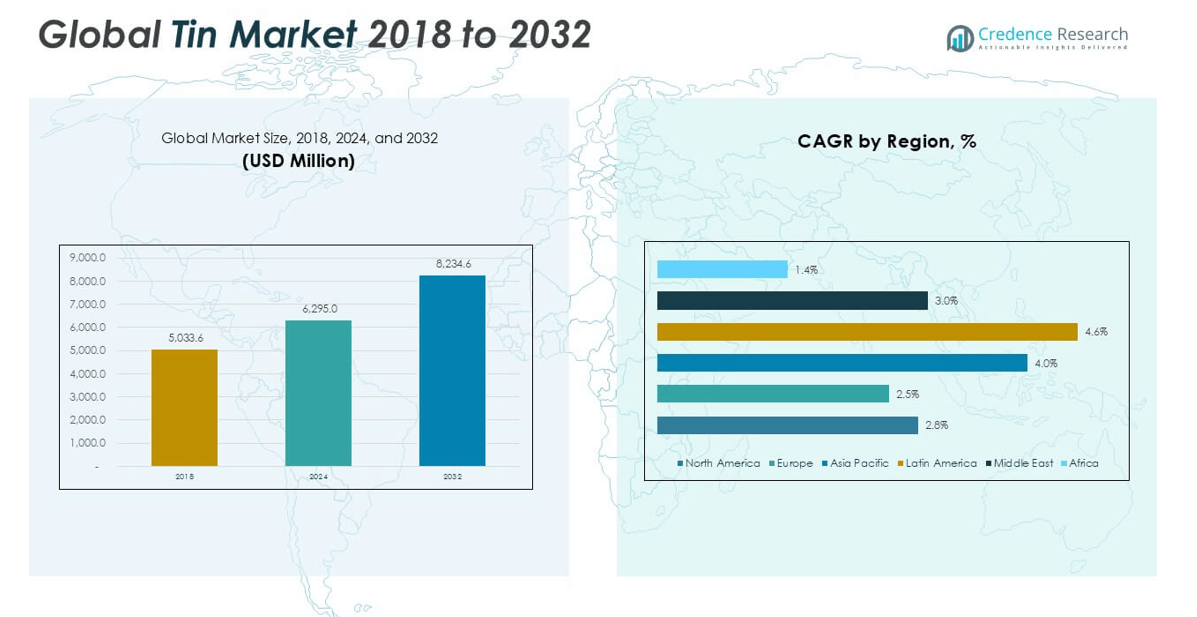
The Global Tin Market is projected to grow from USD6,295.0 million in 2024 to an estimated USD8,234.6 million by 2032, with a compound annual growth rate (CAGR) of 3.40% from 2025 to 2032.
Market growth is driven by the rapid expansion of the electronics industry, where tin is predominantly used in soldering processes for semiconductors and circuit boards. Additionally, the shift toward sustainable and lead-free soldering materials has heightened tin demand globally. Emerging trends include growing adoption of recycled tin to address supply chain concerns and reduce environmental impact. Advancements in battery technology, particularly in lithium-ion and next-generation batteries, are also creating new avenues for tin utilization. However, market fluctuations in raw material prices and geopolitical uncertainties in major tin-producing regions may affect supply stability.
Geographically, the Asia Pacific region dominates the global tin market due to high consumption in countries such as China, Japan, and South Korea, driven by robust electronics and manufacturing sectors. North America and Europe follow, supported by technological advancements and demand for sustainable materials. Key players in the global tin market include Yunnan Tin Company Limited, PT Timah, Malaysia Smelting Corporation, Minsur S.A., and Thailand Smelting and Refining Co. Ltd., all of which play a crucial role in global production and trade.
Market Insights
- The Global Tin Market is projected to grow from USD 6,295.0 million in 2024 to USD 8,234.6 million by 2032, registering a CAGR of 3.40% from 2025 to 2032.
- Rising demand in electronics, automotive, packaging, and construction sectors fuels tin consumption due to its corrosion resistance and essential role in soldering and plating applications.
- Expansion of the electronics industry and adoption of lead-free soldering materials significantly drive market growth worldwide.
- Supply challenges stem from volatile raw material prices and geopolitical uncertainties in key tin-producing regions, impacting market stability.
- Asia Pacific dominates the tin market, supported by robust manufacturing hubs in China, Japan, and South Korea.
- North America and Europe maintain steady growth, driven by technological advancements and increasing demand for sustainable materials.
- Growing focus on tin recycling and sustainable sourcing addresses environmental concerns and helps stabilize supply chains globally.
Market Drivers
Rising Demand from Electronics and Soldering Applications
The Global Tin Market continues to benefit from the growing demand in the electronics sector. Tin is a critical component in soldering materials used for assembling electronic circuits, semiconductors, and PCBs. The expansion of consumer electronics, electric vehicles, and industrial automation is fueling consistent consumption. Lead-free regulations have prompted manufacturers to adopt tin-based solders, strengthening its role across production processes. It plays a central role in miniaturized and high-performance electronics, reinforcing its necessity in modern technologies. The ongoing innovation in electronics manufacturing supports steady demand for high-purity tin. This trend positions the Global Tin Market for sustained long-term growth.
- For instance, in 2024, over 186,000 metric tons of refined tin were consumed annually in electronics soldering applications worldwide, reflecting the sector’s dominant share in tin usage and underscoring its critical role in semiconductor and PCB assembly processes
Expansion in Renewable Energy and Electric Vehicles
The increasing focus on clean energy and electrification of transport is accelerating the use of tin in renewable energy infrastructure and EVs. It plays a key role in the assembly of battery systems, where tin-coated components help improve conductivity and reduce degradation. Solar technologies also incorporate tin in various coatings and panel structures. Government policies supporting green energy transitions have spurred capital investment in these sectors. The Global Tin Market benefits from these structural changes in energy and mobility systems. Its usage in energy storage and distribution networks reinforces its strategic importance. This dynamic opens new revenue streams across emerging applications.
- For instance, India’s renewable energy capacity increased by 24.2 gigawatts within a year ending October 2024, reaching a total of 203.18 gigawatts, a growth that significantly drives demand for tin-based components in solar and battery technologies
Growing Focus on Sustainable and Recycled Materials
Industries are turning to sustainable raw materials due to environmental regulations and circular economy principles. Tin is well-suited for recycling, and secondary tin production is gaining traction. It supports lower carbon emissions and helps reduce dependency on primary mining operations. The Global Tin Market aligns with this sustainability drive through increased use of recycled tin in electronics and packaging. Technological improvements have enhanced recovery rates and purity levels in recycled tin. Regulatory frameworks across regions now promote recycled content, boosting market acceptance. It supports long-term supply stability and environmental compliance.
Infrastructure Development and Industrial Growth in Asia Pacific
Rapid urbanization and industrialization in Asia Pacific drive construction, packaging, and manufacturing activities. These sectors require large volumes of tin-based products, including coatings and alloys. China, Indonesia, and India are leading contributors to regional demand growth. The Global Tin Market gains strength from favorable government policies and rising domestic consumption. It plays a vital role in supporting regional export industries, particularly electronics and automotive manufacturing. Infrastructure expansion projects demand high-performance materials, sustaining tin’s relevance. Economic growth and foreign investment in industrial sectors further amplify its regional impact.
Market Trends
Rising Investments in Battery Technologies and Energy Storage
The Global Tin Market is experiencing a significant shift driven by the growing role of tin in battery technologies. It is increasingly used in lithium-ion and emerging solid-state battery systems due to its conductive and stabilizing properties. Manufacturers are exploring tin-based anodes to enhance battery performance and safety. The trend aligns with global initiatives to expand electric mobility and grid storage capacity. Governments and private investors are allocating capital to scale battery production, supporting long-term tin demand. The material’s technical compatibility with evolving energy systems ensures its relevance across high-growth applications. It reinforces the market’s diversification beyond traditional soldering uses.
- For instance, in 2024, over 15 major battery manufacturers announced pilot projects or commercial-scale production lines utilizing tin-based anode materials for next-generation lithium-ion and solid-state batteries, according to a recent industry survey.
Increased Adoption of Tin in Advanced Coating and Plating Applications
Advanced coating technologies are driving new applications for tin in various industries. It serves as a protective layer in food packaging, automotive parts, and industrial machinery due to its corrosion resistance and non-toxic nature. The Global Tin Market benefits from increased awareness of hygiene and safety standards, especially in food and medical packaging. Demand for high-performance and environmentally safe materials continues to grow. Tin coatings improve durability and surface performance without introducing harmful substances. It helps industries comply with international safety regulations and reduce maintenance costs. This trend supports wider adoption across both consumer and industrial sectors.
- For instance, in 2023, more than 600,000 tons of tin-coated steel were produced globally for use in food packaging and industrial applications, as reported by leading industry associations.
Technological Advancements in Tin Recycling and Refining
Technological progress is enhancing the efficiency and yield of tin recycling processes. It allows recovery from complex electronic waste and industrial scrap with improved purity levels. The Global Tin Market is seeing growing participation from refiners and recyclers responding to sustainability goals. Innovations in hydrometallurgical and pyrometallurgical methods are expanding recycled tin output. It reduces environmental impacts and stabilizes supply in the face of fluctuating mining production. The shift toward closed-loop supply chains creates long-term advantages for producers and end-users. Regulatory incentives also support scaling up recycling infrastructure globally.
Market Consolidation and Strategic Alliances Among Key Players
Leading companies in the tin industry are focusing on strategic alliances, mergers, and acquisitions to secure raw material access and expand processing capabilities. It helps firms manage supply volatility and strengthen competitive positions in global markets. The Global Tin Market is witnessing consolidation aimed at achieving economies of scale and operational efficiency. Producers are also forming partnerships with electronics and battery manufacturers to ensure stable demand. These alliances support vertical integration and innovation in product development. It enhances resilience against regulatory shifts and geopolitical risks. Consolidated market structures also enable coordinated investments in sustainable mining and recycling practices.
Market Challenges
Volatile Raw Material Prices and Supply Chain Disruptions
The Global Tin Market faces consistent pressure from fluctuating raw material prices and unstable supply chains. Tin mining is concentrated in a few countries, making the market vulnerable to political unrest, labor strikes, and export restrictions. Supply interruptions from key producers like Indonesia, Myanmar, and the Democratic Republic of Congo can tighten global availability and drive price spikes. It becomes challenging for manufacturers to manage production costs and maintain stable pricing. Transportation delays, port congestion, and geopolitical tensions further strain the flow of tin. These issues impact planning and inventory management across industries relying on tin as a critical input.
- For instance, in 2023, Indonesia-the world’s largest tin exporter-temporarily suspended tin shipments for over two months due to new export permit regulations and environmental compliance checks, resulting in a backlog of more than 15,000 metric tons of tin awaiting clearance at major ports. This disruption led to significant delays for electronics and solder manufacturers dependent on Indonesian tin supplies.
Environmental Regulations and Social Licensing Issues
Stringent environmental regulations and growing resistance from local communities are creating operational hurdles for tin mining companies. Governments are enforcing stricter controls on land use, emissions, and water consumption in mining areas. The Global Tin Market must navigate the rising costs of compliance and delays in securing mining permits. It becomes difficult for companies to expand or maintain production without addressing environmental and social expectations. Community protests and ESG scrutiny are influencing investor sentiment and slowing new project approvals. Companies must balance production goals with responsible practices to maintain market access and public trust.
Market Opportunities
Expansion of Tin Applications in Next-Generation Battery Technologies
The shift toward electric vehicles and renewable energy is opening new opportunities for tin in advanced battery systems. Researchers and manufacturers are exploring tin-based anodes to improve energy density, charging speed, and battery lifespan. It shows strong potential in replacing or complementing traditional graphite materials in lithium-ion batteries. The Global Tin Market stands to benefit from rising investments in battery research and pilot-scale production facilities. It supports the development of safer and more efficient energy storage solutions for both mobility and grid applications. Tin's compatibility with innovative chemistries strengthens its position in future battery markets. This emerging demand could eshape supply chains and drive long-term value.
Rising Demand for Sustainable and Circular Tin Products
The growing emphasis on environmental sustainability is creating space for recycled and responsibly sourced tin. Companies are investing in closed-loop systems and advanced recycling technologies to recover tin from electronic waste and industrial byproducts. It aligns with global goals to reduce carbon footprints and resource depletion. The Global Tin Market is well-positioned to capitalize on this trend by offering eco-friendly alternatives to primary tin. Certification standards and consumer awareness are pushing industries to adopt transparent sourcing practices. It encourages long-term partnerships between producers, recyclers, and end-users. These developments support brand differentiation and regulatory compliance across key sectors.
Market Segmentation Analysis
By Product Type
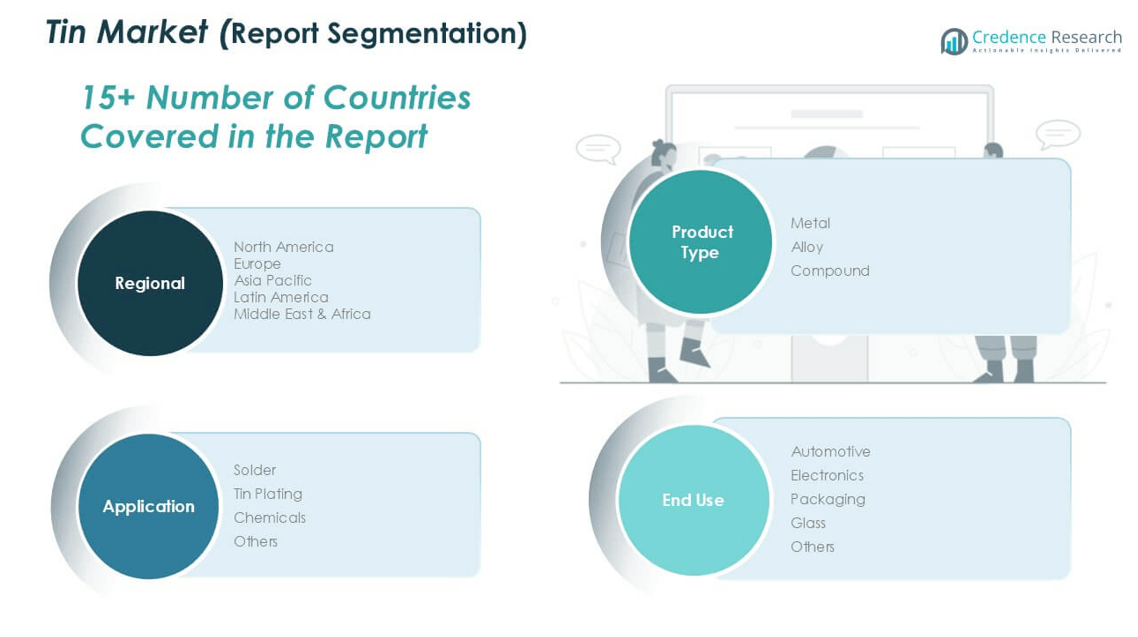
The Global Tin Market splits into three principal product types: metal, alloy, and compounds. Metal tin dominates volume share, supplying primary ingots and billets for downstream processing. Alloy tin captures significant revenue through specialized blends used in high-performance solders and corrosion-resistant coatings. Compound forms, including organotin chemicals and oxides, serve niche applications in stabilizers, catalysts, and glass coatings. It benefits from growing demand for functional additives in plastics and ceramics.
- For instance, electronics soldering applications alone consumed over 186,000 metric tons of refined tin globally in 2024, highlighting the predominance of metal tin in high-volume end uses.
By Application
Soldering leads the tin application segment, driven by the electronics and semiconductor industries’ reliance on tin-based, lead-free solders. Tin plating follows, supplying protective and decorative coatings for automotive parts, food packaging, and industrial equipment. Chemical applications, such as catalysts and organotin intermediates, sustain moderate growth, supported by specialty chemical producers. Other uses include tin foils, alloys for bearings, and niche industrial processes, which together account for a smaller share of total demand.
- For instance, in 2024, China produced approximately 145,000 metric tons of refined tin, representing nearly 39% of global output, while Indonesia contributed about 70,000 metric tons and Peru 38,000 metric tons
By End Use
Electronics constitute the largest end-use sector, where tin solders and coatings ensure product reliability and performance. Automotive follows, leveraging tin’s properties in battery components, connectors, and protective plating. Packaging, particularly food and beverage cans, relies on tin plating for corrosion resistance and food safety. Glass manufacturing uses tin oxide for float glass and photovoltaic panels, while other sectors-such as aerospace and industrial machinery-draw on tin for specialty applications.
Segments
Based on Product Type
- Metal
- Alloy
- Compound
Based on Application
- Solder
- Tin Plating
- Chemicals
- Others
Based on End Use
- Automotive
- Electronics
- Packaging
- Glass
- Others
Based on Region
- North America
- U.S.
- Canada
- Mexico
- Europe
- UK
- France
- Germany
- Italy
- Spain
- Russia
- Belgium
- Netherlands
- Austria
- Sweden
- Poland
- Denmark
- Switzerland
- Rest of Europe
- Asia Pacific
- China
- Japan
- South Korea
- India
- Australia
- Thailand
- Indonesia
- Vietnam
- Malaysia
- Philippines
- Taiwan
- Rest of Asia Pacific
- Latin America
- Brazil
- Argentina
- Peru
- Chile
- Colombia
- Rest of Latin America
- Middle East
- UAE
- KSA
- Israel
- Turkey
- Iran
- Rest of Middle East
- Africa
- Egypt
- Nigeria
- Algeria
- Morocco
- Rest of Africa
Regional Analysis
North America Tin Market
The North America Tin Market is forecast to grow from USD 1,241.29 million in 2024 to USD 1,555.52 million by 2032, exhibiting a CAGR of 2.8%. The region holds approximately 19.7% of the global market share in 2024, reflecting solid demand from automotive, electronics, and packaging industries. The United States and Canada lead in consumption, driven by advanced manufacturing and rising adoption of lead-free solder technologies. Investments in renewable energy projects and electric vehicle production further support tin demand. The region’s focus on sustainable sourcing and recycling also impacts market dynamics. It faces challenges related to raw material imports and geopolitical supply risks, but strong technological innovation sustains steady growth.
Europe Tin Market
Europe’s tin market is valued at USD 1,487.60 million in 2024 and is expected to reach USD 1,819.85 million by 2032, growing at a CAGR of 2.5%. Holding around 23.5% of the global market share, the region benefits from stringent environmental regulations encouraging lead-free solders and recycled tin usage. Germany, France, and the UK are major consumers, driven by automotive, electronics, and packaging sectors. European manufacturers focus on product quality and compliance with EU directives, boosting demand for high-purity tin products. It faces supply chain challenges due to dependency on imports but maintains a strong market position through innovation and sustainability initiatives.
Asia Pacific Tin Market
The Asia Pacific Tin Market leads globally with a market size of USD 2,276.28 million in 2024 and is projected to reach USD 3,129.16 million by 2032 at a CAGR of 4.0%. The region commands approximately 36.1% of the global market share, propelled by China, Japan, South Korea, and India. Rapid industrialization, expanding electronics manufacturing, and growing automotive production drive demand. Government investments in infrastructure and renewable energy further elevate consumption. Tin mining activities in Indonesia and Malaysia support regional supply. It benefits from cost advantages and large-scale production capacity, making Asia Pacific the most dynamic tin market worldwide.
Latin America Tin Market
Latin America’s tin market is valued at USD 708.82 million in 2024 and forecasted to reach USD 1,016.15 million by 2032, with a CAGR of 4.6%. The region accounts for approximately 11.2% of the global market share. Key countries include Brazil, Peru, and Bolivia, which are also significant tin producers. Expanding mining operations and increasing industrial activity in electronics and packaging sectors stimulate market growth. Investment in infrastructure development and growing demand for lead-free solders support consumption. The region faces challenges related to regulatory frameworks and logistical constraints but presents promising opportunities.
Middle East Tin Market
The Middle East tin market stands at USD 436.51 million in 2024 and is expected to reach USD 551.72 million by 2032, growing at a CAGR of 3.0%. It represents about 6.9% of the global market share. Countries like Saudi Arabia, UAE, and Iran lead industrial and energy sector applications. Tin usage in electronics manufacturing, packaging, and construction supports growth. Strategic investments in diversifying economies away from oil dependence increase demand for tin-based products. Supply chain improvements and growing emphasis on sustainable materials further encourage market expansion.
Africa Tin Market
Africa holds the smallest share in the tin market with a value of USD 144.52 million in 2024, expected to grow to USD 162.22 million by 2032 at a CAGR of 1.4%. The region accounts for approximately 2.3% of the global market share. South Africa, Nigeria, and Ghana represent the primary markets, although demand remains limited by infrastructure challenges and slower industrialization. Mining activities provide some supply stability, but consumption in end-use sectors is modest. Efforts to improve economic conditions and industrial capacity may increase future demand. It remains a nascent market with growth potential contingent on investment and development.
Key players
- Empresa Metalúrgica Vinto S.A
- Gejiu Zili Mining and Smelting Co., Ltd.
- Guangxi China Tin Group
- Malaysia Smelting Corporation
- Metallo-Chimique International N.V.
- Minsur S.A.
- ArcelorMittal
- Avalon Advanced Materials Inc.
- Timah
- Yunnan Tin Group Company Limited
- Yunnan Chengfeng Non-ferrous Metals Co., Ltd.
Competitive Analysis
The Global Tin Market features a competitive landscape dominated by established mining and smelting companies focused on securing resource access and expanding production capabilities. Leading players differentiate through vertical integration, controlling mining, refining, and distribution to ensure supply stability. Innovation in recycling technologies and sustainable sourcing is a key factor driving market leadership. Companies invest in capacity expansion and strategic partnerships with end-use industries such as electronics and automotive. Market entrants face high barriers due to capital intensity and regulatory compliance. It fosters consolidation trends and alliances to optimize operational efficiency. The competitive environment rewards firms that can adapt to fluctuating demand and raw material price volatility while meeting increasingly stringent environmental standards.
Recent Developments
- In June 2025, Minsur, a Peruvian mining company, distributed a record $400 million dividend to shareholders following the sale of its Brazilian subsidiary, Mineração Taboca S.A. This payout, approved on June 4, 2025, was a result of the sale to China's CNMC Trade Company Limited for $340 million. The dividend was split, with $266.7 million going to common shareholders and $133.3 million to investment shareholders. This significant dividend payout underscores Minsur's strong financial performance following the asset sale.
- In February 2025, ArcelorMittal reported its Q4 2024 results and projected a 2.5-3.5% increase in global steel demand outside of China for 2025. This projection was part of a statement where the company also acknowledged the challenges of global overcapacity and the impact of rising steel imports on European manufacturing, highlighting the need for policy support.
Market Concentration and Characteristics
The Global Tin Market exhibits a moderately concentrated structure, with a few major producers controlling a significant share of mining and refining capacities worldwide. These key players dominate supply chains, influencing pricing and production levels. It operates in regions with abundant tin reserves but faces challenges due to geopolitical risks and regulatory constraints in key mining countries. The market balances between primary mining and recycled tin sources, which increasingly contribute to supply stability. It demands continuous investment in technology to improve extraction efficiency and environmental compliance. The competitive environment drives innovation in product quality and sustainability practices. Market characteristics include vulnerability to raw material price volatility and reliance on exports from leading producing countries. This concentration creates barriers for new entrants but encourages strategic partnerships among established firms to secure raw materials and expand market reach.
Report Coverage
The research report offers an in-depth analysis based on Product Type, Application, End Use and Region. It details leading market players, providing an overview of their business, product offerings, investments, revenue streams, and key applications. Additionally, the report includes insights into the competitive environment, SWOT analysis, current market trends, as well as the primary drivers and constraints. Furthermore, it discusses various factors that have driven market expansion in recent years. The report also explores market dynamics, regulatory scenarios, and technological advancements that are shaping the industry. It assesses the impact of external factors and global economic changes on marketgrowth. Lastly, it provides strategic recommendations for new entrants and established companies to navigate the complexities of the market.
Future Outlook
- The Global Tin Market will continue to expand driven by increasing demand from the electronics and automotive sectors, particularly for lead-free solder applications.
- Growth in renewable energy and electric vehicle industries will create new opportunities for tin usage in advanced battery technologies and energy storage systems.
- Investments in recycling and secondary tin production will rise, supporting sustainable supply chains and reducing reliance on primary mining.
- Technological advancements will improve tin extraction and refining processes, enhancing efficiency and environmental compliance across the industry.
- Emerging markets in Asia Pacific and Latin America will drive the majority of global tin consumption growth due to rapid industrialization and infrastructure development.
- Price volatility will persist due to geopolitical factors and concentration of mining operations, prompting companies to diversify sourcing strategies.
- Regulatory pressure for eco-friendly materials will encourage adoption of recycled tin and innovation in tin-based compounds for safer applications.
- Strategic partnerships and mergers among leading tin producers will strengthen market stability and promote investment in new mining projects.
- Growing digitalization and demand for miniaturized electronic devices will sustain high consumption of tin-based solders and alloys.
- The Global Tin Market will face challenges balancing supply chain disruptions and environmental sustainability while capitalizing on expanding end-use applications.

Request a Free Sample
Fill in your details and we'll send you a free sample report.
- Sample data tables & charts
- Research methodology
Market Dynamics
Expansion of Electronics and Soldering Applications
The rapid growth of the electronics industry, especially in Asia Pacific, is driving demand for tin as a critical component in soldering materials for semiconductors and circuit boards. The shift to lead-free solders further boosts tin consumption in high-performance and miniaturized electronics.
Growth in Renewable Energy and Electric Vehicles
Increasing investments in renewable energy infrastructure and the electrification of transport are accelerating the use of tin in battery systems and solar technologies. Tin-coated components improve conductivity and durability in batteries, supporting the expansion of clean energy and electric mobility.
Rising Adoption of Sustainable and Recycled Tin
Environmental regulations and circular economy initiatives are encouraging industries to use recycled tin, reducing reliance on primary mining and lowering carbon emissions. Advances in recycling technology and regulatory support are making secondary tin a more significant part of the supply chain.
Industrialization and Infrastructure Development in Asia Pacific
Rapid urbanization and industrial growth in countries like China, India, and Indonesia are increasing demand for tin in construction, packaging, and manufacturing. Government policies and foreign investment in these sectors further amplify regional consumption.
Technological Advancements in Battery and Coating Applications
Innovations in battery technology, such as tin-based anodes for next-generation lithium-ion and solid-state batteries, are opening new markets for tin. Additionally, advanced tin coatings are increasingly used for corrosion resistance and safety in packaging and automotive parts.
Need a Custom Version of This Report?
Tailor the scope, geography, or segments to your exact requirements.
- Custom geography or segment scope
- Direct access to our analyst team
Frequently Asked Questions
What was the market size of the Global Tin Market in 2023 and what is the forecast for 2032?
How is the shift toward sustainable materials impacting the Global Tin Market?
Which regions dominate the Global Tin Market and why?
What challenges does the Global Tin Market face in terms of supply?
Table of Content
Chapter 1 Market Segmentation
- 1.1 Segmentation Framework
- 1.1.1 Product and Service Classification
- 1.1.2 Application and End-Use Classification
- 1.1.3 Technology and Solution Classification
- 1.1.4 Customer and Distribution Channel Classification
- 1.1.5 Geographic Segmentation
- 1.1.6 Market Segment Definitions and Boundaries
- 1.2 By End Use
- 1.2.1 Automotive
- 1.2.2 Electronics
- 1.2.3 Packaging
- 1.2.4 Glass
- 1.2.5 Others
- 1.3 By Application
- 1.3.1 Solder
- 1.3.2 Tin Plating
- 1.3.3 Chemicals
- 1.3.4 Others
- 1.4 By Product Type
- 1.4.1 Metal
- 1.4.2 Alloy
- 1.4.3 Compound
Chapter 2 Introduction
- 2.1 Report Objectives and Scope
- 2.2 Product Definition and Industry Terminology
- 2.3 Market Inclusions and Exclusions
- 2.4 Research Process
- 2.4.1 Primary Research and Expert Interviews
- 2.4.2 Secondary Research and Source Review
- 2.4.3 Top-Down and Bottom-Up Estimation
- 2.4.4 Data Triangulation and Verification
- 2.5 Market Size Measurement Basis
- 2.5.1 2024: USD 6,295.0 million → 2032: USD 8,234.6 million
- 2.6 Historical and Forecast Reference Periods
- 2.6.1 Base Year: 2024
- 2.6.2 Forecast Period: 2024-2032
- 2.7 Research Assumptions and Limitations
Chapter 3 Executive Summary
- 3.1 Market Snapshot and Key Findings
- 3.2 Base-Year Market Size, 2024
- 3.3 Forecast Market Size, 2032
- 3.4 Revenue and Volume Growth Outlook
- 3.5 Key Demand and Supply Indicators
- 3.6 Leading Market Segments
- 3.7 Fastest-Growing Market Opportunities
- 3.8 Regional Performance Highlights
- 3.9 Technology and Industry Transformation
- 3.10 Competitive Landscape Summary
- 3.11 Analyst View and Strategic Implications
Chapter 4 Global Tin Market Trends and Developments
- 4.1 Historical Industry Development
- 4.2 Recent Market Trends and Developments
- 4.3 Demand and Customer Behavior Trends
- 4.4 Technology and Product Innovation
- 4.5 Artificial Intelligence, Automation and Digitalization
- 4.6 Local Manufacturing and Supply Chain Realignment
- 4.7 Industry Partnerships, Mergers and Acquisitions
- 4.8 Sustainability and Circular Economy Developments
- 4.9 Government and Private Sector Investment Trends
- 4.10 Emerging Business Models and Commercialization
- 4.11 Industry Developments and Announcements
Chapter 5 Global Tin Market Production, Supply and Demand Analysis
- 5.1 Demand Trend and Consumption Analysis
- 5.2 Demand Forecast, 2024-2032
- 5.3 Production and Output Trend
- 5.4 Production and Output Forecast, 2024-2032
- 5.5 Installed Capacity and Capacity Utilization
- 5.6 Company-Wise Production Plants and Statistics
- 5.6.1 Installed Production Capacity
- 5.6.2 Actual Production
- 5.6.3 Planned Capacity and Expansion Targets
- 5.7 Supply Chain Structure and Procurement Trends
- 5.8 Supply-Demand Gap and Bottlenecks
- 5.9 Import Dependence and Sourcing Structure
- 5.10 Contract Manufacturing and Outsourcing
- 5.11 Regional Supply and Demand Concentration
Chapter 6 Global Tin Market Pricing Analysis
- 6.1 Pricing Structure and Measurement
- 6.2 Historical Pricing Trends
- 6.3 Pricing Outlook, 2024-2032
- 6.4 Average Selling Price and Unit Economics
- 6.5 Pricing by Product and Market Segment
- 6.6 Geographic Pricing Differences
- 6.7 Key Input, Energy, Labor and Logistics Costs
- 6.8 Contract Pricing and Purchasing Models
- 6.9 Pricing Sensitivity and Competitive Positioning
- 6.10 Price, Margin and Profitability Implications
Chapter 7 Global Tin Market Dynamics
- 7.1 Market Growth Drivers
- 7.1.1 Demand-Side Drivers
- 7.1.2 Technology and Innovation Drivers
- 7.1.3 Infrastructure and Investment Drivers
- 7.1.4 Regulatory and Policy Drivers
- 7.2 Market Restraints
- 7.2.1 Cost and Affordability Constraints
- 7.2.2 Technology and Adoption Barriers
- 7.2.3 Supply Chain and Operational Constraints
- 7.3 Market Challenges
- 7.3.1 Competitive Pressure and Margin Erosion
- 7.3.2 Skills, Infrastructure and Implementation Gaps
- 7.4 Emerging Market Opportunities
- 7.5 Market Dynamics Impact and Time-Horizon Assessment
Chapter 8 Global Tin Value Chain Analysis
- 8.1 Industry Value Chain Overview
- 8.2 Upstream Suppliers and Critical Inputs
- 8.3 Technology and Component Providers
- 8.4 Manufacturing or Service Delivery
- 8.5 Distribution, Channel Partners and Integrators
- 8.6 Downstream Applications and End Users
- 8.7 Value Addition and Profit Pools
- 8.8 Vertical Integration and Outsourcing
- 8.9 Supplier Concentration and Risk
- 8.10 Supply Chain Localization and Resilience
Chapter 9 Global Tin Market Regulations and Policies
- 9.1 Relevant Laws, Standards and Compliance Frameworks
- 9.2 Product, Service, Safety and Quality Requirements
- 9.3 Government Policies, Incentives and Subsidies
- 9.4 Imports, Exports and Trade Barriers
- 9.5 Public Procurement and Local Content Requirements
- 9.6 Environmental and Sustainability Compliance
- 9.7 Upcoming Policy Changes and Market Implications
Chapter 10 Global Tin Market Hotspots and Opportunities
- 10.1 Market Opportunity Mapping and Growth Hotspots
- 10.2 High-Growth Applications and Customer Groups
- 10.3 Underserved Markets and White-Space Opportunities
- 10.4 Emerging Technology and Product Opportunities
- 10.5 New Capacity and Investment Hotspots
- 10.6 Market Entry and Expansion Opportunities
- 10.7 Distribution and Partnership Opportunities
- 10.8 Near-Term and Long-Term Commercial Potential
- 10.9 Opportunity Attractiveness and Execution Risks
Chapter 11 Global Tin Market Outlook, 2024-2032
- 11.1 Market Size and Analysis
- 11.1.1 Revenue (Market Measurement: 2024: USD 6,295.0 million → 2032: USD 8,234.6 million)
- 11.1.2 Market Volume and Quantity Sold
- 11.1.3 Historical Market Size
- 11.1.4 Base-Year Market Size, 2024
- 11.2 Market Forecast, 2024-2032
- 11.2.1 Revenue Forecast to 2032
- 11.2.2 Volume Forecast to 2032
- 11.2.3 CAGR and Year-on-Year Growth
- 11.2.4 Incremental Revenue Opportunity
- 11.3 Forecast Assumptions and Scenario Analysis
- 11.3.1 Base-Case Forecast
- 11.3.2 Optimistic and Conservative Scenarios
- 11.3.3 Technology, Pricing and Policy Sensitivities
- 11.4 Market Attractiveness and Growth Outlook
Chapter 12 Global Tin Market Segmentation and Outlook
- 12.1 Segmentation Summary and Market Shares, 2024
- 12.2 Largest and Fastest-Growing Segments
- 12.3 By End Use - Market Size and Forecast, 2024-2032
- 12.3.1 Segment Definition and Scope
- 12.3.2 Historical Market Size
- 12.3.3 Revenue Forecast, 2024-2032
- 12.3.4 Volume Forecast, 2024-2032
- 12.3.5 Base-Year Market Share, 2024
- 12.3.6 Segment CAGR and Growth Drivers
- 12.3.7 Subsegment Market Size and Forecast
- 12.3.7.1 Automotive
- 12.3.7.2 Electronics
- 12.3.7.3 Packaging
- 12.3.7.4 Glass
- 12.3.7.5 Others
- 12.3.8 Subsegment Pricing and Adoption Trends
- 12.3.9 Leading Suppliers and Competition
- 12.3.10 Regional Demand and Opportunities
- 12.4 By Application - Market Size and Forecast, 2024-2032
- 12.4.1 Segment Definition and Scope
- 12.4.2 Historical Market Size
- 12.4.3 Revenue Forecast, 2024-2032
- 12.4.4 Volume Forecast, 2024-2032
- 12.4.5 Base-Year Market Share, 2024
- 12.4.6 Segment CAGR and Growth Drivers
- 12.4.7 Subsegment Market Size and Forecast
- 12.4.7.1 Solder
- 12.4.7.2 Tin Plating
- 12.4.7.3 Chemicals
- 12.4.7.4 Others
- 12.4.8 Subsegment Pricing and Adoption Trends
- 12.4.9 Leading Suppliers and Competition
- 12.4.10 Regional Demand and Opportunities
- 12.5 By Product Type - Market Size and Forecast, 2024-2032
- 12.5.1 Segment Definition and Scope
- 12.5.2 Historical Market Size
- 12.5.3 Revenue Forecast, 2024-2032
- 12.5.4 Volume Forecast, 2024-2032
- 12.5.5 Base-Year Market Share, 2024
- 12.5.6 Segment CAGR and Growth Drivers
- 12.5.7 Subsegment Market Size and Forecast
- 12.5.7.1 Metal
- 12.5.7.2 Alloy
- 12.5.7.3 Compound
- 12.5.8 Subsegment Pricing and Adoption Trends
- 12.5.9 Leading Suppliers and Competition
- 12.5.10 Regional Demand and Opportunities
- 12.6 Segment Growth Comparison
- 12.7 Segment Attractiveness and Priority Matrix
Chapter 13 Global Tin End-Use and Application Market Outlook
- 13.1 End-Use Industry and Customer Demand Structure
- 13.2 Leading Applications and Customer Groups
- 13.3 End-Use Market Size, Share and Forecast
- 13.4 Major End-Use Industry Deep Dives
- 13.4.1 Customer Requirements and Use Cases
- 13.4.2 Demand and Replacement Cycles
- 13.4.3 Technical and Regulatory Considerations
- 13.4.4 Purchasing and Procurement Models
- 13.4.5 Leading Vendors and Distribution Channels
- 13.4.6 Forecast and Commercial Opportunities
- 13.5 Emerging Applications and Cross-Segment Demand
- 13.6 End-Use Industry Investment Priorities
Chapter 14 Global Tin Geographic Market Outlook, 2024-2032
- 14.1 Regional Market Size and Share, 2024
- 14.2 Regional Market Forecast, 2024-2032
- 14.3 Regional Pricing, Production and Demand Differences
- 14.4 North America
- 14.4.1 United States
- 14.4.2 Canada
- 14.4.3 Mexico
- 14.5 Europe
- 14.5.1 Germany
- 14.5.2 France
- 14.5.3 Italy
- 14.5.4 United Kingdom
- 14.5.5 Spain
- 14.5.6 Poland
- 14.5.7 Russia
- 14.5.8 Netherlands
- 14.5.9 Belgium
- 14.5.10 Sweden
- 14.5.11 Denmark
- 14.5.12 Norway
- 14.5.13 Rest of Europe
- 14.6 Asia Pacific
- 14.6.1 China
- 14.6.2 India
- 14.6.3 Japan
- 14.6.4 South Korea
- 14.6.5 Thailand
- 14.6.6 Indonesia
- 14.6.7 Vietnam
- 14.6.8 Malaysia
- 14.6.9 Australia
- 14.6.10 Rest of Asia Pacific
- 14.7 Latin America
- 14.7.1 Brazil
- 14.7.2 Argentina
- 14.7.3 Colombia
- 14.7.4 Chile
- 14.7.5 Rest of Latin America
- 14.8 Middle East
- 14.8.1 Saudi Arabia
- 14.8.2 United Arab Emirates
- 14.8.3 Turkey
- 14.8.4 Israel
- 14.8.5 Iran
- 14.8.6 Rest of the Middle East
- 14.9 Africa
- 14.9.1 South Africa
- 14.9.2 Egypt
- 14.9.3 Nigeria
- 14.9.4 Morocco
- 14.9.5 Rest of Africa
- 14.10 Regional Investment, Policy and Supply Chain Differences
- 14.11 Regional Competitive Landscape
- 14.12 Geographic Growth Hotspots
Chapter 15 Global Tin Technology, Innovation and Sustainability Outlook
- 15.1 Technology Landscape and Maturity
- 15.2 Product, Process and Service Innovation
- 15.3 AI, Automation and Digital Tools in the Industry
- 15.4 Technology Adoption and Performance Benchmarking
- 15.5 Innovation Pipeline and R&D Investment
- 15.6 Patent and Intellectual Property Trends
- 15.7 Energy Efficiency and Resource Management
- 15.8 Sustainability, Recycling and Circularity
- 15.9 Technology Roadmap, 2024-2032
- 15.10 Risks of Obsolescence and Technology Substitution
Chapter 16 Global Tin Market Key Strategic Imperatives
- 16.1 Growth and Market Entry Priorities
- 16.2 High-Return Products and Segments
- 16.3 Pricing, Profitability and Cost Optimization
- 16.4 Technology Investment and Product Differentiation
- 16.5 Supply Chain Localization and Resilience
- 16.6 Distribution and Customer Acquisition
- 16.7 Partnership, Acquisition and Capacity Strategy
- 16.8 Regional Expansion Priorities
- 16.9 Short-, Medium- and Long-Term Actions
Chapter 17 Competition Outlook
- 17.1 Industry Competition Characteristics
- 17.2 Market Structure and Concentration
- 17.3 Market Share and Competitive Positioning, 2024
- 17.4 Company-Wise Revenue and Product Benchmarking
- 17.5 Production and Service Capacity Benchmarking
- 17.6 Technology, Pricing and Differentiation
- 17.7 Regional Footprint and Distribution Strength
- 17.8 Mergers, Acquisitions and Strategic Alliances
- 17.9 New Entrants and Competitive Threats
- 17.10 Porter's Five Forces and Industry Attractiveness
- 17.11 Competitive Outlook, 2024-2032
Chapter 18 Company Profiles
- 18.1 Company Coverage and Selection Criteria
- 18.2 Yunnan Tin Group Company Limited
- 18.2.1 Business Description
- 18.2.2 Company Ownership and Geographic Presence
- 18.2.3 Product and Service Portfolio
- 18.2.4 Manufacturing and Operating Footprint
- 18.2.5 Production Capacity and Expansion Plans
- 18.2.6 Financial Performance and Investment
- 18.2.7 Market Share and Competitive Position
- 18.2.8 Technology and Innovation Capabilities
- 18.2.9 Strategic Alliances or Partnerships
- 18.2.10 Recent Developments
- 18.2.11 Growth Strategy and Outlook
- 18.3 PT Timah
- 18.4 Malaysia Smelting Corporation
- 18.5 Minsur S.A.
- 18.6 Thailand Smelting and Refining Co. Ltd.
- 18.7 Empresa Metalúrgica Vinto S.A
- 18.8 Guangxi China Tin Group
- 18.9 Gejiu Zili Mining and Smelting Co., Ltd.
- 18.10 Metallo-Chimique International N.V.
- 18.11 ArcelorMittal
- 18.12 Other Relevant Market Participants
Note: Every listed company is profiled on the structure shown under the first company. The company list is preliminary and may change based on research findings, market developments, data availability and client requirements.
Chapter 19 Disclaimer
- 19.1 Research and Forecast Disclaimer
- 19.2 Data Source and Estimation Limitations
Note: The depth of individual sections depends on data availability for this market. Volume, capacity, trade and other unit-based metrics are included where applicable.
