Home » Food & Beverage » Rock Salt Market

Rock Salt Market By Product Type (Coarse Rock Salt, Fine Rock Salt, Himalayan Pink Salt, Black Rock Salt); By Application (Food and Beverage, Industrial Use, De-icing and Melting, Cosmetic and Personal Care); By Distribution Channel (Direct Sales, Online Retail, Supermarkets and Hypermarkets, Convenience Stores); By End-Use Industry (Food Industry, Chemical Industry, Road Safety and Infrastructure, Pharmaceutical Industry) – Growth, Share, Opportunities & Competitive Analysis, 2024 – 2032

Report ID: 10100 | Report Format : Excel, PDF

Market Overview:

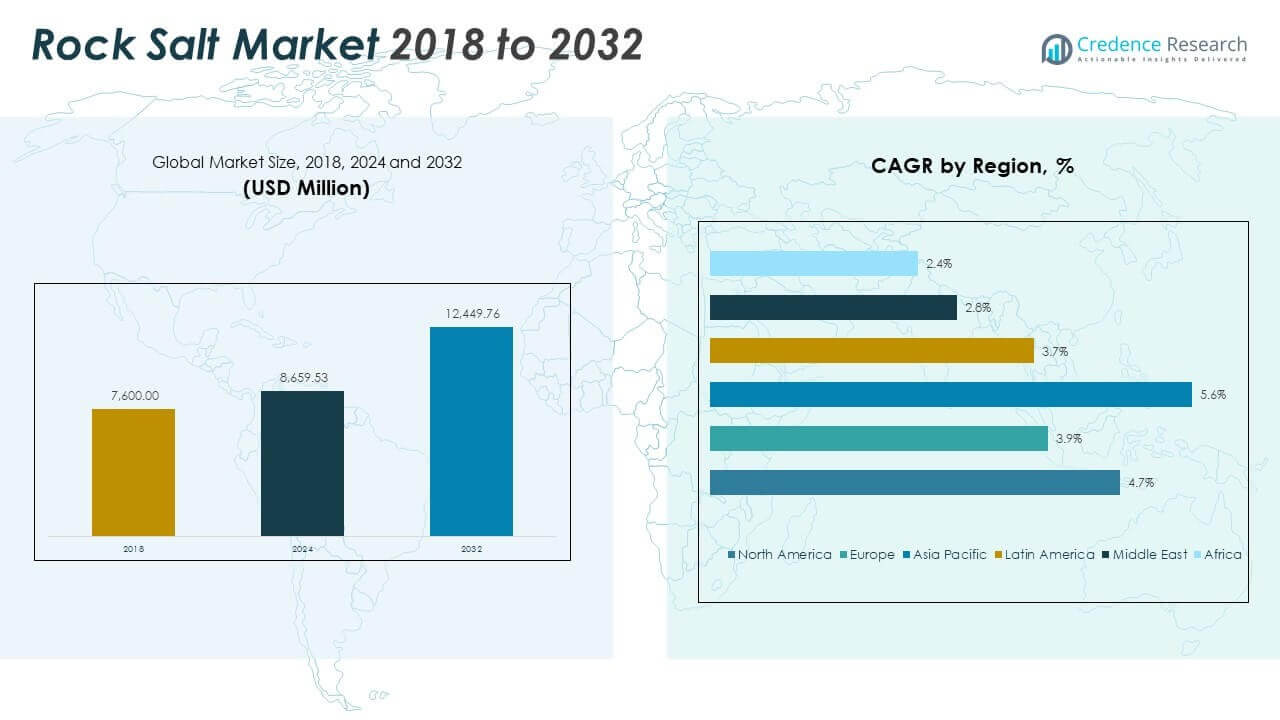
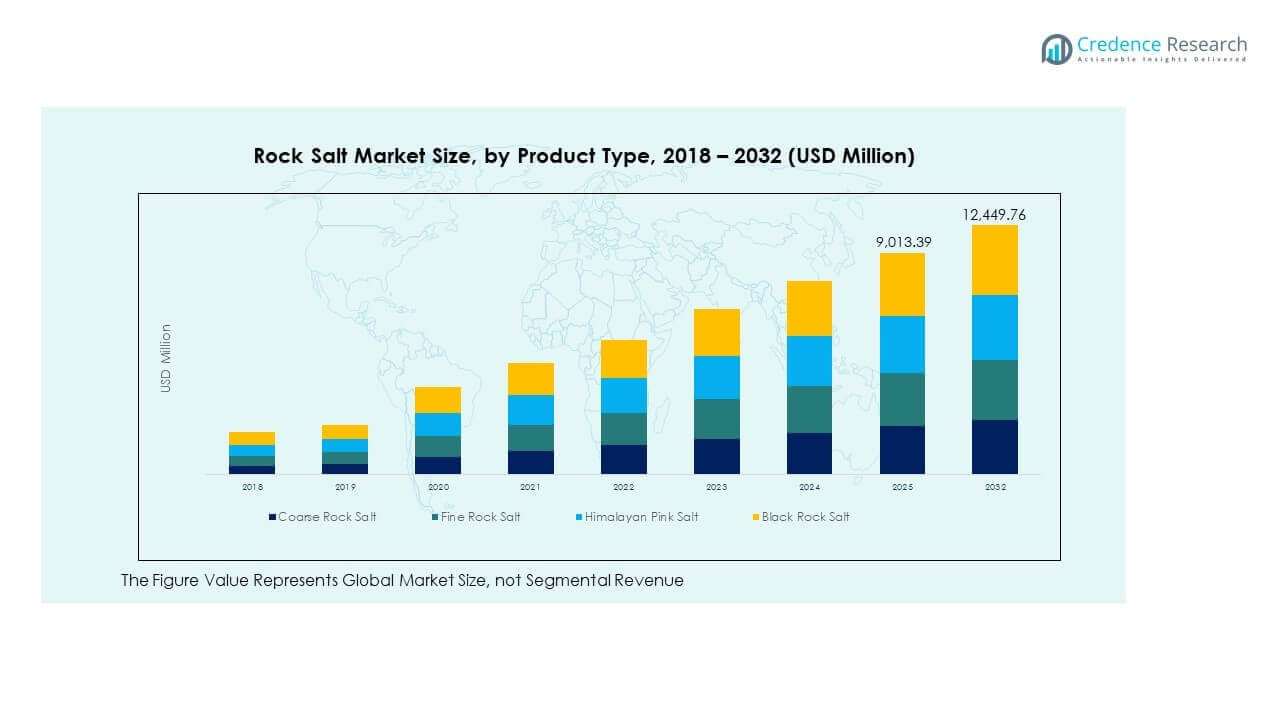
The Rock Salt Market size was valued at USD 7,600.00 million in 2018, increased to USD 8,659.53 million in 2024, and is anticipated to reach USD 12,449.76 million by 2032, at a CAGR of 4.72% during the forecast period.

REPORT ATTRIBUTE DETAILS
Historical Period 2020-2023
Base Year 2024
Forecast Period 2025-2032
Rock Salt Market Size 2024 USD 8,659.53 million
Rock Salt Market, CAGR 4.72%
Rock Salt Market Size 2032 USD 12,449.76 million


The market is driven by the growing demand for de-icing applications in colder regions, particularly during the winter months. Rock salt is an effective solution for maintaining road safety, contributing to its widespread use. Additionally, its increasing application in the food industry for preservation and flavor enhancement further boosts market growth. Consumer demand for natural, unrefined salts also plays a key role in shaping the market landscape.

Regionally, North America leads the Rock Salt Market due to the high demand for de-icing products, particularly in the United States and Canada. Europe follows closely, with significant consumption in countries like Germany and the UK. The Asia Pacific region is emerging as a key market due to rapid industrialization, increased infrastructure development, and a rising demand for road safety solutions. Emerging markets in Latin America and Africa are also expected to drive growth in the coming years.

Market Insights:

  • The Rock Salt Market size was valued at USD 7,600.00 million in 2018, increased to USD 8,659.53 million in 2024, and is anticipated to reach USD 12,449.76 million by 2032, at a CAGR of 4.72% during the forecast period.
  • North America, Europe, and Asia Pacific command the largest shares of the Rock Salt Market due to high demand for de-icing applications in winter climates, established infrastructure, and industrial growth.
  • Asia Pacific is the fastest-growing region, with a significant share driven by rapid industrialization, infrastructure development, and increasing demand for road safety solutions.
  • Coarse Rock Salt holds the highest segment share at approximately 45-50%, followed by Fine Rock Salt with 30-35%, and Himalayan Pink Salt at 15-20%, reflecting their diverse applications across industries.
  • Coarse Rock Salt and Fine Rock Salt together account for a large portion of the market share, highlighting their dominance in industrial and de-icing sectors, with each contributing significant percentages of total market revenue.

Access crucial information at unmatched prices!

Request your sample report today & start making informed decisions powered by Credence Research Inc.!

Download Sample

Market Drivers

Escalating Demand for De-Icing Applications

The demand for rock salt in de-icing applications continues to rise, particularly in regions with severe winter conditions. It is a cost-effective and efficient solution for preventing road accidents and ensuring safe transportation. Countries with colder climates, especially in North America and Europe, heavily depend on rock salt to maintain road safety during the winter months. This consistent demand drives the market growth, as municipalities and road maintenance agencies prioritize effective solutions for snow and ice control.

Growing Use in the Food Industry

The rock salt market also benefits from its widespread use in the food industry. Rock salt plays a significant role as a preservative, enhancing the shelf life of processed foods. Furthermore, it is used for flavor enhancement in various cuisines. As consumer preferences shift toward healthier and natural food ingredients, the demand for rock salt in food production grows. This trend, along with an increasing number of consumers opting for clean-label products, is expected to sustain market growth.

  • For instance, Tata Chemicals disclosed in its Integrated Annual Report FY2023-24 that it achieved edible salt sales of 1.65 million metric tons including rock salt across India, supported by capacity expansions that saw an additional 330,000 metric tons brought online during the year. This data is directly verifiable in Tata Chemicals’ official filings, confirming large-scale rock salt processing tailored to food industry partners.

Health-Conscious Consumer Preferences

The growing awareness of the health benefits associated with rock salt is contributing to its increased demand. Many consumers now prefer rock salt over regular table salt, as it is considered to be less processed and richer in essential minerals. This preference is especially evident in the food and beverage sector, where it is used in health-focused products. With a greater emphasis on wellness and clean eating, the rock salt market is positioned for continued growth, as it aligns with modern consumer values.

Rising Adoption in Industrial Applications

The rock salt market is expanding beyond de-icing and food-related uses, with increased adoption in industrial sectors. It is used in various applications such as chemical production, water treatment, and agriculture. In industries like oil and gas, rock salt is employed to prevent corrosion and improve machinery performance. These diverse industrial applications offer new growth avenues for the market, further broadening its reach and solidifying its relevance across multiple sectors.

  • For example, K+S AG, a major industrial salt supplier, confirms in its 2024 public records that it remains a leading exporter of industrial salt from Germany. The company emphasizes its focus on supplying the water treatment sector, as highlighted in investor presentations and global shipment databases.

Market Trends

Increasing Focus on Sustainable Practices

The rock salt market is witnessing a shift towards sustainability, driven by growing environmental concerns. Companies are focusing on eco-friendly production methods, such as reducing the carbon footprint of mining operations. Additionally, the industry is adopting practices to minimize waste and promote the recycling of materials. Sustainable sourcing and transparent supply chains are becoming a focal point as consumers demand products that align with environmental sustainability. These trends highlight the evolving approach to rock salt production and its integration into broader sustainability goals.

  • Compass Minerals’ Fiscal 2024 ESG Report, published in March 2025, confirms that the company achieved a 5% reduction in combined Scope 1 and 2 greenhouse gas (GHG) emissions and a 53% decline in freshwater withdrawal compared to its fiscal 2021 baseline.

Technological Advancements in Rock Salt Processing

Technological innovations in the processing of rock salt are transforming the market. Automation and improved machinery have led to more efficient mining and refinement processes, increasing production capacity. These advancements also enhance the quality of rock salt, ensuring consistency in grain size and purity levels. Such improvements in processing techniques are allowing companies to cater to the diverse needs of industries ranging from food production to chemical manufacturing. As technology continues to advance, the rock salt market is likely to experience enhanced productivity and quality standards.

Expansion of Global Distribution Networks

The rock salt market is benefiting from the expansion of global distribution networks. Increasing demand for rock salt in emerging economies is prompting companies to enhance their logistics and supply chains. Improved infrastructure, including transportation networks and storage facilities, is enabling faster and more efficient delivery of rock salt to international markets. This expansion is crucial for addressing the needs of regions with rising infrastructure and industrialization, ensuring that the market can meet the demands of new and emerging sectors worldwide.

  • For instance, Hidrovias do Brasil operates at the Port of Santos, handling mineral bulk cargo, including fertilizers and salt, as part of its logistics operations. The company is actively involved in the export of solid mineral bulk through this strategic port.

Rising Consumer Preference for Natural Products

As consumer preferences shift toward natural and unrefined products, rock salt has gained popularity over other types of salt. Rock salt is perceived as a more natural alternative to refined salts, making it an attractive option for health-conscious consumers. This trend is particularly strong in the food industry, where clean-label products are in high demand. As more consumers seek natural ingredients, the rock salt market is positioned to benefit from this ongoing preference, driving demand for unrefined, mineral-rich salt products.

Market Challenges

Supply Chain Constraints

One of the key challenges facing the rock salt market is the disruption in supply chains. Transportation issues, such as delays and increased costs for raw materials, can lead to higher production costs. These challenges are further exacerbated by seasonal demands, particularly in winter months, when the need for de-icing salt is at its peak. The market often struggles to meet the spikes in demand, leading to potential shortages. Companies must invest in robust logistics and contingency planning to manage these supply chain risks and maintain a steady supply of rock salt.

Environmental Concerns Over Mining Practices

Environmental concerns surrounding rock salt mining are another significant challenge for the market. Traditional mining practices, if not properly managed, can result in land degradation, water contamination, and negative impacts on local ecosystems. As regulatory pressure increases to minimize environmental damage, rock salt producers face the challenge of adopting more sustainable mining practices. Balancing market demand with environmental responsibility remains a critical hurdle for companies in the rock salt industry.

Market Opportunities

Expanding Use in Renewable Energy Sector

The growing shift toward renewable energy presents new opportunities for the rock salt market. Rock salt is utilized in some energy storage systems, such as in the production of molten salt for solar thermal energy storage. As the renewable energy sector continues to expand, particularly solar and wind energy, the demand for energy storage solutions is expected to rise. This creates a unique opportunity for rock salt producers to diversify their product offerings and tap into the expanding renewable energy market.

Potential in Emerging Economies

Emerging economies present a significant opportunity for the rock salt market. As industrialization increases in regions like Asia-Pacific and Latin America, the demand for rock salt is likely to rise in applications such as chemical manufacturing and water treatment. Additionally, the rising middle class in these regions is driving the demand for food-grade rock salt. Expanding into these growing markets will allow companies to capitalize on new revenue streams, further strengthening the global market for rock salt.

Market Segmentation Analysis:

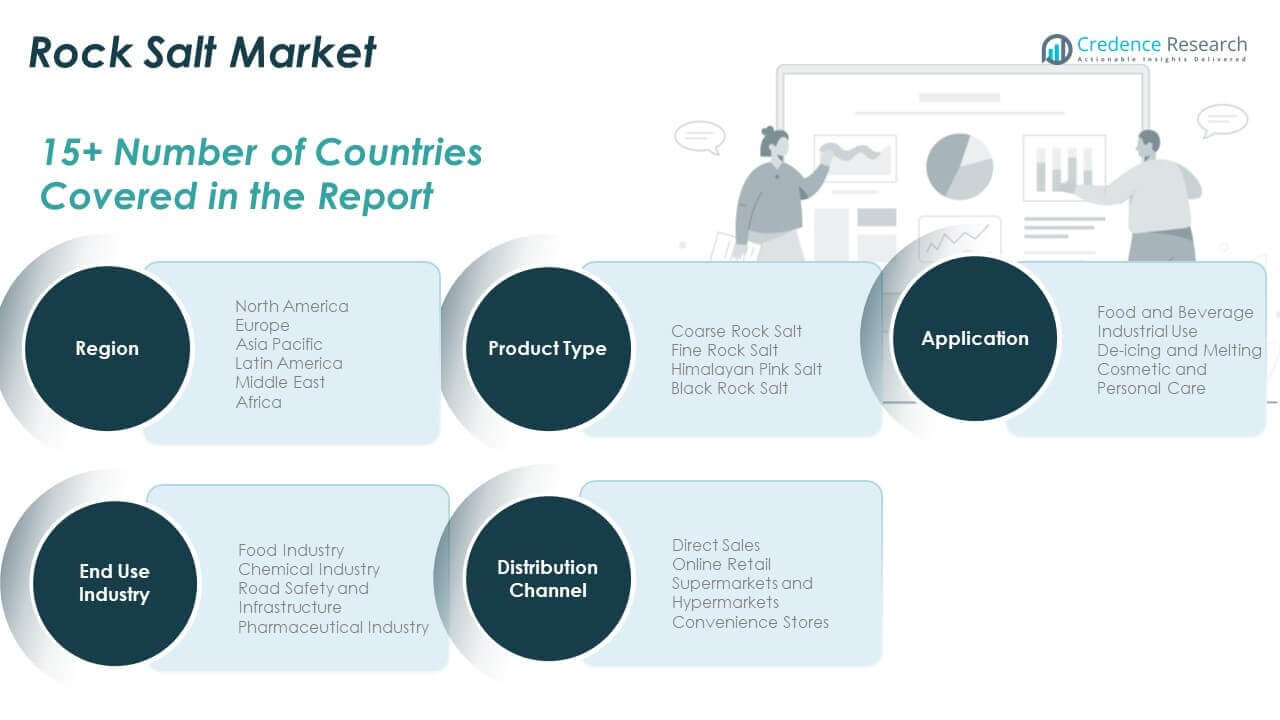
The Rock Salt Market is segmented

By product type into Coarse Rock Salt, Fine Rock Salt, Himalayan Pink Salt, and Black Rock Salt. Coarse rock salt holds a dominant share due to its widespread use in industrial applications and de-icing. Fine rock salt is increasingly popular in food and beverage products, while Himalayan Pink Salt has gained popularity in the health-conscious food segment. Black rock salt, with its unique mineral properties, is often used in culinary and cosmetic applications.

  • For example, K+S AG has a long-standing partnership with TOMRA and utilizes its sensor-based sorting technology at the Grasleben mine to enhance the quality of its salt products. This technology is used to improve sorting efficiency and product quality, including for food-grade salts.

By application, the Rock Salt Market covers food and beverage, industrial use, de-icing and melting, and cosmetic and personal care. De-icing and melting applications drive the market, especially in regions with severe winter climates. The food and beverage sector’s increasing preference for natural, unrefined salts like Himalayan Pink Salt also fuels growth. In industrial use, rock salt is utilized in chemical manufacturing, water treatment, and other processes. Cosmetic products, particularly in bath salts and scrubs, continue to expand their share in the market.

By distribution channel segment includes direct sales, online retail, supermarkets and hypermarkets, and convenience stores. Online retail is rapidly growing, providing convenience and broader reach. Supermarkets and hypermarkets remain key distribution channels for retail consumers, particularly for food-grade rock salt.

By end-use industries such as the food industry, chemical industry, road safety and infrastructure, and pharmaceutical industry also play a crucial role in the market. The chemical industry and infrastructure sectors drive industrial demand, while the food industry increasingly uses rock salt in various products.

  • For instance, Cargill’s Cayuga and Windsor salt mines collectively maintain annual production levels exceeding 1.3 million tonnes of rock salt in North America, as verified by independent reports and company disclosures.

Rock Salt Market Share

Segmentation:

By Product Type

  • Coarse Rock Salt
  • Fine Rock Salt
  • Himalayan Pink Salt
  • Black Rock Salt

By Application

  • Food and Beverage
  • Industrial Use
  • De-icing and Melting
  • Cosmetic and Personal Care

By Distribution Channel

  • Direct Sales
  • Online Retail
  • Supermarkets and Hypermarkets
  • Convenience Stores

By End-Use Industry

  • Food Industry
  • Chemical Industry
  • Road Safety and Infrastructure
  • Pharmaceutical Industry

By Regio

  • North America
    • U.S.
    • Canada
    • Mexico
  • Europe
    • Germany
    • France
    • U.K.
    • Italy
    • Spain
    • Rest of Europe
  • Asia Pacific
    • China
    • Japan
    • India
    • South Korea
    • South-east Asia
    • Rest of Asia Pacific
  • Latin America
    • Brazil
    • Argentina
    • Rest of Latin America
  • Middle East & Africa
    • GCC Countries
    • South Africa
    • Rest of the Middle East and Africa

Rock Salt Market Trends

Regional Analysis:

North America Rock Salt Market

The North America Rock Salt Market size was valued at USD 2,036.80 million in 2018, increased to USD 2,282.60 million in 2024, and is anticipated to reach USD 3,275.55 million by 2032, at a CAGR of 4.7% during the forecast period. It holds a significant share due to its extensive use in de-icing and melting applications, particularly in the United States and Canada, where winter conditions demand efficient road safety solutions. The growing demand for rock salt in the food industry further drives market expansion. The region’s strong infrastructure and demand from the chemical and industrial sectors ensure sustained growth. As municipalities invest more in environmental-friendly de-icing methods, the market is expected to maintain a steady growth trajectory. North America accounts for a notable share, with the U.S. being the largest contributor, particularly in industrial and road safety applications.

Europe Rock Salt Market

The Europe Rock Salt Market size was valued at USD 1,778.40 million in 2018, increased to USD 1,937.77 million in 2024, and is anticipated to reach USD 2,611.37 million by 2032, at a CAGR of 3.9% during the forecast period. The market in Europe is largely driven by the increasing demand for de-icing solutions during the winter months, particularly in countries like Germany, the UK, and France. The region’s consistent focus on road safety and infrastructure maintenance drives the adoption of rock salt in industrial and public sectors. Furthermore, the growing health-conscious consumer base in Europe boosts the demand for Himalayan Pink Salt in the food and cosmetics industries. Europe holds a substantial market share, with a diverse range of applications across several industries.

Asia Pacific Rock Salt Market

The Asia Pacific Rock Salt Market size was valued at USD 2,941.20 million in 2018, increased to USD 3,445.16 million in 2024, and is anticipated to reach USD 5,282.44 million by 2032, at a CAGR of 5.6% during the forecast period. The region exhibits the highest growth potential due to rapid industrialization, particularly in countries like China and India. Increased infrastructure development and the rising demand for road safety and de-icing applications are driving market growth. Furthermore, the demand for Himalayan Pink Salt in food products and personal care items is growing rapidly. The Asia Pacific market is expanding its footprint, with both traditional and emerging markets contributing to its growth.

Latin America Rock Salt Market

The Latin America Rock Salt Market size was valued at USD 463.60 million in 2018, increased to USD 522.95 million in 2024, and is anticipated to reach USD 695.57 million by 2032, at a CAGR of 3.7% during the forecast period. The market is expanding as the region’s demand for road de-icing solutions increases, particularly in countries with colder climates. In addition, the food and beverage industry’s growing adoption of rock salt in health-conscious products contributes to market growth. Latin America’s steady infrastructure development and rising industrialization in countries like Brazil and Argentina further fuel the demand for rock salt. It holds a moderate market share, with Brazil leading in both de-icing and industrial use.

Middle East Rock Salt Market

The Middle East Rock Salt Market size was valued at USD 212.80 million in 2018, increased to USD 221.63 million in 2024, and is anticipated to reach USD 275.21 million by 2032, at a CAGR of 2.8% during the forecast period. The market in the Middle East is primarily driven by the growing demand for industrial use, particularly in chemical processing. Though the region’s cold climate is less severe, rock salt is increasingly used in the food and cosmetic industries, particularly in premium products. The Middle East market holds a smaller share but is expanding due to increasing demand from countries like Saudi Arabia and the UAE.

Africa Rock Salt Market

The Africa Rock Salt Market size was valued at USD 167.20 million in 2018, increased to USD 249.43 million in 2024, and is anticipated to reach USD 309.62 million by 2032, at a CAGR of 2.4% during the forecast period. The market is witnessing growth due to increasing industrialization and infrastructure development, particularly in South Africa and Egypt. Demand for de-icing salt is relatively lower in the region, but the food and chemical industries are driving steady growth. As consumer awareness of the benefits of rock salt increases, the market is likely to expand further. It holds a modest market share, with a focus on industrial and food applications.

Shape Your Report to Specific Countries or Regions & Enjoy 30% Off!

Key Player Analysis:

  • Mid-American Salt LLC
  • Santader Salt
  • Morton Salt
  • Compass Minerals
  • American Rock Salt
  • Detroit Salt Company
  • Multi Rock Salt
  • Natural Salt
  • Cargill
  • Gunther Salt
  • Gama
  • NE Rock

Competitive Analysis:

The Rock Salt Market is highly competitive, with key players such as Cargill Inc., Morton Salt, Compass Minerals, Tata Chemicals, and K+S Aktiengesellschaft dominating the landscape. These companies rely on large production capacities and extensive distribution networks to maintain their market position. For instance, Compass Minerals operates one of the world’s largest salt mines, while Cargill Inc. diversifies its portfolio to meet growing demand for specialty salts like Himalayan pink salt. Strategic initiatives, including mergers and acquisitions, have been critical for growth, such as the acquisition of Morton Salt by Stone Canyon Industries. In response to consumer preferences for natural products, companies are focusing on innovation, introducing new varieties like black and Himalayan pink salt to cater to niche markets. The competitive environment demands continuous adaptation, with firms investing in regional expansions and product differentiation to stay ahead in the market.

Recent Developments:

  • In June 2025, Morton Salt announced a major production expansion of its Consumer segment in North America. The initiative will increase annual evaporated and solar salt production by approximately 860,000 tons, with some new capacity already operational and the remainder set for completion within 12–18 months.
  • In February 2025, American Rock Salt responded to intense winter demands by increasing its daily production by more than 25%. This was achieved through the purchase of new underground mining equipment and the construction of additional conveyor and bin system access, ensuring robust supply to local governments amid significant winter weather stress.

Report Coverage:

The research report offers an in-depth analysis based on Product Type, Application, Distribution Channel and End-Use Industry. It details leading market players, providing an overview of their business, product offerings, investments, revenue streams, and key applications. Additionally, the report includes insights into the competitive environment, SWOT analysis, current market trends, as well as the primary drivers and constraints. Furthermore, it discusses various factors that have driven market expansion in recent years. The report also explores market dynamics, regulatory scenarios, and technological advancements that are shaping the industry. It assesses the impact of external factors and global economic changes on market growth. Lastly, it provides strategic recommendations for new entrants and established companies to navigate the complexities of the market.

Future Outlook:

  • The Rock Salt Market is expected to see continued growth due to the increasing demand for de-icing in colder regions.
  • Rising consumer interest in natural salts, particularly Himalayan Pink Salt, will drive market diversification.
  • The expanding industrial applications of rock salt in sectors such as chemical manufacturing will contribute to market growth.
  • The growing awareness of health and wellness will increase the demand for rock salt in the food and personal care industries.
  • Technological advancements in rock salt extraction and processing will enhance supply efficiency.
  • The development of new distribution channels, such as online retail, will broaden the market reach.
  • Government regulations on road safety and infrastructure will ensure sustained demand for de-icing salt.
  • The increasing adoption of eco-friendly practices in the production of rock salt will boost its appeal.
  • Asia Pacific’s rapid industrialization will drive demand for rock salt in emerging markets.
  • The market is likely to see more mergers and acquisitions as companies aim to expand their product portfolios and geographical presence.

CHAPTER NO. 1 :   GENESIS OF THE MARKET

1.1 Market Prelude – Introduction & Scope

1.2 The Big Picture – Objectives & Vision

1.3 Strategic Edge – Unique Value Proposition

1.4 Stakeholder Compass – Key Beneficiaries

CHAPTER NO. 2 :      EXECUTIVE LENS

2.1 Pulse of the Industry – Market Snapshot

2.2 Growth Arc – Revenue Projections (USD Million)

2.3. Premium Insights – Based on Primary Interviews

CHAPTER NO. 3 :      ROCK SALT MARKET FORCES & INDUSTRY PULSE    

3.1 Foundations of Change – Market Overview
3.2 Catalysts of Expansion – Key Market Drivers
3.2.1 Momentum Boosters – Growth Triggers
3.2.2 Innovation Fuel – Disruptive Technologies
3.3 Headwinds & Crosswinds – Market Restraints
3.3.1 Regulatory Tides – Compliance Challenges
3.3.2 Economic Frictions – Inflationary Pressures
3.4 Untapped Horizons – Growth Potential & Opportunities
3.5 Strategic Navigation – Industry Frameworks
3.5.1 Market Equilibrium – Porter’s Five Forces
3.5.2 Ecosystem Dynamics – Value Chain Analysis
3.5.3 Macro Forces – PESTEL Breakdown

3.6 Price Trend Analysis

    3.6.1 Regional Price Trend
3.6.2 Price Trend by product

CHAPTER NO. 4 :      KEY INVESTMENT EPICENTER    

4.1 Regional Goldmines – High-Growth Geographies

4.2 Product Type Frontiers – Lucrative Product Type Categories

4.3 Application  Sweet Spots – Emerging Demand Segments

CHAPTER NO. 5: REVENUE TRAJECTORY & WEALTH MAPPING

5.1 Momentum Metrics – Forecast & Growth Curves

5.2 Regional Revenue Footprint – Market Share Insights

5.3 Segmental Wealth Flow – Product Type & Application  Revenue

CHAPTER NO. 6 :      TRADE & COMMERCE ANALYSIS

6.1.      Import Analysis by Region

6.1.1.    Global Rock Salt Market Import Revenue By Region

6.2.      Export Analysis by Region

6.2.1.    Global Rock Salt Market Export Revenue By Region

CHAPTER NO. 7 :      COMPETITION ANALYSIS 

7.1.      Company Market Share Analysis

7.1.1.    Global Rock Salt Market: Company Market Share

7.2.      Global Rock Salt Market Company Revenue Market Share

7.3.      Strategic Developments

7.3.1.    Acquisitions & Mergers

7.3.2.    New Product Type Launch

7.3.3.    Regional Expansion

7.4.      Competitive Dashboard

7.5.    Company Assessment Metrics, 2024

CHAPTER NO. 8 :      ROCK SALT MARKET – BY PRODUCT TYPE SEGMENT ANALYSIS     

8.1.      Rock Salt Market Overview by Product Type Segment

8.1.1.    Rock Salt Market Revenue Share By Product Type

8.2.      Coarse Rock Salt

8.3.      Fine Rock Salt

8.4.      Himalayan Pink Salt

8.5.      Black Rock Salt

CHAPTER NO. 9 :      ROCK SALT MARKET – BY APPLICATION SEGMENT ANALYSIS     

9.1.      Rock Salt Market Overview by Application Segment

9.1.1.    Rock Salt Market Revenue Share By Application

9.2.      Food and Beverage

9.3.      Industrial Use

9.4.      De-icing and Melting

9.5.      Cosmetic and Personal Care

CHAPTER NO. 10 :    ROCK SALT MARKET – BY DISTRIBUTION CHANNEL SEGMENT ANALYSIS

10.1.     Rock Salt Market Overview by Distribution Channel Segment

10.1.1.  Rock Salt Market Revenue Share By Distribution Channel

10.2.     Direct Sales

10.3.     Online Retail

10.4.     Supermarkets and Hypermarkets

10.5.     Convenience Stores

CHAPTER NO. 11 :    ROCK SALT MARKET – BY END USE INDUSTRY SEGMENT ANALYSIS

11.1.     Rock Salt Market Overview by End Use Industry Segment

11.1.1.  Rock Salt Market Revenue Share By End Use Industry

11.2.     Food Industry

11.3.     Chemical Industry

11.4.     Road Safety and Infrastructure

11.5.     Pharmaceutical Industry

CHAPTER NO. 12 :    ROCK SALT MARKET – REGIONAL ANALYSIS 

12.1.     Rock Salt Market Overview by Region Segment

12.1.1.  Global Rock Salt Market Revenue Share By Region

12.1.2.  Regions

12.1.3.  Global Rock Salt Market Revenue By Region

12.1.4.  Product Type

12.1.5.  Global Rock Salt Market Revenue By Product Type

12.1.6.  Application

12.1.7.  Global Rock Salt Market Revenue By Application

12.1.8.  Distribution Channel

12.1.9.  Global Rock Salt Market Revenue By Distribution Channel

12.1.10. End Use Industry

12.1.11. Global Rock Salt Market Revenue By End Use Industry

CHAPTER NO. 13 :    NORTH AMERICA ROCK SALT MARKET – COUNTRY ANALYSIS

13.1.     North America Rock Salt Market Overview by Country Segment

13.1.1.  North America Rock Salt Market Revenue Share By Region

13.2.     North America

13.2.1.  North America Rock Salt Market Revenue By Country

13.2.2.  Product Type

13.2.3.  North America Rock Salt Market Revenue By Product Type

13.2.4.  Application

13.2.5.  North America Rock Salt Market Revenue By Application

13.2.6.  Distribution Channel

13.2.7.  North America Rock Salt Market Revenue By Distribution Channel

13.2.8.  End Use Industry

13.2.9.  North America Rock Salt Market Revenue By End Use Industry

13.3.     U.S.

13.4.     Canada

13.5.     Mexico

CHAPTER NO. 14 :    EUROPE ROCK SALT MARKET – COUNTRY ANALYSIS           

14.1.     Europe Rock Salt Market Overview by Country Segment

14.1.1.  Europe Rock Salt Market Revenue Share By Region

14.2.     Europe

14.2.1.  Europe Rock Salt Market Revenue By Country

14.2.2.  Product Type

14.2.3.  Europe Rock Salt Market Revenue By Product Type

14.2.4.  Application

14.2.5.  Europe Rock Salt Market Revenue By Application

14.2.6.  Distribution Channel

14.2.7.  Europe Rock Salt Market Revenue By Distribution Channel

14.2.8.  End Use Industry

14.2.9.  Europe Rock Salt Market Revenue By End Use Industry

14.3.     UK

14.4.     France

14.5.     Germany

14.6.     Italy

14.7.     Spain

14.8.     Russia

14.9.   Rest of Europe

CHAPTER NO. 15 :    ASIA PACIFIC ROCK SALT MARKET – COUNTRY ANALYSIS     

15.1.     Asia Pacific Rock Salt Market Overview by Country Segment

15.1.1.  Asia Pacific Rock Salt Market Revenue Share By Region

15.2.     Asia Pacific

15.2.1.  Asia Pacific Rock Salt Market Revenue By Country

15.2.2.  Product Type

15.2.3.  Asia Pacific Rock Salt Market Revenue By Product Type

15.2.4.  Application

15.2.5.  Asia Pacific Rock Salt Market Revenue By Application

15.2.6.  Distribution Channel

15.2.7.  Asia Pacific Rock Salt Market Revenue By Distribution Channel

15.2.8.  End Use Industry

15.2.9.  Asia Pacific Rock Salt Market Revenue By End Use Industry

15.3.     China

15.4.     Japan

15.5.     South Korea

15.6.     India

15.7.     Australia

15.8.     Southeast Asia

15.9.     Rest of Asia Pacific

CHAPTER NO. 16 :    LATIN AMERICA ROCK SALT MARKET – COUNTRY ANALYSIS

16.1.     Latin America Rock Salt Market Overview by Country Segment

16.1.1.  Latin America Rock Salt Market Revenue Share By Region

16.2.     Latin America

16.2.1.  Latin America Rock Salt Market Revenue By Country

16.2.2.  Product Type

16.2.3.  Latin America Rock Salt Market Revenue By Product Type

16.2.4.  Application

16.2.5.  Latin America Rock Salt Market Revenue By Application

16.2.6.  Distribution Channel

16.2.7.  Latin America Rock Salt Market Revenue By Distribution Channel

16.2.8.  End Use Industry

16.2.9.  Latin America Rock Salt Market Revenue By End Use Industry

16.3.     Brazil

16.4.     Argentina

16.5.     Rest of Latin America

CHAPTER NO. 17 :    MIDDLE EAST ROCK SALT MARKET – COUNTRY ANALYSIS

17.1.     Middle East Rock Salt Market Overview by Country Segment

17.1.1.  Middle East Rock Salt Market Revenue Share By Region

17.2.     Middle East

17.2.1.  Middle East Rock Salt Market Revenue By Country

17.2.2.  Product Type

17.2.3.  Middle East Rock Salt Market Revenue By Product Type

17.2.4.  Application

17.2.5.  Middle East Rock Salt Market Revenue By Application

17.2.6.  Distribution Channel

17.2.7.  Middle East Rock Salt Market Revenue By Distribution Channel

17.2.8.  End Use Industry

17.2.9.  Middle East Rock Salt Market Revenue By End Use Industry

17.3.     GCC Countries

17.4.     Israel

17.5.     Turkey

17.6.     Rest of Middle East

CHAPTER NO. 18 :    AFRICA ROCK SALT MARKET – COUNTRY ANALYSIS

18.1.     Africa Rock Salt Market Overview by Country Segment

18.1.1.  Africa Rock Salt Market Revenue Share By Region

18.2.     Africa

18.2.1.  Africa Rock Salt Market Revenue By Country

18.2.2.  Product Type

18.2.3.  Africa Rock Salt Market Revenue By Product Type

18.2.4.  Application

18.2.5.  Africa Rock Salt Market Revenue By Application

18.2.6.  Distribution Channel

18.2.7.  Africa Rock Salt Market Revenue By Distribution Channel

18.2.8.  End Use Industry

18.2.9.  Africa Rock Salt Market Revenue By End Use Industry

18.3.     South Africa

18.4.     Egypt

18.5.     Rest of Africa

CHAPTER NO. 19 :    COMPANY PROFILES         

19.1.     Mid-American Salt LLC

19.1.1.  Company Overview

19.1.2.  Product Type Portfolio

19.1.3.  Financial Overview

19.1.4.  Recent Developments

19.1.5.  Growth Strategy

19.1.6.  SWOT Analysis

19.2.     Santader Salt

19.3.     Morton Salt

19.4.     Compass Minerals

19.5.     American Rock Salt

19.6.     Detroit Salt Company

19.7.     Multi Rock Salt

19.8.     Natural Salt

19.9.     Cargill

19.10.   Gunther Salt

19.11.   Gama

19.12.   NE Rock

Request Free Sample

We prioritize the confidentiality and security of your data. Our promise: your information remains private.

Ready to Transform Data into Decisions?

Request Your Sample Report and Start Your Journey of Informed Choices


Providing the strategic compass for industry titans.

cr-clients-logos

Frequently Asked Questions

What is the current market size for the Rock Salt Market, and what is its projected size in 2032?

The Rock Salt Market was valued at USD 8,659.53 million in 2024 and is anticipated to reach USD 12,449.76 million by 2032.

At what Compound Annual Growth Rate is the Rock Salt Market projected to grow between 2024 and 2032?

The Rock Salt Market is projected to grow at a CAGR of 4.72% during the forecast period from 2024 to 2032.

Which Rock Salt Market segment held the largest share in 2024?

In 2024, the De-icing and Melting application segment held the largest share of the Rock Salt Market due to its high demand in colder regions.

What is the major growth driving factors for global Rock Salt market?

Growing demand for from chemical and food & beverage industry to lead the demand for rock salt in the years to come

What are the primary factors fueling the growth of the Rock Salt Market?

The primary factors fueling the growth of the Rock Salt Market include rising demand for de-icing applications and growing interest in natural salt products.

Who are the leading companies in the Rock Salt Market?

Leading companies in the Rock Salt Market include Cargill Inc., Morton Salt, Compass Minerals, Tata Chemicals, and K+S Aktiengesellschaft.

About Author

Rajdeep Kumar Deb

Rajdeep Kumar Deb

Lead Analyst – Consumer & Finance

Rajdeep brings a decade of consumer goods and financial services insight to strategic market analysis.

View Profile

Related Reports

Mentha Oil Market

Mentha Oil Market size was valued USD 748.86 million in 2024 and is anticipated to reach USD 1284.76 million by 2032, at a CAGR of 6.98% during the forecast period.

Malaysia Bubble/Boba Tea Market

The Malaysia Bubble/Boba Tea Market size was valued at USD 53.17 million in 2024 and is anticipated to reach USD 87.34 million by 2032, at a CAGR of 6.4% during the forecast period (2024-2032).

Plant-Based Bioactives Market

Plant-Based Bioactives Market size was valued USD 4.5 billion in 2024 and is anticipated to reach USD 9.36 billion by 2032, at a CAGR of 9.6% during the forecast period.

Vitamins Market

Vitamins market was valued at USD 7.29 billion in 2024 and is anticipated to reach USD 11.89 billion by 2032, growing at a CAGR of 6.31 % during the forecast period.

Takeout Dinner Market

The Takeout Dinner market reached USD 270.23 billion in 2024 and is projected to grow to USD 440.55 billion by 2032, reflecting a CAGR of 6.3% during the forecast period.

Pyrolysis Oil Market

Pyrolysis Oil market size reached USD 1,808.5 million in 2024 and is expected to grow to USD 3,670.2 million by 2032, reflecting a CAGR of 9.25% during the forecast period.

Batter and Breader Premixes Market

The Batter and Breader Premixes Market reached USD 4,066.30 million in 2024 and is projected to grow to USD 6,193.33 million by 2032, registering a CAGR of 5.4% during the forecast period.

Food Waste Management Market

The Global Food Waste Management market reached USD 47.73 billion in 2024 and is projected to grow to USD 73.8 billion by 2032, supported by a 5.6% CAGR during the forecast period.

Middle East and Africa Fruit Concentrate Market

Middle East and Africa Fruit Concentrate Market size was valued at USD 3.19 Billion in 2024 and is anticipated to reach USD 5.2 Billion by 2032, at a CAGR of 6.3% during the forecast period.

Black Rice Market

Black Rice Market size was valued USD 9.35 billion in 2024 and is anticipated to reach USD 17.7 billion by 2032, at a CAGR of 8.3% during the forecast period.

Antifreeze Proteins Market

Antifreeze Proteins Market size was valued at USD 13.56 Billion in 2024 and is anticipated to reach USD 54.92 Billion by 2032, at a CAGR of 19.11% during the forecast period.

Exotic Fruits Market

The Global Exotic Fruits Market size was valued at USD 11,976.75 million in 2018 to USD 20,512.47 million in 2024 and is anticipated to reach USD 36,457.03 million by 2032, at a CAGR of 6.94% during the forecast period.

Licence Option

The report comes as a view-only PDF document, optimized for individual clients. This version is recommended for personal digital use and does not allow printing. Use restricted to one purchaser only.
$4999

To meet the needs of modern corporate teams, our report comes in two formats: a printable PDF and a data-rich Excel sheet. This package is optimized for internal analysis. Unlimited users allowed within one corporate location (e.g., regional office).
$6999

The report will be delivered in printable PDF format along with the report’s data Excel sheet. This license offers 100 Free Analyst hours where the client can utilize Credence Research Inc. research team. Permitted for unlimited global use by all users within the purchasing corporation, such as all employees of a single company.
$12999

Report delivery within 24 to 48 hours

Credence Staff 3

WILLIAM, North America

Support Staff at Credence Research

KEITH PHILLIPS, Europe

Lee - CR Sales Staff

LEE VALLANCE, Asia Pacific

Kieran Jameson

KIERAN JAMESON, Australia

Smallform of Sample request
User Review

Thank you for the data! The numbers are exactly what we asked for and what we need to build our business case.

Materials Scientist
(privacy requested)

User Review

The report was an excellent overview of the Industrial Burners market. This report does a great job of breaking everything down into manageable chunks.

Imre Hof
Management Assistant, Bekaert

cr-clients-logos

Request Sample