Home » Advanced Materials » Lyocell Fiber Market

Lyocell Fiber Market By Type (Staple Fiber, Cross-linked Fiber, Filament Fiber, Others [Specialty Variants]); By Application (Apparel [Casual Wear, Sportswear, Innerwear, Formal Wear], Home Textiles [Bed Linen, Towels, Curtains], Medical & Hygiene [Wipes, Hygiene Pads, Bandages], Industrial [Filters, Automotive Textiles, Nonwoven Industrial Fabrics], Others [Niche Uses]) – Growth, Share, Opportunities & Competitive Analysis, 2024 – 2032

Report ID: 12576 | Report Format : Excel, PDF

Market Overview:

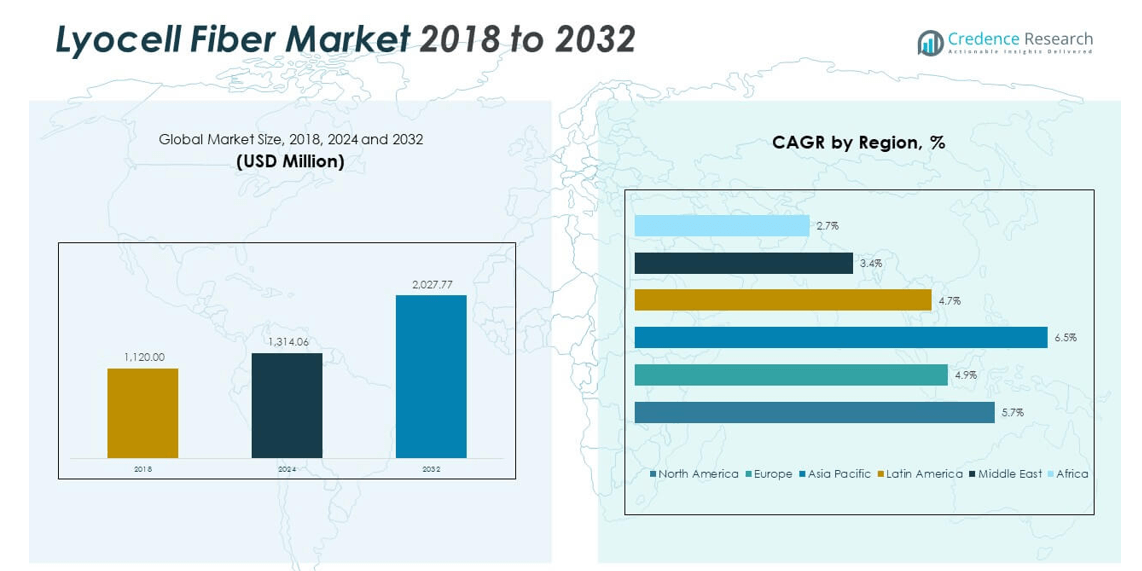
The GLOBAL LYOCELL FIBER MARKET size was valued at USD 1,120.00 million in 2018 to USD 1,314.06 million in 2024 and is anticipated to reach USD 2,027.77 million by 2032, at a CAGR of 5.66% during the forecast period.

REPORT ATTRIBUTE DETAILS
Historical Period 2020-2023
Base Year 2024
Forecast Period 2025-2032
Lyocell Fiber Market Size 2024 USD 1,314.06 million
Lyocell Fiber Market, CAGR 5.66%
Lyocell Fiber Market Size 2032 USD 2,027.77 million

Rising adoption of intelligent building systems drives stronger uptake across commercial and industrial sites. Companies integrate IoT sensors and automated control platforms to cut operational waste and improve asset reliability. Facility teams shift to predictive tools that support faster decisions and reduce downtime. Smart platforms offer real-time visibility that helps operators maintain safer and more productive spaces. Cloud dashboards support remote oversight for multi-site enterprises. Demand strengthens across new construction and retrofit activities.

The GLOBAL LYOCELL FIBER MARKET gains momentum across mature regions with high adoption of digital infrastructure. North America leads due to strong penetration of connected building systems and advanced energy-management tools. Europe follows with active government support for sustainability and smart-city programs. Asia Pacific emerges as the fastest-growing region due to rapid urban development and expanding commercial assets. Middle East markets grow through large-scale infrastructure upgrades and modern business districts. Latin America advances with rising investment in automation and security solutions. Each region adopts smart facility tools based on building maturity and digital readiness.

LYOCELL FIBER MARKET size

Market Insights:

  • The GLOBAL LYOCELL FIBER MARKET was USD 1,120.00 million in 2018, reached USD 1,314.06 million in 2024, and is projected to hit USD 2,027.77 million by 2032 at a CAGR of 5.66%.
  • Asia Pacific leads with 00% due to strong textile production; Europe follows with 25.43% driven by sustainability rules; North America holds 23.85% supported by high adoption of advanced manufacturing systems.
  • Asia Pacific is the fastest-growing region with 00%, supported by expanding apparel exports, rising eco-fiber demand, and large-scale manufacturing capacity.
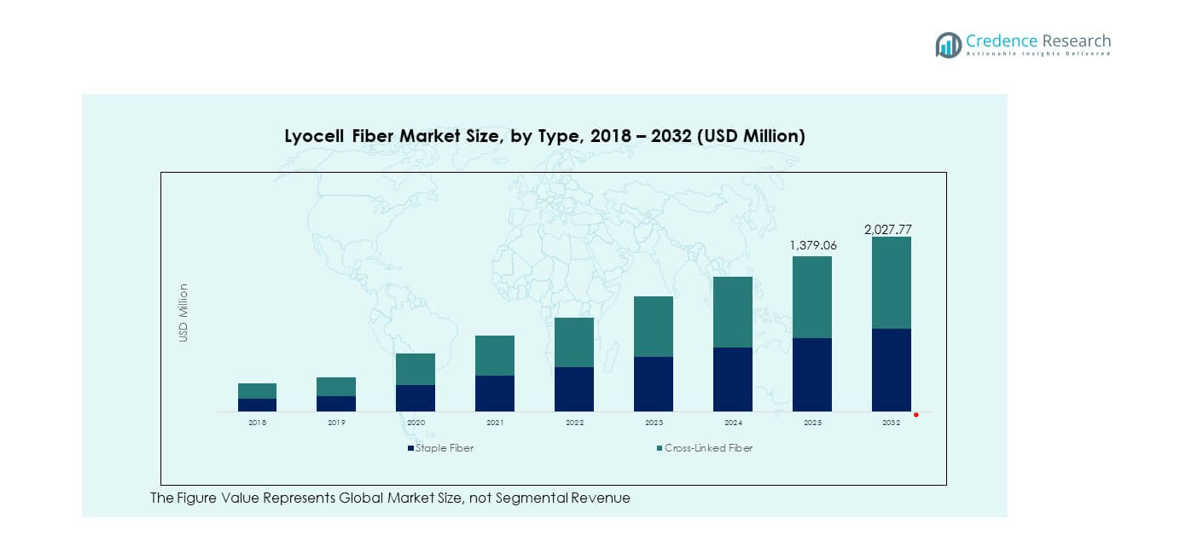
  • Staple Fiber holds the larger share in the chart, reflecting its high-volume use across apparel and home textiles.
  • Cross-Linked Fiber shows a smaller but steady share, driven by rising demand in durable industrial and hygiene applications.

Access crucial information at unmatched prices!

Request your sample report today & start making informed decisions powered by Credence Research Inc.!

Download Sample

Market Drivers:

Growing Demand for Intelligent Building Automation

The GLOBAL LYOCELL FIBER MARKET expands due to strong interest in automated systems that improve speed and accuracy across operations. Building owners invest in smart controls that support safer spaces and better energy use. Predictive tools give teams insight into faults before disruptions arise. IoT sensors help staff track equipment life and set timely tasks for field teams. Cloud dashboards support remote supervision for multi-site networks. Facility leaders adopt real-time alerts that guide fast response during critical events. Smart workflows cut manual errors and improve overall productivity. Companies continue shifting toward integrated platforms that unify key building functions.

  • For instance, Siemens’ Desigo CC platform integrates more than 2,000 device points in large facilities and supports AI-based fault detection features deployed across global enterprise sites.

Rising Focus on Energy Efficiency and Cost Control

Growing operational pressure drives enterprises toward solutions that lower long-term spending. Smart meters track energy patterns and highlight areas that need improvement. Automation tools reduce unnecessary loads and support better use of HVAC assets. Predictive analytics helps leaders schedule maintenance before failures damage key systems. Smart lighting keeps spaces efficient through occupancy patterns and daylight inputs. Real-time monitoring supports faster corrections that lift operational discipline. It encourages higher compliance with green standards and industry rules. Organizations across public and private sectors adopt energy-focused systems to gain stable savings.

  • For instance, Schneider Electric’s EcoStruxure Building solution has delivered energy savings of up to 30% across commercial buildings and manages more than 42 million connected assets worldwide.

Expansion of Connected Devices Across Commercial Spaces

Rapid use of IoT devices increases demand for smarter facility networks. Connected sensors deliver real-time data that helps managers detect anomalies. Automated ticketing systems guide technicians toward tasks with higher urgency. Remote access platforms allow supervisors to track asset health across regions. Smart workplace tools improve resource planning and workforce productivity. AI-driven insights support more accurate predictions for critical equipment. User-friendly dashboards help staff understand performance gaps. Facility owners move to scalable systems that grow with digital expansion.

Growing Shift Toward Predictive and Proactive Maintenance Models

Predictive models reduce downtime and strengthen equipment reliability across facilities. AI platforms study past patterns to guide precise maintenance schedules. Automated alerts help teams fix minor issues before larger failures occur. Digital twins offer simulations that improve decision-making accuracy. Smart tools support tech teams by providing live benchmarks for asset behavior. Better planning reduces emergency repairs that strain budgets. It encourages broader adoption of continuous monitoring tools across sectors. Enterprises choose proactive models to safeguard uptime and protect capital assets.

LYOCELL FIBER MARKET share

Market Trends:

Increasing Adoption of Integrated Facility Experience Platforms

The GLOBAL LYOCELL FIBER MARKET observes rising preference for unified platforms that connect multiple building functions. Integrated systems combine security, HVAC, lighting, and maintenance into one workflow. Centralized dashboards improve visibility and reduce navigation time for staff. Mobile-first interfaces give teams access to insights from any location. Smart workplace apps enhance user comfort and ensure smoother daily operations. Integration also cuts duplication across software assets. AI modules strengthen personalization for workspace users. Enterprises invest in experience-focused tools that support flexible work environments.

  • For instance, Honeywell’s Forge platform manages more than 100 million building data points per day and supports unified control across over 10,000 global sites.

Growth of Autonomous and Robotics-Based Facility Operations

Autonomous service robots gain wider use in cleaning, inspection, and logistics tasks. Robotics supports safer work by reducing direct contact in high-risk zones. Automated navigation improves consistency during repetitive duties. Smart mapping tools direct robots to cover large areas efficiently. AI systems allow machines to adjust routes based on real-time obstacles. Robotics helps teams maintain reliability during labor shortages. It also reduces delays caused by manual workloads. Large campuses deploy robots to strengthen service quality and daily performance.

  • For instance, SoftBank Robotics’ Whiz cleaning robot operates with HEPA filtration and has logged over 8 million kilometers of autonomous cleaning across corporate facilities worldwide.

Rise of Cybersecure Facility Ecosystems

Growing digital exposure drives demand for enhanced cyber protection across facility systems. Organizations secure connected devices through encrypted channels and strict authentication. Monitoring tools detect unusual patterns faster and help prevent disruptions. Zero-trust frameworks support safer exchanges within building networks. Regular updates keep systems aligned with emerging threats. Smart platforms feature built-in protections that shield vital assets. Risk teams use real-time logs to track suspicious events. Operators prioritize cyber health to maintain trust during digital expansion.

Expansion of Remote Operations and Virtual Facility Support

Remote facility control expands due to flexible work and multi-site operations. Virtual monitoring tools help teams track performance without physical presence. Live dashboards improve accuracy during decision tasks. Remote troubleshooting reduces travel time for technicians. Augmented-reality support tools guide field teams during complex repairs. Cloud-based systems keep data secure during remote sessions. It helps teams maintain operational continuity during workforce shifts. Companies invest in virtual facility models to reduce disruptions and raise efficiency.

Market Challenges Analysis:

High Integration Complexity and Limited Interoperability Across Systems

Implementation in the GLOBAL LYOCELL FIBER MARKET becomes difficult when legacy systems fail to align with modern tools. Organizations struggle to merge old assets with newer IoT modules. Fragmented device networks create delays in data flow and maintenance tasks. Vendors often use different communication standards that restrict scalability. Operators need trained teams to handle complex deployments. Budget limits delay upgrades across large properties. Interoperability gaps lead to errors that reduce performance. Enterprises face long deployment cycles that slow transformation.

Cybersecurity Risks, Skill Shortages, and Resistance to System Modernization

Cyber threats increase concerns around connected facilities in many regions. Security gaps expose systems to unauthorized access and operational damage. Enterprises lack skilled workers who manage both technical and physical infrastructure. Training demands rise as systems become more automated. Many organizations show resistance toward replacing legacy tools that feel familiar. Budget limits block rapid upgrades that improve building safety. It forces operators to delay essential modernization steps. Companies balance risk, cost, and workforce capability during digital adoption.

Market Opportunities:

Growing Investment in Smart Infrastructure Programs and Digital Building Upgrades

The GLOBAL LYOCELL FIBER MARKET gains new prospects from rising national and corporate smart infrastructure plans. Governments support modernization through advanced digital frameworks and sustainability targets. Enterprises shift budgets toward intelligent building upgrades to meet new standards. Expanding IoT networks open room for scalable deployments across sectors. Cloud-first platforms improve collaboration between dispersed teams. AI-driven tools help owners gain better forecasting capabilities. It encourages broader adoption across commercial, industrial, and public assets. Integrated modernization creates long-term value for new entrants and established firms.

Rapid Expansion of Smart Workplaces, Green Buildings, and Predictive Ecosystems

Demand for smart workplaces gives vendors strong entry opportunities across high-growth regions. Enterprises adopt tools that enhance user comfort and reduce energy stress. Green building programs promote wider investments in digital systems. Predictive models help owners manage assets with higher precision. Rising sustainability rules increase interest in resource-efficient technologies. Remote work strengthens preference for flexible facility systems. It opens growth prospects for developers who offer secure, adaptive solutions. Companies use modern ecosystems to lift overall building performance.

Market Segmentation Analysis:

By Type

The GLOBAL LYOCELL FIBER MARKET shows structured adoption across major type categories. Staple fiber supports bulk deployment in large facilities due to its balance of strength and cost. Cross-linked fiber offers higher durability for environments that require stable performance under frequent operational cycles. Filament fiber gains traction in premium applications where precision and uniform texture improve functional outcomes. Specialty variants cover niche solutions that address unique facility demands in controlled settings. Each type group supports growth through specific strength profiles that meet performance and sustainability needs.

  • For instance, Lenzing’s TENCEL filament yarn is produced using precision spinning technology and demonstrates tensile strength improvements of over 15% compared with standard regenerated fibers.

By Application

Apparel remains a strong demand generator led by casual wear, sportswear, innerwear, and formal wear, where comfort and breathability guide usage. Home textiles strengthen uptake across bed linen, towels, and curtains due to rising focus on soft-touch material. Medical and hygiene applications grow through wipes, hygiene pads, and bandages that support strict purity norms in sensitive environments. Industrial demand expands across filters, automotive textiles, and nonwoven industrial fabrics that require stability under heavy loads. Other niche uses help extend adoption into smaller specialty streams. Application diversity broadens the market reach, and it supports balanced development across consumer and industrial sectors.

  • For instance, Aditya Birla’s TENCEL fibers are used in over 200 global apparel brands and demonstrate moisture management rates up to 50% higher than conventional cotton.

LYOCELL FIBER MARKET segmentation

Segmentation:

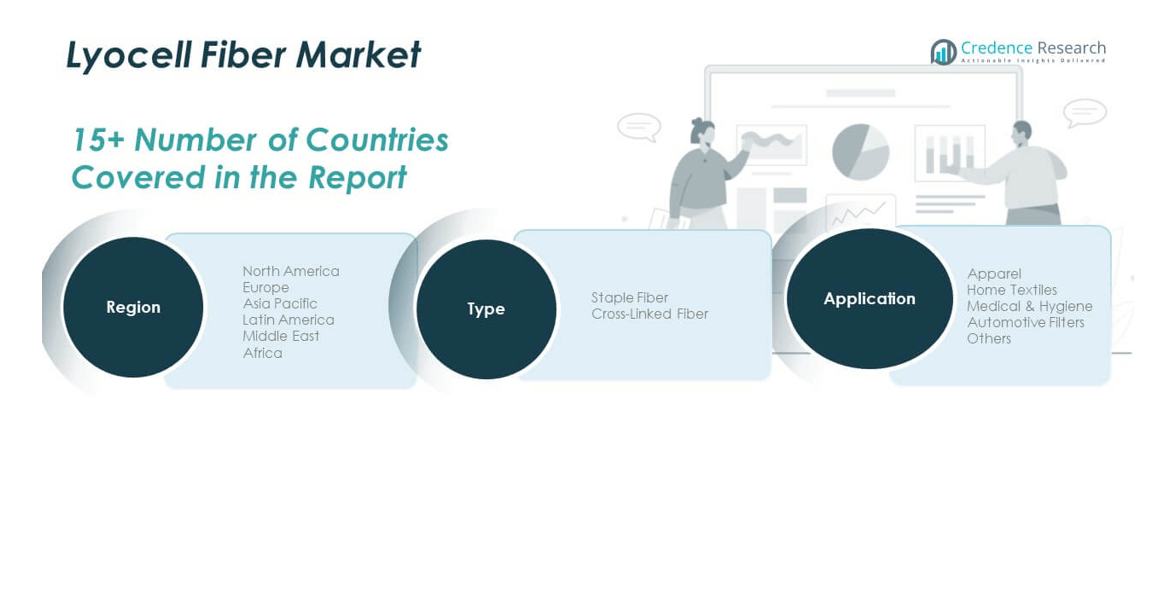
  1. By Type
  • Staple Fiber
  • Cross-linked Fiber
  • Filament Fiber
  • Others (Specialty Variants)
  1. By Application
  • Apparel
    • Casual Wear
    • Sportswear
    • Innerwear
    • Formal Wear
  • Home Textiles
    • Bed Linen
    • Towels
    • Curtains
  • Medical & Hygiene
    • Wipes
    • Hygiene Pads
    • Bandages
  • Industrial
    • Filters
    • Automotive Textiles
    • Nonwoven Industrial Fabrics
  • Others (Niche Uses)
  1. By Region
  • North America
    • U.S.
    • Canada
  • Europe
    • Germany
    • U.K.
    • France
    • Italy
    • Spain
    • Rest of Europe
  • Asia Pacific
    • China
    • India
    • Japan
    • South Korea
    • Southeast Asia
    • Rest of APAC
  • Latin America
    • Brazil
    • Mexico
    • Argentina
    • Rest of LATAM
  • Middle East
    • GCC
    • South Africa
    • Rest of Middle East
  • Africa
    • South Africa
    • Nigeria
    • Rest of Africa

Regional Analysis:

North America

The North America GLOBAL LYOCELL FIBER MARKET size was valued at USD 272.16 million in 2018 to USD 313.53 million in 2024 and is anticipated to reach USD 482.82 million by 2032, at a CAGR of 5.7% during the forecast period. North America holds 23.85% of the global share.
North America records strong adoption due to high digital maturity across enterprise buildings. The GLOBAL LYOCELL FIBER MARKET gains steady traction through rapid integration of IoT and automation. Large companies upgrade control platforms to strengthen remote supervision and predictive maintenance. It benefits from structured sustainability programs that push energy optimization across major cities. Regulatory bodies encourage efficient building operations to reduce long-term costs. Facility managers deploy cloud tools that improve decision speed and service reliability. Demand grows across healthcare, education, and commercial infrastructure. Vendors expand offerings that support hybrid workplace models across major corporate hubs.

Europe

The Europe GLOBAL LYOCELL FIBER MARKET size was valued at USD 296.24 million in 2018 to USD 334.13 million in 2024 and is anticipated to reach USD 487.18 million by 2032, at a CAGR of 4.9% during the forecast period. Europe holds 25.43% of the global share.
Europe sees steady growth driven by strict sustainability regulations and advanced building standards. The GLOBAL LYOCELL FIBER MARKET moves forward as enterprises adopt intelligent systems to meet green compliance needs. Energy rules encourage installation of smart HVAC and occupancy-based automation. It expands through strong investments in smart city initiatives across major economies. Predictive models support efficient building operations and cost control for large campuses. Cloud and IoT tools help facility teams reduce downtime. Public buildings integrate digital tools to improve service delivery and operational planning. Europe maintains growth through active modernization of aging infrastructure.

Asia Pacific

The Asia Pacific GLOBAL LYOCELL FIBER MARKET size was valued at USD 435.68 million in 2018 to USD 525.42 million in 2024 and is anticipated to reach USD 864.44 million by 2032, at a CAGR of 6.5% during the forecast period. Asia Pacific holds 40.00% of the global share.
Asia Pacific advances quickly due to rising construction of commercial towers, industrial parks, and digital campuses. The GLOBAL LYOCELL FIBER MARKET benefits from strong investment in connected systems across high-growth economies. Demand for real-time building intelligence increases across corporate spaces. It gains momentum through rapid expansion of smart city projects. Automation platforms support safety, compliance, and workforce productivity. Predictive maintenance tools attract interest from manufacturing and logistics hubs. Cloud-driven solutions improve scalability for multisite enterprises. Asia Pacific continues to lead in growth due to aggressive digital adoption.

Latin America

The Latin America GLOBAL LYOCELL FIBER MARKET size was valued at USD 69.78 million in 2018 to USD 81.06 million in 2024 and is anticipated to reach USD 115.93 million by 2032, at a CAGR of 4.7% during the forecast period. Latin America holds 6.17% of the global share.
Latin America records gradual adoption supported by modernization of commercial complexes and public infrastructure. The GLOBAL LYOCELL FIBER MARKET benefits from interest in energy-saving systems across urban centers. Companies adopt automation tools to improve service quality in large properties. It gains traction as businesses look for cost-efficient maintenance solutions. IoT platforms help reduce operational risk across industrial sites. Digital control systems support better visibility of utilities and asset performance. Vendors expand footprints through partnerships with regional integrators. Growth remains stable due to rising awareness of smart facility benefits.

Middle East

The Middle East GLOBAL LYOCELL FIBER MARKET size was valued at USD 27.44 million in 2018 to USD 29.03 million in 2024 and is anticipated to reach USD 37.73 million by 2032, at a CAGR of 3.4% during the forecast period. The Middle East holds 2.21% of the global share.
The Middle East progresses through increasing investment in modern infrastructure and large commercial developments. The GLOBAL LYOCELL FIBER MARKET gains support from high-end projects that require advanced automation. Smart building systems improve operational efficiency across new business districts. It advances due to rising demand for centralized monitoring across corporate towers. Energy-focused tools reduce load across facilities operating in warm climates. Predictive tools help owners maintain uptime across critical assets. Governments focus on digital transformation in line with national development plans. Growth remains tied to expanding construction and technology integration.

Africa

The Africa GLOBAL LYOCELL FIBER MARKET size was valued at USD 18.70 million in 2018 to USD 30.89 million in 2024 and is anticipated to reach USD 39.68 million by 2032, at a CAGR of 2.7% during the forecast period. Africa holds 2.35% of the global share.
Africa observes emerging adoption as urban areas modernize public and private facilities. The GLOBAL LYOCELL FIBER MARKET grows through gradual integration of automation across commercial properties. Smart systems improve energy use and operational planning in large buildings. It benefits from rising interest in cost-efficient maintenance and monitoring tools. IoT-based solutions support better resource management across infrastructure projects. Cloud tools help organizations strengthen remote oversight of distributed assets. Vendors explore local partnerships to increase market presence. Growth remains driven by infrastructure expansion and digital readiness.

Shape Your Report to Specific Countries or Regions & Enjoy 30% Off!

Key Player Analysis:

  • Lenzing AG
  • Aditya Birla Group
  • Baoding Swan Fiber Co., Ltd.
  • Chonbang Co., Ltd.
  • Weiqiao Textile Company Limited
  • Zhejiang Yaojiang Industrial Group Limited
  • China Populus Textile Ltd.
  • Acegreen Eco-Material Technology Co., Ltd.
  • Smartfiber AG
  • Nien Foun Fiber Co., Ltd.
  • Acelon Chemicals & Fiber Corporation
  • Grasim Industries Limited
  • Sateri Holdings Limited

Competitive Analysis:

The GLOBAL LYOCELL FIBER MARKET shows strong competition driven by continuous technology upgrades and expanding service portfolios. Vendors focus on IoT integration, predictive platforms, and cloud-based oversight to gain operational advantage. It attracts global and regional companies that invest in scalable systems supporting large corporate environments. Key players strengthen product depth through analytics, workplace automation, and energy optimization tools. Partnerships between software firms and facility service providers increase access to enterprise clients. Leading brands compete on interoperability, cybersecurity strength, and platform reliability. Vendors also expand AI-driven features that support remote supervision and workflow automation. The market remains active due to steady digital adoption across commercial, industrial, and public facilities.

Recent Developments:

  • October 2025 – Partnership with OceanSafe for Next-Generation Performance Textiles: In October 2025, Lenzing announced a strategic partnership with OceanSafe, an innovator in novel textile materials, to launch next-generation performance textiles. This collaboration synergizes Lenzing’s wood-based TENCEL™ Lyocell A100 fibers with OceanSafe’s high-performance, biodegradable co-polyester known as naNea, creating an innovative yarn that combines advanced functionality with environmental responsibility. The new product was unveiled at Performance Days in Munich on October 29-30, 2025, in Hall A2, followed by presentations at the Functional Fabric Fair in Portland in November, targeting manufacturers and brands seeking to transition to circular and biodegradable fiber materials.
  • November 2024 – Expansion of LENZING™ Lyocell Dry Fiber Portfolio: In November 2024, Lenzing , a leading supplier of regenerated cellulose fibers, announced the expansion of its LENZING™ Lyocell Dry fiber portfolio with two innovative new cellulosic fibers designed to address diverse application requirements. The company introduced a fine dry fiber that delivers both strength and softness, enabling customers to produce nonwoven fabrics with higher density compared to the standard LENZING™ Lyocell Dry fiber, with up to 30% more cellulosic fibers in the same space suitable for hygiene applications such as diapers and sanitary pads. Alongside this, Lenzing launched a coarse dry fiber which provides enhanced liquid and air flow capabilities, allowing for more air or liquid to flow through the material, making it particularly suitable for the acquisition and distribution layer in hygiene products and industrial filtration applications.

Report Coverage:

The research report offers an in-depth analysis based on By Type and By Application. It details leading market players, providing an overview of their business, product offerings, investments, revenue streams, and key applications. Additionally, the report includes insights into the competitive environment, SWOT analysis, current market trends, as well as the primary drivers and constraints. Furthermore, it discusses various factors that have driven market expansion in recent years. The report also explores market dynamics, regulatory scenarios, and technological advancements that are shaping the industry. It assesses the impact of external factors and global economic changes on market growth. Lastly, it provides strategic recommendations for new entrants and established companies to navigate the complexities of the market.

Future Outlook:

  • AI-driven facility intelligence will gain stronger demand in large enterprise buildings.
  • Cloud-native platforms will support broader remote supervision across dispersed locations.
  • Predictive maintenance will become a core investment priority for asset-heavy industries.
  • Cybersecure automation frameworks will see higher adoption across regulated sectors.
  • Smart workplace solutions will evolve to support dynamic occupancy and hybrid use cases.
  • Vendors will introduce interoperable systems that improve data exchange across platforms.
  • Sustainable building programs will push greater use of energy optimization technologies.
  • Robotics and autonomous services will expand into cleaning and inspection tasks.
  • Digital twins will support stronger planning accuracy in complex facility environments.
  • Regional markets will accelerate adoption based on infrastructure maturity and digital readiness.

CHAPTER NO. 1 : INTRODUCTION 24

1.1. Report Description 24

Purpose of the Report 24

USP & Key Offerings 24

1.2. Key Benefits for Stakeholders 25

1.3. Target Audience 25

CHAPTER NO. 2 : EXECUTIVE SUMMARY 26

CHAPTER NO. 3 : LYOCELL FIBER MARKET FORCES & INDUSTRY PULSE 28

3.1. Foundations of Change Market Overview 28

3.2. Catalysts of Expansion Key Market Drivers 30

3.2.1. Momentum Boosters Growth Triggers 31

3.2.2. Innovation Fuel Disruptive Technologies 31

3.3. Headwinds & Crosswinds Market Restraints 32

3.3.1. Regulatory Tides Compliance Challenges 33

3.3.2. Economic Frictions Inflationary Pressures 33

3.4. Untapped Horizons Growth Potential & Opportunities and Strategic Navigation Industry Frameworks 34

3.5. Market Equilibrium Porter’s Five Forces 35

3.6. Ecosystem Dynamics Value Chain Analysis 37

3.7. Macro Forces PESTEL Breakdown 39

CHAPTER NO. 4 : COMPETITION ANALYSIS 41

4.1. Company Market Share Analysis 41

4.1.1. Global Lyocell Fiber Market Company Revenue Market Share 41

4.2. Strategic Developments 43

4.2.1. Acquisitions & Mergers 43

4.2.2. New Deployment Mode Launch 44

4.2.3. Agreements & Collaborations 45

4.3. Competitive Dashboard 46

4.4. Company Assessment Metrics, 2024 47

CHAPTER NO. 5 : GLOBAL MARKET ANALYSIS, INSIGHTS & FORECAST, BY TYPE 48

CHAPTER NO. 6 : GLOBAL MARKET ANALYSIS, INSIGHTS & FORECAST, BY APPLICATION 52

CHAPTER NO. 7 : GLOBAL MARKET ANALYSIS, INSIGHTS & FORECAST, BY REGION 56

CHAPTER NO. 8 : NORTH AMERICA MARKET ANALYSIS, INSIGHTS & FORECAST, BY COUNTRY 61

8.1. North America Market Analysis, Insights & Forecast, by Type 63

8.2. North America Market Analysis, Insights & Forecast, by Application 64

CHAPTER NO. 9 : EUROPE MARKET ANALYSIS, INSIGHTS & FORECAST, BY COUNTRY 65

9.1. Europe Market Analysis, Insights & Forecast, by Type 68

9.2. Europe Market Analysis, Insights & Forecast, by Application 69

CHAPTER NO. 10 : ASIA PACIFIC MARKET ANALYSIS, INSIGHTS & FORECAST, BY COUNTRY 70

10.1. Asia Pacific Market Analysis, Insights & Forecast, by Type 73

10.2. Asia Pacific Market Analysis, Insights & Forecast, by Application 74

CHAPTER NO. 11 : LATIN AMERICA MARKET ANALYSIS, INSIGHTS & FORECAST, BY COUNTRY 75

11.1. Latin America Market Analysis, Insights & Forecast, by Type 78

11.2. Latin America Market Analysis, Insights & Forecast, by Application 79

CHAPTER NO. 12 : MIDDLE EAST MARKET ANALYSIS, INSIGHTS & FORECAST, BY COUNTRY 80

12.1. Middle East Market Analysis, Insights & Forecast, by Type 83

12.2. Middle East Market Analysis, Insights & Forecast, by Application 84

CHAPTER NO. 13 : AFRICA MARKET ANALYSIS, INSIGHTS & FORECAST, BY COUNTRY 85

13.1. Africa Market Analysis, Insights & Forecast, by Type 88

13.2. Africa Market Analysis, Insights & Forecast, by Application 89

CHAPTER NO. 14 : COMPANY PROFILE 90

14.1. Lenzing AG 90

14.2. Aditya Birla Group 93

14.3. Baoding Swan Fiber Co., Ltd. 93

14.4. Chonbang Co., Ltd. 93

14.5. Weiqiao Textile Company Limited 93

14.6. Zhejiang Yaojiang Industrial Group Limited 93

14.7. China Populus Textile Ltd. 93

14.8. Acegreen Eco-Material Technology Co., Ltd. 93

14.9. Smartfiber AG 93

14.10. Nien Foun Fiber Co., Ltd. 93

14.11. Acelon Chemicals & Fiber Corporation 93

14.12. Grasim Industries Limited 93

14.13. Sateri Holdings Limited 93

14.14. Company 13 93

14.15. Company 14 93


List of Figures

FIG NO. 1. Lyocell Fiber Market Revenue Share, By Type, 2024 & 2032 48

FIG NO. 2. Market Attractiveness Analysis, By Type 49

FIG NO. 3. Incremental Revenue Growth Opportunity by Type, 2024 – 2032 50

FIG NO. 4. Lyocell Fiber Market Revenue Share, By Application, 2024 & 2032 52

FIG NO. 5. Incremental Revenue Growth Opportunity by Application, 2024 – 2032 53

FIG NO. 6. Incremental Revenue Growth Opportunity by Application, 2024 – 2032 54

FIG NO. 7. Lyocell Fiber Market Revenue Share, By Region, 2024 & 2032 56

FIG NO. 8. Market Attractiveness Analysis, By Region 57

FIG NO. 9. Incremental Revenue Growth Opportunity by Region, 2024 – 2032 58

FIG NO. 10. Lyocell Fiber Market Revenue Share, By Country, 2024 & 2032 61

FIG NO. 11. Lyocell Fiber Market Revenue Share, By Country, 2024 & 2032 65

FIG NO. 12. Lyocell Fiber Market Revenue Share, By Country, 2024 & 2032 70

FIG NO. 13. Lyocell Fiber Market Revenue Share, By Country, 2024 & 2032 75

FIG NO. 14. Lyocell Fiber Market Revenue Share, By Country, 2024 & 2032 80

FIG NO. 15. Lyocell Fiber Market Revenue Share, By Country, 2024 & 2032 85

List of Tables

TABLE NO. 1. : Global Lyocell Fiber Market Revenue, By Type, 2018 2024 (USD Million) 51

TABLE NO. 2. : Global Lyocell Fiber Market Revenue, By Type, 2025 2032 (USD Million) 51

TABLE NO. 3. : Global Lyocell Fiber Market Revenue, By Application, 2018 2024 (USD Million) 55

TABLE NO. 4. : Global Lyocell Fiber Market Revenue, By Application, 2025 2032 (USD Million) 55

TABLE NO. 5. : Global Lyocell Fiber Market Revenue, By Region, 2018 2024 (USD Million) 59

TABLE NO. 6. : Global Lyocell Fiber Market Revenue, By Region, 2025 2032 (USD Million) 60

TABLE NO. 7. : North America Lyocell Fiber Market Revenue, By Country, 2018 2024 (USD Million) 62

TABLE NO. 8. : North America Lyocell Fiber Market Revenue, By Country, 2025 2032 (USD Million) 62

TABLE NO. 9. : North America Lyocell Fiber Market Revenue, By Type, 2018 2024 (USD Million) 63

TABLE NO. 10. : North America Lyocell Fiber Market Revenue, By Type, 2025 2032 (USD Million) 63

TABLE NO. 11. : North America Lyocell Fiber Market Revenue, By Application, 2018 2024 (USD Million) 64

TABLE NO. 12. : North America Lyocell Fiber Market Revenue, By Application, 2025 2032 (USD Million) 64

TABLE NO. 13. : Europe Lyocell Fiber Market Revenue, By Country, 2018 2024 (USD Million) 66

TABLE NO. 14. : Europe Lyocell Fiber Market Revenue, By Country, 2025 2032 (USD Million) 67

TABLE NO. 15. : Europe Lyocell Fiber Market Revenue, By Type, 2018 2024 (USD Million) 68

TABLE NO. 16. : Europe Lyocell Fiber Market Revenue, By Type, 2025 2032 (USD Million) 68

TABLE NO. 17. : Europe Lyocell Fiber Market Revenue, By Application, 2018 2024 (USD Million) 69

TABLE NO. 18. : Europe Lyocell Fiber Market Revenue, By Application, 2025 2032 (USD Million) 69

TABLE NO. 19. : Asia Pacific Lyocell Fiber Market Revenue, By Country, 2018 2024 (USD Million) 71

TABLE NO. 20. : Asia Pacific Lyocell Fiber Market Revenue, By Country, 2025 2032 (USD Million) 72

TABLE NO. 21. : Asia Pacific Lyocell Fiber Market Revenue, By Type, 2018 2024 (USD Million) 73

TABLE NO. 22. : Asia Pacific Lyocell Fiber Market Revenue, By Type, 2025 2032 (USD Million) 73

TABLE NO. 23. : Asia Pacific Lyocell Fiber Market Revenue, By Application, 2018 2024 (USD Million) 74

TABLE NO. 24. : Asia Pacific Lyocell Fiber Market Revenue, By Application, 2025 2032 (USD Million) 74

TABLE NO. 25. : Latin America Lyocell Fiber Market Revenue, By Country, 2018 2024 (USD Million) 76

TABLE NO. 26. : Latin America Lyocell Fiber Market Revenue, By Country, 2025 2032 (USD Million) 77

TABLE NO. 27. : Latin America Lyocell Fiber Market Revenue, By Type, 2018 2024 (USD Million) 78

TABLE NO. 28. : Latin America Lyocell Fiber Market Revenue, By Type, 2025 2032 (USD Million) 78

TABLE NO. 29. : Latin America Lyocell Fiber Market Revenue, By Application, 2018 2024 (USD Million) 79

TABLE NO. 30. : Latin America Lyocell Fiber Market Revenue, By Application, 2025 2032 (USD Million) 79

TABLE NO. 31. : Middle East Lyocell Fiber Market Revenue, By Country, 2018 2024 (USD Million) 81

TABLE NO. 32. : Middle East Lyocell Fiber Market Revenue, By Country, 2025 2032 (USD Million) 82

TABLE NO. 33. : Middle East Lyocell Fiber Market Revenue, By Type, 2018 2024 (USD Million) 83

TABLE NO. 34. : Middle East Lyocell Fiber Market Revenue, By Type, 2025 2032 (USD Million) 83

TABLE NO. 35. : Middle East Lyocell Fiber Market Revenue, By Application, 2018 2024 (USD Million) 84

TABLE NO. 36. : Middle East Lyocell Fiber Market Revenue, By Application, 2025 2032 (USD Million) 84

TABLE NO. 37. : Africa Lyocell Fiber Market Revenue, By Country, 2018 2024 (USD Million) 86

TABLE NO. 38. : Africa Lyocell Fiber Market Revenue, By Country, 2025 2032 (USD Million) 87

TABLE NO. 39. : Africa Lyocell Fiber Market Revenue, By Type, 2018 2024 (USD Million) 88

TABLE NO. 40. : Africa Lyocell Fiber Market Revenue, By Type, 2025 2032 (USD Million) 88

TABLE NO. 41. : Africa Lyocell Fiber Market Revenue, By Application, 2018 2024 (USD Million) 89

TABLE NO. 42. : Africa Lyocell Fiber Market Revenue, By Application, 2025 2032 (USD Million) 89


Request Free Sample

We prioritize the confidentiality and security of your data. Our promise: your information remains private.

Ready to Transform Data into Decisions?

Request Your Sample Report and Start Your Journey of Informed Choices


Providing the strategic compass for industry titans.

cr-clients-logos

Frequently Asked Questions:

What is the current market size for Global Lyocell Fiber Market, and what is its projected size in 2032?

The GLOBAL LYOCELL FIBER MARKET was valued at USD 1,120.00 million in 2018 and reached USD 1,314.06 million in 2024. It is projected to rise to USD 2,027.77 million by 2032. This growth reflects strong demand across apparel, hygiene, and industrial applications. Sustainability-led adoption also supports long-term expansion.

At what Compound Annual Growth Rate is the Global Lyocell Fiber Market projected to grow between 2025 and 2032?

The market is projected to expand at a CAGR of 5.66% through 2032. Steady progress comes from rising consumer preference for eco-friendly fibers. Growth also aligns with wider use across medical, home textile, and industrial applications. Strong regional manufacturing helps sustain output levels.

Which segment held the largest share of the GLOBAL LYOCELL FIBER MARKET in 2024?

The apparel segment held the leading share in 2024. Strong demand for breathable, soft, and durable clothing materials drives this advantage. Casual wear, sportswear, and innerwear remain major volume contributors. Expanding sustainable fashion trends strengthen this segment further.

What are the primary factors fueling the growth of the Global Lyocell Fiber Market?

Key factors include growing consumer demand for eco-friendly products, biodegradability of lyocell fibers, and their versatility across multiple industries. Expanding use in fashion and home textiles further accelerates market growth.

Who are the leading companies in the Global Lyocell Fiber Market?

Prominent companies include Lenzing AG, Birla Cellulose, Sateri Holdings Limited, Aditya Birla Group, and Smartfiber AG. These firms lead through innovation, capacity expansion, and strategic partnerships in the sustainable fiber industry.

About Author

Ganesh Chandwade

Ganesh Chandwade

Senior Industry Consultant

Ganesh is a senior industry consultant specializing in heavy industries and advanced materials.

View Profile


Related Reports

Nylon Films Market

The Nylon films market is projected to grow from USD 963.9 million in 2024 to an estimated USD 1,249.8 million by 2032, with a compound annual growth rate of 3.3% from 2024 to 2032.

India Industrial Hemp Market

The India Industrial Hemp Market size was valued at USD 62.52 million in 2018 to USD 219.79 million in 2024 and is anticipated to reach USD 952.90 million by 2032, at a CAGR of 18.77% during the forecast period.

Serrata Extract Market

Serrata Extract Market size was valued at USD 99.09 Million in 2024 and is anticipated to reach USD 212.41 Million by 2032, at a CAGR of 10% during the forecast period.

Medical Membrane Market

Medical membrane market size was valued at USD 3,952.71 million in 2024 and is anticipated to reach USD 7,818.40 million by 2032, growing at a CAGR of 8.9% during the forecast period.

Indoor Location Market

Indoor Location market size was valued at USD 9,156 Million in 2024 and is anticipated to reach USD 45,827.45 Million by 2032, at a CAGR of 22.3% during the forecast period.

Tubular Electrostatic Precipitator Market

Tubular Electrostatic Precipitator Market size was valued at USD 1,060.85 million in 2024 and is anticipated to reach USD 1,822.74 million by 2032, at a CAGR of 7.0% during the forecast period.

Touchless Sensing Market

The Touchless Sensing Market size was valued at USD 7,529.6 million in 2024 and is anticipated to reach USD 22,415.68 million by 2032, growing at a CAGR of 14.61% during the forecast period.

Touchable Holography Market

The Touchable Holography Market size was valued at USD 8,216.6 million in 2024 and is anticipated to reach USD 20,475.15 million by 2032, expanding at a CAGR of 12.09% during the forecast period.

Tool Steel Market

Tool Steel Market size was valued at USD 6,600.89 million in 2024 and is anticipated to reach USD 10,378.74 million by 2032, registering a CAGR of 5.82% during the forecast period

South Korea Aerial Work Platform (AWP) Rental Market

South Korea Aerial Work Platform (AWP) Rental Market size was valued USD 568.32 million in 2024 and is anticipated to reach USD 1191.92 million by 2032, at a CAGR of 9.7% during the forecast period.

Construction Stones Market

The construction stones market was valued at USD 39,494 million in 2024 and is projected to reach USD 52,693.76 million by 2032, expanding at a compound annual growth rate (CAGR) of 3.67% during the forecast period.

Agro Textile Market

Agro Textiles market size was valued at USD 4,112.2 million in 2018 to USD 5,110.7 million in 2024 and is anticipated to reach USD 7,302.5 million by 2032, at a CAGR of 4.62% during the forecast period.

Licence Option

The report comes as a view-only PDF document, optimized for individual clients. This version is recommended for personal digital use and does not allow printing. Use restricted to one purchaser only.
$4999

To meet the needs of modern corporate teams, our report comes in two formats: a printable PDF and a data-rich Excel sheet. This package is optimized for internal analysis. Unlimited users allowed within one corporate location (e.g., regional office).
$6999

The report will be delivered in printable PDF format along with the report’s data Excel sheet. This license offers 100 Free Analyst hours where the client can utilize Credence Research Inc. research team. Permitted for unlimited global use by all users within the purchasing corporation, such as all employees of a single company.
$12999

Report delivery within 24 to 48 hours

Europe

North America

Email

Smallform of Sample request
User Review

Thank you for the data! The numbers are exactly what we asked for and what we need to build our business case.

Materials Scientist
(privacy requested)

User Review

The report was an excellent overview of the Industrial Burners market. This report does a great job of breaking everything down into manageable chunks.

Imre Hof
Management Assistant, Bekaert

cr-clients-logos

Request Sample