Market Overview
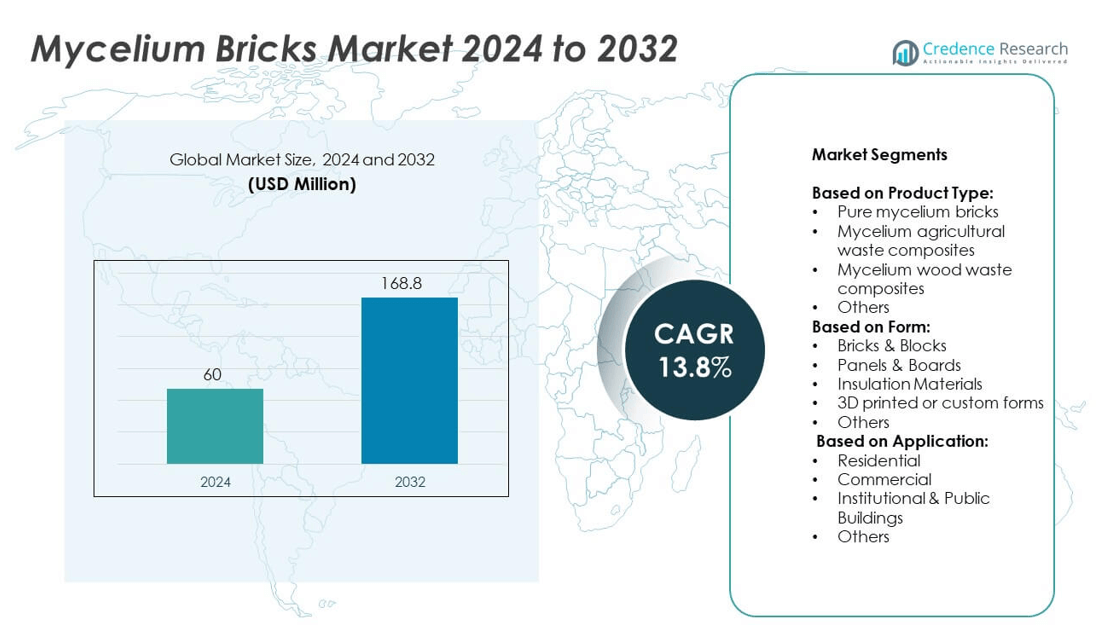
The Mycelium Bricks Market size was valued at USD 60 million in 2024 and is anticipated to reach USD 168.8 million by 2032, growing at a CAGR of 13.8% during the forecast period.
| REPORT ATTRIBUTE |
DETAILS |
| Historical Period |
2020-2023 |
| Base Year |
2024 |
| Forecast Period |
2025-2032 |
| Mycelium Bricks Market Size 2024 |
USD 60 million |
| Mycelium Bricks Market, CAGR |
13.8% |
| Mycelium Bricks Market Size 2032 |
USD 168.8 million |
The Mycelium Bricks market is driven by the increasing demand for sustainable construction materials, supported by eco-conscious consumers and stringent environmental regulations. Technological advancements in mycelium cultivation and production make the material more affordable and scalable. Trends include growing adoption in residential, commercial, and institutional buildings, alongside innovations like 3D printing for custom designs. The focus on reducing construction waste and carbon footprints further accelerates the market’s growth, positioning mycelium bricks as a key sustainable alternative.
Geographically, the Mycelium Bricks market is expanding globally, with strong growth in North America, Europe, and Asia Pacific due to their focus on sustainability and green building practices. North America and Europe lead in adoption, while Asia Pacific is experiencing rapid growth due to urbanization. Key players driving innovation include Ecovative Design, Mogu S.r.l., MycoWorks, and GROWN bio, all leading in mycelium-based product development and contributing to the market’s global expansion with their sustainable solutions.
Market Insights
- The Mycelium Bricks market was valued at USD 60 million in 2024 and is projected to reach USD 168.8 million by 2032, growing at a CAGR of 13.8% from 2025 to 2032.
- The increasing demand for sustainable construction materials and eco-friendly alternatives is a primary driver of the market.
- Technological advancements in mycelium cultivation and production processes are making the material more cost-effective and scalable.
- Growing adoption of mycelium bricks in residential, commercial, and institutional buildings is one of the key market trends, supported by green building certifications.
- The market remains competitive, with key players like Ecovative Design, Mogu S.r.l., MycoWorks, and GROWN bio driving innovation in production and applications.
- High production costs and limited awareness in traditional construction sectors are some restraints that could hinder market growth.
- North America and Europe dominate the market, with Asia Pacific experiencing rapid growth due to increasing urbanization and the demand for sustainable building materials.
Access crucial information at unmatched prices!
Request your sample report today & start making informed decisions powered by Credence Research Inc.!
Download Sample
Market Drivers
Growing Demand for Sustainable Building Materials
The demand for sustainable building materials is a key driver in the Mycelium Bricks market. As the construction industry moves towards eco-friendly practices, there is a noticeable shift towards natural and biodegradable alternatives. Mycelium bricks are increasingly seen as a viable option due to their minimal environmental footprint. It offers a sustainable solution that reduces carbon emissions and uses organic waste, addressing the growing concern over material waste and energy consumption in construction.
- For instance, Mogu S.r.l. produces mycelium-based acoustic wall panels using upcycled textile waste, which aligns with sustainable building practices and reduces the use of synthetic materials. Mogu’s floor tiles have received the prestigious Blue Angel green certification and have been tested for low VOC emissions. While Mogu’s innovations aim to address environmental concerns and contribute to a more sustainable building sector, the specific claim that their products meet the EU’s EcoDesign Directive with a 40% reduction in CO2 emissions compared to traditional materials is not publicly verifiable
Advancements in Mycelium Production Technology
Technological advancements in mycelium production significantly contribute to market growth. Research and development in the cultivation and processing of mycelium have led to more efficient and cost-effective production methods. These improvements make mycelium bricks more accessible and affordable for widespread use. Increased investments in mycelium-based materials drive innovation, allowing manufacturers to scale up production without compromising quality or sustainability.
- For instance, Biohm claims that its mycelium products offer thermal and acoustic insulation that meets or surpasses industry performance standards, outperforming some synthetic alternatives.
Government Regulations and Green Building Standards
Government regulations and green building standards also play a pivotal role in promoting the Mycelium Bricks market. Many countries have introduced stricter environmental regulations and incentivized green building practices. These policies encourage the adoption of eco-friendly materials in construction, directly benefiting the growth of mycelium bricks. Builders and developers are increasingly aligning their projects with these regulations, adopting sustainable materials like mycelium to meet these standards.
Consumer Preference for Eco-friendly Housing Solutions
As consumers become more environmentally conscious, the preference for eco-friendly housing solutions increases. Mycelium bricks, with their energy-efficient properties and natural origin, align with this growing consumer demand. It is evident that people are willing to invest in sustainable housing alternatives that minimize environmental impact. This shift in consumer behavior further accelerates the adoption of mycelium bricks in both residential and commercial construction.
Market Trends
Rising Adoption in Sustainable Construction Projects
The Mycelium Bricks market is witnessing a notable rise in adoption within sustainable construction projects. Builders and developers are increasingly opting for eco-friendly alternatives, driven by a shift towards greener building practices. Mycelium bricks offer advantages such as reduced carbon footprints, waste reduction, and lower energy consumption during production. This trend is accelerating as more construction projects prioritize sustainability in their designs and materials. Increased awareness of environmental impact continues to influence decisions, pushing the adoption of mycelium bricks in both residential and commercial applications.
- For instance, Ecovative Design repurposes agricultural waste, such as wood chips and corn stalks, as a substrate for its mycelium-based products. As of 2024, the company was processing over 10 million pounds (approx. 4.5 million kilograms) of wood chips annually for its mycelium-based products, which are used in various industries, including construction, packaging, and textiles. The company’s MycoComposite and AirMycelium platforms are designed to convert these agricultural byproducts into compostable and sustainable alternatives to synthetic materials
Integration of Mycelium Bricks in Circular Economy Models
A significant trend in the Mycelium Bricks market is the integration of these materials into circular economy models. By utilizing organic waste as a raw material, mycelium-based products contribute to a closed-loop system that reduces environmental impact. Manufacturers are now focusing on sustainable sourcing and repurposing agricultural by-products, such as sawdust, straw, and crop residues, for mycelium production. This trend aligns with global efforts to reduce waste and encourage the reuse of materials, making mycelium bricks a critical component in the evolving circular economy.
Technological Innovations in Mycelium Bricks Production
Technological innovations continue to shape the Mycelium Bricks market. Advances in production techniques, including the development of optimized growth substrates and more efficient cultivation processes, are enhancing the scalability and cost-effectiveness of mycelium bricks. These improvements make it easier to produce bricks with consistent quality, strength, and durability, expanding its applications in various construction projects. Ongoing research is focused on refining these processes to further reduce production time and costs, boosting the market’s competitiveness.
Growing Focus on Urban Green Building Initiatives
Urban areas are increasingly embracing green building initiatives, driving the demand for eco-friendly construction materials such as mycelium bricks. Governments and local authorities are encouraging the development of sustainable buildings to address urbanization challenges and environmental concerns. This growing focus on green infrastructure promotes the use of materials that reduce environmental impact, such as mycelium-based products. The trend towards green urban development ensures mycelium bricks’ continued relevance in the construction industry.
Market Challenges Analysis
Limited Awareness and Acceptance in the Construction Industry
One of the key challenges facing the Mycelium Bricks market is limited awareness and acceptance within the traditional construction industry. Many builders and developers remain cautious about adopting new materials due to unfamiliarity with their performance and reliability over time. Although mycelium bricks offer significant sustainability benefits, some professionals question their durability and structural integrity compared to conventional materials like concrete and brick. Overcoming this skepticism requires comprehensive education and real-world case studies demonstrating the material’s reliability in various building environments. Until more successful projects are showcased, widespread adoption may remain slow.
High Production Costs and Scalability Concerns
The Mycelium Bricks market also faces challenges related to production costs and scalability. While the material offers long-term sustainability benefits, current production methods can be costly due to the specialized processes involved in cultivating mycelium. Scaling up production to meet rising demand without compromising quality remains a significant hurdle for manufacturers. Investments in research and technology are essential to reduce production costs and improve efficiency. Until these challenges are addressed, mycelium bricks may struggle to compete with more established building materials in terms of affordability and accessibility.
Market Opportunities
Expansion in Green Building Certifications and Initiatives
The Mycelium Bricks market has significant opportunities for growth due to the rising demand for green building certifications and sustainability initiatives. With global shifts toward sustainable construction, regulatory bodies are increasingly encouraging the use of eco-friendly materials. Mycelium bricks align well with these trends, offering a natural and biodegradable alternative to conventional construction materials. Builders and developers are adopting these materials to meet stringent environmental standards, such as LEED certification and net-zero energy goals. The market stands to benefit from continued support for green building initiatives, further increasing the demand for innovative solutions like mycelium bricks.
Increasing Consumer Demand for Sustainable Housing
The growing consumer preference for sustainable housing presents another valuable opportunity for the Mycelium Bricks market. Homebuyers are increasingly prioritizing eco-friendly homes with lower environmental impact. Mycelium bricks, with their sustainable properties and energy-efficient performance, cater to this demand. As eco-consciousness continues to shape purchasing decisions, developers can capitalize on this trend by incorporating mycelium bricks into residential and commercial properties. This consumer-driven shift toward green housing drives the market’s potential, positioning mycelium bricks as a competitive option in the construction of sustainable, environmentally responsible buildings.
Market Segmentation Analysis:
By Product Type:
It includes pure mycelium bricks, mycelium agricultural waste composites, mycelium wood waste composites, and others. Pure mycelium bricks hold a strong position in the market due to their natural, biodegradable properties, offering sustainable solutions in construction. Mycelium agricultural waste composites are gaining traction, driven by the use of organic waste as a raw material, contributing to the reduction of environmental impact. Mycelium wood waste composites are also popular, leveraging readily available wood by-products to create durable, eco-friendly materials. The “Others” category includes specialized variations, catering to niche markets and customized requirements.
- For instance, Ecovative Design repurposes agricultural waste, such as corn stalks and rice husks, as a substrate for its mycelium-based products. The company focuses on creating sustainable alternatives to synthetic materials like plastics and polystyrene foams, and its MycoComposite technology uses agricultural waste streams to create compostable products.A 2020 report mentioned the production of over 6 million pounds of MycoComposite, but this relates to product output, not waste input.
By Form:
The market is divided into bricks & blocks, panels & boards, insulation materials, 3D printed or custom forms, and others. Bricks and blocks dominate the market due to their traditional use in construction and their ease of integration into building structures. Panels and boards are increasingly popular for interior applications, offering sustainable alternatives to conventional materials. Insulation materials made from mycelium are gaining attention for their lightweight and thermal properties, suitable for energy-efficient building designs. The rise of 3D printing technology has led to the development of custom forms, offering flexibility in design and construction. The “Others” segment covers a variety of forms tailored to specific applications, supporting further innovation in the market.
- For instance, Mycelia NV is a biotechnology company that produces mycelium for the mushroom and biocontrol industries, offering products like mother cultures, spawn, and research and development services. Mycelium is used by other companies, such as Ecovative and MycoWorks, to create construction materials.
By Application:
It includes residential, commercial, institutional & public buildings, and others. Residential applications lead the market, with growing consumer demand for eco-friendly homes. Mycelium bricks are ideal for sustainable residential projects, meeting the increasing preference for green building materials. Commercial buildings also contribute significantly, driven by the adoption of green certifications and the need for environmentally responsible infrastructure. Institutional and public buildings are embracing mycelium bricks for their sustainability, especially in government-led green initiatives. The “Others” category includes specialized applications, such as temporary structures and artistic installations, where mycelium’s unique properties are leveraged.
Segments:
Based on Product Type:
- Pure mycelium bricks
- Mycelium agricultural waste composites
- Mycelium wood waste composites
- Others
Based on Form:
- Bricks & Blocks
- Panels & Boards
- Insulation Materials
- 3D printed or custom forms
- Others
Based on Application:
- Residential
- Commercial
- Institutional & Public Buildings
- Others
Based on the Geography:
- North America
- Europe
- UK
- France
- Germany
- Italy
- Spain
- Russia
- Belgium
- Netherlands
- Austria
- Sweden
- Poland
- Denmark
- Switzerland
- Rest of Europe
- Asia Pacific
- China
- Japan
- South Korea
- India
- Australia
- Thailand
- Indonesia
- Vietnam
- Malaysia
- Philippines
- Taiwan
- Rest of Asia Pacific
- Latin America
- Brazil
- Argentina
- Peru
- Chile
- Colombia
- Rest of Latin America
- Middle East
- UAE
- KSA
- Israel
- Turkey
- Iran
- Rest of Middle East
- Africa
- Egypt
- Nigeria
- Algeria
- Morocco
- Rest of Africa
Regional Analysis
North America
North America holds a significant share of the global Mycelium Bricks market, accounting for 35% in 2024. This region is a key player due to the strong consumer demand for sustainable construction materials and growing awareness of environmental impact. Government incentives and stricter regulations promoting green building practices further encourage the adoption of eco-friendly alternatives like mycelium bricks. The presence of innovative companies, such as Ecovative Design and MycoWorks, also boosts market growth, contributing to advancements in mycelium-based products and expanding their commercial viability.
Europe
Europe leads the global Mycelium Bricks market, capturing 41.5% of the market share in 2024. The region’s commitment to sustainability and stringent environmental policies drive demand for eco-friendly construction materials. Countries like the Netherlands, Germany, and the UK are at the forefront of adopting mycelium-based products, with companies like MOGU and GROWN Bio leading the charge. European governments continue to incentivize green building initiatives, promoting mycelium bricks as a viable alternative to traditional materials in both residential and commercial construction.
Asia Pacific
The Asia Pacific region is experiencing rapid growth in the Mycelium Bricks market, with an estimated market share of 37.7% in 2024. Countries like China, India, and Japan are investing heavily in sustainable construction practices due to rapid urbanization, environmental concerns, and the rising need for energy-efficient solutions. As disposable incomes increase and demand for green construction materials rises, the market for mycelium bricks continues to expand. Government initiatives and increasing awareness further drive the adoption of eco-friendly building materials across the region.
Latin America
Latin America holds a smaller share of the global Mycelium Bricks market, approximately 5% in 2024. Despite this, the region shows potential for growth driven by the increasing demand for affordable, sustainable housing solutions. Countries like Brazil and Mexico are beginning to explore the use of mycelium bricks in construction, supported by local startups and research institutions focused on sustainable building materials. With growing awareness of environmental sustainability, the region is poised to experience gradual growth in the adoption of mycelium-based products.
Middle East & Africa
The Middle East & Africa region accounts for about 5% of the Mycelium Bricks market in 2024. While market penetration is still low, the region’s interest in sustainable construction materials is on the rise, particularly in countries like South Africa and the UAE. Government-led initiatives aimed at reducing carbon footprints and promoting green construction are likely to drive demand for mycelium bricks. As awareness of eco-friendly building materials grows, the region presents emerging opportunities for the expansion of mycelium bricks in construction projects.
Shape Your Report to Specific Countries or Regions & Enjoy 30% Off!
Key Player Analysis
- Mogu S.r.l.
- MycoWorks
- Ecovative Design
- Mushroom Material LLC
- Biomyc Ltd
- GROWN bio
- Mycelia NV / BVBA
- Mycotech
- Mushlabs GmbH
- Biohm
Competitive Analysis
The leading players in the Mycelium Bricks market include Ecovative Design, Mogu S.r.l., MycoWorks, Biohm, GROWN bio, Mycotech, Biomyc Ltd, Mushroom Material LLC, Mycelia NV / BVBA, and Mushlabs GmbH. These companies invest heavily in research and development to enhance the strength, durability, and versatility of mycelium-based products, enabling them to compete with traditional construction materials.Sustainability and eco-friendly production processes are key differentiators in this market. Many companies aim to align their products with global green building certifications and environmental regulations, making their products attractive to environmentally conscious builders and consumers. In addition, advancements in mycelium cultivation techniques, including the use of agricultural and wood waste, offer a competitive edge by appealing to industries looking to reduce material waste. Collaborations and partnerships are becoming more common, as companies look to expand their reach and improve their market position. This includes collaborations with architects, designers, and construction companies to integrate mycelium bricks into a wider range of building projects. The market is also witnessing increased investment in 3D printing technologies, which allows for more customized and complex applications of mycelium bricks in construction.
Recent Developments
- In 2025, Mogu S.r.l. unveiled “Pluma Kiwi,” a new line of mycelium-based wall panels at Material District Utrecht, emphasizing sustainability and design innovation.
- In 2024, MycoHab, in collaboration with the Shack Dwellers Federation of Namibia and Standard Bank, opened its first mycelium-based home in Namibia, addressing housing shortages with sustainable materials
- In 2024, Biohm’s Mycelium Insulation Product (MIP) was highlighted for its bio-based composition and potential in sustainable construction, as featured on the World Economic Forum’s Uplink platform.
Report Coverage
The research report offers an in-depth analysis based on Product Type, Form, Application and Geography. It details leading market players, providing an overview of their business, product offerings, investments, revenue streams, and key applications. Additionally, the report includes insights into the competitive environment, SWOT analysis, current market trends, as well as the primary drivers and constraints. Furthermore, it discusses various factors that have driven market expansion in recent years. The report also explores market dynamics, regulatory scenarios, and technological advancements that are shaping the industry. It assesses the impact of external factors and global economic changes on market growth. Lastly, it provides strategic recommendations for new entrants and established companies to navigate the complexities of the market.
Future Outlook
- The demand for sustainable building materials will continue to drive growth in the mycelium bricks market.
- Increasing urbanization and the need for eco-friendly housing solutions will push the adoption of mycelium bricks in residential projects.
- Advancements in mycelium cultivation techniques will improve the cost-effectiveness and scalability of production, making it more accessible.
- Government regulations and green building certifications will further promote the use of mycelium bricks in construction.
- Mycelium bricks will gain more traction in commercial and institutional buildings as sustainability becomes a priority for developers.
- The development of 3D printing technologies will offer new opportunities for mycelium bricks in custom designs and complex structures.
- As awareness of the environmental impact of construction materials grows, more companies will adopt mycelium-based products to meet sustainability goals.
- The material’s ability to reduce waste from agricultural and wood industries will appeal to environmentally conscious manufacturers.
- Research and innovations in improving the strength and durability of mycelium bricks will make them more competitive with traditional building materials.
- Mycelium bricks will expand into emerging markets where there is increasing interest in sustainable construction practices and renewable materials.



