Market Overview
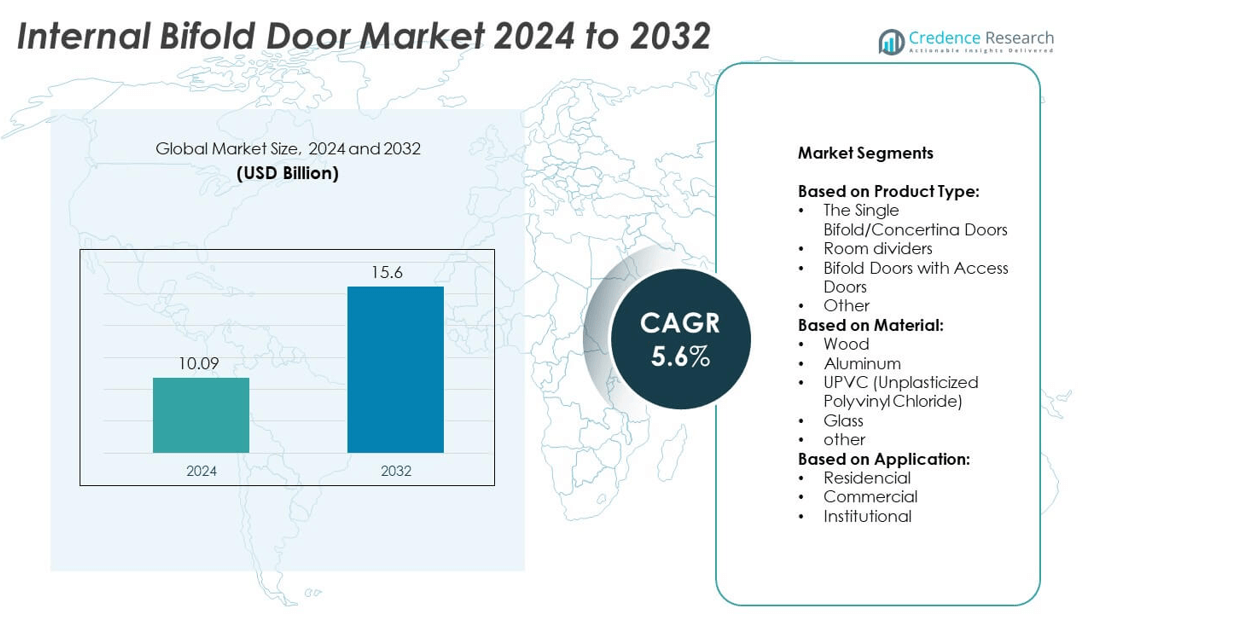
The Internal Bifold Door Market size was valued at USD 10.09 Billion in 2024 and is projected to reach USD 15.6 Billion by 2032, growing at a CAGR of 5.6% during the forecast period.
| REPORT ATTRIBUTE |
DETAILS |
| Historical Period |
2020-2023 |
| Base Year |
2024 |
| Forecast Period |
2025-2032 |
| Internal Bifold Door Market Size 2024 |
USD 10.09 Billion |
| Internal Bifold Door Market, CAGR |
5.6% |
| Internal Bifold Door Market Size 2032 |
USD 15.6 Billion |
The Internal Bifold Door market grows with rising demand for space-saving interior solutions and modern aesthetics. Increasing urbanization and smaller living spaces drive adoption in residential and commercial projects. Consumers prefer customizable designs, energy-efficient materials, and easy-to-operate mechanisms. Advancements in automation and smart home integration enhance product appeal among premium buyers. Sustainable materials such as recyclable aluminum and certified wood gain traction. Rising renovation activities and e-commerce availability further expand market reach, supporting steady growth during the forecast period.
North America leads the Internal Bifold Door market, supported by strong residential remodeling and new housing projects. Europe follows with rising demand for energy-efficient and customizable bifold solutions in renovation activities. Asia Pacific shows rapid growth driven by urbanization and expanding middle-class housing needs. Key players include Andersen Corporation, Marvin, Milgard Windows & Doors, and Pella Corporation, who focus on product innovation, sustainable materials, and smart door solutions to strengthen their presence across these regions and meet evolving customer preferences.
Market Insights
- The Internal Bifold Door market was valued at USD 10.09 Billion in 2024 and is projected to reach USD 15.6 Billion by 2032, growing at a CAGR of 5.6%.
- Rising demand for space-saving interior solutions and modern designs drives consistent market growth worldwide.
- Increasing popularity of minimalistic and open-concept interiors boosts adoption of bifold doors in residential and commercial spaces.
- Leading companies focus on innovation, durable hardware, and sustainable materials to strengthen competitiveness.
- High installation and maintenance costs remain a restraint, limiting adoption among price-sensitive buyers.
- North America leads in demand, followed by Europe, with Asia Pacific showing the fastest growth due to urbanization.
- Growing e-commerce sales, customization options, and integration of smart features create new opportunities for manufacturers.
Access crucial information at unmatched prices!
Request your sample report today & start making informed decisions powered by Credence Research Inc.!
Download Sample
Market Drivers
Rising Demand for Space-Saving Interior Solutions
The Internal Bifold Door market benefits from the growing need for compact, space-efficient designs. Urbanization drives smaller living spaces where homeowners prioritize flexible layouts. Bifold doors allow seamless transitions between rooms, creating open areas when required. Their folding mechanism improves functionality compared to traditional swing doors. Architects and builders prefer bifold systems for residential and commercial projects. It enhances the overall aesthetic appeal and maximizes usable floor space for property owners.
- For instance, Leader Doors, a UK-based retailer for internal bifold doors, offers a wide variety of sizes for its products. While the specific available sizes vary by product model and style (such as White Primed, Oak, or Pine), common width options start at 610 mm and include wider options like 762 mm, 838 mm, and often much wider configurations for multi-door room dividers. Common heights include 1981 mm and 2040 mm, though exact availability depends on the specific product, the “Liberty Doors White Internal Bi-fold Primed Victorian Shaker 4 Panel Door” is offered in sizes such as 1981x610x35 mm and 1981x838x35 mm
Increasing Preference for Modern and Customizable Designs
Consumers seek doors that match contemporary interior trends and reflect personal style. The Internal Bifold Door market offers multiple material choices, including wood, aluminum, and glass. Customizable panel configurations enable better integration with diverse architectural themes. Manufacturers introduce innovative finishes and frame colors to meet demand. It drives adoption among renovation projects and premium housing segments. Rising interest in minimalistic and elegant interiors further accelerates product uptake.
- For instance, The JELD-WEN Birkdale Bifold interior door features a door thickness of 1.375 inches (approximately 35 mm) and uses a hollow core, often made with honeycomb-cell technology, which makes it lightweight and affordable.
Growth of the Construction and Real Estate Industry
Rising construction of residential apartments and commercial buildings supports market expansion. Builders specify bifold doors to meet customer expectations for modern interiors. The Internal Bifold Door market benefits from real estate growth in urban and semi-urban regions. Increasing disposable income encourages homeowners to upgrade interiors with functional solutions. Government-backed housing initiatives also support demand in developing economies. It strengthens opportunities for suppliers and distributors in emerging markets.
Advancements in Product Quality and Durability
Manufacturers invest in improved hardware systems to ensure smooth operation and long lifespan. The Internal Bifold Door market adopts high-quality tracks, hinges, and locking mechanisms. Use of lightweight but sturdy materials reduces maintenance requirements. Glass bifold doors now feature better insulation and safety standards. It appeals to both residential and commercial buyers seeking long-term value. Focus on energy efficiency and noise reduction further boosts product appeal.
Market Trends
Rising Popularity of Minimalistic and Open-Concept Interiors
The Internal Bifold Door market reflects the growing shift toward clean, open spaces in modern homes. Homeowners favor seamless room-to-room transitions and natural light flow. Bifold doors support these layouts by removing visual barriers between spaces. Architects specify them to create functional yet visually appealing interiors. It meets the demand for contemporary aesthetics and practical space use. Growing adoption in high-end residential projects strengthens this trend globally.
- For instance, Centor Architectural’s E4 system supports panels with maximum weight 160 kg (≈ 350 lb) each, up to 1300 mm width and 4000 mm height, for large commercial/residential bifold openings
Integration of Smart and Automated Door Systems
Smart home adoption drives the development of motorized and sensor-based bifold doors. The Internal Bifold Door market sees growing use of automation for convenience and security. Motorized tracks and remote-control options appeal to premium buyers. Integration with voice assistants enhances user experience and energy management. It improves accessibility for elderly users and individuals with limited mobility. Manufacturers continue innovating to deliver smooth, quiet, and efficient door operation.
- For instance, Smart Systems / Smart Visofold offers aluminium bifold doors that can be built with frame depth of 70 mm sometime deeper, sashes weighing up to 100 kg
Sustainability and Eco-Friendly Material Selection
Eco-conscious buyers demand doors made from responsibly sourced and recyclable materials. The Internal Bifold Door market increasingly offers FSC-certified wood and low-VOC finishes. Recyclable aluminum frames and energy-efficient glazing gain traction. Builders adopt these solutions to meet green building standards. It aligns with the shift toward reducing environmental footprints in construction. Rising interest in sustainable interior solutions encourages manufacturers to expand green product lines.
Expansion of E-Commerce and Direct-to-Consumer Sales
Online retail platforms simplify product discovery and customization for homeowners. The Internal Bifold Door market benefits from virtual design tools and configuration apps. Buyers can select sizes, finishes, and glass types online before purchase. Direct-to-consumer sales reduce costs and improve delivery speed. It widens product reach across urban and rural markets. Growing preference for online consultations and doorstep installations boosts digital channel adoption.
Market Challenges Analysis
High Installation Costs and Maintenance Concerns
The Internal Bifold Door market faces challenges due to higher installation and maintenance expenses. Professional fitting is often required to ensure proper alignment and smooth operation. Incorrect installation can cause track misalignment, leading to functional issues. It increases long-term maintenance costs for homeowners and businesses. Replacement of hardware components such as rollers and hinges adds to expenses. Price-sensitive buyers often opt for conventional swing or sliding doors to reduce costs.
Limited Awareness and Compatibility Issues in Retrofit Projects
Many consumers remain unaware of bifold door benefits in improving space efficiency. The Internal Bifold Door market experiences slow adoption in regions with limited promotional efforts. Retrofitting older buildings can be difficult due to structural constraints. It creates additional costs for modifying openings or reinforcing frames. Contractors sometimes avoid recommending bifold solutions for small renovation budgets. Low awareness among end-users limits potential demand in emerging markets.
Market Opportunities
Growing Adoption in Residential Renovation and Remodeling Projects
The Internal Bifold Door market holds strong potential in the home renovation sector. Rising interest in open-plan living drives demand for space-saving doors. Homeowners seek to upgrade interiors with modern, functional solutions. It creates opportunities for suppliers to offer customizable designs and easy-to-install kits. Rising disposable incomes encourage investment in premium finishes and glass options. Expanding renovation activities in urban and suburban areas support sustained growth.
Emergence of Smart and Sustainable Door Solutions
Innovation in smart home technology opens new avenues for product differentiation. The Internal Bifold Door market can benefit from motorized systems and IoT integration. Energy-efficient glass and recyclable materials appeal to eco-conscious consumers. It allows manufacturers to target green building and smart home projects. Partnerships with home automation companies can expand market reach. Growing emphasis on sustainability and convenience will shape future product development.
Market Segmentation Analysis:
By Product Type:
The Internal Bifold Door market is divided into single bifold/concertina doors, room dividers, bifold doors with access doors, and others. Single bifold doors dominate due to their wide use in residential spaces. Room dividers gain traction in open-plan apartments and offices, offering flexible partitioning. Bifold doors with access doors appeal to customers needing everyday convenience without folding the full panel set. It creates value in high-traffic areas such as kitchens and patios. Other types include specialty designs that target niche renovation and premium segments.
- For instance, PRL Glass offers accordion bifold panel systems in multiple configurations. The bottom-rolling system can accommodate panels with a maximum weight of 264 lbs each, a maximum panel size of 47 in x 118 in, and an adjustable jamb that allows for ± 0.315 in of lateral tolerance. PRL also offers an impact-rated bottom-rolling accordion bifold system designed for hurricane-prone regions. This system can accommodate panels with a maximum weight of 220 lbs and a maximum panel size of 42 in x 120 in.
By Material:
Wood remains a preferred choice for its natural look and versatility in staining or painting. The Internal Bifold Door market sees rising adoption of aluminum doors for durability and low maintenance. UPVC offers a cost-effective alternative, ideal for budget-sensitive projects and moisture-prone areas. Glass bifold doors gain demand for their ability to enhance natural light and create a sense of openness. It supports modern interiors where aesthetics and functionality are key. Other materials, including composites, are emerging to combine strength with design flexibility.
- For instance, Johnson Hardware’s 100FD series bifold hardware is designed for interior doors weighing up to 75 lbs (34 kg) per panel. The system includes heavy-duty tricycle hangers that use rollers with a 1-inch (25 mm) wheel diameter and nylon encapsulated ball bearings for smooth operation
By Application:
Residential use leads the market, driven by demand for space-saving interior solutions and home renovation trends. Commercial applications include offices, restaurants, and retail outlets where bifold doors create flexible layouts and improve accessibility. The Internal Bifold Door market benefits from institutional demand in schools, hospitals, and community centers for partitioning large spaces efficiently. It enables multi-functional areas without permanent structural changes. Growing investment in modern infrastructure continues to expand usage across all application segments.
Segments:
Based on Product Type:
- The Single Bifold/Concertina Doors
- Room dividers
- Bifold Doors with Access Doors
- Other
Based on Material:
- Wood
- Aluminum
- UPVC (Unplasticized Polyvinyl Chloride)
- Glass
- other
Based on Application:
- Residencial
- Commercial
- Institutional
Based on the Geography:
- North America
- Europe
- UK
- France
- Germany
- Italy
- Spain
- Russia
- Belgium
- Netherlands
- Austria
- Sweden
- Poland
- Denmark
- Switzerland
- Rest of Europe
- Asia Pacific
- China
- Japan
- South Korea
- India
- Australia
- Thailand
- Indonesia
- Vietnam
- Malaysia
- Philippines
- Taiwan
- Rest of Asia Pacific
- Latin America
- Brazil
- Argentina
- Peru
- Chile
- Colombia
- Rest of Latin America
- Middle East
- UAE
- KSA
- Israel
- Turkey
- Iran
- Rest of Middle East
- Africa
- Egypt
- Nigeria
- Algeria
- Morocco
- Rest of Africa
Regional Analysis
North America
North America holds a market share of 35%, making it the leading region in the Internal Bifold Door market. Strong demand comes from residential remodeling and new housing construction across the United States and Canada. Homeowners invest in modern interior solutions that optimize space and improve aesthetics. It benefits from high adoption of premium wood and glass bifold doors in luxury housing projects. Commercial applications such as office spaces and retail stores also contribute significantly, with architects specifying bifold systems for flexible layouts. Growing popularity of open-plan designs and sustainable building materials further drives demand. Rising disposable incomes and steady urban development continue to reinforce market growth in the region.
Europe
Europe accounts for a market share of 28%, driven by strong demand in Western European countries such as the United Kingdom, Germany, and France. The Internal Bifold Door market in this region benefits from growing investments in residential renovation and refurbishment projects. Consumers prefer energy-efficient glass bifold doors to improve insulation and daylight penetration. It also gains traction in commercial and hospitality sectors where bifold doors are used to create seamless transitions between indoor and outdoor spaces. Strict regulations for green building standards encourage the use of sustainable materials. Increasing construction of high-end apartments and offices fuels product adoption. Rising focus on design innovation and customization strengthens the region’s competitive position.
Asia Pacific
Asia Pacific holds a market share of 22% and shows strong potential for growth due to rapid urbanization and infrastructure development. The Internal Bifold Door market benefits from rising middle-class incomes and a surge in residential construction. Builders adopt bifold systems in urban apartments to maximize usable space. It sees high growth in countries such as China, Japan, and India where modern housing demand continues to expand. Commercial projects, including retail complexes and co-working spaces, also boost sales. Growing e-commerce platforms improve product availability and customization options for consumers. Rising awareness of interior design trends among young homeowners further supports demand.
Latin America
Latin America represents a market share of 8%, driven mainly by Brazil, Mexico, and Argentina. The Internal Bifold Door market experiences rising demand from the residential sector, particularly in urban centers. It benefits from government-supported housing initiatives that encourage adoption of space-saving solutions. Middle-class homeowners seek cost-effective options such as UPVC bifold doors. Commercial adoption grows steadily in hotels, restaurants, and office buildings. Expanding distribution networks and online retail platforms enhance product reach. Increasing consumer focus on modern interiors continues to fuel market penetration in the region.
Middle East & Africa
Middle East & Africa hold a market share of 7%, supported by growth in construction and real estate development projects. The Internal Bifold Door market gains traction in luxury housing, hospitality, and commercial spaces. It benefits from rising investments in smart city initiatives and high-end residential communities. Demand for glass and aluminum bifold doors increases due to their durability and ability to handle regional climatic conditions. Commercial spaces such as resorts and shopping malls adopt bifold systems to create flexible and elegant interiors. Expanding construction activities in Gulf countries and parts of Africa sustain future growth prospects. Growing interest in modern architectural designs encourages wider adoption of bifold door solutions.
Shape Your Report to Specific Countries or Regions & Enjoy 30% Off!
Key Player Analysis
- Andersen Corporation
- Marvin
- Milgard Windows & Doors
- Schuco
- Western Window Systems
- Jeld-Wen
- Simpson Doors
- Pella Corporation
- Kawneer
- Hormann
- VELUX
- AG Millworks
- AWM Building Maintenance Ltd.
- Ply Gem Industries Inc.
- ATIS Group
- Associated Windows & Conservatories
- JELD-WEN Inc.
Competitive Analysis
The Internal Bifold Door market is shaped by leading players such as Andersen Corporation, Marvin, Milgard Windows & Doors, Schuco, Western Window Systems, Jeld-Wen, Simpson Doors, Pella Corporation, Kawneer, Hormann, VELUX, AG Millworks, AWM Building Maintenance Ltd., Ply Gem Industries Inc., ATIS Group, Associated Windows & Conservatories, and JELD-WEN Inc. These companies focus on offering diverse product portfolios with customizable bifold door solutions to meet residential, commercial, and institutional demand. They invest heavily in R&D to enhance product durability, energy efficiency, and design flexibility, which strengthens their competitive positioning. The market is driven by innovation in materials such as aluminum, UPVC, and energy-efficient glass, enabling manufacturers to cater to eco-conscious customers and comply with green building standards. Strong distribution networks and expansion into e-commerce channels allow wider product reach and faster customer engagement. Strategic collaborations with construction firms and architects support their presence in new residential and commercial projects. Many players are also adopting automation technology, integrating smart solutions to attract premium buyers. Intense competition encourages continuous improvement in quality and cost optimization, ensuring better value for end-users. This competitive environment fosters consistent market growth and drives global adoption of bifold door solutions.
Recent Developments
- In 2025, AG Millworks launched the Pico Luxury Bi-Fold Door System, focusing on modern aesthetics and functionality.
- In 2023, Milgard’s “AX550 Moving Glass Walls” received recognition in Good Housekeeping’s 2023 Home Renovation Awards in the Window and Door category.
- In 2022, Schuco launched the ASFD75 bifold door platform, which continues to be promoted for its class-leading features.
Report Coverage
The research report offers an in-depth analysis based on Product Type, Material, Application and Geography. It details leading market players, providing an overview of their business, product offerings, investments, revenue streams, and key applications. Additionally, the report includes insights into the competitive environment, SWOT analysis, current market trends, as well as the primary drivers and constraints. Furthermore, it discusses various factors that have driven market expansion in recent years. The report also explores market dynamics, regulatory scenarios, and technological advancements that are shaping the industry. It assesses the impact of external factors and global economic changes on market growth. Lastly, it provides strategic recommendations for new entrants and established companies to navigate the complexities of the market.
Future Outlook
- The Internal Bifold Door market will grow steadily with rising residential renovation projects.
- Demand for space-saving interior solutions will remain a key growth driver.
- Smart and automated bifold doors will gain higher adoption in premium housing.
- Sustainable materials like FSC-certified wood and recyclable aluminum will see increased use.
- Commercial spaces will adopt bifold systems to create flexible, multi-use layouts.
- Manufacturers will focus on improving hardware durability and noise-free operation.
- E-commerce platforms will expand product reach to rural and semi-urban areas.
- Customization options in panel design and finishes will attract more buyers.
- Emerging economies will witness strong demand due to urbanization and new housing developments.
- Collaboration with smart home solution providers will shape the next wave of innovation.



