Market Overview:
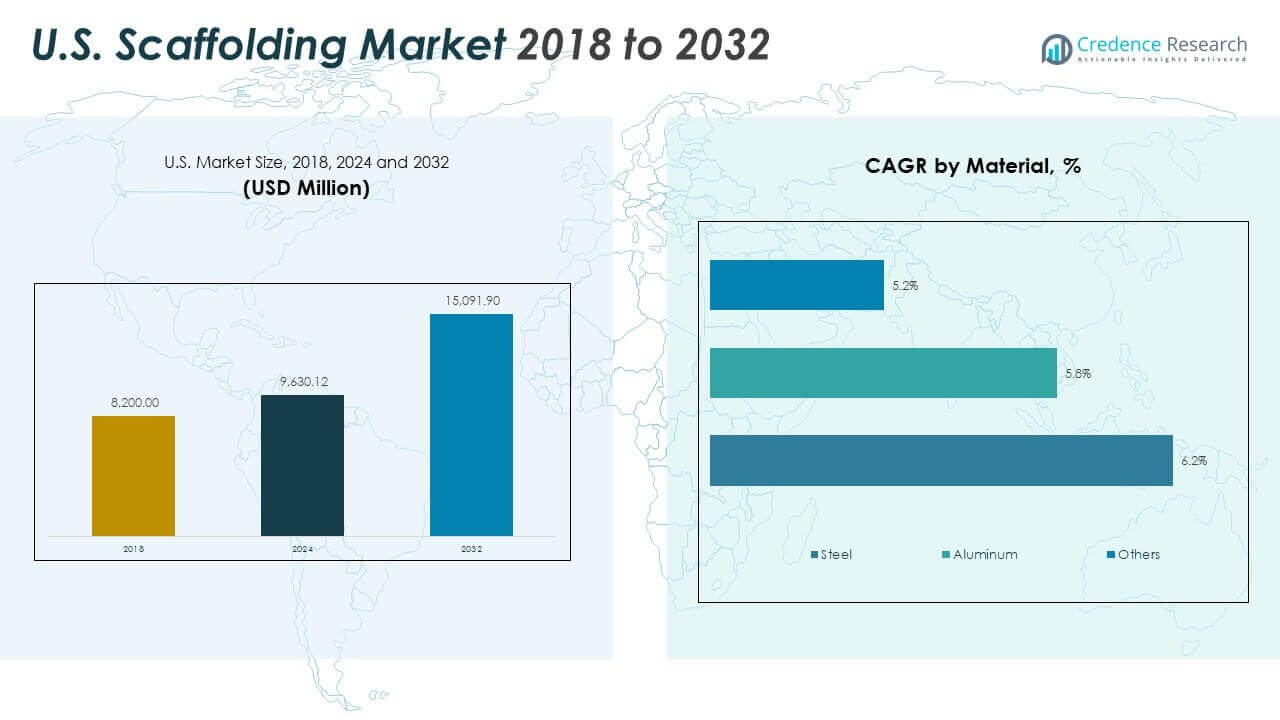
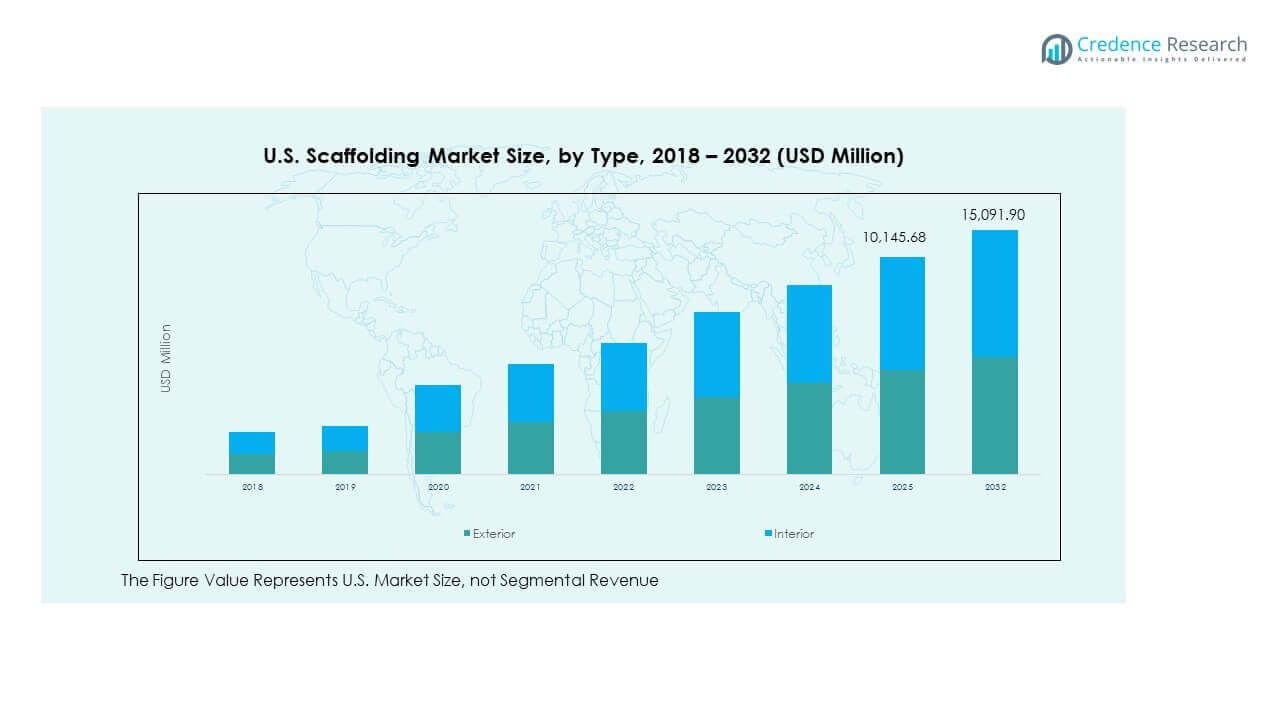
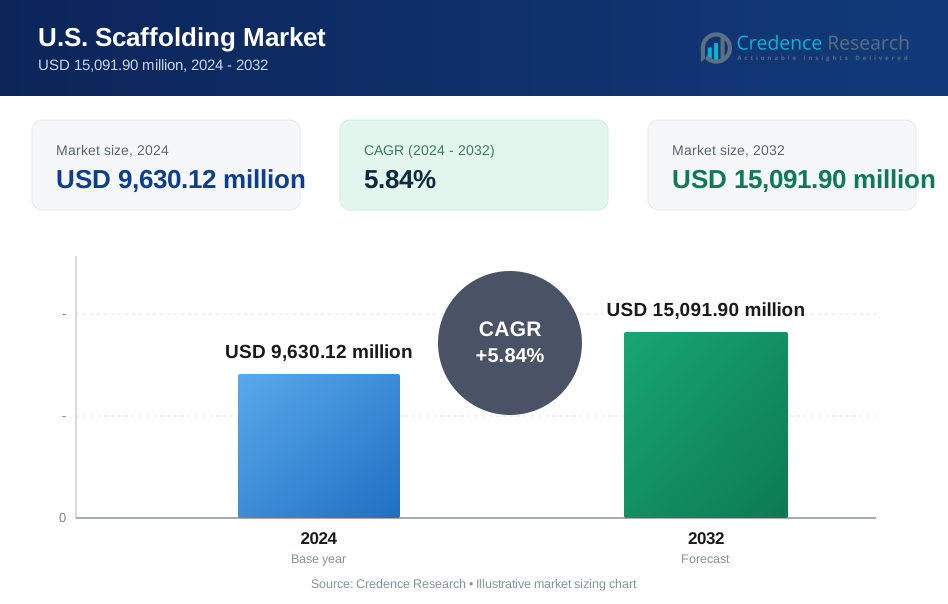
The U.S. Scaffolding Market size was valued at USD 8,200.00 million in 2018 to USD 9,630.12 million in 2024 and is anticipated to reach USD 15,091.90 million by 2032, at a CAGR of 5.84% during the forecast period.
| REPORT ATTRIBUTE | DETAILS |
|---|---|
| Historical Period | 2020-2023 |
| Base Year | 2024 |
| Forecast Period | 2025-2032 |
| U.S. Scaffolding Market Size 2024 | USD 9,630.12 Million |
| U.S. Scaffolding Market, CAGR | 5.84% |
| U.S. Scaffolding Market Size 2032 | USD 15,091.90 Million |
The market is driven by increasing construction activity across residential, commercial, and industrial sectors. Demand for safe and modular scaffolding systems continues to grow with rising infrastructure repair and retrofitting needs. Contractors favor advanced scaffold types that reduce assembly time and comply with safety regulations. Strong government spending on bridge repairs and public building upgrades adds to market momentum. Renovation of aging urban buildings further supports growth. Preference for rental-based scaffolding solutions has grown among small and mid-sized contractors due to cost efficiency and flexibility.
The South leads the market with strong demand from new housing and commercial projects in fast-growing states. The West is emerging rapidly, supported by green construction codes and urban tech infrastructure growth. The Northeast remains steady due to heavy renovation activity and infrastructure upgrades in older cities. The Midwest is seeing increased investment in transportation and industrial facilities. Each region plays a distinct role in shaping market trends, driven by varying construction needs, climate conditions, and regulatory priorities. Urban zones continue to drive high-volume scaffold deployment.
Market Insights
- The U.S. Scaffolding Market was valued at USD 8,200.00 million in 2018, reached USD 9,630.12 million in 2024, and is projected to hit USD 15,091.90 million by 2032, growing at a CAGR of 5.84%.
- The South leads with a 32% share due to strong housing and infrastructure activity, followed by the Northeast at 24% and the West at 24%, driven by retrofits and green building codes.
- The West is the fastest-growing region, supported by seismic retrofitting, urban tech developments, and green energy standards.
- By material, “Others” segment is the fastest growing with a CAGR of 6.2%, followed by aluminum at 5.8% and steel at 5.2%.
- Aluminum scaffolding sees increasing adoption for its lightweight structure and mobility, gaining traction in residential and fast-turnover commercial projects.
Market Drivers
Strong Demand from Urban Residential and Commercial Construction Activity Across Major Cities
Urban growth drives steady demand for scaffolding across the U.S., especially in metropolitan hubs. Population migration to cities fuels new high-rise residential and mixed-use buildings. Developers rely on scaffolding for vertical expansion and site safety. Commercial office towers, retail centers, and hotel projects sustain continuous scaffold rentals. Short project timelines raise the need for efficient modular systems. The U.S. Scaffolding Market benefits from this momentum. It supports frequent maintenance cycles for city infrastructure. Public and private sector investments in urban redevelopment contribute to repeat demand. Growth in Tier 2 cities adds new volume outside the top metro zones.
- For instance, BrandSafway's SafwayAtlantic team installed scaffolding for a 15-story stack replicating six Louis Vuitton trunks at 57th Street and Fifth Avenue in New York City, creating a viral installation noted by The Wall Street Journal in 2024.
Government Infrastructure Bills Fuel Bridge, Road, and Rail Modernization Projects
Federal infrastructure packages boost funding for transportation upgrades across the country. Bridge refurbishments, interstate expansions, and rail enhancements rely heavily on scaffolding. Many structures require long-term repairs needing safe worker access. Modular scaffold systems are deployed for suspended and mobile support. Projects span both urban and rural corridors. The U.S. Scaffolding Market gains from this recurring structural overhaul. State agencies and contractors prefer scalable systems for rapid deployment. Heavy-duty frames suit highway overpasses and tunnel work. Labor unions also emphasize jobsite safety, increasing scaffolding compliance.
Shift Toward Renovation and Retrofit Projects in Aging Urban Infrastructure
Aging buildings in older cities require extensive façade repairs and structural upgrades. Historic preservation work uses scaffolding to access rooftops, ledges, and facades. Insurance requirements now mandate scaffolded access for certain repairs. Contractors deploy weather-resistant scaffolds for longer exterior jobs. Retrofit demand rises with new energy efficiency codes. Cities like New York, Boston, and Chicago show high retrofit activity. The U.S. Scaffolding Market supports these projects with advanced safety and flexibility. It also aligns with real estate asset value preservation goals. Developers prefer adaptable platforms for complex retrofits.
- For instance, PERI has used BIM-planned scaffolding and modular systems on high-rise retrofit projects, enabling faster installation and safer access on buildings exceeding 80 floors.
Increased Labor Safety Regulations and Adoption of Fall Protection Standards
Regulatory agencies enforce stricter jobsite safety compliance. OSHA mandates safe access at elevation for construction workers. Contractors use certified scaffold systems with secure platforms and guardrails. Worker unions support safer assembly and dismantling processes. Accidents from unprotected heights prompt enforcement actions. The U.S. Scaffolding Market sees wider adoption of engineered systems. Standardized product use lowers liability and improves insurance acceptance. Training programs drive awareness of proper scaffold use. Safety remains a top procurement factor in most public bids.
Market Trends
Growth in Scaffolding Rental Business Model Among Construction Contractors and Builders
Contractors increasingly opt for renting scaffolding rather than purchasing it outright. Shorter project cycles make rentals cost-efficient for builders. Equipment providers offer flexible daily or monthly plans. Scaffolding rental firms handle maintenance, reducing contractor responsibilities. Demand rises for bundled services including transport and assembly. The U.S. Scaffolding Market supports this shift with expanding rental fleets. Construction firms prefer avoiding long-term storage and logistics burdens. Regional players expand reach through branch networks. Market share of rental-based services continues to rise each year.
- For instance, United Rentals expanded its aerial access fleet, which includes scaffolding-related equipment, by 9.04% to 205,000 units in 2024, enhancing rental capacity across North America.
Increased Use of Lightweight and Modular Scaffolding Systems for Faster Setup
The industry sees a rising preference for aluminum-based lightweight scaffold frames. Quick-lock mechanisms and tool-free assembly designs gain traction. Modular units reduce labor time and speed up site turnover. Compact systems improve mobility within tight urban zones. Builders value the ergonomic benefits during high-volume deployments. The U.S. Scaffolding Market shifts toward standardized modular kits. Manufacturers innovate with interlocking features and durable joints. Demand for collapsible or stackable units rises across metropolitan areas. These systems fit varied elevation and site layouts.
- For instance, Altrad Group expanded its scaffolding capabilities through acquisitions, strengthening its modular aluminum system offerings used in global construction and industrial projects for faster, safer assembly.
Integration of Digital Design, BIM Modeling, and Scaffold Planning Software
Digital transformation enters scaffold planning processes. Contractors use BIM software to pre-plan scaffold structures. 3D models help assess weight loads, anchoring, and elevation needs. Software enables simulation of scaffold stages by construction phase. Clash detection minimizes rework and time delays. The U.S. Scaffolding Market aligns with this through digital platform adoption. Larger scaffold rental firms now offer design support services. Integration reduces on-site design errors. This trend supports efficiency and project cost control.
Rising Popularity of Suspended and Hanging Scaffold Systems for Vertical Projects
Vertical construction projects require suspended access solutions. Hanging scaffolds assist in window installation, exterior cleaning, and façade finishing. Urban developers prefer suspended scaffolds for tall buildings. These systems reduce ground obstruction and allow faster work. Motorized platforms offer more worker control and height coverage. The U.S. Scaffolding Market benefits from this segment’s growing share. Innovation in hoists, brakes, and safety locks enhances reliability. Skyscraper construction in cities sustains high demand. The market expands to accommodate custom hanging configurations.
Market Challenges Analysis
Fluctuating Raw Material Prices and Cost Pressures on Scaffold Manufacturers
Steel and aluminum price volatility creates cost unpredictability for scaffold makers. Tariff policies, supply chain disruptions, and global demand shifts impact input pricing. Manufacturers face pressure to maintain competitive prices while absorbing higher material costs. Smaller firms struggle with bulk purchasing disadvantages. Profit margins tighten when contracts are locked in before material surges. The U.S. Scaffolding Market must manage pricing dynamics to avoid client loss. Frequent price updates also challenge long-term service agreements. Cost-sensitive segments like small contractors delay scaffold upgrades. Some buyers shift to second-hand or refurbished systems, affecting new sales.
Shortage of Skilled Labor and Scaffold Erection Technicians Across Key Construction Zones
A growing skills gap hampers scaffold system deployment timelines. Fewer trained technicians are available for safe assembly and dismantling. Certification requirements further reduce the eligible labor pool. Aging construction workforce and low new entrant rates worsen shortages. Project delays and safety violations emerge without proper setup. The U.S. Scaffolding Market depends on training partnerships to close the gap. Companies now invest in apprentice programs and digital learning tools. Labor cost inflation also adds to project bidding challenges. Regional variations in licensing slow interstate project staffing.
Market Opportunities
Expansion of Green Building Projects and Energy-Efficient Building Retrofitting
Rising investment in sustainable buildings creates new scaffold demand. LEED-certified and net-zero buildings require extensive exterior work. Retrofitting older properties for energy codes boosts access needs. The U.S. Scaffolding Market aligns with this push toward eco-efficiency. Scaffolding supports solar panel mounting, façade insulation, and window upgrades. Government green incentives accelerate such construction activity. Urban energy codes in California and New York drive consistent volumes.
Adoption of Robotics, Drones, and Automation in Scaffold Monitoring and Inspection
Technology integration opens new service niches in scaffold management. Drones inspect large scaffolds for defects, reducing manual risk. Robotics handle repetitive tasks in setup planning. The U.S. Scaffolding Market sees innovation-led opportunities for smarter scaffolding logistics. Safety audits become faster and more accurate. Automation boosts efficiency in warehouse and rental yard operations. Scaffold providers explore tech partnerships for differentiation.
Market Segmentation Analysis
By Type
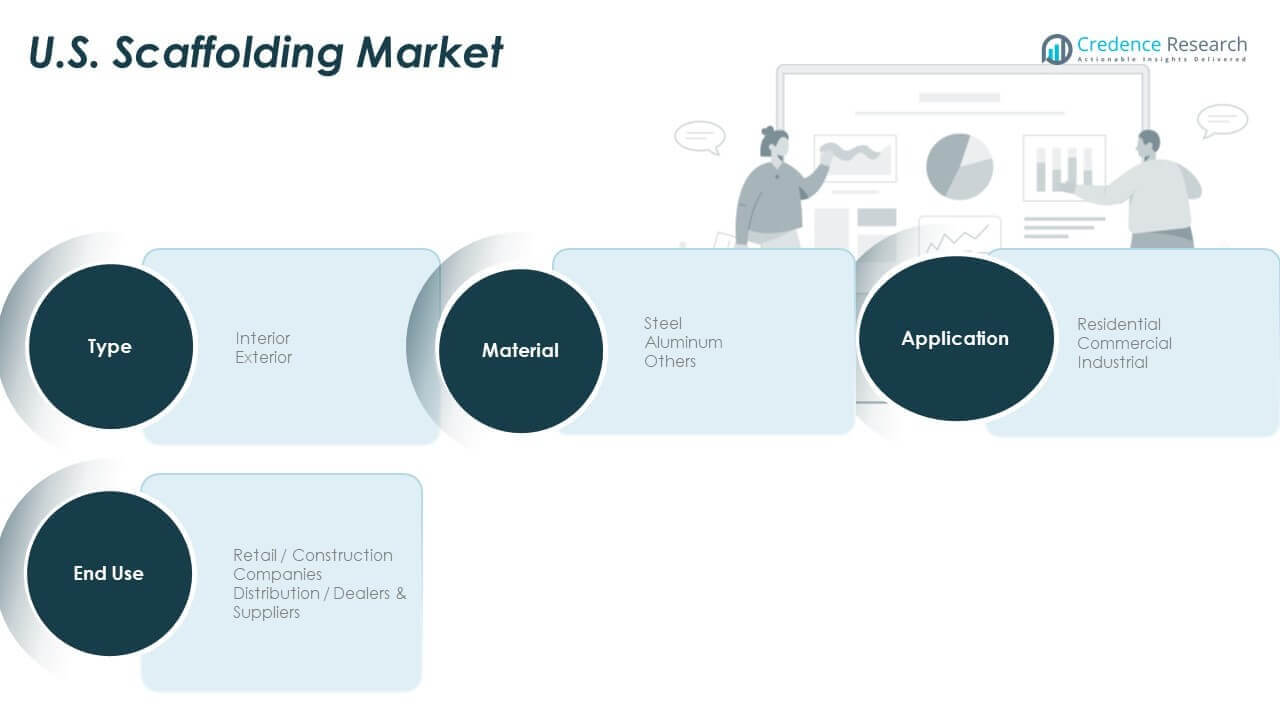
The U.S. Scaffolding Market is segmented into interior and exterior types. Exterior scaffolding dominates due to high demand in commercial and infrastructure projects. It supports façade work, building maintenance, and large-scale construction. Interior scaffolding is used for indoor repairs, ceiling work, and renovation in residential and commercial buildings. It is lighter and modular, preferred for constrained indoor spaces. Growth in remodeling and interior upgrades supports this segment. Both types see stable demand across urban and suburban projects. Contractors prioritize safety and accessibility across all types. Type selection depends on site access, project height, and duration.
- For instance, BrandSafway provided scaffolding and access solutions for the 270 Park Avenue JP Morgan Chase headquarters in New York, the tallest building powered by hydroelectric energy.
By Material
Steel scaffolding holds the largest share in the U.S. Scaffolding Market due to its strength and load-bearing capacity. It suits heavy construction work like bridges and commercial towers. Aluminum is gaining traction for its lightweight nature and faster setup. It fits well in projects requiring mobility and frequent assembly. Contractors choose aluminum for interiors and quick-turnaround jobs. Other materials like composites are niche and used in custom scaffolds. Material choice depends on job complexity, height, and weather exposure. Safety regulations influence the material selection process. Durability and handling cost also drive purchasing decisions.
By Application
Residential applications lead in terms of volume due to consistent housing projects and renovations. New builds, exterior repairs, and multi-family housing fuel scaffold demand. Commercial applications follow with strong demand from office, retail, and hotel developments. Scaffolding is used for both structural and aesthetic work. Industrial applications involve power plants, factories, and warehouses requiring robust scaffolds. Industrial work zones demand high-safety and corrosion-resistant structures. The U.S. Scaffolding Market caters to varied heights and load demands across applications. Each sector needs flexible and compliant scaffold systems. Usage intensity is highest in industrial scaffolds due to long duration work.
- For instance, Layher's Allround scaffolding supported multi-family residential builds with modular frames accessing heights over 100 meters safely.
By End Use
Retail/construction companies are the primary users, driving regular demand for purchase and rental of scaffolding systems. Contractors invest in scaffolds for direct project use. Large construction firms often maintain their own inventory. Distribution/dealers and suppliers facilitate market access, especially for smaller builders. They act as rental partners and maintenance service providers. Dealers ensure availability across regional hubs. The U.S. Scaffolding Market depends on strong end-use networks for service consistency. End-user preference shifts toward rental-based use over ownership. Both channels play a critical role in national coverage and supply efficiency.
Segmentation
By Type
- Interior
- Exterior
By Material
- Steel
- Aluminum
- Others
By Application
- Residential
- Commercial
- Industrial
By End Use
- Retail / Construction Companies
- Distribution / Dealers & Suppliers
Regional Analysis
Northeast and Midwest Regions Hold Steady Demand Driven by Urban Renovation and Infrastructure Upgrades
The Northeast accounts for nearly 24% of the U.S. Scaffolding Market, supported by ongoing infrastructure repair and high-rise renovation across cities like New York, Boston, and Philadelphia. Aging commercial and residential buildings drive steady demand for exterior scaffolding systems. State-level funding boosts bridge repairs and metro upgrades, sustaining industrial use. The Midwest contributes around 20%, driven by revitalization in cities such as Chicago, Detroit, and Minneapolis. Infrastructure projects, including rail expansions and public facility upgrades, require long-duration scaffold use. Construction growth in suburban areas around these hubs adds to residential scaffold needs.
South Region Leads the Market with New Residential and Commercial Construction Activity
The South holds the highest share at 32%, led by construction booms in states like Texas, Florida, Georgia, and North Carolina. Rapid population growth and economic development increase housing starts, fueling demand for lightweight and mobile scaffolding. Mixed-use developments, highways, and school construction projects raise both commercial and infrastructure scaffold deployment. Warmer climates allow year-round work, increasing scaffold utilization rates. The U.S. Scaffolding Market sees high rental activity across this region, especially from small and mid-sized contractors. Government funding for disaster resilience construction also boosts long-term demand.
West Region Emerges as a Tech-Driven Construction and Retrofit Hub
The West commands about 24% of the market, led by California, Arizona, and Washington. Green building regulations and seismic retrofitting initiatives raise scaffold requirements. Urban growth in cities like Los Angeles, San Diego, and Seattle drives demand for commercial scaffolding systems. The region supports high-rise residential and tech infrastructure development. Retrofit demand from energy efficiency upgrades adds to application diversity. It supports increasing use of aluminum and modular scaffolds. Construction companies in this region also adopt digital planning and scaffold design tools at a higher rate.
Key Player Analysis
- Layher Inc.
- Aluma Systems Inc.
- BrandSafway
- BilJax Inc.
- PERI Inc.
Competitive Analysis
The U.S. Scaffolding Market is moderately consolidated, with a mix of global manufacturers and regional rental companies. Key players include Safway Group, BrandSafway, Waco International, Layher Inc., and PERI USA. These companies offer a wide range of scaffolding types and materials with integrated design, erection, and dismantling services. Many large firms operate through branch networks, providing direct support across states. Innovation focuses on modular scaffolding systems, fall protection enhancements, and time-saving assembly technologies. Rental service providers hold a significant share, meeting the flexible needs of small and mid-size contractors. Players differentiate through customer service, fleet variety, and location coverage. Digital integration in scaffold planning and tracking is rising among top-tier firms. The U.S. Scaffolding Market rewards companies that offer scalable logistics, safety compliance, and rapid deployment capabilities. Competitive intensity is high in urban zones with frequent project turnovers. Market leaders continue expanding through acquisitions and joint ventures to strengthen regional footholds.
Report Coverage
The research report offers an in-depth analysis based on Type, Material, Application and End Use. It details leading market players, providing an overview of their business, product offerings, investments, revenue streams, and key applications. Additionally, the report includes insights into the competitive environment, SWOT analysis, current market trends, as well as the primary drivers and constraints. Furthermore, it discusses various factors that have driven market expansion in recent years. The report also explores market dynamics, regulatory scenarios, and technological advancements that are shaping the industry. It assesses the impact of external factors and global economic changes on market growth. Lastly, it provides strategic recommendations for new entrants and established companies to navigate the complexities of the market.
Future Outlook
- Rapid urban expansion will sustain long-term scaffolding demand in both residential and commercial segments.
- Increased retrofitting and maintenance of aging infrastructure will drive scaffold usage in older cities.
- Green building upgrades and energy-efficient construction will create steady growth in scaffold deployment.
- Rental-based scaffolding services will dominate due to cost efficiency and shorter project timelines.
- Southern states will continue leading in new project volume, supported by strong housing and infrastructure pipelines.
- Technological integration, including BIM and scaffold design software, will improve project planning precision.
- Modular aluminum systems will grow in adoption for lightweight, fast-setup needs across sectors.
- Safety regulations will remain a key demand driver for compliant and certified scaffolding systems.
- Skilled labor shortages will encourage automation, digital training, and simplified scaffold designs.
- Expansion of supplier and dealer networks will improve scaffold availability in mid-tier and emerging cities.
Request a Free Sample
Fill in your details and we'll send you a free sample report.
- Sample data tables & charts
- Research methodology
Market Dynamics
Urban Construction and Population Growth
Rapid urbanization and migration to metropolitan areas are fueling demand for scaffolding in high-rise residential, commercial, and mixed-use developments. This trend drives frequent scaffold deployment for both new builds and ongoing maintenance in major U.S. cities.
Government Infrastructure Investment
Federal and state infrastructure bills are increasing funding for bridge, road, and rail modernization, directly boosting demand for scaffolding systems required for safe worker access and large-scale structural repairs across the country.
Rise in Renovation and Retrofit Projects
Aging urban infrastructure and stricter energy efficiency codes are driving extensive renovation and retrofitting activities, particularly in older cities. These projects require adaptable and advanced scaffolding solutions for façade repairs, historic preservation, and energy upgrades.
Shift Toward Rental-Based Scaffolding Models
Contractors and builders increasingly prefer renting scaffolding due to cost efficiency, flexibility, and reduced maintenance responsibilities. This shift is expanding the rental market and increasing the frequency of scaffold utilization across diverse project types.
Stringent Safety Regulations and Standards
Enhanced OSHA regulations and industry safety standards are compelling contractors to adopt certified, modular, and safer scaffolding systems. Compliance requirements are driving upgrades and increasing demand for advanced scaffold products and training.
Need a Custom Version of This Report?
Tailor the scope, geography, or segments to your exact requirements.
- Custom geography or segment scope
- Direct access to our analyst team
Frequently Asked Questions
What is the current market size for U.S. Scaffolding Market, and what is its projected size in 2032?
At what Compound Annual Growth Rate is the U.S. Scaffolding Market projected to grow between 2024 and 2032?
Which U.S. Scaffolding Market segment held the largest share in 2024?
What are the primary factors fueling the growth of the U.S. Scaffolding Market?
Who are the leading companies in the U.S. Scaffolding Market?
Which region commanded the largest share of the U.S. Scaffolding Market in 2024?
Table of Content
Chapter 1 Market Segmentation
- 1.1 Segmentation Framework
- 1.1.1 Product and Service Classification
- 1.1.2 Application and End-Use Classification
- 1.1.3 Technology and Solution Classification
- 1.1.4 Customer and Distribution Channel Classification
- 1.1.5 Geographic Segmentation
- 1.1.6 Market Segment Definitions and Boundaries
- 1.2 By Type
- 1.2.1 Interior
- 1.2.2 Exterior
- 1.3 By End Use
- 1.3.1 Retail / Construction Companies
- 1.3.2 Distribution / Dealers & Suppliers
- 1.4 By Material
- 1.4.1 Steel
- 1.4.2 Aluminum
- 1.4.3 Others
- 1.5 By Application
- 1.5.1 Residential
- 1.5.2 Commercial
- 1.5.3 Industrial
Chapter 2 Introduction
- 2.1 Report Objectives and Scope
- 2.2 Product Definition and Industry Terminology
- 2.3 Market Inclusions and Exclusions
- 2.4 Research Process
- 2.4.1 Primary Research and Expert Interviews
- 2.4.2 Secondary Research and Source Review
- 2.4.3 Top-Down and Bottom-Up Estimation
- 2.4.4 Data Triangulation and Verification
- 2.5 Market Size Measurement Basis
- 2.5.1 2024: USD 9,630.12 million → 2032: USD 15,091.90 million
- 2.6 Historical and Forecast Reference Periods
- 2.6.1 Base Year: 2024
- 2.6.2 Forecast Period: 2024-2032
- 2.7 Research Assumptions and Limitations
Chapter 3 Executive Summary
- 3.1 Market Snapshot and Key Findings
- 3.2 Base-Year Market Size, 2024
- 3.3 Forecast Market Size, 2032
- 3.4 Revenue and Volume Growth Outlook
- 3.5 Key Demand and Supply Indicators
- 3.6 Leading Market Segments
- 3.7 Fastest-Growing Market Opportunities
- 3.8 Regional Performance Highlights
- 3.9 Technology and Industry Transformation
- 3.10 Competitive Landscape Summary
- 3.11 Analyst View and Strategic Implications
Chapter 4 U.S. Scaffolding Market Trends and Developments
- 4.1 Historical Industry Development
- 4.2 Recent Market Trends and Developments
- 4.3 Demand and Customer Behavior Trends
- 4.4 Technology and Product Innovation
- 4.5 Artificial Intelligence, Automation and Digitalization
- 4.6 Local Manufacturing and Supply Chain Realignment
- 4.7 Industry Partnerships, Mergers and Acquisitions
- 4.8 Sustainability and Circular Economy Developments
- 4.9 Government and Private Sector Investment Trends
- 4.10 Emerging Business Models and Commercialization
- 4.11 Industry Developments and Announcements
Chapter 5 U.S. Scaffolding Market Production, Supply and Demand Analysis
- 5.1 Demand Trend and Consumption Analysis
- 5.2 Demand Forecast, 2024-2032
- 5.3 Production and Output Trend
- 5.4 Production and Output Forecast, 2024-2032
- 5.5 Installed Capacity and Capacity Utilization
- 5.6 Company-Wise Production Plants and Statistics
- 5.6.1 Installed Production Capacity
- 5.6.2 Actual Production
- 5.6.3 Planned Capacity and Expansion Targets
- 5.7 Supply Chain Structure and Procurement Trends
- 5.8 Supply-Demand Gap and Bottlenecks
- 5.9 Import Dependence and Sourcing Structure
- 5.10 Contract Manufacturing and Outsourcing
- 5.11 Regional Supply and Demand Concentration
Chapter 6 U.S. Scaffolding Market Pricing Analysis
- 6.1 Pricing Structure and Measurement
- 6.2 Historical Pricing Trends
- 6.3 Pricing Outlook, 2024-2032
- 6.4 Average Selling Price and Unit Economics
- 6.5 Pricing by Product and Market Segment
- 6.6 Geographic Pricing Differences
- 6.7 Key Input, Energy, Labor and Logistics Costs
- 6.8 Contract Pricing and Purchasing Models
- 6.9 Pricing Sensitivity and Competitive Positioning
- 6.10 Price, Margin and Profitability Implications
Chapter 7 U.S. Scaffolding Market Dynamics
- 7.1 Market Growth Drivers
- 7.1.1 Demand-Side Drivers
- 7.1.2 Technology and Innovation Drivers
- 7.1.3 Infrastructure and Investment Drivers
- 7.1.4 Regulatory and Policy Drivers
- 7.2 Market Restraints
- 7.2.1 Cost and Affordability Constraints
- 7.2.2 Technology and Adoption Barriers
- 7.2.3 Supply Chain and Operational Constraints
- 7.3 Market Challenges
- 7.3.1 Competitive Pressure and Margin Erosion
- 7.3.2 Skills, Infrastructure and Implementation Gaps
- 7.4 Emerging Market Opportunities
- 7.5 Market Dynamics Impact and Time-Horizon Assessment
Chapter 8 U.S. Scaffolding Value Chain Analysis
- 8.1 Industry Value Chain Overview
- 8.2 Upstream Suppliers and Critical Inputs
- 8.3 Technology and Component Providers
- 8.4 Manufacturing or Service Delivery
- 8.5 Distribution, Channel Partners and Integrators
- 8.6 Downstream Applications and End Users
- 8.7 Value Addition and Profit Pools
- 8.8 Vertical Integration and Outsourcing
- 8.9 Supplier Concentration and Risk
- 8.10 Supply Chain Localization and Resilience
Chapter 9 U.S. Scaffolding Market Regulations and Policies
- 9.1 Relevant Laws, Standards and Compliance Frameworks
- 9.2 Product, Service, Safety and Quality Requirements
- 9.3 Government Policies, Incentives and Subsidies
- 9.4 Imports, Exports and Trade Barriers
- 9.5 Public Procurement and Local Content Requirements
- 9.6 Environmental and Sustainability Compliance
- 9.7 Upcoming Policy Changes and Market Implications
Chapter 10 U.S. Scaffolding Market Hotspots and Opportunities
- 10.1 Market Opportunity Mapping and Growth Hotspots
- 10.2 High-Growth Applications and Customer Groups
- 10.3 Underserved Markets and White-Space Opportunities
- 10.4 Emerging Technology and Product Opportunities
- 10.5 New Capacity and Investment Hotspots
- 10.6 Market Entry and Expansion Opportunities
- 10.7 Distribution and Partnership Opportunities
- 10.8 Near-Term and Long-Term Commercial Potential
- 10.9 Opportunity Attractiveness and Execution Risks
Chapter 11 U.S. Scaffolding Market Outlook, 2024-2032
- 11.1 Market Size and Analysis
- 11.1.1 Revenue (Market Measurement: 2024: USD 9,630.12 million → 2032: USD 15,091.90 million)
- 11.1.2 Market Volume and Quantity Sold
- 11.1.3 Historical Market Size
- 11.1.4 Base-Year Market Size, 2024
- 11.2 Market Forecast, 2024-2032
- 11.2.1 Revenue Forecast to 2032
- 11.2.2 Volume Forecast to 2032
- 11.2.3 CAGR and Year-on-Year Growth
- 11.2.4 Incremental Revenue Opportunity
- 11.3 Forecast Assumptions and Scenario Analysis
- 11.3.1 Base-Case Forecast
- 11.3.2 Optimistic and Conservative Scenarios
- 11.3.3 Technology, Pricing and Policy Sensitivities
- 11.4 Market Attractiveness and Growth Outlook
Chapter 12 U.S. Scaffolding Market Segmentation and Outlook
- 12.1 Segmentation Summary and Market Shares, 2024
- 12.2 Largest and Fastest-Growing Segments
- 12.3 By Type - Market Size and Forecast, 2024-2032
- 12.3.1 Segment Definition and Scope
- 12.3.2 Historical Market Size
- 12.3.3 Revenue Forecast, 2024-2032
- 12.3.4 Volume Forecast, 2024-2032
- 12.3.5 Base-Year Market Share, 2024
- 12.3.6 Segment CAGR and Growth Drivers
- 12.3.7 Subsegment Market Size and Forecast
- 12.3.7.1 Interior
- 12.3.7.2 Exterior
- 12.3.8 Subsegment Pricing and Adoption Trends
- 12.3.9 Leading Suppliers and Competition
- 12.3.10 Regional Demand and Opportunities
- 12.4 By End Use - Market Size and Forecast, 2024-2032
- 12.4.1 Segment Definition and Scope
- 12.4.2 Historical Market Size
- 12.4.3 Revenue Forecast, 2024-2032
- 12.4.4 Volume Forecast, 2024-2032
- 12.4.5 Base-Year Market Share, 2024
- 12.4.6 Segment CAGR and Growth Drivers
- 12.4.7 Subsegment Market Size and Forecast
- 12.4.7.1 Retail / Construction Companies
- 12.4.7.2 Distribution / Dealers & Suppliers
- 12.4.8 Subsegment Pricing and Adoption Trends
- 12.4.9 Leading Suppliers and Competition
- 12.4.10 Regional Demand and Opportunities
- 12.5 By Material - Market Size and Forecast, 2024-2032
- 12.5.1 Segment Definition and Scope
- 12.5.2 Historical Market Size
- 12.5.3 Revenue Forecast, 2024-2032
- 12.5.4 Volume Forecast, 2024-2032
- 12.5.5 Base-Year Market Share, 2024
- 12.5.6 Segment CAGR and Growth Drivers
- 12.5.7 Subsegment Market Size and Forecast
- 12.5.7.1 Steel
- 12.5.7.2 Aluminum
- 12.5.7.3 Others
- 12.5.8 Subsegment Pricing and Adoption Trends
- 12.5.9 Leading Suppliers and Competition
- 12.5.10 Regional Demand and Opportunities
- 12.6 By Application - Market Size and Forecast, 2024-2032
- 12.6.1 Segment Definition and Scope
- 12.6.2 Historical Market Size
- 12.6.3 Revenue Forecast, 2024-2032
- 12.6.4 Volume Forecast, 2024-2032
- 12.6.5 Base-Year Market Share, 2024
- 12.6.6 Segment CAGR and Growth Drivers
- 12.6.7 Subsegment Market Size and Forecast
- 12.6.7.1 Residential
- 12.6.7.2 Commercial
- 12.6.7.3 Industrial
- 12.6.8 Subsegment Pricing and Adoption Trends
- 12.6.9 Leading Suppliers and Competition
- 12.6.10 Regional Demand and Opportunities
- 12.7 Segment Growth Comparison
- 12.8 Segment Attractiveness and Priority Matrix
Chapter 13 U.S. Scaffolding End-Use and Application Market Outlook
- 13.1 End-Use Industry and Customer Demand Structure
- 13.2 Leading Applications and Customer Groups
- 13.3 End-Use Market Size, Share and Forecast
- 13.4 Major End-Use Industry Deep Dives
- 13.4.1 Customer Requirements and Use Cases
- 13.4.2 Demand and Replacement Cycles
- 13.4.3 Technical and Regulatory Considerations
- 13.4.4 Purchasing and Procurement Models
- 13.4.5 Leading Vendors and Distribution Channels
- 13.4.6 Forecast and Commercial Opportunities
- 13.5 Emerging Applications and Cross-Segment Demand
- 13.6 End-Use Industry Investment Priorities
Chapter 14 U.S. Scaffolding Geographic Market Outlook, 2024-2032
- 14.1 Domestic Market Distribution and Demand Clusters
- 14.2 State- or Province-Wise Market Size and Forecast, 2024-2032
- 14.3 City and Metropolitan Market Outlook
- 14.4 Industrial, Manufacturing and Commercial Clusters
- 14.5 Geographic Concentration of Key End Users
- 14.6 Local Pricing and Purchasing Differences
- 14.7 Domestic Production Facilities and Capacity Map
- 14.8 Local Infrastructure and Project Pipeline
- 14.9 State-Level Policy and Incentive Differences
- 14.10 Subnational Investment Hotspots and Opportunities
- 14.11 Distribution and Logistics Networks
- 14.12 Domestic Competitive Footprint
Chapter 15 U.S. Scaffolding Technology, Innovation and Sustainability Outlook
- 15.1 Technology Landscape and Maturity
- 15.2 Product, Process and Service Innovation
- 15.3 AI, Automation and Digital Tools in the Industry
- 15.4 Technology Adoption and Performance Benchmarking
- 15.5 Innovation Pipeline and R&D Investment
- 15.6 Patent and Intellectual Property Trends
- 15.7 Energy Efficiency and Resource Management
- 15.8 Sustainability, Recycling and Circularity
- 15.9 Technology Roadmap, 2024-2032
- 15.10 Risks of Obsolescence and Technology Substitution
Chapter 16 U.S. Scaffolding Market Key Strategic Imperatives
- 16.1 Growth and Market Entry Priorities
- 16.2 High-Return Products and Segments
- 16.3 Pricing, Profitability and Cost Optimization
- 16.4 Technology Investment and Product Differentiation
- 16.5 Supply Chain Localization and Resilience
- 16.6 Distribution and Customer Acquisition
- 16.7 Partnership, Acquisition and Capacity Strategy
- 16.8 Regional Expansion Priorities
- 16.9 Short-, Medium- and Long-Term Actions
Chapter 17 Competition Outlook
- 17.1 Industry Competition Characteristics
- 17.2 Market Structure and Concentration
- 17.3 Market Share and Competitive Positioning, 2024
- 17.4 Company-Wise Revenue and Product Benchmarking
- 17.5 Production and Service Capacity Benchmarking
- 17.6 Technology, Pricing and Differentiation
- 17.7 Regional Footprint and Distribution Strength
- 17.8 Mergers, Acquisitions and Strategic Alliances
- 17.9 New Entrants and Competitive Threats
- 17.10 Porter's Five Forces and Industry Attractiveness
- 17.11 Competitive Outlook, 2024-2032
Chapter 18 Company Profiles
- 18.1 Company Coverage and Selection Criteria
- 18.2 Layher Inc.
- 18.2.1 Business Description
- 18.2.2 Company Ownership and Geographic Presence
- 18.2.3 Product and Service Portfolio
- 18.2.4 Manufacturing and Operating Footprint
- 18.2.5 Production Capacity and Expansion Plans
- 18.2.6 Financial Performance and Investment
- 18.2.7 Market Share and Competitive Position
- 18.2.8 Technology and Innovation Capabilities
- 18.2.9 Strategic Alliances or Partnerships
- 18.2.10 Recent Developments
- 18.2.11 Growth Strategy and Outlook
- 18.3 Aluma Systems Inc.
- 18.4 BrandSafway
- 18.5 BilJax Inc.
- 18.6 PERI Inc.
- 18.7 Waco International
- 18.8 United Rentals
- 18.9 Altrad Group
- 18.10 Safway Group
- 18.11 Sunbelt Rentals
- 18.12 Other Relevant Market Participants
Note: Every listed company is profiled on the structure shown under the first company. The company list is preliminary and may change based on research findings, market developments, data availability and client requirements.
Chapter 19 Disclaimer
- 19.1 Research and Forecast Disclaimer
- 19.2 Data Source and Estimation Limitations
Note: The depth of individual sections depends on data availability for this market. Volume, capacity, trade and other unit-based metrics are included where applicable.