Market Overview
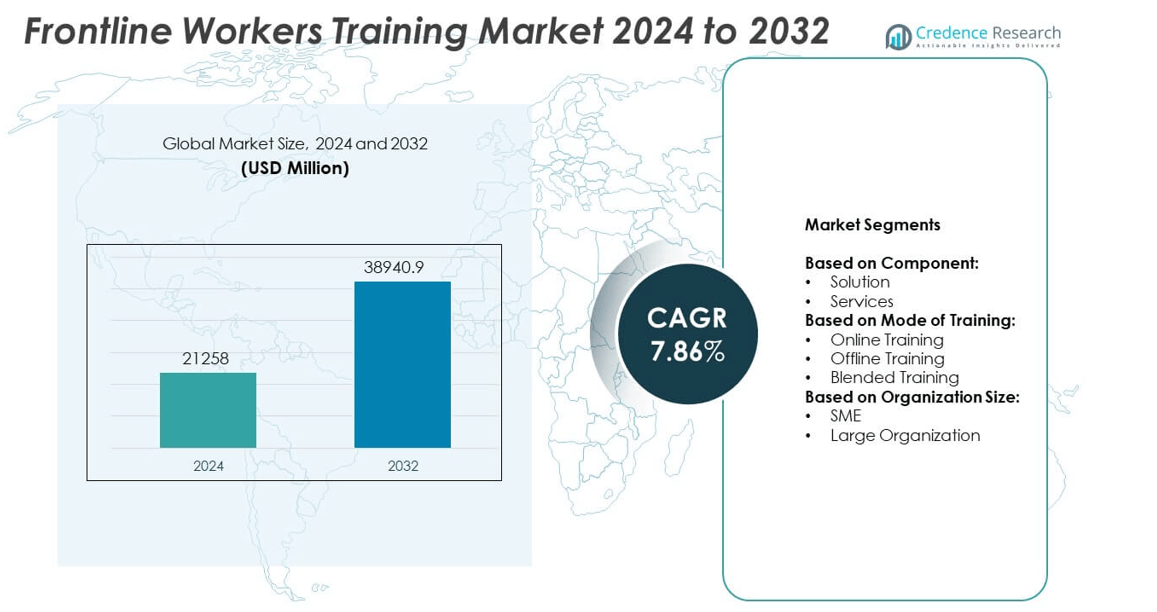
The Frontline Workers Training Market was valued at USD 21,258 million in 2024. It is projected to reach USD 38,940.9 million by 2032, growing at a CAGR of 7.86% during the forecast period.
| REPORT ATTRIBUTE |
DETAILS |
| Historical Period |
2020-2023 |
| Base Year |
2024 |
| Forecast Period |
2025-2032 |
| Frontline Workers Training Market Size 2024 |
USD 21,258 million |
| Frontline Workers Training Market, CAGR |
7.86% |
| Frontline Workers Training Market Size 2032 |
USD 38,940.9 million |
The Frontline Workers Training market grows due to rising demand for workforce upskilling, compliance adherence, and improved employee engagement. Companies adopt digital platforms, microlearning, and blended models to enhance accessibility and retention. It benefits from government workforce development initiatives and corporate investments in productivity improvement. Advanced technologies like AI and VR create immersive training experiences, boosting adoption. Data-driven insights help organizations measure performance and refine programs. Growing focus on retention and safety training supports consistent expansion across industries worldwide.
North America leads the Frontline Workers Training market due to strong adoption of digital learning platforms and high corporate investment in workforce development. Europe follows with demand driven by strict compliance regulations and multilingual training needs. Asia-Pacific shows the fastest growth supported by industrial expansion and rising internet penetration. Key players active in the market include Cornerstone OnDemand, Axonify, Skillsoft, and Adobe Inc., all focusing on scalable solutions, personalized learning, and technology-driven platforms to meet diverse industry requirements.
Market Insights
- The Frontline Workers Training market was valued at USD 21,258 million in 2024 and is expected to reach USD 38,940.9 million by 2032, growing at a CAGR of 7.86%.
- Rising demand for workforce upskilling, compliance adherence, and productivity improvement drives market growth.
- Growing adoption of digital platforms, microlearning modules, and blended training formats enhances engagement and knowledge retention.
- Competition is strong, with players focusing on technology integration, scalable solutions, and personalized content to stay ahead.
- High implementation costs and difficulty in measuring training effectiveness act as key restraints for organizations.
- North America leads due to advanced digital infrastructure, while Asia-Pacific shows fastest growth with industrial expansion and internet penetration.
- Future opportunities lie in AI-driven, industry-specific training programs and mobile-first platforms supporting global workforce needs.
Access crucial information at unmatched prices!
Request your sample report today & start making informed decisions powered by Credence Research Inc.!
Download Sample
Market Drivers
Rising Focus on Workforce Skill Development
The Frontline Workers Training market benefits from a global focus on workforce skill development. Governments and organizations invest in training to improve productivity and service quality. It ensures employees meet evolving safety standards and operational requirements. Companies implement structured programs to reduce workplace errors and enhance compliance. Demand rises in sectors like healthcare, retail, and logistics, where skilled staff are critical. This focus supports continuous improvement and employee retention across industries.
- For instance, APC Overnight achieved a 20% reduction in injuries year-on-year, along with 5% increase in frontline staff retention, after introducing mobile microlearning modules via eduMe.
Adoption of Digital and Blended Learning Models
Growing preference for digital training platforms drives market adoption. It allows remote access to training modules, reducing time away from work. Companies use blended models combining online and in-person sessions for flexibility. This approach improves participation and knowledge retention. Digital solutions support performance tracking and real-time feedback for workers. Organizations leverage data-driven insights to adjust programs and meet workforce needs.
- For instance, Strivr enabled Walmart to reduce the training time for its Pickup Tower staff by 96%, replacing longer in-person sessions with a 15-minute VR module.
Compliance with Regulatory and Safety Standards
Strict industry regulations create demand for targeted training programs. The Frontline Workers Training market supports compliance with occupational health and safety requirements. It helps companies avoid penalties and reduce incident rates. Industries such as manufacturing and energy require workers to follow updated safety protocols. Training programs ensure workers stay prepared for audits and inspections. This compliance-driven approach strengthens overall workplace safety culture.
Rising Employee Engagement and Retention Needs
Businesses use training as a tool to improve employee engagement and satisfaction. It encourages professional growth and career advancement opportunities. Well-trained workers deliver higher service quality, boosting customer satisfaction. The Frontline Workers Training market responds to the need for a motivated workforce. High engagement reduces turnover and recruitment costs for employers. This approach helps organizations maintain competitive advantage through a skilled and committed workforce.
Market Trends
Increasing Integration of Technology in Training Programs
The Frontline Workers Training market is seeing rapid integration of advanced technologies. Companies adopt AI, VR, and AR tools to create immersive learning experiences. It allows workers to practice scenarios safely and build confidence. Digital simulations improve decision-making skills and reduce on-the-job risks. Organizations also use mobile apps for flexible and continuous learning. This trend supports personalized training paths for different job roles.
- For instance, Frontline Education’s internal “LIFT” program delivered a 50% reduction in employee turnover, a 66% decrease in open requisitions, and a 14-point gain on their engagement survey index after launching structured learning and recognition initiatives. This program was a company-wide internal initiative, not a product for clients.
Growing Emphasis on Microlearning and Modular Content
Organizations shift toward shorter, modular training formats to improve engagement. It enables workers to complete lessons in small intervals during work hours. Microlearning boosts knowledge retention and minimizes productivity loss. The Frontline Workers Training market benefits from rising demand for bite-sized, focused content. Companies deliver modules on smartphones for easy access. This format helps reinforce skills through frequent, quick refreshers.
- For instance, In partnership with Strivr, Walmart deployed an immersive virtual reality (VR) training module for associates using its in-store Pickup Towers. By switching from in-person instruction to the 15-minute VR module, Walmart reduced the training time for this task by 96%, from 8 hours
Focus on Data-Driven Training and Analytics
Employers increasingly use analytics to measure training effectiveness. It provides insights into completion rates, performance scores, and skill gaps. Companies adjust programs based on data to achieve better outcomes. The Frontline Workers Training market is shaped by the need for measurable ROI. Predictive analytics also identify future training needs. This approach aligns learning initiatives with business goals.
Shift Toward Personalized and Role-Specific Learning
Businesses prioritize training tailored to specific job functions. It ensures relevance and keeps workers engaged. Personalized programs improve adoption rates and reduce wasted time. The Frontline Workers Training market supports content customization for industries like healthcare, retail, and hospitality. Organizations build learning paths matching employee career progression. This trend promotes continuous skill development and workforce resilience.
Market Challenges Analysis
High Cost of Implementation and Resource Constraints
The Frontline Workers Training market faces challenges due to high implementation costs. Developing digital platforms, content, and infrastructure demands significant investment. It strains budgets for small and medium enterprises with limited resources. Continuous updates to training materials add to expenses. Organizations must also allocate staff time, which impacts productivity. High upfront and ongoing costs slow adoption for cost-sensitive industries. This limits scalability and delays training rollouts in some regions.
Difficulty in Measuring Training Effectiveness and Engagement
Organizations struggle to measure the impact of training on performance. The Frontline Workers Training market requires reliable metrics to justify investments. It becomes challenging to track knowledge retention and behavioral change over time. Some workers show low participation or fail to complete programs. Cultural and language barriers further reduce engagement in diverse teams. Companies need better tools to analyze outcomes and optimize delivery. These challenges impact the overall return on training initiatives.
Market Opportunities
Expansion of Digital Platforms and Remote Training Solutions
The Frontline Workers Training market holds strong opportunities with the expansion of digital platforms. Organizations adopt remote training to reach dispersed teams and reduce travel costs. It supports consistent learning experiences across multiple locations. Cloud-based systems enable real-time updates and seamless content delivery. Integration with mobile devices allows workers to learn at their own pace. Growing demand for hybrid work models drives investment in scalable e-learning solutions. This creates potential for providers offering user-friendly and adaptive platforms.
Rising Demand for Industry-Specific and Customized Programs
Businesses seek tailored programs that address sector-specific challenges and regulations. The Frontline Workers Training market benefits from the need for niche content. It allows organizations to target skills that directly impact operational performance. Providers offering customization gain a competitive edge with industry-focused solutions. Demand is high in healthcare, logistics, and retail sectors requiring compliance training. Partnerships with technology vendors and industry experts expand program relevance. This opportunity supports long-term growth through specialized learning offerings.
Market Segmentation Analysis:
By Component:
Solutions and services. Solutions dominate demand due to their ability to deliver scalable and customizable training platforms. It enables organizations to standardize learning modules and track employee performance efficiently. Services play a crucial role in implementation, consultation, and technical support, ensuring smooth program adoption. Demand for services grows with increasing complexity of training technologies. Companies invest in ongoing support to keep systems updated and effective. This segment continues to expand with the rise of cloud-based training solutions
- For instance, according to recent reports from August 2025, India’s Skill Impact Bond (SIB) program, launched in 2021, has trained over 23,700 young people. Of these trainees, 75% have secured jobs, and 60% have maintained employment for at least three months, with over 70% of trainees being women from vulnerable backgrounds.
By Mode of Training:
Online training leads the market with strong adoption across industries. It provides flexibility and cost efficiency by reducing time away from work. Offline training remains relevant for industries requiring hands-on practice and compliance-driven certifications. Blended training gains traction by combining digital content with in-person sessions to improve engagement. It offers a balanced approach that enhances learning retention and interaction. Organizations prefer blended formats for leadership development and complex operational roles. Growing emphasis on digital transformation drives more companies toward hybrid learning models.
- For instance, according to ADP Research’s “People at Work 2025” report, 37% of Indian workers are confident in their skills for career progression. Meanwhile, 32% feel their employer is investing in their skill development.
By Organization Size:
Large organizations hold the largest share of demand. Their distributed workforce requires robust and scalable training platforms. It helps maintain consistency in compliance and skill development across locations. SMEs increasingly adopt cost-effective digital solutions to train their employees efficiently. They benefit from subscription-based models and mobile-first learning options. Vendors target SMEs with affordable, ready-to-use platforms to accelerate adoption. This segment shows strong potential with growing awareness of structured training benefits.
Segments:
Based on Component:
Based on Mode of Training:
- Online Training
- Offline Training
- Blended Training
Based on Organization Size:
Based on the Geography:
- North America
- Europe
- UK
- France
- Germany
- Italy
- Spain
- Russia
- Belgium
- Netherlands
- Austria
- Sweden
- Poland
- Denmark
- Switzerland
- Rest of Europe
- Asia Pacific
- China
- Japan
- South Korea
- India
- Australia
- Thailand
- Indonesia
- Vietnam
- Malaysia
- Philippines
- Taiwan
- Rest of Asia Pacific
- Latin America
- Brazil
- Argentina
- Peru
- Chile
- Colombia
- Rest of Latin America
- Middle East
- UAE
- KSA
- Israel
- Turkey
- Iran
- Rest of Middle East
- Africa
- Egypt
- Nigeria
- Algeria
- Morocco
- Rest of Africa
Regional Analysis
North America
North America holds the largest share of the Frontline Workers Training market, accounting for 38.2% in 2024. Strong corporate investment in employee skill development drives the regional market. It benefits from early adoption of digital learning platforms and strong presence of key technology vendors. Healthcare, retail, and manufacturing sectors invest heavily in compliance and upskilling programs. Government support for workforce development initiatives strengthens adoption. Organizations prefer blended and online training solutions to reduce time away from work while maintaining productivity. Continuous innovation in e-learning platforms and use of immersive technologies such as AR and VR create opportunities for growth. Rising focus on employee retention and engagement further accelerates training investments across industries.
Europe
Europe represents 27.4% of the global market, supported by stringent labor regulations and compliance requirements. Industries in countries such as Germany, the UK, and France focus on structured training to meet workforce safety and operational standards. It is driven by growing need for digital transformation and skill enhancement in sectors like logistics and manufacturing. European enterprises adopt multilingual training platforms to address workforce diversity. Demand for services segment grows as companies rely on expert consultation for content development. Increasing government and EU-backed funding for digital education supports adoption of scalable training programs. Rising emphasis on sustainability and green skills training adds a new dimension to market growth in this region.
Asia-Pacific
Asia-Pacific accounts for 22.8% of the Frontline Workers Training market and is the fastest-growing region. Rapid industrialization and expansion of retail, healthcare, and logistics sectors fuel demand. It gains momentum from rising internet penetration and mobile learning adoption. Companies in India, China, and Southeast Asia invest in cost-effective digital platforms to reach large workforces. Government initiatives to improve vocational skills and workforce readiness boost the market. Local vendors collaborate with global players to deliver localized training solutions. Growing workforce population and focus on productivity improvements position this region as a major growth hub over the forecast period.
Latin America
Latin America contributes 6.3% of the global market, with growth led by Brazil and Mexico. Expanding manufacturing and retail sectors increase the need for trained frontline employees. It is supported by rising adoption of mobile-based learning tools and affordable cloud solutions. Organizations in the region face challenges with workforce turnover, making continuous training a priority. The demand for compliance training grows in industries such as mining, oil and gas, and food processing. Public-private partnerships promote workforce development initiatives and skill enhancement programs. Investments in internet infrastructure improve accessibility, boosting the reach of online training.
Middle East and Africa
Middle East and Africa hold 5.3% of the market share, supported by economic diversification efforts and industrial growth. The region focuses on workforce training in sectors such as oil and gas, construction, and healthcare. It relies on international vendors for advanced training solutions while gradually building local capacity. Government-backed initiatives such as national workforce development programs promote skill-building efforts. Increasing investments in digital infrastructure support the expansion of online and blended learning. Demand for safety and compliance training remains high in industries with strict operational standards. Organizations prioritize scalable platforms to reach remote and distributed frontline employees effectively.
Shape Your Report to Specific Countries or Regions & Enjoy 30% Off!
Key Player Analysis
- Cornerstone OnDemand
- Axonify
- Skillsoft
- Adobe Inc.
- Beekeeper
- Frontline data solution
- Microsoft Corporation
- Intertek Alchemy
- Google LLC
- PTC
Competitive Analysis
The leading players in the Frontline Workers Training market include Cornerstone OnDemand, Axonify, Skillsoft, Adobe Inc., Beekeeper, Frontline Data Solution, Microsoft Corporation, Intertek Alchemy, Google LLC, and PTC. These companies focus on delivering scalable, innovative, and data-driven training solutions to meet the needs of diverse industries. They invest in developing robust learning management systems, mobile-first platforms, and interactive content to enhance employee engagement and retention. Many players integrate AI, analytics, and cloud technology into their offerings to deliver personalized learning experiences and track workforce performance effectively. Strategic partnerships and acquisitions remain common as companies expand their capabilities and geographic reach. Competition is intense, with providers differentiating through platform flexibility, industry-specific content, and integration with enterprise systems. Growing demand for blended learning and microlearning drives continuous innovation in product features. Vendors target large enterprises as well as SMEs with cost-effective subscription-based solutions to capture a wider market. By focusing on compliance, safety, and upskilling programs, these players strengthen their relevance across key sectors such as healthcare, logistics, and retail. Their ability to offer measurable outcomes and align training with business objectives gives them a competitive edge in this growing market.
Recent Developments
- In 2025, Axonify emphasizes a frontline training strategy delivering content in short bursts (3-5 minutes), personalized learning paths, and real-time data for effective coaching. Their platform engages frontline workers using gamification and real-time insights tailored for frontline roles.
- In 2024, Cornerstone OnDemand launched its AI-powered Workforce Agility platform, named Cornerstone Galaxy, to address the “Workforce Readiness Gap”. Cornerstone explicitly offers AI-powered solutions for frontline worker development to improve training and retention.
- In 2023, Intertek Alchemy launched a Lean Training Library for frontline workers and management, combining eLearning and group sessions to teach lean manufacturing principles broadly across industries, aimed at increasing efficiency and engagement
Report Coverage
The research report offers an in-depth analysis based on Component, Mode of Training, Organization Size and Geography. It details leading market players, providing an overview of their business, product offerings, investments, revenue streams, and key applications. Additionally, the report includes insights into the competitive environment, SWOT analysis, current market trends, as well as the primary drivers and constraints. Furthermore, it discusses various factors that have driven market expansion in recent years. The report also explores market dynamics, regulatory scenarios, and technological advancements that are shaping the industry. It assesses the impact of external factors and global economic changes on market growth. Lastly, it provides strategic recommendations for new entrants and established companies to navigate the complexities of the market.
Future Outlook
- The market will grow steadily with rising focus on workforce skill enhancement.
- Digital training platforms will dominate adoption across industries.
- Demand for blended learning models will continue to expand.
- AI and VR tools will gain traction for immersive training experiences.
- SMEs will adopt cost-effective subscription-based training solutions.
- Compliance and safety training will remain a top priority for companies.
- Mobile-first learning platforms will see higher engagement from workers.
- Data-driven analytics will shape future training program designs.
- Industry-specific and localized content will drive higher adoption rates.
- Partnerships between training providers and enterprises will increase to deliver customized solutions.



