Home » Advanced Materials » Fire Collar Market

Fire Collar Market By Type (Cast-in Collar, Retrofit Collar, Others); By Material (Plastic, Metal, Steel, Others); By Application (Commercial, Residential, Industrial); By Installation Type (Pre-installed, Retrofit); By Distribution Channel (Direct, Indirect) – Growth, Share, Opportunities & Competitive Analysis, 2024 – 2032

Report ID: 145887 | Report Format : Excel, PDF

Market Overview:

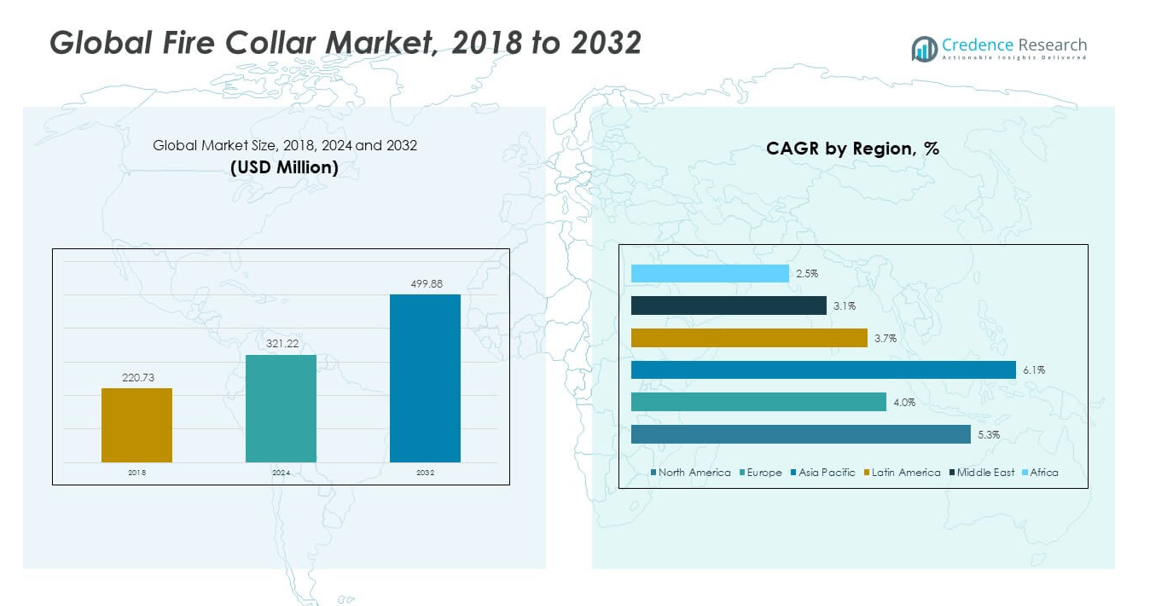
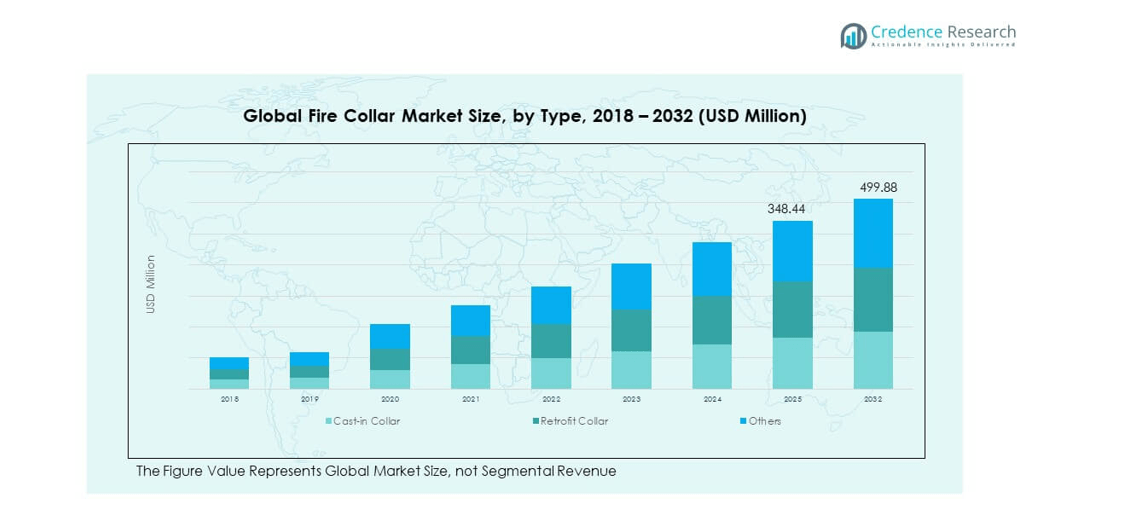
The Global Fire Collar Market size was valued at USD 220.73 million in 2018 to USD 321.22 million in 2024 and is anticipated to reach USD 499.88 million by 2032, at a CAGR of 5.29% during the forecast period.

REPORT ATTRIBUTE DETAILS
Historical Period 2020-2023
Base Year 2024
Forecast Period 2025-2032
Fire Collar Market Size 2024 USD 321.22 million
Fire Collar Market, CAGR 5.29%
Fire Collar Market Size 2032 USD 499.88 million


The Global Fire Collar Market is expanding due to rising fire safety regulations in residential, commercial, and industrial infrastructure. Growing construction projects, urbanization, and increasing awareness of passive fire protection systems are major drivers. The demand for fire collars is rising across developed and developing economies, supported by strict building codes and safety standards that require effective fire containment solutions in plumbing and electrical penetrations.

North America and Europe lead the market due to mature construction sectors and stringent fire safety norms. Asia-Pacific is emerging rapidly, driven by large-scale infrastructure development and industrial expansion in countries such as China, India, and Japan. The Middle East also shows strong potential, supported by urban growth and adoption of advanced fire protection technologies in modern buildings. Africa and Latin America are gradually adopting fire safety practices through regulatory reforms.

Fire Collar Market size

Market Insights:

  • The Global Fire Collar Market was valued at USD 220.73 million in 2018, reached USD 321.22 million in 2024, and is projected to attain USD 499.88 million by 2032, growing at a CAGR of 5.29%.
  • North America held the largest share at 34%, driven by strict building codes, widespread fire safety awareness, and the dominance of certified manufacturers. Europe followed with 21%, supported by stringent EN standards and retrofitting activities in older structures. Asia Pacific captured 16%, propelled by large-scale urban construction and infrastructure development.
  • Asia Pacific remains the fastest-growing region due to strong industrial expansion, smart city investments, and rising fire safety regulations across emerging economies like China and India.
  • By type, cast-in collars accounted for approximately 55% of the total market share in 2024, benefiting from widespread use in new commercial and residential projects.
  • Retrofit collars represented nearly 35% of the market, favored in infrastructure renovation, while other collar types captured the remaining 10%, catering to specialized industrial applications.

Access crucial information at unmatched prices!

Request your sample report today & start making informed decisions powered by Credence Research Inc.!

Download Sample

Market Drivers:

Rising Demand for Fire Protection Systems Across Commercial and Residential Construction

The Global Fire Collar Market is driven by increasing construction of high-rise buildings, commercial complexes, and residential projects. Rapid urbanization and industrialization across developed and emerging nations are boosting the installation of advanced fire safety systems. Governments are enforcing strict building codes that mandate the use of certified fire collars to prevent fire spread. Infrastructure modernization programs in Europe and Asia are further supporting demand. The need for passive fire protection is increasing across plumbing and electrical conduits. Builders are focusing on compliance and safety assurance in large-scale projects. Manufacturers are responding by offering products that meet global fire resistance standards. This trend is creating steady demand across multiple end-user industries.

  • For instance, Hilti’s CFS-CID Cast-in Firestop Collar features modular connections for close placement of multiple penetrations, achieves up to 4 hours of fire resistance (as per EN 13501-2:2007+A1:2009, EN 1366-3:2009), and is designed for quick, one-step installation in concrete slabs, eliminating additional coring and reducing labor costs.

Stringent Regulatory Framework and Emphasis on Building Safety Compliance

Tightened safety standards are a major growth driver in the Global Fire Collar Market. Authorities worldwide are revising fire safety codes to reduce risks in industrial and commercial buildings. These regulations require certified firestop materials, including collars, for penetration sealing in walls and floors. Insurance providers are increasingly linking premiums to compliance with such standards. It is encouraging property owners to invest in reliable fire protection solutions. Certification programs like UL and FM approvals enhance credibility and adoption rates. Manufacturers are focusing on testing and documentation to meet regional compliance needs. This regulatory push ensures sustainable long-term market growth.

  • For instance, Promat fire collars have been tested for over 30 years to multiple international standards and are designed using intumescent technology that expands to form an insulating barrier during fire events, ensuring compliance with building code requirements in lightweight and concrete floor assemblies.

Growth in Industrial and Infrastructure Development Projects Globally

Industrial growth across energy, manufacturing, and logistics sectors is propelling the Global Fire Collar Market. Large factories, warehouses, and processing plants require robust fire containment systems. Expanding oil and gas, power generation, and transport infrastructure projects are contributing to market expansion. Countries are investing heavily in industrial corridors, smart cities, and special economic zones. It is creating massive demand for certified fire protection materials. Fire collars are increasingly used to seal cable and pipe penetrations in critical installations. Manufacturers are developing advanced designs suitable for industrial-grade applications. This trend ensures continuous adoption across developing and developed economies.

Increasing Focus on Retrofitting and Maintenance of Aging Infrastructure

Upgrading old buildings with modern fire safety features is strengthening the Global Fire Collar Market. Governments and private owners are prioritizing retrofitting to meet new safety codes. Existing structures in Europe, North America, and Asia are being upgraded with certified collars and fire barriers. Facility management companies are investing in inspection and replacement programs. It is driving demand for easy-to-install, cost-effective collar solutions. The rise of green renovation projects also supports integration of sustainable fire protection products. Technological advancements are allowing retrofitting with minimal structural disruption. This ongoing maintenance cycle provides consistent market revenue potential.

Market Trends:

Shift Toward Innovative and Lightweight Fire Collar Designs

The Global Fire Collar Market is witnessing a move toward lightweight, flexible, and easier-to-install designs. Manufacturers are adopting advanced materials such as intumescent polymers for improved performance. Compact and modular collars are gaining preference in commercial and industrial projects. The use of recyclable and non-toxic compounds is aligning with green construction goals. It is improving product sustainability and compliance with environmental regulations. Innovation in design is helping contractors reduce installation time and cost. Smart manufacturing processes are allowing better consistency and quality assurance. This shift reflects a strong focus on safety and ease of application.

  • For instance, Walraven’s Pacifyre® MK II Fire Sleeve can be installed easily without special tools, provides fire resistance up to EI 240 for metal pipes and EI 120 for plastic pipes, and has been awarded a European Technical Assessment (ETA-20/0732), validating its performance and simplifying installation for both walls and floors.

Integration of Digital Tools and Smart Inspection Systems

Digital transformation is becoming a key trend in the Global Fire Collar Market. Companies are integrating IoT-enabled sensors for monitoring collar conditions in critical installations. Digital inspection tools ensure better tracking and maintenance of installed products. Software-based compliance management platforms are supporting real-time audits and certification tracking. It is improving operational efficiency and reducing manual errors in inspections. Data-driven insights are helping optimize fire safety strategies in large facilities. The trend supports proactive safety management in smart buildings. Manufacturers are also exploring partnerships with tech firms to expand digital integration.

  • For instance, while fire collar manufacturers such as Hilti have developed digital libraries and technical support tools, the integration of inspection-friendly features like Hilti’s “red footprint” in the CFS-CID device simplifies post-installation inspection processes, enhancing compliance and quality assurance at the jobsite.

Rising Adoption of Sustainable and Eco-Certified Fire Protection Materials

Sustainability is a growing trend influencing the Global Fire Collar Market. The demand for halogen-free, low-VOC, and recyclable materials is increasing. Governments and developers are promoting green building certifications like LEED and BREEAM. It is encouraging the use of eco-friendly collars with proven fire resistance. Manufacturers are reformulating materials to minimize environmental impact without reducing performance. Consumers are becoming more conscious of product sourcing and safety credentials. The adoption of cleaner production technologies is improving brand reputation. The move toward sustainability is reshaping product development priorities across regions.

Expansion of Product Portfolios Through Strategic Collaborations and Mergers

Collaborations are shaping competition in the Global Fire Collar Market. Leading players are acquiring or partnering with regional manufacturers to expand their portfolios. These alliances allow quicker market entry and product localization. It is helping companies serve construction standards unique to each region. Mergers are also driving technological exchange and cost optimization. Companies are focusing on expanding distribution networks through global partnerships. Joint ventures with insulation and construction solution providers are becoming common. This trend strengthens brand visibility and broadens product reach across end-user sectors.

Fire Collar Market shaare

Market Challenges Analysis:

High Installation Costs and Limited Awareness in Developing Regions

The Global Fire Collar Market faces challenges from high installation and maintenance costs. Price-sensitive regions often delay or neglect fire protection integration in small projects. Lack of awareness about the benefits of passive fire safety further limits adoption. Contractors sometimes prefer cheaper, uncertified alternatives that compromise safety. It reduces overall product penetration in low-income markets. Training gaps among construction workers also lead to improper installation and inefficiency. It affects the overall effectiveness of fire safety systems. Bridging this knowledge gap and offering affordable solutions are essential for market expansion.

Complex Certification Standards and Supply Chain Disruptions

Compliance complexity is a major challenge in the Global Fire Collar Market. Manufacturers must meet multiple regional testing and certification standards, increasing cost and time-to-market. Variations between EU, UL, and local codes create product approval barriers. Supply chain disruptions for raw materials and logistics have further delayed delivery timelines. It affects project schedules and customer confidence. Dependence on specialized components increases production vulnerability during global crises. Quality assurance requirements demand continuous investment in testing infrastructure. These factors together restrain the overall pace of market growth.

Market Opportunities:

Expansion of Fire Safety Regulations and Modern Infrastructure Projects

New infrastructure development and stricter safety codes are creating opportunities in the Global Fire Collar Market. Government-led urbanization initiatives in Asia-Pacific and the Middle East drive large-scale adoption. Public infrastructure, transport hubs, and healthcare facilities increasingly demand certified fire protection. It encourages long-term contracts and bulk installations. Companies with localized production units can leverage cost advantages. Emerging economies are expected to contribute significantly through regulatory alignment. These opportunities enhance overall industry resilience and profitability.

Product Innovation and Green Material Adoption for Competitive Advantage

Innovation in fire collar design and materials offers major growth prospects for the Global Fire Collar Market. Development of sustainable, halogen-free, and smart collars is attracting new customers. It allows manufacturers to meet both environmental and safety expectations. Partnerships with construction technology firms enhance R&D and customization. The rise in modular and prefabricated construction creates additional application areas. Expanding into niche segments like marine and data center safety provides new revenue streams. Continuous product evolution ensures long-term industry competitiveness.

Market Segmentation Analysis:

By Type

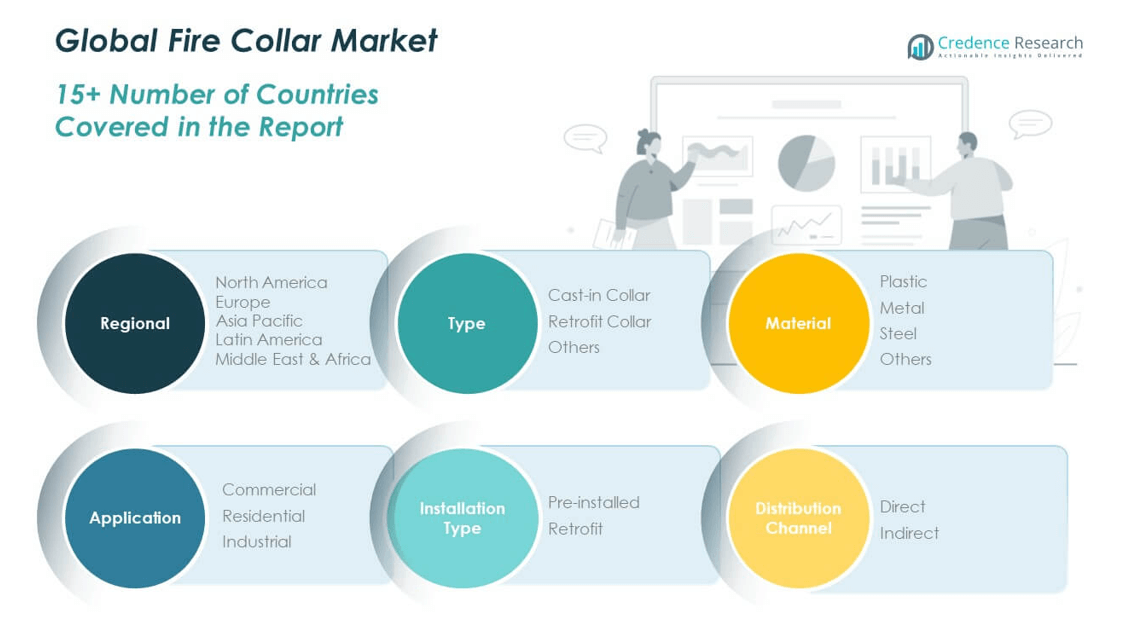
The Global Fire Collar Market is segmented into cast-in collar, retrofit collar, and others. Cast-in collars hold the dominant share due to their suitability in new construction projects and compliance with international fire safety codes. Retrofit collars are gaining traction in renovation and refurbishment applications, especially across developed regions focused on upgrading older structures. Other collar types, including customized and modular variants, cater to specialized industrial needs and flexible installations. Continuous design improvements are enhancing ease of fitting and long-term fire resistance performance.

  • For instance, Promat’s family of retrofit fire collars (such as the PROMASEAL FC Retrofit Collar) are split open for easier retrofitting as needed, and are tested for up to 240 minutes fire resistance in accordance with AS 1530: Part 4 and AS 4072: Part 1 with various types and sizes of plastic pipe.

By Material

Plastic, metal, steel, and other materials define the material segmentation. Steel fire collars lead the market because of their high durability, heat resistance, and superior performance under extreme fire conditions. Metal variants follow closely, favored for their cost-efficiency and ease of manufacturing. Plastic collars are popular in residential and low-risk applications for their lightweight and affordable properties. Innovation in composite materials is expanding product diversity and compliance scope.

  • For instance, Walraven’s Pacifyre® MK II Fire Sleeve employs a stainless-steel casing combined with a reactive intumescent inlay, and is designed to maintain fire compartment integrity for at least 25 years as indicated in European conformity assessments.

By Application

Commercial, residential, and industrial segments drive the demand landscape. The commercial segment dominates, driven by strict building codes in offices, malls, and institutional facilities. The residential sector benefits from growing awareness of fire protection in multi-story buildings. Industrial applications continue to expand in energy, manufacturing, and logistics due to critical safety requirements.

By Installation Type and Distribution Channel

Pre-installed and retrofit categories define installation scope, with pre-installed collars leading in new infrastructure projects. Retrofit types are widely used in renovation and compliance upgrades. Direct distribution channels dominate due to partnerships with contractors and developers, while indirect sales grow through distributors and e-commerce networks.

Fire Collar Market segmentation

Segmentation:

  • By Type
    • Cast-in Collar
    • Retrofit Collar
    • Others
  • By Material
    • Plastic
    • Metal
    • Steel
    • Others
  • By Application
    • Commercial
    • Residential
    • Industrial
  • By Installation Type
    • Pre-installed
    • Retrofit
  • By Distribution Channel
    • Direct
    • Indirect
  • By Country (Regional Breakdown)
    • North America
      • U.S.
      • Canada
      • Mexico
    • Europe
      • Germany
      • France
      • U.K.
      • Italy
      • Spain
      • Rest of Europe
    • Asia Pacific
      • China
      • Japan
      • India
      • South Korea
      • South-east Asia
      • Rest of Asia Pacific
    • Latin America
      • Brazil
      • Argentina
      • Rest of Latin America
    • Middle East & Africa
      • GCC Countries
      • South Africa
      • Rest of the Middle East and Africa

Regional Analysis:

North America

The North America Global Fire Collar Market size was valued at USD 97.39 million in 2018 to USD 140.28 million in 2024 and is anticipated to reach USD 218.90 million by 2032, at a CAGR of 5.3% during the forecast period. North America accounted for 34% of the global market share in 2024. The region leads due to strict enforcement of building safety codes and widespread use of advanced fire protection systems. High-rise commercial buildings, industrial plants, and residential complexes increasingly adopt fire collars to meet NFPA and UL standards. The U.S. drives the regional market with a mature construction industry and ongoing modernization of infrastructure. Canada supports growth with its focus on sustainable building designs and energy-efficient construction. It benefits from strong presence of leading manufacturers offering certified and eco-friendly solutions. Continuous R&D and technological upgrades maintain regional dominance in global trade.

Europe

The Europe Global Fire Collar Market size was valued at USD 60.75 million in 2018 to USD 85.13 million in 2024 and is anticipated to reach USD 124.47 million by 2032, at a CAGR of 4.5% during the forecast period. Europe captured 21% of the global market share in 2024. Strong regulatory compliance under EN fire standards drives product adoption across residential and industrial sectors. Countries such as Germany, the UK, and France lead installations through advanced safety frameworks and building modernization programs. Retrofitting projects in aging infrastructure are boosting demand for certified firestop materials. Manufacturers focus on product innovation using recyclable and low-emission materials. It benefits from government-backed safety campaigns and fire prevention awareness initiatives. The region remains an early adopter of sustainable construction technologies. Growth is steady, supported by continuous renovation activity and infrastructure resilience policies.

Asia Pacific

The Asia Pacific Global Fire Collar Market size was valued at USD 42.48 million in 2018 to USD 67.00 million in 2024 and is anticipated to reach USD 118.09 million by 2032, at a CAGR of 6.9% during the forecast period. Asia Pacific held a 16% market share in 2024. Rapid urbanization, rising industrial projects, and government-led infrastructure investments are fueling market expansion. China, India, Japan, and South Korea contribute strongly through large-scale construction and smart city programs. Growing awareness of passive fire protection in developing economies supports product adoption. It benefits from increasing private investment in commercial and industrial complexes. Domestic manufacturers are enhancing production capacity to meet safety standards. Local regulatory reforms are aligning with international fire norms, strengthening regional competitiveness. This region is expected to remain the fastest-growing market globally.

Latin America

The Latin America Global Fire Collar Market size was valued at USD 10.43 million in 2018 to USD 14.98 million in 2024 and is anticipated to reach USD 20.64 million by 2032, at a CAGR of 3.7% during the forecast period. Latin America represented 4% of the global market share in 2024. The region experiences growing demand from commercial and institutional construction, particularly in Brazil and Mexico. Development of new business complexes and public infrastructure is stimulating product usage. It faces challenges from limited awareness and inconsistent enforcement of fire safety codes. Local governments are introducing stricter regulations to improve compliance in new projects. Affordable retrofitting solutions are attracting adoption in residential buildings. Manufacturers are focusing on cost-effective fire collars tailored to regional needs. The construction sector recovery is expected to drive gradual market improvement.

Middle East

The Middle East Global Fire Collar Market size was valued at USD 6.23 million in 2018 to USD 8.30 million in 2024 and is anticipated to reach USD 10.91 million by 2032, at a CAGR of 3.1% during the forecast period. The Middle East accounted for 3% of the global market share in 2024. Demand is supported by large-scale infrastructure, hospitality, and oil & gas projects. Countries like the UAE, Saudi Arabia, and Qatar are integrating advanced fire safety systems in smart cities and mega projects. Rapid urban expansion is driving installations across commercial towers and industrial zones. It benefits from strict government mandates in high-occupancy buildings. Adoption is rising due to focus on international safety certification and improved fire resilience. Imports dominate supply chains, though local production is increasing gradually. Long-term construction growth sustains steady demand across the region.

Africa

The Africa Global Fire Collar Market size was valued at USD 3.45 million in 2018 to USD 5.53 million in 2024 and is anticipated to reach USD 6.87 million by 2032, at a CAGR of 2.3% during the forecast period. Africa held a 2% share of the global market in 2024. The market is developing gradually, driven by expanding commercial construction in South Africa, Egypt, and Nigeria. Urban growth and government housing initiatives are supporting modest adoption. It faces limitations in infrastructure funding and fire safety enforcement. International organizations are helping promote compliance and safety awareness. The entry of foreign construction firms brings advanced building standards to major cities. Local distributors are forming alliances with global brands to widen access. Although small in scale, Africa presents long-term potential through infrastructure modernization.

Shape Your Report to Specific Countries or Regions & Enjoy 30% Off!

Key Player Analysis:

Competitive Analysis:

The Global Fire Collar Market is characterized by strong competition among established global and regional players. Leading companies focus on product innovation, regulatory compliance, and expanding distribution networks. Key participants such as Hilti Corporation, 3M Company, Promat International, and Trafalgar Fire emphasize developing lightweight, easy-to-install, and eco-friendly fire protection solutions. It benefits from rising construction safety standards and retrofit demand across developed markets. Strategic mergers and collaborations strengthen supply capabilities and enhance product reach. Continuous investment in R&D supports material advancement and fire resistance testing. The market shows balanced competition, with regional manufacturers focusing on cost efficiency and tailored product portfolios.

Recent Developments:

  • In September 2025, Hilti Corporation earned six Pro Tool Innovation Awards for its wide range of construction solutions, including advancements in fire protection and safety accessories. Though not explicitly tied to a new fire collar launch, this recognition highlights Hilti’s leadership in developing innovative safety products for commercial buildings, and its commitment to enhancing passive fire protection systems is a driving force in the sector.
  • In 2025, 3M continues to play a significant role in the fire collar market by advancing its fire barrier technologies, including products that function as intumescent wraps and plastic pipe devices—key solutions for passive fire prevention. The company regularly introduces enhancements within its fire barrier portfolio to address evolving building codes and increased demand for high-performance fire safety components in global construction projects.
  • On April 7, 2025, Specified Technologies Inc.—also known as STI Firestop—launched the SpecSeal® 8 Inch Cast-In Device, expanding its offerings for firestop pipe penetrations in new constructions. This product aims to simplify installation while delivering robust fire protection, serving the growing need for reliable and efficient passive fire safety measures across diverse building types.
  • In June 2025, Promat International became the first UK manufacturer to formally accept design responsibility for passive fire protection systems installed according to its standard details and testing protocols. This move aligns the company’s fire collars and passive protection solutions with the latest Building Safety Act requirements—enhancing accountability and raising safety standards within the industry.

Report Coverage:

The research report offers an in-depth analysis based on type, material, application, installation type, and distribution channel. It details leading market players, providing an overview of their business, product offerings, investments, revenue streams, and key applications. Additionally, the report includes insights into the competitive environment, SWOT analysis, current market trends, as well as the primary drivers and constraints. Furthermore, it discusses various factors that have driven market expansion in recent years. The report also explores market dynamics, regulatory scenarios, and technological advancements that are shaping the industry. It assesses the impact of external factors and global economic changes on market growth. Lastly, it provides strategic recommendations for new entrants and established companies to navigate the complexities of the market.

Future Outlook:

  • Increasing adoption of certified fire protection systems across high-rise and industrial buildings.
  • Rising government enforcement of building codes promoting passive fire safety solutions.
  • Growing demand for eco-friendly, recyclable, and halogen-free fire collar materials.
  • Expanding infrastructure and smart city projects in emerging economies.
  • Greater focus on digital inspection and IoT-enabled fire safety monitoring systems.
  • Regional players enhancing capacity to meet international safety certifications.
  • Rising retrofitting demand for older structures in developed markets.
  • Advancements in intumescent materials improving fire resistance and durability.
  • Expanding partnerships between global brands and local distributors.
  • Increasing R&D investment focused on cost-effective and lightweight designs.

CHAPTER NO. 1: GENESIS OF THE MARKET     

1.1 Market Prelude – Introduction & Scope

1.2 The Big Picture – Objectives & Vision

1.3 Strategic Edge – Unique Value Proposition

1.4 Stakeholder Compass – Key Beneficiaries

CHAPTER NO. 2: EXECUTIVE LENS

2.1 Pulse of the Industry – Market Snapshot

2.2 Growth Arc – Revenue Projections (USD Million)

2.3. Premium Insights – Based on Primary Interviews  

CHAPTER NO. 3: FIRE COLLAR MARKET FORCES & INDUSTRY PULSE      

3.1 Foundations of Change – Market Overview
3.2 Catalysts of Expansion – Key Market Drivers
3.2.1 Momentum Boosters – Growth Triggers
3.2.2 Innovation Fuel – Disruptive Technologies
3.3 Headwinds & Crosswinds – Market Restraints
3.3.1 Regulatory Tides – Compliance Challenges
3.3.2 Economic Frictions – Inflationary Pressures
3.4 Untapped Horizons – Growth Potential & Opportunities
3.5 Strategic Navigation – Industry Frameworks
3.5.1 Market Equilibrium – Porter’s Five Forces
3.5.2 Ecosystem Dynamics – Value Chain Analysis
3.5.3 Macro Forces – PESTEL Breakdown

3.6 Price Trend Analysis

3.6.1 Regional Price Trend
3.6.2 Price Trend by product

CHAPTER NO. 4: KEY INVESTMENT EPICENTER         

4.1 Regional Goldmines – High-Growth Geographies

4.2 Product Frontiers – Lucrative Product Categories

4.3 Application Sweet Spots – Emerging Demand Segments

CHAPTER NO. 5: REVENUE TRAJECTORY & WEALTH MAPPING

5.1 Momentum Metrics – Forecast & Growth Curves

5.2 Regional Revenue Footprint – Market Share Insights

5.3 Segmental Wealth Flow – Type & Material Revenue

CHAPTER NO. 6: TRADE & COMMERCE ANALYSIS     

6.1.      Import Analysis by Region

6.1.1.    Global Fire Collar Market Import Revenue By Region

6.2.      Export Analysis by Region

6.2.1.    Global Fire Collar Market Export Revenue By Region

CHAPTER NO. 7: COMPETITION ANALYSIS       

7.1.      Company Market Share Analysis

7.1.1.    Global Fire Collar Market: Company Market Share

7.2.      Global Fire Collar Market Company Revenue Market Share

7.3.      Strategic Developments

7.3.1.    Acquisitions & Mergers

7.3.2.    New Product Launch

7.3.3.    Regional Expansion

7.4.      Competitive Dashboard

7.5.    Company Assessment Metrics, 2024

CHAPTER NO. 8: FIRE COLLAR MARKET – BY TYPE SEGMENT ANALYSIS

8.1.      Fire Collar Market Overview by Type Segment

8.1.1.    Fire Collar Market Revenue Share By Type

8.2.      Cast-in Collar

8.3.      Retrofit Collar

8.4.      Others

CHAPTER NO. 9: FIRE COLLAR MARKET – BY MATERIAL SEGMENT ANALYSIS     

9.1.      Fire Collar Market Overview by Material Segment

9.1.1.    Fire Collar Market Revenue Share By Material

9.2.      Plastic

9.3.      Metal

9.4.      Steel

9.5.      Others

CHAPTER NO. 10: FIRE COLLAR MARKET – BY APPLICATION SEGMENT ANALYSIS

10.1.     Fire Collar Market Overview by Application Segment

10.1.1.  Fire Collar Market Revenue Share By Application

10.2.     Commercial

10.3.     Residential

10.4.     Industrial

CHAPTER NO. 11:     FIRE COLLAR MARKET – BY INSTALLATION TYPE SEGMENT ANALYSIS

11.1.     Fire Collar Market Overview by Installation Type Segment

11.1.1.  Fire Collar Market Revenue Share By Installation Type

11.2.     Pre-installed

11.3.     Retrofit

CHAPTER NO. 12: FIRE COLLAR MARKET – BY DISTRIBUTION CHANNEL SEGMENT ANALYSIS

12.1.     Fire Collar Market Overview by Distribution Channel Segment

12.1.1.  Fire Collar Market Revenue Share By Distribution Channel

12.2.     Direct

12.3.     Indirect

CHAPTER NO. 13: FIRE COLLAR MARKET – REGIONAL ANALYSIS

13.1.     Fire Collar Market Overview by Region Segment

13.1.1.  Global Fire Collar Market Revenue Share By Region

13.1.2.  Regions

13.1.3.  Global Fire Collar Market Revenue By Region

13.1.4.  Type

13.1.5.  Global Fire Collar Market Revenue By Type

13.1.6.  Material

13.1.7.  Global Fire Collar Market Revenue By Material

13.1.8.  Application

13.1.9.  Global Fire Collar Market Revenue By Application

13.1.10. Installation Type

13.1.12. Global Fire Collar Market Revenue By Installation Type

13.1.13. Distribution Channel

13.1.14. Global Fire Collar Market Revenue By Distribution Channel

CHAPTER NO. 14: NORTH AMERICA FIRE COLLAR MARKET – COUNTRY ANALYSIS     

14.1.     North America Fire Collar Market Overview by Country Segment

14.1.1.  North America Fire Collar Market Revenue Share By Region

14.2.     North America

14.2.1.  North America Fire Collar Market Revenue By Country

14.2.2.  Type

14.2.3.  North America Fire Collar Market Revenue By Type

14.2.4.  Material

14.2.5.  North America Fire Collar Market Revenue By Material

14.2.6.  Application

14.2.7.  North America Fire Collar Market Revenue By Application

14.2.8.  Installation Type

14.2.9.  North America Fire Collar Market Revenue By Installation Type

14.2.10. Distribution Channel

14.2.11. North America Fire Collar Market Revenue By Distribution Channel

14.3.     U.S.

14.4.     Canada

14.5.     Mexico

CHAPTER NO. 15: EUROPE FIRE COLLAR MARKET – COUNTRY ANALYSIS           

15.1.     Europe Fire Collar Market Overview by Country Segment

15.1.1.  Europe Fire Collar Market Revenue Share By Region

15.2.     Europe

15.2.1.  Europe Fire Collar Market Revenue By Country

15.2.2.  Type

15.2.3.  Europe Fire Collar Market Revenue By Type

15.2.4.  Material

15.2.5.  Europe Fire Collar Market Revenue By Material

15.2.6.  Application

15.2.7.  Europe Fire Collar Market Revenue By Application

15.2.8.  Installation Type

15.2.9.  Europe Fire Collar Market Revenue By Installation Type

15.2.10. Distribution Channel

15.2.11. Europe Fire Collar Market Revenue By Distribution Channel

15.3.     UK

15.4.     France

15.5.     Germany

15.6.     Italy

15.7.     Spain

15.8.     Russia

15.9.   Rest of Europe

CHAPTER NO. 16: ASIA PACIFIC FIRE COLLAR MARKET – COUNTRY ANALYSIS

16.1.     Asia Pacific Fire Collar Market Overview by Country Segment

16.1.1.  Asia Pacific Fire Collar Market Revenue Share By Region

16.2.     Asia Pacific

16.2.1.  Asia Pacific Fire Collar Market Revenue By Country

16.2.2.  Type

16.2.3.  Asia Pacific Fire Collar Market Revenue By Type

16.2.4.  Material

16.2.5.  Asia Pacific Fire Collar Market Revenue By Material

16.2.6.  Application

16.2.7.  Asia Pacific Fire Collar Market Revenue By Application

16.2.8.  Installation Type

16.2.9.  Asia Pacific Fire Collar Market Revenue By Installation Type

16.2.10. Distribution Channel

16.2.11. Asia Pacific Fire Collar Market Revenue By Distribution Channel

16.3.     China

16.4.     Japan

16.5.     South Korea

16.6.     India

16.7.     Australia

16.8.     Southeast Asia

16.9.     Rest of Asia Pacific

CHAPTER NO. 17: LATIN AMERICA FIRE COLLAR MARKET – COUNTRY ANALYSIS

17.1.     Latin America Fire Collar Market Overview by Country Segment

17.1.1.  Latin America Fire Collar Market Revenue Share By Region

17.2.     Latin America

17.2.1.  Latin America Fire Collar Market Revenue By Country

17.2.2.  Type

17.2.3.  Latin America Fire Collar Market Revenue By Type

17.2.4.  Material

17.2.5.  Latin America Fire Collar Market Revenue By Material

17.2.6.  Application

17.2.7.  Latin America Fire Collar Market Revenue By Application

17.2.8.  Installation Type

17.2.9.  Latin America Fire Collar Market Revenue By Installation Type

17.2.10. Distribution Channel

17.2.11. Latin America Fire Collar Market Revenue By Distribution Channel

17.3.     Brazil

17.4.     Argentina

17.5.     Rest of Latin America

CHAPTER NO. 18: MIDDLE EAST FIRE COLLAR MARKET – COUNTRY ANALYSIS

18.1.     Middle East Fire Collar Market Overview by Country Segment

18.1.1.  Middle East Fire Collar Market Revenue Share By Region

18.2.     Middle East

18.2.1.  Middle East Fire Collar Market Revenue By Country

18.2.2.  Type

18.2.3.  Middle East Fire Collar Market Revenue By Type

18.2.4.  Material

18.2.5.  Middle East Fire Collar Market Revenue By Material

18.2.6.  Application

18.2.7.  Middle East Fire Collar Market Revenue By Application

18.2.8.  Installation Type

18.2.9.  Middle East Fire Collar Market Revenue By Installation Type

18.2.10. Distribution Channel

18.2.11. Middle East Fire Collar Market Revenue By Distribution Channel

18.3.     GCC Countries

18.4.     Israel

18.5.     Turkey

18.6.     Rest of Middle East

CHAPTER NO. 19: AFRICA FIRE COLLAR MARKET – COUNTRY ANALYSIS

19.1.     Africa Fire Collar Market Overview by Country Segment

19.1.1.  Africa Fire Collar Market Revenue Share By Region

19.2.     Africa

19.2.1.  Africa Fire Collar Market Revenue By Country

19.2.2.  Type

19.2.3.  Africa Fire Collar Market Revenue By Type

19.2.4.  Material

19.2.5.  Africa Fire Collar Market Revenue By Material

19.2.6.  Application

19.2.7.  Africa Fire Collar Market Revenue By Application

19.2.8.  Installation Type

19.2.9.  Africa Fire Collar Market Revenue By Installation Type

19.2.10. Distribution Channel

19.2.11. Africa Fire Collar Market Revenue By Distribution Channel

19.3.     South Africa

19.4.     Egypt

19.5.     Rest of Africa

CHAPTER NO. 20: COMPANY PROFILES 

20.1.     Hilti Corporation

20.1.1.  Company Overview

20.1.2.  Product Portfolio

20.1.3.  Financial Overview

20.1.4.  Recent Developments

20.1.5.  Growth Strategy

20.1.6.  SWOT Analysis

20.2.     3M Company

20.3.     Specified Technologies Inc.

20.4.     STI Firestop

20.5.     Tenmat Ltd.

20.6.     Promat International

20.7.     Trafalgar Fire

20.8.     Company 8

20.9.     Company 9

20.10.   Company 10

Request Free Sample

We prioritize the confidentiality and security of your data. Our promise: your information remains private.

Ready to Transform Data into Decisions?

Request Your Sample Report and Start Your Journey of Informed Choices


Providing the strategic compass for industry titans.

cr-clients-logos

Frequently Asked Questions

What is the current market size for the Fire Collar Market, and what is its projected size in 2032?

The Global Fire Collar Market was valued at USD 321.22 million in 2024 and is projected to reach USD 499.88 million by 2032. It shows stable expansion supported by rising infrastructure safety investments and regulatory mandates.

At what Compound Annual Growth Rate is the Fire Collar Market projected to grow between 2024 and 2032?

The Fire Collar Market is projected to grow at a CAGR of 5.29% from 2024 to 2032.

Which Fire Collar Market segment held the largest share in 2024?

The commercial segment held the largest share of the Fire Collar Market in 2024.

What are the primary factors fueling the growth of the Fire Collar Market?

Key drivers include rising awareness about fire safety, adoption of fire-resistant materials, and advancements in fire collar technology, such as enhanced fire-resistance capabilities and ease of installation.

Who are the leading companies in the Fire Collar Market?

Leading companies in the Fire Collar Market include Hilti Group, 3M, ROCKWOOL International A/S, Armacell International S.A., and Johnson Controls.

Which region commanded the largest share of the Fire Collar Market in 2024?

North America commanded the largest share of the Fire Collar Market in 2024, driven by strong construction safety norms and a robust industrial sector.

About Author

Ganesh Chandwade

Ganesh Chandwade

Senior Industry Consultant

Ganesh is a senior industry consultant specializing in heavy industries and advanced materials.

View Profile

Related Reports

Shrink Films Market

The Global Shrink Films Market is projected to grow from USD 18023.45 million in 2024 to an estimated USD 29181.66 million by 2032, with a compound annual growth rate (CAGR) of 5.50% from 2024 to 2032.

Plastic Shrink Wrap Market

The plastic shrink wrap market was valued at USD 8 billion in 2024 and is projected to reach USD 11.57 billion by 2032, exhibiting a CAGR of 4.9% over the forecast period.

Biodegradable Plastic Film Market

The biodegradable plastic film market was valued at USD 1.25 billion in 2024 and is anticipated to reach USD 1.75 billion by 2032, registering a CAGR of 4.3% during the forecast period.

Carbon Fiber Reinforced Plastic (CFRP) Market

The Global Carbon Fiber Reinforced Plastic Market size was valued at USD 13,629.3 million in 2018 to USD 23,256.0 million in 2024 and is anticipated to reach USD 43,668.9 million by 2032, at a CAGR of  8.17% during the forecast period.

Polymeric Sand Market

The Polymeric Sand Market is projected to grow from USD 118,578.52 million in 2024 to an estimated USD 205,268.3 million by 2032, with a compound annual growth rate (CAGR) of 7.1% from 2024 to 2032.

Polymethyl Methacrylate Microspheres Market

The Polymethyl Methacrylate Microspheres Market is projected to grow from USD 416.38 million in 2024 to an estimated USD 694.3 million by 2032, with a compound annual growth rate (CAGR) of 6.6% from 2024 to 2032.

Silicone Roof Coatings Market

Silicone roof coatings market was valued at USD 7.03 billion in 2024 and is anticipated to reach USD 9.49 billion by 2032, growing at a CAGR of 3.82 % during the forecast period.

Shade Nets Market

The Shade Nets market was valued at USD 1,848.05 million in 2024 and is projected to reach USD 3,320.56 million by 2032, expanding at a CAGR of 7.6% during the forecast period.

Pipette Tips Market

Pipette tips market was valued at USD 798.94 million in 2024 and is anticipated to reach USD 1412.22 million by 2032, growing at a CAGR of 7.38 % during the forecast period.

Paraffin Wax Market

The paraffin wax market was valued at USD 5,607.5 million in 2024 and is anticipated to reach USD 8,221.92 million by 2032, registering a CAGR of 4.9% during the forecast period.

Fire Safety Valves Market

Fire Safety Valves Market size was valued USD 5.6 billion in 2024 and is anticipated to reach USD 7.96 billion by 2032, at a CAGR of 4.5% during the forecast period.

3D Printing Materials Market

3d Printing Materials Market size was valued at USD 2.68 billion in 2024 and is anticipated to reach USD 10.7 billion by 2032, at a CAGR of 18.9% during the forecast period.

Licence Option

The report comes as a view-only PDF document, optimized for individual clients. This version is recommended for personal digital use and does not allow printing. Use restricted to one purchaser only.
$4999

To meet the needs of modern corporate teams, our report comes in two formats: a printable PDF and a data-rich Excel sheet. This package is optimized for internal analysis. Unlimited users allowed within one corporate location (e.g., regional office).
$6999

The report will be delivered in printable PDF format along with the report’s data Excel sheet. This license offers 100 Free Analyst hours where the client can utilize Credence Research Inc. research team. Permitted for unlimited global use by all users within the purchasing corporation, such as all employees of a single company.
$12999

Report delivery within 24 to 48 hours

Credence Staff 3

WILLIAM, North America

Support Staff at Credence Research

KEITH PHILLIPS, Europe

Lee - CR Sales Staff

LEE VALLANCE, Asia Pacific

Kieran Jameson

KIERAN JAMESON, Australia

Smallform of Sample request
User Review

Thank you for the data! The numbers are exactly what we asked for and what we need to build our business case.

Materials Scientist
(privacy requested)

User Review

The report was an excellent overview of the Industrial Burners market. This report does a great job of breaking everything down into manageable chunks.

Imre Hof
Management Assistant, Bekaert

cr-clients-logos

Request Sample