Market Overview
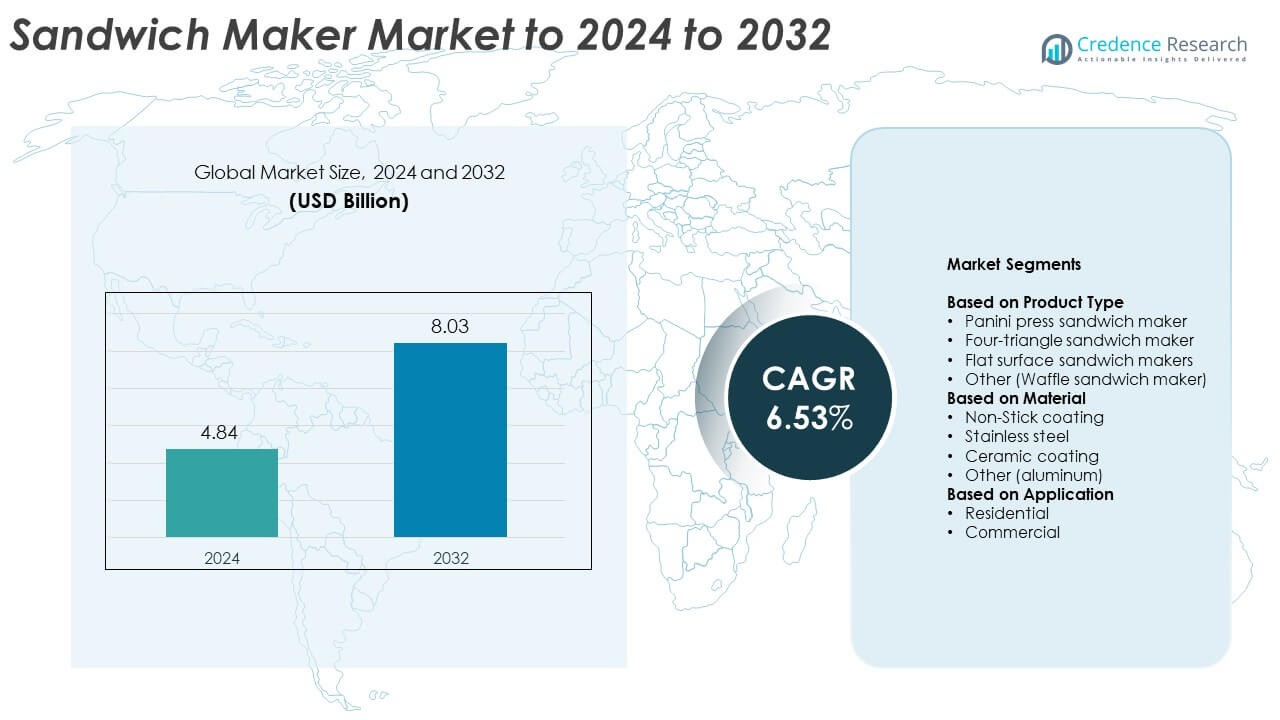
The sandwich maker market size was valued at USD 4.84 billion in 2024 and is anticipated to reach USD 8.03 billion by 2032, at a CAGR of 6.53% during the forecast period.
| REPORT ATTRIBUTE |
DETAILS |
| Historical Period |
2020-2023 |
| Base Year |
2024 |
| Forecast Period |
2025-2032 |
| Sandwich Maker Market Size 2024 |
USD 4.84 Billion |
| Sandwich Maker Market, CAGR |
6.53% |
| Sandwich Maker Market Size 2032 |
USD 8.03 Billion |
The sandwich maker market is highly competitive, led by companies such as Philips, Black+Decker, Morphy Richards, Hamilton Beach, Bajaj Electricals, Russell Hobbs, Panasonic, TTK Prestige Ltd, Breville, Kenwood, Cuisinart, Oster, George Foreman, Sunbeam, Tefal, and Reliance Digital. North America holds the leading position with approximately 34% market share, driven by high consumer awareness, urban lifestyles, and strong adoption of convenient kitchen appliances. The region benefits from established retail and e-commerce networks, enabling wide product accessibility. Continuous product innovation, multifunctional designs, and energy-efficient features strengthen market presence. Commercial and residential demand supports growth, while aggressive marketing and brand loyalty help maintain competitiveness. Asia-Pacific and Europe follow, showing steady expansion due to rising disposable incomes and growing interest in home-cooked meals. Manufacturers focus on regional customization to capture emerging consumer segments.
Access crucial information at unmatched prices!
Request your sample report today & start making informed decisions powered by Credence Research Inc.!
Download Sample
Market Insights
- The Sandwich Maker Market size was valued at USD 4.84 billion in 2024 and is projected to reach USD 8.03 billion by 2032, growing at a CAGR of 6.53%.
- Rising urban lifestyles, demand for quick meal solutions, and technological innovations drive market growth globally.
- Consumers increasingly prefer multi-functional and energy-efficient appliances, while health-conscious trends encourage low-oil cooking, supporting product adoption.
- The market is highly competitive, with leading players focusing on product innovation, retail and e-commerce expansion, and brand promotion to strengthen market share.
- North America leads the market with approximately 34% share, followed by Europe at 28%, Asia-Pacific at 25%, Latin America at 7%, and Middle East & Africa at 6%; panini press sandwich makers dominate the product segment with around 38% share.
Market Segmentation Analysis:
By Product Type
The panini press sandwich maker segment dominated the market in 2024, holding approximately 38% share. Its popularity stems from convenience, even heating, and versatility for preparing a variety of sandwiches. Consumers increasingly prefer quick and easy meal options, driving demand for panini presses in both residential and small commercial kitchens. The growing adoption of compact, multi-functional appliances further supports this segment. Four-triangle and flat surface sandwich makers also contribute to the market, but the panini press remains the preferred choice due to its consistent performance, user-friendly design, and compatibility with modern kitchen aesthetics.
- For instance, Hamilton Beach Brands Holding Company reported total revenue of $654.7 million for the full year 2024.
By Material
The non-stick coating segment led the sandwich maker market in 2024 with around 42% share. Non-stick surfaces enable easy cleaning and prevent food from sticking, enhancing user convenience. Rising awareness of hygiene and ease of maintenance drives consumer preference for non-stick appliances. Stainless steel and ceramic-coated variants are also in demand, offering durability and premium appeal. However, non-stick remains dominant due to its combination of affordability, energy efficiency, and minimal maintenance requirements. Manufacturers continue innovating with reinforced non-stick coatings to improve scratch resistance and longevity, further strengthening this segment’s market position.
- For instance, the Breville Sear & Press Grill (model BGR710BSS) is a multi-functional appliance that includes reversible and removable ceramic-coated grill and flat plates.
By Application
The residential segment accounted for the largest share of approximately 65% in 2024, driven by rising urban lifestyles and increased at-home cooking trends. Consumers seek time-efficient solutions for daily meals, making compact sandwich makers highly popular. Growth in e-commerce and retail availability has further expanded residential adoption. Commercial applications, including cafes, small restaurants, and convenience stores, also show steady demand but lag behind households. Convenience, ease of use, and multifunctionality remain key drivers for the residential segment. The segment’s expansion is supported by ongoing product innovation and affordability, making it the primary revenue contributor in the sandwich maker market.
Key Growth Drivers
Rising Urban Lifestyles
Increasing urbanization and busy lifestyles are driving demand for convenient cooking appliances. Consumers seek quick and easy meal preparation solutions, boosting sandwich maker adoption. Compact designs and multifunctional features cater to limited kitchen spaces, making these appliances ideal for apartments and small homes. The growing preference for home-cooked meals over dining out further accelerates market growth. Manufacturers are responding with energy-efficient and user-friendly models, enhancing appeal. Rising awareness about healthy eating and customizable meal options continues to support the segment, positioning residential consumers as the primary growth engine in the sandwich maker market.
- For instance, TTK Prestige Ltd. reported a consolidated net profit of ₹642.4 million (₹64.24 crore) for the second quarter of fiscal year 2026 (Q2 FY26), ending September 30, 2025.
Technological Advancements
Innovations in sandwich maker design, including non-stick coatings, adjustable temperature control, and multi-functional plates, are fueling market growth. Smart and energy-efficient models enhance convenience and cooking precision. Enhanced durability and easy-to-clean features improve user experience, encouraging repeat purchases. Integration of premium materials such as stainless steel and ceramic coatings caters to evolving consumer preferences. Technological improvements also expand commercial applications, supporting cafes and small restaurants. Continuous product innovation and customization options ensure that consumers can prepare a wider variety of dishes, strengthening overall market demand and driving segment growth.
- For instance, TTK Prestige Ltd. plans to expand its store count by 30% over the next four years, aiming to increase its presence in both large and small towns to meet rising demands.
Expansion of Retail and Online Channels
Widespread availability through online marketplaces and retail stores is a key growth driver. E-commerce platforms enable consumers to compare features, prices, and brands, facilitating informed purchases. Retail expansion into tier-2 and tier-3 cities increases market penetration. Promotions, discounts, and bundled offers further attract consumers. Enhanced distribution networks allow manufacturers to reach diverse consumer segments efficiently. Easy access and convenience boost impulse buying and repeat sales. The growing role of digital marketing and social media campaigns also amplifies consumer awareness, contributing to the sustained adoption of sandwich makers across residential and commercial sectors.
Key Trends & Opportunities
Demand for Multi-functional Appliances
Consumers increasingly prefer appliances capable of preparing multiple dishes beyond sandwiches. Multi-functional models with interchangeable plates for grilling, baking, or making waffles are gaining traction. Rising interest in time-efficient, versatile kitchen solutions drives adoption. Manufacturers are introducing compact, space-saving designs with advanced features to meet evolving demands. The trend also opens opportunities in premium and mid-range segments, targeting both residential and commercial users. Multi-functionality enhances perceived value and convenience, creating scope for product differentiation. Continuous innovation in this space allows brands to strengthen market share and capture emerging consumer preferences.
- For instance, Morphy Richards offers a 3-in-1 sandwich maker with interchangeable plates, including the Luxe Rose TWG model, which was released in 2023.
Focus on Health and Customization
The growing health-conscious consumer base is driving demand for appliances that allow controlled cooking with minimal oil or fat. Adjustable temperature settings and non-stick surfaces support healthier meal preparation. Consumers also seek personalized cooking options to accommodate dietary restrictions and preferences. This trend encourages manufacturers to develop innovative features catering to nutrition-conscious users. Opportunities exist for integrating smart technologies and app-controlled operations to enhance customization. Health-oriented features not only appeal to individual consumers but also attract commercial establishments emphasizing healthier menu options, providing long-term market growth potential.
- For instance, Panasonic offers several sandwich makers, including the NF-GW1 model, which features non-stick heating plates for easy cleaning and healthier cooking. The NF-GW1 is a compact, 760-watt appliance capable of making up to four sandwiches at a time.
Key Challenges
High Competition and Price Sensitivity
Intense competition among global and regional manufacturers challenges profitability and market positioning. Many consumers are price-sensitive, often opting for low-cost alternatives over premium models. This pressure limits margins and forces continuous innovation at competitive costs. Differentiation through features, design, and durability becomes crucial to retain consumer interest. Smaller players face challenges in scaling production and marketing effectively. Moreover, the availability of counterfeit or low-quality products in some regions affects brand reputation. Navigating pricing pressures while maintaining quality standards remains a significant challenge for sustained growth in the sandwich maker market.
Limited Awareness in Emerging Markets
In several emerging regions, awareness of sandwich maker benefits and multifunctional features remains low. Consumers often rely on traditional cooking methods, restricting market penetration. Lack of exposure to modern appliances limits adoption despite increasing disposable incomes. Educational marketing campaigns and localized promotions are required to bridge knowledge gaps. Infrastructure and distribution limitations also hinder accessibility in rural or semi-urban areas. Overcoming these awareness and accessibility challenges is essential for manufacturers to expand into untapped markets and sustain long-term growth opportunities in the global sandwich maker sector.
Regional Analysis
North America
North America dominated the sandwich maker market in 2024, holding around 34% share. High disposable income, busy urban lifestyles, and growing preference for home-cooked meals drive residential demand. Multi-functional and compact designs appeal to apartment dwellers, while commercial cafes adopt advanced models to enhance operational efficiency. Easy availability through online and retail channels further supports adoption. Technological advancements, such as non-stick coatings and adjustable temperature controls, increase consumer convenience. The presence of established brands and strong marketing campaigns strengthens market penetration. Rising awareness of healthy cooking and energy-efficient appliances also contributes to sustained growth in North America.
Europe
Europe accounted for approximately 28% of the sandwich maker market in 2024, driven by urban households and increasing café culture. Consumers prefer high-quality, multifunctional appliances with durable materials like stainless steel and ceramic coatings. Growing health awareness and demand for quick meal solutions support residential adoption. Commercial use in restaurants, bakeries, and cafés is also expanding. Retail and e-commerce channels provide easy access to a variety of models, enhancing market penetration. Energy efficiency and compact designs are key purchasing considerations. Continuous innovation and brand presence in Western European countries maintain growth, while emerging markets in Eastern Europe show rising potential.
Asia-Pacific
Asia-Pacific held around 25% market share in 2024, reflecting rapid urbanization and rising disposable incomes. Increasing awareness of convenience cooking appliances and growth of modern retail channels drive residential adoption. Expanding café culture and small restaurant operations create commercial demand. Affordable mid-range and multifunctional models appeal to young urban consumers. E-commerce platforms accelerate product availability, particularly in India, China, and Southeast Asia. Manufacturers focus on energy-efficient, easy-to-clean designs to meet local preferences. Rising interest in health-conscious and home-cooked meals further boosts adoption. Government initiatives promoting electrical appliances and smart kitchen solutions also support market growth in the region.
Latin America
Latin America accounted for about 7% of the sandwich maker market in 2024. Rising urbanization, increasing middle-class population, and growing interest in modern kitchen appliances support residential demand. Multi-functional and compact designs cater to limited kitchen spaces in urban apartments. Commercial demand from small cafés and convenience stores is gradually increasing. E-commerce adoption facilitates access to various product ranges. Price sensitivity influences purchasing decisions, encouraging mid-range models. Awareness campaigns highlighting convenience and energy efficiency promote adoption. Brazil and Mexico lead the regional market, while smaller countries show emerging opportunities. Market growth is supported by increasing lifestyle modernization and evolving consumer preferences.
Middle East & Africa
Middle East & Africa contributed around 6% share to the sandwich maker market in 2024. Rising urban lifestyles, increasing disposable income, and growing interest in modern kitchen appliances drive residential adoption. Expat communities in urban centers increase demand for versatile cooking appliances. Commercial use in cafés, hotels, and small eateries is gradually growing. Limited awareness and price sensitivity in certain regions constrain penetration, but e-commerce and retail expansion support gradual growth. Compact, multifunctional, and energy-efficient models are preferred. The market is emerging in the GCC countries and South Africa, with gradual adoption expected in North Africa and other developing regions.
Market Segmentations:
By Product Type
- Panini press sandwich maker
- Four-triangle sandwich maker
- Flat surface sandwich makers
- Other (Waffle sandwich maker)
By Material
- Non-Stick coating
- Stainless steel
- Ceramic coating
- Other (aluminum)
By Application
By Geography
- North America
- Europe
- Germany
- France
- U.K.
- Italy
- Spain
- Rest of Europe
- Asia Pacific
- China
- Japan
- India
- South Korea
- South-east Asia
- Rest of Asia Pacific
- Latin America
- Brazil
- Argentina
- Rest of Latin America
- Middle East & Africa
- GCC Countries
- South Africa
- Rest of the Middle East and Africa
Competitive Landscape
Competitive landscape in the sandwich maker market is characterized by intense competition among established global and regional players such as Philips, Black+Decker, Morphy Richards, Hamilton Beach, Bajaj Electricals, Russell Hobbs, Panasonic, TTK Prestige Ltd, Breville, Kenwood, Cuisinart, Oster, George Foreman, Sunbeam, Tefal, and Reliance Digital. Companies focus on product innovation, introducing multifunctional and compact designs to meet evolving consumer preferences. Strong distribution networks, including retail and e-commerce channels, enhance market reach and accessibility. Brands leverage marketing campaigns, promotional offers, and after-sales services to strengthen loyalty and visibility. Technological advancements, such as non-stick coatings, adjustable temperature controls, and energy-efficient features, provide differentiation in a highly competitive market. The industry also experiences pressure from price-sensitive consumers, encouraging mid-range and value-for-money offerings. Continuous innovation, consumer engagement, and strategic expansion remain critical for maintaining market share and driving sustainable growth in the global sandwich maker sector.
Shape Your Report to Specific Countries or Regions & Enjoy 30% Off!
Key Player Analysis
- Philips
- Black+Decker
- Morphy Richards
- Hamilton Beach
- Bajaj Electricals
- Russell Hobbs
- Panasonic
- TTK Prestige Ltd
- Breville
- Kenwood
- Cuisinart
- Oster
- George Foreman
- Sunbeam
- Tefal
- Reliance Digital
Recent Developments
- In 2025, Morphy Richards promoted its updated Luxe Rose TWG Sandwich Maker. This versatile 3-in-1 appliance includes interchangeable plates for toasting, grilling, and making waffles, featuring a sleek rose gold finish to appeal to style-conscious consumers.
- In 2024, Reliance Digital, an Indian retail chain, expanded its new product line of consumer electronics, ‘Wyzr.’ This brand encompasses a wide range of consumer products, including small home appliances, such as sandwich-making appliances, which are also available in other e-commerce channels.
- In 2022, TTK Prestige Ltd announced the launch of its new flagship store in Udaipur, India. The inauguration of this store features a range of kitchen products, including sandwich toasters, thus catering to the growing customer needs and requirements.
Report Coverage
The research report offers an in-depth analysis based on Product Type, Material, Application and Geography. It details leading market players, providing an overview of their business, product offerings, investments, revenue streams, and key applications. Additionally, the report includes insights into the competitive environment, SWOT analysis, current market trends, as well as the primary drivers and constraints. Furthermore, it discusses various factors that have driven market expansion in recent years. The report also explores market dynamics, regulatory scenarios, and technological advancements that are shaping the industry. It assesses the impact of external factors and global economic changes on market growth. Lastly, it provides strategic recommendations for new entrants and established companies to navigate the complexities of the market.
Future Outlook
- Rising urban lifestyles will continue to drive demand for convenient cooking appliances.
- Multi-functional sandwich makers will gain popularity among residential and commercial users.
- E-commerce and retail expansion will improve product accessibility and boost sales.
- Technological innovations like smart controls and energy-efficient designs will enhance adoption.
- Health-conscious consumers will prefer appliances that allow low-oil and customizable cooking.
- Compact and space-saving designs will appeal to small apartments and urban homes.
- Growth in café culture and small restaurants will support commercial segment expansion.
- Emerging markets in Asia-Pacific, Latin America, and Middle East will show steady growth.
- Strong brand presence and marketing campaigns will influence consumer preference.
- Rising awareness of hygiene and easy-to-clean appliances will sustain market growth.



