Market Overview:
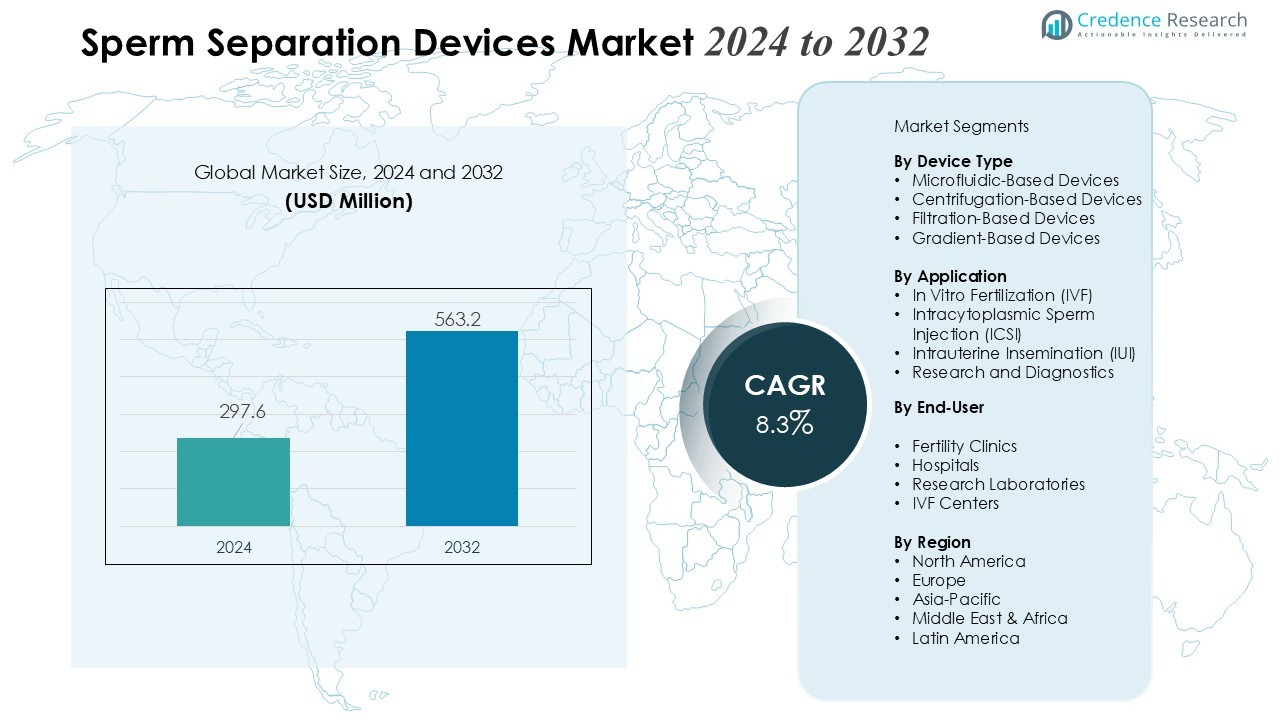
The Sperm Separation Devices Market size was valued at USD 297.6 million in 2024 and is anticipated to reach USD 563.2 million by 2032, at a CAGR of 8.3% during the forecast period (2024-2032).
| REPORT ATTRIBUTE |
DETAILS |
| Historical Period |
2020-2023 |
| Base Year |
2024 |
| Forecast Period |
2025-2032 |
| Sperm Separation Devices Market Size 2024 |
USD 297.6 Million |
| Sperm Separation Devices Market, CAGR |
8.3% |
| Sperm Separation Devices Market Size 2032 |
USD 563.2 Million |
Key market drivers include the rising prevalence of infertility due to delayed parenthood, lifestyle changes, and increasing exposure to environmental toxins. Advancements in microfluidics, lab-on-chip technologies, and non-invasive sperm selection methods are improving the precision and efficiency of sperm separation procedures. Growing awareness of male reproductive health and the expanding adoption of ART procedures such as IVF and ICSI further support market expansion. Additionally, increasing investments in fertility clinics and the introduction of automated, user-friendly sperm separation systems are contributing to broader clinical adoption.
Regionally, North America dominates the market due to robust healthcare infrastructure, high infertility awareness, and strong technological adoption. Europe follows closely, supported by established fertility centers and favorable reimbursement policies. The Asia-Pacific region is expected to experience the fastest growth, driven by rising medical tourism, expanding ART usage, and improving healthcare accessibility across emerging economies.
Access crucial information at unmatched prices!
Request your sample report today & start making informed decisions powered by Credence Research Inc.!
Download Sample
Market Insights:
- The Sperm Separation Devices Market was valued at USD 297.6 million in 2024 and is projected to reach USD 563.2 million by 2032, reflecting strong industry growth.
- Rising infertility rates due to delayed parenthood, lifestyle changes, and environmental factors are driving demand for advanced sperm separation solutions.
- Technological advancements, including microfluidics, lab-on-chip systems, and non-invasive sperm selection methods, enhance precision and clinical efficiency.
- Increasing awareness of male reproductive health and growing adoption of ART procedures such as IVF and ICSI support market expansion.
- Expansion of fertility clinics, coupled with investments in automated, user-friendly devices, strengthens clinical adoption and workflow consistency.
- High device costs, technical complexity, and limited availability of trained personnel remain key challenges, particularly in low- and middle-income regions.
- Regionally, North America dominates due to advanced healthcare infrastructure, Europe shows steady growth with established fertility networks, and Asia-Pacific is the fastest-growing market fueled by medical tourism and increasing ART utilization.
 Market Drivers:
Growing Demand for Assisted Reproductive Technologies Strengthens Market Adoption
The Sperm Separation Devices Market benefits from the rising demand for assisted reproductive technologies (ART) among couples facing fertility challenges. Higher infertility rates link to lifestyle changes, environmental exposure, and delayed family planning. Clinics invest in improved sperm selection tools to increase treatment success rates. It supports fertility specialists in obtaining higher-quality sperm samples. Growing patient awareness reinforces the adoption of evidence-based reproductive solutions.
- For instance, a high-throughput microfluidic sperm selection device isolates over 2.5 million motile sperm cells per ml from a 500 µL semen sample within 20 minutes.
Advancements in Microfluidic and Lab-on-Chip Technologies Enhance Clinical Efficiency
Rapid technological progress strengthens device performance and accuracy in the Sperm Separation Devices Market. Microfluidic platforms enable precise sorting of sperm based on motility and morphology. Lab-on-chip innovations reduce manual intervention and improve sample purity. It provides clinicians with reliable tools for advanced ART procedures. Higher efficiency and reproducibility influence purchasing decisions among fertility centers.
- For instance, a simple microfluidic device from a 2025 study achieved up to 100% sperm isolation and post-separation sperm concentrations of 5.37 million/ml at 40 nL/s flow rate.
Rising Focus on Male Reproductive Health Boosts Device Utilization
Male infertility receives greater clinical attention, which increases demand for specialized sperm separation solutions. Improved diagnostic screening identifies the need for high-performance separation devices. The Sperm Separation Devices Market benefits from innovations that target male-factor infertility with higher precision. It supports treatment pathways that rely on optimal sperm quality for IVF and ICSI. Increased patient education encourages proactive infertility management.
Expansion of Fertility Clinics and Investment in Reproductive Medicine Drives Growth
Healthcare providers expand fertility clinic networks to meet growing patient volumes, which accelerates device adoption trends. Government and private investments strengthen reproductive healthcare capabilities. The Sperm Separation Devices Market grows due to the integration of automated and user-friendly systems. It helps clinics maintain consistency and improve throughput during ART procedures. Rising medical tourism reinforces demand for advanced reproductive technologies across emerging regions.
Market Trends:
Integration of Advanced Automation and Microfluidics Shapes Next-Generation Solutions
The Sperm Separation Devices Market observes strong momentum toward automated and microfluidic-based systems that improve accuracy and efficiency in sperm selection. Clinics prefer platforms that reduce operator dependency and enhance procedural consistency. Automation supports standardized workflows that strengthen ART outcomes. Microfluidic devices enable gentler handling of sperm, which preserves viability and functional integrity. It drives broader acceptance among fertility specialists seeking precision-driven tools. Demand rises for compact, lab-on-chip systems tailored for quick processing. Product innovation accelerates as manufacturers focus on reliability and speed.
- For instance, a microfluidic device from research by MM Tekiyeh achieved post-separation sperm concentrations of 5.37 million/ml and 4.00 million/ml at flow rates of 40 nL/s and 50 nL/s, respectively
Shift Toward Non-Invasive and High-Purity Sperm Selection Techniques Gains Traction
The Sperm Separation Devices Market experiences a shift toward non-invasive methods that improve sperm quality without chemical agents or centrifugation stress. Clinics adopt tools that isolate sperm with superior DNA integrity to support advanced reproductive procedures. Demand increases for techniques that align with emerging clinical guidelines on male infertility management. It encourages manufacturers to strengthen research efforts focused on physiological sperm sorting. Patient preference trends support modalities that reduce procedural risks and optimize embryology outcomes. Growth in fertility tourism stimulates global interest in sophisticated separation systems. Industry players prioritize scalable designs that support diverse clinical environments.
- For instance, the BLASTO-chip device from researchers at Tsinghua University achieved a 70.8% fertilization rate using sperm from samples with 10% live but 100% immotile sperm.
Market Challenges Analysis:
High Cost of Advanced Devices and Limited Accessibility Restrict Wider Adoption
The Sperm Separation Devices Market faces constraints due to the high cost of advanced systems and variable reimbursement support across regions. Many fertility clinics in low- and middle-income markets struggle to adopt premium devices. Budget limitations reduce technology upgrades and slow the shift toward automated or microfluidic platforms. It creates disparities in clinical quality and patient access. Regulatory hurdles prolong product approvals and increase development expenses. Price-sensitive environments favor conventional methods despite lower efficiency. Market penetration slows where healthcare infrastructure remains underdeveloped.
Technical Complexity and Workforce Skill Gaps Challenge Clinical Implementation
The Sperm Separation Devices Market encounters operational challenges linked to technical complexity and the need for trained embryologists. Clinics require skilled personnel to handle precision-based sperm selection tools. Limited training programs reduce the confidence of new users and impact procedural consistency. It widens performance variations between centers and affects ART success rates. Device maintenance and calibration demands increase operational burdens for small clinics. Inconsistent laboratory standards further complicate adoption. Integration of advanced systems slows where staffing capacity remains insufficient.
Market Opportunities:
Rising Adoption of Advanced ART Techniques Creates Strong Commercial Potential
The Sperm Separation Devices Market holds significant opportunity due to the rapid expansion of assisted reproductive technologies across developed and emerging regions. Clinics seek advanced sperm selection tools that support higher ART success rates and reduce procedural risks. Demand increases for devices that deliver high-purity samples with improved DNA integrity. It strengthens the market outlook as fertility centers upgrade laboratory capabilities. Growth in medical tourism expands the customer base for innovative solutions. Wider acceptance of non-invasive sperm selection methods encourages product diversification. Manufacturers gain scope to introduce cost-effective systems tailored to varying clinical capacities.
Technological Innovation and Strategic Collaborations Accelerate Market Expansion
The Sperm Separation Devices Market benefits from rising investment in microfluidics, AI-enabled analysis, and lab-on-chip platforms that enhance precision and efficiency. Partnerships between fertility clinics, research institutions, and device manufacturers support faster development cycles. It drives breakthroughs in user-friendly and automated systems with consistent performance. Growing interest in personalized reproductive treatments heightens demand for advanced separation technologies. Opportunities expand in emerging markets where healthcare infrastructure is improving. Regulatory support for safe and effective ART solutions encourages new product launches. Companies gain competitive advantage by focusing on scalable, high-throughput devices that address global fertility needs.
Market Segmentation Analysis:
By Device Type
The Sperm Separation Devices Market is classified into microfluidic-based devices, centrifugation-based systems, and filtration-based solutions. Microfluidic devices gain strong traction due to their precision and ability to preserve sperm integrity. Centrifugation systems retain use in conventional ART settings that prioritize cost-efficient workflows. Filtration-based solutions attract clinics seeking simplified processing with reduced mechanical stress on sperm cells. It supports diverse clinical needs across varying laboratory capacities. Demand shifts toward advanced platforms that enhance sample purity and ART outcomes.
- For instance, a novel two-layer microfluidic-assisted sperm sorting device isolates over 2.5 million motile sperm cells per ml from a 500 µL semen sample within 20 minutes.
By Application
The Sperm Separation Devices Market supports applications in IVF, ICSI, IUI, and research-based sperm analysis. IVF and ICSI dominate due to the rising use of high-quality sperm selection in complex infertility cases. IUI benefits from improved devices that provide cleaner samples for intrauterine procedures. Research laboratories adopt advanced systems to study sperm function, motility patterns, and DNA integrity. It strengthens development of new reproductive technologies and diagnostic tools. Growth in ART procedures drives consistent demand across all application categories.
- For instance, a biomimetic microfluidic device from UTS and NeoGenix Biosciences improved DNA integrity by 85 units and reduced sperm cell death by 90 units compared to swim-up methods.
By End-User
The Sperm Separation Devices Market serves fertility clinics, hospitals, and research laboratories. Fertility clinics hold the largest usage share due to high patient volumes and advanced ART workflows. Hospitals integrate these systems to support male infertility assessments and assisted conception services. Research institutions rely on high-precision devices for reproductive biology studies. It enhances innovation in sperm physiology and treatment methodologies. Strong investment in advanced reproductive facilities supports sustained demand across end-user segments.
Segmentations:
By Device Type
- Microfluidic-Based Devices
- Centrifugation-Based Devices
- Filtration-Based Devices
- Gradient-Based Devices
By Application
- In Vitro Fertilization (IVF)
- Intracytoplasmic Sperm Injection (ICSI)
- Intrauterine Insemination (IUI)
- Research and Diagnostics
By End-User
- Fertility Clinics
- Hospitals
- Research Laboratories
- IVF Centers
By Region
- North America
- Europe
- Germany
- France
- U.K.
- Italy
- Spain
- Rest of Europe
- Asia Pacific
- China
- Japan
- India
- South Korea
- South-east Asia
- Rest of Asia Pacific
- Latin America
- Brazil
- Argentina
- Rest of Latin America
- Middle East & Africa
- GCC Countries
- South Africa
- Rest of the Middle East and Africa
Regional Analysis:
North America Maintains Market Leadership with Strong Clinical Infrastructure
North America leads global demand in the Sperm Separation Devices Market due to its established fertility care ecosystem and rapid adoption of advanced reproductive technologies. Strong clinical infrastructure and access to specialized embryology services support consistent technology utilization. Fertility centers prioritize devices that enhance sperm quality and strengthen ART outcomes. It benefits from high awareness of male infertility and rising investment in reproductive research. Regulatory frameworks support safe clinical integration of next-generation sperm separation systems. Growing acceptance of automated and microfluidic platforms reinforces regional dominance.
Europe Strengthens Growth Through Advanced Fertility Networks and Supportive Clinical Standards
Europe shows steady expansion driven by its mature fertility networks and commitment to evidence-based reproductive practices. Countries such as Germany, Denmark, Spain, and the United Kingdom maintain strong demand for high-precision sperm separation tools. The Sperm Separation Devices Market gains momentum through R&D activities that enhance device accuracy and non-invasive selection methods. It benefits from structured training programs that support skilled embryology practices across major clinics. Cross-border fertility care increases patient inflow and strengthens demand for advanced technologies. Consistent adoption of ART guidelines sustains market growth across the region.
Asia-Pacific Emerges as the Fastest-Growing Region Driven by Rising ART Utilization
Asia-Pacific records the highest growth potential supported by rising infertility prevalence and expanding access to reproductive healthcare. Growing fertility clinic networks in China, India, Japan, and South Korea strengthen demand for modern sperm separation systems. Medical tourism contributes significantly to procedure volumes and technology adoption. It creates strong opportunities for manufacturers offering scalable and cost-efficient solutions. Government-backed investments elevate clinical standards and create favorable conditions for ART expansion. Rapid improvements in laboratory capabilities support long-term regional advancement.
Key Player Analysis:
- Vitrolife
- Hamilton Thorne
- CooperSurgical
- DxNow
- Memphasys
- Nidacon International
- Cook Medical
- Zeiss Group
- IVFtech
- Thermo Fisher Scientific
- Genea Biomedx
- Lotus Bio
Competitive Analysis:
The Sperm Separation Devices Market features a competitive landscape driven by innovation, technical advancement, and strong product differentiation. Leading companies focus on microfluidic platforms, non-invasive separation technologies, and automated systems that improve clinical precision. It strengthens competition as manufacturers prioritize devices that enhance sperm viability and support high ART success rates. Established players expand product portfolios through strategic collaborations, research initiatives, and geographic reach. Emerging companies introduce cost-efficient and user-friendly solutions that target fertility clinics in developing markets. Competitive intensity increases as industry participants invest in advanced materials, digital integration, and improved workflow efficiency. The market continues to shift toward technologies that deliver consistent performance and support evolving clinical standards.
Recent Developments:
- In May 2025, Twist Bioscience Corporation expanded its collaboration with Element Biosciences, becoming the sole provider of Trinity library preparation and target enrichment kits for the AVITI sequencer.
- In May 2025, Telesis Bio entered into a licensing agreement with Regeneron Pharmaceuticals to deploy Gibson SOLA platform, enabling automated, high-throughput gene synthesis directly in Regeneron’s laboratories, drastically reducing biologics discovery time.
Shape Your Report to Specific Countries or Regions & Enjoy 30% Off!
Report Coverage:
The research report offers an in-depth analysis based on Device Type, Application, End-User and Region. It details leading market players, providing an overview of their business, product offerings, investments, revenue streams, and key applications. Additionally, the report includes insights into the competitive environment, SWOT analysis, current market trends, as well as the primary drivers and constraints. Furthermore, it discusses various factors that have driven market expansion in recent years. The report also explores market dynamics, regulatory scenarios, and technological advancements that are shaping the industry. It assesses the impact of external factors and ITALY economic changes on market growth. Lastly, it provides strategic recommendations for new entrants and established companies to navigate the complexities of the market.
Future Outlook:
- Demand for advanced sperm selection systems will rise as fertility centers prioritize technologies that enhance ART outcomes and reduce procedural risks.
- Adoption of microfluidic and non-invasive devices will expand due to their ability to preserve sperm integrity and improve sample quality.
- Integration of automation and AI-supported analysis will strengthen workflow efficiency in high-volume fertility clinics.
- Product innovation will accelerate as manufacturers invest in research focused on DNA integrity, motility optimization, and physiological sorting methods.
- Growth in male infertility evaluations will increase the need for precision-driven diagnostic and separation tools.
- Emerging markets will show strong uptake driven by expanding fertility infrastructure and rising medical tourism.
- Partnerships between technology developers and fertility clinics will support faster clinical validation and broader adoption.
- User-friendly, compact, and cost-effective devices will gain traction among small and mid-sized clinics seeking operational efficiency.
- Digital connectivity and real-time quality monitoring features will become standard in next-generation devices.
- Regulatory support for safer and more effective reproductive technologies will encourage global deployment of innovative sperm separation solutions.



