Home » Advanced Materials » Agro Textile Market

Agro Textile Market By Type (Woven, Non-Woven, Knitted, Others); By Material (Synthetic Fibers, Natural Fibers) – Growth, Share, Opportunities & Competitive Analysis, 2024 – 2032

Report ID: 2813 | Report Format : Excel, PDF

Market Overview:

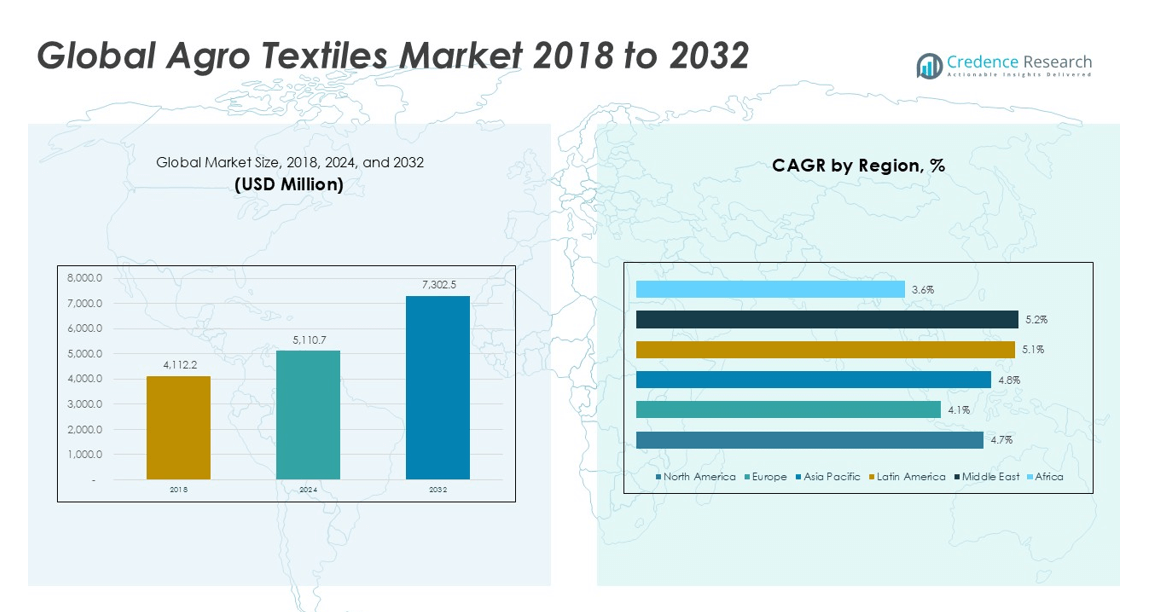
Agro Textile Market size was valued at USD 6.1 Billion in 2024 and is anticipated to reach USD 8.29 Billion by 2032, at a CAGR of 3.91% during the forecast period.

REPORT ATTRIBUTE DETAILS
Historical Period 2020-2023
Base Year 2024
Forecast Period 2025-2032
Agro Textile Market Size 2024 USD 6.1 Billion
Agro Textile Market, CAGR 3.91%
Agro Textile Market Size 2032 USD 8.29 Billion


The Agro Textile Market includes major players such as Garware Technical Fabrics, Solmax, Beaulieu Technical Textiles, TenCate Industrial Fabrics, Diatex SAS, Belton Industries, Inc., and Freudenberg Performance Materials. These companies compete through innovations in woven, knitted, and non-woven solutions that enhance crop protection, soil management, and greenhouse performance. Asia Pacific led the market in 2024 with about 34% share due to large-scale farming and rapid adoption of protected cultivation. North America followed with nearly 27% share, driven by advanced horticulture and greenhouse operations, while Europe held around 25% share supported by high-tech farming and strong quality standards.

Agro Textile Market size

Market Insights

  • Agro Textile Market reached USD 6.1 Billion in 2024 and is projected to hit USD 8.29 Billion by 2032, growing at a CAGR of 3.91%.
  • Demand grew as woven textiles held about 48% share, supported by rising crop-protection needs, greenhouse expansion, and wider use of mulch fabrics across high-value crops.
  • Manufacturers focused on durable, UV-stabilized, and eco-friendly materials, while trends such as light-diffusing covers, biodegradable fibers, and climate-adaptive fabrics strengthened long-term adoption.
  • Competition intensified as leading companies expanded capacity and introduced advanced knitted and non-woven solutions, though high product costs and limited recycling options restrained growth.
  • Asia Pacific led the market with around 34% share, followed by North America at 27% and Europe at 25%, while Latin America and the Middle East & Africa expanded steadily due to rising greenhouse farming.

Access crucial information at unmatched prices!

Request your sample report today & start making informed decisions powered by Credence Research Inc.!

Download Sample

Market Segmentation Analysis:

By Type

Woven agro textiles held the dominant position in 2024 with about 48% share due to their strong durability, UV resistance, and superior mechanical strength. These fabrics supported crop protection against harsh weather, weeds, and pests, which increased adoption across large farms and horticulture units. Non-woven products gained traction as growers used them for crop covers and frost protection. Knitted options expanded in greenhouses where good ventilation and flexibility were needed. Other textile types saw moderate growth in niche uses such as shading and soil stabilization.

  • For instance, Garware Technical Fibres’ V5 shade nets are supplied in rolls of 100 meters length and up to 6.5 meters width, with a fabric weight of 105 grams per square meter and a field life of around 3–4 years for protected cultivation.

By Material

Synthetic fibers led the segment in 2024 with nearly 72% share because polypropylene and polyethylene offered high tensile strength, moisture control, and long service life. These materials supported heavy use in mulch mats, shade nets, insect nets, and turf protection systems. Natural fibers such as jute and coir grew at a steady pace due to rising interest in biodegradable and eco-friendly farm solutions. Farmers adopted these fibers in soil erosion control and weed-management applications, though durability concerns limited wider use.

  • For instance, Al Aweer Trading’s HDPE agro shade net for farms is offered in 100 grams-per-square-meter thickness, with a standard roll width of 3 meters and roll lengths of either 50 or 100 meters, giving total roll areas of 150 or 300 square meters.

Key Growth Drivers

Rising Demand for Crop Protection Solutions

Growing focus on improving crop yield pushed the use of shade nets, mulch mats, and insect-control fabrics. Farmers adopted these textiles to reduce crop loss from pests, frost, heat stress, and erratic rainfall. Expanding greenhouse farming also supported higher consumption of UV-stabilized covers and protective nets. The shift toward controlled-environment agriculture strengthened demand across high-value crops, including vegetables, fruits, and floriculture. Rising climate risks continued to make crop-protection textiles essential across both small and large farming units.

  • For instance, the Ahmedabad-based supplier Light Speed Ventures supplies agro shade nets for greenhouses in standard 50-meter roll lengths, among other custom sizes.

Expansion of Greenhouse and Protected Farming

Protected cultivation expanded across Europe, Asia, and the Middle East as growers targeted higher productivity and year-round output. Agro textiles such as knitted nets, greenhouse covers, and thermal screens became core components of these systems. The need for temperature regulation, light diffusion, and humidity control strengthened adoption in intensive farming clusters. Governments promoted modern farming through subsidies and training programs, further supporting uptake. Growth in hydroponics and vertical farming also encouraged steady use of advanced textile materials.

  • For instance, Ludvig Svensson’s LUXOUS climate screen trials in greenhouses recorded annual gas usage of 29.0 cubic meters per square meter in a reference house and 24.7 cubic meters per square meter with a double-screen installation

Shift Toward Sustainable and Efficient Farm Inputs

Farmers increasingly preferred solutions that reduced water loss, improved soil health, and lowered chemical dependence. Mulch fabrics, biodegradable mats, and permeable covers helped conserve moisture and limit weed growth, making these textiles attractive in arid and semi-arid regions. Rising interest in organic farming supported demand for natural-fiber products such as jute and coir. Technological improvements in synthetic fibers enabled longer-lasting and more energy-efficient shading materials. This shift toward sustainable productivity drove consistent use of agro textiles across diverse crops.

Key Trends & Opportunities

Growth of Smart and Functional Agro Textiles

Manufacturers developed advanced textiles with UV-control coatings, thermal regulation, and improved tear resistance. Smart materials that support microclimate control gained attention across greenhouses and orchards. Light-diffusing covers became popular because they improved photosynthesis efficiency and crop color development. The trend toward precision agriculture opened opportunities for integrating sensors and monitoring tools into textile structures. These innovations positioned agro textiles as value-added components in high-tech farming systems.

  • For instance, Beaulieu Technical Textiles’ Agrolys WH FR horticultural groundcover is available in 100gr/m² and 130gr/m² varieties.

Rising Adoption of Biodegradable and Eco-Friendly Materials

Eco-friendly farming practices boosted interest in natural and biodegradable textile solutions. Jute, coir, and other plant-based fabrics attracted growers who aimed to reduce plastic usage and soil contamination. Governments supported sustainable agriculture policies that encouraged low-impact mulch mats and erosion-control blankets. Increasing awareness of plastic pollution in fields opened strong opportunities for alternatives based on natural fibers. This trend aligned with wider demand for circular and low-waste agricultural systems.

  • For instance, Velexports in India lists a production capacity of 100,000 square meters per month for woven coir geotextiles in general, which are typically packed in 100 square meter rolls.

Expansion of Agro Textiles in Emerging Markets

Rising agricultural modernization in India, China, Brazil, and Southeast Asia created significant opportunities. Farmers adopted agro textiles to reduce climate risk, improve land productivity, and support greenhouse expansion. Growing investments in horticulture and export-oriented farming also pushed demand. Local manufacturing capacity improved, reducing product costs and increasing accessibility. These developments positioned emerging markets as fast-growing regions for advanced textile-based farm solutions.

Key Challenges

High Cost of Advanced Agro Textile Products

Premium-grade greenhouse covers, UV-stabilized nets, and coated fabrics remained costly for small and marginal farmers. Limited awareness of long-term benefits often reduced willingness to invest in durable solutions. In many regions, cheaper low-quality products entered the market, leading to shorter lifespans and replacement costs. High import dependency for specialized materials also raised pricing. These cost barriers slowed adoption across low-income farming communities and restricted market expansion.

Environmental Concerns Linked to Synthetic Fibers

Most agro textiles used polypropylene and polyethylene, which created disposal and recycling challenges. Improper waste handling caused soil and water pollution in several farming regions. Growing regulatory pressure against single-use plastics increased compliance burdens for manufacturers. Limited availability of large-scale recycling programs made it difficult to manage used nets and mulch films. These concerns encouraged a shift toward natural fibers but also highlighted the need for sustainable synthetic alternatives.

Regional Analysis

North America

North America held about 27% share in 2024, supported by strong adoption of greenhouse covers, shade nets, and mulch fabrics across the US and Canada. Farmers invested in advanced agro textiles to reduce climate stress, enhance soil management, and improve output in high-value crops. Large horticulture industries and commercial greenhouse facilities boosted demand for durable woven and knitted products. Government support for protected farming and water-efficient practices also encouraged wider use across arid regions. Steady modernization of agricultural infrastructure helped maintain stable growth in the regional market.

Europe

Europe accounted for nearly 25% share in 2024, driven by extensive greenhouse farming across Spain, Italy, the Netherlands, and France. The region’s focus on energy efficiency and climate-controlled cultivation increased the use of thermal screens, light-diffusing films, and insect-control nets. Strict quality standards encouraged adoption of long-lasting and UV-stabilized fabrics. Rising demand for organic produce supported the use of natural-fiber textiles for soil protection and erosion management. Expansion of horticultural exports and controlled-environment agriculture ensured sustained demand across major European countries.

Asia Pacific

Asia Pacific dominated the global market with about 34% share in 2024, supported by large-scale farming operations in China, India, Japan, and Southeast Asia. Rapid expansion of horticulture, floriculture, and greenhouse cultivation increased demand for shade nets, mulch mats, and crop-protection fabrics. Government initiatives promoting protected farming and micro-irrigation strengthened adoption among small and mid-sized growers. Growing need to manage heat stress, pests, and water scarcity drove heavy use of both synthetic and natural materials. Rising manufacturing capacity further lowered product costs and boosted regional consumption.

Latin America

Latin America held around 9% share in 2024, led by expanding fruit, vegetable, and floriculture industries in Brazil, Mexico, and Chile. Farmers used agro textiles to protect crops from extreme sunlight, pests, and unpredictable rainfall. Greenhouse farming gained traction, raising the demand for knitted shading nets and UV-resistant covers. Export-driven agriculture encouraged investment in solutions that enhanced product quality and reduced post-harvest losses. Wider adoption of water-saving farming practices increased the use of mulch fabrics and soil-stabilization materials across the region.

Middle East & Africa

Middle East & Africa captured nearly 5% share in 2024, driven by rising adoption of protected cultivation in the UAE, Saudi Arabia, South Africa, and Egypt. Harsh climatic conditions increased reliance on shading nets, thermal screens, and moisture-retention textiles. Governments invested in greenhouse projects to support food security and reduce import dependence. Farmers adopted advanced materials to manage heat, conserve water, and sustain crop growth in arid zones. Expanding horticulture and new investments in modern farming technologies supported steady market growth across the region.

Market Segmentations:

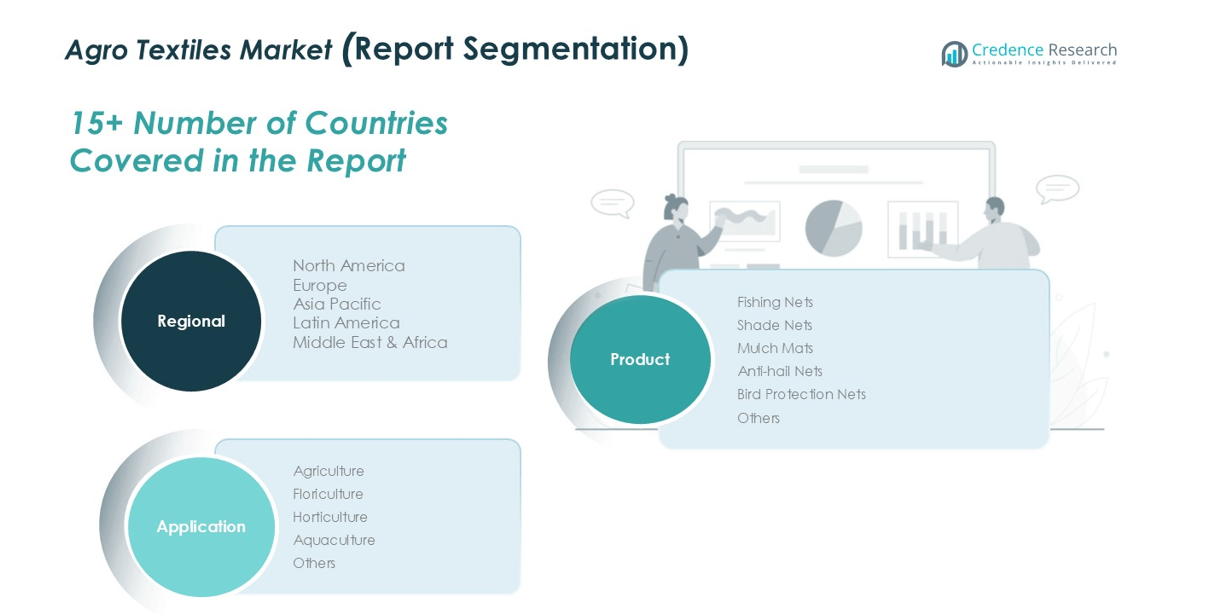
By Type

  • Woven
  • Non-Woven
  • Knitted
  • Others

By Material

  • Synthetic Fibers
  • Natural Fibers

By Geography

  • North America
    • U.S.
    • Canada
    • Mexico
  • Europe
    • Germany
    • France
    • U.K.
    • Italy
    • Spain
    • Rest of Europe
  • Asia Pacific
    • China
    • Japan
    • India
    • South Korea
    • South-east Asia
    • Rest of Asia Pacific
  • Latin America
    • Brazil
    • Argentina
    • Rest of Latin America
  • Middle East & Africa
    • GCC Countries
    • South Africa
    • Rest of the Middle East and Africa

Competitive Landscape

The Agro Textile Market features leading companies such as Garware Technical Fabrics, Solmax, Beaulieu Technical Textiles, TenCate Industrial Fabrics, Diatex SAS, Belton Industries, Inc., and Freudenberg Performance Materials. The competitive environment reflects steady innovation in woven, knitted, and non-woven solutions designed for crop protection and soil management. Manufacturers focus on high-strength fibers, UV-stabilized coatings, and materials that support greenhouse and open-field cultivation. Many firms invest in expanding production capacity to meet rising demand from horticulture, floriculture, and protected farming systems. Sustainability remains a core strategic priority, encouraging development of recyclable and biodegradable alternatives. Companies also strengthen distribution networks to increase accessibility across Asia Pacific, Europe, and emerging agricultural regions. Continuous product upgrades, compliance with quality standards, and tailored solutions for climate-specific needs support long-term competitiveness in the global market.

Shape Your Report to Specific Countries or Regions & Enjoy 30% Off!

Key Player Analysis

  • Garware Technical Fabrics
  • Solmax
  • Beaulieu Technical Textiles
  • TenCate Industrial Fabrics
  • Diatex SAS
  • Belton Industries, Inc.
  • Freudenberg Performance Materials

Recent Developments

  • In 2025, Garware emphasized sustainability and eco-friendly materials in agro textiles, providing high-performance nets and coated fabrics to improve crop protection and resource efficiency.
  • In 2025, Solmax launched a new “Performance Materials” platform to house the industrial fabrics business it acquired from TenCate Geosynthetics
  • In 2025, Beaulieu International Group (B.I.G.) announced the sale of Beaulieu Technical Textiles (BTT) to funds advised by the private equity firm RCP.

Report Coverage

The research report offers an in-depth analysis based on Type, Material and Geography. It details leading market players, providing an overview of their business, product offerings, investments, revenue streams, and key applications. Additionally, the report includes insights into the competitive environment, SWOT analysis, current market trends, as well as the primary drivers and constraints. Furthermore, it discusses various factors that have driven market expansion in recent years. The report also explores market dynamics, regulatory scenarios, and technological advancements that are shaping the industry. It assesses the impact of external factors and global economic changes on market growth. Lastly, it provides strategic recommendations for new entrants and established companies to navigate the complexities of the market.

Future Outlook

  1. Demand for advanced crop-protection textiles will rise as climate risks intensify.
  2. Greenhouse and protected farming will expand across major agricultural regions.
  3. Smart agro textiles with thermal control and light-diffusion features will gain adoption.
  4. Biodegradable and eco-friendly textile options will see stronger acceptance among growers.
  5. Emerging markets will drive high consumption as farming practices modernize.
  6. Innovation in high-strength synthetic fibers will improve product lifespan and efficiency.
  7. Government support for sustainable farming will boost textile use in soil and water management.
  8. Integrated textile solutions for precision agriculture will become more common.
  9. Manufacturers will expand local production to reduce costs and improve availability.
  10. Rising horticulture and floriculture output will support long-term market growth.

1.     Introduction
1.1. Report Description
1.2. Purpose of the Report
1.3. USP & Key Offerings
1.4. Key Benefits for Stakeholders
1.5. Target Audience
1.6. Report Scope
1.7. Regional Scope

2.     Scope and Methodology
2.1. Objectives of the Study
2.2. Stakeholders
2.3. Data Sources
2.3.1. Primary Sources
2.3.2. Secondary Sources
2.4. Market Estimation
2.4.1. Bottom-Up Approach
2.4.2. Top-Down Approach
2.5. Forecasting Methodology

3.     Executive Summary

4.     Introduction
4.1. Overview
4.2. Key Industry Trends

5.     Global Agro Textile Market
5.1. Market Overview
5.2. Market Performance
5.3. Impact of COVID-19
5.4. Market Forecast

6.     Market Breakup by Type
6.1. Woven
6.1.1. Market Trends
6.1.2. Market Forecast
6.1.3. Revenue Share
6.1.4. Revenue Growth Opportunity

6.2. Non-Woven
6.2.1. Market Trends
6.2.2. Market Forecast
6.2.3. Revenue Share
6.2.4. Revenue Growth Opportunity

6.3. Knitted
6.3.1. Market Trends
6.3.2. Market Forecast
6.3.3. Revenue Share
6.3.4. Revenue Growth Opportunity

6.4. Others
6.4.1. Market Trends
6.4.2. Market Forecast
6.4.3. Revenue Share
6.4.4. Revenue Growth Opportunity

7.     Market Breakup by Material
7.1. Synthetic Fibers
7.1.1. Market Trends
7.1.2. Market Forecast
7.1.3. Revenue Share
7.1.4. Revenue Growth Opportunity

7.2. Natural Fibers
7.2.1. Market Trends
7.2.2. Market Forecast
7.2.3. Revenue Share
7.2.4. Revenue Growth Opportunity

8.     Market Breakup by Region
8.1. North America
8.1.1. United States
8.1.2. Canada
8.2. Asia-Pacific
8.2.1. China
8.2.2. Japan
8.2.3. India
8.2.4. South Korea
8.2.5. Australia
8.2.6. Indonesia
8.3. Europe
8.3.1. Germany
8.3.2. France
8.3.3. United Kingdom
8.3.4. Italy
8.3.5. Spain
8.3.6. Russia
8.4. Latin America
8.4.1. Brazil
8.4.2. Mexico
8.5. Middle East and Africa

9.     SWOT Analysis
9.1. Overview
9.2. Strengths
9.3. Weaknesses
9.4. Opportunities
9.5. Threats

10.  Value Chain Analysis

11.  Porter’s Five Forces Analysis
11.1. Overview
11.2. Bargaining Power of Buyers
11.3. Bargaining Power of Suppliers
11.4. Degree of Competition
11.5. Threat of New Entrants
11.6. Threat of Substitutes

12.  Price Analysis

13.  Competitive Landscape
13.1. Market Structure
13.2. Key Players
13.3. Profiles of Key Players
13.3.1. Garware Technical Fabrics
13.3.2. Solmax
13.3.3. Beaulieu Technical Textiles
13.3.4. TenCate Industrial Fabrics
13.3.5. Diatex SAS
13.3.6. Belton Industries, Inc.
13.3.7. Freudenberg Performance Materials

14.  Research Methodology

Request Free Sample

We prioritize the confidentiality and security of your data. Our promise: your information remains private.

Ready to Transform Data into Decisions?

Request Your Sample Report and Start Your Journey of Informed Choices


Providing the strategic compass for industry titans.

cr-clients-logos

Frequently Asked Questions

What is the current size of the Agro Textile Market?

The market reached USD 6.1 Billion in 2024 and is projected to reach USD 8.29 Billion by 2032.

At what Compound Annual Growth Rate is the Agro Textile Market projected to grow between 2025 and 2032?

The market is projected to grow at a CAGR of 3.91%.

What factors are driving the growth of the Agro Textile Market?

Growth is primarily driven by the increasing global demand for food due to population growth, the need for resource optimization in agriculture, and the rise of protected farming practices. Agro textiles help manage water usage, reduce pesticide requirements, and enhance plant growth by controlling sunlight and temperature. Technological advancements, such as UV-resistant and biodegradable fabrics, alongside government subsidies and incentives, are further accelerating market growth.

What are some challenges faced by the Agro Textile Market?

Challenges include the high initial costs of agro textile products, environmental concerns regarding non-biodegradable materials, dependency on regional climate needs, and a lack of awareness among farmers about the benefits and applications of agro textiles.

Who are the major players in the Agro Textile Market?

Key companies include Garware Technical Fabrics, Solmax, Beaulieu Technical Textiles, TenCate Industrial Fabrics, Diatex SAS, Belton Industries, Inc., and Freudenberg Performance Materials.

Which segment is leading the market share?

The shading nets and crop protection fabrics segment leads the market, owing to their adaptability across various climates and effectiveness in controlling sunlight and temperature, which supports optimal plant growth.

About Author

Ganesh Chandwade

Ganesh Chandwade

Senior Industry Consultant

Ganesh is a senior industry consultant specializing in heavy industries and advanced materials.

View Profile

Related Reports

Seismic Reinforcement Materials Market

Seismic Reinforcement Materials Market size was valued USD 10.17 Billion in 2024 and is anticipated to reach USD 16.72 Billion by 2032, at a CAGR of 6.41% during the forecast period.

Pre-Painted Galvanized Iron (PPGI) Market

Pre Painted Galvanized Iron (PPGI) Market size was valued at USD 153,808 million in 2024 and is anticipated to reach USD 196,053.3 million by 2032, at a CAGR of 3.08% during the forecast period.

Reclaimed Rubber Market

The Reclaimed Rubber market was valued at USD 4.06 billion in 2024 and is projected to reach USD 8.74 billion by 2032, growing at a CAGR of 10.06% during the forecast period.

Degassing Valves Market

Degassing Valves market was valued at USD 649.62 million in 2024 and is anticipated to reach USD 930.92 million by 2032, growing at a CAGR of 4.6 % during the forecast period.

Flanges Market

Flanges Market size reached USD 6,448 million in 2024 and is projected to rise to USD 9,368.11 million by 2032, expanding at a CAGR of 4.78% during the forecast period.

Recycled Elastomers Market

Recycled Elastomers market size reached USD 10.75 billion in 2024 and is projected to rise to USD 23.02 billion by 2032, supported by a 9.99% CAGR during the forecast period.

Vapour Barrier Market

Vapour Barrier Market size was valued at USD 14.66 billion in 2024 and is anticipated to reach USD 21.97 billion by 2032, at a CAGR of 5.19% during the forecast period.

Global and India Beyerite Market

The Global and India Beyerite Market size was valued at USD 1,390.90 million in 2018 to USD 2,003.04 million in 2024 and is anticipated to reach USD 3,231.07 million by 2032, at a CAGR of 5.73% during the forecast period.

Metallurgical Coal Market

The Metallurgical Coal Market size was valued at USD 72.63 Billion in 2024 and is anticipated to reach USD 90.23 Billion by 2032, at a CAGR of 2.75% during the forecast period.

Hard Carbon Material Market

Hard Carbon Material Market size was valued USD 125.83 million in 2024 and is anticipated to reach USD 556.01 million by 2032, at a CAGR of 20.41% during the forecast period.

Recycling Waste Machinery Market

The Global Recycling Waste Machinery Market size was valued at USD 12,646.8 Billion in 2018 and is projected to reach USD 17,165.3 Billion by 2024. It is anticipated to grow to USD 26,732.5 Billion by 2032, at a CAGR of 5.74% during the forecast period.

Polybutadiene Rubber Market

Polybutadiene Rubber Market size was valued USD 9408 million in 2024 and is anticipated to reach USD 12776.79 million by 2032, at a CAGR of 3.9% during the forecast period.

Licence Option

The report comes as a view-only PDF document, optimized for individual clients. This version is recommended for personal digital use and does not allow printing. Use restricted to one purchaser only.
$4999

To meet the needs of modern corporate teams, our report comes in two formats: a printable PDF and a data-rich Excel sheet. This package is optimized for internal analysis. Unlimited users allowed within one corporate location (e.g., regional office).
$6999

The report will be delivered in printable PDF format along with the report’s data Excel sheet. This license offers 100 Free Analyst hours where the client can utilize Credence Research Inc. research team. Permitted for unlimited global use by all users within the purchasing corporation, such as all employees of a single company.
$12999

Report delivery within 24 to 48 hours

Credence Staff 3

WILLIAM, North America

Support Staff at Credence Research

KEITH PHILLIPS, Europe

Lee - CR Sales Staff

LEE VALLANCE, Asia Pacific

Kieran Jameson

KIERAN JAMESON, Australia

Smallform of Sample request
User Review

Thank you for the data! The numbers are exactly what we asked for and what we need to build our business case.

Materials Scientist
(privacy requested)

User Review

The report was an excellent overview of the Industrial Burners market. This report does a great job of breaking everything down into manageable chunks.

Imre Hof
Management Assistant, Bekaert

cr-clients-logos

Request Sample