Home » Aerospace & defense » Flight Simulator Market

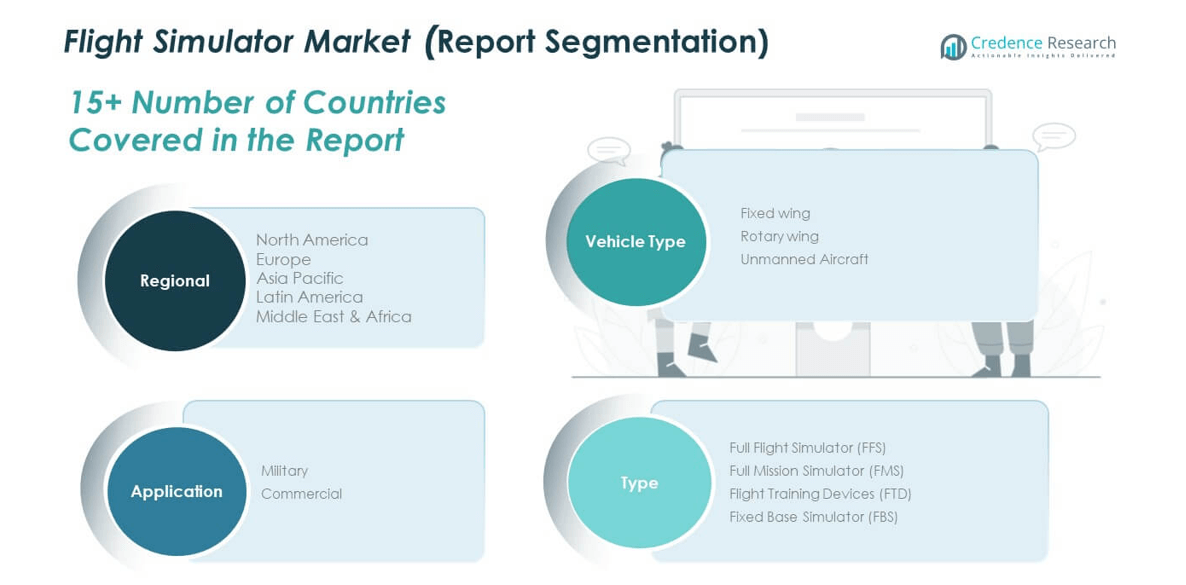
Flight Simulator Market By Vehicle Type (Fixed Wing, Rotary Wing, Unmanned Aircraft); By Application (Military, Commercial); By Type (Full Flight Simulator (FFS), Full Mission Simulator (FMS), Flight Training Devices (FTD), Fixed Base Simulator (FBS)) – Growth, Share, Opportunities & Competitive Analysis, 2024 – 2032

Report ID: 4882 | Report Format : Excel, PDF

Market Overview:

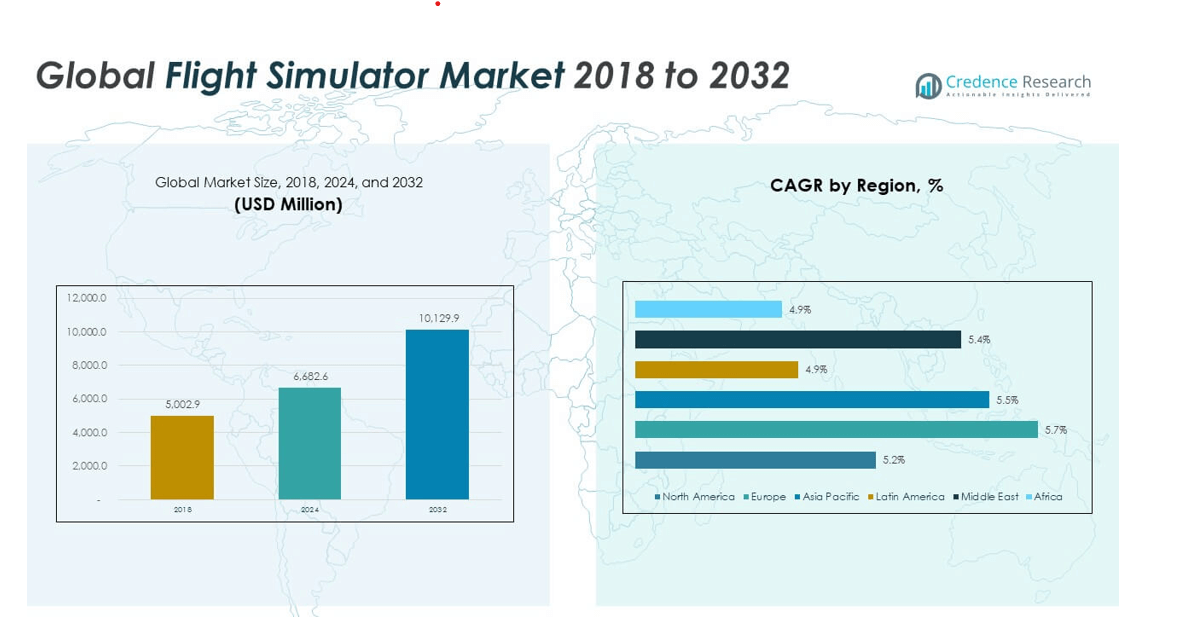
The Global Flight Simulator Market size was valued at USD 5,002.9 million in 2018, reaching USD 6,682.6 million in 2024, and is anticipated to attain USD 10,129.9 million by 2032, growing at a CAGR of 5.37% during the forecast period.

REPORT ATTRIBUTE DETAILS
Historical Period 2020-2023
Base Year 2024
Forecast Period 2025-2032
Flight Simulator Market Size 2024 USD 6,682.6 million
Flight Simulator Market, CAGR 5.73%
Flight Simulator Market Size 2032 USD 10,129.9 million


The market growth is driven by rising demand for pilot training and the growing emphasis on flight safety. Increasing aircraft deliveries, the expansion of the aviation industry, and cost-effective simulation-based training programs are further supporting market growth. Advancements in virtual reality, motion sensors, and AI-based simulation technologies are enhancing training accuracy, reducing operational risks, and improving the overall efficiency of pilot instruction.

North America leads the market due to its strong aviation infrastructure and presence of major simulator manufacturers. Europe follows closely, supported by stringent pilot training regulations and high adoption rates in commercial aviation. Asia Pacific is emerging rapidly, driven by expanding airline fleets, rising passenger traffic, and the need for skilled pilots in nations like China, India, and Japan. Other regions are also adopting simulation solutions to enhance flight safety and reduce training costs

Flight Simulator Market size

Market Insights:

  • The Global Flight Simulator Market size was valued at USD 5,002.9 million in 2018, reached USD 6,682.6 million in 2024, and is projected to attain USD 10,129.9 million by 2032, growing at a CAGR of 5.37% during the forecast period.
  • North America (32.1%), Asia Pacific (26.9%), and Europe (25.7%) collectively account for over 84% of the total market share, driven by advanced aviation infrastructure, strong regulatory frameworks, and high simulator adoption for both commercial and defense training.
  • Asia Pacific is the fastest-growing region, holding 9% share, supported by expanding airline fleets, rapid air traffic growth, and rising investments in pilot training centers across China, India, and Japan.
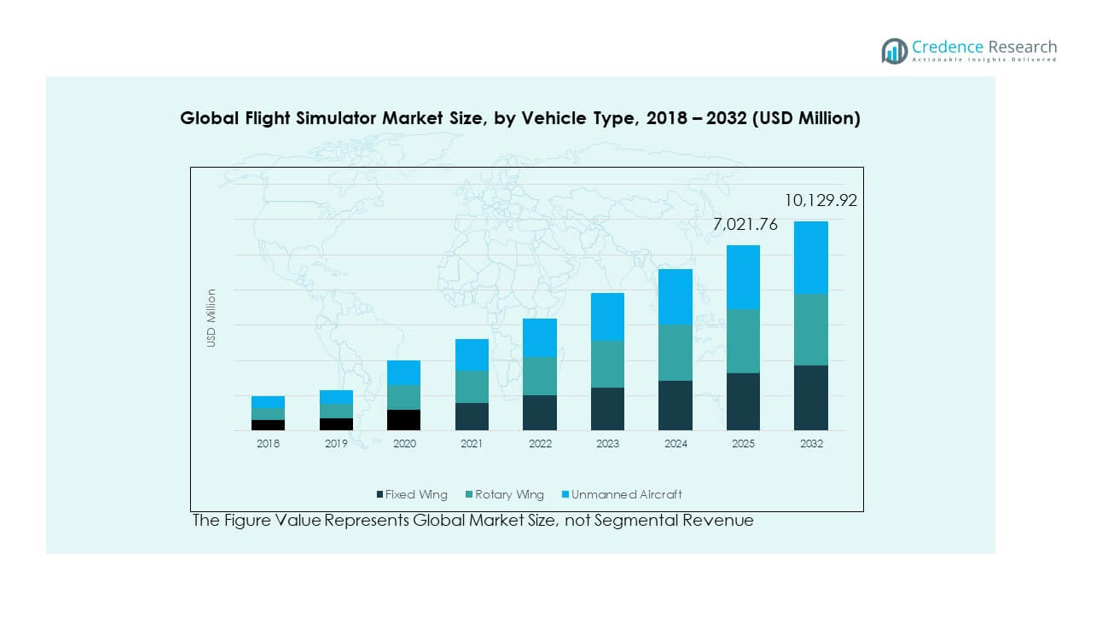
  • By vehicle type, Fixed Wing simulators dominate the market, accounting for approximately 47% share, due to their widespread use in commercial aviation training programs.
  • Rotary Wing and Unmanned Aircraft simulators collectively capture about 53% share, reflecting the growing adoption of helicopter and drone simulation for defense, logistics, and emergency response applications.

Access crucial information at unmatched prices!

Request your sample report today & start making informed decisions powered by Credence Research Inc.!

Download Sample

Market Drivers:

Rising Global Demand for Pilot Training and Aviation Safety Standards

The Global Flight Simulator Market is expanding due to the growing need for efficient pilot training programs worldwide. The rise in commercial and military aircraft fleets has increased the requirement for skilled pilots. Simulation-based training provides a safer and more cost-effective way to develop flight skills. It helps pilots handle complex flight conditions without operational risks. The increasing focus on safety regulations by aviation authorities is further accelerating simulator adoption. Airlines are investing heavily in advanced simulators to ensure regulatory compliance. Enhanced realism in simulation training is helping reduce human error in actual flight operations. The market continues to grow as pilot shortage challenges drive training investments globally.

  • For instance, in October 2025, CAE Inc. secured an agreement to deliver a Boeing 737MAX full-flight simulator to MAB Academy, featuring the CAE Prodigy Image Generator, which supports the highest level of regulatory-certifiable flight training for major global airlines and is scheduled to be operational by July 2026.

Technological Advancements in Simulation Hardware and Software Systems

Continuous innovation in flight simulation technology is transforming pilot training quality. The integration of AI, virtual reality, and motion capture systems enhances immersion and training precision. These advancements allow realistic replication of flight dynamics and cockpit experiences. The Global Flight Simulator Market benefits from improved visual fidelity and motion accuracy. Modern simulators can now mimic multiple aircraft types, improving operational flexibility. The inclusion of cloud connectivity supports remote training capabilities. It also enables consistent data monitoring for performance evaluation. The adoption of next-generation software is optimizing simulator maintenance and lifecycle costs.

  • For instance, Indra Sistemas launched its NEXUS fighter simulator in June 2025, which provides 8K ultra-high-resolution visuals, immersive cave environments, and connectivity for joint tactical exercises across multiple operator stations, advancing the technological ceiling for tactical pilot training.

Growth in Commercial Aviation and Aircraft Deliveries Worldwide

Rising air travel demand and new aircraft deliveries are fueling simulator requirements. Commercial airlines are increasing their investments in training centers to meet regulatory standards. The Global Flight Simulator Market supports cost-efficient pilot certification and recurrent training. It helps reduce dependence on actual flight hours, lowering operational costs. The rise in low-cost carriers across emerging economies has expanded training demand. Flight simulators provide scalable training models suited for diverse aircraft fleets. Growing air traffic management complexity also boosts simulator relevance. The expansion of fleet modernization programs ensures sustained demand for training devices.

Military Modernization and Increased Defense Spending for Pilot Training

Defense forces across major economies are investing in simulation systems to enhance operational readiness. Advanced simulators allow military pilots to practice complex combat and mission scenarios. The Global Flight Simulator Market benefits from rising defense modernization budgets. It provides training solutions for fighter jets, helicopters, and UAVs. Governments prefer simulation-based modules to reduce fuel costs and aircraft wear. These systems support frequent drills and tactical mission planning without risk. The integration of AR and mixed reality enhances real-time situational awareness. The shift toward next-generation aircraft platforms further drives simulator procurement in defense programs.

Market Trends:

Integration of Artificial Intelligence and Data Analytics in Training Modules

Artificial intelligence is redefining simulation systems by enabling personalized pilot training. AI-driven simulators analyze performance data to identify learning gaps and suggest improvements. It enhances operational efficiency by creating adaptive training programs for each trainee. The Global Flight Simulator Market is adopting analytics-based systems to monitor skill progression. Data-driven insights improve decision-making for both instructors and regulators. Predictive analytics also aid in scheduling maintenance and minimizing downtime. Machine learning integration supports error prediction during virtual flight sessions. This trend enhances training quality while reducing operational risks across civil and defense sectors.

Expansion of Cloud-Based and Remote Training Platforms

The growing adoption of cloud technology is transforming simulator accessibility. Remote simulator operation allows flexible pilot training schedules across locations. The Global Flight Simulator Market is witnessing a rise in web-based interfaces and hybrid setups. These systems reduce infrastructure costs for flight academies and airlines. Cloud platforms ensure centralized data storage and synchronization across multiple simulators. It enables real-time performance monitoring and progress assessment. Remote connectivity supports instructor-led virtual sessions for continuous learning. This trend improves scalability for commercial and defense aviation training centers.

  • For instance, in September 2025, FlightSafety International expanded its VITAL MR mixed-reality platform to over 30 certified training centers, enabling remote session management, real-time monitoring, and central data access for thousands of pilots each quarter.

Increasing Use of Virtual and Mixed Reality in Simulation Environments

Virtual and mixed reality technologies are improving simulation realism. These technologies enable immersive cockpit experiences that replicate real-world conditions. The Global Flight Simulator Market is leveraging VR to enhance pilot engagement during training. Head-mounted displays and haptic feedback systems improve situational awareness. Simulators now integrate spatial audio and 3D visualization for realistic interaction. The enhanced sensory experience strengthens pilot reflexes and crisis management skills. VR-based simulators are also gaining traction in academic institutions. This trend is reshaping conventional flight training approaches with interactive and cost-efficient solutions.

Collaborations and Mergers to Develop Advanced Simulator Solutions

Leading companies are forming strategic alliances to innovate and expand simulator portfolios. Partnerships between OEMs, airlines, and training centers foster technology integration. The Global Flight Simulator Market benefits from collaborations that align research and development efforts. These ventures accelerate the production of high-fidelity simulators for diverse aircraft types. Mergers strengthen product distribution and after-sales support globally. Joint development programs help standardize training systems across regions. It ensures simulator interoperability and cross-platform compatibility. These partnerships also encourage regulatory alignment and enhance global training infrastructure.

Flight Simulator Market share

Market Challenges Analysis:

High Initial Investment and Maintenance Cost Limiting Adoption

The Global Flight Simulator Market faces significant cost-related constraints. High initial investment requirements for full flight simulators restrict access for smaller training academies. Maintenance and system upgrades add continuous financial pressure on operators. The complex hardware setup demands specialized technicians and calibration tools. It often leads to extended downtime and higher operational expenses. Budget limitations in developing economies further slow down simulator adoption. Many training institutes rely on used or outdated equipment to manage costs. These challenges hinder scalability and restrict widespread deployment. The market must balance technological advancement with affordability to sustain growth.

Regulatory Complexities and Limited Availability of Skilled Instructors

Regulatory differences among countries complicate simulator certification and approval processes. Each region has distinct training standards and compliance norms, delaying deployment timelines. The Global Flight Simulator Market is also impacted by a shortage of qualified simulation instructors. Training programs require experienced pilots who can accurately interpret simulator data. The lack of uniform regulations raises certification costs for manufacturers. Delayed approval cycles slow down fleet-wide training adoption for airlines. Skill shortages lead to inconsistent training quality and reduced simulator utilization. Addressing these regulatory and human resource gaps remains crucial for market expansion.

Market Opportunities:

Growing Demand for Next-Generation Aircraft and Pilot Recurrent Training

The increasing production of modern aircraft is creating new opportunities for simulator manufacturers. The Global Flight Simulator Market is expected to benefit from mandatory pilot recertification and ongoing training. Airlines are investing in simulator-based programs to ensure proficiency in advanced avionics. Expanding global air traffic will further drive training demand. Many operators seek cost-efficient and environmentally friendly training methods. Simulators meet both needs by minimizing fuel use and reducing carbon emissions. The need for tailored training systems for electric and hybrid aircraft adds further growth prospects.

Rising Adoption of Simulation for Urban Air Mobility and Drone Operations

Emerging urban air mobility and drone segments are opening new revenue streams. The Global Flight Simulator Market is witnessing interest in UAM-specific and UAV simulators. These systems help operators train for vertical take-off, air traffic coordination, and emergency protocols. Governments are supporting research for autonomous flight simulation. Simulator vendors are diversifying into these segments to expand their portfolios. Growing investments in smart city and defense drone programs amplify the demand. The evolving air mobility ecosystem ensures strong long-term growth opportunities for simulator developers.

Market Segmentation Analysis:

By Vehicle Type

The Global Flight Simulator Market is divided into fixed wing, rotary wing, and unmanned aircraft simulators. Fixed wing simulators hold the largest share due to their use in commercial and military pilot training. Rotary wing simulators are gaining traction with the growth of helicopter operations in defense and emergency services. Unmanned aircraft simulators are emerging fast as drone adoption expands across surveillance, logistics, and defense sectors. It supports flight mission planning, navigation training, and complex operational rehearsals for unmanned systems.

  • For instance, In May 2023, Thales SA and Simaero signed a contract to relocate an H225 Reality H® Level D full-flight helicopter simulator to serve China Sky-Wings in Shanghai. This relocation project was carried out by Simaero’s engineering team. The new simulator allows for advanced helicopter mission training for pilots in a center certified to the highest simulation standards.

By Application

The market is segmented into military and commercial applications. The military segment dominates due to high defense spending and increased focus on mission readiness. It benefits from advanced training programs for fighter jets, helicopters, and UAVs. The commercial segment is growing with the rise in air passenger traffic and airline expansion. Simulators help reduce fuel consumption and operational costs during pilot training. Training institutions and airlines continue investing in simulator infrastructure to meet global pilot certification requirements.

  • For instance, in October 2025, VirTra demonstrated its Soldier Virtual Training (SVT) system to U.S. Army PEO STRI, providing advanced ballistic and joint fires simulation in portable systems, while Boeing reported that its 2025 simulator upgrades supported over 2,000 device configurations for large airline fleets worldwide.

By Type

The market includes Full Flight Simulator (FFS), Full Mission Simulator (FMS), Flight Training Devices (FTD), and Fixed Base Simulator (FBS). Full Flight Simulators account for the largest share due to their high realism and regulatory recognition for pilot licensing. Full Mission Simulators are preferred for defense applications to replicate combat and tactical scenarios. Flight Training Devices and Fixed Base Simulators support procedural and initial training stages. Each type addresses specific operational and training needs across civil and defense aviation segments.

Flight Simulator Market segmentation

Segmentation:

By Vehicle Type:

  • Fixed Wing
  • Rotary Wing
  • Unmanned Aircraft

By Application:

  • Military
  • Commercial

By Type:

  • Full Flight Simulator (FFS)
  • Full Mission Simulator (FMS)
  • Flight Training Devices (FTD)
  • Fixed Base Simulator (FBS)

By Region:

  • North America
    • U.S.
    • Canada
  • Europe
    • Germany
    • France
    • Italy
    • U.K.
    • Russia
    • Rest of Europe
  • Asia-Pacific
    • India
    • China
    • Japan
    • Rest of Asia-Pacific
  • Latin America
    • Brazil
    • Mexico
    • Rest of Latin America
  • Middle East and Africa
    • GCC Countries
    • South Africa
    • Rest of Middle East and Africa

Regional Analysis:

North America

The North America Flight Simulator Market size was valued at USD 1,651.95 million in 2018, reaching USD 2,179.97 million in 2024, and is anticipated to attain USD 3,250.69 million by 2032, at a CAGR of 5.2% during the forecast period. North America accounts for 32.1% of the total Global Flight Simulator Market share. The region leads due to advanced aviation infrastructure and the presence of key simulator manufacturers. The U.S. dominates the market, driven by high investments in military aviation training and civil pilot programs. Continuous demand from commercial airlines for recurrent pilot certification boosts simulator adoption. Strong regulatory standards by the FAA support simulator-based training across fleets. Canada contributes through its expanding flight schools and defense training facilities. It benefits from technological integration in simulator software and hardware systems, enhancing operational precision and safety outcomes.

Europe

The Europe Flight Simulator Market size was valued at USD 1,239.72 million in 2018, reaching USD 1,684.59 million in 2024, and is anticipated to attain USD 2,611.49 million by 2032, at a CAGR of 5.7% during the forecast period. Europe holds 25.7% of the total Global Flight Simulator Market share. The region’s dominance is supported by strong aviation regulation and an expanding network of airline training centers. The UK, Germany, and France remain major contributors to simulator production and export. The European Union Aviation Safety Agency (EASA) enforces strict simulator certification standards, promoting technology upgrades. Growing commercial airline operations across Europe increase simulator demand. Defense modernization programs in the UK and France further support the market. It also benefits from collaboration between European OEMs and training service providers to expand simulator capabilities and cost efficiency.

Asia Pacific

The Asia Pacific Flight Simulator Market size was valued at USD 1,316.76 million in 2018, reaching USD 1,773.19 million in 2024, and is anticipated to attain USD 2,716.85 million by 2032, at a CAGR of 5.5% during the forecast period. Asia Pacific captures 26.9% of the total Global Flight Simulator Market share. Rapid air traffic growth and fleet expansion across China, India, and Japan are driving regional demand. Major airlines are investing in training facilities to manage rising pilot requirements. China leads with large-scale simulator installations in new aviation academies. India’s focus on domestic aviation and low-cost carriers adds to growth. Japan and South Korea contribute through advanced defense aviation programs. It benefits from increasing government support for training infrastructure and partnerships with global simulator developers to strengthen regional capabilities.

Latin America

The Latin America Flight Simulator Market size was valued at USD 366.21 million in 2018, reaching USD 476.85 million in 2024, and is anticipated to attain USD 697.95 million by 2032, at a CAGR of 4.9% during the forecast period. Latin America accounts for 6.9% of the total Global Flight Simulator Market share. The region is expanding its aviation training infrastructure to meet growing pilot demand. Brazil leads with simulator installations for both commercial and defense applications. Mexico and Argentina are investing in new pilot training centers to support airline expansion. The market benefits from modernization programs in regional carriers. Economic recovery and air traffic growth across Latin America are improving simulator adoption. It faces challenges from budget constraints and limited access to advanced technologies but continues to show steady progress in simulator-based aviation training.

Middle East

The Middle East Flight Simulator Market size was valued at USD 289.17 million in 2018, reaching USD 387.40 million in 2024, and is anticipated to attain USD 589.56 million by 2032, at a CAGR of 5.4% during the forecast period. The Middle East contributes 5.8% to the total Global Flight Simulator Market share. The region’s growth is led by strong aviation investments in GCC nations, primarily the UAE, Qatar, and Saudi Arabia. Expanding fleets of major airlines such as Emirates and Qatar Airways drive training requirements. Governments are funding simulator-based academies to support pilot localization initiatives. Defense aviation also plays a key role, with military forces investing in combat and mission simulators. It benefits from collaborations between regional training institutions and international simulator manufacturers, improving training quality and capacity.

Africa

The Africa Flight Simulator Market size was valued at USD 139.08 million in 2018, reaching USD 180.62 million in 2024, and is anticipated to attain USD 263.38 million by 2032, at a CAGR of 4.9% during the forecast period. Africa holds 2.6% of the total Global Flight Simulator Market share. The region’s growth is driven by expanding air transport networks and rising interest in aviation training. South Africa leads with well-established training schools and regional airline hubs. Egypt is investing in simulator technology to strengthen its aviation infrastructure. Limited financial resources and low simulator availability restrict market expansion in other African nations. However, rising regional connectivity and international partnerships are helping improve training access. It continues to advance gradually through focused aviation development initiatives across key African economies.

Shape Your Report to Specific Countries or Regions & Enjoy 30% Off!

Key Player Analysis:

  • CAE Inc.
  • L3Harris Technologies, Inc.
  • Thales SA
  • Indra Sistemas S.A.
  • FlightSafety International Inc.
  • The Boeing Company
  • VirTra, Inc.
  • Teledyne Brown Engineering, Inc.
  • Saab AB
  • Meggitt PLC
  • Other Key Players – including regional and niche simulator manufacturers, technology developers, and training service providers contributing to innovation and global market expansion.

Competitive Analysis:

The Global Flight Simulator Market is highly competitive, with major players focusing on innovation, product development, and expansion. Companies such as CAE Inc., L3Harris Technologies, Thales SA, and FlightSafety International dominate through advanced simulation solutions and extensive training networks. It emphasizes continuous R&D investments to enhance realism, automation, and connectivity in simulator platforms. Partnerships with airlines, defense organizations, and training academies strengthen market positioning. Emerging players are targeting niche applications such as UAV training and urban air mobility. Competitive differentiation depends on simulator fidelity, cost efficiency, and after-sales support. Strategic alliances and mergers continue to shape the market’s technological edge and global presence.

Recent Developments:

  • VirTra, Inc. demonstrated its next-generation Soldier Virtual Training (SVT) system for the U.S. Army PEO STRI on October 7, 2025. The portable V-100 SVT system showcased marksmanship, joint fires, and use-of-force training capabilities and integrated with VBS4 simulation software. The demonstration reportedly exceeded requirements, with advanced ballistic accuracy and analytics included at no additional cost.
  • In October 2025, CAE Inc. announced an agreement to deliver a new Boeing 737MAX full-flight simulator to MAB Academy, the training arm of Malaysia Airlines Group. The simulator is equipped with the CAE Prodigy Image Generator powered by Unreal Engine, offering photorealistic visual capabilities, and is expected to be ready for training by July 2026. This collaboration marks a long-standing partnership between CAE and Malaysia Airlines since 2008.
  • FlightSafety International advanced its mixed reality training capabilities in September 2025 by expanding its VITAL MR technology across certified training environments. This technology adds immersive, scenario-based instruction layers to flight simulators, enhancing pilot readiness while reducing dependency on actual aircraft through scalable training options across fixed- and rotary-wing platforms.

Report Coverage:

The research report offers an in-depth analysis based on vehicle type, application, and type segments. It details leading market players, providing an overview of their business, product offerings, investments, revenue streams, and key applications. Additionally, the report includes insights into the competitive environment, SWOT analysis, current market trends, as well as the primary drivers and constraints. Furthermore, it discusses various factors that have driven market expansion in recent years. The report also explores market dynamics, regulatory scenarios, and technological advancements that are shaping the industry. It assesses the impact of external factors and global economic changes on market growth. Lastly, it provides strategic recommendations for new entrants and established companies to navigate the complexities of the market.

Future Outlook:

  • Growing adoption of AI and VR technologies will transform pilot training realism.
  • Defense modernization programs will increase simulator investments across regions.
  • Expansion of airline fleets will drive demand for advanced Full Flight Simulators.
  • Urban air mobility and drone operations will open new simulator market segments.
  • Strategic collaborations between OEMs and simulator developers will accelerate innovation.
  • Increased focus on sustainability will boost virtual training to reduce fuel use.
  • Cloud-based platforms will enable remote and connected simulator training models.
  • Regional training centers in Asia Pacific and the Middle East will see rapid expansion.
  • Simulation standardization by aviation authorities will enhance global training quality.
  • AI-based analytics will support predictive maintenance and performance optimization.

CHAPTER NO. 1 :             GENESIS OF THE MARKET           

1.1 Market Prelude – Introduction & Scope

1.2 The Big Picture – Objectives & Vision

1.3 Strategic Edge – Unique Value Proposition

1.4 Stakeholder Compass – Key Beneficiaries

CHAPTER NO. 2 :             EXECUTIVE LENS

2.1 Pulse of the Industry – Market Snapshot

2.2 Growth Arc – Revenue Projections (USD Million)

2.3. Premium Insights – Based on Primary Interviews

CHAPTER NO. 3 :             FLIGHT SIMULATOR MARKET FORCES & INDUSTRY PULSE

3.1 Foundations of Change – Market Overview
3.2 Catalysts of Expansion – Key Market Drivers
3.2.1 Momentum Boosters – Growth Triggers
3.2.2 Innovation Fuel – Disruptive Technologies
3.3 Headwinds & Crosswinds – Market Restraints
3.3.1 Regulatory Tides – Compliance Challenges
3.3.2 Economic Frictions – Inflationary Pressures
3.4 Untapped Horizons – Growth Potential & Opportunities
3.5 Strategic Navigation – Industry Frameworks
3.5.1 Market Equilibrium – Porter’s Five Forces
3.5.2 Ecosystem Dynamics – Value Chain Analysis
3.5.3 Macro Forces – PESTEL Breakdown

CHAPTER NO. 4 : KEY INVESTMENT EPICENTER 

4.1 Regional Goldmines – High-Growth Geographies

4.2 Product Frontiers – Lucrative Vehicle Type Categories

4.3 Type Sweet Spots – Emerging Demand Segments

CHAPTER NO. 5: REVENUE TRAJECTORY & WEALTH MAPPING

5.1 Momentum Metrics – Forecast & Growth Curves

5.2 Regional Revenue Footprint – Market Share Insights

5.3 Segmental Wealth Flow – Vehicle Type, Application, and Type Revenue

CHAPTER NO. 6 : TRADE & COMMERCE ANALYSIS           

6.1.        Import Analysis By Region

6.1.1.     Global Flight Simulator Market Import Revenue By Region

6.2.        Export Analysis By Region

6.2.1.     Global Flight Simulator Market Export Revenue By Region

CHAPTER NO. 7 :             COMPETITION ANALYSIS            

7.1.        Company Market Share Analysis

7.1.1.     Global Flight Simulator Market: Company Market Share

7.2.        Global Flight Simulator Market Company Revenue Market Share

7.3.        Strategic Developments

7.3.1.     Acquisitions & Mergers

7.3.2.     New Product Launch

7.3.3.     Regional Expansion

7.4.        Competitive Dashboard

7.5.      Company Assessment Metrics, 2024

CHAPTER NO. 8 : FLIGHT SIMULATOR MARKET – BY VEHICLE TYPE SEGMENT ANALYSIS

8.1.        Flight Simulator Market Overview By Vehicle Type Segment

8.1.1.     Flight Simulator Market Revenue Share By Vehicle Type

8.2.       Fixed wing

8.3.       Rotary wing

8.4.       Unmanned Aircraft

CHAPTER NO. 9 : FLIGHT SIMULATOR MARKET – BY APPLICATION SEGMENT ANALYSIS

9.1.        Flight Simulator Market Overview By Application Segment

9.1.1.     Flight Simulator Market Revenue Share By Application

9.2.      Military

9.3.      Commercial

CHAPTER NO. 10 : FLIGHT SIMULATOR MARKET – BY TYPE SEGMENT ANALYSIS

10.1.      Flight Simulator Market Overview By Type Segment

10.1.1.  Flight Simulator Market Revenue Share By Type

10.2.    Full Flight Simulator (FFS)

10.3.    Full Mission Simulator (FMS)

10.4.    Flight Training Devices (FTD)

10.5.    Fixed Base Simulator (FBS)

CHAPTER NO. 11 : FLIGHT SIMULATOR MARKET – REGIONAL ANALYSIS

11.1.      Flight Simulator Market Overview By Region Segment

11.1.1.  Global Flight Simulator Market Revenue Share By Region

10.1.2.  Regions

11.1.3.  Global Flight Simulator Market Revenue By Region

11.1.4.  Vehicle Type

11.1.5.  Global Flight Simulator Market Revenue By Vehicle Type

11.1.6.  Application

11.1.7. Global Flight Simulator Market Revenue By Application

11.1.8.  Type

11.1.9. Global Flight Simulator Market Revenue By Type

CHAPTER NO. 12 : NORTH AMERICA FLIGHT SIMULATOR MARKET – COUNTRY ANALYSIS

12.1.      North America Flight Simulator Market Overview By Country Segment

12.1.1.  North America Flight Simulator Market Revenue Share By Region

12.2.      North America

12.2.1.  North America Flight Simulator Market Revenue By Country

12.2.2.  Vehicle Type

12.2.3.  North America Flight Simulator Market Revenue By Vehicle Type

12.2.4.  Application

12.2.5.  North America Flight Simulator Market Revenue By Application

12.2.6.  Type

12.2.7.  North America Flight Simulator Market Revenue By Type

12.3.      U.S.

12.4.      Canada

12.5.      Mexico

CHAPTER NO. 13 : EUROPE FLIGHT SIMULATOR MARKET – COUNTRY ANALYSIS

13.1.      Europe Flight Simulator Market Overview By Country Segment

13.1.1.  Europe Flight Simulator Market Revenue Share By Region

13.2.      Europe

13.2.1.  Europe Flight Simulator Market Revenue By Country

13.2.2.  Vehicle Type

13.2.3.  Europe Flight Simulator Market Revenue By Vehicle Type

13.2.4.  Application

13.2.5.  Europe Flight Simulator Market Revenue By Application

13.2.6.  Type

13.2.7.  Europe Flight Simulator Market Revenue By Type

13.3.      UK

13.4.      France

13.5.      Germany

13.6.      Italy

13.7.      Spain

13.8.      Russia

13.9.    Rest of Europe

CHAPTER NO. 14 : ASIA PACIFIC FLIGHT SIMULATOR MARKET – COUNTRY ANALYSIS

14.1.      Asia Pacific Flight Simulator Market Overview By Country Segment

14.1.1.  Asia Pacific Flight Simulator Market Revenue Share By Region

14.2.      Asia Pacific

14.2.1.  Asia Pacific Flight Simulator Market Revenue By Country

14.2.2.  Vehicle Type

14.2.3.  Asia Pacific Flight Simulator Market Revenue By Vehicle Type

14.2.4.  Application

14.2.5.  Asia Pacific Flight Simulator Market Revenue By Application

14.2.6.  Type

14.2.7.  Asia Pacific Flight Simulator Market Revenue By Type

14.3.      China

14.4.      Japan

14.5.      South Korea

14.6.      India

14.7.      Australia

14.8.      Southeast Asia

14.9.      Rest of Asia Pacific

CHAPTER NO. 15 : LATIN AMERICA FLIGHT SIMULATOR MARKET – COUNTRY ANALYSIS

15.1.      Latin America Flight Simulator Market Overview By Country Segment

15.1.1.  Latin America Flight Simulator Market Revenue Share By Region

15.2.      Latin America

15.2.1.  Latin America Flight Simulator Market Revenue By Country

15.2.2.  Vehicle Type

15.2.3.  Latin America Flight Simulator Market Revenue By Vehicle Type

15.2.4.  Application

15.2.5.  Latin America Flight Simulator Market Revenue By Application

15.2.6.  Type

15.2.7.  Latin America Flight Simulator Market Revenue By Type

15.3.      Brazil

15.4.      Argentina

15.5.      Rest of Latin America

CHAPTER NO. 16 : MIDDLE EAST FLIGHT SIMULATOR MARKET – COUNTRY ANALYSIS

16.1.      Middle East Flight Simulator Market Overview By Country Segment

16.1.1.  Middle East Flight Simulator Market Revenue Share By Region

16.2.      Middle East

16.2.1.  Middle East Flight Simulator Market Revenue By Country

16.2.2.  Vehicle Type

16.2.3.  Middle East Flight Simulator Market Revenue By Vehicle Type

16.2.4.  Application

16.2.5.  Middle East Flight Simulator Market Revenue By Application

16.2.6.  Type

16.2.7.  Middle East Flight Simulator Market Revenue By Type

16.3.      GCC Countries

16.4.      Israel

16.5.      Turkey

16.6.      Rest of Middle East

CHAPTER NO. 17 : AFRICA FLIGHT SIMULATOR MARKET – COUNTRY ANALYSIS

17.1.      Africa Flight Simulator Market Overview By Country Segment

17.1.1.  Africa Flight Simulator Market Revenue Share By Region

17.2.      Africa

17.2.1.  Africa Flight Simulator Market Revenue By Country

17.2.2.  Vehicle Type

17.2.3.  Africa Flight Simulator Market Revenue By Vehicle Type

17.2.4.  Application

17.2.5.  Africa Flight Simulator Market Revenue By Application

17.2.6.  Type

17.2.7.  Africa Flight Simulator Market Revenue By Type

17.3.      South Africa

17.4.      Egypt

17.5.      Rest of Africa

CHAPTER NO. 18 : COMPANY PROFILES

18.1.       CANE Inc.

18.1.1.  Company Overview

18.1.2.  Vehicle Type Portfolio

18.1.3.  Financial Overview

18.1.4.  Recent Developments

18.1.5.  Growth Strategy

18.1.6.  SWOT Analysis

18.2.    L3Harries Technologies, Inc.

18.3.    Thales SA

18.4.    Indra

18.5.    Flight Safety International

18.6.    The Boeing Company

18.7.    VirTra, Inc.

18.8.    Teledyne Brown Engineering

18.9.    Saab AB

18.10.  Meggitt PLC

18.11.  Other Key Players

 

Request Free Sample

We prioritize the confidentiality and security of your data. Our promise: your information remains private.

Ready to Transform Data into Decisions?

Request Your Sample Report and Start Your Journey of Informed Choices


Providing the strategic compass for industry titans.

cr-clients-logos

Frequently Asked Questions

hat is the current market size for Global Flight Simulator Market, and what is its projected size in 2032?

The Global Flight Simulator Market size was valued at USD 6,682.6 million in 2024 and is projected to reach USD 10,129.9 million by 2032. This growth reflects the steady expansion of commercial and defense aviation training infrastructure.

At what Compound Annual Growth Rate is the Global Flight Simulator Market projected to grow between 2025 and 2032?

The market is projected to grow at a CAGR of 5.37% during the forecast period. The consistent rise in air traffic and advanced pilot training requirements are major contributors to this growth.

Which Global Flight Simulator Market segment held the largest share in 2024?

The Fixed Wing segment held the largest share in 2024. It remains dominant due to high usage in commercial pilot training and widespread adoption by major airlines.

What are the primary factors fueling the growth of the Global Flight Simulator Market?

Key growth factors include increasing aircraft deliveries, rising demand for pilot training, and integration of advanced simulation technologies such as AI, VR, and motion systems.

Who are the leading companies in the Global Flight Simulator Market?

Leading companies include CAE Inc., L3Harris Technologies, Thales SA, Indra Sistemas, FlightSafety International, The Boeing Company, and Saab AB, each offering diverse simulation solutions.

Who are the major players in this market?

CAE, Inc., FlightSafety International, Inc., Thales Group, Cubic Corporation, Boeing International Corporation Pvt. Ltd., Elbit Systems Ltd., Alsim Flight Training Solutions,. are some of the major players in the global market.

About Author

Ganesh Chandwade

Ganesh Chandwade

Senior Industry Consultant

Ganesh is a senior industry consultant specializing in heavy industries and advanced materials.

View Profile

Related Reports

Countermine And Counter-IED Equipment Market

Countermine and Counter-IED Equipment Market size was valued at USD 6.48 Billion in 2024 and is anticipated to reach USD 9.79 Billion by 2032, at a CAGR of 5.3% during the forecast period.

Leisure and Defense Power Boats Market

The Leisure and Defense Power Boats market reached USD 24.01 billion in 2024 and is projected to reach USD 39.44 billion by 2032, registering a 6.4% CAGR during the forecast period.

Aircraft Electrical Systems Market

The Aircraft Electrical Systems market reached USD 21.92 billion in 2024 and is projected to reach USD 38.89 billion by 2032, expanding at a 7.43% CAGR during the forecast period.

Aerostat Systems Market

The Aerostat Systems Market was valued at USD 15.68 billion in 2024 and is projected to reach USD 47.63 billion by 2032, expanding at a CAGR of 14.9% during the forecast period.

Explosive Ordnance Disposal (EOD) Equipment Market

The Explosive Ordnance Disposal (EOD) Equipment Market was valued at USD 5.63 billion in 2024 and is projected to reach USD 7.92 billion by 2032, registering a CAGR of 4.36% during the forecast period.

Autonomous Ships Market

Autonomous Ships Market size was valued at USD 20.26 billion in 2024 and is anticipated to reach USD 39.49 billion by 2032, at a CAGR of 8.7% during the forecast period.

Green Aerospace Coatings Market

The Global Green Aerospace Coatings Market size was valued at USD 1,040.47 million in 2018 to USD 1,547.66 million in 2024 and is anticipated to reach USD 2,621.55 million by 2032, at a CAGR of 6.34% during the forecast period.

Military Airborne Radar Market

The Military Airborne Radar Market is projected to grow from USD 16,144.5 million in 2024 to an estimated USD 33,662.24 million by 2032, with a compound annual growth rate (CAGR) of 9.62% from 2024 to 2032.

Aircraft Windshield Wiper Systems Market

Aircraft Windshield Wiper Systems Market size was valued at USD 97.62 Million in 2024 and is anticipated to reach USD 126.28 Million by 2032, at a CAGR of 3.27% during the forecast period.

Electronic Flight Instrument System Market

The Electronic Flight Instrument System (EFIS) market was valued at USD 658.8 million in 2024. The market is projected to reach USD 847.6 million by 2032, registering a CAGR of 3.2% during the forecast period.

Fuel Cell UAV Market

The Fuel Cell UAV Market size was valued at USD 1.83 billion in 2024 and is anticipated to reach USD 5.31 billion by 2032, at a CAGR of 14.2 % during the forecast period.

Military Defense Semiconductor Market

Military Defense Semiconductor market size was valued USD 6.75 Billion in 2024 and is anticipated to reach USD 11.42 Billion by 2032, at a CAGR of 6.8% during the forecast period.

Licence Option

The report comes as a view-only PDF document, optimized for individual clients. This version is recommended for personal digital use and does not allow printing. Use restricted to one purchaser only.
$4999

To meet the needs of modern corporate teams, our report comes in two formats: a printable PDF and a data-rich Excel sheet. This package is optimized for internal analysis. Unlimited users allowed within one corporate location (e.g., regional office).
$6999

The report will be delivered in printable PDF format along with the report’s data Excel sheet. This license offers 100 Free Analyst hours where the client can utilize Credence Research Inc. research team. Permitted for unlimited global use by all users within the purchasing corporation, such as all employees of a single company.
$12999

Report delivery within 24 to 48 hours

Credence Staff 3

WILLIAM, North America

Support Staff at Credence Research

KEITH PHILLIPS, Europe

Lee - CR Sales Staff

LEE VALLANCE, Asia Pacific

Kieran Jameson

KIERAN JAMESON, Australia

Smallform of Sample request
User Review

Thank you for the data! The numbers are exactly what we asked for and what we need to build our business case.

Materials Scientist
(privacy requested)

User Review

The report was an excellent overview of the Industrial Burners market. This report does a great job of breaking everything down into manageable chunks.

Imre Hof
Management Assistant, Bekaert

cr-clients-logos

Request Sample