Home » Advanced Materials » Flexible Glass Market

Flexible Glass Market By Application (Display, Solar Panel, Photovoltaic Cell, Others); By Technology (Down-draw, Float Glass); By End User (Electric and Electronic, Automotive, Medical, Others) – Growth, Share, Opportunities & Competitive Analysis, 2024 – 2032

Report ID: 5016 | Report Format : Excel, PDF

Market Overview:

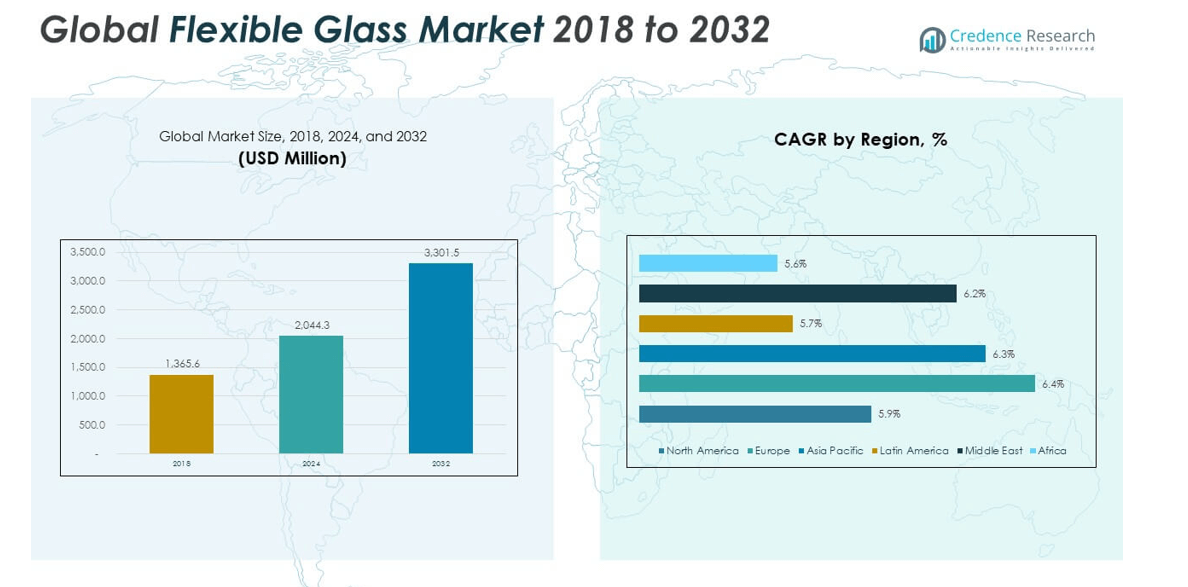
The Global Flexible Glass Market size was valued at USD 1,365.6 million in 2018 to USD 2,044.3 million in 2024 and is anticipated to reach USD 3,301.5 million by 2032, at a CAGR of 6.15% during the forecast period.

REPORT ATTRIBUTE DETAILS
Historical Period 2020-2023
Base Year 2024
Forecast Period 2025-2032
Flexible Glass Market Size 2024 USD 2,044.3 million
Flexible Glass Market, CAGR 6.15%
Flexible Glass Market Size 2032 USD 3,301.5 million


The Global Flexible Glass Market is driven by increasing demand for lightweight, durable, and bendable materials in electronic devices such as smartphones, tablets, and wearable gadgets. Its superior flexibility, strength, and optical clarity make it ideal for next-generation displays and touch sensors. Growing applications in solar panels, automotive displays, and smart windows also support its growth, as industries seek advanced materials that combine performance with design adaptability. Rising investments in flexible electronics manufacturing further accelerate the market expansion.

Asia-Pacific leads the Global Flexible Glass Market due to high production of consumer electronics and presence of major manufacturers in China, South Korea, and Japan. North America follows, driven by strong R&D investments and adoption in automotive and renewable sectors. Europe shows steady growth, supported by sustainability goals and demand for energy-efficient building materials. Emerging economies in Southeast Asia and Latin America are witnessing growing adoption driven by urbanization and increased use of smart devices.

Flexible Glass Market size

Market Insights:

  • The Global Flexible Glass Market was valued at USD 1,365.6 million in 2018, reached USD 2,044.3 million in 2024, and is projected to hit USD 3,301.5 million by 2032, growing at a CAGR of 6.15%.
  • Asia Pacific holds the largest share at 32%, driven by strong electronics manufacturing in China, Japan, and South Korea. North America follows with 28%, supported by advanced R&D and adoption in automotive and solar sectors. Europe ranks third with 25%, led by sustainable building and renewable initiatives.
  • Latin America is the fastest-growing region with a 7% share, fueled by increasing solar power projects, industrial modernization, and supportive clean energy policies.
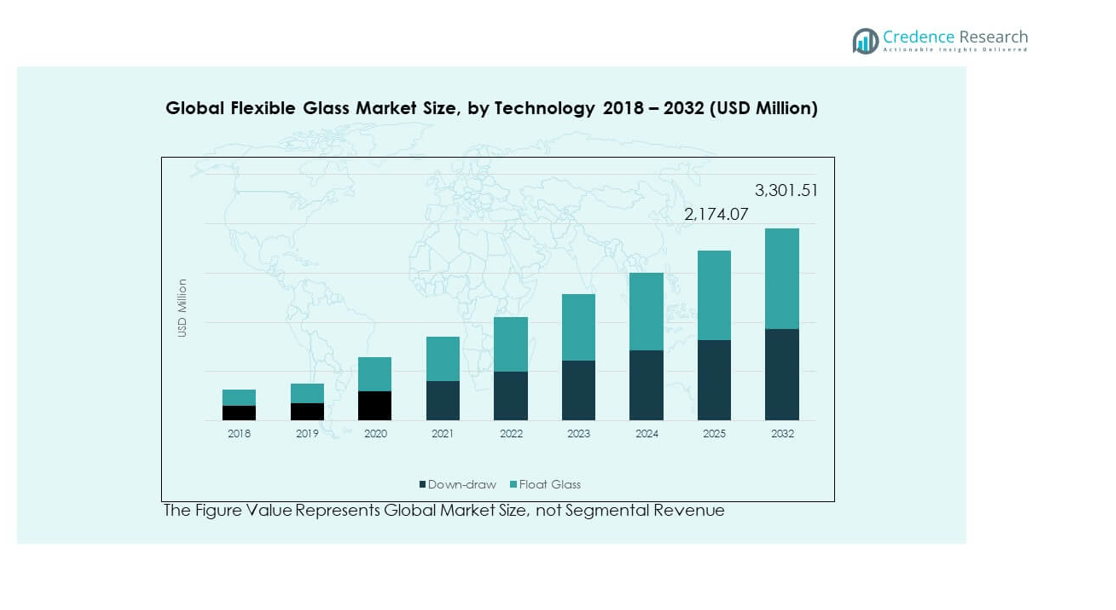
  • Down-draw technology accounts for about 55% of the market, favored for its precision, high-quality finish, and suitability for flexible displays.
  • Float glass holds roughly 45% share, benefiting from large-scale manufacturing and wider adoption in solar and architectural applications.

Access crucial information at unmatched prices!

Request your sample report today & start making informed decisions powered by Credence Research Inc.!

Download Sample

Market Drivers:

Rising Demand for Flexible Displays and Lightweight Materials in Consumer Electronics

The Global Flexible Glass Market is driven by its increasing adoption in advanced display technologies. Manufacturers are replacing traditional rigid glass with bendable alternatives for smartphones, tablets, and wearable devices. Its thinness, strength, and transparency make it ideal for curved and foldable displays. The market benefits from consumer preference for compact and durable gadgets. Rising disposable incomes and expanding electronics production in Asia-Pacific strengthen demand. Companies are investing in R&D to enhance flexibility and reduce production costs. It continues to replace polymer substrates due to its superior optical performance and scratch resistance.

  • For instance, Corning’s bendable glass solutions for foldable smartphones, like the ultra-thin glass utilized in Samsung’s Galaxy Z Fold and Flip series, have been certified to withstand hundreds of thousands of folds, with some reports citing over 200,000 folds during testing. While Corning has developed glass as thin as 30 micrometers in a separate context, the optimal thickness for foldable phones involves balancing flexibility with durability to protect against drops.

Expanding Application Scope in Solar Panels, Automotive, and Smart Windows

Flexible glass adoption is expanding beyond electronics into automotive and renewable sectors. Its ability to tolerate temperature variations and mechanical stress supports its use in solar panels and vehicle interiors. The Global Flexible Glass Market benefits from increasing installation of smart windows in buildings to improve energy efficiency. Automakers are integrating flexible glass for lightweight displays and sunroofs. Its optical clarity and durability make it suitable for advanced lighting and infotainment systems. Growing investments in solar energy infrastructure boost demand for flexible, high-transparency materials. The trend aligns with sustainability initiatives emphasizing material efficiency and recyclability.

  • For instance, AGC Automotive’s solar roof glass utilizes back contact cells with a conversion efficiency exceeding 25% and enhances passenger headroom by 30 mm using advanced ultra-thin configurations, as reported in peer-reviewed engineering releases.

Technological Advancements and Innovations in Ultra-Thin Glass Manufacturing

Continuous advancements in glass processing are creating growth opportunities in the Global Flexible Glass Market. Manufacturers are developing ultra-thin glass with improved flexibility and impact resistance. Innovations in lamination and coating techniques enhance durability and reduce production waste. Demand for high-precision glass cutting and surface finishing supports industrial expansion. It benefits from automation and nanotechnology integration, which improve consistency and performance. Collaborations among glass producers, electronics firms, and research institutions accelerate material optimization. The introduction of new fabrication techniques reduces defects and enhances scalability. These improvements make flexible glass more viable for mass-market applications.

Sustainability Goals and Shift Toward Eco-Friendly Manufacturing Practices

The Global Flexible Glass Market is gaining traction through the global emphasis on eco-friendly materials. Manufacturers are adopting sustainable production techniques to reduce emissions and energy consumption. Recyclable and lightweight glass solutions help reduce environmental footprints in end-use sectors. The trend aligns with green building standards and energy conservation initiatives. Companies focus on reducing waste in glass manufacturing through precision cutting and reusability. It supports a circular economy by enabling recyclable product designs. Partnerships with renewable energy and green tech companies foster sustainable innovation. This alignment with global climate goals strengthens the market’s long-term outlook.

Market Trends:

Integration of Flexible Glass in Foldable Smartphones and Wearable Devices

The Global Flexible Glass Market is witnessing strong demand from foldable smartphones and smartwatches. Manufacturers are using flexible glass for improved touch sensitivity and durability compared to plastic substrates. The material’s ability to bend without cracking enhances design flexibility in consumer electronics. Growing competition among smartphone brands accelerates innovation in display materials. Wearable device producers use flexible glass to achieve lightweight, shatterproof surfaces. It provides better scratch resistance, improving long-term usability. The adoption of foldable screens has become a defining trend in premium devices. This trend supports the steady rise in flexible glass production capacity worldwide.

  • For instance, in 2019, Corning was testing prototypes of its ultrathin, bendable glass that were 0.1 mm thick and could achieve a bend radius of 3–5 mm. The company reported that these prototypes were functional but still required improvements to achieve both tight bendability and durability for consumer devices.

Increasing Adoption of Flexible Glass in Energy-Efficient Building Applications

Architectural and construction sectors are adopting flexible glass for next-generation smart windows and façades. The Global Flexible Glass Market benefits from the global focus on green infrastructure and energy conservation. These smart systems regulate light transmission and reduce energy costs. Flexible glass enables curved and frameless designs that enhance aesthetics and sustainability. Technological integration with IoT and sensors drives advanced climate-responsive window solutions. The use of flexible glass in commercial buildings supports net-zero energy goals. It also improves UV protection and thermal insulation performance. Demand for smart glass installations in luxury real estate projects continues to grow rapidly.

  • For instance, AGC Europe’s integration of photovoltaic flat glass enables up to 98% recovery of chemically recycled cullet from end-of-life solar panels, decreasing CO₂ emissions by 0.7 tons per ton of recycled input as featured in sustainability reports.

Growing Use of Flexible Glass in Automotive Displays and Interior Applications

The automotive sector represents a rising demand segment within the Global Flexible Glass Market. Automakers are adopting flexible glass for digital dashboards, infotainment systems, and heads-up displays. Its lightweight and shatterproof properties enhance both safety and design efficiency. The material supports curved display integration in electric and autonomous vehicles. Manufacturers focus on optimizing viewing clarity and touch sensitivity. It offers better resistance to thermal expansion, vital for vehicle environments. Increasing EV production boosts flexible glass adoption in solar roofs and lighting panels. These applications are expected to redefine vehicle interiors and improve user experience.

Emergence of Flexible Glass in Medical and Wearable Healthcare Devices

The healthcare sector is emerging as a promising user of flexible glass technology. The Global Flexible Glass Market is benefiting from applications in diagnostic sensors and biomedical devices. Its flexibility allows comfortable integration in wearable health monitors and implants. Manufacturers are using biocompatible coatings to ensure safety and durability. It supports micro-display and optical sensor applications for precision monitoring. Growing digital healthcare adoption drives innovation in flexible materials. Companies are investing in transparent, thin, and sterilizable glass substrates. The convergence of electronics and healthcare continues to broaden its application potential.

Flexible Glass Market share

Market Challenges Analysis:

High Production Costs and Complex Manufacturing Processes Limiting Mass Adoption

The Global Flexible Glass Market faces cost challenges due to intricate production requirements. Manufacturing ultra-thin glass demands high precision, advanced machinery, and skilled labor. These factors increase operational expenses, limiting affordability for mid-tier manufacturers. Yield loss from breakage during processing also adds to production cost. Scaling up mass production without compromising quality remains a challenge. Equipment maintenance and energy use further elevate total cost per unit. Smaller firms face entry barriers due to high capital investments. It restricts widespread use across lower-cost applications such as consumer electronics accessories.

Material Fragility and Supply Chain Constraints Impacting Performance Consistency

The brittle nature of flexible glass continues to challenge product integration in various sectors. The Global Flexible Glass Market must address breakage risks during transport and handling. Supply chain limitations in specialty glass materials affect consistent delivery timelines. Fluctuations in raw material prices and shortage of processing expertise hinder smooth operations. It requires optimized packaging and testing solutions to maintain reliability. Lack of standardization across suppliers affects performance uniformity in end-use industries. Collaboration among manufacturers and suppliers is vital to stabilize the ecosystem. These issues collectively restrict market penetration in high-volume applications.

Market Opportunities:

Expansion of Flexible Glass Applications in Emerging Sectors and Smart Technologies

Emerging industries offer new growth pathways for the Global Flexible Glass Market. Flexible glass is finding opportunities in smart wearables, solar cells, and curved TV displays. The rise of flexible OLED panels and transparent electronics creates sustained demand. It is also used in augmented reality (AR) and virtual reality (VR) devices for improved optics. Manufacturers are focusing on expanding partnerships to target new applications. Governments promoting renewable energy and digital infrastructure stimulate material innovation. These developments will broaden the revenue base across technology and energy domains.

Rising Focus on Lightweight and Sustainable Material Adoption in Transportation and Energy

The Global Flexible Glass Market is positioned for growth through lightweight and recyclable solutions. Its durability and flexibility suit transport applications like aircraft panels and vehicle glazing. Demand for solar energy and sustainable mobility increases its market potential. It supports advanced manufacturing practices aligned with global carbon reduction goals. Companies adopting closed-loop recycling systems will gain competitive advantage. Continued focus on sustainability enhances brand image and market credibility. These shifts encourage innovation, leading to wider product adoption across industries.

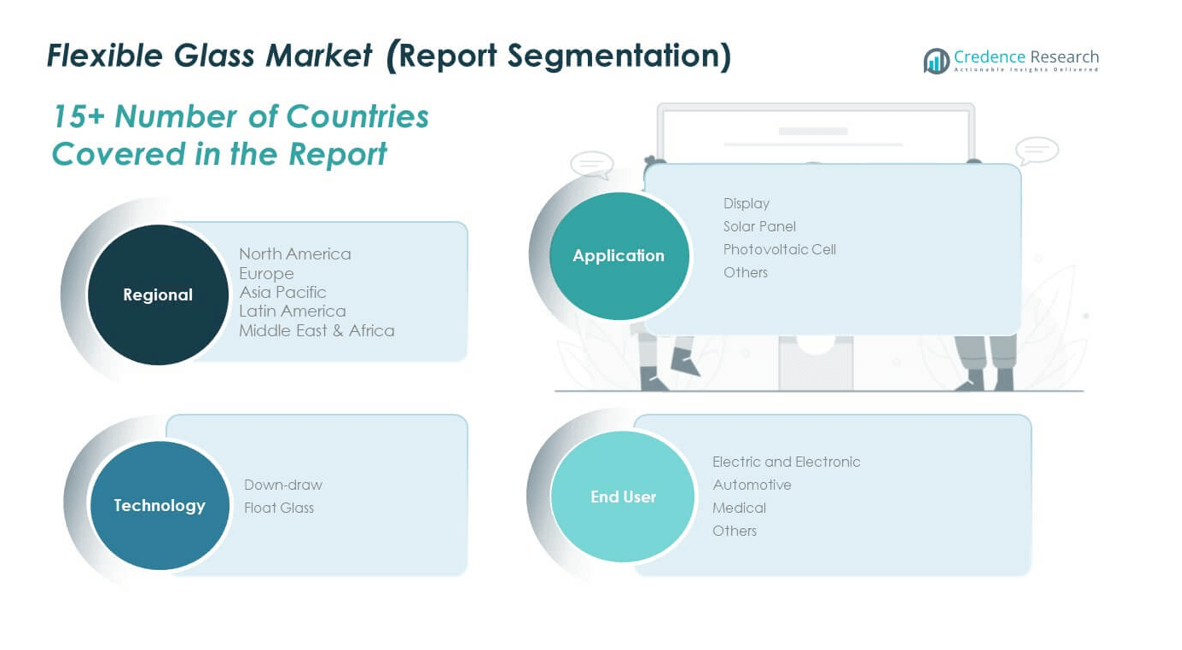
Market Segmentation Analysis:

By Application

The Global Flexible Glass Market demonstrates strong growth across display, solar panel, and photovoltaic cell applications. Displays remain the leading segment, driven by demand for flexible, lightweight materials in smartphones, tablets, and wearable devices. Flexible glass provides durability, high transparency, and touch sensitivity for modern display technologies. Solar panel and photovoltaic applications are expanding due to rising investments in renewable energy. Its thermal stability and flexibility enhance energy efficiency and performance under varied conditions. The “Others” category, including smart windows and lighting, shows potential through growing adoption in architecture and automotive interiors.

  • For instance, Schott AG’s D263T flexible glass offers a thermal expansion coefficient of 7.2 × 10⁻⁶ K⁻¹, supports 11.2% conversion efficiency in CIGS solar modules, and retains at least 80% efficiency after three bends at a 50 mm curvature radius, per technical papers and product specifications.

By Technology

Down-draw technology dominates the Global Flexible Glass Market, valued for its ability to produce ultra-thin, high-quality glass with superior surface smoothness. This method supports the growing need for precise, lightweight materials in electronics and display applications. Float glass follows, benefiting from large-scale industrial manufacturing and lower production costs. It offers structural integrity suitable for automotive and solar energy sectors. Each technology contributes uniquely to the market’s scalability and product diversification. Continuous process optimization enhances yield efficiency, enabling producers to balance performance and cost.

  • For instance, Corning’s Gen 10.5 Fusion method produces up to eight 65-inch ultra-thin TV panels per substrate, and ColdForm Gorilla Glass achieves 85% visible light transmittance in automotive clusters without added polymer layers, according to display engineering showcases and company reports.

By End User

Electric and electronic industries lead the Global Flexible Glass Market, using flexible glass for foldable devices, sensors, and touchscreens. The automotive sector adopts it for digital dashboards, infotainment systems, and lightweight glazing solutions. Medical applications are growing due to its biocompatibility and use in diagnostic devices. Other segments, including energy and construction, utilize flexible glass for sustainable and aesthetic designs. It continues to evolve as manufacturers integrate advanced coatings and materials to enhance flexibility, impact resistance, and longevity across diverse industries.

Flexible Glass Market segmentation

Segmentation:

By Application

  • Display
  • Solar Panel
  • Photovoltaic Cell
  • Others

By Technology

  • Down-draw
  • Float Glass

By End User

  • Electric and Electronic
  • Automotive
  • Medical
  • Others

By Region

  • North America
    • U.S.
    • Canada
  • Europe
    • Germany
    • France
    • Italy
    • U.K.
    • Russia
    • Rest of Europe
  • Asia-Pacific
    • India
    • China
    • Japan
    • Rest of Asia-Pacific
  • Latin America
    • Brazil
    • Mexico
    • Rest of Latin America
  • Middle East and Africa
    • GCC Countries
    • South Africa
    • Rest of Middle East and Africa

North America

The North America Flexible Glass Market size was valued at USD 450.93 million in 2018 to USD 666.87 million in 2024 and is anticipated to reach USD 1,059.46 million by 2032, at a CAGR of 5.9% during the forecast period. North America holds a significant share in the Global Flexible Glass Market, driven by strong demand from the electronics, automotive, and renewable energy sectors. The U.S. dominates regional revenue through high R&D spending and adoption of flexible display technologies. It benefits from advanced manufacturing infrastructure and strong innovation in OLED and solar glass applications. Canada and Mexico contribute through growing solar installations and automotive production. The region’s focus on lightweight and energy-efficient materials continues to strengthen product integration. Strategic collaborations among tech giants and glass producers enhance market scalability.

Europe

The Europe Flexible Glass Market size was valued at USD 338.40 million in 2018 to USD 515.33 million in 2024 and is anticipated to reach USD 851.13 million by 2032, at a CAGR of 6.4% during the forecast period. Europe shows consistent growth in the Global Flexible Glass Market due to sustainable manufacturing practices and renewable energy expansion. Germany, France, and the UK lead adoption for use in automotive glazing, smart windows, and photovoltaic modules. The region’s strict environmental standards encourage the use of recyclable and energy-saving materials. European firms are developing advanced coating technologies to improve strength and transparency. It benefits from public funding supporting energy-efficient infrastructure and clean technology projects. The transition toward green buildings and electric vehicles strengthens flexible glass demand. Strategic mergers and research partnerships sustain Europe’s position as a technology innovator.

Asia Pacific

The Asia Pacific Flexible Glass Market size was valued at USD 359.43 million in 2018 to USD 542.43 million in 2024 and is anticipated to reach USD 885.47 million by 2032, at a CAGR of 6.3% during the forecast period. Asia Pacific dominates the Global Flexible Glass Market due to extensive electronics manufacturing in China, Japan, and South Korea. High consumer demand for smartphones, wearables, and foldable devices drives large-scale production. The region hosts major glass manufacturers and display panel producers, ensuring a robust supply chain. India and Southeast Asia are emerging markets supported by rising investments in solar and construction industries. It benefits from cost-effective labor and government incentives promoting domestic manufacturing. Continuous innovation in ultra-thin glass production enhances product competitiveness. Expanding export activities and infrastructure projects strengthen the region’s long-term outlook.

Latin America

The Latin America Flexible Glass Market size was valued at USD 99.96 million in 2018 to USD 145.87 million in 2024 and is anticipated to reach USD 227.47 million by 2032, at a CAGR of 5.7% during the forecast period. Latin America’s participation in the Global Flexible Glass Market is expanding through investments in solar power and automotive manufacturing. Brazil leads regional demand with industrial growth and renewable energy projects. Mexico supports adoption through electronics assembly and export operations. The region focuses on cost-effective flexible glass applications in construction and transportation. It faces infrastructure challenges but benefits from government programs encouraging green technologies. Growing demand for sustainable building materials and smart displays promotes adoption. Partnerships with Asian and European manufacturers improve regional product availability and technology transfer.

Middle East

The Middle East Flexible Glass Market size was valued at USD 78.93 million in 2018 to USD 118.51 million in 2024 and is anticipated to reach USD 192.15 million by 2032, at a CAGR of 6.2% during the forecast period. The Middle East is steadily growing in the Global Flexible Glass Market due to its renewable energy and construction boom. GCC countries lead demand for solar panels and energy-efficient architectural glass. The region’s investments in smart city projects create opportunities for advanced glazing and flexible materials. It benefits from partnerships with global glass manufacturers for technology integration. Rising energy diversification efforts support solar and photovoltaic deployments. High spending on infrastructure modernization fuels material innovation. Strategic initiatives to develop domestic manufacturing capacity are reshaping regional market dynamics.

Africa

The Africa Flexible Glass Market size was valued at USD 37.96 million in 2018 to USD 55.25 million in 2024 and is anticipated to reach USD 85.84 million by 2032, at a CAGR of 5.6% during the forecast period. Africa represents a developing frontier in the Global Flexible Glass Market with rising demand in construction and solar power applications. South Africa leads regional adoption through renewable energy projects and sustainable housing initiatives. Egypt and Nigeria are witnessing growing interest in electronic and automotive integration. The region benefits from international collaborations improving access to advanced glass materials. It faces constraints in manufacturing infrastructure but shows strong potential for long-term expansion. Government policies promoting energy efficiency encourage adoption across industries. Rising urbanization and investment inflows drive the region’s emerging role in the flexible glass sector.

Shape Your Report to Specific Countries or Regions & Enjoy 30% Off!

Key Player Analysis:

  • Corning Incorporated
  • AGC Inc.
  • Nippon Electric Glass Co. Ltd
  • Schott AG
  • Saint-Gobain
  • DuPont
  • Kent Displays, Inc.
  • Samsung Corning Precision Materials
  • Nippon Sheet Glass Co., Ltd.
  • LG Chem Ltd.

Competitive Analysis:

The Global Flexible Glass Market is moderately consolidated, with a few major players holding strong global positions. Companies such as Corning Incorporated, AGC Inc., Nippon Electric Glass Co. Ltd, Schott AG, and Saint-Gobain dominate the industry through extensive product portfolios and continuous innovation. It is characterized by strategic investments in ultra-thin and durable glass technologies catering to consumer electronics, automotive, and solar applications. Firms focus on improving flexibility, thermal resistance, and optical quality to meet rising demand for advanced displays and lightweight materials. Strategic collaborations and regional expansions enhance competitiveness and production efficiency across key markets.

Recent Developments:

  • On October 1, 2025, AGC Glass Europe formed a strategic partnership with SOLAR MATERIALS, a German cleantech startup, to advance circularity in flat glass production for the PV sector. By integrating chemically recycled photovoltaic glass cullet, this initiative supports AGC’s sustainability goals and strengthens its Low-Carbon Glass product range. For instance, this collaboration enables AGC to utilize up to 98% of end-of-life solar panel material, reducing the use of virgin resources and cutting CO₂ emissions by 0.7 tonnes per tonne of cullet used.
  • In September 2025, Corning collaborated with GlobalFoundries to launch GlassBridge™, a glass-waveguide based detachable fiber connector for silicon photonics platforms, targeting AI data center applications. This partnership aims to scale next-generation optical connectivity using Corning’s advanced glass compositions and manufacturing innovations. For instance, the collaboration leverages Corning’s expertise in precision glass and high-density connectivity, directly addressing surging bandwidth needs in AI datacenter environments.
  • Additionally, in July 2025, AGC partnered with Unelko Corporation to commercialize glass coatings and cleaning products within its global e-commerce networks, enhancing the maintenance and functionality of architectural and automotive glass. For instance, AGC now supplies Invisible Shield® coatings, extending the durability and ease of cleaning for commercial and residential glass installations worldwide.

Report Coverage:

The research report offers an in-depth analysis based on Application (Display, Solar Panel, Photovoltaic Cell, Others) and Technology (Down-draw, Float Glass). It details leading market players, providing an overview of their business, product offerings, investments, revenue streams, and key applications. Additionally, the report includes insights into the competitive environment, SWOT analysis, current market trends, as well as the primary drivers and constraints. Furthermore, it discusses various factors that have driven market expansion in recent years. The report also explores market dynamics, regulatory scenarios, and technological advancements that are shaping the industry. It assesses the impact of external factors and global economic changes on market growth. Lastly, it provides strategic recommendations for new entrants and established companies to navigate the complexities of the market.

Future Outlook:

  • Rising demand for foldable and wearable devices will drive material innovation.
  • Expansion in solar energy and smart construction will strengthen adoption.
  • Cost optimization and automation will enhance manufacturing scalability.
  • Increased collaboration between glass and electronics firms will boost R&D.
  • Integration of flexible glass in automotive displays will expand applications.
  • Growing interest in sustainable materials will guide new production methods.
  • Regional diversification will help reduce supply chain risks.
  • Advanced coating and lamination technologies will improve durability.
  • Lightweight glass solutions will gain traction in transport and aerospace.
  • Evolving consumer preferences will shape next-generation flexible products.

CHAPTER NO. 1 :             GENESIS OF THE MARKET           

1.1 Market Prelude – Introduction & Scope

1.2 The Big Picture – Objectives & Vision

1.3 Strategic Edge – Unique Value Proposition

1.4 Stakeholder Compass – Key Beneficiaries

CHAPTER NO. 2 :             EXECUTIVE LENS

2.1 Pulse of the Industry – Market Snapshot

2.2 Growth Arc – Revenue Projections (USD Million)

2.3. Premium Insights – Based on Primary Interviews

CHAPTER NO. 3 :             FLEXIBLE GLASS MARKET FORCES & INDUSTRY PULSE

3.1 Foundations of Change – Market Overview
3.2 Catalysts of Expansion – Key Market Drivers
3.2.1 Momentum Boosters – Growth Triggers
3.2.2 Innovation Fuel – Disruptive Technologies
3.3 Headwinds & Crosswinds – Market Restraints
3.3.1 Regulatory Tides – Compliance Challenges
3.3.2 Economic Frictions – Inflationary Pressures
3.4 Untapped Horizons – Growth Potential & Opportunities
3.5 Strategic Navigation – Industry Frameworks
3.5.1 Market Equilibrium – Porter’s Five Forces
3.5.2 Ecosystem Dynamics – Value Chain Analysis
3.5.3 Macro Forces – PESTEL Breakdown

CHAPTER NO. 4 : KEY INVESTMENT EPICENTER 

4.1 Regional Goldmines – High-Growth Geographies

4.2 Product Frontiers – Lucrative Application Categories

4.3 End User Sweet Spots – Emerging Demand Segments

CHAPTER NO. 5: REVENUE TRAJECTORY & WEALTH MAPPING

5.1 Momentum Metrics – Forecast & Growth Curves

5.2 Regional Revenue Footprint – Market Share Insights

5.3 Segmental Wealth Flow – Application, Technology, and End User Revenue

CHAPTER NO. 6 : TRADE & COMMERCE ANALYSIS           

6.1.        Import Analysis By Region

6.1.1.     Global Flexible Glass Market Import Revenue By Region

6.2.        Export Analysis By Region

6.2.1.     Global Flexible Glass Market Export Revenue By Region

CHAPTER NO. 7 :             COMPETITION ANALYSIS            

7.1.        Company Market Share Analysis

7.1.1.     Global Flexible Glass Market: Company Market Share

7.2.        Global Flexible Glass Market Company Revenue Market Share

7.3.        Strategic Developments

7.3.1.     Acquisitions & Mergers

7.3.2.     New Product Launch

7.3.3.     Regional Expansion

7.4.        Competitive Dashboard

7.5.      Company Assessment Metrics, 2024

CHAPTER NO. 8 : FLEXIBLE GLASS MARKET – BY APPLICATION SEGMENT ANALYSIS

8.1.        Flexible Glass Market Overview By Application Segment

8.1.1.     Flexible Glass Market Revenue Share By Application

8.2.       Display

8.3.       Solar Panel

8.4.       Photovoltaic Cell

8.5.       Others

CHAPTER NO. 9 : FLEXIBLE GLASS MARKET – BY TECHNOLOGY SEGMENT ANALYSIS

9.1.        Flexible Glass Market Overview By Technology Segment

9.1.1.     Flexible Glass Market Revenue Share By Technology

9.2.      Down-draw

9.3.      Float Glass

CHAPTER NO. 10 : FLEXIBLE GLASS MARKET – BY END USER SEGMENT ANALYSIS

10.1.      Flexible Glass Market Overview By End User Segment

10.1.1.  Flexible Glass Market Revenue Share By End User

10.2.    Electric and Electronic

10.3.    Automotive

10.4.    Medical

10.5.   Others

CHAPTER NO. 11 : FLEXIBLE GLASS MARKET – REGIONAL ANALYSIS

11.1.      Flexible Glass Market Overview By Region Segment

11.1.1.  Global Flexible Glass Market Revenue Share By Region

10.1.2.  Regions

11.1.3.  Global Flexible Glass Market Revenue By Region

11.1.4.  Application

11.1.5.  Global Flexible Glass Market Revenue By Application

11.1.6.  Technology

11.1.7. Global Flexible Glass Market Revenue By Technology

11.1.8.  End User

11.1.9. Global Flexible Glass Market Revenue By End User

CHAPTER NO. 12 : NORTH AMERICA FLEXIBLE GLASS MARKET – COUNTRY ANALYSIS

12.1.      North America Flexible Glass Market Overview By Country Segment

12.1.1.  North America Flexible Glass Market Revenue Share By Region

12.2.      North America

12.2.1.  North America Flexible Glass Market Revenue By Country

12.2.2.  Application

12.2.3.  North America Flexible Glass Market Revenue By Application

12.2.4.  Technology

12.2.5.  North America Flexible Glass Market Revenue By Technology

12.2.6.  End User

12.2.7.  North America Flexible Glass Market Revenue By End User

12.3.      U.S.

12.4.      Canada

12.5.      Mexico

CHAPTER NO. 13 : EUROPE FLEXIBLE GLASS MARKET – COUNTRY ANALYSIS

13.1.      Europe Flexible Glass Market Overview By Country Segment

13.1.1.  Europe Flexible Glass Market Revenue Share By Region

13.2.      Europe

13.2.1.  Europe Flexible Glass Market Revenue By Country

13.2.2.  Application

13.2.3.  Europe Flexible Glass Market Revenue By Application

13.2.4.  Technology

13.2.5.  Europe Flexible Glass Market Revenue By Technology

13.2.6.  End User

13.2.7.  Europe Flexible Glass Market Revenue By End User

13.3.      UK

13.4.      France

13.5.      Germany

13.6.      Italy

13.7.      Spain

13.8.      Russia

13.9.    Rest of Europe

CHAPTER NO. 14 : ASIA PACIFIC FLEXIBLE GLASS MARKET – COUNTRY ANALYSIS

14.1.      Asia Pacific Flexible Glass Market Overview By Country Segment

14.1.1.  Asia Pacific Flexible Glass Market Revenue Share By Region

14.2.      Asia Pacific

14.2.1.  Asia Pacific Flexible Glass Market Revenue By Country

14.2.2.  Application

14.2.3.  Asia Pacific Flexible Glass Market Revenue By Application

14.2.4.  Technology

14.2.5.  Asia Pacific Flexible Glass Market Revenue By Technology

14.2.6.  End User

14.2.7.  Asia Pacific Flexible Glass Market Revenue By End User

14.3.      China

14.4.      Japan

14.5.      South Korea

14.6.      India

14.7.      Australia

14.8.      Southeast Asia

14.9.      Rest of Asia Pacific

CHAPTER NO. 15 : LATIN AMERICA FLEXIBLE GLASS MARKET – COUNTRY ANALYSIS

15.1.      Latin America Flexible Glass Market Overview By Country Segment

15.1.1.  Latin America Flexible Glass Market Revenue Share By Region

15.2.      Latin America

15.2.1.  Latin America Flexible Glass Market Revenue By Country

15.2.2.  Application

15.2.3.  Latin America Flexible Glass Market Revenue By Application

15.2.4.  Technology

15.2.5.  Latin America Flexible Glass Market Revenue By Technology

15.2.6.  End User

15.2.7.  Latin America Flexible Glass Market Revenue By End User

15.3.      Brazil

15.4.      Argentina

15.5.      Rest of Latin America

CHAPTER NO. 16 : MIDDLE EAST FLEXIBLE GLASS MARKET – COUNTRY ANALYSIS

16.1.      Middle East Flexible Glass Market Overview By Country Segment

16.1.1.  Middle East Flexible Glass Market Revenue Share By Region

16.2.      Middle East

16.2.1.  Middle East Flexible Glass Market Revenue By Country

16.2.2.  Application

16.2.3.  Middle East Flexible Glass Market Revenue By Application

16.2.4.  Technology

16.2.5.  Middle East Flexible Glass Market Revenue By Technology

16.2.6.  End User

16.2.7.  Middle East Flexible Glass Market Revenue By End User

16.3.      GCC Countries

16.4.      Israel

16.5.      Turkey

16.6.      Rest of Middle East

CHAPTER NO. 17 : AFRICA FLEXIBLE GLASS MARKET – COUNTRY ANALYSIS

17.1.      Africa Flexible Glass Market Overview By Country Segment

17.1.1.  Africa Flexible Glass Market Revenue Share By Region

17.2.      Africa

17.2.1.  Africa Flexible Glass Market Revenue By Country

17.2.2.  Application

17.2.3.  Africa Flexible Glass Market Revenue By Application

17.2.4.  Technology

17.2.5.  Africa Flexible Glass Market Revenue By Technology

17.2.6.  End User

17.2.7.  Africa Flexible Glass Market Revenue By End User

17.3.      South Africa

17.4.      Egypt

17.5.      Rest of Africa

CHAPTER NO. 18 : COMPANY PROFILES

18.1.       Abrisa Technologies

18.1.1.  Company Overview

18.1.2.  Product Portfolio

18.1.3.  Financial Overview

18.1.4.  Recent Developments

18.1.5.  Growth Strategy

18.1.6.  SWOT Analysis

18.2.    AGC Inc.

18.3.    Corning Incorporated

18.4.    DuPont

18.5.    Kent Displays, Inc.

18.6.    KYOCERA Corporation

18.7.   Murata Manufacturing Co., Ltd

18.8.   Nippon Electric Glass Co. Ltd

18.9.   Saint-Gobain

18.10. Nohken Inc.

18.11.  Other Key Players

Request Free Sample

We prioritize the confidentiality and security of your data. Our promise: your information remains private.

Ready to Transform Data into Decisions?

Request Your Sample Report and Start Your Journey of Informed Choices


Providing the strategic compass for industry titans.

cr-clients-logos

Frequently Asked Questions

What is the current market size for Global Flexible Glass Market, and what is its projected size in 2032?

The Global Flexible Glass Market was valued at USD 1,365.6 million in 2018 and USD 2,044.3 million in 2024. It is projected to reach USD 3,301.5 million by 2032, reflecting steady growth across major application sectors.

At what Compound Annual Growth Rate is the Global Flexible Glass Market projected to grow between 2025 and 2032?

The Global Flexible Glass Market is projected to grow at a CAGR of 6.15% from 2025 to 2032, supported by expansion in consumer electronics, solar, and automotive industries.

Which Global Flexible Glass Market segment held the largest share in 2024?

The display segment held the largest share in 2024, driven by high adoption in smartphones, tablets, and wearable devices demanding lightweight and durable materials.

What are the primary factors fueling the growth of the Global Flexible Glass Market?

Key factors include technological innovation in ultra-thin glass manufacturing, rising demand for flexible displays, and expanding use in renewable energy and automotive applications

Who are the leading companies in the Global Flexible Glass Market?

Leading companies include Corning Incorporated, AGC Inc., Nippon Electric Glass Co. Ltd, Schott AG, Saint-Gobain, DuPont, and KYOCERA Corporation, all focusing on high-performance and sustainable glass technologies.

Who are the major players in this market?

Honeywell International, Inc., Infineon Technologies AG, Siemens AG, General Electric (GE) Company, ABB Ltd., Electro-Sensors, Inc., Pepperl+Fuchs GmbH, NOHKEN, Inc. are some of the major players in the global market.

About Author

Ganesh Chandwade

Ganesh Chandwade

Senior Industry Consultant

Ganesh is a senior industry consultant specializing in heavy industries and advanced materials.

View Profile

Related Reports

Seismic Reinforcement Materials Market

Seismic Reinforcement Materials Market size was valued USD 10.17 Billion in 2024 and is anticipated to reach USD 16.72 Billion by 2032, at a CAGR of 6.41% during the forecast period.

Agro Textile Market

Agro Textile Market size was valued at USD 6.1 Billion in 2024 and is anticipated to reach USD 8.29 Billion by 2032, at a CAGR of 3.91% during the forecast period.

Pre-Painted Galvanized Iron (PPGI) Market

Pre Painted Galvanized Iron (PPGI) Market size was valued at USD 153,808 million in 2024 and is anticipated to reach USD 196,053.3 million by 2032, at a CAGR of 3.08% during the forecast period.

Reclaimed Rubber Market

The Reclaimed Rubber market was valued at USD 4.06 billion in 2024 and is projected to reach USD 8.74 billion by 2032, growing at a CAGR of 10.06% during the forecast period.

Degassing Valves Market

Degassing Valves market was valued at USD 649.62 million in 2024 and is anticipated to reach USD 930.92 million by 2032, growing at a CAGR of 4.6 % during the forecast period.

Flanges Market

Flanges Market size reached USD 6,448 million in 2024 and is projected to rise to USD 9,368.11 million by 2032, expanding at a CAGR of 4.78% during the forecast period.

Recycled Elastomers Market

Recycled Elastomers market size reached USD 10.75 billion in 2024 and is projected to rise to USD 23.02 billion by 2032, supported by a 9.99% CAGR during the forecast period.

Vapour Barrier Market

Vapour Barrier Market size was valued at USD 14.66 billion in 2024 and is anticipated to reach USD 21.97 billion by 2032, at a CAGR of 5.19% during the forecast period.

Global and India Beyerite Market

The Global and India Beyerite Market size was valued at USD 1,390.90 million in 2018 to USD 2,003.04 million in 2024 and is anticipated to reach USD 3,231.07 million by 2032, at a CAGR of 5.73% during the forecast period.

Metallurgical Coal Market

The Metallurgical Coal Market size was valued at USD 72.63 Billion in 2024 and is anticipated to reach USD 90.23 Billion by 2032, at a CAGR of 2.75% during the forecast period.

Hard Carbon Material Market

Hard Carbon Material Market size was valued USD 125.83 million in 2024 and is anticipated to reach USD 556.01 million by 2032, at a CAGR of 20.41% during the forecast period.

Recycling Waste Machinery Market

The Global Recycling Waste Machinery Market size was valued at USD 12,646.8 Billion in 2018 and is projected to reach USD 17,165.3 Billion by 2024. It is anticipated to grow to USD 26,732.5 Billion by 2032, at a CAGR of 5.74% during the forecast period.

Licence Option

The report comes as a view-only PDF document, optimized for individual clients. This version is recommended for personal digital use and does not allow printing. Use restricted to one purchaser only.
$4999

To meet the needs of modern corporate teams, our report comes in two formats: a printable PDF and a data-rich Excel sheet. This package is optimized for internal analysis. Unlimited users allowed within one corporate location (e.g., regional office).
$6999

The report will be delivered in printable PDF format along with the report’s data Excel sheet. This license offers 100 Free Analyst hours where the client can utilize Credence Research Inc. research team. Permitted for unlimited global use by all users within the purchasing corporation, such as all employees of a single company.
$12999

Report delivery within 24 to 48 hours

Credence Staff 3

WILLIAM, North America

Support Staff at Credence Research

KEITH PHILLIPS, Europe

Lee - CR Sales Staff

LEE VALLANCE, Asia Pacific

Kieran Jameson

KIERAN JAMESON, Australia

Smallform of Sample request
User Review

Thank you for the data! The numbers are exactly what we asked for and what we need to build our business case.

Materials Scientist
(privacy requested)

User Review

The report was an excellent overview of the Industrial Burners market. This report does a great job of breaking everything down into manageable chunks.

Imre Hof
Management Assistant, Bekaert

cr-clients-logos

Request Sample