Home » Packaging » High Barrier Packaging Films Market

High Barrier Packaging Films Market By Material (Polyethylene (PE), BOPET (Biaxially Oriented Polyethylene Terephthalate), Polypropylene (PP), Polyvinyl Chloride (PVC)); By Product (Bags & Pouches, Trays & Lidding Films, Wrapping Films, Blister Packs, Others); By Application (Food & Beverages, Pharmaceuticals, Personal Care & Cosmetics, Others); By Region – Growth, Share, Opportunities & Competitive Analysis, 2024 – 2032

Report ID: 6798 | Report Format : Excel, PDF

Market Overview:

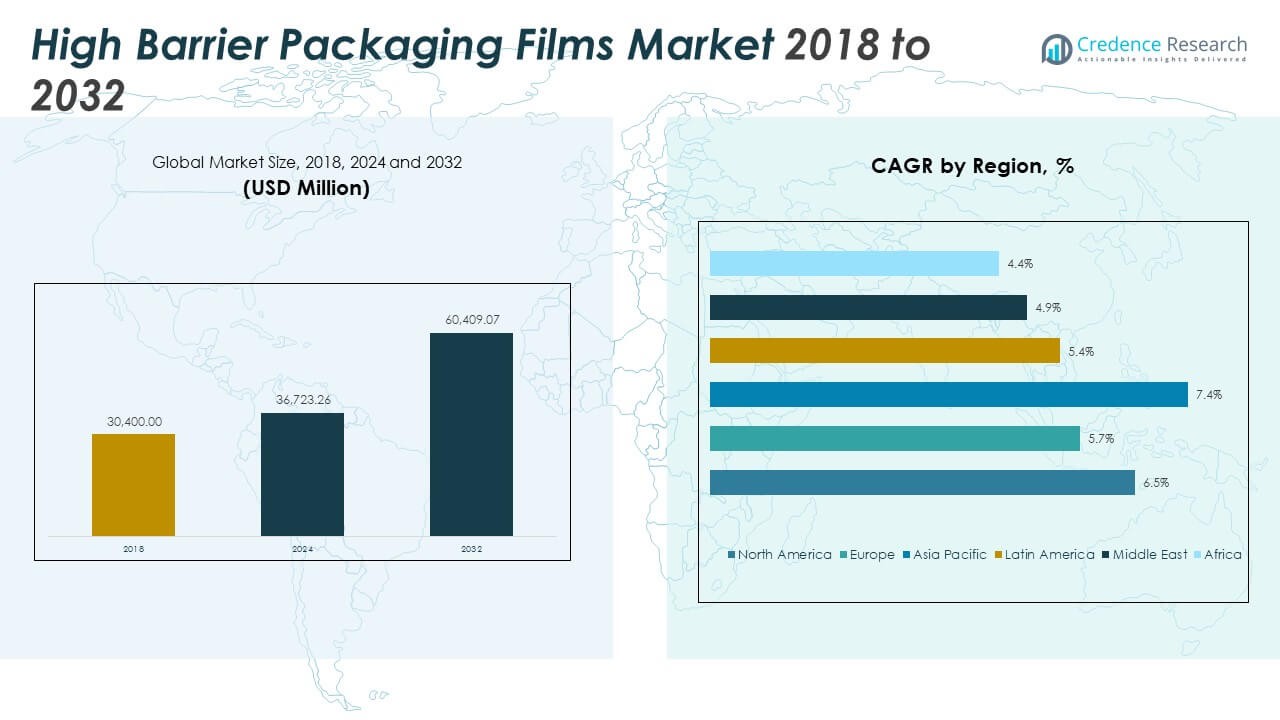
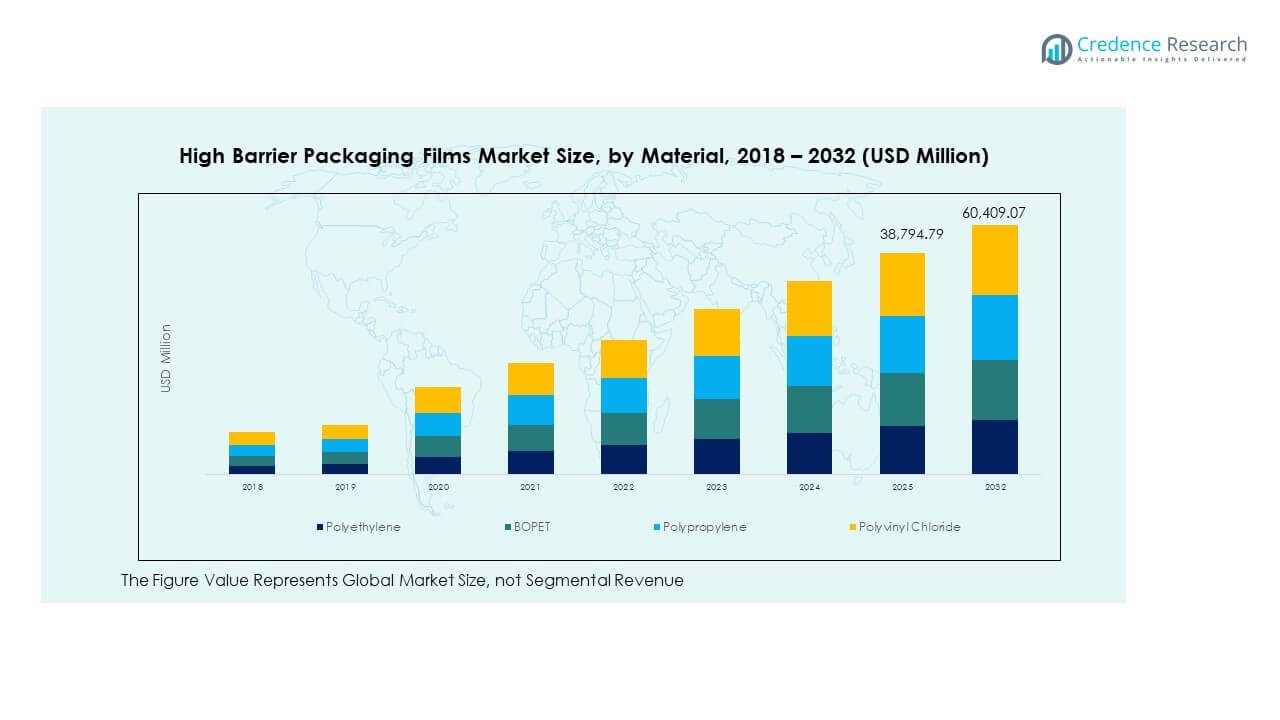
The High Barrier Packaging Films Market size was valued at USD 30,400.00 million in 2018 to USD 36,723.26 million in 2024 and is anticipated to reach USD 60,409.07 million by 2032, at a CAGR of 6.53% during the forecast period.

REPORT ATTRIBUTE DETAILS
Historical Period 2020-2023
Base Year 2024
Forecast Period 2025-2032
High Barrier Packaging Films Market Size 2024 USD 36,723.26 Million
High Barrier Packaging Films Market , CAGR 6.53%
High Barrier Packaging Films Market Size 2032 USD 60,409.07 Million


The market growth is driven by rising demand for durable, lightweight, and sustainable packaging solutions. Increasing consumption of packaged foods, pharmaceuticals, and personal care products supports adoption in multiple industries. Technological advancements in multi-layer extrusion and coating processes improve film strength, clarity, and recyclability. Growing preference for recyclable and bio-based materials aligns with sustainability initiatives. Manufacturers are also investing in product innovation to meet evolving consumer and regulatory expectations.

Regionally, Asia Pacific leads the global market, supported by high packaging demand across China, Japan, and India. Europe follows, with strong growth driven by strict environmental standards and material innovation. North America maintains steady demand, supported by advanced packaging technologies and growing emphasis on sustainable designs. Latin America and the Middle East & Africa are emerging markets, benefiting from expanding retail sectors and increasing consumption of packaged goods. The global shift toward circular packaging continues to shape regional strategies and market dynamics.

Access crucial information at unmatched prices!

Request your sample report today & start making informed decisions powered by Credence Research Inc.!

Download Sample

Market Insights:

  • The High Barrier Packaging Films Market was valued at USD 30,400.00 million in 2018, increased to USD 36,723.26 million in 2024, and is projected to reach USD 60,409.07 million by 2032, growing at a CAGR of 6.53%.
  • Asia Pacific holds the largest share of 44%, driven by rapid industrialization, expanding food exports, and strong demand for packaged goods in China, India, and Japan.
  • North America represents 25% of the global market, supported by technological innovation and rising demand for convenience foods and pharmaceuticals, while Europe follows with 23% due to advanced recycling infrastructure and strict environmental regulations.
  • Asia Pacific remains the fastest-growing region with a 7.4% CAGR, fueled by expanding e-commerce channels, food processing industries, and the adoption of sustainable flexible packaging.
  • Among materials, Polyethylene (36%) dominates the market due to its flexibility and cost efficiency, followed by BOPET (28%), favored for high clarity and mechanical strength across diverse packaging applications.

High Barrier Packaging Films Market Size

Market Drivers

Rising Consumer Preference for Extended Shelf Life and Freshness Protection

Consumers increasingly demand packaged products with longer shelf life and preserved freshness. The High Barrier Packaging Films Market benefits from this trend by providing advanced protection against oxygen, moisture, and light. Food and beverage producers adopt multi-layer films to retain flavor, texture, and aroma. It supports perishable goods such as dairy, snacks, and meats that need superior preservation. The demand for hygienic and contamination-free packaging boosts industry adoption. Changing consumption habits toward ready-to-eat meals enhance the need for barrier technology. Growing urbanization and smaller household sizes further accelerate usage. This shift reinforces the industry’s role in maintaining product safety and quality.

Technological Advancements in Film Composition and Manufacturing Efficiency

Continuous material innovation drives the market’s competitiveness and reliability. Advanced co-extrusion techniques enable the production of thinner yet stronger films. Manufacturers integrate nanocoatings and biodegradable layers to improve recyclability and environmental compliance. It enhances barrier strength without compromising flexibility or transparency. The use of hybrid polymer blends supports high seal integrity and puncture resistance. Automation in production lines ensures consistency and precision across batches. Energy-efficient extrusion systems also reduce manufacturing costs. These advancements make high barrier films adaptable to multiple end-use sectors including pharmaceuticals and personal care.

  • For instance, Sealed Air’s CRYOVAC® Brand Eco BDF films feature ultra-thin 21-micron structures designed for LDPE (RIC 4) recycling streams. These recyclable barrier films are used for fresh meat, poultry, and cheese packaging, offering significant material reduction compared with conventional thermoformable films.

Growing Demand from Food, Pharmaceutical, and Personal Care Industries

Rising food exports and stringent hygiene regulations push industries toward effective packaging. The High Barrier Packaging Films Market fulfills safety requirements by providing materials resistant to contaminants. It ensures that medicines, cosmetics, and foods maintain stability and potency throughout storage. Pharmaceutical producers use films for blister packaging and moisture control. Personal care companies employ them to maintain fragrance and formulation strength. Growth in e-commerce has multiplied packaging needs across delivery channels. Increased use in flexible packaging formats supports lightweight and portable designs. Industry alignment with international packaging standards enhances product acceptance globally.

Sustainability Regulations and Shift Toward Recyclable Barrier Films

Global sustainability goals influence packaging innovation and raw material selection. Governments enforce strict environmental standards for reducing single-use plastics. The High Barrier Packaging Films Market supports this by developing recyclable and bio-based solutions. It enables manufacturers to meet extended producer responsibility mandates effectively. Companies invest in circular packaging systems to minimize waste and energy usage. Bio-polymer integration helps achieve both performance and ecological goals. Transparent labeling and traceability strengthen consumer trust in eco-friendly packaging. These regulatory and social dynamics create long-term growth prospects for sustainable barrier films.

  • For instance, Amcor’s AmPrima® Recycle-Ready range eliminates aluminum, uses PE and PP structures compatible with regional recycling streams, and delivers reduced environmental taxes and carbon footprints relative to conventional packaging. This technology has received pre-qualification from How2Recycle® and active adoption in Europe and Latin America for food and personal care products, supporting government sustainability mandates.

Market Trends

Adoption of Smart and Active Packaging Technologies for Improved Protection

Manufacturers introduce smart packaging to monitor freshness and detect spoilage in real time. Sensors and indicators integrated into barrier films enhance visibility across the supply chain. The High Barrier Packaging Films Market embraces such technologies to improve traceability and consumer assurance. It promotes safety through oxygen scavengers and antimicrobial layers that extend product life. Food producers apply active films to reduce waste and ensure quality control. Intelligent packaging features aid retailers in stock management and distribution planning. The demand for data-enabled packaging grows among exporters and logistics operators. This trend is redefining the role of packaging beyond simple containment.

  • For instance, DuPont develops advanced barrier film technologies with antimicrobial coatings and high chemical resistance, widely applied in pharmaceutical and medical packaging to preserve product integrity and extend shelf life.

Shift Toward Lightweight and Flexible Packaging Alternatives

Industries adopt thinner, lighter films to cut material costs and transportation emissions. Flexible barrier films replace rigid packaging due to easier handling and reduced waste. The High Barrier Packaging Films Market supports this transformation through advanced polymer engineering. It ensures mechanical strength despite material reduction. Consumer brands favor flexible designs for convenience and improved aesthetic appeal. Rollstock and pouch formats dominate due to their portability and custom printing options. Logistics providers also prefer lightweight films to improve space efficiency. This trend aligns with the global movement toward sustainable, cost-effective packaging systems.

Increased Integration of Recycled and Bio-Based Materials

Sustainability remains a central influence on market trends worldwide. Manufacturers incorporate recycled polyethylene and polylactic acid into film structures. The High Barrier Packaging Films Market benefits from this transition by offering low-carbon packaging solutions. It encourages the use of post-consumer resin without losing functional properties. Partnerships between polymer suppliers and recyclers enhance material recovery rates. Consumers prefer packaging that aligns with ethical and environmental values. Brand commitments to carbon neutrality amplify demand for bio-based films. This shift reflects the growing importance of responsible production in global trade networks.

  • For instance, Mondi invested €16 million in its Solec, Poland plant to expand production of FunctionalBarrier Paper Ultimate, a recyclable high-barrier paper solution offering oxygen transmission rates below 0.5 cm³/m²-day and water vapor rates below 0.5 g/m²-day, designed for recycling according to CEPI and 4evergreen test methods.

Expansion of High-Performance Coating and Printing Technologies

Advancements in surface coatings improve film resistance to gases and odors. Digital and flexographic printing methods ensure vivid designs and faster customization. The High Barrier Packaging Films Market leverages these developments to meet branding demands. It allows manufacturers to combine durability with aesthetic precision. Vacuum metallization and plasma coatings enhance moisture protection and clarity. Printing innovations reduce lead times and enable quick product launches. Converters invest in solvent-free laminating systems for safer operations. These upgrades create value by merging technical performance with visual differentiation.

High Barrier Packaging Films Market Share

Market Challenges Analysis

High Production Costs and Complex Raw Material Sourcing Constraints

Manufacturing high barrier films involves expensive polymers, advanced machinery, and precise layering methods. The High Barrier Packaging Films Market faces challenges due to fluctuations in resin and metal prices. It often depends on imports of specialized raw materials, raising operational costs. Small-scale producers struggle to match the technological investment required for premium films. Energy-intensive processes also increase the overall cost burden. Maintaining product quality while reducing expenses remains difficult. Currency instability affects trade margins for global suppliers. This cost-pressure dynamic limits adoption among price-sensitive sectors in developing economies.

Limited Recycling Infrastructure and Compatibility with Circular Economy Goals

Despite sustainability efforts, limited recycling capacity restricts large-scale reuse of multi-layer films. The High Barrier Packaging Films Market must overcome issues with separating mixed materials during recycling. It encounters technical barriers that prevent efficient recovery of polymers and coatings. Lack of standardized collection systems complicates material segregation. Recycling technologies for complex laminates remain underdeveloped in many regions. It creates compliance challenges under new waste management policies. Manufacturers seek chemical recycling alternatives to offset these limitations. Strengthening collection networks and developing mono-material solutions are key steps to address this obstacle.

Market Opportunities

Emerging Demand for Advanced Packaging in E-Commerce and Food Delivery Channels

The surge in online food and retail services fuels opportunities for high-performance packaging. The High Barrier Packaging Films Market gains from the need for puncture-resistant and lightweight materials. It supports moisture and odor control during long-distance shipping. Packaging manufacturers tailor products to withstand temperature changes in transit. Growth in quick-commerce platforms expands the use of flexible barrier films. Producers collaborate with delivery brands to design sustainable solutions. Increased consumer awareness of freshness and hygiene drives premium packaging demand. These factors enhance growth prospects across global e-commerce ecosystems.

Rising Investments in Biopolymer and Circular Economy Innovations

Companies invest heavily in renewable material research to meet regulatory and consumer expectations. The High Barrier Packaging Films Market benefits from funding directed toward recyclable and compostable films. It encourages partnerships between resin developers and converters for next-generation solutions. Pilot projects for chemical recycling create long-term environmental and economic benefits. Governments support initiatives promoting green technology in packaging. Biopolymer blends offer comparable strength and sealing performance to conventional plastics. This innovation wave paves the way for a resilient, sustainable packaging future across industries.

Market Segmentation Analysis:

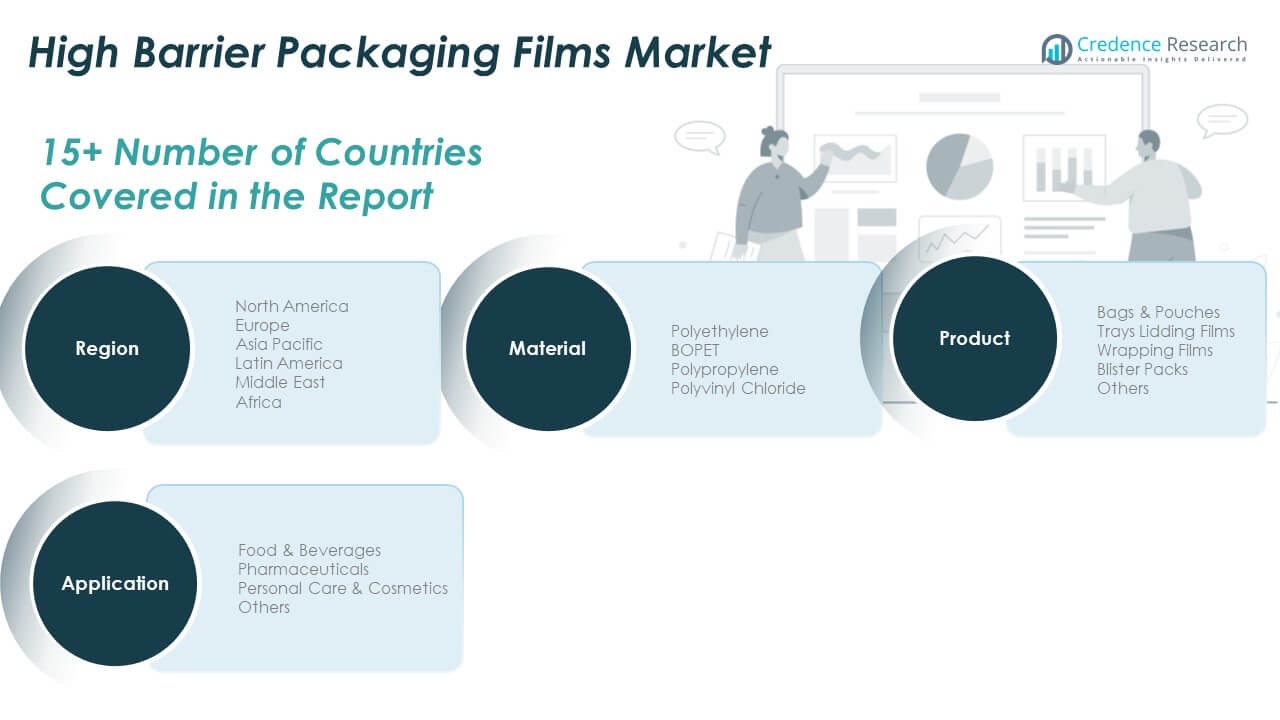
The High Barrier Packaging Films Market is segmented by material, product, and application, reflecting its diverse industrial scope.

By material, polyethylene (PE) dominates due to its flexibility, cost efficiency, and wide compatibility with food packaging formats. BOPET films hold a significant share owing to their excellent mechanical strength and clarity. Polypropylene (PP) is preferred for its moisture resistance and recyclability, while polyvinyl chloride (PVC) supports pharmaceutical and personal care packaging with superior sealing properties. Each material type caters to unique performance requirements and regulatory standards across end-use sectors.

  • For instance, in August 2023, ExxonMobil introduced its HD7165L high-density polyethylene resin for machine direction oriented (MDO) films, engineered for mono-material laminate structures compatible with polyethylene recycling streams and offering strong mechanical and optical performance.

By product, bags and pouches lead due to their adaptability across retail and industrial packaging. Trays and lidding films are gaining traction for ready-to-eat and perishable food segments. Wrapping films support convenience packaging for snacks and bakery items, while blister packs ensure secure product containment for medicines and cosmetics. The “others” category includes specialty films used in industrial packaging applications. Product diversification enhances supply flexibility and supports innovation in sustainability and performance design.

By application, food and beverages represent the largest demand segment due to growing packaged food consumption and export activities. Pharmaceuticals rely on barrier films for moisture-sensitive and temperature-stable formulations. The personal care and cosmetics industry uses these films for odor retention and contamination prevention. Other applications, including electronics and household goods, are expanding with the rise of e-commerce and global logistics networks. This segmentation underlines the industry’s ability to meet specialized performance, safety, and sustainability needs across multiple sectors.

  • For instance, Berry Global’s flexible packaging division expanded its 2024 sustainable portfolio with films containing post-consumer recycled polyethylene, while Amcor and Mondi continued supplying high-barrier recyclable films designed to extend shelf life and support food safety compliance for major consumer brands.

High Barrier Packaging Films Market Segmentation

Segmentation:

By Material

  • Polyethylene (PE)
  • BOPET (Biaxially Oriented Polyethylene Terephthalate)
  • Polypropylene (PP)
  • Polyvinyl Chloride (PVC)

By Product

  • Bags & Pouches
  • Trays & Lidding Films
  • Wrapping Films
  • Blister Packs
  • Others

By Application

  • Food & Beverages
  • Pharmaceuticals
  • Personal Care & Cosmetics
  • Others

By Region

  • North America
    • U.S.
    • Canada
    • Mexico
  • Europe
    • Germany
    • France
    • U.K.
    • Italy
    • Spain
    • Rest of Europe
  • Asia Pacific
    • China
    • Japan
    • India
    • South Korea
    • South-east Asia
    • Rest of Asia Pacific
  • Latin America
    • Brazil
    • Argentina
    • Rest of Latin America
  • Middle East & Africa
    • GCC Countries
    • South Africa
    • Rest of the Middle East and Africa

Regional Analysis:

North America

The North America High Barrier Packaging Films Market size was valued at USD 7,721.60 million in 2018 to USD 9,165.91 million in 2024 and is anticipated to reach USD 15,048.01 million by 2032, at a CAGR of 6.5% during the forecast period. North America holds a 25% share of the global market. The region benefits from strong demand in packaged food, pharmaceuticals, and personal care sectors. The U.S. leads with advanced packaging technologies and high consumer preference for convenient and sustainable solutions. It is supported by innovation in bio-based and recyclable materials. Canada and Mexico contribute through growing manufacturing and export capabilities. The expanding retail sector strengthens film adoption in flexible packaging. Regulatory focus on eco-friendly production also supports regional market expansion.

Europe

The Europe High Barrier Packaging Films Market size was valued at USD 7,052.80 million in 2018 to USD 8,144.21 million in 2024 and is anticipated to reach USD 12,550.14 million by 2032, at a CAGR of 5.7% during the forecast period. Europe accounts for a 23% share of the global market. The region emphasizes recyclable and compostable materials to meet strict environmental standards. Countries such as Germany, France, and the U.K. lead in material innovation and film engineering. It benefits from strong demand in food preservation and pharmaceutical safety packaging. Advanced coating and extrusion technologies enhance barrier strength and recyclability. The EU’s circular economy initiatives drive manufacturers toward sustainable designs. Rising preference for lightweight and flexible formats continues to shape regional demand.

Asia Pacific

The Asia Pacific High Barrier Packaging Films Market size was valued at USD 12,251.20 million in 2018 to USD 15,197.77 million in 2024 and is anticipated to reach USD 26,598.16 million by 2032, at a CAGR of 7.4% during the forecast period. Asia Pacific commands a 44% share of the global market, making it the largest regional contributor. China, Japan, and India drive growth through expanding food processing and healthcare industries. It benefits from rapid urbanization and increasing packaged food consumption. Government support for sustainable manufacturing boosts production capacity. Strong e-commerce growth fuels flexible packaging applications. Investments in polymer innovation and extrusion infrastructure enhance competitiveness. Rising middle-class income levels continue to support product diversification across industries.

Latin America

The Latin America High Barrier Packaging Films Market size was valued at USD 1,641.60 million in 2018 to USD 1,960.65 million in 2024 and is anticipated to reach USD 2,952.19 million by 2032, at a CAGR of 5.4% during the forecast period. Latin America holds a 5% share of the global market. The region’s demand is fueled by food export growth and increasing packaged product penetration. Brazil and Argentina lead due to established food and beverage industries. It benefits from expanding retail networks and urbanization. Local film producers invest in cost-effective barrier solutions to enhance competitiveness. Demand for pharmaceutical and personal care packaging is rising. Flexible and multilayer films gain preference due to improved storage and logistics performance. The region focuses on upgrading production capacity to meet export requirements.

Middle East

The Middle East High Barrier Packaging Films Market size was valued at USD 957.60 million in 2018 to USD 1,068.41 million in 2024 and is anticipated to reach USD 1,546.80 million by 2032, at a CAGR of 4.9% during the forecast period. The Middle East accounts for a 2.6% share of the global market. The region experiences growing demand from packaged food, cosmetics, and pharmaceutical industries. The GCC countries drive the market with rising disposable incomes and population growth. It benefits from the expansion of local manufacturing hubs and food processing units. Investments in sustainable materials are increasing in response to regional environmental goals. Retail packaging trends favor durable and visually appealing films. The region also sees growth in logistics-driven flexible packaging applications.

Africa

The Africa High Barrier Packaging Films Market size was valued at USD 775.20 million in 2018 to USD 1,186.31 million in 2024 and is anticipated to reach USD 1,713.76 million by 2032, at a CAGR of 4.4% during the forecast period. Africa represents a 2.4% share of the global market. The region’s expansion is supported by a growing population and rising packaged food demand. South Africa leads with industrial packaging innovation and expanding retail infrastructure. It is supported by local initiatives to improve waste management and recycling. North African economies show increasing adoption in pharmaceutical and personal care packaging. Import substitution policies encourage domestic manufacturing. Investments in lightweight packaging support product accessibility. Rising urban consumption continues to strengthen future market prospects.

Key Player Analysis:

  • Amcor plc
  • Sealed Air Corporation
  • Huhtamaki Oyj
  • Klöckner Pentaplast Group
  • Mondi Group
  • Constantia Flexibles
  • Berry Global Inc.
  • Coveris Holdings S.A.
  • Sonoco Products Company
  • Wipak Group
  • Uflex Limited
  • Printpack, Inc.
  • Jindal Poly Films Ltd.
  • Cosmo Films Ltd.

Competitive Analysis:

The High Barrier Packaging Films Market features strong competition among global and regional players focused on innovation, sustainability, and performance efficiency. Key companies such as Amcor plc, Sealed Air, Huhtamaki, Mondi, and Berry Global Inc. dominate through advanced product portfolios and consistent investment in research and development. It emphasizes recyclable, multilayer, and bio-based solutions to meet environmental standards and consumer preferences. Strategic mergers, acquisitions, and capacity expansions strengthen supply chain networks and market presence. Firms leverage digital printing, coating, and extrusion technologies to enhance barrier strength and customization. Regional producers compete by offering cost-effective and localized packaging solutions. The rising importance of eco-friendly materials and regulatory compliance encourages continuous technological evolution and product differentiation.

Shape Your Report to Specific Countries or Regions & Enjoy 30% Off!

Recent Developments:

  • In October 2025, Amcor plc announced plans to showcase its latest responsible and patient-centric packaging innovations at CPHI Frankfurt 2025, building on recent launches of recyclable and high-barrier flexible packaging solutions that address sustainability and advanced barrier needs for food, pharmaceutical, and personal care products.
  • In April 2025, Soteria Flexibles Corp. expanded its capabilities within the high barrier packaging films sector by acquiring Hamilton Plastics Inc. in Tennessee. This acquisition enables Soteria Flexibles to leverage Hamilton Plastics’ advanced co-extrusion technologies and research facilities, thereby strengthening its presence in food, industrial, and medical packaging.
  • In October 2024, Klöckner Pentaplast introduced two new recyclable barrier flow wrap films, kp FlexiFlow EH 155 R and kp FlexiFlow PH 255 R. These films offer high barrier protection, rapid packing speeds, and superior recyclability, supporting the food, dairy, and fresh produce sectors.

Report Coverage:

The research report offers an in-depth analysis based on Material, Product and Application. It details leading market players, providing an overview of their business, product offerings, investments, revenue streams, and key applications. Additionally, the report includes insights into the competitive environment, SWOT analysis, current market trends, as well as the primary drivers and constraints. Furthermore, it discusses various factors that have driven market expansion in recent years. The report also explores market dynamics, regulatory scenarios, and technological advancements that are shaping the industry. It assesses the impact of external factors and global economic changes on market growth. Lastly, it provides strategic recommendations for new entrants and established companies to navigate the complexities of the market.

Future Outlook:

  • The High Barrier Packaging Films Market will advance through rapid adoption of sustainable and recyclable barrier materials across packaging applications.
  • Rising investments in nanotechnology and bio-based polymers will enhance film performance and extend product shelf life.
  • Growth in e-commerce and ready-to-eat food categories will strengthen demand for flexible and lightweight packaging solutions.
  • Automation and digital printing advancements will improve efficiency, reduce waste, and enable faster product customization.
  • Increasing government support for circular economy initiatives will encourage production of mono-material and recyclable films.
  • Pharmaceutical and personal care sectors will boost market expansion through high demand for contamination-resistant packaging.
  • Strategic collaborations among resin suppliers, converters, and brand owners will accelerate innovation in film manufacturing.
  • Regional players will expand capacity to meet rising consumption in Asia-Pacific and emerging markets.
  • Sustainability certifications and eco-label compliance will drive competitive differentiation among manufacturers.
  • Continuous R&D efforts will lead to improved mechanical strength, seal integrity, and recyclability of high-barrier materials.

CHAPTER NO. 1 : GENESIS OF THE MARKET

1.1 Market Prelude – Introduction & Scope

1.2 The Big Picture – Objectives & Vision

1.3 Strategic Edge – Unique Value Proposition

1.4 Stakeholder Compass – Key Beneficiaries

CHAPTER NO. 2 : EXECUTIVE LENS

2.1 Pulse of the Industry – Market Snapshot

2.2 Growth Arc – Revenue Projections (USD Million)

2.3. Premium Insights – Based on Primary Interviews

CHAPTER NO. 3 : HIGH BARRIER PACKAGING FILMS MARKET FORCES & INDUSTRY PULSE

3.1 Foundations of Change – Market Overview

3.2 Catalysts of Expansion – Key Market Drivers

3.2.1 Momentum Boosters – Growth Triggers

3.2.2 Innovation Fuel – Disruptive Technologies

3.3 Headwinds & Crosswinds – Market Restraints

3.3.1 Regulatory Tides – Compliance Challenges

3.3.2 Economic Frictions – Inflationary Pressures

3.4 Untapped Horizons – Growth Potential & Opportunities

3.5 Strategic Navigation – Industry Frameworks

3.5.1 Market Equilibrium – Porter’s Five Forces

3.5.2 Ecosystem Dynamics – Value Chain Analysis

3.5.3 Macro Forces – PESTEL Breakdown

3.6 Price Trend Analysis

3.6.1 Regional Price Trend

3.6.2 Price Trend by product

CHAPTER NO. 4 : KEY INVESTMENT EPICENTER

4.1 Regional Goldmines – High-Growth Geographies

4.2 Material Frontiers – Lucrative Material Categories

4.3 Product Sweet Spots – Emerging Demand Segments

CHAPTER NO. 5: REVENUE TRAJECTORY & WEALTH MAPPING

5.1 Momentum Metrics – Forecast & Growth Curves

5.2 Regional Revenue Footprint – Market Share Insights

5.3 Segmental Wealth Flow – Material & Product Revenue

CHAPTER NO. 6 : TRADE & COMMERCE ANALYSIS

6.1. Import Analysis by Region

6.1.1. Global High Barrier Packaging Films Market Import Revenue By Region

6.2. Export Analysis by Region

6.2.1. Global High Barrier Packaging Films Market Export Revenue By Region

CHAPTER NO. 7 : COMPETITION ANALYSIS

7.1. Company Market Share Analysis

7.1.1. Global High Barrier Packaging Films Market: Company Market Share

7.2. Global High Barrier Packaging Films Market Company Revenue Market Share

7.3. Strategic Developments

7.3.1. Acquisitions & Mergers

7.3.2. New Material Launch

7.3.3. Regional Expansion

7.4. Competitive Dashboard

7.5. Company Assessment Metrics, 2024

CHAPTER NO. 8 : HIGH BARRIER PACKAGING FILMS MARKET – BY MATERIAL SEGMENT ANALYSIS

8.1. High Barrier Packaging Films Market Overview by Material Segment

8.1.1. High Barrier Packaging Films Market Revenue Share By Material

8.2. Polyethylene

8.3. BOPET

8.4. Polypropylene

8.5. Polyvinyl Chloride

CHAPTER NO. 9 : HIGH BARRIER PACKAGING FILMS MARKET – BY PRODUCT SEGMENT ANALYSIS

9.1. High Barrier Packaging Films Market Overview by Product Segment

9.1.1. High Barrier Packaging Films Market Revenue Share By Product

9.2. Bags & Pouches

9.3. Trays Lidding Films

9.4. Wrapping Films

9.5. Blister Packs

9.6. Others

CHAPTER NO. 10 : HIGH BARRIER PACKAGING FILMS MARKET – BY APPLICATION SEGMENT ANALYSIS

10.1. High Barrier Packaging Films Market Overview by Application Segment

10.1.1. High Barrier Packaging Films Market Revenue Share By Application

10.2. Food & Beverages

10.3. Pharmaceuticals

10.4. Personal Care & Cosmetics

10.5. Others

CHAPTER NO. 11 : HIGH BARRIER PACKAGING FILMS MARKET – REGIONAL ANALYSIS

11.1. High Barrier Packaging Films Market Overview by Region Segment

11.1.1. Global High Barrier Packaging Films Market Revenue Share By Region

11.1.3. Regions

11.1.4. Global High Barrier Packaging Films Market Revenue By Region

.1.6. Material

11.1.7. Global High Barrier Packaging Films Market Revenue By Material

11.1.9. Product

11.1.10. Global High Barrier Packaging Films Market Revenue By Product

11.1.12. Application

11.1.13. Global High Barrier Packaging Films Market Revenue By Application

CHAPTER NO. 12 : NORTH AMERICA HIGH BARRIER PACKAGING FILMS MARKET – COUNTRY ANALYSIS

12.1. North America High Barrier Packaging Films Market Overview by Country Segment

12.1.1. North America High Barrier Packaging Films Market Revenue Share By Region

12.2. North America

12.2.1. North America High Barrier Packaging Films Market Revenue By Country

12.2.2. Material

12.2.3. North America High Barrier Packaging Films Market Revenue By Material

12.2.4. Product

12.2.5. North America High Barrier Packaging Films Market Revenue By Product

2.2.6. Application

12.2.7. North America High Barrier Packaging Films Market Revenue By Application

2.3. U.S.

12.4. Canada

12.5. Mexico

CHAPTER NO. 13 : EUROPE HIGH BARRIER PACKAGING FILMS MARKET – COUNTRY ANALYSIS

13.1. Europe High Barrier Packaging Films Market Overview by Country Segment

13.1.1. Europe High Barrier Packaging Films Market Revenue Share By Region

13.2. Europe

13.2.1. Europe High Barrier Packaging Films Market Revenue By Country

13.2.2. Material

13.2.3. Europe High Barrier Packaging Films Market Revenue By Material

13.2.4. Product

13.2.5. Europe High Barrier Packaging Films Market Revenue By Product

13.2.6. Application

13.2.7. Europe High Barrier Packaging Films Market Revenue By Application

13.3. UK

13.4. France

13.5. Germany

13.6. Italy

13.7. Spain

13.8. Russia

13.9. Rest of Europe

CHAPTER NO. 14 : ASIA PACIFIC HIGH BARRIER PACKAGING FILMS MARKET – COUNTRY ANALYSIS

14.1. Asia Pacific High Barrier Packaging Films Market Overview by Country Segment

14.1.1. Asia Pacific High Barrier Packaging Films Market Revenue Share By Region

14.2. Asia Pacific

14.2.1. Asia Pacific High Barrier Packaging Films Market Revenue By Country

14.2.2. Material

14.2.3. Asia Pacific High Barrier Packaging Films Market Revenue By Material

14.2.4. Product

14.2.5. Asia Pacific High Barrier Packaging Films Market Revenue By Product

14.2.5. Application

14.2.7. Asia Pacific High Barrier Packaging Films Market Revenue By Application

14.3. China

14.4. Japan

14.5. South Korea

14.6. India

14.7. Australia

14.8. Southeast Asia

14.9. Rest of Asia Pacific

CHAPTER NO. 15 : LATIN AMERICA HIGH BARRIER PACKAGING FILMS MARKET – COUNTRY ANALYSIS

15.1. Latin America High Barrier Packaging Films Market Overview by Country Segment

15.1.1. Latin America High Barrier Packaging Films Market Revenue Share By Region

15.2. Latin America

15.2.1. Latin America High Barrier Packaging Films Market Revenue By Country

15.2.2. Material

15.2.3. Latin America High Barrier Packaging Films Market Revenue By Material

15.2.4. Product

15.2.5. Latin America High Barrier Packaging Films Market Revenue By Product

15.2.6. Application

15.2.7. Latin America High Barrier Packaging Films Market Revenue By Application

15.3. Brazil

15.4. Argentina

15.5. Rest of Latin America

CHAPTER NO. 16 : MIDDLE EAST HIGH BARRIER PACKAGING FILMS MARKET – COUNTRY ANALYSIS

16.1. Middle East High Barrier Packaging Films Market Overview by Country Segment

16.1.1. Middle East High Barrier Packaging Films Market Revenue Share By Region

16.2. Middle East

16.2.1. Middle East High Barrier Packaging Films Market Revenue By Country

16.2.2. Material

16.2.3. Middle East High Barrier Packaging Films Market Revenue By Material

16.2.4. Product

16.2.5. Middle East High Barrier Packaging Films Market Revenue By Product

16.2.6. Application

16.2.7. Middle East High Barrier Packaging Films Market Revenue By Application

16.3. GCC Countries

16.4. Israel

16.5. Turkey

16.6. Rest of Middle East

CHAPTER NO. 17 : AFRICA HIGH BARRIER PACKAGING FILMS MARKET – COUNTRY ANALYSIS

17.1. Africa High Barrier Packaging Films Market Overview by Country Segment

17.1.1. Africa High Barrier Packaging Films Market Revenue Share By Region

17.2. Africa

17.2.1. Africa High Barrier Packaging Films Market Revenue By Country

17.2.2. Material

17.2.3. Africa High Barrier Packaging Films Market Revenue By Material

17.2.4. Product

17.2.5. Africa High Barrier Packaging Films Market Revenue By Product

17.2.6. Application

17.2.7. Africa High Barrier Packaging Films Market Revenue By Application

17.3. South Africa

17.4. Egypt

17.5. Rest of Africa

CHAPTER NO. 18 : COMPANY PROFILES

18.1. Amcor plc

18.1.1. Company Overview

18.1.2. Material Portfolio

18.1.3. Financial Overview

18.1.4. Recent Developments

18.1.5. Growth Strategy

18.1.6. SWOT Analysis

18.2. Sealed air

18.3. Huhtamaki

18.4. Klockner pentaplast

18.5. Mondi

18.6. Constantia flexibles

18.7. Berry global inc

18.8. Coveris

18.9. Sonoco product company

18.10. Wipak

18.11. Uflex limited

18.12. Printpack

18.13. Jindal poly films

18.14. Cosmo films ltd.

Request Free Sample

We prioritize the confidentiality and security of your data. Our promise: your information remains private.

Ready to Transform Data into Decisions?

Request Your Sample Report and Start Your Journey of Informed Choices


Providing the strategic compass for industry titans.

cr-clients-logos

Frequently Asked Questions:

What is the current market size for the High Barrier Packaging Films Market, and what is its projected size in 2032?

The High Barrier Packaging Films Market was valued at USD 36,723.26 million in 2024 and is projected to reach USD 60,409.07 million by 2032, reflecting steady global expansion across industries.

At what Compound Annual Growth Rate is the High Barrier Packaging Films Market projected to grow between 2024 and 2032?

The High Barrier Packaging Films Market is anticipated to grow at a CAGR of 6.53% during the forecast period from 2024 to 2032.

Which High Barrier Packaging Films Market segment held the largest share in 2024?

In 2024, the food and beverages segment accounted for the largest share of the High Barrier Packaging Films Market, driven by strong packaged food demand and export activities.

What are the primary factors fueling the growth of the High Barrier Packaging Films Market?

Key drivers of the High Barrier Packaging Films Market include the rising demand for extended shelf life, sustainable packaging solutions, and technological advancements in multilayer film design.

Who are the leading companies in the High Barrier Packaging Films Market?

Major players in the High Barrier Packaging Films Market include Amcor plc, Sealed Air, Huhtamaki, Mondi, Berry Global Inc., and Constantia Flexibles, each emphasizing innovation and sustainable production.

Which region commanded the largest share of the High Barrier Packaging Films Market in 2024?

Asia Pacific held the largest share of the High Barrier Packaging Films Market in 2024, supported by growing consumption in food, pharmaceutical, and personal care industries.

About Author

Rajdeep Kumar Deb

Rajdeep Kumar Deb

Lead Analyst – Consumer & Finance

Rajdeep brings a decade of consumer goods and financial services insight to strategic market analysis.

View Profile

Related Reports

Chemically Recycled Flexible Packaging Market

The chemically recycled flexible packaging market was valued at USD 8.1 billion in 2024 and is projected to reach USD 17.17 billion by 2032, advancing at a CAGR of 9.85% during the forecast period.

Retail Ready Packaging Market

The Retail Ready Packaging market size reached USD 92.69 billion in 2024 and is projected to reach USD 137.88 billion by 2032, supported by a 5.09% CAGR during the forecast period.

Polypropylene Packaging Films Market

The Polypropylene Packaging Films market reached USD 32.24 billion in 2024 and is projected to rise to USD 45.81 billion by 2032, registering a CAGR of 4.49% during the forecast period.

UK Anti-Counterfeit Packaging Market

The UK Anti-Counterfeit Packaging Market size was valued at USD 11,551.97 million in 2018 to USD 11,963.70 million in 2024 and is anticipated to reach USD 15,437.99 million by 2032, at a CAGR of 3.24% during the forecast period.

U.S. Anti-Counterfeit Packaging Market

The U.S. Anti-Counterfeit Packaging Market size was valued at USD 26,325.13 million in 2018, increased to USD 27,045.00 million in 2024, and is anticipated to reach USD 34,437.41 million by 2032, growing at a CAGR of 3.07% during the forecast period.

Spain Anti-Counterfeit Packaging Market

The Spain Anti-Counterfeit Packaging Market size was valued at USD 3,600.61 million in 2018 to USD 3,675.96 million in 2024 and is anticipated to reach USD 3,912.89 million by 2032, at a CAGR of 0.78% during the forecast period.

North America Anti-Counterfeit Packaging Market

The North America Anti-Counterfeit Packaging Market size was valued at USD 50,632.40 million in 2018 to USD 75,161.09 million in 2024 and is anticipated to reach USD 1,82,198.10 million by 2032, at a CAGR of 11.70% during the forecast period.

Medication Pouch Inspection Systems Market

Medication Pouch Inspection Systems Market size was valued at USD 33.75 Million in 2024 and is anticipated to reach USD 61.55 Million by 2032, at a CAGR of 7.8% during the forecast period.

Plastic Bucket Market

The Global Plastic Bucket Market size was valued at USD 5,200.00 million in 2018 to USD 6,130.23 million in 2024 and is anticipated to reach USD 9,768.35 million by 2032, at a CAGR of 6.11% during the forecast period.

Inverted Pouch Market

Inverted Pouch Market size was valued USD 13.98 Billion in 2024 and is anticipated to reach USD 24.56 Billion by 2032, at a CAGR of 7.3% during the forecast period.

Corrugated Handle Box Market

Corrugated handle box market was valued at USD 46.18 billion in 2024 and is anticipated to reach USD 77.58 billion by 2032, growing at a CAGR of 6.7 % during the forecast period.

Case Sealers Market

Case Sealers Market size was valued at USD 1178.5 million in 2024 and is anticipated to reach USD 1808.63 million by 2032, at a CAGR of 5.5% during the forecast period.

Licence Option

The report comes as a view-only PDF document, optimized for individual clients. This version is recommended for personal digital use and does not allow printing. Use restricted to one purchaser only.
$4999

To meet the needs of modern corporate teams, our report comes in two formats: a printable PDF and a data-rich Excel sheet. This package is optimized for internal analysis. Unlimited users allowed within one corporate location (e.g., regional office).
$6999

The report will be delivered in printable PDF format along with the report’s data Excel sheet. This license offers 100 Free Analyst hours where the client can utilize Credence Research Inc. research team. Permitted for unlimited global use by all users within the purchasing corporation, such as all employees of a single company.
$12999

Report delivery within 24 to 48 hours

Credence Staff 3

WILLIAM, North America

Support Staff at Credence Research

KEITH PHILLIPS, Europe

Lee - CR Sales Staff

LEE VALLANCE, Asia Pacific

Kieran Jameson

KIERAN JAMESON, Australia

Smallform of Sample request
User Review

Thank you for the data! The numbers are exactly what we asked for and what we need to build our business case.

Materials Scientist
(privacy requested)

User Review

The report was an excellent overview of the Industrial Burners market. This report does a great job of breaking everything down into manageable chunks.

Imre Hof
Management Assistant, Bekaert

cr-clients-logos

Request Sample