Home » Consumer Goods » Airlaid Paper For Food Market

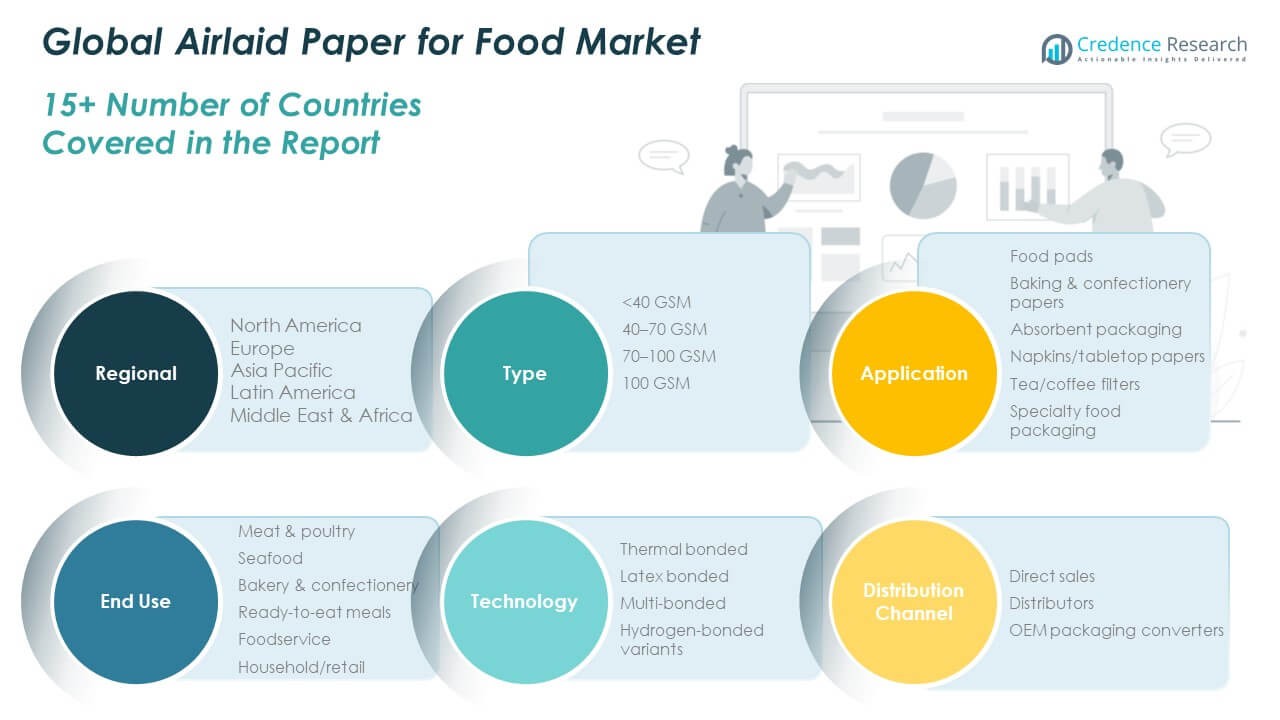
Airlaid Paper for Food Market By Type (< 40 GSM, 40–70 GSM, 70–100 GSM, 100 GSM); By Application (Food Pads, Baking & Confectionery Papers, Absorbent Packaging, Napkins/Tabletop Papers, Tea/Coffee Filters, Specialty Food Packaging); By End Use (Meat & Poultry, Seafood, Bakery & Confectionery, Ready-to-Eat Meals, Foodservice, Household/Retail); By Technology (Thermal Bonded, Latex Bonded, Multi-Bonded, Hydrogen-Bonded Variants); By Distribution Channel (Direct Sales, Distributors, OEM Packaging Converters) – Growth, Share, Opportunities & Competitive Analysis, 2024 – 2032

Report ID: 6991 | Report Format : Excel, PDF

Market Overview:

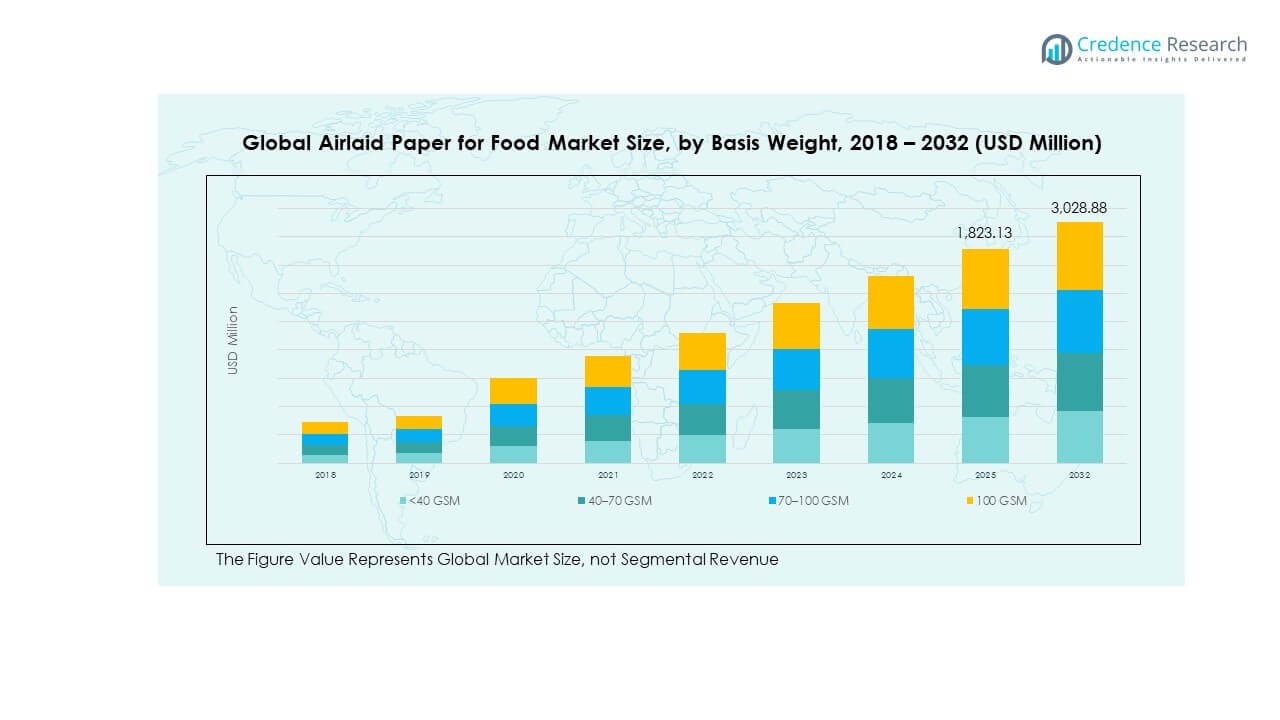
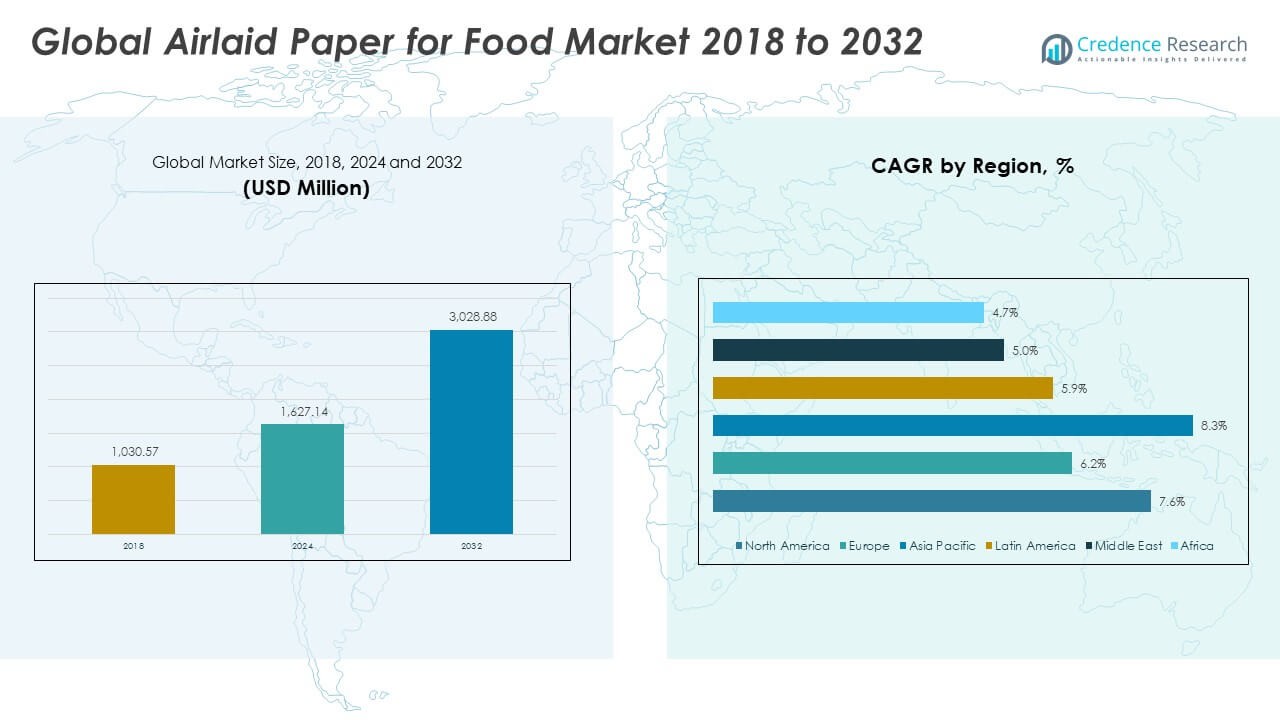
The Global Airlaid Paper for Food Market size was valued at USD 1,030.57 million in 2018 to USD 1,627.14 million in 2024 and is anticipated to reach USD 3,028.88 million by 2032, at a CAGR of 7.52% during the forecast period.

REPORT ATTRIBUTE DETAILS
Historical Period 2020-2023
Base Year 2024
Forecast Period 2025-2032
Airlaid Paper for Food Market Size 2024 USD 1,627.14 Million
Airlaid Paper for Food Market, CAGR 7.52%
Airlaid Paper for Food Market Size 2032 USD 3,028.88 Million


The Global Airlaid Paper for Food Market is primarily driven by rising demand for hygienic, absorbent, and sustainable packaging solutions. The shift from plastic-based materials toward biodegradable alternatives encourages large-scale adoption of airlaid paper in meat pads, bakery wraps, and napkins. Manufacturers invest in high-performance materials that enhance durability and absorption while supporting recyclability. Increasing foodservice expansion, growth of ready-to-eat meals, and heightened focus on product safety continue to strengthen overall market demand.

Geographically, Asia Pacific leads the Global Airlaid Paper for Food Market due to expanding food processing industries, urbanization, and growing sustainability awareness. North America and Europe hold significant shares, supported by stringent packaging standards and advanced production technologies. Latin America shows steady growth, driven by rising disposable incomes and food retail expansion. The Middle East and Africa are emerging markets where changing consumer lifestyles and growing investment in food packaging infrastructure are creating new opportunities for manufacturers.

Access crucial information at unmatched prices!

Request your sample report today & start making informed decisions powered by Credence Research Inc.!

Download Sample

Market Insights:

  • The Global Airlaid Paper for Food Market was valued at USD 1,030.57 million in 2018, reached USD 1,627.14 million in 2024, and is projected to attain USD 3,028.88 million by 2032, growing at a CAGR of 7.52%.
  • Asia Pacific holds around 36% of the global share, leading due to rapid industrial expansion, urbanization, and demand for sustainable food packaging materials.
  • North America accounts for about 28% of the market, supported by strong hygiene standards and widespread adoption of absorbent food packaging. Europe follows with roughly 24%, driven by advanced sustainability regulations and high consumer awareness.
  • Asia Pacific remains the fastest-growing region, supported by increasing food processing activities and investments in biodegradable material technologies.
  • By type, the 40–70 GSM segment accounts for nearly 45% of total market share, while 70–100 GSM represents about 30%, highlighting strong demand for mid-weight and high-strength paper grades in packaging applications.

Airlaid Paper for Food Market

Market Drivers

Rising Shift Toward Sustainable Food Packaging Materials

The Global Airlaid Paper for Food Market is expanding due to the growing focus on sustainable packaging solutions. Consumers and regulators demand eco-friendly alternatives to plastic wraps and synthetic liners. Airlaid paper meets these expectations through biodegradability, compostability, and minimal chemical processing. Manufacturers benefit from its low energy requirements and recyclability. The food industry increasingly adopts airlaid paper for bakery wraps, absorbent pads, and disposable food packaging. Stronger environmental regulations in Europe and North America further push manufacturers toward renewable materials. The transition aligns with global climate commitments. These factors collectively accelerate market penetration and long-term adoption.

Growing Demand from Foodservice and Ready-to-Eat Segments

Expansion in foodservice chains and the ready-to-eat sector strengthens demand for airlaid paper packaging. The material offers high absorbency, hygiene, and structural stability under heat and moisture. Restaurants, cafeterias, and delivery platforms use it for napkins, wraps, and disposable trays. It supports compliance with food-safety standards and improves convenience. Growing urban populations and fast-paced lifestyles encourage higher consumption of packaged meals. Airlaid paper helps brands maintain product freshness and reduce leakage risks. Cost efficiency and easy disposal contribute to large-scale adoption. These characteristics strengthen its position across commercial and household food applications.

Technological Advancements Enhancing Performance and Customization

Technological innovation plays a central role in improving airlaid paper quality and production efficiency. Modern equipment enables uniform fiber distribution, precise layering, and advanced bonding techniques. These developments enhance softness, strength, and absorbency across product lines. Manufacturers design specialized airlaid grades for greasy, moist, or hot food applications. Integration of natural binders and biopolymers reduces reliance on synthetic additives. Customization capabilities allow brands to align packaging properties with specific food categories. Continuous R&D investment supports higher throughput and cost competitiveness. This innovation-driven evolution widens adoption in industrial and retail packaging formats.

  • For instance, McAirlaid’s Vliesstoffe GmbH specializes in premium airlaid nonwoven materials using proprietary bonding and layering technologies that enhance absorbency and strength. The company’s innovations focus on food and hygiene packaging, offering customized airlaid products for greasy and moist food applications, aligning with sustainability and performance trends in the Global Airlaid Paper for Food Market.

Rising Hygiene Standards and Regulatory Pressure in Food Handling

Increasing hygiene awareness influences packaging decisions in the food sector. Governments enforce stricter regulations on contact materials to ensure safety and traceability. Airlaid paper offers a clean, lint-free surface suitable for direct food contact. Its production involves minimal chemical residues, aligning with global safety norms. Retailers prefer airlaid materials for meat pads, fruit liners, and bakery wrapping. The ongoing replacement of single-use plastics strengthens its role in the hygiene-focused food economy. It provides superior barrier protection and absorption performance. These regulatory and health-driven preferences amplify the market’s expansion prospects.

  • For instance, Duni AB, a Swedish company specializing in sustainable packaging and tableware, produces airlaid paper products designed for strict EU food-contact compliance. Its airlaid meat pads and fruit liners meet stringent chemical residue and hygiene standards, supporting food retailers’ efforts to maintain safety and regulatory adherence within the Global Airlaid Paper for Food Market.

Airlaid Paper for Food Market Share

Market Trends

Integration of Bio-Based Fibers and Advanced Manufacturing Techniques

Producers are focusing on bio-based fibers like bamboo and hemp to enhance sustainability. These materials improve strength, flexibility, and softness while reducing carbon footprint. Automation and sensor-based production systems enhance output consistency. Companies employ waterless processes and renewable binders to limit environmental impact. Lightweight airlaid variants are gaining traction in food packaging. The shift aligns with global goals for resource efficiency and cleaner manufacturing. Adoption of smart equipment shortens production cycles and ensures quality stability. These developments redefine the manufacturing landscape of airlaid paper.

  • For instance, industrial hemp has been scientifically shown to produce up to 25 tons of fiber matter per hectare while using about 77% less water and inputs than cotton. Its high cellulose content of around 72% in bast fibers enables stronger, sustainable fiber output. Research confirms that the organosolv pulping process for hemp stalks enhances fiber yield and quality with reduced chemical impact, supporting sustainable raw material sourcing relevant to airlaid paper and packaging applications.

Expansion of Private Label and Customized Packaging Solutions

Private label brands increasingly demand tailored airlaid packaging designs. Retailers prefer customized absorbent pads, wraps, and liners to reflect brand identity. Producers respond with printable surfaces and embossing techniques that support brand differentiation. The rise of small and medium-sized food businesses encourages flexible design and low-volume production. Digital printing integration enables rapid response to short production runs. Airlaid paper’s versatility supports both luxury and budget packaging needs. Growing collaboration between converters and retailers drives innovation in personalized designs. This trend fosters greater brand engagement and product visibility.

  • For instance, HP and Xerox have introduced verified digital printing innovations enabling short-run, customized packaging with rapid turnaround. Industry case studies report up to 30% faster job completion, supporting the growing use of digitally printed airlaid packaging within the Global Airlaid Paper for Food Market, where personalized and small-batch food packaging solutions are increasingly in demand.

Increased Use in Frozen and Perishable Food Applications

Rising consumption of frozen foods fuels demand for moisture-absorbent and durable packaging. Airlaid paper serves as an effective moisture barrier during thawing and storage. Its structure maintains integrity under varying temperatures. Producers design specific formulations for seafood, poultry, and bakery packaging. Demand grows from large supermarket chains emphasizing shelf-life extension. Airlaid liners reduce contamination risk and maintain product quality. The trend supports broader use in cold-chain logistics. These performance advantages enhance product appeal and customer satisfaction.

Digital Transformation Across the Supply Chain

Manufacturers deploy digital tools for quality monitoring and inventory management. Automated tracking systems help optimize material usage and minimize waste. Data-driven production supports real-time control of moisture levels and fiber distribution. Advanced analytics predict equipment maintenance and reduce downtime. Online platforms enhance collaboration between suppliers and end-users. Transparency across sourcing and production builds buyer confidence. Integration of Industry 4.0 technologies boosts operational efficiency and environmental compliance. This digital transformation defines the next growth phase for airlaid paper producers.

Market Challenges Analysis

High Production Costs and Limited Fiber Availability

The Global Airlaid Paper for Food Market faces cost challenges due to fiber dependency and energy requirements. Natural fiber prices fluctuate with global supply chain disruptions and climatic conditions. Production consumes considerable power, increasing operational expenses. Smaller manufacturers struggle to maintain cost parity with synthetic alternatives. Equipment maintenance and process upgrades demand heavy investment. Limited access to specialty pulps in emerging regions restricts scalability. These economic pressures slow expansion in cost-sensitive markets. Balancing quality with affordability remains a major industry obstacle.

Intense Competition from Substitute Materials and Recycling Constraints

Alternative materials like coated papers, tissue laminates, and biodegradable films compete with airlaid paper. These substitutes offer varying performance at lower cost in some applications. Recycling airlaid composites with binders presents technical difficulties. Mixed fiber content complicates material recovery and reuse. Regional recycling infrastructure often lacks capacity to process specialty packaging. Regulatory differences between markets hinder standardized recycling programs. Market participants must address sustainability communication gaps. Tackling these material and waste-management issues is essential for long-term competitiveness.

Market Opportunities

Growing Penetration in Emerging Economies and Quick-Service Food Chains

Expanding foodservice infrastructure in developing economies opens new revenue avenues. Urbanization and rising disposable income accelerate packaged food demand. Airlaid paper meets hygiene and sustainability expectations of fast-growing restaurant networks. Governments in Asia-Pacific and Latin America promote eco-friendly packaging alternatives. The material’s cost-to-performance ratio appeals to small manufacturers seeking plastic reduction. Collaborations with local converters enhance regional accessibility. This growth supports broader market diversification and supply resilience. The ongoing expansion of quick-service chains ensures consistent consumption volumes.

Innovation in Functional Coatings and Multi-Layered Product Designs

Producers explore coatings that improve grease resistance and barrier strength without compromising recyclability. Combining airlaid substrates with bio-films enhances durability and printability. These innovations target convenience packaging, bakery wraps, and heat-seal applications. Research into water-based adhesives and cellulose-derived resins improves performance standards. The integration of antimicrobial agents offers extended food protection. Partnerships between material scientists and packaging firms drive product differentiation. Technological innovation unlocks higher-value applications across multiple food categories. These advancements promise long-term opportunities for premium-grade airlaid paper adoption.

Airlaid Paper for Food Market Segmentation

Market Segmentation Analysis:

The Global Airlaid Paper for Food Market is structured across multiple segments that define its performance and growth dynamics.

By type, categories such as < 40 GSM, 40–70 GSM, 70–100 GSM, and 100 GSM serve distinct applications based on thickness, softness, and absorbency. The 40–70 GSM range is most common due to its balance of strength and cost efficiency, supporting mass production for food pads and packaging liners. Lighter variants find use in napkins and filters, while heavier grades suit absorbent or industrial packaging. Each type aligns with specific product performance and sustainability goals.

  • For instance, Georgia-Pacific LLC operates advanced airlaid manufacturing facilities that utilize fiber defibration and binder application technologies to enhance absorbency and softness. The company’s airlaid materials are widely used in hygiene and food packaging applications, emphasizing consistent quality and performance across global markets.

By application, airlaid paper is used in food pads, baking and confectionery papers, absorbent packaging, napkins, tea or coffee filters, and specialty food packaging. Food pads remain the leading segment, driven by high demand from meat and seafood packaging for leakage control and hygiene. Baking and confectionery applications grow steadily due to expanding demand for grease-resistant and non-stick wrapping. Specialty packaging attracts innovation with biodegradable coatings and printed designs for brand differentiation.

By end use, meat & poultry, seafood, bakery & confectionery, ready-to-eat meals, foodservice, and household retail define consumption trends. The meat & poultry sector dominates due to widespread use of absorbent pads. Foodservice adoption is rising rapidly, fueled by quick-service outlets and delivery expansion. Household usage continues growing through retail adoption of disposable, compostable food wraps.

  • For instance, Suominen Corporation, a leading nonwoven producer, implemented technological upgrades that improved processing efficiency and product softness in its airlaid paper portfolio. These enhancements support growing demand from meat, poultry, and foodservice packaging sectors, aligning with the performance and hygiene standards of the Global Airlaid Paper for Food Market.

By technology, thermal-bonded airlaid paper leads due to durability and high absorbency. Latex and multi-bonded types are expanding with new hygiene standards, while hydrogen-bonded variants offer premium softness. Distribution occurs mainly through direct sales, distributors, and OEM packaging converters, ensuring strong supply integration across regions.

Segmentation:

By Type

  • < 40 GSM
  • 40–70 GSM
  • 70–100 GSM
  • 100 GSM

By Application

  • Food Pads
  • Baking & Confectionery Papers
  • Absorbent Packaging
  • Napkins/Tabletop Papers
  • Tea/Coffee Filters
  • Specialty Food Packaging

By End Use

  • Meat & Poultry
  • Seafood
  • Bakery & Confectionery
  • Ready-to-Eat Meals
  • Foodservice
  • Household/Retail

By Technology

  • Thermal Bonded
  • Latex Bonded
  • Multi-Bonded
  • Hydrogen-Bonded Variants

By Distribution Channel

  • Direct Sales
  • Distributors
  • OEM Packaging Converters

By Region

  • North America
    • U.S.
    • Canada
    • Mexico
  • Europe
    • Germany
    • France
    • U.K.
    • Italy
    • Spain
    • Rest of Europe
  • Asia Pacific
    • China
    • Japan
    • India
    • South Korea
    • South-east Asia
    • Rest of Asia Pacific
  • Latin America
    • Brazil
    • Argentina
    • Rest of Latin America
  • Middle East & Africa
    • GCC Countries
    • South Africa
    • Rest of the Middle East and Africa

Regional Analysis:

North America

The North America Global Airlaid Paper for Food Market size was valued at USD 295.10 million in 2018 to USD 458.54 million in 2024 and is anticipated to reach USD 857.20 million by 2032, at a CAGR of 7.6 % during the forecast period. North America accounts for nearly 28 % of the global market share, driven by strong food packaging regulations and advanced manufacturing capabilities. The U.S. leads consumption due to a high demand for absorbent food pads and ready-to-eat meal packaging. Canada and Mexico contribute through expanding retail food chains and adoption of biodegradable materials. Major producers invest in automation and fiber innovation to improve absorbency and sustainability. Consumer awareness of hygiene and food safety further enhances market penetration. Stringent standards on single-use plastics encourage rapid substitution with airlaid paper formats. Robust distribution networks and strategic partnerships support regional growth.

Europe

The Europe Global Airlaid Paper for Food Market size was valued at USD 186.78 million in 2018 to USD 278.27 million in 2024 and is anticipated to reach USD 469.53 million by 2032, at a CAGR of 6.2 % during the forecast period. Europe holds about 24 % of the global share, anchored by early adoption of sustainable packaging solutions. Germany, France, and the U.K. remain key markets supported by strict food contact regulations and circular-economy initiatives. Manufacturers integrate recyclable coatings and renewable binders to meet EU sustainability directives. The bakery and confectionery sectors dominate demand, supported by premium packaging standards. Regional brands emphasize compostable food wraps and grease-resistant airlaid materials. Ongoing R&D in bio-fiber technology enhances material performance. Growing exports to Central and Eastern Europe expand production capacity across major countries.

Asia Pacific

The Asia Pacific Global Airlaid Paper for Food Market size was valued at USD 455.87 million in 2018 to USD 746.01 million in 2024 and is anticipated to reach USD 1,472.40 million by 2032, at a CAGR of 8.3 % during the forecast period. The region dominates with an estimated 36 % market share, supported by high population density and rapid urbanization. China and Japan are key producers leveraging large-scale food packaging industries. India and Southeast Asia show rising consumption driven by quick-service restaurants and disposable hygiene culture. Domestic manufacturers adopt advanced bonding technologies to enhance production efficiency. Government initiatives promoting sustainable packaging accelerate demand in export-oriented food processing. Expanding retail infrastructure and e-commerce strengthen supply networks. Local companies invest in low-cost biodegradable variants to capture emerging consumer segments.

Latin America

The Latin America Global Airlaid Paper for Food Market size was valued at USD 48.68 million in 2018 to USD 75.90 million in 2024 and is anticipated to reach USD 125.05 million by 2032, at a CAGR of 5.9 % during the forecast period. Latin America contributes around 6 % of the global market share, led by Brazil and Mexico. Expanding foodservice industries and rising demand for hygienic packaging support growth. Regional suppliers introduce affordable airlaid grades suitable for bakery and meat packaging. Import reliance remains moderate, with new local production units emerging in key cities. Government efforts to limit plastic waste stimulate sustainable alternatives. Retail chains increasingly adopt compostable food pads and wrapping paper. Rising consumer preference for clean-label packaging drives innovation. Continuous expansion in supermarket networks sustains long-term adoption.

Middle East

The Middle East Global Airlaid Paper for Food Market size was valued at USD 26.92 million in 2018 to USD 38.59 million in 2024 and is anticipated to reach USD 59.72 million by 2032, at a CAGR of 5.0 % during the forecast period. The region holds about 3 % of the global share, supported by growth in the food processing and hospitality sectors. The UAE and Saudi Arabia lead adoption with rising fast-food consumption and imported food packaging standards. Manufacturers emphasize high-absorbency papers for meat and bakery applications. Investment in food logistics and cold-chain operations expands usage of absorbent liners. Local distributors strengthen supply channels across retail and institutional buyers. Regulatory alignment toward sustainable packaging increases import of eco-certified products. Gradual localization of production facilities enhances regional competitiveness and cost efficiency.

Africa

The Africa Global Airlaid Paper for Food Market size was valued at USD 17.22 million in 2018 to USD 29.82 million in 2024 and is anticipated to reach USD 44.97 million by 2032, at a CAGR of 4.7 % during the forecast period. Africa accounts for approximately 3 % of the global market share, showing steady progress in urban and retail expansion. South Africa, Nigeria, and Egypt lead regional demand with growing packaged food consumption. Adoption remains limited by high production costs and import dependency. Local converters are beginning to introduce small-scale manufacturing for absorbent packaging. Rising middle-class income and modern retail growth create long-term opportunities. Awareness of hygiene and sustainability is spreading among consumers. International partnerships are improving material availability and technology transfer across the continent.

Key Player Analysis:

Competitive Analysis:

The competitive landscape for the Global Airlaid Paper for Food Market features several well-established firms that drive innovation, manufacturing scale and geographical reach. Leading companies such as Glatfelter Corporation, Georgia‑Pacific LLC and Domtar Corporation maintain substantial market share through extensive product portfolios and global distribution networks. These firms invest heavily in research and development to enhance absorbency, softness and sustainability of their airlaid offerings. Mid-level players such as McAirlaid’s Vliesstoffe GmbH and Ahlstrom‑Munksjö Corporation pursue strategic partnerships and regional manufacturing to accelerate growth. Smaller niche participants often focus on eco-friendly binders or regional specialty packaging solutions. Competitive tactics include capacity expansion, acquisitions and new product launches targeted at rising end-use segments such as meat & poultry and ready-to-eat meals. Ultimately, it remains critical for companies to differentiate on performance metrics and sustainability credentials to maintain leadership.

Recent Developments:

  • In July 2024, Berry Global Group, Inc. and Glatfelter Corporation officially announced the new brand identity “Magnera Corporation” for their proposed merged nonwovens and films business. The rebranding reflects the companies’ strategic alignment to strengthen their presence in sustainable materials, including food-grade airlaid applications.

Shape Your Report to Specific Countries or Regions & Enjoy 30% Off!

Report Coverage:

The research report offers an in-depth analysis based on Type, Application, End Use, Technology and Distribution Channel. It details leading market players, providing an overview of their business, product offerings, investments, revenue streams, and key applications. Additionally, the report includes insights into the competitive environment, SWOT analysis, current market trends, as well as the primary drivers and constraints. Furthermore, it discusses various factors that have driven market expansion in recent years. The report also explores market dynamics, regulatory scenarios, and technological advancements that are shaping the industry. It assesses the impact of external factors and global economic changes on market growth. Lastly, it provides strategic recommendations for new entrants and established companies to navigate the complexities of the market.

Future Outlook:

  • Rising global demand for sustainable food packaging materials will continue to drive strong growth across developed and emerging economies.
  • Expansion of foodservice, bakery, and ready-to-eat meal sectors will increase adoption of absorbent and hygienic airlaid paper solutions.
  • Manufacturers will prioritize recyclable and compostable grades to comply with tightening environmental regulations worldwide.
  • Technological innovations in bonding, fiber alignment, and biodegradable coatings will enhance product performance and durability.
  • Growth in private-label packaging and custom branding will encourage design diversification and premium product development.
  • Strategic alliances between producers and food packaging converters will strengthen supply chain integration and market reach.
  • Asia Pacific will remain the fastest-growing region, supported by industrial expansion, urbanization, and changing dietary patterns.
  • North America and Europe will focus on R&D and automation to maintain quality leadership in sustainable manufacturing.
  • New entrants will explore niche applications such as tea filters and specialty wrapping, targeting eco-conscious consumers.
  • Long-term investments in circular packaging ecosystems will ensure steady market expansion and material innovation.

CHAPTER NO. 1 : INTRODUCTION 24

1.1.1. Report Description 24

Purpose of the Report 24

USP & Key Offerings 24

1.1.2. Key Benefits for Stakeholders 24

1.1.3. Target Audience 25

1.1.4. Report Scope 25

1.1.5. Regional Scope 26

CHAPTER NO. 2 : EXECUTIVE SUMMARY 27

2.1. Airlaid Paper for Food Market Snapshot 27

2.1.1. Global Airlaid Paper for Food Market, 2020 – 2033 (USD Million) 29

2.2. Insights from Primary Respondents 29

CHAPTER NO. 3 : AIRLAID PAPER FOR FOOD MARKET – INDUSTRY ANALYSIS 30

3.1. Introduction 30

3.2. Market Drivers 31

3.2.1. Increasing demand for sustainable and biodegradable packaging solutions 31

3.2.2. Rising consumption of ready-to-eat meals, meat, seafood, and bakery products 32

3.3. Market Restraints 33

3.3.1. High production costs associated with advanced bonding techniques 33

3.4. Market Opportunities 34

3.4.1. Market Opportunity Analysis 34

3.5. Porter’s Five Forces Analysis 35

3.6. Value Chain Analysis 36

3.7. Buying Criteria 37

CHAPTER NO. 4 : ANALYSIS COMPETITIVE LANDSCAPE 38

4.1. Company Market Share Analysis – 2024 38

4.1.1. Global Airlaid Paper for Food Market: Company Market Share, by Revenue, 2024 38

4.1.2. Global Airlaid Paper for Food Market: Top 6 Company Market Share, by Revenue, 2024 39

4.1.3. Global Airlaid Paper for Food Market: Top 3 Company Market Share, by Revenue, 2024 39

4.2. Global Airlaid Paper for Food Market Company Revenue Market Share, 2023 40

4.3. Company Assessment Metrics, 2024 41

4.3.1. Stars 41

4.3.2. Emerging Leaders 41

4.3.3. Pervasive Players 41

4.3.4. Participants 41

4.4. Start-ups /SMEs Assessment Metrics, 2024 41

4.4.1. Progressive Companies 41

4.4.2. Responsive Companies 41

4.4.3. Dynamic Companies 41

4.4.4. Starting Blocks 41

4.5. Strategic Developments 42

4.5.1. Acquisitions & Mergers 42

4.5.2. New Product Launch 42

4.5.3. Regional Expansion 42

4.6. Key Players Product Matrix 43

CHAPTER NO. 5 : PESTEL & ADJACENT MARKET ANALYSIS 44

5.1. PESTEL 44

5.1.1. Political Factors 44

5.1.2. Economic Factors 44

5.1.3. Social Factors 44

5.1.4. Technological Factors 44

5.1.5. Environmental Factors 44

5.1.6. Legal Factors 44

5.2. Adjacent Market Analysis 44

CHAPTER NO. 6 : AIRLAID PAPER FOR FOOD MARKET – BY TYPE SEGMENT ANALYSIS 45

6.1. Airlaid Paper for Food Market Overview, by Type Segment 45

6.1.1. Airlaid Paper for Food Market Revenue Share, By Type, 2024 & 2033 46

6.1.2. Airlaid Paper for Food Market Attractiveness Analysis, By Type 47

6.1.3. Incremental Revenue Growth Opportunity, by Type, 2026 – 2033 48

6.1.4. Airlaid Paper for Food Market Revenue, By Type, 2020, 2024, 2029 & 2033 49

6.2. <40 GSM 50

6.3. 40–70 GSM 51

6.4. 70–100 GSM 52

6.5. 100 GSM 53

CHAPTER NO. 7 : AIRLAID PAPER FOR FOOD MARKET – BY APPLICATION SEGMENT ANALYSIS 54

7.1. Airlaid Paper for Food Market Overview, by Application Segment 54

7.1.1. Airlaid Paper for Food Market Revenue Share, By Application, 2024 & 2033 55

7.1.2. Airlaid Paper for Food Market Attractiveness Analysis, By Application 56

7.1.3. Incremental Revenue Growth Opportunity, by Application, 2026 – 2033 57

7.1.4. Airlaid Paper for Food Market Revenue, By Application, 2020, 2024, 2029 & 2033 58

7.2. Food pads 59

7.3. Baking & confectionery papers 60

7.4. Absorbent packaging 61

7.5. Napkins/tabletop papers 62

7.6. Tea/coffee filters 63

7.7. Specialty food packaging 64

CHAPTER NO. 8 : AIRLAID PAPER FOR FOOD MARKET – BY END USE SEGMENT ANALYSIS 65

8.1. Airlaid Paper for Food Market Overview, by End Use Segment 65

8.1.1. Airlaid Paper for Food Market Revenue Share, By End Use, 2024 & 2033 66

8.1.2. Airlaid Paper for Food Market Attractiveness Analysis, By End Use 67

8.1.3. Incremental Revenue Growth Opportunity, by End Use, 2026 – 2033 68

8.1.4. Airlaid Paper for Food Market Revenue, By End Use, 2020, 2024, 2029 & 2033 69

8.2. Meat & poultry 70

8.3. Seafood 71

8.4. Bakery & confectionery 72

8.5. Ready-to-eat meals 73

8.6. Foodservice 74

8.7. Household/retail 75

CHAPTER NO. 9 : AIRLAID PAPER FOR FOOD MARKET – BY TECHNOLOGY SEGMENT ANALYSIS 76

9.1. Airlaid Paper for Food Market Overview, by Technology Segment 76

9.1.1. Airlaid Paper for Food Market Revenue Share, By Technology, 2024 & 2033 77

9.1.2. Airlaid Paper for Food Market Attractiveness Analysis, By Technology 78

9.1.3. Incremental Revenue Growth Opportunity, by Technology, 2026 – 2033 79

9.1.4. Airlaid Paper for Food Market Revenue, By Technology, 2020, 2024, 2029 & 2033 80

9.2. Thermal bonded 81

9.3. Latex bonded 82

9.4. Multi-bonded 83

9.5. Hydrogen-bonded variants 84

CHAPTER NO. 10 : AIRLAID PAPER FOR FOOD MARKET – BY DISTRIBUTION CHANNEL SEGMENT ANALYSIS 85

10.1. Airlaid Paper for Food Market Overview, by Distribution Channel Segment 85

10.1.1. Airlaid Paper for Food Market Revenue Share, By Distribution Channel, 2024 & 2033 86

10.1.2. Airlaid Paper for Food Market Attractiveness Analysis, By Distribution Channel 87

10.1.3. Incremental Revenue Growth Opportunity, by Distribution Channel, 2026 – 2033 88

10.1.4. Airlaid Paper for Food Market Revenue, By Distribution Channel, 2020, 2024, 2029 & 2033 89

10.2. Direct sales 90

10.3. Distributors 91

10.4. OEM packaging converters 92

CHAPTER NO. 11 : AIRLAID PAPER FOR FOOD MARKET – REGIONAL ANALYSIS 93

11.1. Airlaid Paper for Food Market Overview, by Regional Segments 93

11.2. Region 94

11.2.1. Global Airlaid Paper for Food Market Revenue Share, By Region, 2024 & 2033 94

11.2.2. Airlaid Paper for Food Market Attractiveness Analysis, By Region 95

11.2.3. Incremental Revenue Growth Opportunity, by Region, 2025 – 2033 95

11.2.4. Airlaid Paper for Food Market Revenue, By Region, 2020, 2024, 2029 & 2033 96

CHAPTER NO. 12 : AIRLAID PAPER FOR FOOD MARKET – NORTH AMERICA 97

12.1. North America 97

12.1.1. Key Highlights 97

12.1.2. North America Airlaid Paper for Food Market Revenue, By Country, 2020 – 2025 (USD Million) 98

12.1.3. North America Airlaid Paper for Food Market Revenue, By Type, 2020 – 2025 (USD Million) 99

12.1.4. North America Airlaid Paper for Food Market Revenue, By Application, 2020 – 2025 (USD Million) 100

12.1.5. North America Airlaid Paper for Food Market Revenue, By End Use, 2020 – 2025 (USD Million) 101

12.1.6. North America Airlaid Paper for Food Market Revenue, By Technology, 2020 – 2025 (USD Million) 102

12.1.7. North America Airlaid Paper for Food Market Revenue, By Distribution Channel, 2020 – 2025 (USD Million) 103

12.2. U.S. 104

12.3. Canada 104

12.4. Mexico 104

CHAPTER NO. 13 : AIRLAID PAPER FOR FOOD MARKET – EUROPE 105

13.1. Europe 105

13.1.1. Key Highlights 105

13.1.2. Europe Airlaid Paper for Food Market Revenue, By Country, 2020 – 2025 (USD Million) 106

13.1.3. Europe Airlaid Paper for Food Market Revenue, By Type, 2020 – 2025 (USD Million) 108

13.1.4. Europe Airlaid Paper for Food Market Revenue, By Application, 2020 – 2025 (USD Million) 109

13.1.5. Europe Airlaid Paper for Food Market Revenue, By End Use, 2020 – 2025 (USD Million) 110

13.1.6. Europe Airlaid Paper for Food Market Revenue, By Technology, 2020 – 2025 (USD Million) 111

13.1.7. Europe Airlaid Paper for Food Market Revenue, By Distribution Channel, 2020 – 2025 (USD Million) 112

13.2. UK 113

13.3. France 113

13.4. Germany 113

13.5. Italy 113

13.6. Spain 113

13.7. Russia 113

13.8. Belgium 113

13.9. Netherland 113

13.10. Austria 113

13.11. Sweden 113

13.12. Poland 113

13.13. Denmark 113

13.14. Switzerland 113

13.15. Rest of Europe 113

CHAPTER NO. 14 : AIRLAID PAPER FOR FOOD MARKET – ASIA PACIFIC 114

14.1. Asia Pacific 114

14.1.1. Key Highlights 114

14.1.2. Asia Pacific Airlaid Paper for Food Market Revenue, By Country, 2020 – 2025 (USD Million) 115

14.1.3. Asia Pacific Airlaid Paper for Food Market Revenue, By Type, 2020 – 2025 (USD Million) 117

14.1.4. Asia Pacific Airlaid Paper for Food Market Revenue, By Application, 2020 – 2025 (USD Million) 118

14.1.5. Asia Pacific Airlaid Paper for Food Market Revenue, By End Use, 2020 – 2025 (USD Million) 119

14.1.6. Asia Pacific Airlaid Paper for Food Market Revenue, By Technology, 2020 – 2025 (USD Million) 120

14.1.7. Asia Pacific Airlaid Paper for Food Market Revenue, By Distribution Channel, 2020 – 2025 (USD Million) 121

14.2. China 122

14.3. Japan 122

14.4. South Korea 122

14.5. India 122

14.6. Australia 122

14.7. Thailand 122

14.8. Indonesia 122

14.9. Vietnam 122

14.10. Malaysia 122

14.11. Philippines 122

14.12. Taiwan 122

14.13. Rest of Asia Pacific 122

CHAPTER NO. 15 : AIRLAID PAPER FOR FOOD MARKET – LATIN AMERICA 123

15.1. Latin America 123

15.1.1. Key Highlights 123

15.1.2. Latin America Airlaid Paper for Food Market Revenue, By Country, 2020 – 2025 (USD Million) 124

15.1.3. Latin America Airlaid Paper for Food Market Revenue, By Type, 2020 – 2025 (USD Million) 125

15.1.4. Latin America Airlaid Paper for Food Market Revenue, By Application, 2020 – 2025 (USD Million) 126

15.1.5. Latin America Airlaid Paper for Food Market Revenue, By End Use, 2020 – 2025 (USD Million) 127

15.1.6. Latin America Airlaid Paper for Food Market Revenue, By Technology, 2020 – 2025 (USD Million) 128

15.1.7. Latin America Airlaid Paper for Food Market Revenue, By Distribution Channel, 2020 – 2025 (USD Million) 129

15.2. Brazil 130

15.3. Argentina 130

15.4. Peru 130

15.5. Chile 130

15.6. Colombia 130

15.7. Rest of Latin America 130

CHAPTER NO. 16 : AIRLAID PAPER FOR FOOD MARKET – MIDDLE EAST 131

16.1. Middle East 131

16.1.1. Key Highlights 131

16.1.2. Middle East Airlaid Paper for Food Market Revenue, By Country, 2020 – 2025 (USD Million) 132

16.1.3. Middle East Airlaid Paper for Food Market Revenue, By Type, 2020 – 2025 (USD Million) 133

16.1.4. Middle East Airlaid Paper for Food Market Revenue, By Application, 2020 – 2025 (USD Million) 134

16.1.5. Middle East Airlaid Paper for Food Market Revenue, By End Use, 2020 – 2025 (USD Million) 135

16.1.6. Middle East Airlaid Paper for Food Market Revenue, By Technology, 2020 – 2025 (USD Million) 136

16.1.7. Middle East Airlaid Paper for Food Market Revenue, By Distribution Channel, 2020 – 2025 (USD Million) 137

16.2. UAE 138

16.3. KSA 138

16.4. Israel 138

16.5. Turkey 138

16.6. Iran 138

16.7. Rest of Middle East 138

CHAPTER NO. 17 : AIRLAID PAPER FOR FOOD MARKET – AFRICA 139

17.1. Africa 139

17.1.1. Key Highlights 139

17.1.2. Africa Airlaid Paper for Food Market Revenue, By Country, 2020 – 2025 (USD Million) 140

17.1.3. Africa Airlaid Paper for Food Market Revenue, By Type, 2020 – 2025 (USD Million) 141

17.1.4. Africa Airlaid Paper for Food Market Revenue, By Application, 2020 – 2025 (USD Million) 142

17.1.5. Africa Airlaid Paper for Food Market Revenue, By End Use, 2020 – 2025 (USD Million) 143

17.1.6. Africa Airlaid Paper for Food Market Revenue, By Technology, 2020 – 2025 (USD Million) 144

17.1.7. Africa Airlaid Paper for Food Market Revenue, By Distribution Channel, 2020 – 2025 (USD Million) 145

17.2. Egypt 146

17.3. Nigeria 146

17.4. Algeria 146

17.5. Morocco 146

17.6. Rest of Africa 146

CHAPTER NO. 18 : COMPANY PROFILES 147

18.1. Glatfelter Corporation 147

18.1.1. Company Overview 147

18.1.2. Product Portfolio 147

18.1.3. Financial Overview 147

18.2. Domtar Corporation 148

18.3. Ahlstrom 148

18.4. Mölnlycke Health Care 148

18.5. Nippon Paper Industries 148

18.6. Company 6 148

18.7. Company 7 148

18.8. Company 8 148

18.9. Company 9 148

18.10. Company 10 148

18.11. Company 11 148

18.12. Company 12 148

18.13. Company 13 148

18.14. Company 14 148

List of Figures

FIG NO. 1. Global Airlaid Paper for Food Market Volume & Revenue, 2020 – 2033 (Kilo Tons) (USD Million) 29

FIG NO. 2. Porter’s Five Forces Analysis for Global Airlaid Paper for Food Market 35

FIG NO. 3. Value Chain Analysis for Global Airlaid Paper for Food Market 36

FIG NO. 4. Company Share Analysis, 2024 38

FIG NO. 5. Company Share Analysis, 2024 39

FIG NO. 6. Company Share Analysis, 2024 39

FIG NO. 7. Airlaid Paper for Food Market – Company Revenue Market Share, 2023 40

FIG NO. 8. Airlaid Paper for Food Market Revenue Share, By Type, 2024 & 2033 46

FIG NO. 9. Market Attractiveness Analysis, By Type 47

FIG NO. 10. Incremental Revenue Growth Opportunity by Type, 2026 – 2033 48

FIG NO. 11. Airlaid Paper for Food Market Revenue, By Type, 2020, 2024, 2029 & 2033 49

FIG NO. 12. Global Airlaid Paper for Food Market for <40 GSM, Revenue (USD Million) 2020 – 2033 50

FIG NO. 13. Global Airlaid Paper for Food Market for 40–70 GSM, Revenue (USD Million) 2020 – 2033 51

FIG NO. 14. Global Airlaid Paper for Food Market for 70–100 GSM, Revenue (USD Million) 2020 – 2033 52

FIG NO. 15. Global Airlaid Paper for Food Market for 100 GSM, Revenue (USD Million) 2020 – 2033 53

FIG NO. 16. Airlaid Paper for Food Market Revenue Share, By Application, 2024 & 2033 55

FIG NO. 17. Market Attractiveness Analysis, By Application 56

FIG NO. 18. Incremental Revenue Growth Opportunity by Application, 2026 – 2033 57

FIG NO. 19. Airlaid Paper for Food Market Revenue, By Application, 2020, 2024, 2029 & 2033 58

FIG NO. 20. Global Airlaid Paper for Food Market for Food pads, Revenue (USD Million) 2020 – 2033 59

FIG NO. 21. Global Airlaid Paper for Food Market for Baking & confectionery papers, Revenue (USD Million) 2020 – 2033 60

FIG NO. 22. Global Airlaid Paper for Food Market for Absorbent packaging, Revenue (USD Million) 2020 – 2033 61

FIG NO. 23. Global Airlaid Paper for Food Market for Napkins/tabletop papers, Revenue (USD Million) 2020 – 2033 62

FIG NO. 24. Global Airlaid Paper for Food Market for Tea/coffee filters, Revenue (USD Million) 2020 – 2033 63

FIG NO. 25. Global Airlaid Paper for Food Market for Specialty food packaging, Revenue (USD Million) 2020 – 2033 64

FIG NO. 26. Airlaid Paper for Food Market Revenue Share, By End Use, 2024 & 2033 66

FIG NO. 27. Market Attractiveness Analysis, By End Use 67

FIG NO. 28. Incremental Revenue Growth Opportunity by End Use, 2026 – 2033 68

FIG NO. 29. Airlaid Paper for Food Market Revenue, By End Use, 2020, 2024, 2029 & 2033 69

FIG NO. 30. Global Airlaid Paper for Food Market for Meat & poultry, Revenue (USD Million) 2020 – 2033 70

FIG NO. 31. Global Airlaid Paper for Food Market for Seafood, Revenue (USD Million) 2020 – 2033 71

FIG NO. 32. Global Airlaid Paper for Food Market for Bakery & confectionery, Revenue (USD Million) 2020 – 2033 72

FIG NO. 33. Global Airlaid Paper for Food Market for Ready-to-eat meals, Revenue (USD Million) 2020 – 2033 73

FIG NO. 34. Global Airlaid Paper for Food Market for Foodservice, Revenue (USD Million) 2020 – 2033 74

FIG NO. 35. Global Airlaid Paper for Food Market for Household/retail, Revenue (USD Million) 2020 – 2033 75

FIG NO. 36. Airlaid Paper for Food Market Revenue Share, By Technology, 2024 & 2033 77

FIG NO. 37. Market Attractiveness Analysis, By Technology 78

FIG NO. 38. Incremental Revenue Growth Opportunity by Technology, 2026 – 2033 79

FIG NO. 39. Airlaid Paper for Food Market Revenue, By Technology, 2020, 2024, 2029 & 2033 80

FIG NO. 40. Global Airlaid Paper for Food Market for Thermal bonded, Revenue (USD Million) 2020 – 2033 81

FIG NO. 41. Global Airlaid Paper for Food Market for Latex bonded, Revenue (USD Million) 2020 – 2033 82

FIG NO. 42. Global Airlaid Paper for Food Market for Multi-bonded, Revenue (USD Million) 2020 – 2033 83

FIG NO. 43. Global Airlaid Paper for Food Market for Hydrogen-bonded variants, Revenue (USD Million) 2020 – 2033 84

FIG NO. 44. Airlaid Paper for Food Market Revenue Share, By Distribution Channel, 2024 & 2033 86

FIG NO. 45. Market Attractiveness Analysis, By Distribution Channel 87

FIG NO. 46. Incremental Revenue Growth Opportunity by Distribution Channel, 2026 – 2033 88

FIG NO. 47. Airlaid Paper for Food Market Revenue, By Distribution Channel, 2020, 2024, 2029 & 2033 89

FIG NO. 48. Global Airlaid Paper for Food Market for Direct sales, Revenue (USD Million) 2020 – 2033 90

FIG NO. 49. Global Airlaid Paper for Food Market for Distributors, Revenue (USD Million) 2020 – 2033 91

FIG NO. 50. Global Airlaid Paper for Food Market for OEM packaging converters, Revenue (USD Million) 2020 – 2033 92

FIG NO. 51. Global Airlaid Paper for Food Market Revenue Share, By Region, 2024 & 2033 94

FIG NO. 52. Market Attractiveness Analysis, By Region 95

FIG NO. 53. Incremental Revenue Growth Opportunity by Region, 2025 – 2033 95

FIG NO. 54. Airlaid Paper for Food Market Revenue, By Region, 2020, 2024, 2029 & 2033 96

FIG NO. 55. North America Airlaid Paper for Food Market Volume & Revenue, 2020 – 2033 (Kilo Tons) (USD Million) 97

FIG NO. 56. Europe Airlaid Paper for Food Market Volume & Revenue, 2020 – 2033 (Kilo Tons) (USD Million) 105

FIG NO. 57. Asia Pacific Airlaid Paper for Food Market Volume & Revenue, 2020 – 2033 (Kilo Tons) (USD Million) 114

FIG NO. 58. Latin America Airlaid Paper for Food Market Volume & Revenue, 2020 – 2033 (Kilo Tons) (USD Million) 123

FIG NO. 59. Middle East Airlaid Paper for Food Market Volume & Revenue, 2020 – 2033 (Kilo Tons) (USD Million) 131

FIG NO. 60. Africa Airlaid Paper for Food Market Volume & Revenue, 2020 – 2033 (Kilo Tons) (USD Million) 139

List of Tables

TABLE NO. 1. : Global Airlaid Paper for Food Market: Snapshot 27

TABLE NO. 2. : Drivers for the Airlaid Paper for Food Market: Impact Analysis 31

TABLE NO. 3. : Restraints for the Airlaid Paper for Food Market: Impact Analysis 33

TABLE NO. 4. : North America Airlaid Paper for Food Market Revenue, By Country, 2020 – 2025 (USD Million) 98

TABLE NO. 5. : North America Airlaid Paper for Food Market Revenue, By Country, 2026 – 2033 (USD Million) 98

TABLE NO. 6. : North America Airlaid Paper for Food Market Revenue, By Type, 2020 – 2025 (USD Million) 99

TABLE NO. 7. : North America Airlaid Paper for Food Market Revenue, By Type, 2026 – 2033 (USD Million) 99

TABLE NO. 8. : North America Airlaid Paper for Food Market Revenue, By Application, 2020 – 2025 (USD Million) 100

TABLE NO. 9. : North America Airlaid Paper for Food Market Revenue, By Application, 2026 – 2033 (USD Million) 100

TABLE NO. 10. : North America Airlaid Paper for Food Market Revenue, By End Use, 2020 – 2025 (USD Million) 101

TABLE NO. 11. : North America Airlaid Paper for Food Market Revenue, By End Use, 2026 – 2033 (USD Million) 101

TABLE NO. 12. : North America Airlaid Paper for Food Market Revenue, By Technology, 2020 – 2025 (USD Million) 102

TABLE NO. 13. : North America Airlaid Paper for Food Market Revenue, By Technology, 2026 – 2033 (USD Million) 102

TABLE NO. 14. : North America Airlaid Paper for Food Market Revenue, By Distribution Channel, 2020 – 2025 (USD Million) 103

TABLE NO. 15. : North America Airlaid Paper for Food Market Revenue, By Distribution Channel, 2026 – 2033 (USD Million) 103

TABLE NO. 16. : Europe Airlaid Paper for Food Market Revenue, By Country, 2020 – 2025 (USD Million) 106

TABLE NO. 17. : Europe Airlaid Paper for Food Market Revenue, By Country, 2026 – 2033 (USD Million) 107

TABLE NO. 18. : Europe Airlaid Paper for Food Market Revenue, By Type, 2020 – 2025 (USD Million) 108

TABLE NO. 19. : Europe Airlaid Paper for Food Market Revenue, By Type, 2026 – 2033 (USD Million) 108

TABLE NO. 20. : Europe Airlaid Paper for Food Market Revenue, By Application, 2020 – 2025 (USD Million) 109

TABLE NO. 21. : Europe Airlaid Paper for Food Market Revenue, By Application, 2026 – 2033 (USD Million) 109

TABLE NO. 22. : Europe Airlaid Paper for Food Market Revenue, By End Use, 2020 – 2025 (USD Million) 110

TABLE NO. 23. : Europe Airlaid Paper for Food Market Revenue, By End Use, 2026 – 2033 (USD Million) 110

TABLE NO. 24. : Europe Airlaid Paper for Food Market Revenue, By Technology, 2020 – 2025 (USD Million) 111

TABLE NO. 25. : Europe Airlaid Paper for Food Market Revenue, By Technology, 2026 – 2033 (USD Million) 111

TABLE NO. 26. : Europe Airlaid Paper for Food Market Revenue, By Distribution Channel, 2020 – 2025 (USD Million) 112

TABLE NO. 27. : Europe Airlaid Paper for Food Market Revenue, By Distribution Channel, 2026 – 2033 (USD Million) 112

TABLE NO. 28. : Asia Pacific Airlaid Paper for Food Market Revenue, By Country, 2020 – 2025 (USD Million) 115

TABLE NO. 29. : Asia Pacific Airlaid Paper for Food Market Revenue, By Country, 2026 – 2033 (USD Million) 116

TABLE NO. 30. : Asia Pacific Airlaid Paper for Food Market Revenue, By Type, 2020 – 2025 (USD Million) 117

TABLE NO. 31. : Asia Pacific Airlaid Paper for Food Market Revenue, By Type, 2026 – 2033 (USD Million) 117

TABLE NO. 32. : Asia Pacific Airlaid Paper for Food Market Revenue, By Application, 2020 – 2025 (USD Million) 118

TABLE NO. 33. : Asia Pacific Airlaid Paper for Food Market Revenue, By Application, 2026 – 2033 (USD Million) 118

TABLE NO. 34. : Asia Pacific Airlaid Paper for Food Market Revenue, By End Use, 2020 – 2025 (USD Million) 119

TABLE NO. 35. : Asia Pacific Airlaid Paper for Food Market Revenue, By End Use, 2026 – 2033 (USD Million) 119

TABLE NO. 36. : Asia Pacific Airlaid Paper for Food Market Revenue, By Technology, 2020 – 2025 (USD Million) 120

TABLE NO. 37. : Asia Pacific Airlaid Paper for Food Market Revenue, By Technology, 2026 – 2033 (USD Million) 120

TABLE NO. 38. : Asia Pacific Airlaid Paper for Food Market Revenue, By Distribution Channel, 2020 – 2025 (USD Million) 121

TABLE NO. 39. : Asia Pacific Airlaid Paper for Food Market Revenue, By Distribution Channel, 2026 – 2033 (USD Million) 121

TABLE NO. 40. : Latin America Airlaid Paper for Food Market Revenue, By Country, 2020 – 2025 (USD Million) 124

TABLE NO. 41. : Latin America Airlaid Paper for Food Market Revenue, By Country, 2026 – 2033 (USD Million) 124

TABLE NO. 42. : Latin America Airlaid Paper for Food Market Revenue, By Type, 2020 – 2025 (USD Million) 125

TABLE NO. 43. : Latin America Airlaid Paper for Food Market Revenue, By Type, 2026 – 2033 (USD Million) 125

TABLE NO. 44. : Latin America Airlaid Paper for Food Market Revenue, By Application, 2020 – 2025 (USD Million) 126

TABLE NO. 45. : Latin America Airlaid Paper for Food Market Revenue, By Application, 2026 – 2033 (USD Million) 126

TABLE NO. 46. : Latin America Airlaid Paper for Food Market Revenue, By End Use, 2020 – 2025 (USD Million) 127

TABLE NO. 47. : Latin America Airlaid Paper for Food Market Revenue, By End Use, 2026 – 2033 (USD Million) 127

TABLE NO. 48. : Latin America Airlaid Paper for Food Market Revenue, By Technology, 2020 – 2025 (USD Million) 128

TABLE NO. 49. : Latin America Airlaid Paper for Food Market Revenue, By Technology, 2026 – 2033 (USD Million) 128

TABLE NO. 50. : Latin America Airlaid Paper for Food Market Revenue, By Distribution Channel, 2020 – 2025 (USD Million) 129

TABLE NO. 51. : Latin America Airlaid Paper for Food Market Revenue, By Distribution Channel, 2026 – 2033 (USD Million) 129

TABLE NO. 52. : Middle East Airlaid Paper for Food Market Revenue, By Country, 2020 – 2025 (USD Million) 132

TABLE NO. 53. : Middle East Airlaid Paper for Food Market Revenue, By Country, 2026 – 2033 (USD Million) 132

TABLE NO. 54. : Middle East Airlaid Paper for Food Market Revenue, By Type, 2020 – 2025 (USD Million) 133

TABLE NO. 55. : Middle East Airlaid Paper for Food Market Revenue, By Type, 2026 – 2033 (USD Million) 133

TABLE NO. 56. : Middle East Airlaid Paper for Food Market Revenue, By Application, 2020 – 2025 (USD Million) 134

TABLE NO. 57. : Middle East Airlaid Paper for Food Market Revenue, By Application, 2026 – 2033 (USD Million) 134

TABLE NO. 58. : Middle East Airlaid Paper for Food Market Revenue, By End Use, 2020 – 2025 (USD Million) 135

TABLE NO. 59. : Middle East Airlaid Paper for Food Market Revenue, By End Use, 2026 – 2033 (USD Million) 135

TABLE NO. 60. : Middle East Airlaid Paper for Food Market Revenue, By Technology, 2020 – 2025 (USD Million) 136

TABLE NO. 61. : Middle East Airlaid Paper for Food Market Revenue, By Technology, 2026 – 2033 (USD Million) 136

TABLE NO. 62. : Middle East Airlaid Paper for Food Market Revenue, By Distribution Channel, 2020 – 2025 (USD Million) 137

TABLE NO. 63. : Middle East Airlaid Paper for Food Market Revenue, By Distribution Channel, 2026 – 2033 (USD Million) 137

TABLE NO. 64. : Africa Airlaid Paper for Food Market Revenue, By Country, 2020 – 2025 (USD Million) 140

TABLE NO. 65. : Africa Airlaid Paper for Food Market Revenue, By Country, 2026 – 2033 (USD Million) 140

TABLE NO. 66. : Africa Airlaid Paper for Food Market Revenue, By Type, 2020 – 2025 (USD Million) 141

TABLE NO. 67. : Africa Airlaid Paper for Food Market Revenue, By Type, 2026 – 2033 (USD Million) 141

TABLE NO. 68. : Africa Airlaid Paper for Food Market Revenue, By Application, 2020 – 2025 (USD Million) 142

TABLE NO. 69. : Africa Airlaid Paper for Food Market Revenue, By Application, 2026 – 2033 (USD Million) 142

TABLE NO. 70. : Africa Airlaid Paper for Food Market Revenue, By End Use, 2020 – 2025 (USD Million) 143

TABLE NO. 71. : Africa Airlaid Paper for Food Market Revenue, By End Use, 2026 – 2033 (USD Million) 143

TABLE NO. 72. : Africa Airlaid Paper for Food Market Revenue, By Technology, 2020 – 2025 (USD Million) 144

TABLE NO. 73. : Africa Airlaid Paper for Food Market Revenue, By Technology, 2026 – 2033 (USD Million) 144

TABLE NO. 74. : Africa Airlaid Paper for Food Market Revenue, By Distribution Channel, 2020 – 2025 (USD Million) 145

TABLE NO. 75. : Africa Airlaid Paper for Food Market Revenue, By Distribution Channel, 2026 – 2033 (USD Million) 145

Request Free Sample

We prioritize the confidentiality and security of your data. Our promise: your information remains private.

Ready to Transform Data into Decisions?

Request Your Sample Report and Start Your Journey of Informed Choices


Providing the strategic compass for industry titans.

cr-clients-logos

Frequently Asked Questions

What is the current market size for Global Airlaid Paper for Food Market, and what is its projected size in 2032?

The Global Airlaid Paper for Food Market was valued at USD 1,627.14 million in 2024 and is projected to reach USD 3,028.88 million by 2032, reflecting steady expansion across all segments.

At what Compound Annual Growth Rate is the Global Airlaid Paper for Food Market projected to grow between 2024 and 2032?

The Global Airlaid Paper for Food Market is projected to grow at a CAGR of 7.52 % during the forecast period from 2024 to 2032.

Which Global Airlaid Paper for Food Market segment held the largest share in 2024?

The 40–70 GSM type segment held the largest share in the Global Airlaid Paper for Food Market in 2024 due to its balance of strength, softness, and suitability for diverse food packaging uses.

What are the primary factors fueling the growth of the Global Airlaid Paper for Food Market?

The Global Airlaid Paper for Food Market growth is fueled by rising demand for sustainable packaging, expanding foodservice networks, and stricter hygiene regulations promoting eco-friendly materials.

Who are the leading companies in the Global Airlaid Paper for Food Market?

Key players in the Global Airlaid Paper for Food Market include Glatfelter Corporation, Domtar Corporation, Ahlstrom, Georgia-Pacific LLC, and McAirlaid’s Vliesstoffe GmbH, known for innovation and global distribution.

Which region commanded the largest share of the Global Airlaid Paper for Food Market in 2024?

Asia Pacific commanded the largest share of the Global Airlaid Paper for Food Market in 2024, driven by rapid urbanization, strong food processing industries, and growing adoption of sustainable packaging.

About Author

Rajdeep Kumar Deb

Rajdeep Kumar Deb

Lead Analyst – Consumer & Finance

Rajdeep brings a decade of consumer goods and financial services insight to strategic market analysis.

View Profile

Related Reports

Refrigerated Display Cases (RDC) Market

Refrigerated Display Cases (RDC) Market was valued at USD 10.15 billion in 2024 and is anticipated to reach USD 15.72 billion by 2032, growing at a CAGR of 5.62 % during the forecast period.

Luxury Condoms Market

Luxury Condoms Market was valued at USD 10.33 billion in 2024 and is anticipated to reach USD 16.09 billion by 2032, growing at a CAGR of 5.7% during the forecast period.

Home Fragrance Market

The Global Home Fragrance Market was valued at USD 24.87 billion in 2024 and is projected to reach USD 40.73 billion by 2032, reflecting a CAGR of 6.36% during the forecast period.

Interactive Whiteboards Market

The global interactive whiteboards market was valued at USD 4,817.5 million in 2024 and is projected to reach USD 8,339.45 million by 2032, expanding at a CAGR of 7.1% during the forecast period.

Europe Hair Brush Market

The Europe hair brush market was valued at USD 1,380.39 million in 2024 and is anticipated to reach USD 2,183.58 million by 2032, expanding at a CAGR of 5.8% during the forecast period.

Luxury Tourism Market

The Global Luxury Tourism Market size was valued at USD 15,500.03 million in 2018, reached USD 29,087.83 million in 2024, and is anticipated to reach USD 57,659.99 million by 2032, at a CAGR of 8.32% during the forecast period.

U.S. Work Boot Market

The U.S. Work Boot Market size was valued at USD 3,912.76 million in 2018, reached USD 5,284.38 million in 2024, and is anticipated to reach USD 7,741.63 million by 2032, at a CAGR of 4.55% during the forecast period.

Cotton Buds Market

The Cotton Buds Market is projected to grow from USD 1730.5 million in 2024 to an estimated USD 2655.78 million by 2032, with a CAGR of 5.5% from 2024 to 2032.

Racket Sports Products Market

The Racket Sports Products market reached USD 4,739.31 million in 2024. The market is expected to reach USD 7,440.47 million by 2032, growing at a CAGR of 5.8% during the forecast period.

Racing Simulator Market

The Racing Simulator market reached USD 515.35 million in 2024. The market is expected to reach USD 1,620.87 million by 2032, growing at a CAGR of 15.4% during the forecast period.

Pressure Coffee Machines Market

Pressure Coffee Machines Market size was valued at USD 7,301 Million in 2024 and is anticipated to reach USD 10,069.04 Million by 2032, at a CAGR of 4.1% during the forecast period.

Preserved Flowers Market

Preserved Flowers Market size was valued at USD 184.7 Million in 2024 and is anticipated to reach USD 250.84 Million by 2032, at a CAGR of 3.9% during the forecast period.

Licence Option

The report comes as a view-only PDF document, optimized for individual clients. This version is recommended for personal digital use and does not allow printing. Use restricted to one purchaser only.
$4999

To meet the needs of modern corporate teams, our report comes in two formats: a printable PDF and a data-rich Excel sheet. This package is optimized for internal analysis. Unlimited users allowed within one corporate location (e.g., regional office).
$6999

The report will be delivered in printable PDF format along with the report’s data Excel sheet. This license offers 100 Free Analyst hours where the client can utilize Credence Research Inc. research team. Permitted for unlimited global use by all users within the purchasing corporation, such as all employees of a single company.
$12999

Report delivery within 24 to 48 hours

Europe

North America

Email

Smallform of Sample request
User Review

Thank you for the data! The numbers are exactly what we asked for and what we need to build our business case.

Materials Scientist
(privacy requested)

User Review

The report was an excellent overview of the Industrial Burners market. This report does a great job of breaking everything down into manageable chunks.

Imre Hof
Management Assistant, Bekaert

cr-clients-logos

Request Sample