Home » Food & Beverage » Jackfruit Market

Jackfruit Market By Variety (Cheena, Golden Pillow, Tabouey, Black Gold, Cochin, Others); By Application (Fresh Consumption, Beverages, Confectioneries, Others); By Distribution Channel (Online Stores, Supermarkets/Hypermarkets, Specialty Stores, Others); By Region – Growth, Share, Opportunities & Competitive Analysis, 2024 – 2032

Report ID: 7637 | Report Format : Excel, PDF

Market Overview:

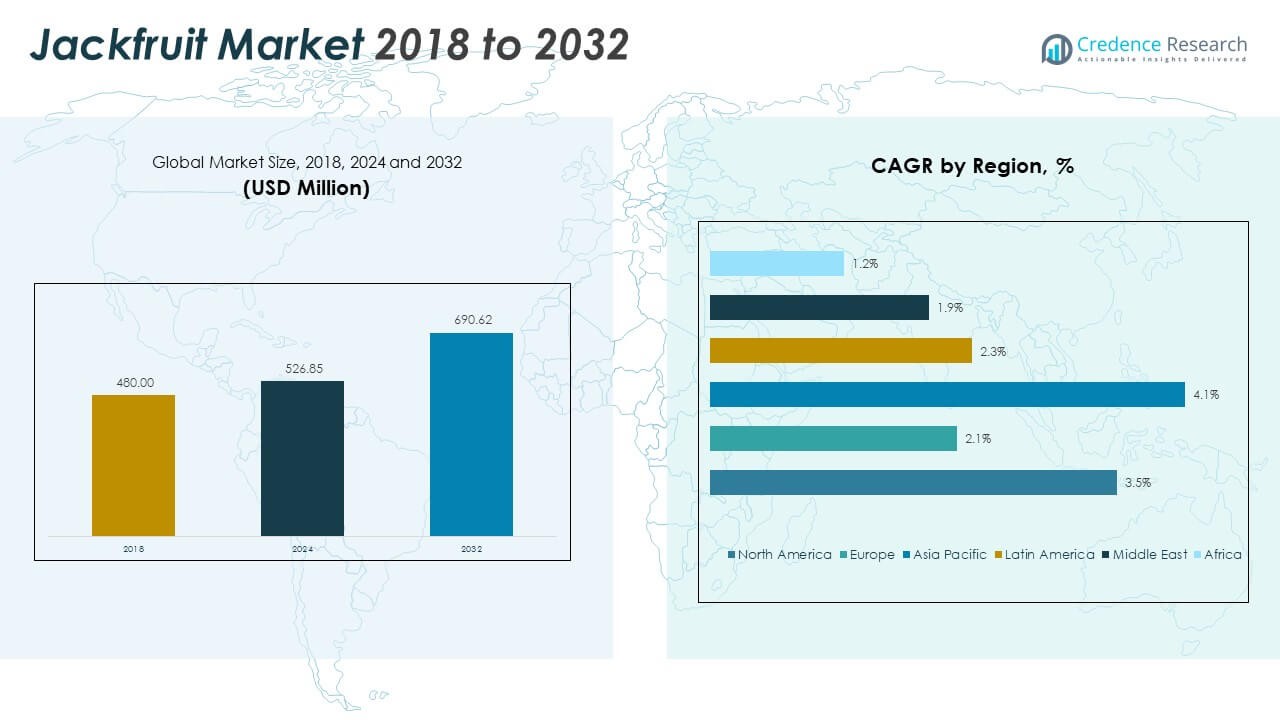
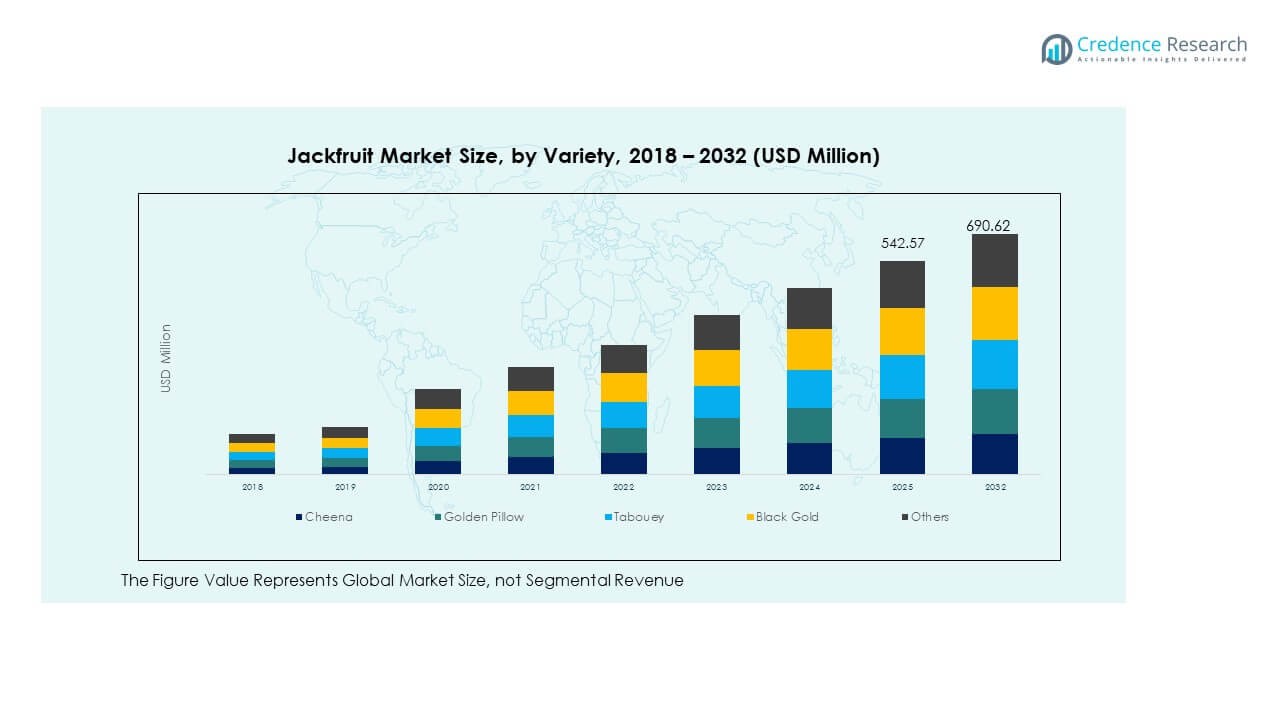
The Jackfruit Market size was valued at USD 480.00 million in 2018 to USD 526.85 million in 2024 and is anticipated to reach USD 690.62 million by 2032, at a CAGR of 3.51% during the forecast period.

REPORT ATTRIBUTE DETAILS
Historical Period 2020-2023
Base Year 2024
Forecast Period 2025-2032
Jackfruit Market Size 2024 USD 526.85 Million
Jackfruit Market, CAGR 3.51%
Jackfruit Market Size 2032 USD 690.62 Million


The key driver for the market’s growth is rising demand for healthy, natural, and vegan-friendly food options. Jackfruit’s high fiber content and low-fat composition support its inclusion in health-conscious diets. The food and beverage industry is incorporating jackfruit into plant-based meals, snacks, and beverages, responding to evolving consumer preferences. Supportive government policies promoting sustainable agriculture and fruit-based processing also enhance its global production and export potential.

Asia-Pacific dominates the global market due to favorable climatic conditions and large-scale cultivation in countries like India, Bangladesh, and Thailand. North America and Europe are emerging growth regions, supported by increasing vegan populations and greater retail availability of tropical fruit-based products. Latin America shows steady expansion driven by local production and growing export capacity, while the Middle East and Africa exhibit rising adoption through specialty stores and import-led supply chains.

Access crucial information at unmatched prices!

Request your sample report today & start making informed decisions powered by Credence Research Inc.!

Download Sample

Market Insights:

  • The Jackfruit Market was valued at USD 480.00 million in 2018, reached USD 526.85 million in 2024, and is projected to attain USD 690.62 million by 2032, expanding at a CAGR of 3.51% during the forecast period.
  • Asia Pacific leads with a 55% market share, driven by abundant cultivation in India, Thailand, and Bangladesh, coupled with strong domestic consumption and export support.
  • North America holds 20% and Europe 14% of the global share, supported by growing vegan trends, expanding retail availability, and increasing product innovations in processed jackfruit.
  • Asia Pacific remains the fastest-growing region, fueled by government-backed agricultural programs, growing fruit-based processing industries, and expanding export capabilities.
  • Among varieties, Cheena and Golden Pillow collectively account for over 40% share due to high yield and consumer preference, while Black Gold and Cochin segments together contribute nearly 30%, reflecting their strong export demand and superior pulp quality.

Jackfruit Market Size

Market Drivers

Rising Consumer Demand for Plant-Based Meat Alternatives

Growing awareness of plant-based diets drives the Jackfruit Market, supported by global vegan movements and meat reduction campaigns. Jackfruit’s fibrous texture closely mimics meat, increasing its use in ready-to-eat and frozen meals. Food brands are expanding portfolios with jackfruit-based curries, tacos, and sandwiches to attract flexitarian consumers. The rise in chronic health conditions linked to red meat is pushing consumers toward cleaner options. Restaurants and quick-service chains are adding plant-based menu items to meet new demand. Governments promoting sustainable agriculture also support fruit-based protein production. Online platforms enhance product reach, improving accessibility across regions. The category’s ability to blend nutrition, taste, and sustainability strengthens its long-term growth.

Growing Awareness of Health and Nutritional Benefits

Consumers increasingly associate jackfruit with rich nutrient content, fiber, and antioxidants, boosting its inclusion in daily diets. The Jackfruit Market benefits from rising adoption among health-conscious consumers seeking natural energy sources. Its low-calorie and low-fat profile make it suitable for diabetic and weight-conscious populations. Functional food producers use jackfruit extracts in smoothies, snacks, and supplements for added nutritional value. Health campaigns highlight its vitamin and mineral richness, fostering greater recognition among global audiences. Fitness enthusiasts use jackfruit as a natural carbohydrate replacement in training diets. Packaged food producers promote clean-label formulations featuring the fruit. The market’s alignment with holistic wellness and preventive nutrition trends continues to strengthen consumer trust.

  • For instance, a clinical trial published in 2021 showed that patients consuming green jackfruit flour had 25% fewer calories, 33% fewer net carbohydrates, and 57% more fiber per serving compared to conventional flour, and it demonstrated measurable improvements in glycemic control in type-2 diabetes patients.​

Expansion of Processed and Packaged Food Applications

The global demand for processed foods containing jackfruit is increasing due to changing consumption habits. The Jackfruit Market benefits from food processors launching shelf-stable, frozen, and dehydrated variants for urban consumers. Manufacturers develop vacuum-packed and ready-to-cook options to extend shelf life and reduce waste. The growing retail presence of tropical fruit-based snacks is expanding category visibility. Packaging innovations ensure nutrient retention and improve convenience for on-the-go consumers. Companies invest in flavor adaptation to appeal to Western palates. Private-label brands in supermarkets are increasing product diversity. The expanding food retail infrastructure supports higher distribution efficiency and consumer penetration across multiple geographies.

Government Support for Sustainable Agriculture and Export Expansion

Government policies promoting fruit cultivation and processing are strengthening the Jackfruit Market’s production chain. Agricultural boards in India, Sri Lanka, and Bangladesh provide subsidies and training for jackfruit farmers. Export initiatives target high-value markets in North America and Europe, where tropical fruit imports are increasing. R&D institutions invest in post-harvest management and value-added product innovation. Sustainability policies encourage cultivation methods that reduce waste and improve yield quality. Collaborations between cooperatives and exporters streamline supply chains. The food processing sector receives incentives for fruit dehydration and pulp extraction. Such initiatives ensure consistent quality, enhance farmer income, and support long-term export growth.

  • For instance, agricultural research institutions in Karnataka have conducted varietal improvement programs for jackfruit to enhance yield stability and fruit quality. These initiatives, supported by state agricultural universities, focus on developing high-yielding and disease-resistant cultivars suited to local agro-climatic conditions.

Jackfruit Market Share

Market Trends

Innovation in Value-Added Products and Functional Food Development

Product innovation drives the Jackfruit Market toward diversification in processed and functional food categories. Manufacturers develop jackfruit-based protein powders, snacks, and beverages to meet fitness and wellness demands. Food technology companies experiment with fermentation and dehydration techniques to preserve flavor and nutrition. The rising appeal of clean-label and allergen-free foods supports this trend. Ready-to-eat jackfruit meals are gaining shelf space in health stores and supermarkets. Snack producers use jackfruit seeds for high-protein formulations. Brands highlight sustainability credentials and eco-friendly packaging to attract ethical consumers. Product innovation continues to reinforce jackfruit’s role as a multipurpose functional ingredient.

  • For instance, Fiber Foods’ PrimeJack® employs a patent-pending dehydration technology that produces shelf-stable jackfruit with 57% fiber content (8.1g/100g rehydrated). The process reduces product volume by 90%, cutting transport emissions and extending shelf life for global shipment.

Rapid Expansion of Vegan and Vegetarian Food Service Chains

The global increase in vegan and vegetarian food outlets accelerates demand for jackfruit-based menu items. The Jackfruit Market benefits from restaurant partnerships promoting sustainable dining. Quick-service restaurants and cafés introduce jackfruit wraps, burgers, and curries to attract conscious eaters. Food delivery platforms feature vegan options prominently, improving accessibility. Culinary influencers and chefs experiment with jackfruit recipes, enhancing awareness. Frozen meal companies target urban consumers with easy-preparation options. The rise of plant-based protein innovation continues to shape consumer perceptions. Foodservice adoption reinforces jackfruit’s mainstream acceptance across both developed and emerging regions.

Increasing Integration of Digital Retail and E-Commerce Platforms

E-commerce growth supports the expansion of jackfruit-based product sales across international markets. The Jackfruit Market leverages online platforms to connect manufacturers directly with consumers. Subscription models and wellness boxes featuring tropical fruits are becoming popular. Small enterprises benefit from digital marketing and influencer-led product promotions. E-retailers highlight sustainability certifications and product sourcing transparency. Global health food marketplaces are increasing their tropical fruit portfolios. Online visibility supports the growth of niche brands in competitive regions. Digital retail integration ensures steady market expansion and improved consumer engagement worldwide.

  • For instance, Upton’s Naturals (US) has its Original Jackfruit 2.2-lb bulk packs actively listed for sale on major online retailers like BuyItByTheCase and VeganEssentials in 2025, expanding vegan SKUs for sandwiches, burgers, wraps, and bowls, and commercially supplying frozen jackfruit for retail and foodservice channels.

Focus on Sustainability and Circular Production Practices

Sustainability remains a defining trend influencing procurement and processing strategies in the Jackfruit Market. Companies emphasize zero-waste production, utilizing seeds and peels for by-products like flour and animal feed. Eco-friendly farming practices reduce environmental impact and improve yield consistency. Food producers adopt biodegradable packaging to meet regulatory standards. Sustainable farming certifications are attracting environmentally conscious investors. Local cooperatives promote organic farming, ensuring traceability and fair-trade compliance. Global brands use carbon-neutral labeling to strengthen brand image. Such initiatives align consumer preference with ethical sourcing, reinforcing long-term brand loyalty.

Market Challenges Analysis

Limited Supply Chain Infrastructure and Post-Harvest Management Issues

Inefficient supply chain networks and poor storage conditions hinder the Jackfruit Market’s growth in several regions. The fruit’s short shelf life increases waste during transport and handling. Small farmers lack access to cold storage facilities and efficient logistics. Limited mechanization leads to inconsistent quality and higher production losses. The absence of standardized processing technologies reduces competitiveness in export markets. Supply chain fragmentation also affects pricing stability. Exporters struggle to meet global quality standards due to limited infrastructure. Strengthening farm-to-market systems and improving cold chain investment remain key industry challenges.

Low Consumer Awareness and Market Penetration in Non-Tropical Regions

Consumer awareness about jackfruit’s culinary versatility remains low in many Western countries. The Jackfruit Market faces slow penetration due to limited product education and cultural familiarity. Many consumers associate it only with exotic fruit rather than a protein-rich food alternative. Retailers hesitate to allocate shelf space without consistent demand patterns. Marketing campaigns remain localized, restricting broader consumer engagement. Lack of standardized product labeling creates confusion among first-time buyers. Import costs further elevate product prices, affecting affordability. Expanding consumer education and global awareness campaigns is critical for overcoming these barriers.

Market Opportunities

Expansion of Export Potential and Entry into New Geographic Markets

Rising global interest in tropical and plant-based foods offers new trade opportunities for the Jackfruit Market. Exporters can target Europe, North America, and the Middle East, where vegan trends are increasing. Governments support agricultural exports through subsidies and product certifications. Technological advancements in packaging extend product lifespan during shipment. Strategic alliances between cooperatives and processors enable efficient value chain management. Improved branding and organic certifications enhance product appeal in international markets. Logistics partnerships expand reach to untapped regions. Strengthening trade policies and infrastructure development will further support export diversification.

Growth in Food Processing and Alternative Protein Industries

Expanding demand for natural meat alternatives creates opportunities in the Jackfruit Market. Food processors invest in texture optimization and flavor enhancement technologies. Jackfruit’s versatility makes it suitable for meat substitutes, bakery fillings, and confectionery. The alternative protein industry recognizes it as a sustainable ingredient source. Startups and established brands focus on R&D to create innovative product lines. Growing partnerships between producers and retailers support commercial scalability. Technological innovation ensures higher yield and cost efficiency. The evolving global preference for plant-based diets strengthens long-term market potential.

Market Segmentation Analysis:

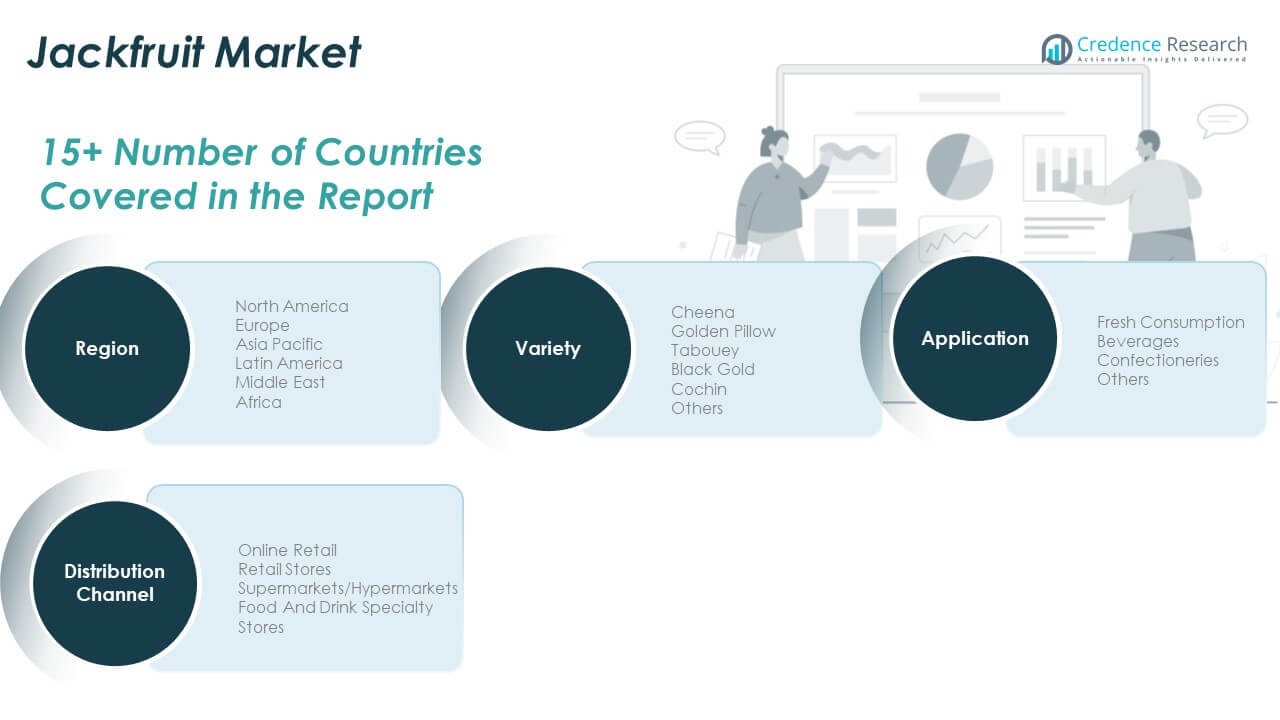
The Jackfruit Market is segmented

By variety into Cheena, Golden Pillow, Tabouey, Black Gold, Cochin, and Others. Cheena and Golden Pillow varieties lead due to their high yield, rich flavor, and strong acceptance in both fresh and processed food segments. Black Gold and Cochin varieties are gaining traction in international trade because of superior pulp quality and extended shelf life. Growing export activities and hybrid cultivation practices support their increased adoption among farmers and food processors.

  • For instance, several Indian agribusiness exporters promote jackfruit varieties such as Black Gold and Cochin for international markets, emphasizing quality grading, proper packaging, and compliance with food safety standards to meet global trade requirements.

By application, the market is divided into Fresh Consumption, Beverages, Confectioneries, and Others. Fresh consumption dominates due to widespread use of raw fruit and seeds in traditional diets across Asia-Pacific. It also finds use in frozen and dehydrated forms for urban retail. The beverages and confectionery segments are expanding with rising demand for natural flavoring and fruit-based products. Increasing awareness about plant-based nutrition is further boosting its use in functional and organic food manufacturing.

  • For instance, Campco launched jackfruit éclairs in July 2021, using around 100 kg of jackfruit flesh per tonne of toffees, offering a nine-month shelf life, and initially targeting markets in Karnataka and Kerala.

By distribution channel, segmentation includes Online Stores, Supermarkets/Hypermarkets, Specialty Stores, and Others. Supermarkets and hypermarkets hold the major share due to strong consumer reach and availability of multiple product varieties. Specialty stores cater to niche consumers seeking organic or premium-quality jackfruit products. Online stores are rapidly expanding, supported by growing e-commerce penetration and digital marketing. It benefits from efficient supply chains and home delivery services that enhance convenience and accessibility across domestic and international markets.

Jackfruit Market Segmentation

Segmentation:

By Variety

  • Cheena
  • Golden Pillow
  • Tabouey
  • Black Gold
  • Cochin
  • Others

By Application

  • Fresh Consumption
  • Beverages
  • Confectioneries
  • Others

By Distribution Channel

  • Online Stores
  • Supermarkets/Hypermarkets
  • Specialty Stores
  • Others

By Region

  • North America
    • U.S.
    • Canada
    • Mexico
  • Europe
    • Germany
    • France
    • U.K.
    • Italy
    • Spain
    • Rest of Europe
  • Asia Pacific
    • China
    • Japan
    • India
    • South Korea
    • South-east Asia
    • Rest of Asia Pacific
  • Latin America
    • Brazil
    • Argentina
    • Rest of Latin America
  • Middle East & Africa
    • GCC Countries
    • South Africa
    • Rest of the Middle East and Africa

Regional Analysis:

North America

The North America Jackfruit Market size was valued at USD 100.03 million in 2018 to USD 107.47 million in 2024 and is anticipated to reach USD 140.54 million by 2032, at a CAGR of 3.5% during the forecast period. North America holds an estimated 20% market share, driven by increasing consumer preference for plant-based and clean-label products. The U.S. dominates regional demand, supported by growing vegan and vegetarian populations. Food manufacturers are expanding product portfolios with frozen, canned, and ready-to-eat jackfruit meals. Retail distribution through health food chains and supermarkets boosts visibility. Import reliance from Asia-Pacific remains high due to limited domestic cultivation. Rising awareness about sustainable and alternative proteins is further driving market acceptance. Product innovation and branding focused on taste and convenience enhance regional growth prospects.

Europe

The Europe Jackfruit Market size was valued at USD 70.56 million in 2018 to USD 72.06 million in 2024 and is anticipated to reach USD 84.78 million by 2032, at a CAGR of 2.1% during the forecast period. Europe accounts for nearly 14% of the global market, with strong demand from the UK, Germany, and France. Growing awareness of tropical fruits and plant-based diets fuels adoption in retail and foodservice sectors. European consumers value organic and ethically sourced products, supporting imports from certified suppliers. Companies are expanding private-label offerings of dried and frozen jackfruit products. Retail penetration in health and specialty food stores continues to rise. Importers benefit from government incentives promoting sustainable sourcing. The region’s steady preference for innovative meat substitutes strengthens long-term growth potential.

Asia Pacific

The Asia Pacific Jackfruit Market size was valued at USD 260.64 million in 2018 to USD 291.79 million in 2024 and is anticipated to reach USD 400.77 million by 2032, at a CAGR of 4.1% during the forecast period. Asia Pacific leads the global market with nearly 55% share, supported by abundant cultivation and strong domestic demand. India, Bangladesh, and Thailand are key producers, with favorable agro-climatic conditions promoting large-scale harvesting. Rising investments in food processing industries enhance export potential. Local manufacturers are launching packaged and dehydrated jackfruit for urban consumers. Governments encourage fruit-based entrepreneurship and sustainable farming initiatives. Technological improvements in preservation and cold-chain logistics improve market efficiency. The region’s dominance is strengthened by its role as a key supplier to international markets.

Latin America

The Latin America Jackfruit Market size was valued at USD 23.38 million in 2018 to USD 25.34 million in 2024 and is anticipated to reach USD 30.09 million by 2032, at a CAGR of 2.3% during the forecast period. Latin America represents nearly 5% of the global market, with Brazil being the primary contributor. The region’s tropical climate supports favorable cultivation, while domestic consumption is expanding in processed food formats. Export activities to North America and Europe are growing due to improved trade logistics. Food companies are introducing value-added products such as jackfruit snacks and purees. Urbanization and lifestyle shifts are increasing demand for ready-to-eat fruit products. Investments in agricultural training and sustainable practices enhance productivity. The region is emerging as a potential exporter in the global fruit value chain.

Middle East

The Middle East Jackfruit Market size was valued at USD 15.12 million in 2018 to USD 15.33 million in 2024 and is anticipated to reach USD 17.68 million by 2032, at a CAGR of 1.9% during the forecast period. The region contributes nearly 3% of the total market share, supported by import-driven consumption. Demand is rising in the UAE and Saudi Arabia through supermarkets and specialty retailers. Consumers are increasingly exploring tropical fruits as part of premium and health-conscious diets. Food importers collaborate with Asian suppliers for consistent supply. Distribution networks are expanding to include frozen and dried product categories. The growing hospitality and tourism industries enhance demand for exotic fruit ingredients. Strategic alliances with exporters are improving product visibility and supply stability.

Africa

The Africa Jackfruit Market size was valued at USD 10.27 million in 2018 to USD 14.86 million in 2024 and is anticipated to reach USD 16.76 million by 2032, at a CAGR of 1.2% during the forecast period. Africa accounts for nearly 3% market share, primarily led by South Africa and Egypt. The region’s growth is supported by gradual adoption of fruit-based processed foods. Domestic cultivation is increasing in tropical zones with favorable weather conditions. Imports from Asia-Pacific supplement limited regional production. Awareness about jackfruit’s nutritional benefits is slowly improving through urban retail exposure. Food processors explore its potential for canned and dried fruit categories. Expanding supermarket chains and online grocery platforms enhance accessibility. Investments in agri-food infrastructure are expected to improve long-term market potential.

Key Player Analysis:

  • Jackfruit365
  • Nutty Yogi
  • The Jackfruit Company
  • Artocarpus Foods Pvt. Ltd.
  • NatureLoC
  • Madam Sun
  • Island Valley Delights
  • Mother Dairy Fruit & Vegetable Pvt. Ltd.
  • Anna Food Products
  • Frubites

Competitive Analysis:

The Jackfruit Market is characterized by moderate competition, with key players focusing on product innovation, distribution expansion, and sustainability. Companies such as Jackfruit365, The Jackfruit Company, Nutty Yogi, and Artocarpus Foods Pvt. Ltd. emphasize developing processed and ready-to-eat formats to meet rising consumer demand. It benefits from growing collaborations between food processors and retail chains to strengthen global reach. Firms invest in branding strategies highlighting nutritional and environmental benefits to attract health-conscious buyers. The market witnesses new entrants leveraging e-commerce platforms for faster penetration. Established brands enhance product quality through improved preservation and packaging technologies. Partnerships with exporters and agricultural cooperatives support supply consistency and pricing stability. Competitive positioning depends on innovation, scalability, and strategic marketing that align with the expanding plant-based food ecosystem.

Shape Your Report to Specific Countries or Regions & Enjoy 30% Off!

Recent Developments:

  • In October 2024, The Jackfruit Company, a Colorado-based leading US producer of jackfruit products, secured a $5 million Series B extension from existing investors including InvestEco, Creadev, and Grosvenor Food & AgTech. The fresh capital is intended to help the company refine its plant-based meat products, made from whole jackfruit, and accelerate expansion within the US market.

Report Coverage:

The research report offers an in-depth analysis based on Variety, Application and Distribution Channel. It details leading market players, providing an overview of their business, product offerings, investments, revenue streams, and key applications. Additionally, the report includes insights into the competitive environment, SWOT analysis, current market trends, as well as the primary drivers and constraints. Furthermore, it discusses various factors that have driven market expansion in recent years. The report also explores market dynamics, regulatory scenarios, and technological advancements that are shaping the industry. It assesses the impact of external factors and global economic changes on market growth. Lastly, it provides strategic recommendations for new entrants and established companies to navigate the complexities of the market.

Future Outlook:

  • Rising global adoption of plant-based diets will continue to strengthen demand for jackfruit-based food products.
  • Expanding product innovations such as frozen, canned, and ready-to-eat options will enhance consumer accessibility.
  • Increasing use of jackfruit as a natural meat substitute will drive growth in the processed food industry.
  • Investments in food preservation, packaging, and supply chain technology will improve product stability and reduce waste.
  • Online retail platforms will boost market reach, offering wider availability across domestic and international markets.
  • Government initiatives supporting sustainable farming and fruit-based processing will enhance production efficiency.
  • Partnerships between exporters and retailers will expand trade opportunities in high-growth regions.
  • Demand from vegan and flexitarian consumers will influence product diversification and branding strategies.
  • Growing use of jackfruit in beverages, confectioneries, and health snacks will broaden application scope.
  • Continuous innovation in cultivation and processing will sustain long-term competitiveness in global markets.

CHAPTER NO. 1 : GENESIS OF THE MARKET

1.1 Market Prelude – Introduction & Scope

1.2 The Big Picture – Objectives & Vision

1.3 Strategic Edge – Unique Value Proposition

1.4 Stakeholder Compass – Key Beneficiaries

CHAPTER NO. 2 : EXECUTIVE LENS

2.1 Pulse of the Industry – Market Snapshot

2.2 Growth Arc – Revenue Projections (USD Million)

2.3. Premium Insights – Based on Primary Interviews

CHAPTER NO. 3 : JACK FRUIT MARKET FORCES & INDUSTRY PULSE

3.1 Foundations of Change – Market Overview

3.2 Catalysts of Expansion – Key Market Drivers

3.2.1 Momentum Boosters – Growth Triggers

3.2.2 Innovation Fuel – Disruptive Technologies

3.3 Headwinds & Crosswinds – Market Restraints

3.3.1 Regulatory Tides – Compliance Challenges

3.3.2 Economic Frictions – Inflationary Pressures

3.4 Untapped Horizons – Growth Potential & Opportunities

3.5 Strategic Navigation – Industry Frameworks

3.5.1 Market Equilibrium – Porter’s Five Forces

3.5.2 Ecosystem Dynamics – Value Chain Analysis

3.5.3 Macro Forces – PESTEL Breakdown

3.6 Price Trend Analysis

3.6.1 Regional Price Trend

3.6.2 Price Trend by product

CHAPTER NO. 4 : KEY INVESTMENT EPICENTER

4.1 Regional Goldmines – High-Growth Geographies

4.2 Variety Frontiers – Lucrative Variety Categories

4.3 Application Sweet Spots – Emerging Demand Segments

CHAPTER NO. 5: REVENUE TRAJECTORY & WEALTH MAPPING

5.1 Momentum Metrics – Forecast & Growth Curves

5.2 Regional Revenue Footprint – Market Share Insights

5.3 Segmental Wealth Flow – Variety & Application Revenue

CHAPTER NO. 6 : TRADE & COMMERCE ANALYSIS

6.1. Import Analysis by Region

6.1.1. Global Jack Fruit Market Import Revenue By Region

6.2. Export Analysis by Region

6.2.1. Global Jack Fruit Market Export Revenue By Region

CHAPTER NO. 7 : COMPETITION ANALYSIS

7.1. Company Market Share Analysis

7.1.1. Global Jack Fruit Market: Company Market Share

7.2. Global Jack Fruit Market Company Revenue Market Share

7.3. Strategic Developments

7.3.1. Acquisitions & Mergers

7.3.2. New Variety Launch

7.3.3. Regional Expansion

7.4. Competitive Dashboard

7.5. Company Assessment Metrics, 2024

CHAPTER NO. 8 : JACK FRUIT MARKET – BY VARIETY SEGMENT ANALYSIS

8.1. Jack Fruit Market Overview by Variety Segment

8.1.1. Jack Fruit Market Revenue Share By Variety

8.2. Cheena

8.3. Golden Pillow

8.4. Tabouey

8.5. Black Gold

8.6. Cochin

8.7. Others

CHAPTER NO. 9 : JACK FRUIT MARKET – BY APPLICATION SEGMENT ANALYSIS

9.1. Jack Fruit Market Overview by Application Segment

9.1.1. Jack Fruit Market Revenue Share By Application

9.2. Fresh Consumption

9.3. Beverages

9.4. Confectioneries

9.5. Others

CHAPTER NO. 10 : JACK FRUIT MARKET – BY DISTRIBUTION CHANNEL SEGMENT ANALYSIS

10.1. Jack Fruit Market Overview by Distribution Channel Segment

10.1.1. Jack Fruit Market Revenue Share By Distribution Channel

10.2. Online Stores

10.3. Supermarkets/Hypermarkets

10.4. Specialty Stores

10.5. Others

CHAPTER NO. 11 : JACK FRUIT MARKET – REGIONAL ANALYSIS

11.1. Jack Fruit Market Overview by Region Segment

11.1.1. Global Jack Fruit Market Revenue Share By Region

11.1.3. Regions

11.1.4. Global Jack Fruit Market Revenue By Region

.1.6. Variety

11.1.7. Global Jack Fruit Market Revenue By Variety

11.1.9. Application

11.1.10. Global Jack Fruit Market Revenue By Application

11.1.12. Distribution Channel

11.1.13. Global Jack Fruit Market Revenue By Distribution Channel

CHAPTER NO. 12 : NORTH AMERICA JACK FRUIT MARKET – COUNTRY ANALYSIS

12.1. North America Jack Fruit Market Overview by Country Segment

12.1.1. North America Jack Fruit Market Revenue Share By Region

12.2. North America

12.2.1. North America Jack Fruit Market Revenue By Country

12.2.2. Variety

12.2.3. North America Jack Fruit Market Revenue By Variety

12.2.4. Application

12.2.5. North America Jack Fruit Market Revenue By Application

2.2.6. Distribution Channel

12.2.7. North America Jack Fruit Market Revenue By Distribution Channel

2.3. U.S.

12.4. Canada

12.5. Mexico

CHAPTER NO. 13 : EUROPE JACK FRUIT MARKET – COUNTRY ANALYSIS

13.1. Europe Jack Fruit Market Overview by Country Segment

13.1.1. Europe Jack Fruit Market Revenue Share By Region

13.2. Europe

13.2.1. Europe Jack Fruit Market Revenue By Country

13.2.2. Variety

13.2.3. Europe Jack Fruit Market Revenue By Variety

13.2.4. Application

13.2.5. Europe Jack Fruit Market Revenue By Application

13.2.6. Distribution Channel

13.2.7. Europe Jack Fruit Market Revenue By Distribution Channel

13.3. UK

13.4. France

13.5. Germany

13.6. Italy

13.7. Spain

13.8. Russia

13.9. Rest of Europe

CHAPTER NO. 14 : ASIA PACIFIC JACK FRUIT MARKET – COUNTRY ANALYSIS

14.1. Asia Pacific Jack Fruit Market Overview by Country Segment

14.1.1. Asia Pacific Jack Fruit Market Revenue Share By Region

14.2. Asia Pacific

14.2.1. Asia Pacific Jack Fruit Market Revenue By Country

14.2.2. Variety

14.2.3. Asia Pacific Jack Fruit Market Revenue By Variety

14.2.4. Application

14.2.5. Asia Pacific Jack Fruit Market Revenue By Application

14.2.5. Distribution Channel

14.2.7. Asia Pacific Jack Fruit Market Revenue By Distribution Channel

14.3. China

14.4. Japan

14.5. South Korea

14.6. India

14.7. Australia

14.8. Southeast Asia

14.9. Rest of Asia Pacific

CHAPTER NO. 15 : LATIN AMERICA JACK FRUIT MARKET – COUNTRY ANALYSIS

15.1. Latin America Jack Fruit Market Overview by Country Segment

15.1.1. Latin America Jack Fruit Market Revenue Share By Region

15.2. Latin America

15.2.1. Latin America Jack Fruit Market Revenue By Country

15.2.2. Variety

15.2.3. Latin America Jack Fruit Market Revenue By Variety

15.2.4. Application

15.2.5. Latin America Jack Fruit Market Revenue By Application

15.2.6. Distribution Channel

15.2.7. Latin America Jack Fruit Market Revenue By Distribution Channel

15.3. Brazil

15.4. Argentina

15.5. Rest of Latin America

CHAPTER NO. 16 : MIDDLE EAST JACK FRUIT MARKET – COUNTRY ANALYSIS

16.1. Middle East Jack Fruit Market Overview by Country Segment

16.1.1. Middle East Jack Fruit Market Revenue Share By Region

16.2. Middle East

16.2.1. Middle East Jack Fruit Market Revenue By Country

16.2.2. Variety

16.2.3. Middle East Jack Fruit Market Revenue By Variety

16.2.4. Application

16.2.5. Middle East Jack Fruit Market Revenue By Application

16.2.6. Distribution Channel

16.2.7. Middle East Jack Fruit Market Revenue By Distribution Channel

16.3. GCC Countries

16.4. Israel

16.5. Turkey

16.6. Rest of Middle East

CHAPTER NO. 17 : AFRICA JACK FRUIT MARKET – COUNTRY ANALYSIS

17.1. Africa Jack Fruit Market Overview by Country Segment

17.1.1. Africa Jack Fruit Market Revenue Share By Region

17.2. Africa

17.2.1. Africa Jack Fruit Market Revenue By Country

17.2.2. Variety

17.2.3. Africa Jack Fruit Market Revenue By Variety

17.2.4. Application

17.2.5. Africa Jack Fruit Market Revenue By Application

17.2.6. Distribution Channel

17.2.7. Africa Jack Fruit Market Revenue By Distribution Channel

17.3. South Africa

17.4. Egypt

17.5. Rest of Africa

CHAPTER NO. 18 : COMPANY PROFILES

18.1. Jackfruit365

18.1.1. Company Overview

18.1.2. Variety Portfolio

18.1.3. Financial Overview

18.1.4. Recent Developments

18.1.5. Growth Strategy

18.1.6. SWOT Analysis

18.2. Nutty Yogi

18.3. The Jackfruit Company

18.4. Artocarpus Foods Pvt. Ltd.

18.5. NatureLoC

18.6. Madam Sun

18.7. Island Valley Delights

18.8. Mother Dairy Fruit & Vegetable Pvt. Ltd.

18.9. Anna Food Products

18.10. Frubites

Request Free Sample

We prioritize the confidentiality and security of your data. Our promise: your information remains private.

Ready to Transform Data into Decisions?

Request Your Sample Report and Start Your Journey of Informed Choices


Providing the strategic compass for industry titans.

cr-clients-logos

Frequently Asked Questions

What is the current market size for the Jackfruit Market, and what is its projected size in 2032?

The Jackfruit Market was valued at USD 526.85 million in 2024 and is projected to reach USD 690.62 million by 2032, reflecting steady global expansion.

At what Compound Annual Growth Rate is the Jackfruit Market projected to grow between 2024 and 2032?

The Jackfruit Market is projected to grow at a CAGR of 3.51% during the forecast period from 2024 to 2032.

Which Jackfruit Market segment held the largest share in 2024?

The Fresh Consumption segment held the largest share of the Jackfruit Market in 2024 due to strong demand for raw and minimally processed fruit.

What are the primary factors fueling the growth of the Jackfruit Market?

The Jackfruit Market is driven by rising consumer preference for plant-based foods, expanding vegan populations, and innovations in food processing and packaging.

Who are the leading companies in the Jackfruit Market?

Leading players in the Jackfruit Market include Jackfruit365, The Jackfruit Company, Nutty Yogi, Artocarpus Foods Pvt. Ltd., and NatureLoC, all focusing on product innovation and retail expansion.

Which region commanded the largest share of the Jackfruit Market in 2024?

The Asia Pacific region commanded the largest share of the Jackfruit Market in 2024 due to abundant cultivation, export growth, and strong domestic consumption.

About Author

Rajdeep Kumar Deb

Rajdeep Kumar Deb

Lead Analyst – Consumer & Finance

Rajdeep brings a decade of consumer goods and financial services insight to strategic market analysis.

View Profile

Related Reports

Mentha Oil Market

Mentha Oil Market size was valued USD 748.86 million in 2024 and is anticipated to reach USD 1284.76 million by 2032, at a CAGR of 6.98% during the forecast period.

Malaysia Bubble/Boba Tea Market

The Malaysia Bubble/Boba Tea Market size was valued at USD 53.17 million in 2024 and is anticipated to reach USD 87.34 million by 2032, at a CAGR of 6.4% during the forecast period (2024-2032).

Plant-Based Bioactives Market

Plant-Based Bioactives Market size was valued USD 4.5 billion in 2024 and is anticipated to reach USD 9.36 billion by 2032, at a CAGR of 9.6% during the forecast period.

Vitamins Market

Vitamins market was valued at USD 7.29 billion in 2024 and is anticipated to reach USD 11.89 billion by 2032, growing at a CAGR of 6.31 % during the forecast period.

Takeout Dinner Market

The Takeout Dinner market reached USD 270.23 billion in 2024 and is projected to grow to USD 440.55 billion by 2032, reflecting a CAGR of 6.3% during the forecast period.

Pyrolysis Oil Market

Pyrolysis Oil market size reached USD 1,808.5 million in 2024 and is expected to grow to USD 3,670.2 million by 2032, reflecting a CAGR of 9.25% during the forecast period.

Batter and Breader Premixes Market

The Batter and Breader Premixes Market reached USD 4,066.30 million in 2024 and is projected to grow to USD 6,193.33 million by 2032, registering a CAGR of 5.4% during the forecast period.

Food Waste Management Market

The Global Food Waste Management market reached USD 47.73 billion in 2024 and is projected to grow to USD 73.8 billion by 2032, supported by a 5.6% CAGR during the forecast period.

Middle East and Africa Fruit Concentrate Market

Middle East and Africa Fruit Concentrate Market size was valued at USD 3.19 Billion in 2024 and is anticipated to reach USD 5.2 Billion by 2032, at a CAGR of 6.3% during the forecast period.

Black Rice Market

Black Rice Market size was valued USD 9.35 billion in 2024 and is anticipated to reach USD 17.7 billion by 2032, at a CAGR of 8.3% during the forecast period.

Antifreeze Proteins Market

Antifreeze Proteins Market size was valued at USD 13.56 Billion in 2024 and is anticipated to reach USD 54.92 Billion by 2032, at a CAGR of 19.11% during the forecast period.

Exotic Fruits Market

The Global Exotic Fruits Market size was valued at USD 11,976.75 million in 2018 to USD 20,512.47 million in 2024 and is anticipated to reach USD 36,457.03 million by 2032, at a CAGR of 6.94% during the forecast period.

Licence Option

The report comes as a view-only PDF document, optimized for individual clients. This version is recommended for personal digital use and does not allow printing. Use restricted to one purchaser only.
$4999

To meet the needs of modern corporate teams, our report comes in two formats: a printable PDF and a data-rich Excel sheet. This package is optimized for internal analysis. Unlimited users allowed within one corporate location (e.g., regional office).
$6999

The report will be delivered in printable PDF format along with the report’s data Excel sheet. This license offers 100 Free Analyst hours where the client can utilize Credence Research Inc. research team. Permitted for unlimited global use by all users within the purchasing corporation, such as all employees of a single company.
$12999

Report delivery within 24 to 48 hours

Credence Staff 3

WILLIAM, North America

Support Staff at Credence Research

KEITH PHILLIPS, Europe

Lee - CR Sales Staff

LEE VALLANCE, Asia Pacific

Kieran Jameson

KIERAN JAMESON, Australia

Smallform of Sample request
User Review

Thank you for the data! The numbers are exactly what we asked for and what we need to build our business case.

Materials Scientist
(privacy requested)

User Review

The report was an excellent overview of the Industrial Burners market. This report does a great job of breaking everything down into manageable chunks.

Imre Hof
Management Assistant, Bekaert

cr-clients-logos

Request Sample