Home » Food & Beverage » Sparkling Juices Market

Sparkling Juices Market By Type (100% Sparkling Juice, Sparkling Juice Drinks, Nectar Sparkling Juices, Others); By Distribution Channel (Supermarkets and Hypermarkets, Convenience Stores, Online Stores) – Growth, Share, Opportunities & Competitive Analysis, 2024 – 2032

Report ID: 9481 | Report Format : Excel, PDF

Market Overview:

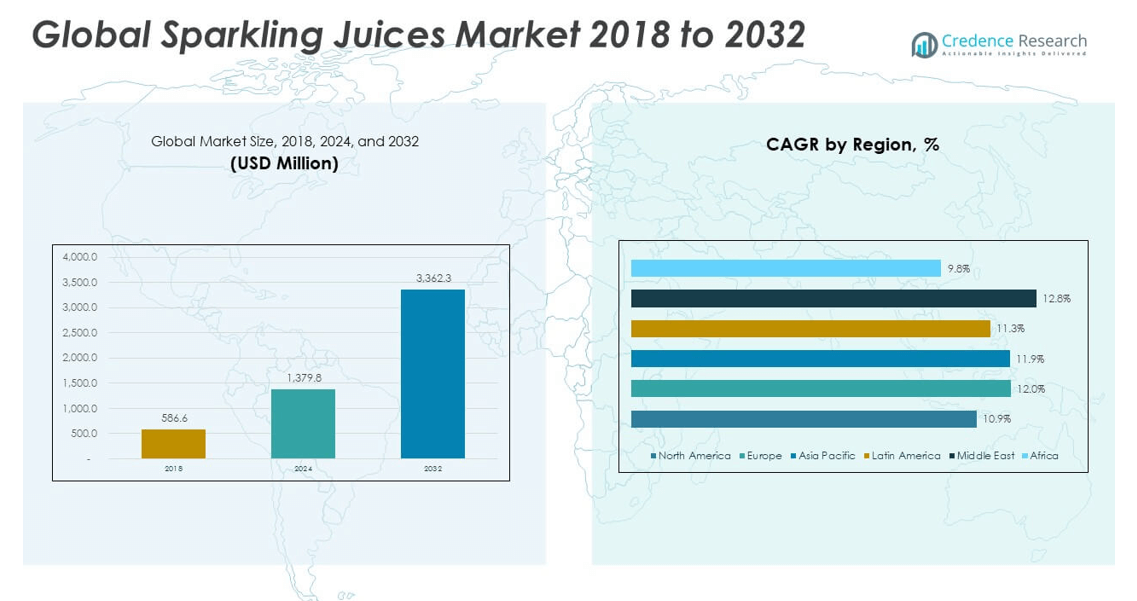
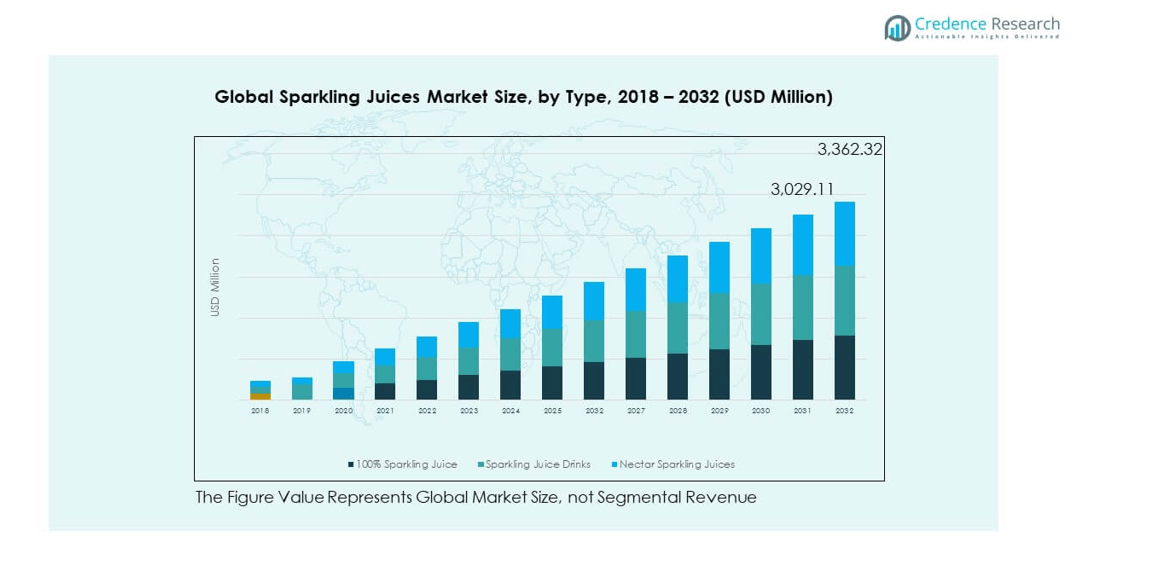
The Global Sparkling Juices Market size was valued at USD 586.6 million in 2018 to USD 1,379.8 million in 2024 and is anticipated to reach USD 3,362.3 million by 2032, at a CAGR of 11.67% during the forecast period.

REPORT ATTRIBUTE DETAILS
Historical Period 2020-2023
Base Year 2024
Forecast Period 2025-2032
Sparkling Juices Market Size 2024  USD 1,379.8 million
Sparkling Juices Market, CAGR 11.67%
Sparkling Juices Market Size 2032 USD 3,362.3 million


The Global Sparkling Juices Market is driven by rising consumer demand for healthier non-alcoholic beverages and a shift away from traditional carbonated drinks. It benefits from growing awareness of natural ingredients, clean labels, and reduced sugar options. Manufacturers focus on innovative flavors, sustainable packaging, and premium positioning to attract health-conscious and younger consumers. Foodservice and hospitality industries contribute to wider adoption by offering sparkling juices as alcohol-free celebratory options. Expanding e-commerce platforms further strengthen product reach and consumer accessibility across regions.

The Global Sparkling Juices Market shows strong regional variations shaped by consumer preferences and retail dynamics. North America leads with strong product availability and established distribution networks, supported by a health-driven consumer base. Europe follows closely, supported by demand for premium, organic, and sustainably packaged options. Asia Pacific emerges as the fastest-growing region due to rising disposable incomes, urbanization, and growing interest in natural alternatives to soft drinks. Latin America shows steady growth, while the Middle East demonstrates strong cultural alignment with non-alcoholic beverages. Africa presents long-term potential through urban expansion and wider modern retail penetration.

Sparkling Juices Market size

Market Insights:

  • The Global Sparkling Juices Market size was USD 586.6 million in 2018, USD 1,379.8 million in 2024, and is projected to reach USD 3,362.3 million by 2032, growing at a CAGR of 11.67%.
  • Asia Pacific led with a 35.65% share in 2024, followed by Europe with 27.70% and North America with 21.25%, supported by strong consumer awareness, retail expansion, and premium product adoption.
  • The Middle East, holding a 4.81% share in 2024, is the fastest-growing region, driven by cultural preference for alcohol-free beverages, premium positioning, and expanding hospitality demand.
  • By type, 100% sparkling juice accounted for 42% share in 2024, reflecting consumer preference for natural, clean-label products over other variants.
  • Sparkling juice drinks followed with a 36% share in 2024, supported by affordability, flavor variety, and growing acceptance among younger consumers across emerging economies.

Access crucial information at unmatched prices!

Request your sample report today & start making informed decisions powered by Credence Research Inc.!

Download Sample

Market Drivers

Growing Shift Toward Health-Conscious Beverage Choices

Consumers are moving toward healthier beverage alternatives that exclude artificial additives and excess sugar. The Global Sparkling Juices Market benefits from this change by offering fruit-based products with perceived nutritional value. It provides a substitute for carbonated soft drinks without caffeine or synthetic ingredients. Health-driven consumers demand juices with natural flavors, vitamins, and antioxidants. Rising concerns about obesity and diabetes further boost adoption among young adults. Brands highlight clean labels and transparency in sourcing to gain trust. Premium juice launches help expand product acceptance in wellness-driven markets. Retailers strengthen placement in supermarkets and convenience stores to target health-focused demographics.

  • For instance, Knudsen & Sons and Welch’s are prominent brands in the sparkling juice segment, offering 100% juice-based sparkling drinks with clean-label formulations and no artificial sweeteners in global supermarkets and convenience stores. Welch’s most Sparkling Juice is notably marketed as being made with only juice and no added sugars or artificial ingredients, addressing health-driven consumer preferences worldwide

Increasing Demand from Millennials and Urban Populations

Urban populations are embracing sparkling juices as stylish and convenient lifestyle beverages. Millennials lead consumption patterns, favoring unique flavors and innovative packaging designs. The Global Sparkling Juices Market responds with sleek bottles and ready-to-drink formats. It aligns with on-the-go lifestyles that demand portability and functionality. Social media platforms accelerate visibility, making fruit-infused beverages trendy. Marketing campaigns emphasize sustainable packaging and plant-based options. The segment attracts repeat purchases from younger demographics seeking variety. Distribution through caf     es, vending machines, and modern retail supports wider market penetration.

  • For instance, Martinelli & Company launched a line of sparkling juice in single-serve 8.4oz cans and flavor varieties (such as Sparkling Apple-Pomegranate and Sparkling Apple-Mango) tailored expressly for young, on-the-go urban consumers, with broad distribution in U.S., European, and Asian metro markets in 2024

Rising Hospitality Sector and Foodservice Partnerships Boosting Visibility

Hospitality and foodservice operators increase sparkling juice offerings to meet non-alcoholic demand. The Global Sparkling Juices Market gains traction in hotels, restaurants, and airlines. It provides alternatives for customers seeking celebratory drinks without alcohol. Catering events adopt sparkling juices for weddings, parties, and corporate gatherings. Partnerships with foodservice distributors improve supply consistency. Seasonal menus include fruit-based sparkling beverages, enhancing consumer interest. Tourism growth contributes to higher volumes in destination markets. International players invest in expanding horeca channels for brand recognition.

Expanding Product Innovation Through Flavor Diversity and Packaging Advancements

Manufacturers continue to introduce bold and exotic flavors to attract diverse consumers. The Global Sparkling Juices Market thrives on launches that blend tropical fruits and botanicals. It benefits from advanced packaging that ensures freshness and appeal. Glass bottles, aluminum cans, and recyclable cartons expand product reach. Limited-edition releases generate excitement and drive higher engagement. R&D investment supports functional variants enriched with vitamins and minerals. Flavor experimentation resonates with younger populations exploring premium indulgence. Retail strategies highlight shelf visibility with eye-catching labels and sustainable packaging.

Market Trends

Premiumization and Stronger Positioning of Sparkling Juices as Lifestyle Products

Premium product positioning plays a crucial role in brand differentiation. The Global Sparkling Juices Market introduces high-end variants marketed as sophisticated lifestyle beverages. It resonates with consumers who associate sparkling juices with indulgence. Brands highlight organic fruits, artisanal methods, and limited editions. Premium pricing strategies target consumers willing to pay for exclusivity. Influencer endorsements and celebrity collaborations reinforce aspirational value. Shelf placement in gourmet stores and high-end cafes strengthens appeal. Regional brands leverage luxury cues to compete with global players.

  • For instance, in March 2025, Cawston Press introduced 250ml Sparkling Can Multipacks across major UK retailers, expanding its premium range with sustainable packaging designed to reduce waste and align with evolving consumer preferences.

Sustainability Integration into Packaging and Production Processes

Sustainability drives innovation across manufacturing and distribution strategies. The Global Sparkling Juices Market adapts by adopting recyclable, biodegradable, and eco-friendly packaging. It appeals to environmentally conscious consumers who value green practices. Brands invest in renewable energy and water-efficient production. Supply chains emphasize local sourcing to reduce carbon footprints. Marketing campaigns highlight sustainable commitments to build customer loyalty. Retailers prioritize eco-labeled sparkling juices in promotions. Partnerships with recycling organizations strengthen brand image and regulatory compliance.

  • For instance, in August 2023, PepsiCo rolled out paperboard packaging for beverage multipacks in the U.S. and Canada, directly targeting single-use plastics in sparkling juice and soft drink categories as part of a company-wide shift to sustainable packaging solutions.

Expanding Online Retail and E-Commerce Penetration in Beverages

E-commerce channels open new revenue streams for beverage companies. The Global Sparkling Juices Market capitalizes on growing online grocery platforms and direct-to-consumer models. It benefits from fast home delivery and digital visibility. Subscription-based services encourage repeat purchases among urban buyers. Social commerce allows brands to engage with younger audiences. Seasonal promotions and bundle offers boost online sales volume. Advanced analytics help companies understand consumer preferences and refine product offerings. Cross-border shipping expands product availability to global markets.

Emerging Functional and Fortified Sparkling Juice Variants

Consumers demand beverages that deliver additional health benefits. The Global Sparkling Juices Market embraces functional juices enriched with probiotics, vitamins, and adaptogens. It aligns with rising interest in immunity-boosting products. Fortified options target niche groups such as athletes and working professionals. Functional innovation improves differentiation in competitive beverage categories. Marketing highlights wellness benefits without compromising taste. Retail visibility increases for fortified sparkling juices in pharmacy chains and health stores. Product expansion focuses on blending indulgence with functionality.

Sparkling Juices Market share

Market Challenges Analysis

High Production Costs and Competitive Pricing Pressure in Non-Alcoholic Beverages

Production costs remain a major challenge for beverage manufacturers. The Global Sparkling Juices Market faces higher expenses due to natural ingredients and sustainable packaging requirements. It competes against traditional carbonated drinks priced at lower points. Raw material fluctuations add unpredictability in fruit sourcing. Manufacturers struggle to balance quality with affordability. Premium juices face resistance in price-sensitive markets. Competition from other non-alcoholic categories such as kombucha and flavored water intensifies pressure. High logistics costs further limit margins for global players.

Regulatory Compliance and Shelf-Life Management Across Global Markets

Regulatory frameworks differ across regions, complicating compliance for producers. The Global Sparkling Juices Market contends with strict labeling, health claims, and packaging laws. It requires continuous monitoring of ingredient approvals and food safety standards. Limited shelf-life creates supply chain challenges, particularly in hot climates. Storage requirements raise distribution complexity and costs. Exporters face delays due to cross-border checks and regulatory variations. Smaller brands struggle to navigate global certifications. These factors reduce speed-to-market and expansion opportunities.

Market Opportunities

Rising Growth Potential Across Emerging Economies with Expanding Middle-Class Population

Emerging economies present untapped growth opportunities for beverage producers. The Global Sparkling Juices Market benefits from rising disposable incomes and lifestyle changes. It attracts middle-class populations seeking healthier non-alcoholic choices. Expanding urbanization accelerates modern retail penetration. Festivals and cultural events enhance demand for celebratory drinks. Local production reduces dependency on imports and ensures affordability. Distribution expansion in supermarkets and e-commerce platforms widens accessibility.

Innovations in Functional Beverages and Cross-Sector Collaborations

Functional beverage innovation creates space for differentiation. The Global Sparkling Juices Market can integrate botanicals, probiotics, and adaptogens. It benefits from collaborations with wellness, fitness, and hospitality sectors. Functional products strengthen brand loyalty and justify premium pricing. Cross-industry alliances improve visibility in gyms, spas, and cafes. R&D drives novel flavor infusions that combine indulgence with health. Companies exploring plant-based ingredients expand product appeal. These innovations shape long-term revenue opportunities in competitive beverage segments.

Market Segmentation Analysis:

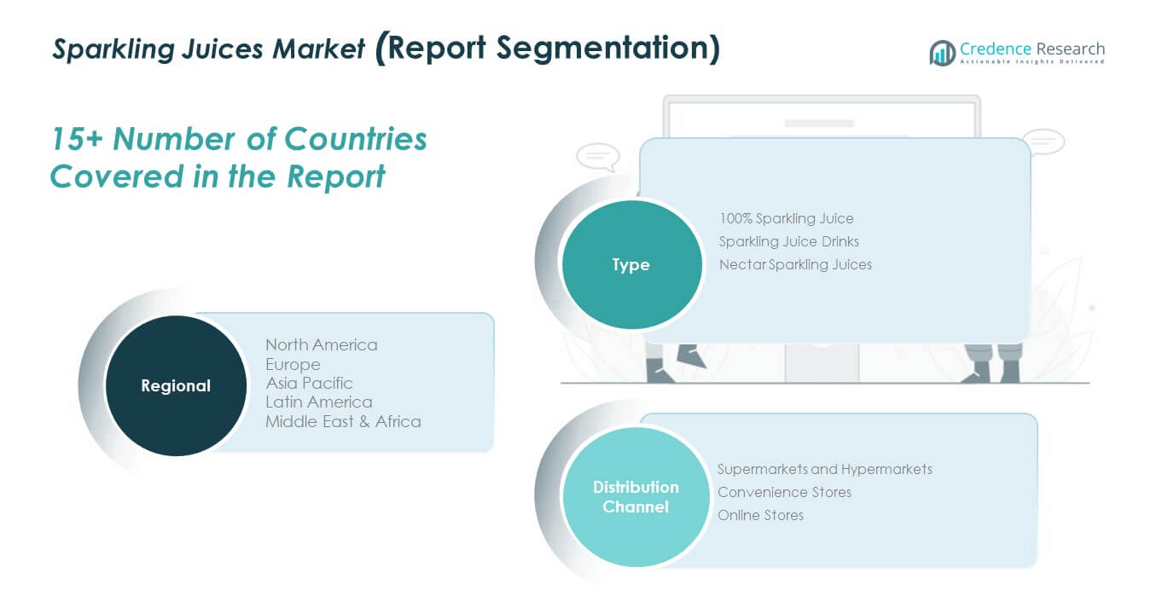
By type, the Global Sparkling Juices Market is divided into 100% sparkling juice, sparkling juice drinks, nectar sparkling juices, and others. Among these, 100% sparkling juice dominates due to its strong appeal among health-conscious consumers seeking natural fruit-based options. It benefits from rising demand for clean-label products without additives. Sparkling juice drinks follow with wide adoption across younger demographics, supported by affordability and flavor variety. Nectar sparkling juices occupy a niche with sweeter profiles that appeal in specific regional markets. The “others” category includes innovative blends and limited editions, attracting experimental consumers and supporting product diversification strategies.

  • For instance, in April 2025, Maison Perrier (Nestlé Waters) introduced its “Maison Perrier Chic” collection of non-alcoholic sparkling beverages in the U.S., following an earlier 2024 launch in Canada, with the range featuring real fruit extracts and zero added sugar to cater to health-driven consumers.

By distribution channel, the Global Sparkling Juices Market is segmented into supermarkets and hypermarkets, convenience stores, and online stores. Supermarkets and hypermarkets lead sales, providing strong visibility and consumer access through extensive retail networks. It gains momentum from premium placements and promotional campaigns in organized retail outlets. Convenience stores support growth in urban areas, where impulse buying and on-the-go consumption remain high. Online stores show rapid expansion, fueled by digital retail penetration and direct-to-consumer models. Seasonal promotions, subscription packs, and doorstep delivery strengthen the channel’s relevance in connecting brands to younger, tech-savvy buyers.

  • For instance, Spindrift, a U.S.-based sparkling beverage company, continues to expand its retail presence across major chains like Kroger and Target, offering sparkling fruit drinks made with real squeezed fruit and no added sugars, reinforcing demand for clean-label functional beverages.

Sparkling Juices Market segmentaton

Segmentation:

By Type

  • 100% Sparkling Juice
  • Sparkling Juice Drinks
  • Nectar Sparkling Juices
  • Others

By Distribution Channel

  • Supermarkets and Hypermarkets
  • Convenience Stores
  • Online Stores

By Region

  • North America
    • U.S.
    • Canada
    • Mexico
  • Europe
    • UK
    • France
    • Germany
    • Italy
    • Spain
    • Russia
    • Belgium
    • Netherlands
    • Austria
    • Sweden
    • Poland
    • Denmark
    • Switzerland
    • Rest of Europe
  • Asia Pacific
    • China
    • Japan
    • South Korea
    • India
    • Australia
    • Thailand
    • Indonesia
    • Vietnam
    • Malaysia
    • Philippines
    • Taiwan
    • Rest of Asia Pacific
  • Latin America
    • Brazil
    • Argentina
    • Peru
    • Chile
    • Colombia
    • Rest of Latin America
  • Middle East
    • UAE
    • KSA
    • Israel
    • Turkey
    • Iran
    • Rest of Middle East
  • Africa
    • Egypt
    • Nigeria
    • Algeria
    • Morocco
    • Rest of Africa

Regional Analysis:

North America

The North America Global Sparkling Juices Market size was valued at USD 129.64 million in 2018 to USD 293.16 million in 2024 and is anticipated to reach USD 676.16 million by 2032, at a CAGR of 10.9% during the forecast period. The region holds a market share of 21.25%. The Global Sparkling Juices Market in North America is driven by consumer preference for natural, non-alcoholic beverages. It benefits from established retail networks, including supermarkets and convenience chains. Demand rises among health-conscious consumers seeking alternatives to carbonated soft drinks. Marketing campaigns emphasize clean-label and organic attributes, boosting premium product sales. Growth is also supported by high adoption in the hospitality sector and foodservice channels. Strong purchasing power encourages consumers to explore new flavors and formats. The region remains a hub for innovative product launches and sustainable packaging initiatives.

Europe

The Europe Global Sparkling Juices Market size was valued at USD 159.74 million in 2018 to USD 382.15 million in 2024 and is anticipated to reach USD 952.21 million by 2032, at a CAGR of 12.0% during the forecast period. The region accounts for a market share of 27.70%. The Global Sparkling Juices Market in Europe is shaped by rising demand for premium and organic beverages. Consumers value health, wellness, and sustainability, which boosts interest in fruit-based sparkling juices. Strong demand is observed in the UK, Germany, France, and Italy due to urbanization and diverse retail structures. Hospitality venues offer sparkling juices as alcohol-free alternatives. Innovation in exotic flavors and eco-friendly packaging resonates with consumers. Online sales channels further strengthen access to niche brands and regional specialties. High awareness of clean labels and ethical sourcing accelerates adoption. Europe continues to lead with product differentiation and quality-driven demand.

Asia Pacific

The Asia Pacific Global Sparkling Juices Market size was valued at USD 205.91 million in 2018 to USD 491.62 million in 2024 and is anticipated to reach USD 1,221.87 million by 2032, at a CAGR of 11.9% during the forecast period. The region contributes a market share of 35.65%. The Global Sparkling Juices Market in Asia Pacific grows rapidly due to rising disposable incomes and urban lifestyles. It attracts younger consumers seeking innovative and natural beverages. Expansion of modern retail, e-commerce, and convenience outlets increases product reach. Strong growth in China, India, and Southeast Asia drives demand for flavored sparkling juices. Local manufacturers introduce affordable options to compete with global brands. Hospitality, tourism, and cultural celebrations create higher consumption opportunities. Growing awareness of healthier alternatives to carbonated soft drinks supports market expansion. The region shows strong momentum with untapped potential in emerging economies.

Latin America

The Latin America Global Sparkling Juices Market size was valued at USD 46.28 million in 2018 to USD 106.91 million in 2024 and is anticipated to reach USD 254.19 million by 2032, at a CAGR of 11.3% during the forecast period. The region holds a market share of 7.41%. The Global Sparkling Juices Market in Latin America is supported by increasing consumer interest in fruit-based, non-alcoholic beverages. It gains traction through supermarkets and expanding convenience stores. Brazil and Argentina lead consumption due to cultural acceptance of juice-based drinks. Local players contribute by offering affordable variants tailored to regional preferences. Tourism-driven demand adds to consumption across hospitality channels. Product innovation focuses on tropical fruit flavors popular among younger consumers. Online platforms gradually expand market accessibility. Despite economic fluctuations, rising health awareness sustains long-term demand.

Middle East

The Middle East Global Sparkling Juices Market size was valued at USD 25.46 million in 2018 to USD 63.84 million in 2024 and is anticipated to reach USD 168.45 million by 2032, at a CAGR of 12.8% during the forecast period. The region contributes a market share of 4.81%. The Global Sparkling Juices Market in the Middle East grows due to strong demand for alcohol-free celebratory beverages. Cultural and religious preferences support adoption in social gatherings and hospitality venues. It benefits from premium product positioning and innovative packaging formats. GCC countries dominate demand, with rising disposable incomes fueling purchases. Retail expansion strengthens product availability in supermarkets and hypermarkets. Young consumers embrace new flavors and health-focused variants. Foodservice establishments adopt sparkling juices to cater to diverse customer preferences. The region shows strong potential through lifestyle-driven consumption.

Africa

The Africa Global Sparkling Juices Market size was valued at USD 19.59 million in 2018 to USD 42.06 million in 2024 and is anticipated to reach USD 89.44 million by 2032, at a CAGR of 9.8% during the forecast period. The region accounts for a market share of 3.15%. The Global Sparkling Juices Market in Africa is gradually expanding due to urbanization and lifestyle changes. South Africa leads adoption with established beverage infrastructure and retail penetration. Egypt and Nigeria show rising demand, supported by young populations. It benefits from affordability-focused product strategies by local producers. Distribution through supermarkets and convenience stores widens availability. Flavored sparkling juices resonate with younger consumers seeking non-alcoholic alternatives. Online retail channels are still emerging but hold promise for future expansion. Despite economic and logistical challenges, the market shows steady long-term growth potential.

Shape Your Report to Specific Countries or Regions & Enjoy 30% Off!

Key Player Analysis:

  • Apple and Eve LLC
  • Campbell Soup Co.
  • Cawston Press Ltd.
  • ENVASADOS EVA SA
  • Good Juicery
  • Keurig Dr Pepper Inc.
  • Kristian Regale Inc.
  • National Beverage Corp.
  • Nestle SA
  • Other Key Players

Competitive Analysis:

The Global Sparkling Juices Market is characterized by strong competition among multinational corporations and regional brands. Leading players such as Nestlé SA, Keurig Dr Pepper Inc., and Campbell Soup Co. focus on product innovation, clean-label offerings, and expanding premium juice portfolios. It emphasizes strategic partnerships with supermarkets, hypermarkets, and online retailers to strengthen distribution reach. Smaller companies like Cawston Press Ltd. and Good Juicery compete by highlighting natural ingredients and niche flavor innovations. Sustainability initiatives, recyclable packaging, and functional juice launches define competitive differentiation. Companies pursue mergers, acquisitions, and regional expansions to consolidate market presence. Hospitality and foodservice channels serve as key growth platforms for global and local players. Competitive intensity remains high, with brand loyalty, affordability, and innovation driving market positioning.

Recent Developments:

  • In March 2025, Cawston Press introduced slimline sparkling can multipacks across major UK retailers, aiming to reduce packaging waste and cater to evolving consumer habits. This launch forms part of the brand’s ‘Pressing for Better’ strategy to reach net zero by 2050, reflecting ongoing product innovation and sustainability efforts.
  • In January 2025, Gryphon Advisors announced its acquisition of Spindrift Beverage, a specialist in sparkling juice drinks, marking a strategic move to accelerate Spindrift’s innovation capacity and international growth in the premium sparkling juices segment.

Report Coverage:

The research report offers an in-depth analysis based on Type and Distribution Channel. It details leading market players, providing an overview of their business, product offerings, investments, revenue streams, and key applications. Additionally, the report includes insights into the competitive environment, SWOT analysis, current market trends, as well as the primary drivers and constraints. Furthermore, it discusses various factors that have driven market expansion in recent years. The report also explores market dynamics, regulatory scenarios, and technological advancements that are shaping the industry. It assesses the impact of external factors and global economic changes on market growth. Lastly, it provides strategic recommendations for new entrants and established companies to navigate the complexities of the market.

Future Outlook:

  • Product innovation will focus on exotic fruit blends, botanical infusions, and functional enhancements.
  • Sustainability initiatives will expand with recyclable packaging and eco-friendly sourcing methods.
  • E-commerce platforms will drive accessibility, supported by direct-to-consumer subscription models.
  • Premium positioning will grow as consumers seek indulgent and lifestyle-oriented beverage choices.
  • Hospitality and foodservice sectors will increase adoption of sparkling juices as alcohol-free options.
  • Regional players will strengthen competitiveness by offering affordable, locally inspired flavors.
  • Marketing campaigns will emphasize wellness attributes such as natural, organic, and clean-label.
  • Emerging economies will experience rapid growth due to rising disposable incomes and urbanization.
  • Strategic collaborations will expand distribution networks across retail and horeca channels.
  • Research and development will intensify to create differentiated offerings with longer shelf life.

CHAPTER NO. 1 : GENESIS OF THE MARKET    

1.1 Market Prelude – Introduction & Scope

1.2 The Big Picture – Objectives & Vision

1.3 Strategic Edge – Unique Value Proposition

1.4 Stakeholder Compass – Key Beneficiaries

CHAPTER NO. 2 : EXECUTIVE LENS

2.1 Pulse of the Industry – Market Snapshot

2.2 Growth Arc – Revenue Projections (USD Million)

2.3. Premium Insights – Based on Primary Interviews

CHAPTER NO. 3 : SPARKLING JUICES MARKET FORCES & INDUSTRY PULSE           

3.1 Foundations of Change – Market Overview
3.2 Catalysts of Expansion – Key Market Drivers
3.2.1 Momentum Boosters – Growth Triggers
3.2.2 Innovation Fuel – Disruptive Technologies
3.3 Headwinds & Crosswinds – Market Restraints
3.3.1 Regulatory Tides – Compliance Challenges
3.3.2 Economic Frictions – Inflationary Pressures
3.4 Untapped Horizons – Growth Potential & Opportunities
3.5 Strategic Navigation – Industry Frameworks
3.5.1 Market Equilibrium – Porter’s Five Forces
3.5.2 Ecosystem Dynamics – Value Chain Analysis
3.5.3 Macro Forces – PESTEL Breakdown

CHAPTER NO. 4 :      KEY INVESTMENT EPICENTER    

4.1 Regional Goldmines – High-Growth Geographies

4.2 Product Frontiers – Lucrative Type Categories

4.3 Distribution Channel Sweet Spots – Emerging Demand Segments

CHAPTER NO. 5: REVENUE TRAJECTORY & WEALTH MAPPING

5.1 Momentum Metrics – Forecast & Growth Curves

5.2 Regional Revenue Footprint – Market Share Insights

5.3 Segmental Wealth Flow – Type & Distribution Channel Revenue

CHAPTER NO. 6 : TRADE & COMMERCE ANALYSIS    

6.1.      Import Analysis By Region

6.1.1.    Global Sparkling Juices Market Import Revenue By Region

6.2.      Export Analysis By Region

6.2.1.    Global Sparkling Juices Market Export Revenue By Region

CHAPTER NO. 7 : COMPETITION ANALYSIS      

7.1.      Company Market Share Analysis

7.1.1.    Global Sparkling Juices Market: Company Market Share

7.2.      Global Sparkling Juices Market Company Revenue Market Share

7.3.      Strategic Developments

7.3.1.    Acquisitions & Mergers

7.3.2.    New Type Launch

7.3.3.    Regional Expansion

7.4.      Competitive Dashboard

7.5.      Company Assessment Metrics, 2024

CHAPTER NO. 8 : SPARKLING JUICES MARKET – BY TYPE SEGMENT ANALYSIS

8.1.      Sparkling Juices Market Overview By Type Segment

8.1.1.    Sparkling Juices Market Revenue Share By Type

8.2.       100% Sparkling Juice

8.3.       Sparkling Juice Drinks

8.4.        Nectar Sparkling Juices

OthersCHAPTER NO. 9 : SPARKLING JUICES MARKET – BY DISTRIBUTION CHANNEL SEGMENT ANALYSIS

9.1.      Sparkling Juices Market Overview By Distribution Channel Segment

9.1.1.    Sparkling Juices Market Revenue Share By Distribution Channel

9.2.      Supermarkets and Hypermarkets

9.3.      Convenience Stores

9.4.      Online Stores

CHAPTER NO. 10 : SPARKLING JUICES MARKET – REGIONAL ANALYSIS  

10.1.     Sparkling Juices Market Overview By Region Segment

10.1.1.  Global Sparkling Juices Market Revenue Share By Region

10.1.2.  Regions

10.1.3.  Global Sparkling Juices Market Revenue By Region

10.1.4.  Type

10.1.5.  Global Sparkling Juices Market Revenue By Type

10.1.6.  Distribution Channel

10.1.7. Global Sparkling Juices Market Revenue By Distribution Channel

CHAPTER NO. 11 : NORTH AMERICA SPARKLING JUICES MARKET – COUNTRY ANALYSIS

11.1.     North America Sparkling Juices Market Overview By Country Segment

11.1.1.  North America Sparkling Juices Market Revenue Share By Region

11.2.     North America

11.2.1.  North America Sparkling Juices Market Revenue By Country

11.2.2.  Type

11.2.3.  North America Sparkling Juices Market Revenue By Type

11.2.4.  Distribution Channel

11.2.5.  North America Sparkling Juices Market Revenue By Distribution Channel

11.3.     U.S.

11.4.     Canada

11.5.     Mexico

CHAPTER NO. 12 : EUROPE SPARKLING JUICES MARKET – COUNTRY ANALYSIS

12.1.     Europe Sparkling Juices Market Overview By Country Segment

12.1.1.  Europe Sparkling Juices Market Revenue Share By Region

12.2.     Europe

12.2.1.  Europe Sparkling Juices Market Revenue By Country

12.2.2.  Type

12.2.3.  Europe Sparkling Juices Market Revenue By Type

12.2.4.  Distribution Channel

12.2.5.  Europe Sparkling Juices Market Revenue By Distribution Channel

12.3.     UK

12.4.     France

12.5.     Germany

12.6.     Italy

12.7.     Spain

12.8.     Russia

12.9.   Rest of Europe

CHAPTER NO. 13 : ASIA PACIFIC SPARKLING JUICES MARKET – COUNTRY ANALYSIS

13.1.     Asia Pacific Sparkling Juices Market Overview By Country Segment

13.1.1.  Asia Pacific Sparkling Juices Market Revenue Share By Region

13.2.     Asia Pacific

13.2.1.  Asia Pacific Sparkling Juices Market Revenue By Country

13.2.2.  Type

13.2.3.  Asia Pacific Sparkling Juices Market Revenue By Type

13.2.4.  Distribution Channel

13.2.5.  Asia Pacific Sparkling Juices Market Revenue By Distribution Channel

13.3.     China

13.4.     Japan

13.5.     South Korea

13.6.     India

13.7.     Australia

13.8.     Southeast Asia

13.9.     Rest of Asia Pacific

CHAPTER NO. 14 : LATIN AMERICA SPARKLING JUICES MARKET – COUNTRY ANALYSIS

14.1.     Latin America Sparkling Juices Market Overview By Country Segment

14.1.1.  Latin America Sparkling Juices Market Revenue Share By Region

14.2.     Latin America

14.2.1.  Latin America Sparkling Juices Market Revenue By Country

14.2.2.  Type

14.2.3.  Latin America Sparkling Juices Market Revenue By Type

14.2.4.  Distribution Channel

14.2.5.  Latin America Sparkling Juices Market Revenue By Distribution Channel

14.3.     Brazil

14.4.     Argentina

14.5.     Rest of Latin America

CHAPTER NO. 15 : MIDDLE EAST SPARKLING JUICES MARKET – COUNTRY ANALYSIS

15.1.     Middle East Sparkling Juices Market Overview By Country Segment

15.1.1.  Middle East Sparkling Juices Market Revenue Share By Region

15.2.     Middle East

15.2.1.  Middle East Sparkling Juices Market Revenue By Country

15.2.2.  Type

15.2.3.  Middle East Sparkling Juices Market Revenue By Type

15.2.4.  Distribution Channel

15.2.5.  Middle East Sparkling Juices Market Revenue By Distribution Channel

15.3.     GCC Countries

15.4.     Israel

15.5.     Turkey

15.6.     Rest of Middle East

CHAPTER NO. 16 : AFRICA SPARKLING JUICES MARKET – COUNTRY ANALYSIS

16.1.     Africa Sparkling Juices Market Overview By Country Segment

16.1.1.  Africa Sparkling Juices Market Revenue Share By Region

16.2.     Africa

16.2.1.  Africa Sparkling Juices Market Revenue By Country

16.2.2.  Type

16.2.3.  Africa Sparkling Juices Market Revenue By Type

16.2.4.  Distribution Channel

16.2.5.  Africa Sparkling Juices Market Revenue By Distribution Channel

16.3.     South Africa

16.4.     Egypt

16.5.     Rest of Africa

CHAPTER NO. 17 : COMPANY PROFILES

17.1.     Apple and Eve LLC

17.1.2.  Product Portfolio

17.1.3.  Financial Overview

17.1.4.  Recent Developments

17.1.5.  Growth Strategy

17.1.6.  SWOT Analysis

17.2.    Campbell Soup Co.

17.3.    Cawston Press Ltd.

17.4.    ENVASADOS EVA SA

17.5.    Good Juicery

17.6.   Keurig Dr Pepper Inc.

17.8.   Kristian Regale Inc.

17.9.   National Beverage Corp.

17.10.  Nestle SA

17.11.  Other Key Players

Request Free Sample

We prioritize the confidentiality and security of your data. Our promise: your information remains private.

Ready to Transform Data into Decisions?

Request Your Sample Report and Start Your Journey of Informed Choices


Providing the strategic compass for industry titans.

cr-clients-logos

Frequently Asked Question:

What is the current market size for Global Sparkling Juices Market, and what is its projected size in 2032?

The Global Sparkling Juices Market was valued at USD 1,379.8 million in 2024 and is projected to reach USD 3,362.3 million by 2032.

At what Compound Annual Growth Rate is the Global Sparkling Juices Market projected to grow between 2024 and 2032?

The Global Sparkling Juices Market is projected to grow at a CAGR of 11.67% during the forecast period.

Which Global Sparkling Juices Market segment held the largest share in 2024?

In 2024, the 100% sparkling juice segment held the largest share of the Global Sparkling Juices Market due to its natural and health-driven appeal.

What are the primary factors fueling the growth of the Global Sparkling Juices Market?

The Global Sparkling Juices Market growth is fueled by rising health awareness, demand for non-alcoholic alternatives, and innovation in flavors and packaging.

Who are the major players in this market?

Coca-Cola, Ocean Spray, Alta Palla, Bai, Campbell Soup Company, Cawston Press, PepsiCo, evaGROUP, JUICE&WORLD, Kristian Regle, MAYADOR CELLARS, ONLY Beverages, Arizona Beverages. are some of the major players in the global market.

About Author

Rajdeep Kumar Deb

Rajdeep Kumar Deb

Lead Analyst – Consumer & Finance

Rajdeep brings a decade of consumer goods and financial services insight to strategic market analysis.

View Profile

Related Reports

Specialty Bakery Market

Specialty Bakery Market was valued at USD 5200 million in 2024 and is anticipated to reach USD 8670.84 million by 2032, growing at a CAGR of 6.6 % during the forecast period.

Singapore Food Services Market

Singapore Food Services Market was valued at USD 13371.70 million in 2024 and is anticipated to reach USD 40648.94 million by 2032, growing at a CAGR of 14.91% during the forecast period.

Anti-Aging Nutraceutical Ingredients Market

The global anti-aging nutraceutical ingredients market was valued at USD 12.3 billion in 2024 and is projected to reach USD 21.45 billion by 2032, reflecting a CAGR of 7.2% over the forecast period.

Protein Sequencing Market

The Protein Sequencing Market was valued at USD 1,737.5 million in 2024 and is projected to reach USD 2,287.96 million by 2032, registering a CAGR of 3.5% during the forecast period (2025–2032).

Nitro Coffee Market

Nitro Coffee Market was valued at USD 1478.5 million in 2024 and is anticipated to reach USD 3481.63 million by 2032, growing at a CAGR of 11.3% during the forecast period.

Impulse Ice Cream Market

The global impulse ice cream market was valued at USD 59.04 billion in 2024 and is projected to reach USD 82.56 billion by 2032, expanding at a CAGR of 4.28% over the forecast period.

Fermented Bean Curd Market

The Fermented Bean Curd Market is projected to grow from USD 1497.6 million in 2024 to an estimated USD 2631.44 million by 2032, with a CAGR of 7.3% from 2024 to 2032.

Rice Flour Market

The Rice Flour Market is projected to grow from USD 848.6 million in 2024 to an estimated USD 1,126.11 million by 2032, with a compound annual growth rate (CAGR) of 3.6% from 2024 to 2032.

Prepared Flour Mixes Market

Prepared Flour Mixes Market size was valued at USD 34,600 Million in 2024 and is anticipated to reach USD 64,997.13 Million by 2032, at a CAGR of 8.2% during the forecast period.

Prepared Baby Food Market

Prepared Baby Food Market size was valued at USD 76,415.09 Million in 2024 and is anticipated to reach USD 119,967.70 Million by 2032, at a CAGR of 5.8% during the forecast period.

Plant Protein Ingredients Market

The Plant Protein Ingredients Market was valued at USD 18,732.78 million in 2024 and is expected to reach USD 35,451.11 million by 2032, registering a CAGR of 8.3% during the forecast period.

Lab Grown Meat Market

Lab grown meat Market was valued at USD 579.33 million in 2024 and is anticipated to reach USD 2535.36 million by 2032, growing at a CAGR of 20.26 % during the forecast period.

Licence Option

The report comes as a view-only PDF document, optimized for individual clients. This version is recommended for personal digital use and does not allow printing. Use restricted to one purchaser only.
$4999

To meet the needs of modern corporate teams, our report comes in two formats: a printable PDF and a data-rich Excel sheet. This package is optimized for internal analysis. Unlimited users allowed within one corporate location (e.g., regional office).
$6999

The report will be delivered in printable PDF format along with the report’s data Excel sheet. This license offers 100 Free Analyst hours where the client can utilize Credence Research Inc. research team. Permitted for unlimited global use by all users within the purchasing corporation, such as all employees of a single company.
$12999

Report delivery within 24 to 48 hours

Europe

North America

Email

Smallform of Sample request
User Review

Thank you for the data! The numbers are exactly what we asked for and what we need to build our business case.

Materials Scientist
(privacy requested)

User Review

The report was an excellent overview of the Industrial Burners market. This report does a great job of breaking everything down into manageable chunks.

Imre Hof
Management Assistant, Bekaert

cr-clients-logos

Request Sample