
| REPORT ATTRIBUTE | DETAILS |
|---|---|
| Historical Period | 2020-2023 |
| Base Year | 2024 |
| Forecast Period | 2025-2032 |
| Access Control As A Service (ACaaS) Market Size 2024 | USD 2,105 Million |
| Access Control As A Service (ACaaS) Market, CAGR | 7.24% |
| Access Control As A Service (ACaaS) Market Size 2032 | USD 3,682 Million |
Market Overview
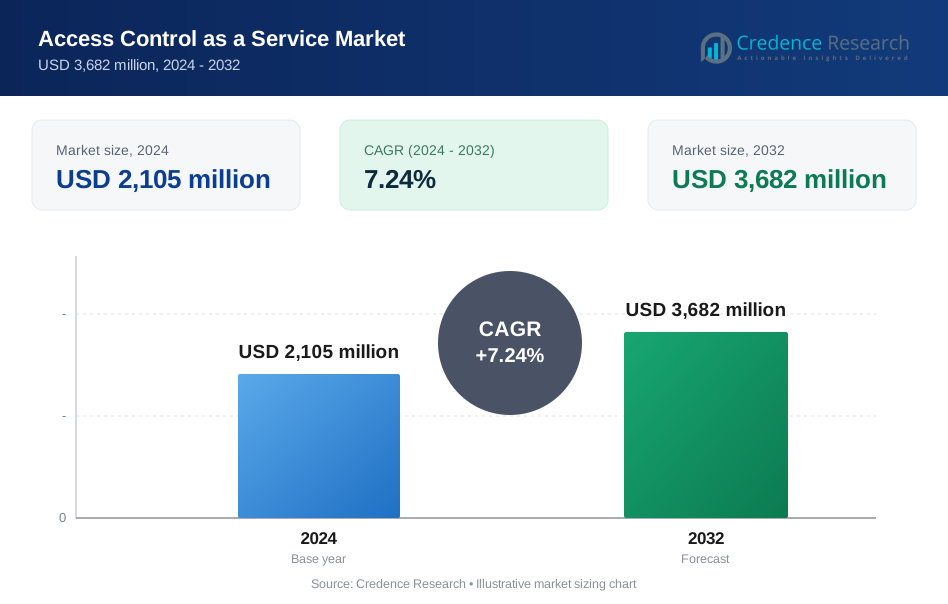
The Access Control As A Service (ACaaS) Market is projected to grow from USD 2,105 million in 2024 to USD 3,682 million by 2032, with a compound annual growth rate (CAGR) of 7.24%.
The Access Control as a Service (ACaaS) market is driven by the increasing demand for cloud-based security solutions, offering scalability, flexibility, and cost-efficiency to organizations. As businesses transition towards hybrid and remote work environments, the need for secure and remote management of access controls has surged. Additionally, rising concerns over data breaches and compliance requirements have prompted enterprises to adopt ACaaS for enhanced security and regulatory adherence. Technological advancements, including AI, IoT, and mobile-based access control, are further shaping the market, allowing for seamless integration with existing systems and enhanced user experience. The growing focus on reducing operational costs, alongside the preference for subscription-based models, is also accelerating the shift towards ACaaS. These trends, coupled with increasing investments in smart infrastructure and smart buildings, are anticipated to drive continuous growth in the ACaaS market, creating opportunities for innovation in security solutions.
The Access Control as a Service (ACaaS) market exhibits strong geographical growth, with North America leading the market, holding around 38% share in 2024, driven by technological adoption and compliance needs. Europe follows closely with a 30% market share, propelled by stringent regulations like GDPR and strong demand for cloud-based security solutions. The Asia-Pacific region is experiencing rapid growth, expected to account for 22% of the global market by 2024, driven by urbanization, smart city initiatives, and increasing cybersecurity concerns. Latin America and the Middle East & Africa together represent about 10% of the market, with growing investments in smart infrastructure and public safety initiatives. Key players driving this global expansion include Honeywell, Brivo Inc., dormakaba Group, Feenics, IBM Corporation, and Cloudastructure Inc., who are leveraging advanced technologies and strategic partnerships to strengthen their market presence.
Market Insights
- The Access Control as a Service (ACaaS) market is projected to grow from USD 2,105 million in 2024 to USD 3,682 million by 2032, with a CAGR of 7.24%.
- Cloud-based security solutions are driving demand for ACaaS, offering scalability, flexibility, and cost efficiency for businesses across sectors.
- Increased cybersecurity threats and compliance requirements, such as GDPR and HIPAA, are pushing organizations to adopt ACaaS for better security and regulatory adherence.
- Technological advancements in AI, IoT, and mobile-based access control are enhancing ACaaS solutions, improving integration and user experience.
- The market is witnessing a shift toward subscription-based models, reducing upfront costs and making ACaaS an attractive option for enterprises of all sizes.
- North America leads the global market with a 38% share in 2024, followed by Europe with 30%, while Asia-Pacific is growing rapidly, capturing 22%.
- Key players in the global ACaaS market include Honeywell, Brivo Inc., dormakaba Group, Feenics, IBM Corporation, and Cloudastructure Inc.
Market Drivers
Cloud-Based Security Solutions
The rise of cloud-based technology is a key driver in the Access Control as a Service (ACaaS) market. Cloud-based security solutions offer flexibility, scalability, and reduced infrastructure costs, making them an attractive option for organizations seeking to streamline their access control systems. For instance, Kisi provides cloud-based access control solutions that enable remote management, real-time monitoring, and seamless updates. This technology is particularly appealing to businesses with multiple locations or a distributed workforce. The ability to manage access control remotely without relying on on-site servers significantly enhances operational efficiency, further propelling demand for ACaaS.
Increasing Cybersecurity Threats and Compliance Needs
With the rise in data breaches and cyber threats, organizations are placing greater emphasis on strengthening their security measures, including physical access control. ACaaS offers enhanced security by integrating access control with cybersecurity protocols, helping organizations mitigate risks associated with unauthorized access. For instance, Johnson Controls offers ACaaS solutions that comply with stringent regulatory requirements and standards such as GDPR and HIPAA. The service's ability to offer audit trails and detailed reporting further supports compliance and risk management efforts.
Technological Advancements and Integration
Technological advancements in artificial intelligence (AI), Internet of Things (IoT), and mobile technologies are transforming the ACaaS landscape. These innovations allow for more efficient and secure access control systems, with features like biometric authentication, facial recognition, and mobile credentials. For instance, HID Global leverages AI and IoT to offer enhanced user experience, increased convenience, and stronger security in their ACaaS solutions. The seamless integration of ACaaS with existing infrastructure and other enterprise systems, such as HR and facility management, is also a key driver for its adoption.
Cost-Effectiveness and Subscription-Based Models
Organizations are increasingly opting for ACaaS due to its cost-effectiveness. By eliminating the need for significant upfront capital investment in hardware and software, ACaaS offers a more affordable, subscription-based model. For instance, Brivo provides subscription-based access control solutions that reduce maintenance costs and offer predictable, scalable options. This aligns with the financial strategies of both small and large enterprises, making it a preferred choice across the board.
Market Trends
Shift Towards Mobile-Based Access Control
A growing trend in the Access Control as a Service (ACaaS) market is the increasing adoption of mobile-based access control solutions. With the widespread use of smartphones, businesses are replacing traditional key cards and physical credentials with mobile devices to enhance security and convenience. For instance, LenelS2 provides mobile access solutions that allow for seamless, contactless entry and offer advanced security features like multi-factor authentication. This trend is gaining momentum as it meets the demand for flexible, user-friendly access control systems.
Integration of Artificial Intelligence and Analytics
Artificial intelligence (AI) and data analytics are playing an increasingly significant role in ACaaS solutions. AI-powered access control systems can detect unusual patterns, predict potential security risks, and provide actionable insights. For instance, Brivo incorporates AI and machine learning algorithms to continuously improve security measures based on real-time data. These innovations not only enhance security but also improve operational efficiency, allowing businesses to automate routine tasks such as identity verification and credential management.
Expansion of IoT Integration
The integration of the Internet of Things (IoT) with access control systems is another important trend shaping the ACaaS market. IoT-enabled devices, such as smart locks and sensors, provide real-time monitoring and control over physical access points. For instance, Honeywell offers IoT-enabled access control solutions that allow organizations to achieve more granular control over who can access specific areas and at what times, enhancing overall security. IoT integration also supports the development of more interconnected, smart building systems, further driving demand for ACaaS.
Growing Demand for Scalability and Flexibility
As businesses evolve and expand, there is an increasing demand for scalable and flexible access control solutions. ACaaS offers organizations the ability to scale their security systems according to their changing needs without significant infrastructure investment. For instance, Centrify provides scalable access control solutions that allow for the easy addition or removal of users and locations. The flexibility of ACaaS solutions aligns with the dynamic nature of modern enterprises, making it an attractive option in today’s market.
Market Challenges Analysis
Data Security and Privacy Concerns
One of the primary challenges in the Access Control as a Service (ACaaS) market is addressing data security and privacy concerns. As ACaaS solutions rely on cloud-based platforms, they require the transmission and storage of sensitive data, including personal and access credentials. This raises concerns about the vulnerability of such data to cyberattacks, breaches, and unauthorized access. Enterprises are often cautious about moving critical security operations to the cloud due to these risks, especially in sectors dealing with highly sensitive information such as finance, healthcare, and government. Service providers must ensure robust encryption, secure communication protocols, and compliance with industry regulations to alleviate these concerns. Additionally, the risk of data misuse and compliance issues related to varying global privacy laws, such as GDPR, creates further hesitation among potential adopters, limiting the growth of ACaaS in regions with stricter regulatory frameworks. Overcoming these issues is crucial to building trust in cloud-based access control.
Integration Complexities and Legacy Systems
Another significant challenge in the ACaaS market is the complexity involved in integrating new solutions with existing infrastructure and legacy systems. Many organizations, especially large enterprises, already have physical access control systems in place, some of which may be outdated or incompatible with modern ACaaS platforms. Integrating cloud-based access control with legacy systems can be technically challenging, often requiring custom solutions, significant investment, and time-consuming implementation processes. These hurdles may deter businesses from transitioning to ACaaS, particularly if they are concerned about potential disruptions to their security operations or the additional costs associated with upgrades. Furthermore, organizations with strict operational requirements may face difficulties in achieving seamless integration without compromising their current workflows. ACaaS providers must continue to develop flexible, interoperable solutions to address these integration challenges, allowing businesses to adopt cloud-based access control without sacrificing functionality or incurring excessive costs during the transition.
Market Opportunities
The Access Control as a Service (ACaaS) market presents significant opportunities as organizations increasingly seek cost-effective, scalable, and flexible security solutions. With the growing adoption of cloud-based technologies across industries, ACaaS offers a compelling option for businesses looking to enhance their security infrastructure without the need for substantial upfront investments. Small and medium-sized enterprises (SMEs), in particular, stand to benefit from ACaaS, as it allows them to access enterprise-level security features through affordable subscription models. This creates a large market opportunity for service providers to cater to a broad range of businesses, including those that previously could not afford advanced access control solutions.
Additionally, the rising adoption of smart cities, smart buildings, and IoT-enabled infrastructure creates a favorable environment for ACaaS providers. As urban centers become more connected, the demand for integrated and seamless security solutions will grow, opening opportunities for ACaaS solutions to be deployed in smart environments. Furthermore, the integration of advanced technologies such as biometrics, AI, and machine learning into access control systems offers further opportunities for differentiation and value creation in the market. Providers that can deliver innovative, interoperable, and secure solutions will be well-positioned to capture a larger share of the expanding market. As businesses across industries continue to prioritize security, the demand for flexible, cloud-based access control solutions is expected to grow, driving future opportunities for ACaaS providers globally.
Market Segmentation Analysis:
By Service
The Access Control as a Service (ACaaS) market is segmented by service into managed, hosted, and hybrid services. Managed services dominate the market, offering full outsourcing of access control management, which appeals to businesses seeking to minimize operational burdens. Hosted and hybrid models provide more flexible options, allowing organizations to tailor services according to their specific needs.
By Deployment
ACaaS is segmented by deployment into cloud-based and on-premise solutions. Cloud-based deployment leads the market due to its scalability, cost-efficiency, and ease of integration with existing systems. On-premise solutions, while less popular, remain essential for businesses with strict data privacy requirements or limited internet connectivity, offering more direct control over security infrastructure.
By End User
The market is segmented by end users into commercial, government, healthcare, and industrial sectors. The commercial sector is the largest, driven by the increasing need for advanced security in office buildings, retail, and financial institutions. Government and healthcare sectors are also significant users, given their stringent security and compliance demands.
Segments:
Based on Service
- Managed Services
- Hosted Service
- Hybrid Service
- Others
Based on Deployment
- Public Cloud
- Private Cloud
- Hybrid Cloud
Based on End User
- Pharmaceuticals & Healthcare
- Government
- Education
- Healthcare
- Retail
- Transportation
- Others
Based on the Geography:
- North America
- U.S.
- Canada
- Mexico
- Europe
- Germany
- France
- U.K.
- Italy
- Spain
- Rest of Europe
- Asia Pacific
- China
- Japan
- India
- South Korea
- South-east Asia
- Rest of Asia Pacific
- Latin America
- Brazil
- Argentina
- Rest of Latin America
- Middle East & Africa
- GCC Countries
- South Africa
- Rest of the Middle East and Africa
Regional Analysis
North America
North America holds the largest share of the Access Control as a Service (ACaaS) market, accounting for 38% of the global market in 2024. This region is driven by the high adoption rate of advanced security technologies, including cloud-based access control solutions, across industries such as commercial, healthcare, and government. The presence of key players, such as Honeywell and Kastle Systems, further strengthens the market in this region. The growing demand for scalable security solutions due to increasing cybersecurity threats and compliance regulations, such as HIPAA and CCPA, also fuels market growth. Additionally, the rapid development of smart cities and IoT-enabled infrastructure in the United States and Canada is expected to bolster the demand for ACaaS in the coming years.
Europe
Europe holds a significant share of the ACaaS market, contributing to 30% of the global market in 2024. The demand for advanced access control solutions in this region is primarily driven by stringent regulatory requirements such as GDPR, which mandates the protection of personal data. The commercial and government sectors, in particular, are leading adopters of ACaaS, as they seek to ensure compliance with these regulations while securing their physical and digital assets. Countries like Germany, the UK, and France are at the forefront of ACaaS adoption, with strong investments in cloud-based security technologies. The growing trend of remote work and hybrid working models also supports the expansion of ACaaS in the region, as businesses seek flexible, cost-effective security solutions.
Asia-Pacific
The Asia-Pacific region is one of the fastest-growing markets for ACaaS, expected to capture 22% of the global market share by 2024. The rapid urbanization, increasing construction of smart buildings, and the growing need for advanced security solutions in countries like China, Japan, and India are major drivers of the ACaaS market in this region. Additionally, the expansion of the IT and financial services sectors has increased the demand for secure access control systems. The rise in cyber threats and the adoption of cloud technologies by enterprises further accelerates the market’s growth in Asia-Pacific. Governments across the region are also investing in smart city projects, which will require scalable and efficient access control systems, providing additional growth opportunities for ACaaS providers.
Latin America and Middle East & Africa
Latin America and the Middle East & Africa together account for 10% of the global ACaaS market in 2024. While these regions are relatively smaller markets, they show significant potential for future growth. The increasing focus on digital transformation and smart infrastructure in countries like Brazil, Mexico, and the UAE is creating demand for advanced access control solutions. In addition, government initiatives to enhance public safety and secure critical infrastructure are expected to drive the adoption of ACaaS in these regions. However, economic constraints and limited technological infrastructure in some areas may pose challenges to market penetration.
Key Player Analysis
- Honeywell International Inc.
- Cloudastructure Inc.
- Forcefield Systems Inc.
- dormakaba Group
- Feenics
- IBM Corporation
- Digital Hands
- Gemalto N.V
- Brivo Inc.
- Fleming Companies
- Centrify Corporation
- Datawatch Systems Inc.
Competitive Analysis
The Access Control as a Service (ACaaS) market is highly competitive, with leading players such as Brivo Inc., Honeywell International Inc., IBM Corporation, dormakaba Group, Feenics, Cloudastructure Inc., Centrify Corporation, and Datawatch Systems Inc. These companies are constantly innovating to maintain their competitive edge by offering scalable, cloud-based access control solutions that cater to a wide range of industries. Honeywell International Inc., for instance, is constantly innovating to maintain its competitive edge by integrating cutting-edge technologies like AI, IoT, and mobile-based access control to meet the evolving security needs of businesses. The market is also characterized by strategic partnerships, mergers, and acquisitions, which allow companies to expand their geographic footprint and improve their product portfolios. For example, Honeywell’s acquisition of Global Access Solutions has strengthened its position in the commercial access control segment. As competition intensifies, market leaders are increasingly focusing on improving customer experience, providing flexible pricing models, and ensuring regulatory compliance to maintain their market share.
Recent Developments
- In January 2025, ASSA ABLOY is set to acquire 3millID Corporation and Third Millennium Systems Ltd, US and UK-based companies specializing in readers and credentials for physical access control. This acquisition will enhance ASSA ABLOY’s existing solutions by incorporating technological advancements and creating complementary growth opportunities.
- In June 2024, Honeywell (US) acquired the Global Access Solutions (GAS) division of Carrier in Florida, which focused on advanced access control and security systems for commercial buildings. This division specializes in electronic access control, video surveillance, and integrated security management systems.
- In September 2023, ASSA ABLOY (Sweden) launched the Aperio KL100, a wireless access solution for lockers and cabinets. The device integrates with over 100 existing access control systems, providing security for small access points like lockers and drawers. It operates on a single battery, supports various credential technologies, and ensures easy integration with minimal disruption.
- In November 2023, Kastle, a leader in property technology and managed security, introduced Kastle EverPresence, the first fully interoperable physical access control system. Designed to seamlessly integrate with existing infrastructure, this system provides a more efficient and flexible approach to security management.
Market Concentration & Characteristics
The Access Control as a Service (ACaaS) market is moderately concentrated, with a mix of established players and emerging companies competing for market share. Key players like Honeywell, IBM Corporation, dormakaba Group, and Brivo Inc. dominate the market, leveraging their extensive portfolios, global presence, and strategic partnerships to strengthen their positions. Despite the dominance of these large firms, the market also presents opportunities for smaller companies and new entrants, particularly those offering innovative, cloud-based security solutions. The market is characterized by rapid technological advancements, with a strong focus on integrating AI, IoT, and mobile-based technologies. The shift toward cloud-based access control, driven by the demand for scalable and cost-efficient solutions, is a defining characteristic. Additionally, as enterprises seek compliance with stricter data protection regulations and enhance security measures, the market continues to evolve with a growing emphasis on remote management, automation, and seamless integration with existing systems.
Report Coverage
The research report offers an in-depth analysis based on Service, Deployment, End-User and Geography. It details leading market players, providing an overview of their business, product offerings, investments, revenue streams, and key applications. Additionally, the report includes insights into the competitive environment, SWOT analysis, current market trends, as well as the primary drivers and constraints. Furthermore, it discusses various factors that have driven market expansion in recent years. The report also explores market dynamics, regulatory scenarios, and technological advancements that are shaping the industry. It assesses the impact of external factors and global economic changes on market growth. Lastly, it provides strategic recommendations for new entrants and established companies to navigate the complexities of the market.
Future Outlook
- The Access Control as a Service (ACaaS) market will continue to grow steadily, driven by increasing demand for cloud-based security solutions.
- Technological advancements in AI and IoT will lead to more sophisticated access control systems with enhanced security features.
- The shift towards hybrid and remote work environments will further fuel the adoption of ACaaS for remote access management.
- Subscription-based pricing models will become more popular, providing cost-effective solutions for businesses of all sizes.
- Integration with existing IT infrastructure and other enterprise systems will be key to the success of ACaaS solutions.
- Rising concerns over data privacy and regulatory compliance will drive businesses to adopt secure, scalable ACaaS platforms.
- North America will maintain its dominance in the market, but Asia-Pacific will experience the fastest growth in the coming years.
- Investments in smart cities and smart buildings will create new opportunities for ACaaS providers.
- Smaller companies offering innovative and niche solutions will continue to challenge established market players.
- Ongoing improvements in cybersecurity protocols will strengthen the overall reliability of ACaaS platforms.
Request a Free Sample
Fill in your details and we'll send you a free sample report.
- Sample data tables & charts
- Research methodology
Need a Custom Version of This Report?
Tailor the scope, geography, or segments to your exact requirements.
- Custom geography or segment scope
- Direct access to our analyst team
Frequently Asked Questions
What is the current size of the Access Control as a Service (ACaaS) market?
What factors are driving the growth of the Access Control as a Service (ACaaS) market?
What are the key segments within the Access Control as a Service (ACaaS) market?
What are some challenges faced by the Access Control as a Service (ACaaS) market?
Who are the major players in the Access Control as a Service (ACaaS) market?
Table of Content
Chapter 1. Report Introduction
- 1.1 Report Description & Purpose
- 1.1.1 Report Title & Market Definition
- 1.1.2 Unique Selling Propositions (USP) & Key Differentiators
- 1.1.3 Value Proposition for Stakeholders
- 1.2 Research Objectives
- 1.2.1 Market Sizing Objectives (Volume & Revenue) (Volume Where Applicable)
- 1.2.2 Segmentation Objectives
- 1.2.3 Competitive Intelligence Objectives
- 1.2.4 Forecast & Scenario Objectives
- 1.3 Report Scope
- 1.3.1 Access Control as a Service Scope – Segments & Subsegments Covered
- 1.3.2 Geographic Scope – Regions & Countries Covered
- 1.3.3 Historical Period, Base Year & Forecast Period (2024; forecast to 2032)
- 1.3.4 Inclusions & Exclusions
- 1.4 Industry Classification & Applicable Codes
- 1.5 Currency, Measurement Units & Valuation Basis
- 1.6 Target Stakeholders
- 1.7 Limitations & Assumptions
Chapter 2. Executive Summary
- 2.1 Global Access Control as a Service Market Snapshot
- 2.1.1 Market Size – Historical (2024) & Forecast (2024-2032) (2024: USD 2,105 million → 2032: USD 3,682 million)
- 2.1.2 Volume & Revenue – Global Totals (Volume Where Applicable)
- 2.1.3 Key Market Highlights – Top Five Facts
- 2.2 Access Control as a Service Market Segmentation Snapshot
- 2.2.1 Market Split by Region – 2024 vs. 2032
- 2.3 Competitive Snapshot
- 2.3.1 Top 10 Players by Revenue Share – 2024
- 2.3.2 Top 10 Players by Volume Share – 2024 (Volume Where Applicable)
- 2.3.3 Recent Strategic Developments (18-Month Summary)
- 2.4 Key Investment Highlights & Strategic Conclusions
Chapter 3. Access Control as a Service Market Dynamics & Industry Analysis
- 3.1 Market Overview & Context
- 3.1.1 Access Control as a Service Market Position in the Broader Industry Value Chain
- 3.1.2 Demand Structure & Purchasing Dynamics
- 3.1.3 Market Maturity & Development Stage by Region
- 3.2 Access Control as a Service Market Drivers
- 3.3 Access Control as a Service Market Restraints & Challenges
- 3.4 Access Control as a Service Market Opportunities
- 3.5 Porter's Five Forces Analysis
- 3.5.1 Threat of New Entrants
- 3.5.2 Bargaining Power of Suppliers
- 3.5.3 Bargaining Power of Buyers
- 3.5.4 Threat of Substitutes
- 3.5.5 Competitive Rivalry – Intensity Assessment
- 3.6 Access Control as a Service Value Chain Analysis
- 3.6.1 Upstream – Key Inputs, Resources & Suppliers
- 3.6.1.1 Key Input/Resource 1
- 3.6.1.2 Key Input/Resource 2
- 3.6.1.3 Key Input/Resource 3
- 3.6.2 Midstream – Core Operations & Value Creation
- 3.6.2.1 Operating Model & Process Overview
- 3.6.2.2 Key Operating Locations & Capabilities by Company
- 3.6.3 Downstream – Market Channels & End Users
- 3.6.3.1 Direct Sales & Customer Engagement Channels
- 3.6.3.2 Indirect Sales, Intermediaries & Partner Channels
- 3.6.4 Value Chain Profitability Analysis
- 3.6.1 Upstream – Key Inputs, Resources & Suppliers
- 3.7 PESTEL Analysis
- 3.7.1 Political Factors
- 3.7.2 Economic Factors
- 3.7.3 Social Factors
- 3.7.4 Technological Factors
- 3.7.5 Environmental Factors
- 3.7.6 Legal Factors
- 3.8 Access Control as a Service Supply Chain Analysis
- 3.8.1 Critical Input & Resource Availability Risk Assessment
- 3.8.2 Supplier & Operational Concentration Risk (Geographic Exposure)
- 3.8.3 Supply & Service Disruption Impact Analysis
- 3.9 Regulatory & Policy Landscape
Note: The regulatory and policy landscape section covers regulations based on their applicability to the market, Access Control as a Service category, geography, and scope of the study. Only regulatory frameworks with a material impact on operations, compliance, trade, sustainability, or market access are analyzed in detail.
Chapter 4. Key Investment Pockets & Opportunity Analysis
- 4.1 Access Control as a Service Market Attractiveness Analysis
- 4.1.1 By Region – Investment Attractiveness Matrix (Market Size × CAGR)
- 4.2 Absolute Revenue Growth Opportunity
- 4.2.1 By Region – Absolute Revenue Growth Through 2032
- 4.3 Incremental Demand Opportunity
- 4.3.1 By Region – Incremental Demand Through 2032
- 4.3.2 Segment – Incremental Demand
- 4.4 Emerging Submarket Opportunity Deep Dive (Subject to Applicability)
- 4.5 Priority Market Opportunity Scorecards
- 4.5.1 United States
- 4.5.2 Europe
- 4.5.3 Asia
- 4.5.4 Middle East & Africa
Note: Priority market opportunity scorecards reflect the geographic scope and strategic relevance of the study. Listed markets are indicative and may be adapted to the industry.
Chapter 5. Access Control as a Service Cross-Border Trade & Market Access Analysis
- 5.1 International Trade & Cross-Border Activity Overview
- 5.1.1 Global Export Value by Country (2024)
- 5.1.2 Global Export Volume by Country (2024) (Volume Where Applicable)
- 5.1.3 Global Import Value by Country (2024)
- 5.1.4 Global Import Volume by Country (2024) (Volume Where Applicable)
- 5.1.5 Net Trade Balance by Country (2024)
- 5.2 Export Analysis – Segment
- 5.2.1 Category 1 (Applicable Classification Code)
- 5.2.2 Category 2 (Applicable Classification Code)
- 5.2.3 Category 3 (Applicable Classification Code)
- 5.2.4 Category 4 (Applicable Classification Code)
- 5.2.5 Category 5 (Applicable Classification Code)
- 5.3 Import Analysis – Segment
- 5.3.1 Category 1 (Applicable Classification Code)
- 5.3.2 Category 2 (Applicable Classification Code)
- 5.3.3 Category 3 (Applicable Classification Code)
- 5.3.4 Category 4 (Applicable Classification Code)
- 5.3.5 Category 5 (Applicable Classification Code)
- 5.4 Cross-Border Pricing & Transaction Benchmarks
- 5.4.1 Export Pricing – Segment & Country
- 5.4.2 Import Pricing – Segment & Source Country
- 5.4.3 Price Trends (2024)
- 5.5 Key Cross-Border Trade & Delivery Routes
- 5.5.1 Cross-Border Trade/Delivery Route 1
- 5.5.2 Cross-Border Trade/Delivery Route 2
- 5.5.3 Cross-Border Trade/Delivery Route 3
- 5.5.4 Cross-Border Trade/Delivery Route 4
- 5.5.5 Cross-Border Trade/Delivery Route 5
- 5.6 Trade Policy & Market Access Impact Assessment
- 5.6.1 Tariff & Non-Tariff Barriers
- 5.6.2 Regional Trade & Economic Integration Frameworks
- 5.6.3 Bilateral & Multilateral Trade Agreements
- 5.6.4 Cross-Border Operating, Licensing & Localization Requirements
Note: This chapter applies where cross-border trade or delivery is relevant to Access Control as a Service. Goods, services, and digital offerings are assessed using applicable classifications and transaction measures. Import-export volumes, trade balances, and route analyses are included only where meaningful to the market.
Chapter 6. Competitive Landscape & Company Benchmarking
- 6.1 Access Control as a Service Market Concentration & Structure
- 6.1.1 Herfindahl-Hirschman Index (HHI) – vs. 2024
- 6.1.2 Leading, Mid-Sized & Emerging Player Structure
- 6.1.3 Global, Regional & Local Player Dynamics
- 6.2 Access Control as a Service Market Share Analysis – 2024
- 6.2.1 Global Revenue Share by Company
- 6.2.2 Global Volume Share by Company (Volume Where Applicable)
- 6.2.3 Regional Revenue Share
- 6.2.4 Market Share Evolution ( vs. 2024)
- 6.2.5 Company Market Share by Key Segment
- 6.2.6 Company Market Share by Customer Group
- 6.3 Operating Scale, Capacity & Infrastructure Analysis
- 6.3.1 Global Operating Scale & Supply Capacity
- 6.3.2 Resource Utilization & Operating Efficiency
- 6.3.3 Output, Service Delivery & Activity Metrics
- 6.3.4 Operating Footprint & Infrastructure Map
- 6.3.5 Planned Operational & Capacity Expansion
- 6.4 Access Control as a Service Competitive Benchmarking Matrix
- 6.4.1 Revenue, Growth, Profitability & Operating Metric Comparison
- 6.4.2 Channel Revenue Mix
- 6.4.3 Geographic Revenue Exposure
- 6.4.4 R&D Intensity
- 6.4.5 Sustainability Maturity
- 6.5 Strategic Developments in Access Control as a Service (Last 24 Months)
- 6.5.1 Mergers, Acquisitions & Divestments
- 6.5.2 New Products, Services & Solutions in Access Control as a Service
- 6.5.3 Operational & Infrastructure Expansions
- 6.5.4 Strategic Alliances, Joint Ventures & Partnerships
- 6.5.5 Distribution Expansion & Market Entry
- 6.5.6 Sustainability & ESG Initiatives
- 6.6 Competitive Strategy Mapping
- 6.6.1 Leader, Challenger, Follower & Niche Classification
- 6.6.2 Pricing Strategy Comparison
- 6.6.3 Channel Strategy Matrix
Note: Strategic developments are included based on their materiality and the availability of reliable information.
Chapter 7. Global Access Control as a Service Market – By Sales & Delivery Channel
- 7.1 Segment Overview
- 7.1.1 Volume & Revenue Split by Channel (2024 & 2032) (Volume Where Applicable)
- 7.1.2 Channel Mix Evolution (2024-2032)
Chapter 8. Regional Market Analysis – Global Overview
- 8.1 Global Regional Overview
- 8.1.1 Regional Volume Share (Volume Where Applicable)
- 8.1.2 Regional Revenue Share
- 8.1.3 Regional Volume by Region (Volume Where Applicable)
- 8.1.4 Regional Revenue by Region
- 8.1.5 Regional Forecast Through 2032
- 8.2 Cross-Regional Segment Analysis
- 8.2.1 By Sales & Delivery Channel
- 8.2.2 By Competitive Positioning & Price Tier
Chapter 9. North America Access Control as a Service Market
- 9.1 United States
- 9.2 Canada
- 9.3 Mexico
Chapter 10. Europe Access Control as a Service Market
- 10.1 Germany
- 10.2 France
- 10.3 Italy
- 10.4 United Kingdom
- 10.5 Spain
- 10.6 Poland
- 10.7 Russia
- 10.8 Netherlands
- 10.9 Belgium
- 10.10 Sweden
- 10.11 Denmark
- 10.12 Norway
- 10.13 Rest of Europe
Chapter 11. Asia Pacific Access Control as a Service Market
- 11.1 China
- 11.2 India
- 11.3 Japan
- 11.4 South Korea
- 11.5 Thailand
- 11.6 Indonesia
- 11.7 Vietnam
- 11.8 Malaysia
- 11.9 Australia
- 11.10 Rest of Asia Pacific
Chapter 12. Latin America Access Control as a Service Market
- 12.1 Brazil
- 12.2 Argentina
- 12.3 Colombia
- 12.4 Chile
- 12.5 Rest of Latin America
Chapter 13. Middle East Access Control as a Service Market
- 13.1 Saudi Arabia
- 13.2 United Arab Emirates
- 13.3 Turkey
- 13.4 Israel
- 13.5 Iran
- 13.6 Rest of the Middle East
Chapter 14. Africa Access Control as a Service Market
- 14.1 South Africa
- 14.2 Egypt
- 14.3 Nigeria
- 14.4 Morocco
- 14.5 Rest of Africa
Chapter 15. Access Control as a Service Company Profiles
- 15.1 [Company 01]
- 15.1.1 Company Overview
- 15.1.2 Key Management Personnel
- 15.1.3 Products & Services Portfolio
- 15.1.4 Financial Performance
- 15.1.5 Key Market Focus & Geographic Presence
- 15.1.6 Recent Developments & Strategic Initiatives
Note: The company profile list is preliminary and may change based on research findings, market developments, data availability, and client requirements.
Chapter 16. Appendices
- Appendix A – List of Abbreviations & Acronyms
- Appendix B – Industry Classification Code Reference – Full Series
- Appendix C – Supply, Output & Operating Capacity Data Tables
- Appendix D – End-Use & Demand Base Tables
- Appendix E – Demand, Adoption & Usage Assumptions
- Appendix F – Pricing & Revenue Metric Reference Tables
- Appendix G – Company Operations & Infrastructure Database
- Appendix H – Cross-Border Trade & Activity Data Tables (Where Applicable)
- Appendix I – Regulatory Summary Tables
- Appendix J – Primary Research Participant List (Anonymized)
- Appendix K – Primary Research Questionnaire Framework
- Appendix L – Data Sources & Bibliography
- Appendix M – Market Size Divergence & Source Comparison
Chapter 17. Research Methodology
- 17.1 Research Framework & Philosophy
- 17.2 Secondary Research – Sources, Hierarchy & Data Extraction
- 17.3 Data Modeling – Bottom-Up & Top-Down Market Sizing
- 17.4 Primary Research – Stakeholder Framework, LOI & Sample Sizes
- 17.5 Forecast Methodology – Regression, Scenario & Sensitivity Analysis
- 17.6 Quality Control – Four-Layer Validation Framework
- 17.7 Limitations & Standard Assumptions
- 17.8 Disclaimer
