
Market Overview
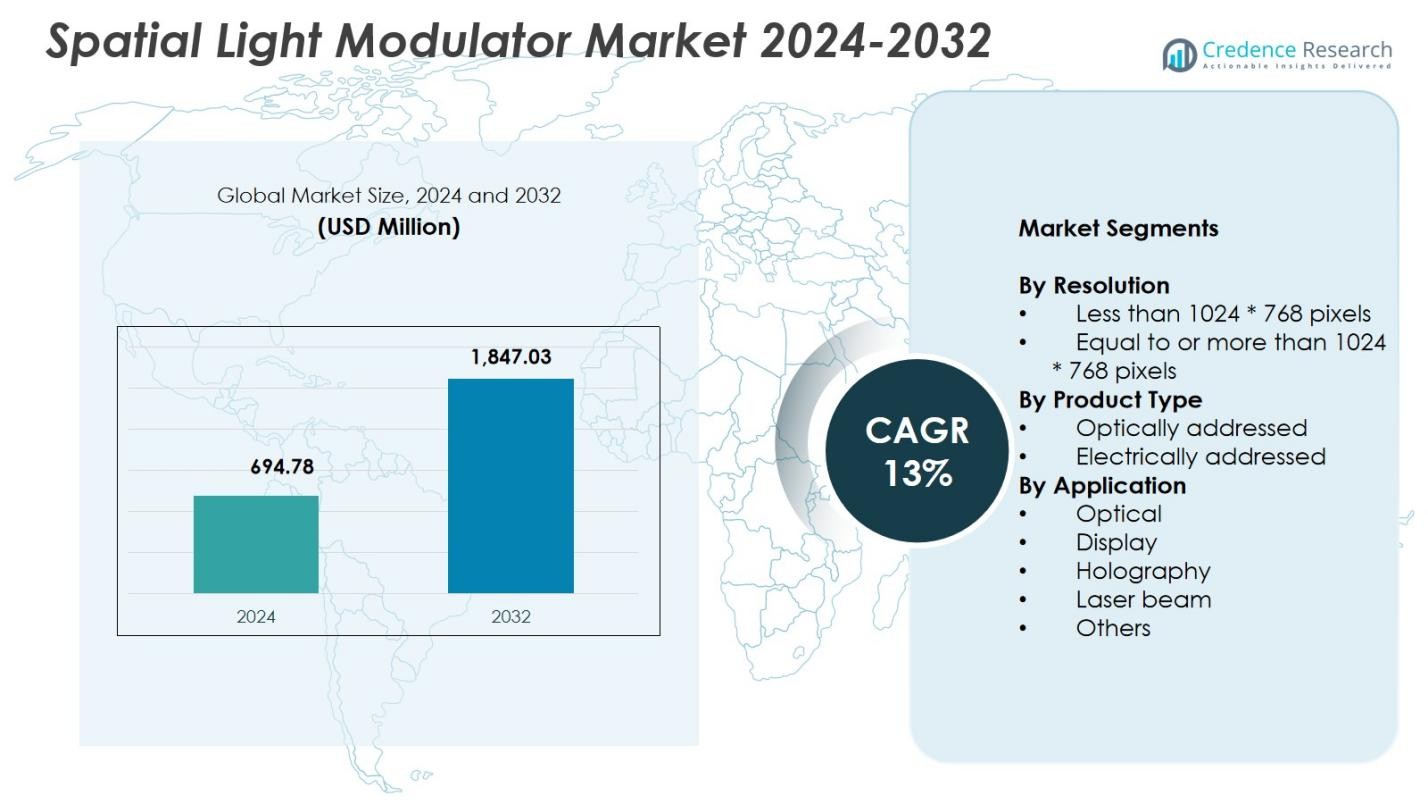
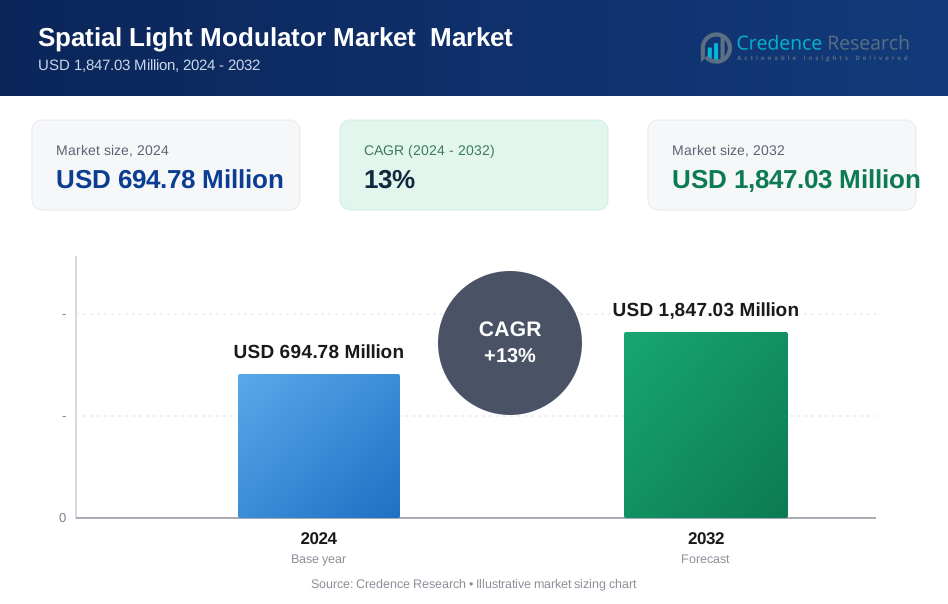
Spatial Light Modulator Market size was valued at USD 694.78 Million in 2024 and is anticipated to reach USD 1,847.03 Million by 2032, at a CAGR of 13% during the forecast period.
| REPORT ATTRIBUTE | DETAILS |
|---|---|
| Historical Period | 2020-2023 |
| Base Year | 2024 |
| Forecast Period | 2025-2032 |
| Spatial Light Modulator Market Size 2024 | USD 694.78 Million |
| Spatial Light Modulator Market , CAGR | 13% |
| Spatial Light Modulator Market Size 2032 | USD 1,847.03 Million |
Spatial Light Modulator Market is shaped by leading players such as Hamamatsu Photonics K.K., Meadowlark Optics, JENOPTIK AG, HOLOEYE Photonics AG, Thorlabs Inc., PerkinElmer Inc., Texas Instruments Incorporated, Laser 2000, Santec Holdings Corporation, and KOPIN Corporation, each driving innovation in high-resolution LCoS, MEMS, and holographic modulation technologies. These companies strengthen market growth through advancements in AR/VR displays, laser beam shaping, adaptive optics, and quantum research applications. Regionally, North America led the market with 34.6% share in 2024, supported by strong adoption in research, industrial photonics, and advanced optical communication systems, followed closely by Europe and Asia-Pacific.
Market Insights
- Spatial Light Modulator Market was valued at USD 694.78 Million in 2024 and will grow at a CAGR of 13% through 2032.
- Market growth is driven by increasing adoption of high-resolution SLMs in laser beam shaping, AR/VR systems, holography, microscopy, and optical communication technologies.
- Key trends include rapid advancements in LCoS and MEMS architectures, rising integration in quantum optics, and growing demand for ultra-fast, AI-optimized modulators across scientific and industrial applications.
- Leading players such as Hamamatsu Photonics, Meadowlark Optics, Thorlabs, and HOLOEYE Photonics advance the market through innovations in high-contrast, high-speed, and miniaturized SLM platforms, strengthening their presence in major application areas.
- North America held 34.6% share in 2024, followed by Europe with 27.8% and Asia-Pacific with 29.4%, while the equal to or more than 1024 × 768 pixels segment dominated the market with 63.4% share due to rising demand for high-precision optical modulation.
Market Segmentation Analysis:
By Resolution
The Spatial Light Modulator Market by resolution is dominated by the equal to or more than 1024 × 768 pixels segment, which captured 63.4% share in 2024. This leadership reflects its superior modulation precision, higher pixel density, and widespread adoption in holography, augmented reality systems, advanced microscopy, and laser beam shaping. Demand increases as research institutions and semiconductor manufacturers prioritize high-resolution SLMs for phase modulation accuracy, wavefront correction, and real-time optical computing. The less than 1024 × 768 pixels category continues to serve cost-sensitive uses such as basic optics experiments and entry-level display applications.
- For instance, HOLOEYE's PLUTO-2.1 phase-only LCOS SLM features 1920 × 1080 pixel resolution with an 8.0 μm pixel pitch and 93% fill factor, enabling at least 2π phase retardation across 420-650 nm for holography and beam shaping tasks.
By Product Type
By product type, electrically addressed spatial light modulators (EASLMs) dominated the market with 58.7% share in 2024, driven by their fast response times, high frame rates, and ease of integration into digital optical systems. Their strong presence in beam steering, adaptive optics, and high-speed optical communication supports this segment’s leadership. Increasing deployment in VR/AR devices and precision imaging further strengthens adoption. Optically addressed SLMs (OASLMs) remain relevant for applications requiring high contrast and wavelength flexibility, although their slower speed limits uptake in dynamic modulation environments.
- For instance, Thorlabs' Exulus-HD2 EASLM offers 1920 x 1200 WUXGA resolution with a 60 Hz frame rate and >92% fill factor for beam steering and holography applications.
By Application
The laser beam application segment led the Spatial Light Modulator Market with 41.2% share in 2024, supported by rapid uptake in industrial laser processing, biomedical imaging, optical trapping, and beam shaping for research laboratories. The ability of SLMs to precisely modulate amplitude, phase, and polarization in real time enhances demand. Holography and display applications also exhibit strong growth due to advancements in 3D visualization, AR micro-displays, and photonics-based data storage. Optical applications, including interferometry and wavefront control, continue expanding as defense and semiconductor industries adopt high-performance modulators for next-generation photonic systems.
Key Growth Drivers
Rising Adoption in Advanced Laser Beam Shaping and Industrial Photonics
The Spatial Light Modulator Market experiences strong growth as industries increasingly adopt SLMs for precision laser beam shaping, optical trapping, lithography, and micro-fabrication. Their ability to dynamically control phase, amplitude, and polarization enables higher accuracy in semiconductor processing, biomedical imaging, and materials research. As laser-based manufacturing accelerates globally, SLMs support improved throughput, finer patterning, and enhanced automation. These capabilities position SLMs as essential components in next-generation photonics systems, driving sustained demand across industrial and scientific applications.
- For instance, Fraunhofer ILT and Hamamatsu jointly deployed an industrial SLM head in Aachen for ultrashort‑pulsed laser material processing, operating up to 150 W average power to deliver dynamic beam shaping for high‑throughput micromachining applications.
Expanding Use in Holography, AR/VR, and 3D Display Technologies
Demand for spatial light modulators surges due to their expanding roles in holographic displays, augmented reality, virtual reality, and advanced 3D visualization systems. Their high-resolution phase modulation enhances depth rendering, optical field reconstruction, and immersive display performance. As consumer electronics manufacturers and research institutions invest heavily in next-generation display architectures, SLMs provide essential optical control for high-fidelity imaging. The technology’s ability to support real-time holographic projection and wavefront modulation continues to accelerate its adoption, particularly in entertainment, medical visualization, and simulation environments.
- For instance, Santec's SLM-200 provides WUXGA (1920 x 1200) resolution with 10-bit phase control (1024 levels) and phase stability below 0.001 π rad., supporting wavefront correction and holographic reconstruction across 400-1600 nm wavelengths.
Growing Adoption in Optical Communication and Adaptive Optics
The market benefits from the rising need for adaptive optics and coherent optical communication, where SLMs enable wavefront correction, phase alignment, channel multiplexing, and distortion mitigation. Their integration improves signal integrity in free-space optical links, satellite communication, and astronomical imaging. As bandwidth demand increases and data transmission systems evolve toward photonics-based architectures, SLMs support modulation flexibility and low-latency control. This trend strengthens adoption in telecommunications, aerospace, and scientific observatories, driving long-term growth.
Key Trends & Opportunities
Integration of SLMs in Quantum Optics and Photonic Computing
A major trend shaping the Spatial Light Modulator Market is the growing integration of SLMs into quantum information systems, photonic computing, and quantum simulation setups. Their precise phase modulation enables quantum state manipulation, beam routing, and spatial mode encoding. As global research accelerates in quantum technologies, SLMs offer versatile tools for laboratory experimentation and early-stage quantum hardware development. This creates substantial opportunities for manufacturers to target research institutions and emerging quantum startups seeking high-performance optical control components.
- For instance, at MIT's Englund lab, Santec deployed seven SLM-200 units, one SLM-300, and one SLM-210 for quantum computer research, leveraging their reliability and phase stability to form optical wavefronts and generate focused optical tweezers beams.
Shift Toward High-Resolution, Fast-Response, and AI-Optimized Modulators
An important opportunity emerges from the industry’s shift toward ultra-high-resolution SLMs with faster refresh rates and AI-enhanced control algorithms. Advances in liquid crystal on silicon (LCoS), MEMS-based SLMs, and holographic modulation enable improved accuracy for AR/VR micro-displays, biomedical diagnostics, and dynamic beam shaping. AI-driven calibration and error correction further enhance stability and optical fidelity. Manufacturers investing in intelligent SLM platforms can address growing demand from semiconductor fabrication, autonomous systems, and high-precision scientific applications.
- For instance, Sony’s 1.3‑type 4K OLED and LCOS microdisplays, used in AR/VR headsets and mixed‑reality systems, integrate high‑speed driver circuits that support frame rates around 90 fps with brightness near 1,000 cd/m², improving motion clarity and visual fidelity for ultra‑high‑resolution immersive displays.
Key Challenges
High Cost of Advanced SLM Technologies and Integration Complexity
One of the key challenges is the high cost of developing and integrating advanced spatial light modulators, particularly LCoS and MEMS variants requiring specialized materials, precise fabrication, and complex driver electronics. These costs hinder adoption across price-sensitive industries and limit scalability in volume-driven markets such as consumer electronics. Additionally, integration into optical setups often demands extensive alignment, calibration, and thermal management, increasing system complexity and deployment time for manufacturers and end users.
Performance Limitations Affecting Speed, Contrast, and Wavelength Flexibility
Despite technological advances, SLMs still face performance constraints that limit their application in high-speed or broadband environments. Liquid-crystal-based SLMs often exhibit slower response times and restricted wavelength compatibility, reducing effectiveness in fast laser modulation or multi-spectral imaging. MEMS devices, while faster, may face limitations in achieving high contrast and phase stability. These constraints restrict widespread adoption in demanding sectors such as ultrafast optics, high-power laser systems, and real-time holography, presenting ongoing technical challenges for developers.
Regional Analysis
North America
North America held 34.6% share of the Spatial Light Modulator Market in 2024, driven by strong demand from advanced research institutions, semiconductor manufacturing, and industrial laser processing sectors. The U.S. leads adoption due to extensive investment in holography, AR/VR development, optical communication, and defense-based adaptive optics programs. Growing integration of SLMs in biomedical imaging and quantum research further strengthens regional growth. Major photonics companies and universities continue to expand R&D initiatives, supporting rapid technological advancements and accelerating commercialization of high-resolution, fast-response modulators across scientific, industrial, and commercial applications.
Europe
Europe accounted for 27.8% share of the market in 2024, supported by strong photonics ecosystems in Germany, the U.K., and France. The region benefits from significant deployment of SLMs in automotive lidar research, optical metrology, precision manufacturing, and holographic display development. Government-funded photonics programs and active university collaborations contribute to continuous innovation in beam shaping, adaptive optics, and 3D imaging technologies. Demand from aerospace, microscopy, and semiconductor inspection applications further drives adoption. Europe’s emphasis on high-accuracy optical instrumentation ensures steady growth for advanced LCoS and MEMS-based SLM platforms.
Asia-Pacific
Asia-Pacific led global expansion momentum and captured 29.4% share in 2024, driven by robust semiconductor fabrication, consumer electronics manufacturing, and accelerating adoption of holographic and AR/VR technologies. China, Japan, and South Korea dominate regional demand due to strong photonics production capabilities and rapid investments in industrial lasers, optical computing, and biomedical imaging. The growing presence of OEMs focused on high-resolution displays and quantum optics research strengthens SLM deployment. Favorable government support for advanced manufacturing and photonics innovation positions Asia-Pacific as a long-term growth hub for next-generation modulators.
Latin America
Latin America represented 4.1% share of the Spatial Light Modulator Market in 2024, supported by expanding adoption of laser technologies in medical diagnostics, industrial inspection, and academic research. Countries such as Brazil and Mexico increasingly incorporate SLMs in optical laboratories, materials processing, and display research initiatives. Growth is driven by rising investment in scientific infrastructure and partnerships with global photonics suppliers. Although the market remains in early development stages, increasing demand for precision optics and educational deployments indicates strong long-term potential for advanced modulation technologies across the region.
Middle East & Africa
The Middle East & Africa market accounted for 4.1% share in 2024, driven by emerging adoption in defense optics, laser-based surveying, and scientific research institutions. Countries such as the UAE, Israel, and Saudi Arabia invest in photonics innovation, fostering deployment of SLMs in holography, adaptive optics, and remote sensing. Industrial sectors increasingly utilize laser beam shaping and optical testing tools, supporting gradual market expansion. While overall penetration remains lower than other regions, growing national research programs and technology diversification efforts are expected to elevate SLM demand throughout the forecast period.
Market Segmentations:
By Resolution
- Less than 1024 * 768 pixels
- Equal to or more than 1024 * 768 pixels
By Product Type
- Optically addressed
- Electrically addressed
By Application
- Optical
- Display
- Holography
- Laser beam
- Others
By Geography
- North America
- U.S.
- Canada
- Mexico
- Europe
- Germany
- France
- U.K.
- Italy
- Spain
- Rest of Europe
- Asia Pacific
- China
- Japan
- India
- South Korea
- South-east Asia
- Rest of Asia Pacific
- Latin America
- Brazil
- Argentina
- Rest of Latin America
- Middle East & Africa
- GCC Countries
- South Africa
- Rest of the Middle East and Africa
Competitive Landscape
Competitive landscape in the Spatial Light Modulator Market features key players such as Hamamatsu Photonics K.K., Meadowlark Optics, Santec Holdings Corporation, JENOPTIK AG, HOLOEYE Photonics AG, Texas Instruments Incorporated, PerkinElmer Inc., Laser 2000, Thorlabs Inc., and KOPIN Corporation. The market is shaped by continuous innovation in high-resolution LCoS, MEMS-based, and fast-response modulators tailored for holography, AR/VR, industrial lasers, and quantum research. Companies focus on enhancing phase stability, pixel density, and refresh rates to meet rising demand across scientific, commercial, and industrial applications. Strategic partnerships with research institutes, expansion into next-generation display technologies, and development of AI-assisted calibration platforms accelerate product differentiation. Leading vendors increasingly invest in miniaturized SLMs for AR micro-projectors, ultrafast beam shaping modules for semiconductor manufacturing, and high-contrast modulators for biomedical imaging. Continuous R&D investment, portfolio diversification, and global distribution strengthening remain critical to sustaining competitive advantage in this rapidly evolving photonics market.
Key Player Analysis
- Meadowlark Optics, Inc. (U.S.)
- Santec Holdings Corporation (Japan)
- JENOPTIK AG (Germany)
- Thorlabs, Inc. (U.S.)
- HOLOEYE Photonics AG (Germany)
- PerkinElmer Inc. (U.S.)
- Texas Instruments Incorporated (U.S.)
- Laser 2000 (Germany)
- Hamamatsu Photonics K.K. (Japan)
- KOPIN Corporation (U.K.)
Recent Developments
- In 2025, Santec AOC Corporation introduced the SLM-310, an LCOS-based spatial light modulator designed for high-power laser applications like metal 3D printing.
- In July 2024, Kopin Corporation launched high-resolution ferroelectric LCOS spatial light modulators for fluorescence super-resolution microscopy in biomedical research.
- In November 2024, HOLOEYE Photonics AG partnered with Fraunhofer Institute for Photonic Microsystems to develop next-generation LCOS microdisplays and spatial light modulation solutions.
Report Coverage
The research report offers an in-depth analysis based on Resolution, Product Type, Application, End User and Geography. It details leading market players, providing an overview of their business, product offerings, investments, revenue streams, and key applications. Additionally, the report includes insights into the competitive environment, SWOT analysis, current market trends, as well as the primary drivers and constraints. Furthermore, it discusses various factors that have driven market expansion in recent years. The report also explores market dynamics, regulatory scenarios, and technological advancements that are shaping the industry. It assesses the impact of external factors and global economic changes on market growth. Lastly, it provides strategic recommendations for new entrants and established companies to navigate the complexities of the market.
Future Outlook
- The market will expand with rising adoption of high-resolution SLMs in holography, AR/VR, and advanced display systems.
- Demand for precision laser beam shaping will accelerate usage across industrial photonics and semiconductor fabrication.
- Advancements in LCoS and MEMS technologies will enable faster response, higher contrast, and improved optical stability.
- Quantum computing and quantum optics research will create new opportunities for high-performance modulation platforms.
- Integration of AI-driven calibration and control will enhance accuracy and reduce operational complexity.
- Miniaturized SLMs will gain traction in wearable optics, AR micro-projectors, and smart imaging devices.
- Adoption in biomedical imaging and life-science research will continue to strengthen due to improved phase modulation.
- Defense and aerospace applications will expand with growing use in adaptive optics and high-precision sensing.
- Growth in optical communication will boost demand for SLMs supporting wavefront shaping and multiplexing.
- Increasing government and institutional funding in photonics research will support long-term technological advancements.
Request a Free Sample
Fill in your details and we'll send you a free sample report.
- Sample data tables & charts
- Research methodology
Need a Custom Version of This Report?
Tailor the scope, geography, or segments to your exact requirements.
- Custom geography or segment scope
- Direct access to our analyst team
Frequently Asked Questions
What is the current market size for Spatial Light Modulator Market, and what is its projected size in 2032?
At what Compound Annual Growth Rate is the Spatial Light Modulator Market projected to grow between 2024 and 2032?
Which Spatial Light Modulator Market segment held the largest share in 2024?
What are the primary factors fueling the growth of the Spatial Light Modulator Market?
Who are the leading companies in the Spatial Light Modulator Market?
Which region commanded the largest share of the Spatial Light Modulator Market in 2024?
Table of Content
Chapter 1. Report Introduction
- 1.1 Report Description & Purpose
- 1.1.1 Report Title & Market Definition
- 1.1.2 Unique Selling Propositions (USP) & Key Differentiators
- 1.1.3 Value Proposition for Stakeholders
- 1.2 Research Objectives
- 1.2.1 Market Sizing Objectives (Volume & Revenue)
- 1.2.2 Segmentation Objectives
- 1.2.3 Competitive Intelligence Objectives
- 1.2.4 Forecast & Scenario Objectives
- 1.3 Report Scope
- 1.3.1 Spatial Light Modulator Market Scope – Types & Subtypes Covered
- 1.3.2 Geographic Scope – Regions & Countries Covered
- 1.3.3 Historical Period, Base Year & Forecast Period (2024; forecast to 2032)
- 1.3.4 Inclusions & Exclusions
- 1.4 HS Code & Classification Framework
- 1.5 Currency, Units & Pricing Basis
- 1.6 Target Stakeholders
- 1.7 Limitations & Assumptions
Chapter 2. Executive Summary
- 2.1 Global Spatial Light Modulator Market Market Snapshot
- 2.1.1 Market Size – Historical (2024) & Forecast (2024-2032) (2024: USD 694.78 Million → 2032: USD 1,847.03 Million)
- 2.1.2 Volume & Revenue – Global Totals
- 2.1.3 Key Market Highlights – Top Five Facts
- 2.2 Spatial Light Modulator Market Market Segmentation Snapshot
- 2.2.1 Market Split by Region – 2024 vs. 2032
- 2.3 Competitive Snapshot
- 2.3.1 Top 10 Players by Revenue Share – 2024
- 2.3.2 Top 10 Players by Volume Share – 2024
- 2.3.3 Recent Strategic Developments (18-Month Summary)
- 2.4 Key Investment Highlights & Strategic Conclusions
Chapter 3. Spatial Light Modulator Market Market Dynamics & Industry Analysis
- 3.1 Market Overview & Context
- 3.1.1 Spatial Light Modulator Market Market Position in the Broader Automotive Value Chain
- 3.1.2 OEM vs. Replacement Market Dynamics
- 3.1.3 Market Maturity & Development Stage by Region
- 3.2 Spatial Light Modulator Market Market Drivers
- 3.3 Spatial Light Modulator Market Market Restraints & Challenges
- 3.4 Spatial Light Modulator Market Market Opportunities
- 3.5 Porter's Five Forces Analysis
- 3.5.1 Threat of New Entrants
- 3.5.2 Bargaining Power of Suppliers
- 3.5.3 Bargaining Power of Buyers
- 3.5.4 Threat of Substitutes
- 3.5.5 Competitive Rivalry – Intensity Assessment
- 3.6 Spatial Light Modulator Market Value Chain Analysis
- 3.6.1 Upstream – Raw Material/Input Suppliers
- 3.6.1.1 Raw Material/Input 1
- 3.6.1.2 Raw Material/Input 2
- 3.6.1.3 Raw Material/Input 3
- 3.6.2 Midstream – Production/Manufacturing/Service Delivery
- 3.6.2.1 Production/Process Overview
- 3.6.2.2 Key Facility Locations & Capacity by Manufacturer
- 3.6.3 Downstream – Distribution & End Consumer
- 3.6.3.1 Primary Channel – B2B/OEM
- 3.6.3.2 Secondary Channels – Dealer, Retail, Online, Direct
- 3.6.4 Value Chain Profitability Analysis
- 3.6.1 Upstream – Raw Material/Input Suppliers
- 3.7 PESTEL Analysis
- 3.7.1 Political Factors
- 3.7.2 Economic Factors
- 3.7.3 Social Factors
- 3.7.4 Technological Factors
- 3.7.5 Environmental Factors
- 3.7.6 Legal Factors
- 3.8 Spatial Light Modulator Market Supply Chain Analysis
- 3.8.1 Raw Material/Input Supply Risk Assessment
- 3.8.2 Manufacturing Concentration Risk (Geographic Exposure)
- 3.8.3 Trade Disruption Impact Analysis
- 3.9 Regulatory & Policy Landscape
Note: The regulatory and policy landscape section covers regulations based on their applicability to the market, Spatial Light Modulator Market category, geography, and scope of the study. Only regulatory frameworks with a material impact on operations, compliance, trade, sustainability, or market access are analyzed in detail.
Chapter 4. Key Investment Pockets & Opportunity Analysis
- 4.1 Spatial Light Modulator Market Market Attractiveness Analysis
- 4.1.1 By Region – Investment Attractiveness Matrix (Volume × CAGR)
- 4.2 Absolute Revenue Growth Opportunity
- 4.2.1 By Region – Absolute USD Growth Through 2032
- 4.3 Incremental Volume Opportunity
- 4.3.1 By Region – Incremental Volume Through 2032
- 4.3.2 Segment – Incremental Volume
- 4.4 Emerging Submarket Opportunity Deep Dive (Subject to Applicability)
- 4.5 Emerging Market Opportunity Scorecards
- 4.5.1 United States
- 4.5.2 Europe
- 4.5.3 Asia
- 4.5.4 Middle East & Africa
Note: Emerging Market Opportunity Scorecards will be included based on relevance and strategic importance. Regions listed are indicative and may vary depending on data availability and market dynamics.
Chapter 5. Spatial Light Modulator Market Import-Export Analysis & Trade Flows
- 5.1 Global Trade Overview
- 5.1.1 Global Export Value by Country (2024)
- 5.1.2 Global Export Volume by Country (2024)
- 5.1.3 Global Import Value by Country (2024)
- 5.1.4 Global Import Volume by Country (2024)
- 5.1.5 Net Trade Balance by Country (2024)
- 5.2 Export Analysis – Segment
- 5.2.1 Type 1 (HS Code)
- 5.2.2 Type 2 (HS Code)
- 5.2.3 Type 3 (HS Code)
- 5.2.4 Type 4 (HS Code)
- 5.2.5 Type 5 (HS Code)
- 5.3 Import Analysis – Segment
- 5.3.1 Type 1 (HS Code)
- 5.3.2 Type 2 (HS Code)
- 5.3.3 Type 3 (HS Code)
- 5.3.4 Type 4 (HS Code)
- 5.3.5 Type 5 (HS Code)
- 5.4 Average Unit Trade Prices
- 5.4.1 Average Export Price – Segment & Country
- 5.4.2 Average Import Price – Segment & Source Country
- 5.4.3 Price Trends (2024)
- 5.5 Key Trade Route Analysis
- 5.5.1 Trade Route 1
- 5.5.2 Trade Route 2
- 5.5.3 Trade Route 3
- 5.5.4 Trade Route 4
- 5.5.5 Trade Route 5
- 5.6 Trade Policy Impact Assessment
- 5.6.1 US Anti-Dumping & Section 301 Tariffs
- 5.6.2 EU Customs Union Impact
- 5.6.3 Major Free Trade Agreements
- 5.6.4 USMCA Rules of Origin
Note: Trade policy analysis will be included only where relevant to the Spatial Light Modulator Market market.
Chapter 6. Competitive Landscape & Company Benchmarking
- 6.1 Spatial Light Modulator Market Market Concentration & Structure
- 6.1.1 Herfindahl-Hirschman Index (HHI) – vs. 2024
- 6.1.2 Tier 1, Tier 2 & Tier 3 Market Structure
- 6.1.3 Global, Regional & Local Player Dynamics
- 6.2 Spatial Light Modulator Market Market Share Analysis – 2024
- 6.2.1 Global Revenue Share by Company
- 6.2.2 Global Volume Share by Company
- 6.2.3 Regional Revenue Share
- 6.2.4 Market Share Evolution ( vs. 2024)
- 6.2.5 OEM Segment Share by Company
- 6.2.6 Replacement Segment Share by Company
- 6.3 Production/Delivery Capacity & Facility Analysis
- 6.3.1 Global Installed Capacity
- 6.3.2 Capacity Utilization Rates
- 6.3.3 Production/Output Volume
- 6.3.4 Facility Locations & Capacity Map
- 6.3.5 Planned Capacity Additions
- 6.4 Spatial Light Modulator Market Competitive Benchmarking Matrix
- 6.4.1 Revenue, Volume, CAGR & Profitability Comparison
- 6.4.2 Channel Revenue Mix
- 6.4.3 Geographic Revenue Exposure
- 6.4.4 R&D Intensity
- 6.4.5 Sustainability Maturity
- 6.5 Strategic Developments in Spatial Light Modulator Market (Last 24 Months)
- 6.5.1 Mergers, Acquisitions & Divestments
- 6.5.2 New Spatial Light Modulator Market Launches
- 6.5.3 Facility Expansions
- 6.5.4 Strategic Alliances, Joint Ventures & Partnerships
- 6.5.5 Distribution Expansion & Market Entry
- 6.5.6 Sustainability & ESG Initiatives
- 6.6 Competitive Strategy Mapping
- 6.6.1 Leader, Challenger, Follower & Niche Classification
- 6.6.2 Pricing Strategy Comparison
- 6.6.3 Channel Strategy Matrix
Note: Strategic developments are included based on their materiality and the availability of reliable information.
Chapter 7. Global Spatial Light Modulator Market Market – By Distribution Channel
- 7.1 Segment Overview
- 7.1.1 Volume & Revenue Split by Channel (2024 & 2032)
- 7.1.2 Channel Mix Evolution (2024-2032)
Chapter 8. Regional Market Analysis – Global Overview
- 8.1 Global Regional Overview
- 8.1.1 Regional Volume Share
- 8.1.2 Regional Revenue Share
- 8.1.3 Regional Volume by Region
- 8.1.4 Regional Revenue by Region
- 8.1.5 Regional Forecast Through 2032
- 8.2 Cross-Regional Segment Analysis
- 8.2.1 By Distribution Channel
- 8.2.2 By Brand/Price Tier
Chapter 9. North America Spatial Light Modulator Market Market
- 9.1 United States
- 9.2 Canada
- 9.3 Mexico
Chapter 10. Europe Spatial Light Modulator Market Market
- 10.1 Germany
- 10.2 France
- 10.3 Italy
- 10.4 United Kingdom
- 10.5 Spain
- 10.6 Poland
- 10.7 Russia
- 10.8 Netherlands
- 10.9 Belgium
- 10.10 Sweden
- 10.11 Denmark
- 10.12 Norway
- 10.13 Rest of Europe
Chapter 11. Asia Pacific Spatial Light Modulator Market Market
- 11.1 China
- 11.2 India
- 11.3 Japan
- 11.4 South Korea
- 11.5 Thailand
- 11.6 Indonesia
- 11.7 Vietnam
- 11.8 Malaysia
- 11.9 Australia
- 11.10 Rest of Asia Pacific
Chapter 12. Latin America Spatial Light Modulator Market Market
- 12.1 Brazil
- 12.2 Argentina
- 12.3 Colombia
- 12.4 Chile
- 12.5 Rest of Latin America
Chapter 13. Middle East Spatial Light Modulator Market Market
- 13.1 Saudi Arabia
- 13.2 United Arab Emirates
- 13.3 Turkey
- 13.4 Israel
- 13.5 Iran
- 13.6 Rest of the Middle East
Chapter 14. Africa Spatial Light Modulator Market Market
- 14.1 South Africa
- 14.2 Egypt
- 14.3 Nigeria
- 14.4 Morocco
- 14.5 Rest of Africa
Chapter 15. Spatial Light Modulator Market Company Profiles
- 15.1 [Company 01]
- 15.1.1 Company Overview
- 15.1.2 Key Management Personnel
- 15.1.3 Products & Services Portfolio
- 15.1.4 Financial Performance
- 15.1.5 Key Market Focus & Geographic Presence
- 15.1.6 Recent Developments & Strategic Initiatives
Note: The company profile list is preliminary and may change based on research findings, market developments, data availability, and client requirements.
Chapter 16. Appendices
- Appendix A – List of Abbreviations & Acronyms
- Appendix B – Industry Classification Code Reference – Full Series
- Appendix C – Production & Capacity Data Tables
- Appendix D – End-Use & Demand Base Tables
- Appendix E – Consumption & Replacement Rate Assumptions
- Appendix F – ASP Reference Tables
- Appendix G – Manufacturing & Facility Database
- Appendix H – Import-Export Data Tables
- Appendix I – Regulatory Summary Tables
- Appendix J – Primary Research Participant List (Anonymized)
- Appendix K – Primary Research Questionnaire Framework
- Appendix L – Data Sources & Bibliography
- Appendix M – Market Size Divergence & Source Comparison
Chapter 17. Research Methodology
- 17.1 Research Framework & Philosophy
- 17.2 Secondary Research – Sources, Hierarchy & Data Extraction
- 17.3 Data Modeling – Bottom-Up & Top-Down Market Sizing
- 17.4 Primary Research – Stakeholder Framework, LOI & Sample Sizes
- 17.5 Forecast Methodology – Regression, Scenario & Sensitivity Analysis
- 17.6 Quality Control – Four-Layer Validation Framework
- 17.7 Limitations & Standard Assumptions
- 17.8 Disclaimer
