
Market Overview:
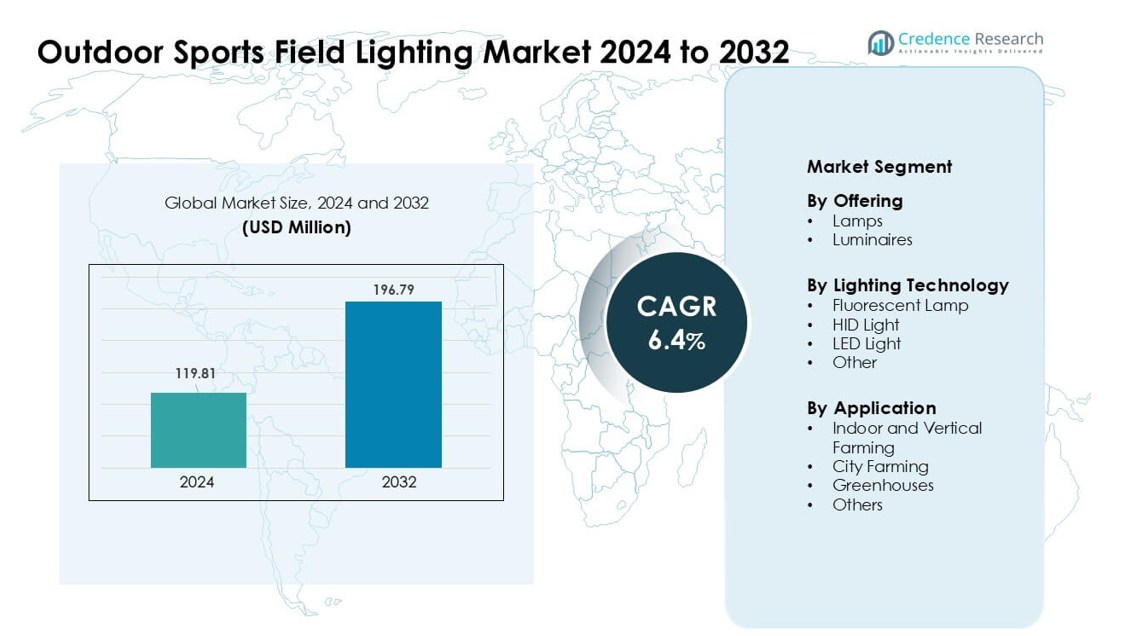
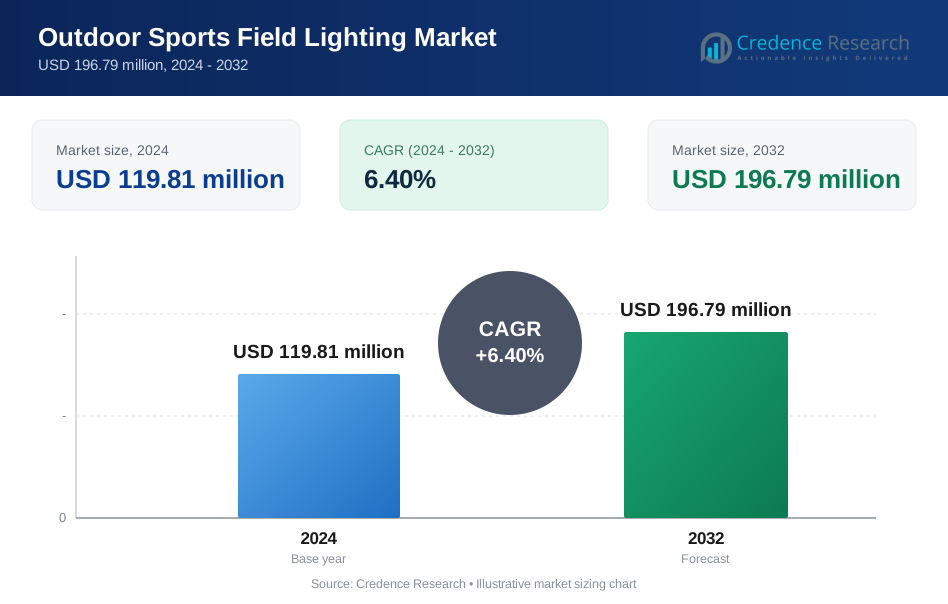
Outdoor Sports Field Lighting Market was valued at USD 119.81 million in 2024 and is anticipated to reach USD 196.79 million by 2032, growing at a CAGR of 6.4% during the forecast period.
| REPORT ATTRIBUTE | DETAILS |
|---|---|
| Historical Period | 2020-2023 |
| Base Year | 2024 |
| Forecast Period | 2025-2032 |
| Outdoor Sports Field Lighting Market Size 2024 | USD 119.81 million |
| Outdoor Sports Field Lighting Market, CAGR | 6.4% |
| Outdoor Sports Field Lighting Market Size 2032 | USD 196.79 million |
The outdoor sports field lighting market is led by major companies such as Hubbell Inc, Panasonic Corporation, Osram, Thorn Lighting, GE Lighting, Eaton Corporation, Cree Inc, Acuity Brands Inc, Philips Lighting, and Schneider Electric. These players focus on high-efficiency LED luminaires, advanced optics, and smart control systems to meet the growing demand for durable, energy-saving lighting across stadiums, schools, and community sports fields. They compete through technological upgrades, broad product portfolios, and partnerships with municipal and sports infrastructure projects. North America remained the leading region in 2024 with 38% share, driven by strong adoption of LED retrofits and continuous investment in modern sports facilities.
Market Insights
- The Outdoor Sports Field Lighting Market was valued at USD 119.81 million in 2024 and is projected to reach USD 196.79 million by 2032, growing at a 6.4% CAGR.
- Rising demand for energy-efficient LED luminaires drives strong adoption across stadiums, school grounds, and community sports fields, with luminaires leading the offering segment at about 63% share.
- LED technology dominates with nearly 72% share, supported by trends such as smart lighting integration, adaptive beam control, and broadcast-ready illumination standards.
- Competition is shaped by key players offering high-performance and durable lighting systems, while higher installation and retrofit costs continue to restrain upgrades in budget-restricted facilities.
- North America leads the market with around 38% share, followed by Europe at 30% and Asia-Pacific at 24%, supported by large-scale infrastructure investments and rapid LED transition.
Market Segmentation Analysis:
By Offering
Luminaires dominated the outdoor sports field lighting market in 2024 with about 63% share, driven by strong demand for integrated fixtures designed for stadiums, arenas, and open-field installations. Sports authorities preferred luminaires because they provide higher lumen output, longer service life, and better uniformity across large playing surfaces. Modern luminaires also support smart controls, dimming, and remote monitoring, which help clubs reduce energy consumption and improve lighting precision for televised events. Lamps held a smaller share due to limited efficiency and shorter operational life compared to advanced fixture-based solutions.
- For instance, Musco Sports Lighting offers a TLC-LED floodlight luminaire (model TLC-LED-1200EP) that delivers 136,000 lumens at 5700 K and maintains full photometric performance for over 81,000 operating hours, per its official datasheet.
By Lighting Technology
LED light technology led the market in 2024 with nearly 72% share, supported by its superior energy efficiency, long lifespan, and high-quality illumination suitable for professional and community sports fields. Stadium operators increasingly adopted LED systems to meet international sporting standards for brightness, glare reduction, and flicker-free performance during high-speed broadcasts. Growing focus on reducing energy costs accelerated LED upgrades, especially in municipal and school facilities. HID lights and fluorescent lamps continued to decline due to higher maintenance requirements, while other technologies maintained niche use in low-budget installations.
- For instance, Philips ArenaVision LED floodlights used in numerous international stadiums comply with HDTV broadcasting standards by delivering uniform pitch illumination with high-quality optics and flicker-free light output.
By Application
Greenhouses held the largest share in 2024 at around 46%, driven by increased adoption of controlled lighting systems to support crop growth, improve yield, and maintain production consistency year-round. Commercial growers preferred advanced outdoor field-grade lighting solutions because they deliver stable intensity and targeted spectrum control for plant development. City farming and indoor farming grew steadily as urban agriculture expanded, while other applications such as research and small-scale production held smaller shares. Rising awareness of energy-efficient lighting and climate-resilient cultivation methods continued to support demand across all application segments.
Key Growth Drivers:
Rising Demand for Energy-Efficient and High-Performance Lighting
Growing global focus on energy savings and performance consistency drives strong adoption of advanced lighting systems across outdoor sports fields. Stadiums, municipal grounds, and school sports complexes increasingly replace legacy HID and fluorescent systems with high-efficiency LED solutions that cut power consumption by up to 60–70% while delivering superior brightness and uniformity. Sports authorities prefer LED luminaires because they minimize glare, improve athlete visibility, and support high-speed broadcast needs with flicker-free output. Many government and city councils also promote energy-efficient upgrades through incentives and sustainability mandates, pushing facilities to invest in long-lasting systems with reduced maintenance requirements. These factors collectively accelerate LED retrofits and new installations across recreational and professional sports infrastructures.
- For instance, when Musco Sports Lighting retrofitted a large-scale stadium from HID to LED, they reported that the new LED system reduced energy consumption by about 80% compared to the previous HID setup.
Expansion of Sports Infrastructure and Night-Time Sporting Events
Growing investments in sports infrastructure worldwide significantly boost demand for advanced field lighting systems. Countries promoting national tournaments, community sports programs, and athletic development initiatives continue building or upgrading stadiums, multi-purpose grounds, and open sports facilities. Night-time sporting events have seen a sharp rise as clubs and organizers seek higher audience engagement, flexible scheduling, and improved event revenue. This shift requires lighting systems with precise illumination levels that meet international standards for football, cricket, hockey, and athletics. Improved durability, wider beam control, and better color rendering encourage operators to adopt modern luminaires that enhance player performance and spectator experience. As more regions promote grassroots and professional sports, lighting upgrades remain a key priority.
- For instance, stadium lighting guides show that LED floodlights replacing older metal-halide fixtures require fewer fixtures overall to achieve the same or better light coverage across a field, thanks to the directional beam control and high efficacy of LED luminaires.
Growing Integration of Smart Lighting and IoT-Based Control Solutions
Smart lighting technologies are becoming a major growth driver as venues adopt digital control systems to improve efficiency and management. Modern outdoor sports lighting now integrates IoT capabilities, sensors, and centralized dashboards that allow operators to adjust brightness, schedule lighting cycles, and monitor energy usage in real time. Adaptive controls help reduce operational costs by dimming lights during low-activity periods and optimizing output based on specific sports requirements. Remote monitoring also minimizes downtime by detecting faults early and reducing on-site maintenance. These capabilities align with the global push for smart cities, where automated infrastructure enhances sustainability and safety across public spaces. As facility owners seek better control and reduced lifecycle costs, IoT-enabled lighting systems gain rapid acceptance.
Key Trends & Opportunities:
Shift Toward LED Retrofits and Sustainable Lighting Initiatives
A strong market trend is the rapid shift toward LED retrofits, driven by sustainability goals and growing restrictions on high-emission technologies. LED upgrades offer long operational life, lower heat output, and enhanced environmental performance, making them a preferred solution for stadiums and outdoor arenas. Many countries now encourage carbon-efficient infrastructure, creating an opportunity for manufacturers to offer eco-friendly lighting with recyclable materials and reduced energy footprints. Additionally, sports clubs aim to meet international sustainability certifications, pushing them toward low-impact lighting. This trend continues to create significant business opportunities for suppliers offering high-efficiency LED luminaires and retrofit kits optimized for sports environments.
- For instance, LEDVANCE lists a FLOODLIGHT MAX sports luminaire line that delivers between 78,000 and 164,000 lumens with a lifespan of up to 100,000 hours (L70) under IP66/IP67-rated housing making it suitable for heavy-duty outdoor stadium use with minimal maintenance.
Adoption of Adaptive Lighting for Broadcast-Quality Sports Events
High-quality broadcasting requirements create new opportunities for manufacturers offering precision illumination technologies. Sports events streamed in 4K and 8K resolution require lighting systems that ensure color accuracy, flicker-free output, and consistent intensity across the field. This demand drives innovation in advanced optics, beam-shaping technologies, and lighting controls that meet strict broadcast standards. Adaptive lighting also helps regulate glare and shadows, improving the visual experience for players and viewers. As streaming platforms and sports broadcasters scale up global coverage, stadiums and clubs continue investing in lighting systems that support professional-grade video production, opening lucrative growth avenues.
- For instance, AEON advertises a line of “flicker-free” stadium luminaires that maintain stable output even under dimming and deliver temporal stability suitable for high-speed cameras (e.g. for slow-motion replays), as well as spatial optics designed to keep glare low (UGR < 19) helping ensure glare control and color fidelity required in broadcast environments.
Growth of Community Sports and Multi-Purpose Recreational Facilities
Community sports programs and mixed-use recreational spaces present a growing opportunity for the lighting industry. Urban regions continue to invest in public athletic facilities to support health, fitness, and youth sports participation. These facilities need affordable yet durable lighting solutions that deliver uniform illumination for football, cricket, basketball, and athletics. Manufacturers offering modular lighting systems and cost-effective LED arrays gain strong traction in this segment. The expansion of community sports enhances demand for easy-to-install luminaires, solar-powered outdoor lighting, and low-maintenance fixtures, creating a robust pipeline for long-term growth.
Key Challenges:
High Installation and Retrofit Costs
Despite the strong benefits of LED and smart lighting systems, high upfront installation and retrofit costs remain a major challenge for many sports facilities. Upgrading from HID or metal halide fixtures requires new mounting structures, electrical systems, and control units, which increase project expenses. Smaller clubs, schools, and community grounds often face budget limitations, delaying modernization plans. Although LED systems reduce long-term operating costs, the initial capital requirement slows adoption in developing regions. This challenge continues to limit large-scale upgrades, especially in facilities not supported by government funding or sponsorships.
Technical Complexity and Compliance with Sports Lighting Standards
Outdoor sports fields must meet strict lighting standards set by national and international sports bodies, making compliance a complex task. Achieving uniform brightness, proper vertical and horizontal illumination, and controlled glare requires precise system design and technical expertise. Many facilities struggle to meet these specifications without professional planning, leading to delays or costly redesigns. The growing integration of smart controls adds another layer of complexity for operators unfamiliar with digital systems. Ensuring compliance across multiple sports formats further challenges facility managers. These issues slow adoption and create demand for specialized installation and consultancy support.
Regional Analysis:
North America
North America held the leading position in the outdoor sports field lighting market in 2024 with about 38% share, supported by strong investments in stadium upgrades, community sports infrastructure, and high school and collegiate athletic programs. The region’s adoption of LED and smart lighting systems accelerated as cities prioritized energy efficiency and sustainability. Professional sports leagues demanded broadcast-ready illumination, driving replacement of legacy HID systems. Government funding for recreational facilities and rising participation in night-time sports further boosted installations across football, baseball, and soccer fields. Technological innovation from major lighting manufacturers strengthened regional dominance.
Europe
Europe accounted for nearly 30% share in 2024, driven by strict energy regulations and widespread adoption of high-efficiency LED luminaires across sports arenas and public athletic grounds. The region’s commitment to carbon-reduction targets encouraged clubs and municipalities to modernize lighting infrastructure with durable, low-emission solutions. Major football stadiums continued implementing advanced beam-control and glare-reduction technologies to support elite match standards. Growth was also fueled by rising night-time community sports participation, especially in the United Kingdom, Germany, France, and the Nordic countries. Public–private partnerships and EU sustainability programs further supported upgrade initiatives.
Asia-Pacific
Asia-Pacific captured around 24% share in 2024 and remained the fastest-growing region due to expanding sports infrastructure, increasing urban population, and rising government investments in recreational facilities. China, India, Japan, and Australia upgraded stadiums and outdoor fields to host domestic leagues and international tournaments. Rapid adoption of LED lighting was driven by lower operating costs, improved durability, and wide availability of local manufacturers offering cost-effective solutions. Growing interest in community sports and school athletics also stimulated demand. Smart city programs across major Asian countries further encouraged deployment of intelligent lighting systems.
Latin America
Latin America represented roughly 5% share in 2024, supported by steady upgrades in football stadiums and municipal sports fields across Brazil, Argentina, Mexico, and Colombia. Regional governments increased focus on sports development, creating demand for energy-efficient lighting in community and semi-professional facilities. Adoption of LED systems rose as operators sought longer life cycles and reduced maintenance. However, budget constraints and uneven infrastructure development limited large-scale modernization. Growing private investment in sports complexes and training academies is expected to support future lighting projects across the region.
Middle East & Africa
The Middle East & Africa accounted for about 3% share in 2024, driven by selective but high-value investments in major sports venues, especially in the Gulf countries. The region upgraded lighting systems to meet global standards for international sports events hosted in Qatar, UAE, and Saudi Arabia. Hot climate conditions increased demand for durable outdoor luminaires with thermal management capabilities. Africa showed gradual adoption as governments developed stadiums and youth sports programs. However, economic and infrastructure challenges slowed widespread installation. Despite this, the region remains an emerging opportunity for LED and solar-powered sports lighting solutions.
Market Segmentations:
By Offering
- Lamps
- Luminaires
By Lighting Technology
- Fluorescent Lamp
- HID Light
- LED Light
- Other
By Application
- Indoor and Vertical Farming
- City Farming
- Greenhouses
- Others
By Geography
- North America
- U.S.
- Canada
- Mexico
- Europe
- Germany
- France
- U.K.
- Italy
- Spain
- Rest of Europe
- Asia Pacific
- China
- Japan
- India
- South Korea
- South-east Asia
- Rest of Asia Pacific
- Latin America
- Brazil
- Argentina
- Rest of Latin America
- Middle East & Africa
- GCC Countries
- South Africa
- Rest of the Middle East and Africa
Competitive Landscape:
The outdoor sports field lighting market features a competitive landscape shaped by established global manufacturers and rapidly advancing LED technology providers. Leading companies such as Hubbell Inc, Panasonic Corporation, Osram, Thorn Lighting, GE Lighting, Eaton Corporation, Cree Inc, Acuity Brands Inc, Philips Lighting, and Schneider Electric focus on developing high-efficiency luminaires with superior beam control, long lifespan, and reduced maintenance needs. These players strengthen competitiveness through continuous innovation in smart lighting, adaptive controls, and IoT-enabled monitoring systems tailored for stadiums and recreational fields. Many companies expand reach by forming partnerships with sports authorities, municipal bodies, and EPC contractors to secure large-scale installation projects. Product differentiation centers on energy performance, optical precision, and environmental sustainability. Manufacturers also invest in rugged outdoor designs that meet global sports lighting standards and withstand harsh weather conditions. Growing emphasis on digital lighting ecosystems further intensifies competition among major suppliers.
Key Player Analysis:
- Hubbell Inc (US)
- Panasonic Corporation (Japan)
- Osram (Germany)
- Thorn Lighting (UK)
- GE Lighting (US)
- Eaton Corporation (Ireland)
- Cree Inc (US)
- Acuity Brands Inc (US)
- Philips Lighting (Netherlands)
- Schneider Electric (France)
Recent Developments:
- In April 2025, Cree Lighting and Lumileds launched a 1900K/50CRI low-blue outdoor LED option. The new color is offered across popular outdoor luminaires and supports more night-friendly exterior projects.
- In October 2024, Osram / ams OSRAM (Germany): ams OSRAM launched the OSCONIQ® C 3030 LED (announced Oct 29, 2024) - a high-intensity, thermally efficient LED series targeted at outdoor and stadium luminaires (engineered for high drive currents, long service life and broadcast-grade color performance), signalling Osram’s product push into next-generation LED packages for stadium/high-mast lighting.
- In February 2024, Panasonic Corporation (Japan): Panasonic posted a new stadium case study for Hanshin Koshien Stadium (LED upgrade) describing bespoke LED solutions (custom 2050K + 5700K mixes for atmosphere), 4K/8K broadcast-compatible color reproduction and DMX-based control of 756 stadium lights to enable pixel-style effects and dynamic fan lighting. This highlights Panasonic’s focus on broadcast-quality spectral tuning and show-lighting features for sports venues.
Report Coverage:
The research report offers an in-depth analysis based on Offering, Lighting Technology, Application and Geography. It details leading market players, providing an overview of their business, product offerings, investments, revenue streams, and key applications. Additionally, the report includes insights into the competitive environment, SWOT analysis, current market trends, as well as the primary drivers and constraints. Furthermore, it discusses various factors that have driven market expansion in recent years. The report also explores market dynamics, regulatory scenarios, and technological advancements that are shaping the industry. It assesses the impact of external factors and global economic changes on market growth. Lastly, it provides strategic recommendations for new entrants and established companies to navigate the complexities of the market.
Future Outlook:
- LED-based sports lighting systems will continue to replace older HID and fluorescent fixtures.
- Smart and connected lighting controls will see wider adoption across stadiums and community fields.
- Energy-efficiency goals will push facilities to invest in long-life, low-maintenance luminaires.
- Broadcast-quality illumination standards will drive upgrades in professional and semi-professional venues.
- Solar-powered outdoor sports lighting solutions will gain traction in cost-sensitive regions.
- Multi-sport and community recreation complexes will create steady demand for modular lighting systems.
- Climate-resilient and weather-proof luminaires will become essential in harsh outdoor environments.
- Government funding for public sports infrastructure will accelerate modernization projects.
- Manufacturers will expand IoT-enabled features for real-time monitoring and remote diagnostics.
- Standardization of lighting requirements for global tournaments will influence future product designs.
Request a Free Sample
Fill in your details and we'll send you a free sample report.
- Sample data tables & charts
- Research methodology
Need a Custom Version of This Report?
Tailor the scope, geography, or segments to your exact requirements.
- Custom geography or segment scope
- Direct access to our analyst team
Frequently Asked Questions
What is the current market size for Outdoor Sports Field Lighting Market, and what is its projected size in 2032?
At what Compound Annual Growth Rate is Outdoor Sports Field Lighting Market projected to grow between 2024 and 2032?
Who are the major players in the global outdoor sports field lighting market?
What are the major market drivers of the outdoor sports field lighting industry?
What are the major market restraints of the outdoor sports field lighting industry?
What are the major market opportunities of the outdoor sports field lighting industry?
Who are the leading companies in Outdoor Sports Field Lighting Market?
Table of Content
Chapter 1. Report Introduction
- 1.1 Report Description & Purpose
- 1.1.1 Report Title & Market Definition
- 1.1.2 Unique Selling Propositions (USP) & Key Differentiators
- 1.1.3 Value Proposition for Stakeholders
- 1.2 Research Objectives
- 1.2.1 Market Sizing Objectives (Volume & Revenue) (Volume Where Applicable)
- 1.2.2 Segmentation Objectives
- 1.2.3 Competitive Intelligence Objectives
- 1.2.4 Forecast & Scenario Objectives
- 1.3 Report Scope
- 1.3.1 Outdoor Sports Field Lighting Scope – Segments & Subsegments Covered
- 1.3.2 Geographic Scope – Regions & Countries Covered
- 1.3.3 Historical Period, Base Year & Forecast Period (2024; forecast to 2032)
- 1.3.4 Inclusions & Exclusions
- 1.4 Industry Classification & Applicable Codes
- 1.5 Currency, Measurement Units & Valuation Basis
- 1.6 Target Stakeholders
- 1.7 Limitations & Assumptions
Chapter 2. Executive Summary
- 2.1 Global Outdoor Sports Field Lighting Market Snapshot
- 2.1.1 Market Size – Historical (2024) & Forecast (2024-2032) (2024: USD 119.81 million → 2032: USD 196.79 million)
- 2.1.2 Volume & Revenue – Global Totals (Volume Where Applicable)
- 2.1.3 Key Market Highlights – Top Five Facts
- 2.2 Outdoor Sports Field Lighting Market Segmentation Snapshot
- 2.2.1 Market Split by Region – 2024 vs. 2032
- 2.3 Competitive Snapshot
- 2.3.1 Top 10 Players by Revenue Share – 2024
- 2.3.2 Top 10 Players by Volume Share – 2024 (Volume Where Applicable)
- 2.3.3 Recent Strategic Developments (18-Month Summary)
- 2.4 Key Investment Highlights & Strategic Conclusions
Chapter 3. Outdoor Sports Field Lighting Market Dynamics & Industry Analysis
- 3.1 Market Overview & Context
- 3.1.1 Outdoor Sports Field Lighting Market Position in the Broader Industry Value Chain
- 3.1.2 Demand Structure & Purchasing Dynamics
- 3.1.3 Market Maturity & Development Stage by Region
- 3.2 Outdoor Sports Field Lighting Market Drivers
- 3.3 Outdoor Sports Field Lighting Market Restraints & Challenges
- 3.4 Outdoor Sports Field Lighting Market Opportunities
- 3.5 Porter's Five Forces Analysis
- 3.5.1 Threat of New Entrants
- 3.5.2 Bargaining Power of Suppliers
- 3.5.3 Bargaining Power of Buyers
- 3.5.4 Threat of Substitutes
- 3.5.5 Competitive Rivalry – Intensity Assessment
- 3.6 Outdoor Sports Field Lighting Value Chain Analysis
- 3.6.1 Upstream – Key Inputs, Resources & Suppliers
- 3.6.1.1 Key Input/Resource 1
- 3.6.1.2 Key Input/Resource 2
- 3.6.1.3 Key Input/Resource 3
- 3.6.2 Midstream – Core Operations & Value Creation
- 3.6.2.1 Operating Model & Process Overview
- 3.6.2.2 Key Operating Locations & Capabilities by Company
- 3.6.3 Downstream – Market Channels & End Users
- 3.6.3.1 Direct Sales & Customer Engagement Channels
- 3.6.3.2 Indirect Sales, Intermediaries & Partner Channels
- 3.6.4 Value Chain Profitability Analysis
- 3.6.1 Upstream – Key Inputs, Resources & Suppliers
- 3.7 PESTEL Analysis
- 3.7.1 Political Factors
- 3.7.2 Economic Factors
- 3.7.3 Social Factors
- 3.7.4 Technological Factors
- 3.7.5 Environmental Factors
- 3.7.6 Legal Factors
- 3.8 Outdoor Sports Field Lighting Supply Chain Analysis
- 3.8.1 Critical Input & Resource Availability Risk Assessment
- 3.8.2 Supplier & Operational Concentration Risk (Geographic Exposure)
- 3.8.3 Supply & Service Disruption Impact Analysis
- 3.9 Regulatory & Policy Landscape
Note: The regulatory and policy landscape section covers regulations based on their applicability to the market, Outdoor Sports Field Lighting category, geography, and scope of the study. Only regulatory frameworks with a material impact on operations, compliance, trade, sustainability, or market access are analyzed in detail.
Chapter 4. Key Investment Pockets & Opportunity Analysis
- 4.1 Outdoor Sports Field Lighting Market Attractiveness Analysis
- 4.1.1 By Region – Investment Attractiveness Matrix (Market Size × CAGR)
- 4.2 Absolute Revenue Growth Opportunity
- 4.2.1 By Region – Absolute Revenue Growth Through 2032
- 4.3 Incremental Demand Opportunity
- 4.3.1 By Region – Incremental Demand Through 2032
- 4.3.2 Segment – Incremental Demand
- 4.4 Emerging Submarket Opportunity Deep Dive (Subject to Applicability)
- 4.5 Priority Market Opportunity Scorecards
- 4.5.1 United States
- 4.5.2 Europe
- 4.5.3 Asia
- 4.5.4 Middle East & Africa
Note: Priority market opportunity scorecards reflect the geographic scope and strategic relevance of the study. Listed markets are indicative and may be adapted to the industry.
Chapter 5. Outdoor Sports Field Lighting Cross-Border Trade & Market Access Analysis
- 5.1 International Trade & Cross-Border Activity Overview
- 5.1.1 Global Export Value by Country (2024)
- 5.1.2 Global Export Volume by Country (2024) (Volume Where Applicable)
- 5.1.3 Global Import Value by Country (2024)
- 5.1.4 Global Import Volume by Country (2024) (Volume Where Applicable)
- 5.1.5 Net Trade Balance by Country (2024)
- 5.2 Export Analysis – Segment
- 5.2.1 Category 1 (Applicable Classification Code)
- 5.2.2 Category 2 (Applicable Classification Code)
- 5.2.3 Category 3 (Applicable Classification Code)
- 5.2.4 Category 4 (Applicable Classification Code)
- 5.2.5 Category 5 (Applicable Classification Code)
- 5.3 Import Analysis – Segment
- 5.3.1 Category 1 (Applicable Classification Code)
- 5.3.2 Category 2 (Applicable Classification Code)
- 5.3.3 Category 3 (Applicable Classification Code)
- 5.3.4 Category 4 (Applicable Classification Code)
- 5.3.5 Category 5 (Applicable Classification Code)
- 5.4 Cross-Border Pricing & Transaction Benchmarks
- 5.4.1 Export Pricing – Segment & Country
- 5.4.2 Import Pricing – Segment & Source Country
- 5.4.3 Price Trends (2024)
- 5.5 Key Cross-Border Trade & Delivery Routes
- 5.5.1 Cross-Border Trade/Delivery Route 1
- 5.5.2 Cross-Border Trade/Delivery Route 2
- 5.5.3 Cross-Border Trade/Delivery Route 3
- 5.5.4 Cross-Border Trade/Delivery Route 4
- 5.5.5 Cross-Border Trade/Delivery Route 5
- 5.6 Trade Policy & Market Access Impact Assessment
- 5.6.1 Tariff & Non-Tariff Barriers
- 5.6.2 Regional Trade & Economic Integration Frameworks
- 5.6.3 Bilateral & Multilateral Trade Agreements
- 5.6.4 Cross-Border Operating, Licensing & Localization Requirements
Note: This chapter applies where cross-border trade or delivery is relevant to Outdoor Sports Field Lighting. Goods, services, and digital offerings are assessed using applicable classifications and transaction measures. Import-export volumes, trade balances, and route analyses are included only where meaningful to the market.
Chapter 6. Competitive Landscape & Company Benchmarking
- 6.1 Outdoor Sports Field Lighting Market Concentration & Structure
- 6.1.1 Herfindahl-Hirschman Index (HHI) – vs. 2024
- 6.1.2 Leading, Mid-Sized & Emerging Player Structure
- 6.1.3 Global, Regional & Local Player Dynamics
- 6.2 Outdoor Sports Field Lighting Market Share Analysis – 2024
- 6.2.1 Global Revenue Share by Company
- 6.2.2 Global Volume Share by Company (Volume Where Applicable)
- 6.2.3 Regional Revenue Share
- 6.2.4 Market Share Evolution ( vs. 2024)
- 6.2.5 Company Market Share by Key Segment
- 6.2.6 Company Market Share by Customer Group
- 6.3 Operating Scale, Capacity & Infrastructure Analysis
- 6.3.1 Global Operating Scale & Supply Capacity
- 6.3.2 Resource Utilization & Operating Efficiency
- 6.3.3 Output, Service Delivery & Activity Metrics
- 6.3.4 Operating Footprint & Infrastructure Map
- 6.3.5 Planned Operational & Capacity Expansion
- 6.4 Outdoor Sports Field Lighting Competitive Benchmarking Matrix
- 6.4.1 Revenue, Growth, Profitability & Operating Metric Comparison
- 6.4.2 Channel Revenue Mix
- 6.4.3 Geographic Revenue Exposure
- 6.4.4 R&D Intensity
- 6.4.5 Sustainability Maturity
- 6.5 Strategic Developments in Outdoor Sports Field Lighting (Last 24 Months)
- 6.5.1 Mergers, Acquisitions & Divestments
- 6.5.2 New Products, Services & Solutions in Outdoor Sports Field Lighting
- 6.5.3 Operational & Infrastructure Expansions
- 6.5.4 Strategic Alliances, Joint Ventures & Partnerships
- 6.5.5 Distribution Expansion & Market Entry
- 6.5.6 Sustainability & ESG Initiatives
- 6.6 Competitive Strategy Mapping
- 6.6.1 Leader, Challenger, Follower & Niche Classification
- 6.6.2 Pricing Strategy Comparison
- 6.6.3 Channel Strategy Matrix
Note: Strategic developments are included based on their materiality and the availability of reliable information.
Chapter 7. Global Outdoor Sports Field Lighting Market – By Sales & Delivery Channel
- 7.1 Segment Overview
- 7.1.1 Volume & Revenue Split by Channel (2024 & 2032) (Volume Where Applicable)
- 7.1.2 Channel Mix Evolution (2024-2032)
Chapter 8. Regional Market Analysis – Global Overview
- 8.1 Global Regional Overview
- 8.1.1 Regional Volume Share (Volume Where Applicable)
- 8.1.2 Regional Revenue Share
- 8.1.3 Regional Volume by Region (Volume Where Applicable)
- 8.1.4 Regional Revenue by Region
- 8.1.5 Regional Forecast Through 2032
- 8.2 Cross-Regional Segment Analysis
- 8.2.1 By Sales & Delivery Channel
- 8.2.2 By Competitive Positioning & Price Tier
Chapter 9. North America Outdoor Sports Field Lighting Market
- 9.1 United States
- 9.2 Canada
- 9.3 Mexico
Chapter 10. Europe Outdoor Sports Field Lighting Market
- 10.1 Germany
- 10.2 France
- 10.3 Italy
- 10.4 United Kingdom
- 10.5 Spain
- 10.6 Poland
- 10.7 Russia
- 10.8 Netherlands
- 10.9 Belgium
- 10.10 Sweden
- 10.11 Denmark
- 10.12 Norway
- 10.13 Rest of Europe
Chapter 11. Asia Pacific Outdoor Sports Field Lighting Market
- 11.1 China
- 11.2 India
- 11.3 Japan
- 11.4 South Korea
- 11.5 Thailand
- 11.6 Indonesia
- 11.7 Vietnam
- 11.8 Malaysia
- 11.9 Australia
- 11.10 Rest of Asia Pacific
Chapter 12. Latin America Outdoor Sports Field Lighting Market
- 12.1 Brazil
- 12.2 Argentina
- 12.3 Colombia
- 12.4 Chile
- 12.5 Rest of Latin America
Chapter 13. Middle East Outdoor Sports Field Lighting Market
- 13.1 Saudi Arabia
- 13.2 United Arab Emirates
- 13.3 Turkey
- 13.4 Israel
- 13.5 Iran
- 13.6 Rest of the Middle East
Chapter 14. Africa Outdoor Sports Field Lighting Market
- 14.1 South Africa
- 14.2 Egypt
- 14.3 Nigeria
- 14.4 Morocco
- 14.5 Rest of Africa
Chapter 15. Outdoor Sports Field Lighting Company Profiles
- 15.1 [Company 01]
- 15.1.1 Company Overview
- 15.1.2 Key Management Personnel
- 15.1.3 Products & Services Portfolio
- 15.1.4 Financial Performance
- 15.1.5 Key Market Focus & Geographic Presence
- 15.1.6 Recent Developments & Strategic Initiatives
Note: The company profile list is preliminary and may change based on research findings, market developments, data availability, and client requirements.
Chapter 16. Appendices
- Appendix A – List of Abbreviations & Acronyms
- Appendix B – Industry Classification Code Reference – Full Series
- Appendix C – Supply, Output & Operating Capacity Data Tables
- Appendix D – End-Use & Demand Base Tables
- Appendix E – Demand, Adoption & Usage Assumptions
- Appendix F – Pricing & Revenue Metric Reference Tables
- Appendix G – Company Operations & Infrastructure Database
- Appendix H – Cross-Border Trade & Activity Data Tables (Where Applicable)
- Appendix I – Regulatory Summary Tables
- Appendix J – Primary Research Participant List (Anonymized)
- Appendix K – Primary Research Questionnaire Framework
- Appendix L – Data Sources & Bibliography
- Appendix M – Market Size Divergence & Source Comparison
Chapter 17. Research Methodology
- 17.1 Research Framework & Philosophy
- 17.2 Secondary Research – Sources, Hierarchy & Data Extraction
- 17.3 Data Modeling – Bottom-Up & Top-Down Market Sizing
- 17.4 Primary Research – Stakeholder Framework, LOI & Sample Sizes
- 17.5 Forecast Methodology – Regression, Scenario & Sensitivity Analysis
- 17.6 Quality Control – Four-Layer Validation Framework
- 17.7 Limitations & Standard Assumptions
- 17.8 Disclaimer
