
Market Overview
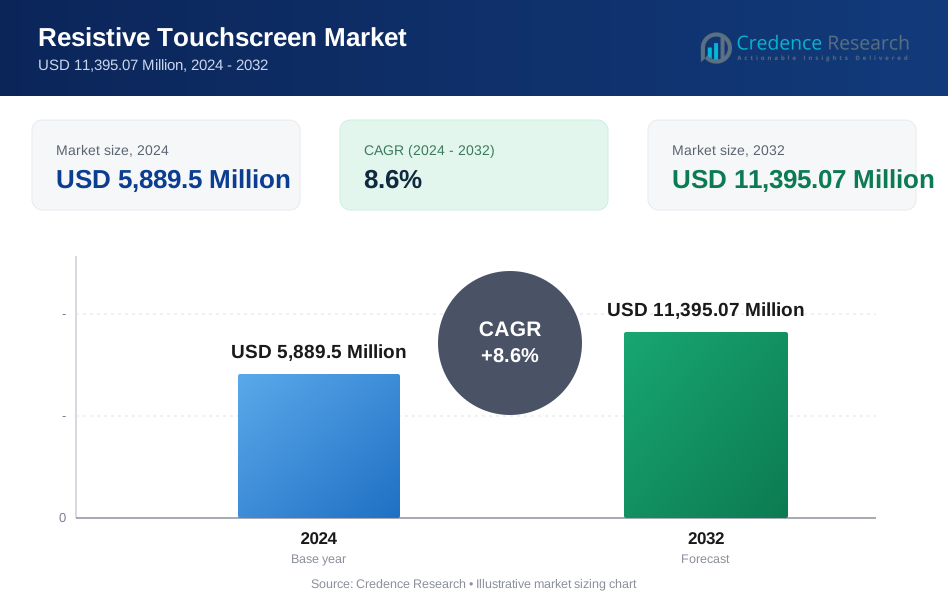
Resistive Touchscreen Market size was valued at USD 5,889.5 Million in 2024 and is anticipated to reach USD 11,395.07 Million by 2032, at a CAGR of 8.6% during the forecast period.
| REPORT ATTRIBUTE | DETAILS |
|---|---|
| Historical Period | 2020-2023 |
| Base Year | 2024 |
| Forecast Period | 2025-2032 |
| Resistive Touchscreen Market Size 2024 | USD 5,889.5 Million |
| Resistive Touchscreen Market, CAGR | 8.6% |
| Resistive Touchscreen Market Size 2032 | USD 11,395.07 Million |
Resistive Touchscreen Market features leading players such as Touch International, Samsung Electronics Co., Ltd., NEC Corporation, Honeywell International Inc., Sharp Corporation, Elo Touch Solutions, Inc., Panasonic Corporation, 3M Company, LG Display Co., Ltd., and Fujitsu Limited, all focusing on durable, precise, and cost-efficient touchscreen solutions across industrial, medical, automotive, and consumer applications. Asia-Pacific led the global market with 38.4% share in 2024, driven by strong electronics manufacturing, growing industrial automation, and widespread adoption of handheld and automotive devices. North America and Europe followed, supported by advanced healthcare systems, robust industrial infrastructures, and rising demand for rugged and high-reliability touchscreen technologies.
Market Insights
- The Resistive Touchscreen Market reached USD 5,889.5 Million in 2024 and will grow at a CAGR of 8.6% through 2032 as demand rises across industrial, medical, and cost-sensitive device categories.
- Market growth is driven by strong adoption in industrial control panels, medical instruments, and automotive systems, with the Analog Resistive segment holding 67.4% share due to its precision and environmental resilience
- Key trends include rising integration of resistive panels in rugged handheld devices, portable diagnostic tools, and compact consumer electronics supported by advances in sensitivity and durability.
- Major players such as Touch International, Samsung, Honeywell, Sharp, Panasonic, and 3M strengthen their presence through product innovation, OEM partnerships, and expansion into high-growth industrial and healthcare applications.
- Asia-Pacific led with 38.4% share in 2024, followed by North America at 27.6% and Europe at 23.1%, while the Consumer Electronics segment remained dominant with 39.2% share across global deployments.
 Market Segmentation Analysis:
By Technology:
In the Resistive Touchscreen Market, the Analog Resistive segment dominated with 67.4% share in 2024, driven by its high accuracy, low activation force, and strong reliability in harsh or contamination-prone environments. Analog resistive screens remain preferred for industrial control panels, medical instruments, and POS terminals due to their ability to function with gloves, styluses, or non-conductive objects. The technology’s cost-efficiency, durability, and compatibility with legacy systems further strengthen adoption. Meanwhile, the digital resistive segment gains traction as manufacturers pursue higher responsiveness and improved multi-touch capabilities for modern interactive applications.
- For instance, Phoenix Contact's BTP 2070W touch panel employs a 7-inch analog resistive TFT display for control systems, supporting glove operation and harsh industrial conditions with robust IP-rated protection.
By Application:
The Consumer Electronics segment held the leading share of 39.2% in 2024, supported by strong use of resistive touchscreens in low-cost smartphones, handheld gaming devices, digital cameras, and portable navigation systems. The segment benefits from the technology’s affordability, low power consumption, and adaptability across compact consumer devices. Automotive applications continue expanding as resistive touchscreens integrate into dashboards and infotainment units requiring reliable operation under varying conditions. Healthcare and industrial sectors show stable growth, leveraging resistive screens for precision, glove compatibility, and durability in mission-critical environments.
- For istance, Miqidisplay offers custom resistive panels for automotive infotainment and climate controls, emphasizing glove compatibility and precise input.
By Screen Size:
Within the Resistive Touchscreen Market, the Small Screen segment accounted for 52.8% share in 2024, driven by widespread adoption in handheld devices, portable medical equipment, digital meters, and compact industrial tools. Small resistive screens excel in cost-sensitive applications requiring precise single-touch input and minimal power usage. The medium-size segment is gaining momentum across automotive displays and mid-range POS systems, while large screens see rising deployment in industrial control interfaces and retail kiosks. Increasing miniaturization, demand for rugged devices, and proliferation of compact electronics sustain the dominance of small-screen formats.
Key Growth Drivers
Expanding Adoption Across Industrial and Healthcare Devices
The Resistive Touchscreen Market experiences strong growth as industrial and healthcare environments increasingly require durable, precise, and glove-compatible interfaces. Resistive technology performs reliably under exposure to moisture, dust, chemicals, and vibration, making it ideal for medical monitors, diagnostic tools, industrial control panels, and handheld scanners. Its low power consumption and cost-effectiveness further support adoption in budget-sensitive applications. As industries accelerate digital transformation and human-machine interaction becomes more critical, demand for dependable single-touch and stylus-based input solutions continues to expand, reinforcing sustained market growth.
- For instance, Contec's CM-ME170R medical monitor features a 17-inch 5-wire resistive touchscreen with 1280 x 1024 resolution and USB/RS-232 interface, designed for precise operation in clinical settings while meeting global safety certifications like CB and UL.
Demand for Cost-Efficient Touch Interfaces in Emerging Economies
Rapid penetration of entry-level consumer electronics in emerging markets acts as a major growth catalyst for resistive touchscreen technology. Manufacturers favor resistive modules for low-cost smartphones, tablets, navigation systems, and feature phones due to their affordability, lightweight construction, and compatibility with simple interfaces. Consumers in developing regions prioritize functional, durable, and price-competitive devices, allowing resistive screens to maintain relevance despite competition from capacitive alternatives. Expanding production capabilities in Asia-Pacific and growing demand for budget electronics further enhance market traction for cost-efficient resistive touch solutions.
- For instance, Elo Touch Solutions' AccuTouch 5-wire resistive technology powers 17-inch monitors like the 1717L model, which withstands splashing liquids and grease while consuming just 20W typical power, ideal for durable entry-level systems in harsh conditions.
Increasing Use in Harsh-Environment Applications
Resistive touchscreens continue gaining momentum in applications where environmental resilience is essential. Sectors such as automotive, outdoor terminals, logistics, and agriculture rely on resistive panels that operate accurately despite temperature fluctuations, contaminants, and heavy use. These screens register contact from any object, enabling operation with gloved hands or styluses, which is critical in fieldwork and manufacturing settings. Their robust construction supports uninterrupted functionality in challenging conditions, driving growing integration into vehicle controls, rugged handheld devices, and outdoor kiosks where reliability outweighs multi-touch capabilities.
Key Trends & Opportunities
Rising Integration of Resistive Touch in Rugged and Portable Devices
A prominent trend shaping the Resistive Touchscreen Market is the expanding use of rugged smartphones, portable testing instruments, and handheld industrial devices. Manufacturers increasingly integrate resistive screens in compact equipment requiring durability, precision, and low energy consumption. Opportunities emerge as industries adopt field-ready digital tools for inspection, diagnostics, asset tracking, and maintenance. The surge in IoT-enabled portable devices further boosts demand for simple, stable, and accurate single-touch interfaces, positioning resistive technologies as a preferred choice for next-generation rugged electronics.
- For instance, Kyocera equips its DuraForce Pro 3 rugged smartphone with a scratch- and shatter-resistant display that supports touch input while wearing gloves, ensuring reliable operation in wet conditions or hazardous environments certified to MIL-STD-810H and IP68 standards.
Technological Improvements in Multi-Touch and Sensitivity Enhancement
Continuous advancements in resistive touchscreen design present new opportunities for vendors seeking to enhance performance and expand application scope. Emerging digital resistive technologies offer improved responsiveness, gesture recognition, and higher clarity, bridging the gap between resistive and capacitive systems. Enhanced thin-film materials and advanced controller algorithms increase touch accuracy while maintaining low cost. These innovations support adoption in customer-facing terminals, automotive displays, and mid-range consumer devices, allowing manufacturers to deliver more intuitive user experiences without compromising durability or affordability.
- For instance, AMT developed Resistive Multi-Touch (RMT) solutions with PenMount PM6601 and PM6602 controllers, supporting dual-finger gestures on panels up to 21.5 inches.
Key Challenges
Rising Competition from Capacitive Touchscreen Technologies
The Resistive Touchscreen Market faces significant pressure from capacitive touchscreens, which dominate modern consumer electronics due to multi-touch capability, enhanced sensitivity, and superior visual quality. As user expectations shift toward smooth gesture interactions and high-resolution displays, resistive technology struggles to match the sophistication offered by capacitive interfaces. This competitive gap limits adoption in premium devices and restricts market penetration in fast-evolving segments. The challenge intensifies as capacitive manufacturing costs continue to fall, prompting manufacturers to shift toward newer, more responsive touch technologies.
Limited Support for Multi-Touch and High-Speed Interactivity
Despite improvements, resistive touchscreens still face functional constraints in multi-touch recognition, gesture control, and rapid interaction—capabilities increasingly demanded across infotainment systems, retail kiosks, and consumer electronics. These limitations hinder user experience in applications requiring fluid navigation or interactive content. Additionally, resistive layers may experience wear over time, reducing long-term responsiveness. As industries move toward immersive and dynamic interfaces, the technology’s slower response rate and restricted touch flexibility present ongoing challenges that manufacturers must address through material and controller innovation.
Regional Analysis
North America
North America captured 27.6% share in 2024, supported by strong demand for resistive touchscreens across industrial controls, medical devices, diagnostics equipment, and rugged handheld systems. The region’s advanced healthcare infrastructure and large installed base of industrial automation platforms sustain adoption, while manufacturers favor resistive panels for precision and reliability in contamination-prone environments. Growth is further strengthened by the rise of portable diagnostic tools, POS terminals, and automotive interfaces requiring dependable single-touch operation. Continuous investment in digital transformation and the proliferation of field-service devices reinforce long-term market expansion across the region.
Europe
Europe accounted for 23.1% share in 2024, driven by widespread utilization of resistive touch interfaces in automotive electronics, medical instruments, industrial machinery, and retail automation. The region’s stringent safety and quality standards promote adoption of robust and precise touchscreen solutions suited for mission-critical operations. Demand remains strong in automotive manufacturing hubs across Germany, France, and Italy, where resistive screens support durable infotainment units and control modules. Expansion in healthcare digitization, pharmacy automation, and public-sector terminals further contributes to regional growth, alongside rising investments in ruggedized equipment for logistics and transport applications.
Asia-Pacific
Asia-Pacific dominated the global market with 38.4% share in 2024, supported by large-scale production of consumer electronics, rapid industrialization, and the strong presence of touchscreen component manufacturers in China, South Korea, Taiwan, and Japan. The region benefits from high demand for low-cost smartphones, handheld devices, portable medical equipment, and automotive displays. Expanding manufacturing capacity, affordable labor, and increasing adoption of industrial automation further accelerate growth. Government-led digitalization initiatives and expanding healthcare infrastructure strengthen usage across diverse sectors, making Asia-Pacific the fastest-growing region for resistive touchscreen integration.
Latin America
Latin America held 6.9% share in 2024, driven by increasing deployment of resistive touchscreens in retail POS systems, automotive interfaces, and healthcare monitoring devices. Economic growth and rising digital adoption across Brazil, Mexico, and Argentina support demand for cost-effective and durable touch technologies. The region’s expanding retail automation sector and the rise of budget consumer electronics contribute to steady adoption. Industrial applications also show traction as manufacturers upgrade control panels and field equipment. Despite import dependency and infrastructure limitations in some countries, the market continues to grow as businesses prioritize affordable digital interfaces.
Middle East & Africa
The Middle East & Africa region captured 4.0% share in 2024, supported by rising investments in healthcare modernization, retail automation, and industrial infrastructure. Demand is strong for resistive touchscreens in medical devices, diagnostic equipment, and rugged control systems used in oil and gas operations. Increasing adoption of POS terminals, ATMs, and self-service kiosks in the Gulf countries further drives market growth. The technology’s durability in high-temperature and high-dust environments strengthens its suitability for regional conditions. Although market expansion is gradual, ongoing digital transformation initiatives across the UAE, Saudi Arabia, and South Africa enhance future growth potential.
Market Segmentations:
By Technology
- Analog Resistive
- Digital Resistive
By Application
- Consumer Electronics
- Automotive
- Healthcare
- Industrial
- Retail
By Screen Size
- Small
- Medium
- Large
By End-User
- BFSI
- Education
- Government
- Hospitality
By Geography
- North America
- U.S.
- Canada
- Mexico
- Europe
- Germany
- France
- U.K.
- Italy
- Spain
- Rest of Europe
- Asia Pacific
- China
- Japan
- India
- South Korea
- South-east Asia
- Rest of Asia Pacific
- Latin America
- Brazil
- Argentina
- Rest of Latin America
- Middle East & Africa
- GCC Countries
- South Africa
- Rest of the Middle East and Africa
Competitive Landscape
The Resistive Touchscreen Market analysis highlights leading players such as Fujitsu Limited, 3M Company, Honeywell International Inc., Panasonic Corporation, Samsung Electronics Co., Ltd., LG Display Co., Ltd., Sharp Corporation, NEC Corporation, Elo Touch Solutions, Inc., and Touch International, Inc. These companies focus on technological refinement, durability enhancement, and cost-efficient production to strengthen their market presence. Manufacturers continue investing in advanced resistive technologies, including improved multi-touch functionality, higher sensitivity, and enhanced optical clarity, to expand applicability across consumer electronics, industrial systems, and healthcare devices. Strategic partnerships, OEM integrations, and expansion of manufacturing capacities remain central to maintaining competitive positioning. Companies also emphasize rugged design engineering to meet growing demand for field-ready and industrial-grade devices. Product diversification, strong distribution networks, and regional expansions further support market growth, while continuous R&D investment enables vendors to balance affordability with performance improvements in an evolving touchscreen landscape.
Key Player Analysis
- Touch International, Inc.
- Samsung Electronics Co., Ltd.
- NEC Corporation
- Honeywell International Inc.
- Sharp Corporation
- Elo Touch Solutions, Inc.
- Panasonic Corporation
- 3M Company
- LG Display Co., Ltd.
- Fujitsu Limited
Recent Developments
- In February 2025, AMT launched its True-flat Resistive Touch Screen (Framed Touch), a five-wire resistive panel available up to 19 inches with customizable frames and noise immunity for industrial and medical uses.
- In December 2025, DMC released a new version of its LST Series Light-touch Resistive Touch Screen, enhancing performance for industrial applications.
- In January 2023, Samsung Display (part of Samsung Electronics) announced it developed the world’s first large-sized On-Cell Touch AMOLED (OCTA) panel a touch-integrated display that embeds touch sensors directly into the OLED panel.
Report Coverage
The research report offers an in-depth analysis based on Technology, Application, Screen Size, End User and Geography. It details leading market players, providing an overview of their business, product offerings, investments, revenue streams, and key applications. Additionally, the report includes insights into the competitive environment, SWOT analysis, current market trends, as well as the primary drivers and constraints. Furthermore, it discusses various factors that have driven market expansion in recent years. The report also explores market dynamics, regulatory scenarios, and technological advancements that are shaping the industry. It assesses the impact of external factors and global economic changes on market growth. Lastly, it provides strategic recommendations for new entrants and established companies to navigate the complexities of the market.
Future Outlook
- The Resistive Touchscreen Market will experience steady demand across industrial, medical, and rugged device applications.
- Manufacturers will focus on improving touch sensitivity, durability, and clarity to enhance user experience.
- Adoption will grow in regions prioritizing cost-effective consumer electronics and handheld devices.
- Digital resistive technologies will gain traction as they offer better responsiveness and limited multi-touch support.
- Industrial automation and healthcare digitalization will continue to drive strong integration of resistive panels.
- Rugged smartphones, portable diagnostic tools, and field instruments will remain major growth contributors.
- Resistive touchscreens will retain preference in environments requiring glove or stylus input.
- Product innovation will center on thinner layers, flexible modules, and improved controller technologies.
- Market players will expand OEM collaborations to strengthen penetration across automotive and retail systems.
- Despite competition from capacitive screens, resistive technology will maintain relevance in specialized operational settings.
Request a Free Sample
Fill in your details and we'll send you a free sample report.
- Sample data tables & charts
- Research methodology
Need a Custom Version of This Report?
Tailor the scope, geography, or segments to your exact requirements.
- Custom geography or segment scope
- Direct access to our analyst team
Frequently Asked Questions
What is the current market size for Resistive Touchscreen Market, and what is its projected size in 2032?
At what Compound Annual Growth Rate is the Resistive Touchscreen Market projected to grow between 2024 and 2032?
Which Resistive Touchscreen Market segment held the largest share in 2024?
What are the primary factors fueling the growth of the Resistive Touchscreen Market?
Who are the leading companies in the Resistive Touchscreen Market?
Which region commanded the largest share of the Resistive Touchscreen Market in 2024?
Table of Content
Chapter 1. Report Introduction
- 1.1 Report Description & Purpose
- 1.1.1 Report Title & Market Definition
- 1.1.2 Unique Selling Propositions (USP) & Key Differentiators
- 1.1.3 Value Proposition for Stakeholders
- 1.2 Research Objectives
- 1.2.1 Market Sizing Objectives (Volume & Revenue)
- 1.2.2 Segmentation Objectives
- 1.2.3 Competitive Intelligence Objectives
- 1.2.4 Forecast & Scenario Objectives
- 1.3 Report Scope
- 1.3.1 Resistive Touchscreen Scope – Types & Subtypes Covered
- 1.3.2 Geographic Scope – Regions & Countries Covered
- 1.3.3 Historical Period, Base Year & Forecast Period (2024; forecast to 2032)
- 1.3.4 Inclusions & Exclusions
- 1.4 HS Code & Classification Framework
- 1.5 Currency, Units & Pricing Basis
- 1.6 Target Stakeholders
- 1.7 Limitations & Assumptions
Chapter 2. Executive Summary
- 2.1 Global Resistive Touchscreen Market Snapshot
- 2.1.1 Market Size – Historical (2024) & Forecast (2024-2032) (2024: USD 5,889.5 Million → 2032: USD 11,395.07 Million)
- 2.1.2 Volume & Revenue – Global Totals
- 2.1.3 Key Market Highlights – Top Five Facts
- 2.2 Resistive Touchscreen Market Segmentation Snapshot
- 2.2.1 Market Split by Region – 2024 vs. 2032
- 2.3 Competitive Snapshot
- 2.3.1 Top 10 Players by Revenue Share – 2024
- 2.3.2 Top 10 Players by Volume Share – 2024
- 2.3.3 Recent Strategic Developments (18-Month Summary)
- 2.4 Key Investment Highlights & Strategic Conclusions
Chapter 3. Resistive Touchscreen Market Dynamics & Industry Analysis
- 3.1 Market Overview & Context
- 3.1.1 Resistive Touchscreen Market Position in the Broader Automotive Value Chain
- 3.1.2 OEM vs. Replacement Market Dynamics
- 3.1.3 Market Maturity & Development Stage by Region
- 3.2 Resistive Touchscreen Market Drivers
- 3.3 Resistive Touchscreen Market Restraints & Challenges
- 3.4 Resistive Touchscreen Market Opportunities
- 3.5 Porter's Five Forces Analysis
- 3.5.1 Threat of New Entrants
- 3.5.2 Bargaining Power of Suppliers
- 3.5.3 Bargaining Power of Buyers
- 3.5.4 Threat of Substitutes
- 3.5.5 Competitive Rivalry – Intensity Assessment
- 3.6 Resistive Touchscreen Value Chain Analysis
- 3.6.1 Upstream – Raw Material/Input Suppliers
- 3.6.1.1 Raw Material/Input 1
- 3.6.1.2 Raw Material/Input 2
- 3.6.1.3 Raw Material/Input 3
- 3.6.2 Midstream – Production/Manufacturing/Service Delivery
- 3.6.2.1 Production/Process Overview
- 3.6.2.2 Key Facility Locations & Capacity by Manufacturer
- 3.6.3 Downstream – Distribution & End Consumer
- 3.6.3.1 Primary Channel – B2B/OEM
- 3.6.3.2 Secondary Channels – Dealer, Retail, Online, Direct
- 3.6.4 Value Chain Profitability Analysis
- 3.6.1 Upstream – Raw Material/Input Suppliers
- 3.7 PESTEL Analysis
- 3.7.1 Political Factors
- 3.7.2 Economic Factors
- 3.7.3 Social Factors
- 3.7.4 Technological Factors
- 3.7.5 Environmental Factors
- 3.7.6 Legal Factors
- 3.8 Resistive Touchscreen Supply Chain Analysis
- 3.8.1 Raw Material/Input Supply Risk Assessment
- 3.8.2 Manufacturing Concentration Risk (Geographic Exposure)
- 3.8.3 Trade Disruption Impact Analysis
- 3.9 Regulatory & Policy Landscape
Note: The regulatory and policy landscape section covers regulations based on their applicability to the market, Resistive Touchscreen category, geography, and scope of the study. Only regulatory frameworks with a material impact on operations, compliance, trade, sustainability, or market access are analyzed in detail.
Chapter 4. Key Investment Pockets & Opportunity Analysis
- 4.1 Resistive Touchscreen Market Attractiveness Analysis
- 4.1.1 By Region – Investment Attractiveness Matrix (Volume × CAGR)
- 4.2 Absolute Revenue Growth Opportunity
- 4.2.1 By Region – Absolute USD Growth Through 2032
- 4.3 Incremental Volume Opportunity
- 4.3.1 By Region – Incremental Volume Through 2032
- 4.3.2 Segment – Incremental Volume
- 4.4 Emerging Submarket Opportunity Deep Dive (Subject to Applicability)
- 4.5 Emerging Market Opportunity Scorecards
- 4.5.1 United States
- 4.5.2 Europe
- 4.5.3 Asia
- 4.5.4 Middle East & Africa
Note: Emerging Market Opportunity Scorecards will be included based on relevance and strategic importance. Regions listed are indicative and may vary depending on data availability and market dynamics.
Chapter 5. Resistive Touchscreen Import-Export Analysis & Trade Flows
- 5.1 Global Trade Overview
- 5.1.1 Global Export Value by Country (2024)
- 5.1.2 Global Export Volume by Country (2024)
- 5.1.3 Global Import Value by Country (2024)
- 5.1.4 Global Import Volume by Country (2024)
- 5.1.5 Net Trade Balance by Country (2024)
- 5.2 Export Analysis – Segment
- 5.2.1 Type 1 (HS Code)
- 5.2.2 Type 2 (HS Code)
- 5.2.3 Type 3 (HS Code)
- 5.2.4 Type 4 (HS Code)
- 5.2.5 Type 5 (HS Code)
- 5.3 Import Analysis – Segment
- 5.3.1 Type 1 (HS Code)
- 5.3.2 Type 2 (HS Code)
- 5.3.3 Type 3 (HS Code)
- 5.3.4 Type 4 (HS Code)
- 5.3.5 Type 5 (HS Code)
- 5.4 Average Unit Trade Prices
- 5.4.1 Average Export Price – Segment & Country
- 5.4.2 Average Import Price – Segment & Source Country
- 5.4.3 Price Trends (2024)
- 5.5 Key Trade Route Analysis
- 5.5.1 Trade Route 1
- 5.5.2 Trade Route 2
- 5.5.3 Trade Route 3
- 5.5.4 Trade Route 4
- 5.5.5 Trade Route 5
- 5.6 Trade Policy Impact Assessment
- 5.6.1 US Anti-Dumping & Section 301 Tariffs
- 5.6.2 EU Customs Union Impact
- 5.6.3 Major Free Trade Agreements
- 5.6.4 USMCA Rules of Origin
Note: Trade policy analysis will be included only where relevant to the Resistive Touchscreen market.
Chapter 6. Competitive Landscape & Company Benchmarking
- 6.1 Resistive Touchscreen Market Concentration & Structure
- 6.1.1 Herfindahl-Hirschman Index (HHI) – vs. 2024
- 6.1.2 Tier 1, Tier 2 & Tier 3 Market Structure
- 6.1.3 Global, Regional & Local Player Dynamics
- 6.2 Resistive Touchscreen Market Share Analysis – 2024
- 6.2.1 Global Revenue Share by Company
- 6.2.2 Global Volume Share by Company
- 6.2.3 Regional Revenue Share
- 6.2.4 Market Share Evolution ( vs. 2024)
- 6.2.5 OEM Segment Share by Company
- 6.2.6 Replacement Segment Share by Company
- 6.3 Production/Delivery Capacity & Facility Analysis
- 6.3.1 Global Installed Capacity
- 6.3.2 Capacity Utilization Rates
- 6.3.3 Production/Output Volume
- 6.3.4 Facility Locations & Capacity Map
- 6.3.5 Planned Capacity Additions
- 6.4 Resistive Touchscreen Competitive Benchmarking Matrix
- 6.4.1 Revenue, Volume, CAGR & Profitability Comparison
- 6.4.2 Channel Revenue Mix
- 6.4.3 Geographic Revenue Exposure
- 6.4.4 R&D Intensity
- 6.4.5 Sustainability Maturity
- 6.5 Strategic Developments in Resistive Touchscreen (Last 24 Months)
- 6.5.1 Mergers, Acquisitions & Divestments
- 6.5.2 New Resistive Touchscreen Launches
- 6.5.3 Facility Expansions
- 6.5.4 Strategic Alliances, Joint Ventures & Partnerships
- 6.5.5 Distribution Expansion & Market Entry
- 6.5.6 Sustainability & ESG Initiatives
- 6.6 Competitive Strategy Mapping
- 6.6.1 Leader, Challenger, Follower & Niche Classification
- 6.6.2 Pricing Strategy Comparison
- 6.6.3 Channel Strategy Matrix
Note: Strategic developments are included based on their materiality and the availability of reliable information.
Chapter 7. Global Resistive Touchscreen Market – By Distribution Channel
- 7.1 Segment Overview
- 7.1.1 Volume & Revenue Split by Channel (2024 & 2032)
- 7.1.2 Channel Mix Evolution (2024-2032)
Chapter 8. Regional Market Analysis – Global Overview
- 8.1 Global Regional Overview
- 8.1.1 Regional Volume Share
- 8.1.2 Regional Revenue Share
- 8.1.3 Regional Volume by Region
- 8.1.4 Regional Revenue by Region
- 8.1.5 Regional Forecast Through 2032
- 8.2 Cross-Regional Segment Analysis
- 8.2.1 By Distribution Channel
- 8.2.2 By Brand/Price Tier
Chapter 9. North America Resistive Touchscreen Market
- 9.1 United States
- 9.2 Canada
- 9.3 Mexico
Chapter 10. Europe Resistive Touchscreen Market
- 10.1 Germany
- 10.2 France
- 10.3 Italy
- 10.4 United Kingdom
- 10.5 Spain
- 10.6 Poland
- 10.7 Russia
- 10.8 Netherlands
- 10.9 Belgium
- 10.10 Sweden
- 10.11 Denmark
- 10.12 Norway
- 10.13 Rest of Europe
Chapter 11. Asia Pacific Resistive Touchscreen Market
- 11.1 China
- 11.2 India
- 11.3 Japan
- 11.4 South Korea
- 11.5 Thailand
- 11.6 Indonesia
- 11.7 Vietnam
- 11.8 Malaysia
- 11.9 Australia
- 11.10 Rest of Asia Pacific
Chapter 12. Latin America Resistive Touchscreen Market
- 12.1 Brazil
- 12.2 Argentina
- 12.3 Colombia
- 12.4 Chile
- 12.5 Rest of Latin America
Chapter 13. Middle East Resistive Touchscreen Market
- 13.1 Saudi Arabia
- 13.2 United Arab Emirates
- 13.3 Turkey
- 13.4 Israel
- 13.5 Iran
- 13.6 Rest of the Middle East
Chapter 14. Africa Resistive Touchscreen Market
- 14.1 South Africa
- 14.2 Egypt
- 14.3 Nigeria
- 14.4 Morocco
- 14.5 Rest of Africa
Chapter 15. Resistive Touchscreen Company Profiles
- 15.1 [Company 01]
- 15.1.1 Company Overview
- 15.1.2 Key Management Personnel
- 15.1.3 Products & Services Portfolio
- 15.1.4 Financial Performance
- 15.1.5 Key Market Focus & Geographic Presence
- 15.1.6 Recent Developments & Strategic Initiatives
Note: The company profile list is preliminary and may change based on research findings, market developments, data availability, and client requirements.
Chapter 16. Appendices
- Appendix A – List of Abbreviations & Acronyms
- Appendix B – Industry Classification Code Reference – Full Series
- Appendix C – Production & Capacity Data Tables
- Appendix D – End-Use & Demand Base Tables
- Appendix E – Consumption & Replacement Rate Assumptions
- Appendix F – ASP Reference Tables
- Appendix G – Manufacturing & Facility Database
- Appendix H – Import-Export Data Tables
- Appendix I – Regulatory Summary Tables
- Appendix J – Primary Research Participant List (Anonymized)
- Appendix K – Primary Research Questionnaire Framework
- Appendix L – Data Sources & Bibliography
- Appendix M – Market Size Divergence & Source Comparison
Chapter 17. Research Methodology
- 17.1 Research Framework & Philosophy
- 17.2 Secondary Research – Sources, Hierarchy & Data Extraction
- 17.3 Data Modeling – Bottom-Up & Top-Down Market Sizing
- 17.4 Primary Research – Stakeholder Framework, LOI & Sample Sizes
- 17.5 Forecast Methodology – Regression, Scenario & Sensitivity Analysis
- 17.6 Quality Control – Four-Layer Validation Framework
- 17.7 Limitations & Standard Assumptions
- 17.8 Disclaimer
