Market Overview:
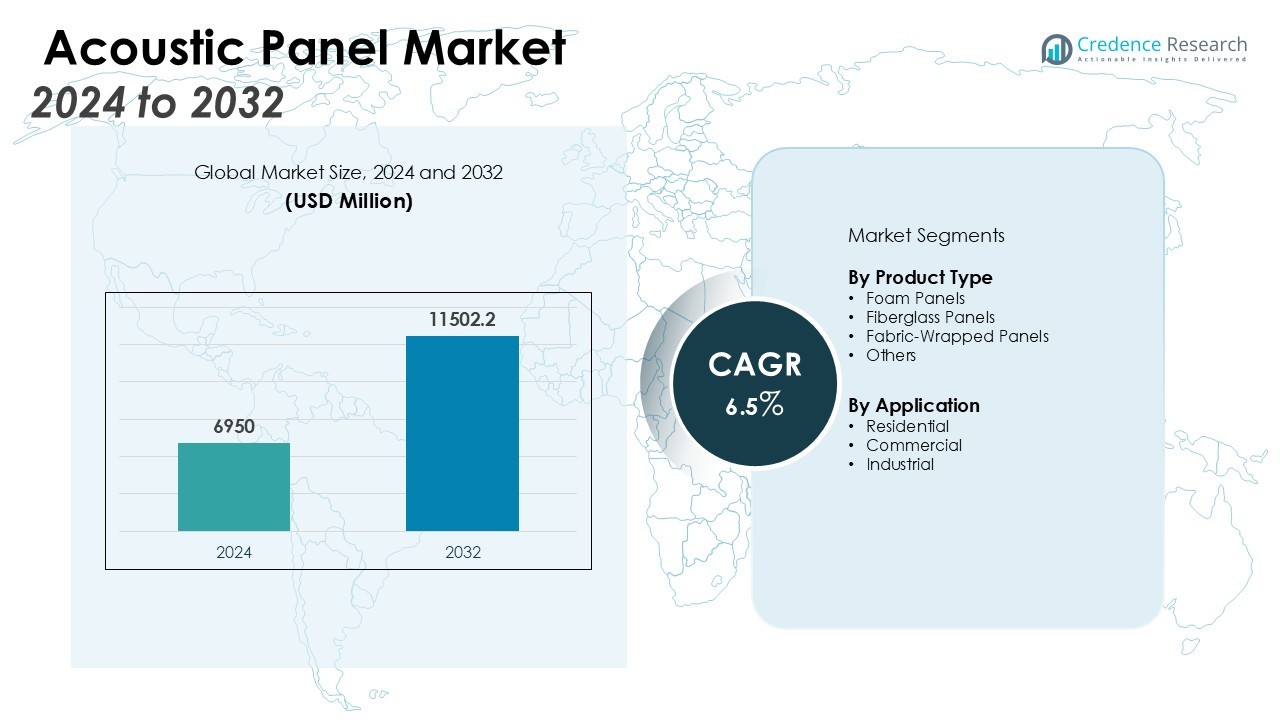
The Acoustic Panel Market size was valued at USD 6950 million in 2024 and is anticipated to reach USD 11502.2 million by 2032, at a CAGR of 6.5% during the forecast period (2024-2032).
| REPORT ATTRIBUTE | DETAILS |
|---|---|
| Historical Period | 2020-2024 |
| Base Year | 2024 |
| Forecast Period | 2025-2032 |
| Acoustic Panel Market Size 2024 | USD 6950 Million |
| Acoustic Panel Market, CAGR | 6.5% |
| Acoustic Panel Market Size 2032 | USD 11502.2 Million |
Key drivers of the market include the rising emphasis on noise control in both residential and commercial spaces, spurred by concerns over noise pollution and its impact on health and productivity. Additionally, advancements in materials and manufacturing processes have led to the development of more effective and aesthetically pleasing acoustic solutions. The integration of sustainable materials in panel production further aligns with global trends towards eco-friendly construction practices. The growing trend of biophilic design, which incorporates natural elements into interior spaces, is also contributing to the demand for aesthetically functional acoustic panels.
Regionally, North America holds a significant share of the market, attributed to stringent building regulations, substantial construction activities, and a strong focus on indoor environmental quality. The Asia-Pacific region is experiencing rapid growth, fueled by rapid urbanization, industrialization, and increasing awareness of the benefits of acoustic treatments. Europe also contributes notably to the market, driven by its commitment to sustainable building practices and the incorporation of aesthetic architectural solutions. Additionally, the Middle East and Africa region is witnessing increasing investments in construction and infrastructure development, which is expected to boost demand for acoustic panels in the coming years.
Market Insights:
- The Acoustic Panel Market size is valued at USD 6,950 million and is projected to reach USD 11,502.2 million by 2032, growing at a CAGR of 6.5%.
- Technological advancements in materials have improved sound absorption while maintaining lightweight and durable panel structures.
- Growing awareness of noise's impact on health and productivity is driving the demand for acoustic panels in office and healthcare environments.
- The market is shifting towards eco-friendly materials, with manufacturers adopting recyclable and biodegradable components in acoustic panels.
- North America holds a significant market share due to stringent building regulations and a strong focus on indoor environmental quality.
- Asia-Pacific is experiencing rapid growth, driven by urbanization, industrialization, and increasing demand for noise control solutions.
- In developing regions, limited awareness and adoption of acoustic panels hinder market growth, requiring educational efforts to increase demand.
Market Drivers:
Increasing Demand for Noise Control in Residential and Commercial Spaces
The Acoustic Panel Market is witnessing growth due to the increasing focus on noise control within residential and commercial spaces. Rising concerns over noise pollution, particularly in urban areas, have driven demand for acoustic solutions that improve sound insulation and mitigate unwanted noise. This is especially important in environments such as offices, schools, and healthcare facilities, where noise levels can negatively impact productivity, learning, and health. The need for a quieter, more comfortable living and working environment continues to push the adoption of acoustic panels.
- For instance, Armstrong World Industries offers ceiling panels engineered for superior sound blocking, measured by their Ceiling Attenuation Class (CAC). A panel with a CAC of 35 demonstrates a significant technological achievement by reducing the sound transmitted between adjacent spaces by 35 decibels.
Advancements in Acoustic Panel Materials and Manufacturing Processes
Technological advancements in the materials and manufacturing processes used for acoustic panels have expanded their application and performance. New, more efficient materials enhance the sound absorption capabilities of these panels while maintaining a lightweight and durable structure. These innovations have led to panels that are not only more effective but also easier to install. The integration of new production techniques has enabled manufacturers to meet the growing demand for both functional and aesthetically pleasing solutions in the Acoustic Panel Market.
- For instance, Megasorber Pty Ltd developed its Soundmesh® G8, a patented non-combustible acoustic facing that provides high-temperature resistance up to 550°C for use in demanding applications.
Rising Awareness of Health and Productivity Benefits
Health and productivity benefits have become key drivers of growth in the Acoustic Panel Market. In office settings, for example, poor acoustics can lead to higher stress levels and reduced work performance. In healthcare facilities, noise control is critical to ensure patient recovery and overall well-being. As awareness of the negative effects of excessive noise grows, the demand for effective soundproofing and acoustic treatment in various industries continues to rise.
Growing Adoption of Sustainable and Eco-friendly Materials
The growing emphasis on sustainability and eco-friendly construction practices has driven the demand for acoustic panels made from sustainable materials. Manufacturers are increasingly utilizing recyclable and biodegradable materials, aligning with global efforts to reduce the environmental impact of construction projects. This trend has boosted the adoption of acoustic panels that not only offer sound insulation but also contribute to building certifications and eco-friendly building standards.
Market Trends:
Growth in Demand for Aesthetic and Multi-functional Acoustic Panels
The Acoustic Panel Market is seeing a trend toward multi-functional and aesthetically pleasing solutions. With the rise of open-plan spaces and modern architectural designs, there is a growing need for acoustic panels that not only perform well in sound absorption but also complement interior décor. Manufacturers are increasingly producing panels in a variety of shapes, sizes, and colors, allowing them to seamlessly integrate into different design aesthetics. These panels are no longer viewed purely as functional elements; they are now essential components in enhancing the overall look and feel of both residential and commercial spaces. This shift toward design-focused acoustic panels is expected to continue as consumers demand higher levels of customization and personalization in their interiors.
- For instance, researchers at Concordia University are pioneering a new method of 3D printing acoustic materials using acoustic holograms, which is capable of achieving speeds up to twenty times faster than conventional methods.
Integration of Smart Technology in Acoustic Panels
Another notable trend in the Acoustic Panel Market is the integration of smart technology into acoustic products. With the advancement of the Internet of Things (IoT), manufacturers are incorporating sensors and smart capabilities into acoustic panels to monitor and adjust room acoustics in real-time. These smart panels can automatically adjust their sound-absorbing properties based on environmental conditions, ensuring optimal acoustic performance at all times. The growing trend of smart buildings and intelligent infrastructure is driving the demand for these innovative solutions. As technology continues to evolve, smart acoustic panels are becoming increasingly popular in commercial spaces like offices, concert halls, and theaters, where dynamic acoustic control is essential. This trend aligns with the increasing preference for integrated, tech-savvy solutions in modern building designs.
- For instance, the SISSI research project has developed smart sound-absorbing panels that integrate 5 different types of IoT sensors.
Market Challenges Analysis:
High Cost of Premium Acoustic Solutions
One of the key challenges facing the Acoustic Panel Market is the high cost associated with premium acoustic solutions. High-quality panels made from advanced materials or with specialized designs often come with a substantial price tag, which can limit their adoption, especially in price-sensitive markets. The cost of installation and maintenance for these panels further adds to the overall expense. This presents a barrier for small businesses or residential customers looking to improve their acoustics within budget constraints. The cost factor becomes even more critical in large-scale commercial construction projects, where a significant number of panels are required, increasing overall project expenses.
Limited Awareness and Adoption in Developing Regions
Despite the growing demand for acoustic panels in developed markets, awareness and adoption remain limited in developing regions. Many businesses and consumers in these areas are either unaware of the benefits of soundproofing or perceive it as a non-essential luxury. This lack of awareness, coupled with lower disposable income, hinders the growth of the Acoustic Panel Market in these regions. As the market for acoustic panels expands, educating consumers and businesses about the value of noise control solutions will be crucial to unlocking potential growth opportunities in these underserved areas.
Market Opportunities:
Growing Demand for Acoustic Panels in Commercial Construction Projects
The Acoustic Panel Market presents significant opportunities in the commercial construction sector. As urbanization accelerates globally, the demand for office spaces, schools, healthcare facilities, and entertainment venues increases, driving the need for effective acoustic solutions. These spaces require high-quality sound control to enhance productivity, learning, and overall user experience. The rising focus on improving indoor environmental quality in commercial properties will create new avenues for acoustic panel manufacturers. Developers and architects are increasingly incorporating acoustic treatments into their designs, considering soundproofing as an essential component for tenant satisfaction and regulatory compliance.
Expansion of Sustainable and Eco-friendly Acoustic Panel Solutions
There is a growing opportunity in the Acoustic Panel Market for sustainable and eco-friendly products. As environmental concerns become more pressing, both consumers and businesses are seeking products that align with green building standards and certifications. Acoustic panels made from recycled or biodegradable materials are gaining traction as part of the broader movement toward sustainability in construction. This shift toward environmentally responsible products not only opens new market segments but also appeals to eco-conscious consumers and businesses. Manufacturers who prioritize sustainability in their product offerings will likely capture the growing demand for green building materials, contributing to long-term market growth.
Market Segmentation Analysis:
By Product Type
The market for acoustic panels is primarily divided into foam panels, fiberglass panels, fabric-wrapped panels, and others. Foam panels dominate due to their lightweight, cost-effective nature and versatility in various settings. They are commonly used in residential, commercial, and industrial applications. Fiberglass panels, known for their superior sound absorption properties, are gaining popularity in commercial and industrial spaces. Fabric-wrapped panels are favored for their aesthetic appeal and are often used in high-end environments where design is a priority. This segmentation caters to different customer needs, from functional to aesthetic solutions.
- For instance, the AlphaSorb® Fabric Wrapped Acoustic Panel from Acoustical Solutions, at a 2-inch thickness, achieves an impressive Noise Reduction Coefficient (NRC) of 1.10.
By Application
The Acoustic Panel Market is also segmented based on application, including residential, commercial, and industrial uses. The commercial sector holds the largest market share, driven by the demand for noise control in offices, healthcare facilities, schools, and public spaces. As the focus on productivity and comfort in workspaces increases, commercial applications remain the leading segment. Residential applications, fueled by urbanization and growing noise pollution concerns, are expanding as more consumers seek soundproofing solutions for their homes. The industrial segment is also experiencing growth, with noise control becoming increasingly important in manufacturing facilities and warehouses where noise levels can impact worker safety and performance.
- For instance, Rockfon contributes to commercial applications like educational facilities by providing highly sound-absorptive products, many with a Noise Reduction Coefficient (NRC) rating of 0.90, to help reduce reverberation and improve speech intelligibility in learning spaces.
Segmentations:
By Product Type
- Foam Panels
- Fiberglass Panels
- Fabric-Wrapped Panels
- Others
By Application
- Residential
- Commercial
- Industrial
By Region
- North America
- Europe
- Asia-Pacific
- Middle East & Africa
- Latin America
Regional Analysis:
North America: Dominating the Acoustic Panel Market
North America holds 35% of the global Acoustic Panel Market share, driven by robust demand from both commercial and residential sectors. The region’s focus on indoor environmental quality, combined with stringent building regulations, supports the widespread adoption of acoustic panels. The United States, in particular, is a key contributor due to its thriving construction industry and high consumer demand for quality acoustic solutions. Commercial spaces such as office buildings, healthcare facilities, and educational institutions prioritize sound control, further boosting the market. Furthermore, ongoing urbanization in cities across North America continues to fuel the need for noise-reducing solutions in both new and retrofitted buildings.
Europe: Growth in Sustainable and Design-Oriented Solutions
Europe accounts for 30% of the Acoustic Panel Market share, with increasing demand for sustainable and aesthetically driven solutions. The region’s commitment to sustainable building practices has led to a rise in the use of eco-friendly materials in acoustic panels. Countries like Germany, the UK, and France emphasize energy-efficient and noise-reducing solutions in both commercial and residential projects. Furthermore, architectural trends in Europe prioritize modern design aesthetics, prompting manufacturers to offer acoustic panels that combine functionality with visual appeal. The European market continues to evolve, with growing investments in green buildings and acoustic treatments for various sectors.
Asia-Pacific: Rapid Expansion from Urbanization and Infrastructure Development
Asia-Pacific holds 25% of the Acoustic Panel Market share, driven by increased urbanization and industrialization. As cities expand and new infrastructure projects emerge, the demand for high-performance acoustic solutions rises. Countries like China, India, and Japan are experiencing a boom in construction activities, particularly in commercial and residential sectors. Growing awareness about noise pollution and its effects on health is further driving the adoption of acoustic panels in the region. The rise of the middle class in these countries, along with rising disposable incomes, is also contributing to the growing demand for noise control solutions in both urban and suburban areas.
Key Player Analysis:
- USG BORAL
- Saint-Gobain
- Beiyang
- Beijing New Building Material
- Armstrong
- STAR-USG
- Leeyin Acoustic Panel
- Knauf Insulation
- Burgeree
- Forgreener Acoustic
- Shengyuan
- Sound Seal
- G&S Acoustics
- Whisper Walls
- Same Acoustic Panel Material
- MBI Acoustical Products
Competitive Analysis:
The Acoustic Panel Market is highly competitive, with key players such as Armstrong World Industries, Acoustical Surfaces, Inc., Auralex Acoustics, Inc., and Saint-Gobain leading the industry. These companies emphasize innovation, quality, and product differentiation, particularly through advanced materials, sustainable solutions, and aesthetically appealing designs. Saint-Gobain, for instance, integrates eco-friendly materials in its products, addressing the increasing demand for sustainable building solutions. Smaller players differentiate themselves by offering customized acoustic solutions for specific applications. Companies also focus on strategic investments in R&D and forming partnerships to enhance product offerings and expand market reach. Regional competition is intense, particularly in North America, Europe, and Asia-Pacific, where urbanization and infrastructure development are driving significant demand for noise-reducing products.
Recent Developments:
- In May 2025, Boral announced the acquisition of the Wallan Concrete plant located north of Melbourne.
- In July 2025, Armstrong World Industries announced record-breaking sales and earnings for the second quarter of 2025.
Market Concentration & Characteristics:
The Acoustic Panel Market is moderately concentrated, with a mix of global and regional players dominating the industry. Leading companies like Armstrong World Industries, Saint-Gobain, and Auralex Acoustics hold significant market shares, driving innovation and product development. These firms focus on offering diverse product portfolios, emphasizing sustainability and performance to meet evolving consumer needs. While large players dominate in terms of market reach and resources, smaller, specialized companies are gaining traction by catering to niche applications and providing tailored acoustic solutions. The market is characterized by a strong emphasis on R&D, with companies continually improving materials and manufacturing processes to enhance acoustic efficiency. Competition is also influenced by the growing trend of eco-friendly construction and the increasing demand for aesthetically designed panels, allowing both large and small players to address different consumer preferences across various regions.
Report Coverage:
The research report offers an in-depth analysis based on Product Type, Application and Region. It details leading market players, providing an overview of their business, product offerings, investments, revenue streams, and key applications. Additionally, the report includes insights into the competitive environment, SWOT analysis, current market trends, as well as the primary drivers and constraints. Furthermore, it discusses various factors that have driven market expansion in recent years. The report also explores market dynamics, regulatory scenarios, and technological advancements that are shaping the industry. It assesses the impact of external factors and global economic changes on market growth. Lastly, it provides strategic recommendations for new entrants and established companies to navigate the complexities of the market.
Future Outlook:
- The Acoustic Panel Market is expected to see increased demand due to heightened awareness of noise pollution and its impact on health and productivity.
- Technological advancements will lead to the development of more effective and aesthetically pleasing acoustic solutions.
- The integration of sustainable materials in panel production aligns with global trends toward eco-friendly construction practices.
- The growing trend of biophilic design, which incorporates natural elements into interior spaces, is contributing to the demand for aesthetically functional acoustic panels.
- North America is projected to hold a significant share of the market, attributed to stringent building regulations, substantial construction activities, and a strong focus on indoor environmental quality.
- The Asia-Pacific region is experiencing rapid growth, fueled by rapid urbanization, industrialization, and increasing awareness of the benefits of acoustic treatments.
- Europe also contributes notably to the market, driven by its commitment to sustainable building practices and the incorporation of aesthetic architectural solutions.
- The Middle East and Africa region is witnessing increasing investments in construction and infrastructure development, which is expected to boost demand for acoustic panels in the coming years.
- The market is characterized by a mix of global and regional players, with companies focusing on innovation and quality to maintain a strong market presence.
- Product differentiation through advanced materials, sustainable solutions, and aesthetic designs is a key strategy among leading firms in the Acoustic Panel Market.

Request a Free Sample
Fill in your details and we'll send you a free sample report.
- Sample data tables & charts
- Research methodology
Market Dynamics
Increasing Demand for Noise Control in Residential and Commercial Spaces
Urbanization and heightened awareness of noise pollution's negative effects on health and productivity are driving the adoption of acoustic panels in offices, schools, healthcare facilities, and homes, where sound insulation is increasingly prioritized.
Advancements in Acoustic Panel Materials and Manufacturing Processes
Innovations in lightweight, durable, and high-performance materials have improved the effectiveness and versatility of acoustic panels, making them more attractive for a wider range of applications and easier to install.
Rising Awareness of Health and Productivity Benefits
Scientific evidence linking excessive noise to stress, reduced cognitive performance, and health issues is prompting organizations and individuals to invest in acoustic solutions that create quieter, more comfortable environments.
Growing Adoption of Sustainable and Eco-friendly Materials
The shift toward green building standards and eco-conscious construction is fueling demand for acoustic panels made from recyclable, biodegradable, or otherwise sustainable materials, aligning with regulatory and consumer preferences.
Growth in Demand for Aesthetic and Multi-functional Acoustic Panels
Modern architectural trends and open-plan designs are increasing the need for acoustic panels that not only control sound but also enhance interior aesthetics, leading to greater customization and integration of panels as design elements.
Need a Custom Version of This Report?
Tailor the scope, geography, or segments to your exact requirements.
- Custom geography or segment scope
- Direct access to our analyst team
Frequently Asked Questions
What is the current market size for Acoustic Panel, and what is its projected size in 2032?
At what Compound Annual Growth Rate is the Acoustic Panel market projected to grow between 2024 and 2032?
Which Acoustic Panel market segment held the largest share in 2024?
What are the primary factors fueling the growth of the Acoustic Panel market?
Who are the leading companies in the Acoustic Panel market?
Which region commanded the largest share of the Acoustic Panel market in 2024?
Table of Content
Chapter 1 Market Segmentation
- 1.1 Segmentation Framework
- 1.1.1 Product and Service Classification
- 1.1.2 Application and End-Use Classification
- 1.1.3 Technology and Solution Classification
- 1.1.4 Customer and Distribution Channel Classification
- 1.1.5 Geographic Segmentation
- 1.1.6 Market Segment Definitions and Boundaries
- 1.2 By Application
- 1.2.1 Residential
- 1.2.2 Commercial
- 1.2.3 Industrial
- 1.3 By Product Type
- 1.3.1 Foam Panels
- 1.3.2 Fiberglass Panels
- 1.3.3 Fabric-Wrapped Panels
- 1.3.4 Others
Chapter 2 Introduction
- 2.1 Report Objectives and Scope
- 2.2 Product Definition and Industry Terminology
- 2.3 Market Inclusions and Exclusions
- 2.4 Research Process
- 2.4.1 Primary Research and Expert Interviews
- 2.4.2 Secondary Research and Source Review
- 2.4.3 Top-Down and Bottom-Up Estimation
- 2.4.4 Data Triangulation and Verification
- 2.5 Market Size Measurement Basis
- 2.5.1 2024: USD 6,950 million → 2032: USD 11,502.2 million
- 2.6 Historical and Forecast Reference Periods
- 2.6.1 Base Year: 2024
- 2.6.2 Forecast Period: 2024-2032
- 2.7 Research Assumptions and Limitations
Chapter 3 Executive Summary
- 3.1 Market Snapshot and Key Findings
- 3.2 Base-Year Market Size, 2024
- 3.3 Forecast Market Size, 2032
- 3.4 Revenue and Volume Growth Outlook
- 3.5 Key Demand and Supply Indicators
- 3.6 Leading Market Segments
- 3.7 Fastest-Growing Market Opportunities
- 3.8 Regional Performance Highlights
- 3.9 Technology and Industry Transformation
- 3.10 Competitive Landscape Summary
- 3.11 Analyst View and Strategic Implications
Chapter 4 Global Acoustic Panel Market Trends and Developments
- 4.1 Historical Industry Development
- 4.2 Recent Market Trends and Developments
- 4.3 Demand and Customer Behavior Trends
- 4.4 Technology and Product Innovation
- 4.5 Artificial Intelligence, Automation and Digitalization
- 4.6 Local Manufacturing and Supply Chain Realignment
- 4.7 Industry Partnerships, Mergers and Acquisitions
- 4.8 Sustainability and Circular Economy Developments
- 4.9 Government and Private Sector Investment Trends
- 4.10 Emerging Business Models and Commercialization
- 4.11 Industry Developments and Announcements
Chapter 5 Global Acoustic Panel Market Production, Supply and Demand Analysis
- 5.1 Demand Trend and Consumption Analysis
- 5.2 Demand Forecast, 2024-2032
- 5.3 Production and Output Trend
- 5.4 Production and Output Forecast, 2024-2032
- 5.5 Installed Capacity and Capacity Utilization
- 5.6 Company-Wise Production Plants and Statistics
- 5.6.1 Installed Production Capacity
- 5.6.2 Actual Production
- 5.6.3 Planned Capacity and Expansion Targets
- 5.7 Supply Chain Structure and Procurement Trends
- 5.8 Supply-Demand Gap and Bottlenecks
- 5.9 Import Dependence and Sourcing Structure
- 5.10 Contract Manufacturing and Outsourcing
- 5.11 Regional Supply and Demand Concentration
Chapter 6 Global Acoustic Panel Market Pricing Analysis
- 6.1 Pricing Structure and Measurement
- 6.2 Historical Pricing Trends
- 6.3 Pricing Outlook, 2024-2032
- 6.4 Average Selling Price and Unit Economics
- 6.5 Pricing by Product and Market Segment
- 6.6 Geographic Pricing Differences
- 6.7 Key Input, Energy, Labor and Logistics Costs
- 6.8 Contract Pricing and Purchasing Models
- 6.9 Pricing Sensitivity and Competitive Positioning
- 6.10 Price, Margin and Profitability Implications
Chapter 7 Global Acoustic Panel Market Dynamics
- 7.1 Market Growth Drivers
- 7.1.1 Demand-Side Drivers
- 7.1.2 Technology and Innovation Drivers
- 7.1.3 Infrastructure and Investment Drivers
- 7.1.4 Regulatory and Policy Drivers
- 7.2 Market Restraints
- 7.2.1 Cost and Affordability Constraints
- 7.2.2 Technology and Adoption Barriers
- 7.2.3 Supply Chain and Operational Constraints
- 7.3 Market Challenges
- 7.3.1 Competitive Pressure and Margin Erosion
- 7.3.2 Skills, Infrastructure and Implementation Gaps
- 7.4 Emerging Market Opportunities
- 7.5 Market Dynamics Impact and Time-Horizon Assessment
Chapter 8 Global Acoustic Panel Value Chain Analysis
- 8.1 Industry Value Chain Overview
- 8.2 Upstream Suppliers and Critical Inputs
- 8.3 Technology and Component Providers
- 8.4 Manufacturing or Service Delivery
- 8.5 Distribution, Channel Partners and Integrators
- 8.6 Downstream Applications and End Users
- 8.7 Value Addition and Profit Pools
- 8.8 Vertical Integration and Outsourcing
- 8.9 Supplier Concentration and Risk
- 8.10 Supply Chain Localization and Resilience
Chapter 9 Global Acoustic Panel Market Regulations and Policies
- 9.1 Relevant Laws, Standards and Compliance Frameworks
- 9.2 Product, Service, Safety and Quality Requirements
- 9.3 Government Policies, Incentives and Subsidies
- 9.4 Imports, Exports and Trade Barriers
- 9.5 Public Procurement and Local Content Requirements
- 9.6 Environmental and Sustainability Compliance
- 9.7 Upcoming Policy Changes and Market Implications
Chapter 10 Global Acoustic Panel Market Hotspots and Opportunities
- 10.1 Market Opportunity Mapping and Growth Hotspots
- 10.2 High-Growth Applications and Customer Groups
- 10.3 Underserved Markets and White-Space Opportunities
- 10.4 Emerging Technology and Product Opportunities
- 10.5 New Capacity and Investment Hotspots
- 10.6 Market Entry and Expansion Opportunities
- 10.7 Distribution and Partnership Opportunities
- 10.8 Near-Term and Long-Term Commercial Potential
- 10.9 Opportunity Attractiveness and Execution Risks
Chapter 11 Global Acoustic Panel Market Outlook, 2024-2032
- 11.1 Market Size and Analysis
- 11.1.1 Revenue (Market Measurement: 2024: USD 6,950 million → 2032: USD 11,502.2 million)
- 11.1.2 Market Volume and Quantity Sold
- 11.1.3 Historical Market Size
- 11.1.4 Base-Year Market Size, 2024
- 11.2 Market Forecast, 2024-2032
- 11.2.1 Revenue Forecast to 2032
- 11.2.2 Volume Forecast to 2032
- 11.2.3 CAGR and Year-on-Year Growth
- 11.2.4 Incremental Revenue Opportunity
- 11.3 Forecast Assumptions and Scenario Analysis
- 11.3.1 Base-Case Forecast
- 11.3.2 Optimistic and Conservative Scenarios
- 11.3.3 Technology, Pricing and Policy Sensitivities
- 11.4 Market Attractiveness and Growth Outlook
Chapter 12 Global Acoustic Panel Market Segmentation and Outlook
- 12.1 Segmentation Summary and Market Shares, 2024
- 12.2 Largest and Fastest-Growing Segments
- 12.3 By Application - Market Size and Forecast, 2024-2032
- 12.3.1 Segment Definition and Scope
- 12.3.2 Historical Market Size
- 12.3.3 Revenue Forecast, 2024-2032
- 12.3.4 Volume Forecast, 2024-2032
- 12.3.5 Base-Year Market Share, 2024
- 12.3.6 Segment CAGR and Growth Drivers
- 12.3.7 Subsegment Market Size and Forecast
- 12.3.7.1 Residential
- 12.3.7.2 Commercial
- 12.3.7.3 Industrial
- 12.3.8 Subsegment Pricing and Adoption Trends
- 12.3.9 Leading Suppliers and Competition
- 12.3.10 Regional Demand and Opportunities
- 12.4 By Product Type - Market Size and Forecast, 2024-2032
- 12.4.1 Segment Definition and Scope
- 12.4.2 Historical Market Size
- 12.4.3 Revenue Forecast, 2024-2032
- 12.4.4 Volume Forecast, 2024-2032
- 12.4.5 Base-Year Market Share, 2024
- 12.4.6 Segment CAGR and Growth Drivers
- 12.4.7 Subsegment Market Size and Forecast
- 12.4.7.1 Foam Panels
- 12.4.7.2 Fiberglass Panels
- 12.4.7.3 Fabric-Wrapped Panels
- 12.4.7.4 Others
- 12.4.8 Subsegment Pricing and Adoption Trends
- 12.4.9 Leading Suppliers and Competition
- 12.4.10 Regional Demand and Opportunities
- 12.5 Segment Growth Comparison
- 12.6 Segment Attractiveness and Priority Matrix
Chapter 13 Global Acoustic Panel End-Use and Application Market Outlook
- 13.1 End-Use Industry and Customer Demand Structure
- 13.2 Leading Applications and Customer Groups
- 13.3 End-Use Market Size, Share and Forecast
- 13.4 Major End-Use Industry Deep Dives
- 13.4.1 Customer Requirements and Use Cases
- 13.4.2 Demand and Replacement Cycles
- 13.4.3 Technical and Regulatory Considerations
- 13.4.4 Purchasing and Procurement Models
- 13.4.5 Leading Vendors and Distribution Channels
- 13.4.6 Forecast and Commercial Opportunities
- 13.5 Emerging Applications and Cross-Segment Demand
- 13.6 End-Use Industry Investment Priorities
Chapter 14 Global Acoustic Panel Geographic Market Outlook, 2024-2032
- 14.1 Regional Market Size and Share, 2024
- 14.2 Regional Market Forecast, 2024-2032
- 14.3 Regional Pricing, Production and Demand Differences
- 14.4 North America
- 14.4.1 United States
- 14.4.2 Canada
- 14.4.3 Mexico
- 14.5 Europe
- 14.5.1 Germany
- 14.5.2 France
- 14.5.3 Italy
- 14.5.4 United Kingdom
- 14.5.5 Spain
- 14.5.6 Poland
- 14.5.7 Russia
- 14.5.8 Netherlands
- 14.5.9 Belgium
- 14.5.10 Sweden
- 14.5.11 Denmark
- 14.5.12 Norway
- 14.5.13 Rest of Europe
- 14.6 Asia Pacific
- 14.6.1 China
- 14.6.2 India
- 14.6.3 Japan
- 14.6.4 South Korea
- 14.6.5 Thailand
- 14.6.6 Indonesia
- 14.6.7 Vietnam
- 14.6.8 Malaysia
- 14.6.9 Australia
- 14.6.10 Rest of Asia Pacific
- 14.7 Latin America
- 14.7.1 Brazil
- 14.7.2 Argentina
- 14.7.3 Colombia
- 14.7.4 Chile
- 14.7.5 Rest of Latin America
- 14.8 Middle East
- 14.8.1 Saudi Arabia
- 14.8.2 United Arab Emirates
- 14.8.3 Turkey
- 14.8.4 Israel
- 14.8.5 Iran
- 14.8.6 Rest of the Middle East
- 14.9 Africa
- 14.9.1 South Africa
- 14.9.2 Egypt
- 14.9.3 Nigeria
- 14.9.4 Morocco
- 14.9.5 Rest of Africa
- 14.10 Regional Investment, Policy and Supply Chain Differences
- 14.11 Regional Competitive Landscape
- 14.12 Geographic Growth Hotspots
Chapter 15 Global Acoustic Panel Technology, Innovation and Sustainability Outlook
- 15.1 Technology Landscape and Maturity
- 15.2 Product, Process and Service Innovation
- 15.3 AI, Automation and Digital Tools in the Industry
- 15.4 Technology Adoption and Performance Benchmarking
- 15.5 Innovation Pipeline and R&D Investment
- 15.6 Patent and Intellectual Property Trends
- 15.7 Energy Efficiency and Resource Management
- 15.8 Sustainability, Recycling and Circularity
- 15.9 Technology Roadmap, 2024-2032
- 15.10 Risks of Obsolescence and Technology Substitution
Chapter 16 Global Acoustic Panel Market Key Strategic Imperatives
- 16.1 Growth and Market Entry Priorities
- 16.2 High-Return Products and Segments
- 16.3 Pricing, Profitability and Cost Optimization
- 16.4 Technology Investment and Product Differentiation
- 16.5 Supply Chain Localization and Resilience
- 16.6 Distribution and Customer Acquisition
- 16.7 Partnership, Acquisition and Capacity Strategy
- 16.8 Regional Expansion Priorities
- 16.9 Short-, Medium- and Long-Term Actions
Chapter 17 Competition Outlook
- 17.1 Industry Competition Characteristics
- 17.2 Market Structure and Concentration
- 17.3 Market Share and Competitive Positioning, 2024
- 17.4 Company-Wise Revenue and Product Benchmarking
- 17.5 Production and Service Capacity Benchmarking
- 17.6 Technology, Pricing and Differentiation
- 17.7 Regional Footprint and Distribution Strength
- 17.8 Mergers, Acquisitions and Strategic Alliances
- 17.9 New Entrants and Competitive Threats
- 17.10 Porter's Five Forces and Industry Attractiveness
- 17.11 Competitive Outlook, 2024-2032
Chapter 18 Company Profiles
- 18.1 Company Coverage and Selection Criteria
- 18.2 Armstrong World Industries
- 18.2.1 Business Description
- 18.2.2 Company Ownership and Geographic Presence
- 18.2.3 Product and Service Portfolio
- 18.2.4 Manufacturing and Operating Footprint
- 18.2.5 Production Capacity and Expansion Plans
- 18.2.6 Financial Performance and Investment
- 18.2.7 Market Share and Competitive Position
- 18.2.8 Technology and Innovation Capabilities
- 18.2.9 Strategic Alliances or Partnerships
- 18.2.10 Recent Developments
- 18.2.11 Growth Strategy and Outlook
- 18.3 Saint-Gobain
- 18.4 USG BORAL
- 18.5 Auralex Acoustics
- 18.6 Knauf Insulation
- 18.7 Acoustical Surfaces, Inc.
- 18.8 Rockfon
- 18.9 Beiyang
- 18.10 MBI Acoustical Products
- 18.11 Sound Seal
- 18.12 Other Relevant Market Participants
Note: Every listed company is profiled on the structure shown under the first company. The company list is preliminary and may change based on research findings, market developments, data availability and client requirements.
Chapter 19 Disclaimer
- 19.1 Research and Forecast Disclaimer
- 19.2 Data Source and Estimation Limitations
Note: The depth of individual sections depends on data availability for this market. Volume, capacity, trade and other unit-based metrics are included where applicable.