
| REPORT ATTRIBUTE | DETAILS |
|---|---|
| Historical Period | 2020-2023 |
| Base Year | 2024 |
| Forecast Period | 2025-2032 |
| Aerospace Valves Market Size 2023 | USD 10,800 Million |
| Aerospace Valves Market, CAGR | 5.23% |
| Aerospace Valves Market Size 2032 | USD 17,087.6 Million |
Market Overview:
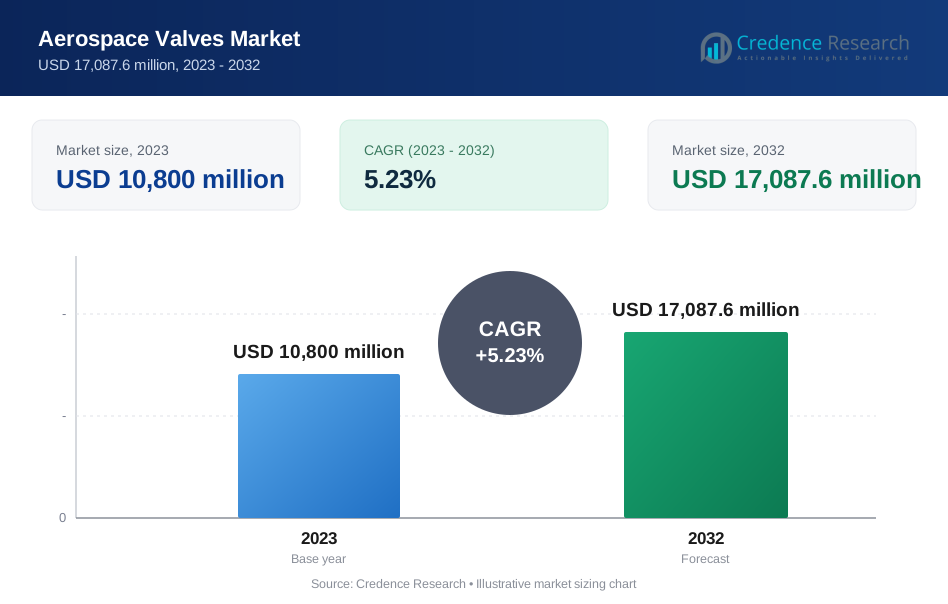
Global Aerospace Valves Market size was valued at USD 10,800 million in 2023 and is anticipated to reach USD 17,087.6 million by 2032, at a CAGR of 5.23% during the forecast period (2023-2032).
Global Aerospace Valves key market drivers include the increasing adoption of lightweight and high-performance valves to enhance fuel efficiency and operational reliability. Rising investments in the aviation sector, coupled with stringent safety and emission regulations, are compelling manufacturers to develop advanced aerospace valve solutions. The growth of the space exploration industry and increasing defense budgets worldwide are further accelerating the demand for aerospace valves in spacecraft and military aircraft applications. Furthermore, the shift toward electric and hybrid propulsion systems is fueling innovations in electro-hydraulic and electro-mechanical valves. Additionally, the increasing focus on reducing aircraft maintenance costs and improving system reliability is driving the adoption of smart valves with real-time monitoring capabilities. The integration of Internet of Things (IoT) and artificial intelligence (AI) in aerospace valve systems is further optimizing performance and predictive maintenance strategies.
Regionally, North America dominates the aerospace valves market, driven by the presence of major aircraft manufacturers, robust defense spending, and a well-established aerospace supply chain. Europe follows closely, supported by strong aviation research initiatives and the presence of leading valve manufacturers. Asia-Pacific is expected to register the highest growth rate due to rising aircraft deliveries, expanding airline fleets, and increasing defense expenditures in countries such as China and India. Meanwhile, the Middle East and Africa region is witnessing demand growth due to expanding airport infrastructure and increased procurement of commercial and military aircraft. The rising focus on domestic aircraft manufacturing and maintenance, repair, and overhaul (MRO) activities in emerging economies is further boosting market expansion. Additionally, government initiatives to enhance regional aerospace capabilities are driving investments in aerospace component manufacturing, including valves.
Market Insights:
- The Global Aerospace Valves Market was valued at USD 10,800 million in 2023 and is expected to reach USD 17,087.6 million by 2032, growing at a CAGR of 5.23% during the forecast period.
- Increasing demand for fuel-efficient and lightweight aircraft is driving the adoption of high-performance aerospace valves made from titanium and advanced composites to enhance efficiency and reduce operational costs.
- Technological advancements, including the integration of IoT, AI, and smart valve systems, are improving aircraft reliability, enabling real-time monitoring and predictive maintenance to reduce downtime.
- Expanding commercial and military aviation sectors, along with rising investments in space exploration, are fueling demand for advanced aerospace valve solutions across various applications.
- Stringent regulatory standards and high certification costs pose challenges for manufacturers, requiring continuous innovation to meet evolving safety and environmental compliance
- Supply chain disruptions and raw material shortages, particularly for titanium and stainless steel, are affecting production timelines and increasing costs, impacting global aerospace valve supply.
- North America leads the market due to strong aircraft manufacturing and defense spending, while Asia-Pacific is the fastest-growing region, driven by increasing aircraft deliveries, fleet expansions, and government-led aerospace initiatives.
Market Drivers:
Increasing Demand for Fuel-Efficient and Lightweight Aircraft
The growing focus on fuel efficiency and sustainability in the aerospace industry is a major driver for the demand for advanced aerospace valves. For instance, the use of lightweight materials like titanium and composites in valve manufacturing is contributing to improved fuel efficiency by reducing aircraft weight. Aircraft manufacturers and airlines are actively investing in lightweight and high-performance components to enhance fuel efficiency and reduce overall operational costs. Aerospace valves play a crucial role in regulating fluid and gas flow across hydraulic, fuel, and pneumatic systems, directly impacting engine performance and fuel consumption. The adoption of lightweight materials such as titanium and composites in valve manufacturing is further contributing to improved fuel efficiency and reducing aircraft weight. As airlines continue to seek operational cost reductions, the demand for technologically advanced aerospace valves is expected to grow.
Expanding Commercial and Military Aviation Sectors
The expansion of both commercial and military aviation is fueling the demand for aerospace valves across various aircraft applications. The commercial aviation sector is witnessing rapid growth due to increasing air passenger traffic, rising aircraft deliveries, and fleet expansion programs by major airlines. For example, major airlines are increasing their aircraft deliveries to meet growing demand. In military aviation, investments in next-generation fighter jets, unmanned aerial vehicles (UAVs), and surveillance aircraft are also driving the need for high-performance valve systems. In parallel, defense and military aviation are experiencing increased investments in next-generation fighter jets, unmanned aerial vehicles (UAVs), and surveillance aircraft. Aerospace valves are critical in ensuring the operational efficiency of these advanced aircraft, particularly in hydraulic and fuel systems. Additionally, modernization programs for aging military aircraft and the development of autonomous aerial platforms are further driving market growth, leading to increased procurement of high-performance valve systems.
Technological Advancements and Smart Valve Integration
Continuous advancements in aerospace valve technology are significantly enhancing the efficiency, reliability, and safety of aircraft systems. The integration of smart valves equipped with sensors and real-time monitoring capabilities is transforming the aerospace industry by enabling predictive maintenance and reducing the risk of component failure. For instance, KTW Technology has developed smart valve systems originally designed for the German Aerospace Center's Rosetta spacecraft, which are now applied in various demanding applications due to their exceptional durability and performance. These intelligent valve systems utilize Internet of Things (IoT) and artificial intelligence (AI) technologies to optimize aircraft operations and improve fuel management. Additionally, the increasing shift toward electro-mechanical and electro-hydraulic valve systems is reducing dependency on traditional hydraulic components, thereby enhancing system efficiency and reducing maintenance costs. As digitalization continues to reshape the aerospace sector, the adoption of technologically advanced valve solutions is expected to accelerate.
Rising Investments in Space Exploration and Emerging Aerospace Markets
The increasing investments in space exploration and the development of next-generation spacecraft are creating significant opportunities for the aerospace valves market. Space agencies and private space companies are investing heavily in advanced propulsion systems, satellite launches, and deep-space exploration missions, all of which require highly reliable valve technologies. For example, NASA is accelerating its Artemis missions with a budget of around $26 billion in 2025, focusing on returning humans to the Moon and establishing a sustainable lunar presence. The growing demand for spacecraft propulsion and fuel control valves is further driving market expansion. Additionally, emerging aerospace markets in Asia-Pacific, the Middle East, and Latin America are witnessing increased aircraft procurement, indigenous manufacturing initiatives, and infrastructure development. Governments and private aerospace firms in these regions are actively investing in aerospace component manufacturing, including valves, to strengthen their aviation and defense capabilities. This trend is expected to contribute to sustained market growth over the coming years.
Market Trends:
Growing Adoption of Additive Manufacturing in Aerospace Valve Production
The increasing use of additive manufacturing, or 3D printing, is transforming the aerospace valves market by enhancing production efficiency and reducing lead times. For instance, Liebherr Aerospace has successfully produced a high-pressure hydraulic block for the Airbus A380 using a metal 3D printer, achieving the same performance as conventionally made parts but with reduced weight and fewer components. Manufacturers are leveraging this technology to create complex valve geometries with improved durability and reduced weight, which contributes to overall aircraft efficiency. Additive manufacturing also allows for the customization of aerospace valves, ensuring optimal performance in specific applications such as fuel management and hydraulic systems. The ability to produce lightweight yet high-strength components is driving the adoption of this technology, particularly as aerospace companies seek innovative solutions to meet stringent industry regulations and performance standards.
Increasing Demand for Electrification in Aircraft Systems
The aerospace industry is witnessing a significant shift toward electrification, leading to the growing adoption of electrically actuated valves over traditional hydraulic and pneumatic systems. More electric aircraft (MEA) designs are being developed to enhance energy efficiency, reduce maintenance costs, and minimize environmental impact. Electrically controlled aerospace valves offer precise flow regulation and improved reliability, making them essential components in advanced propulsion and energy management systems. For example, BAE Systems is leveraging its expertise in flight controls and propulsion to develop reliable systems for hybrid and electric aircraft, focusing on sustainable solutions. This trend is further reinforced by the rising investments in hybrid and electric aircraft, where efficient valve integration is crucial for optimizing battery management and cooling systems. As aviation moves toward greener and more sustainable solutions, the demand for electrically actuated valves is expected to increase.
Expansion of the Aftermarket and Maintenance, Repair, and Overhaul (MRO) Sector
The growing emphasis on aircraft maintenance and operational efficiency is driving the expansion of the aerospace valve aftermarket and MRO sector. Airlines and defense organizations are increasingly focusing on extending the lifespan of their aircraft through component upgrades and regular maintenance. The demand for high-quality replacement aerospace valves is rising as older aircraft fleets continue to operate beyond their expected service life. For instance, Global Aerospace Corporation offers flat-rate overhaul solutions for pneumatic valves, providing cost-effective alternatives to OEM parts and reducing long-term MRO costs for operators. Additionally, the increasing complexity of aerospace systems is prompting MRO providers to adopt predictive maintenance strategies, where advanced aerospace valves with real-time monitoring capabilities are integrated into aircraft to reduce downtime and improve reliability. This expansion of the MRO sector is expected to provide significant growth opportunities for aerospace valve manufacturers.
Regional Growth Driven by Emerging Aerospace Hubs
The global aerospace valves market is experiencing notable expansion due to the emergence of new aerospace hubs, particularly in Asia-Pacific and the Middle East. Countries such as China, India, and the United Arab Emirates are heavily investing in domestic aircraft production, airport infrastructure, and aerospace research programs. For example, Airbus has bolstered its presence in the aviation market through a major deal with China Aviation Supplies Holding Co., involving the sale of 160 aircraft, which highlights the strong demand from Chinese carriers. The rise of indigenous aircraft manufacturing initiatives and collaborations between regional governments and global aerospace firms are creating a strong demand for advanced aerospace components, including valves. Furthermore, increasing defense budgets in these regions are contributing to heightened procurement of military aircraft, driving the need for high-performance aerospace valve solutions. As regional aerospace capabilities continue to grow, market players are strategically expanding their presence in these high-potential markets.
Market Challenges Analysis:
Stringent Regulatory Standards and High Certification Costs
The aerospace valves market is significantly impacted by stringent regulatory standards and the high costs associated with product certification. Aerospace valves must comply with strict safety, performance, and environmental regulations set by organizations such as the Federal Aviation Administration (FAA) and the European Union Aviation Safety Agency (EASA). Meeting these regulatory requirements involves extensive testing, material validation, and certification processes, which can be both time-consuming and expensive. The complexity of these compliance procedures often increases the overall cost of valve production, posing a challenge for manufacturers, particularly small and medium-sized enterprises. Additionally, evolving regulations related to emissions, fuel efficiency, and environmental sustainability require continuous innovation, further adding to research and development expenses.
Supply Chain Disruptions and Raw Material Shortages
The global aerospace valves market faces challenges related to supply chain disruptions and raw material shortages, which have been exacerbated by geopolitical tensions, trade restrictions, and economic uncertainties. Aerospace valve production relies on high-quality materials such as titanium, stainless steel, and advanced composites, many of which are subject to fluctuating availability and price volatility. Any disruption in the supply of these materials can lead to production delays and increased costs for manufacturers. Furthermore, logistical challenges, including transportation delays and limited manufacturing capacities, have further strained the supply chain, affecting timely deliveries of aerospace components. The reliance on a global supply network makes aerospace valve manufacturers vulnerable to regional instabilities and fluctuations in market demand, making supply chain resilience a critical challenge for the industry.
Market Opportunities:
The increasing demand for next-generation aircraft presents a significant growth opportunity for the aerospace valves market. With airlines expanding their fleets to accommodate rising air passenger traffic, aircraft manufacturers are witnessing a surge in new orders for both commercial and cargo aircraft. This expansion is driving the need for advanced aerospace valves that enhance fuel efficiency, improve hydraulic performance, and support sustainable aviation initiatives. Additionally, the development of hybrid and electric aircraft is opening new avenues for aerospace valve manufacturers to innovate and supply high-performance electro-mechanical valves that meet the evolving requirements of modern aviation systems.
Another key opportunity lies in the expansion of space exploration and defense programs worldwide. The increasing investments in satellite launches, deep-space missions, and reusable spacecraft require highly reliable and precision-engineered valves for propulsion and fluid control systems. Similarly, rising defense budgets and military aircraft modernization initiatives are generating demand for advanced aerospace valves in fighter jets, drones, and surveillance aircraft. Emerging aerospace hubs in Asia-Pacific and the Middle East are further driving growth, as governments invest in local aircraft manufacturing and maintenance capabilities. These factors collectively present a lucrative opportunity for aerospace valve manufacturers to expand their market presence and enhance technological innovation in response to the evolving needs of the global aerospace industry.
Market Segmentation Analysis:
The Global Aerospace Valves Market is segmented by type, application, and material, each playing a crucial role in aerospace operations.
By type, check valves, pressure control valves, ball valves, butterfly valves, relief valves, solenoid valves, and other valve types are essential for controlling fluid and gas flow in aircraft systems. Check valves prevent backflow, ensuring efficient fluid movement, while pressure control valves regulate hydraulic and pneumatic pressure for optimal performance. Ball and butterfly valves provide precise flow control, while relief valves ensure system safety by preventing overpressure. Solenoid valves, increasingly integrated with smart technologies, enhance automation in aerospace systems.
By application, aerospace valves are critical in fuel, hydraulic, pneumatic, and environmental control systems (ECS), ensuring operational safety and efficiency. They also play a vital role in landing gear, fire protection, avionics cooling, and other systems, contributing to enhanced performance and reliability. The demand for high-performance valves in fuel and hydraulic systems is growing due to increasing air travel and fleet expansion.
By material, aerospace valves are manufactured using steel, titanium, aluminum, and other materials to optimize strength, durability, and weight reduction. Titanium and aluminum valves are gaining preference due to their lightweight properties, improving fuel efficiency and overall aircraft performance. As sustainability and efficiency drive innovation, the industry is witnessing increased adoption of advanced materials in valve manufacturing.
Segmentation:
By Type
- Check Valves
- Pressure Control Valves
- Ball Valves
- Butterfly Valves
- Relief Valves
- Solenoid Valves
- Other Valves
By Application
- Fuel Systems
- Hydraulic Systems
- Pneumatic Systems
- Environmental Control Systems (ECS)
- Landing Gear Systems
- Fire Protection Systems
- Avionics and Electronics Cooling
- Others
By Material
- Steel
- Titanium
- Aluminum
- Other Materials
Regional Analysis:
North America – Leading Market with Strong Aerospace Infrastructure
North America holds the largest market share in the global aerospace valves market, accounting for approximately 35% of the total revenue. The region’s dominance is driven by the presence of major aircraft manufacturers, including Boeing and Lockheed Martin, as well as a well-established aerospace supply chain. The high demand for commercial and military aircraft, coupled with strong defense spending by the United States government, is fueling market growth. Additionally, North America is a key hub for technological advancements in aerospace systems, with ongoing developments in electric and hybrid aircraft that require next-generation valve technologies. The expansion of space exploration programs by NASA and private entities further strengthens the demand for high-performance aerospace valves in propulsion and fluid management systems.
Europe – Strong Presence of Aircraft and Component Manufacturers
Europe accounts for approximately 25% of the global aerospace valves market, driven by the presence of leading aircraft manufacturers such as Airbus and Rolls-Royce. The region has a well-developed aerospace ecosystem, supported by extensive research and development initiatives focused on sustainable aviation technologies. Stringent emission regulations and fuel efficiency mandates set by the European Union are pushing aerospace companies to adopt lightweight and energy-efficient valve solutions. The expansion of aircraft production facilities, along with increased investments in defense and space programs, is contributing to the steady growth of the aerospace valves market in Europe. Additionally, major MRO (maintenance, repair, and overhaul) hubs in countries like Germany, France, and the United Kingdom are driving demand for high-quality replacement valves.
Asia-Pacific – Fastest-Growing Region with Rising Aircraft Demand
Asia-Pacific is the fastest-growing region in the global aerospace valves market, holding a market share of approximately 22%. The rapid expansion of airline fleets, increasing aircraft deliveries, and growing defense budgets in countries like China, India, and Japan are key factors driving market growth. The region is witnessing substantial investments in domestic aircraft manufacturing, with China’s COMAC and India’s Hindustan Aeronautics Limited (HAL) emerging as key players. Additionally, rising air passenger traffic and government-led initiatives to develop aerospace infrastructure are supporting demand for new aircraft and related components, including aerospace valves. The increasing focus on indigenous aerospace production and maintenance services further presents significant growth opportunities for valve manufacturers in the region.
Middle East & Africa and Latin America – Emerging Growth Markets
The Middle East & Africa and Latin America together account for approximately 18% of the aerospace valves market, with the Middle East witnessing higher demand due to expanding airport infrastructure and increasing military aircraft procurement. The region’s strong commercial aviation sector, led by airlines such as Emirates, Qatar Airways, and Saudi Arabian Airlines, is driving investments in new aircraft, creating demand for aerospace valves. Meanwhile, Latin America is experiencing steady growth due to increasing air travel demand and regional defense modernization efforts. As both regions continue to strengthen their aerospace capabilities, the demand for advanced aerospace valve solutions is expected to grow, particularly in aircraft maintenance and defense applications.
Key Player Analysis:
- Eaton Corporation Plc
- Safran SE (France)
- Woodward Inc. (United States)
- Triumph Group (United States)
- Collins Aerospace
- Aero Fluid Products
- Circor Aerospace, Inc.
- Crissair, Inc.
- W. LISK Company, Inc.
- Cla-Val
- Parker Hannifin Corporation (United States)
- Moog Inc. (United States)
- Liebherr GmbH (Germany)
- Porvair PLC (United Kingdom)
Competitive Analysis:
The global aerospace valves market is highly competitive, with established players focusing on innovation, strategic partnerships, and technological advancements to maintain their market position. Leading manufacturers such as Honeywell International Inc., Parker Hannifin Corporation, Eaton Corporation, Safran S.A., and Moog Inc. dominate the market due to their extensive product portfolios, strong R&D capabilities, and long-term contracts with major aircraft OEMs. These companies emphasize the development of lightweight, high-performance valves that enhance fuel efficiency and system reliability. Market competition is further intensified by emerging players introducing cost-effective and technologically advanced solutions. The increasing adoption of additive manufacturing, IoT-enabled smart valves, and electro-mechanical valve systems is shaping the competitive landscape. Additionally, companies are expanding their presence in high-growth regions, particularly in Asia-Pacific and the Middle East, through mergers, acquisitions, and collaborations with regional aerospace firms. For example, Parker Aerospace has formed a joint venture with AVIC Systems to support the COMAC C919 program, highlighting strategic partnerships in emerging market. This evolving competitive environment is driving continuous advancements in aerospace valve technologies.
Recent Developments:
- In December 2024, Woodward Inc. signed a definitive agreement to acquire Safran's electromechanical actuation business based in the United States, Mexico, and Canada. This acquisition includes advanced electromechanical control technology used in aircraft stabilization systems and is expected to close in mid-2025. The deal enhances Woodward's technology platform for next-generation aircraft.
- In September 2022, Parker-Hannifin Corporationcompleted its acquisition of Meggitt PLC, a UK-based aerospace and defense supplier, for approximately £6.3 billion. This acquisition is expected to enhance Parker's capabilities in offering a comprehensive range of solutions for aircraft and aeroengine components and systems.
- In February 2025, Collins Aerospace launched the Powered by Collins Initiative 2025 edition at Aero India. This initiative invites small and medium-sized enterprises to collaborate on critical aerospace and defense technologies, focusing on material informatics and quantum-enabled navigation. The program aims to accelerate the deployment of innovative solutions for customers.
Market Concentration & Characteristics:
The global aerospace valves market is moderately concentrated, with a mix of established multinational corporations and specialized component manufacturers. A few key players, including Honeywell International Inc., Eaton Corporation, Parker Hannifin Corporation, and Safran S.A., hold a significant share due to their extensive industry expertise, strong supply chain networks, and long-standing partnerships with aircraft manufacturers and defense agencies. These companies invest heavily in research and development to enhance valve efficiency, reliability, and compliance with stringent aviation regulations. The market is characterized by high technological barriers, stringent certification requirements, and long product development cycles. Innovation plays a crucial role, with increasing adoption of smart valves, electro-mechanical systems, and lightweight materials to improve aircraft performance. Additionally, the market is influenced by OEM and aftermarket demand, with a growing focus on predictive maintenance and fuel efficiency. As competition intensifies, companies are expanding their regional presence and enhancing product differentiation strategies.
Report Coverage:
The research report offers an in-depth analysis based on by type, application, and material, It details leading market players, providing an overview of their business, product offerings, investments, revenue streams, and key applications. Additionally, the report includes insights into the competitive environment, SWOT analysis, current market trends, as well as the primary drivers and constraints. Furthermore, it discusses various factors that have driven market expansion in recent years. The report also explores market dynamics, regulatory scenarios, and technological advancements that are shaping the industry. It assesses the impact of external factors and global economic changes on market growth. Lastly, it provides strategic recommendations for new entrants and established companies to navigate the complexities of the market.
Future Outlook:
- The aerospace valves market is expected to witness steady growth driven by rising commercial aircraft production and fleet expansion.
- Increasing demand for fuel-efficient and lightweight valve solutions will shape future product innovations.
- Advancements in electro-mechanical and smart valve technologies will enhance aircraft system efficiency and reliability.
- The growing adoption of additive manufacturing will streamline production processes and enable cost-effective customization.
- Electrification trends in aviation, including hybrid and all-electric aircraft, will accelerate demand for next-generation aerospace valves.
- Expanding space exploration programs and increased satellite launches will create new growth opportunities for aerospace valve manufacturers.
- Strengthening defense budgets worldwide will drive investments in advanced valve solutions for military aircraft and UAVs.
- Asia-Pacific and the Middle East will emerge as high-growth regions due to rising domestic aircraft manufacturing and infrastructure development.
- The aftermarket segment will expand as airlines prioritize predictive maintenance and extended aircraft lifecycles.
- Strategic mergers, acquisitions, and collaborations will reshape market competition and drive technological advancements.
Request a Free Sample
Fill in your details and we'll send you a free sample report.
- Sample data tables & charts
- Research methodology
Need a Custom Version of This Report?
Tailor the scope, geography, or segments to your exact requirements.
- Custom geography or segment scope
- Direct access to our analyst team
Frequently Asked Questions
What is the current size of the Global Aerospace Valves Market?
What factors are driving the growth of the Global Aerospace Valves Market?
What are the key segments within the Global Aerospace Valves Market?
What are some challenges faced by the Global Aerospace Valves Market?
Who are the major players in the Global Aerospace Valves Market?
Table of Content
Chapter 1. Report Introduction
- 1.1 Report Description & Purpose
- 1.1.1 Report Title & Market Definition
- 1.1.2 Unique Selling Propositions (USP) & Key Differentiators
- 1.1.3 Value Proposition for Stakeholders
- 1.2 Research Objectives
- 1.2.1 Market Sizing Objectives (Volume & Revenue) (Volume Where Applicable)
- 1.2.2 Segmentation Objectives
- 1.2.3 Competitive Intelligence Objectives
- 1.2.4 Forecast & Scenario Objectives
- 1.3 Report Scope
- 1.3.1 Aerospace Valves Scope – Segments & Subsegments Covered
- 1.3.2 Geographic Scope – Regions & Countries Covered
- 1.3.3 Historical Period, Base Year & Forecast Period (2023; forecast to 2032)
- 1.3.4 Inclusions & Exclusions
- 1.4 Industry Classification & Applicable Codes
- 1.5 Currency, Measurement Units & Valuation Basis
- 1.6 Target Stakeholders
- 1.7 Limitations & Assumptions
Chapter 2. Executive Summary
- 2.1 Global Aerospace Valves Market Snapshot
- 2.1.1 Market Size – Historical (2023) & Forecast (2023-2032) (2023: USD 10,800 million → 2032: USD 17,087.6 million)
- 2.1.2 Volume & Revenue – Global Totals (Volume Where Applicable)
- 2.1.3 Key Market Highlights – Top Five Facts
- 2.2 Aerospace Valves Market Segmentation Snapshot
- 2.2.1 Market Split by Region – 2023 vs. 2032
- 2.3 Competitive Snapshot
- 2.3.1 Top 10 Players by Revenue Share – 2023
- 2.3.2 Top 10 Players by Volume Share – 2023 (Volume Where Applicable)
- 2.3.3 Recent Strategic Developments (18-Month Summary)
- 2.4 Key Investment Highlights & Strategic Conclusions
Chapter 3. Aerospace Valves Market Dynamics & Industry Analysis
- 3.1 Market Overview & Context
- 3.1.1 Aerospace Valves Market Position in the Broader Industry Value Chain
- 3.1.2 Demand Structure & Purchasing Dynamics
- 3.1.3 Market Maturity & Development Stage by Region
- 3.2 Aerospace Valves Market Drivers
- 3.3 Aerospace Valves Market Restraints & Challenges
- 3.4 Aerospace Valves Market Opportunities
- 3.5 Porter's Five Forces Analysis
- 3.5.1 Threat of New Entrants
- 3.5.2 Bargaining Power of Suppliers
- 3.5.3 Bargaining Power of Buyers
- 3.5.4 Threat of Substitutes
- 3.5.5 Competitive Rivalry – Intensity Assessment
- 3.6 Aerospace Valves Value Chain Analysis
- 3.6.1 Upstream – Key Inputs, Resources & Suppliers
- 3.6.1.1 Key Input/Resource 1
- 3.6.1.2 Key Input/Resource 2
- 3.6.1.3 Key Input/Resource 3
- 3.6.2 Midstream – Core Operations & Value Creation
- 3.6.2.1 Operating Model & Process Overview
- 3.6.2.2 Key Operating Locations & Capabilities by Company
- 3.6.3 Downstream – Market Channels & End Users
- 3.6.3.1 Direct Sales & Customer Engagement Channels
- 3.6.3.2 Indirect Sales, Intermediaries & Partner Channels
- 3.6.4 Value Chain Profitability Analysis
- 3.6.1 Upstream – Key Inputs, Resources & Suppliers
- 3.7 PESTEL Analysis
- 3.7.1 Political Factors
- 3.7.2 Economic Factors
- 3.7.3 Social Factors
- 3.7.4 Technological Factors
- 3.7.5 Environmental Factors
- 3.7.6 Legal Factors
- 3.8 Aerospace Valves Supply Chain Analysis
- 3.8.1 Critical Input & Resource Availability Risk Assessment
- 3.8.2 Supplier & Operational Concentration Risk (Geographic Exposure)
- 3.8.3 Supply & Service Disruption Impact Analysis
- 3.9 Regulatory & Policy Landscape
Note: The regulatory and policy landscape section covers regulations based on their applicability to the market, Aerospace Valves category, geography, and scope of the study. Only regulatory frameworks with a material impact on operations, compliance, trade, sustainability, or market access are analyzed in detail.
Chapter 4. Key Investment Pockets & Opportunity Analysis
- 4.1 Aerospace Valves Market Attractiveness Analysis
- 4.1.1 By Region – Investment Attractiveness Matrix (Market Size × CAGR)
- 4.2 Absolute Revenue Growth Opportunity
- 4.2.1 By Region – Absolute Revenue Growth Through 2032
- 4.3 Incremental Demand Opportunity
- 4.3.1 By Region – Incremental Demand Through 2032
- 4.3.2 Segment – Incremental Demand
- 4.4 Emerging Submarket Opportunity Deep Dive (Subject to Applicability)
- 4.5 Priority Market Opportunity Scorecards
- 4.5.1 United States
- 4.5.2 Europe
- 4.5.3 Asia
- 4.5.4 Middle East & Africa
Note: Priority market opportunity scorecards reflect the geographic scope and strategic relevance of the study. Listed markets are indicative and may be adapted to the industry.
Chapter 5. Aerospace Valves Cross-Border Trade & Market Access Analysis
- 5.1 International Trade & Cross-Border Activity Overview
- 5.1.1 Global Export Value by Country (2023)
- 5.1.2 Global Export Volume by Country (2023) (Volume Where Applicable)
- 5.1.3 Global Import Value by Country (2023)
- 5.1.4 Global Import Volume by Country (2023) (Volume Where Applicable)
- 5.1.5 Net Trade Balance by Country (2023)
- 5.2 Export Analysis – Segment
- 5.2.1 Category 1 (Applicable Classification Code)
- 5.2.2 Category 2 (Applicable Classification Code)
- 5.2.3 Category 3 (Applicable Classification Code)
- 5.2.4 Category 4 (Applicable Classification Code)
- 5.2.5 Category 5 (Applicable Classification Code)
- 5.3 Import Analysis – Segment
- 5.3.1 Category 1 (Applicable Classification Code)
- 5.3.2 Category 2 (Applicable Classification Code)
- 5.3.3 Category 3 (Applicable Classification Code)
- 5.3.4 Category 4 (Applicable Classification Code)
- 5.3.5 Category 5 (Applicable Classification Code)
- 5.4 Cross-Border Pricing & Transaction Benchmarks
- 5.4.1 Export Pricing – Segment & Country
- 5.4.2 Import Pricing – Segment & Source Country
- 5.4.3 Price Trends (2023)
- 5.5 Key Cross-Border Trade & Delivery Routes
- 5.5.1 Cross-Border Trade/Delivery Route 1
- 5.5.2 Cross-Border Trade/Delivery Route 2
- 5.5.3 Cross-Border Trade/Delivery Route 3
- 5.5.4 Cross-Border Trade/Delivery Route 4
- 5.5.5 Cross-Border Trade/Delivery Route 5
- 5.6 Trade Policy & Market Access Impact Assessment
- 5.6.1 Tariff & Non-Tariff Barriers
- 5.6.2 Regional Trade & Economic Integration Frameworks
- 5.6.3 Bilateral & Multilateral Trade Agreements
- 5.6.4 Cross-Border Operating, Licensing & Localization Requirements
Note: This chapter applies where cross-border trade or delivery is relevant to Aerospace Valves. Goods, services, and digital offerings are assessed using applicable classifications and transaction measures. Import-export volumes, trade balances, and route analyses are included only where meaningful to the market.
Chapter 6. Competitive Landscape & Company Benchmarking
- 6.1 Aerospace Valves Market Concentration & Structure
- 6.1.1 Herfindahl-Hirschman Index (HHI) – vs. 2023
- 6.1.2 Leading, Mid-Sized & Emerging Player Structure
- 6.1.3 Global, Regional & Local Player Dynamics
- 6.2 Aerospace Valves Market Share Analysis – 2023
- 6.2.1 Global Revenue Share by Company
- 6.2.2 Global Volume Share by Company (Volume Where Applicable)
- 6.2.3 Regional Revenue Share
- 6.2.4 Market Share Evolution ( vs. 2023)
- 6.2.5 Company Market Share by Key Segment
- 6.2.6 Company Market Share by Customer Group
- 6.3 Operating Scale, Capacity & Infrastructure Analysis
- 6.3.1 Global Operating Scale & Supply Capacity
- 6.3.2 Resource Utilization & Operating Efficiency
- 6.3.3 Output, Service Delivery & Activity Metrics
- 6.3.4 Operating Footprint & Infrastructure Map
- 6.3.5 Planned Operational & Capacity Expansion
- 6.4 Aerospace Valves Competitive Benchmarking Matrix
- 6.4.1 Revenue, Growth, Profitability & Operating Metric Comparison
- 6.4.2 Channel Revenue Mix
- 6.4.3 Geographic Revenue Exposure
- 6.4.4 R&D Intensity
- 6.4.5 Sustainability Maturity
- 6.5 Strategic Developments in Aerospace Valves (Last 24 Months)
- 6.5.1 Mergers, Acquisitions & Divestments
- 6.5.2 New Products, Services & Solutions in Aerospace Valves
- 6.5.3 Operational & Infrastructure Expansions
- 6.5.4 Strategic Alliances, Joint Ventures & Partnerships
- 6.5.5 Distribution Expansion & Market Entry
- 6.5.6 Sustainability & ESG Initiatives
- 6.6 Competitive Strategy Mapping
- 6.6.1 Leader, Challenger, Follower & Niche Classification
- 6.6.2 Pricing Strategy Comparison
- 6.6.3 Channel Strategy Matrix
Note: Strategic developments are included based on their materiality and the availability of reliable information.
Chapter 7. Global Aerospace Valves Market – By Sales & Delivery Channel
- 7.1 Segment Overview
- 7.1.1 Volume & Revenue Split by Channel (2023 & 2032) (Volume Where Applicable)
- 7.1.2 Channel Mix Evolution (2023-2032)
Chapter 8. Regional Market Analysis – Global Overview
- 8.1 Global Regional Overview
- 8.1.1 Regional Volume Share (Volume Where Applicable)
- 8.1.2 Regional Revenue Share
- 8.1.3 Regional Volume by Region (Volume Where Applicable)
- 8.1.4 Regional Revenue by Region
- 8.1.5 Regional Forecast Through 2032
- 8.2 Cross-Regional Segment Analysis
- 8.2.1 By Sales & Delivery Channel
- 8.2.2 By Competitive Positioning & Price Tier
Chapter 9. North America Aerospace Valves Market
- 9.1 United States
- 9.2 Canada
- 9.3 Mexico
Chapter 10. Europe Aerospace Valves Market
- 10.1 Germany
- 10.2 France
- 10.3 Italy
- 10.4 United Kingdom
- 10.5 Spain
- 10.6 Poland
- 10.7 Russia
- 10.8 Netherlands
- 10.9 Belgium
- 10.10 Sweden
- 10.11 Denmark
- 10.12 Norway
- 10.13 Rest of Europe
Chapter 11. Asia Pacific Aerospace Valves Market
- 11.1 China
- 11.2 India
- 11.3 Japan
- 11.4 South Korea
- 11.5 Thailand
- 11.6 Indonesia
- 11.7 Vietnam
- 11.8 Malaysia
- 11.9 Australia
- 11.10 Rest of Asia Pacific
Chapter 12. Latin America Aerospace Valves Market
- 12.1 Brazil
- 12.2 Argentina
- 12.3 Colombia
- 12.4 Chile
- 12.5 Rest of Latin America
Chapter 13. Middle East Aerospace Valves Market
- 13.1 Saudi Arabia
- 13.2 United Arab Emirates
- 13.3 Turkey
- 13.4 Israel
- 13.5 Iran
- 13.6 Rest of the Middle East
Chapter 14. Africa Aerospace Valves Market
- 14.1 South Africa
- 14.2 Egypt
- 14.3 Nigeria
- 14.4 Morocco
- 14.5 Rest of Africa
Chapter 15. Aerospace Valves Company Profiles
- 15.1 [Company 01]
- 15.1.1 Company Overview
- 15.1.2 Key Management Personnel
- 15.1.3 Products & Services Portfolio
- 15.1.4 Financial Performance
- 15.1.5 Key Market Focus & Geographic Presence
- 15.1.6 Recent Developments & Strategic Initiatives
Note: The company profile list is preliminary and may change based on research findings, market developments, data availability, and client requirements.
Chapter 16. Appendices
- Appendix A – List of Abbreviations & Acronyms
- Appendix B – Industry Classification Code Reference – Full Series
- Appendix C – Supply, Output & Operating Capacity Data Tables
- Appendix D – End-Use & Demand Base Tables
- Appendix E – Demand, Adoption & Usage Assumptions
- Appendix F – Pricing & Revenue Metric Reference Tables
- Appendix G – Company Operations & Infrastructure Database
- Appendix H – Cross-Border Trade & Activity Data Tables (Where Applicable)
- Appendix I – Regulatory Summary Tables
- Appendix J – Primary Research Participant List (Anonymized)
- Appendix K – Primary Research Questionnaire Framework
- Appendix L – Data Sources & Bibliography
- Appendix M – Market Size Divergence & Source Comparison
Chapter 17. Research Methodology
- 17.1 Research Framework & Philosophy
- 17.2 Secondary Research – Sources, Hierarchy & Data Extraction
- 17.3 Data Modeling – Bottom-Up & Top-Down Market Sizing
- 17.4 Primary Research – Stakeholder Framework, LOI & Sample Sizes
- 17.5 Forecast Methodology – Regression, Scenario & Sensitivity Analysis
- 17.6 Quality Control – Four-Layer Validation Framework
- 17.7 Limitations & Standard Assumptions
- 17.8 Disclaimer
