
| REPORT ATTRIBUTE | DETAILS |
|---|---|
| Historical Period | 2019-2022 |
| Base Year | 2023 |
| Forecast Period | 2024-2032 |
| Africa Military Aircraft Modernization Market Size 2023 | USD 898.21 Million |
| Africa Military Aircraft Modernization Market, CAGR | 3.72% |
| Africa Military Aircraft Modernization Market Size 2032 | USD 1,203.04 Million |
Market Overview
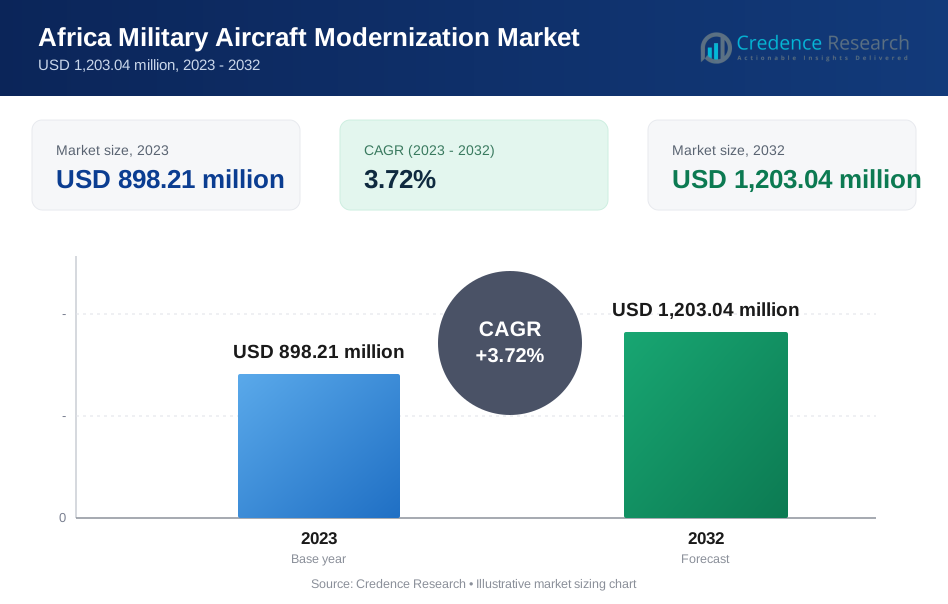
The Africa Military Aircraft Modernization Market is projected to grow from USD 898.21 million in 2023 to USD 1,203.04 million by 2032, at a compound annual growth rate (CAGR) of 3.72%.
The Africa Military Aircraft Modernization market is driven by increasing defense budgets and the need to enhance military capabilities across the continent. Governments are prioritizing the upgrade of aging aircraft fleets to improve operational efficiency and combat readiness. The rising security concerns, including terrorism and regional conflicts, further fuel the demand for advanced military aircraft. Additionally, the growing focus on technological advancements, such as stealth capabilities, improved avionics, and multi-role functionalities, is reshaping the landscape. Another significant trend is the shift towards joint ventures and partnerships with international defense manufacturers to acquire state-of-the-art aircraft and technologies. As countries strive to modernize their forces, collaborations with global aerospace companies are expected to increase, accelerating the adoption of cutting-edge military aircraft. This modernization trend, alongside escalating defense spending, will continue to drive market growth in the coming years.
The Africa Military Aircraft Modernization market is primarily driven by key players across various regions, with significant activities concentrated in North Africa, West Africa, and Sub-Saharan Africa. Leading defense companies like Paramount Group, Denel Aeronautics, Saab South Africa, and Embraer Africa play a crucial role in providing advanced technologies and modernization solutions. Additionally, global giants such as Lockheed Martin, Boeing, and Airbus Defence and Space are heavily involved in the region, offering cutting-edge aircraft and system upgrades. These companies focus on enhancing capabilities across fighter jets, transport aircraft, helicopters, and special mission platforms, addressing regional security concerns such as terrorism and political instability. With increasing collaboration between African governments and international defense contractors, the market is witnessing a rise in defense infrastructure development, aiming to build self-sufficiency and improve operational efficiency. Key players continue to provide technological advancements, contributing to the modernization of military aircraft in Africa.
Market Insights
- The Africa Military Aircraft Modernization market is valued at USD 898.21 million in 2023 and is expected to grow at a CAGR of 3.72%, reaching USD 1,203.04 million by 2032.
- Increasing regional security threats and geopolitical instability are driving the demand for advanced military aircraft and upgrades.
- Technological advancements in avionics, weapon systems, and engine upgrades are major trends shaping the market.
- Key players like Paramount Group, Denel Aeronautics, and Saab South Africa are actively contributing to the modernization efforts across Africa.
- Despite growth, financial constraints and budget limitations hinder the full-scale implementation of modernization projects in several countries.
- North Africa and West Africa lead the market in terms of investment and modernization initiatives, particularly in Egypt, Algeria, and Nigeria.
- Sub-Saharan Africa is expected to see increasing investments in military aircraft modernization as security challenges grow, especially in countries like South Africa and Kenya.
Market Drivers
Increasing Defense Budgets
A key driver of Africa's Military Aircraft Modernization is the significant rise in defense spending across the continent. For instance, as geopolitical tensions and regional conflicts escalate, many African nations are prioritizing the strengthening of their military capabilities. Modernizing military aircraft fleets is viewed as a crucial investment to enhance national security and ensure the ability to respond swiftly to emerging threats. Increased defense budgets provide the necessary financial resources for upgrading outdated aircraft, enabling armed forces to adopt advanced technologies and improve operational efficiency.
Rising Security Threats and Conflicts
The growing threat of terrorism, insurgencies, and regional conflicts across Africa has intensified the need for modern military aircraft. For instance, countries are increasingly investing in air assets capable of handling a variety of missions, such as surveillance, combat operations, and humanitarian aid delivery. The complex security landscape, marked by ongoing conflicts in regions like the Sahel, the Horn of Africa, and Central Africa, is driving the demand for advanced military aircraft that can effectively address both traditional and asymmetrical warfare scenarios.
Technological Advancements in Aviation
Technological advancements are another driving factor for military aircraft modernization in Africa. The integration of next-generation technologies, including advanced avionics, improved propulsion systems, and stealth capabilities, is transforming military aviation. These innovations allow for enhanced performance, improved fuel efficiency, and superior operational capabilities, which are crucial for air superiority. African nations are increasingly seeking aircraft equipped with cutting-edge technologies to meet the demands of modern warfare and ensure their air forces remain competitive in the evolving defense landscape.
International Collaborations and Partnerships
Collaborations between African countries and international defense manufacturers are accelerating the modernization of military aircraft fleets. Many African nations are entering joint ventures and partnerships with global aerospace companies to acquire advanced military aircraft and upgrade their existing fleets. These collaborations provide access to specialized knowledge, technology transfer, and cost-effective solutions. As defense budgets grow and modernization efforts expand, partnerships with international players are expected to play a pivotal role in facilitating the region's military aircraft upgrades, ensuring access to the latest technologies and maintaining operational readiness.
Market Trends
Shift Towards Multi-Role Aircraft
One of the prominent trends in Africa's Military Aircraft Modernization is the increasing demand for multi-role aircraft. For instance, South Africa-based Paramount Aerospace Industries has secured multiple orders for its Mwari multi-role aircraft, which is capable of performing a variety of missions, including surveillance, combat, and transport. As African nations seek to optimize their defense capabilities, the adoption of multi-role aircraft provides flexibility and cost-efficiency. This trend is particularly beneficial for countries with limited defense budgets, as multi-role aircraft can serve a wide range of functions, reducing the need for specialized aircraft for each task.
Emphasis on Advanced Avionics and Digitalization
Another significant trend in military aircraft modernization is the integration of advanced avionics and digital systems. Modern avionics enable improved situational awareness, enhanced navigation, and more effective communication during operations. African nations are increasingly focusing on upgrading aircraft with cutting-edge digital technologies, such as automated flight systems and advanced radar, to improve operational efficiency and combat effectiveness. This shift towards digitalization ensures that African air forces can compete in a technologically advanced defense environment, enhancing their ability to respond to emerging threats and complex security challenges.
Increased Focus on Stealth and Countermeasures
As military technology evolves, African nations are increasingly emphasizing stealth capabilities and countermeasures in their aircraft modernization efforts. Stealth features, such as reduced radar signatures and advanced coatings, enhance the survivability of aircraft in contested environments. Additionally, the integration of advanced electronic warfare systems and countermeasures is becoming more prevalent, allowing aircraft to effectively neutralize enemy threats, including surface-to-air missiles and advanced radar systems. These trends reflect a broader focus on enhancing the survivability and effectiveness of military aircraft in hostile airspaces.
Growing Role of Indigenous Manufacturing
There is a growing trend towards the development of indigenous military aircraft manufacturing capabilities in Africa. Several African nations are focusing on building domestic defense industries to reduce reliance on foreign suppliers and enhance self-sufficiency. This trend is driven by the desire to reduce costs, foster economic growth, and ensure greater control over defense technology. By investing in local aerospace capabilities, African countries aim to develop aircraft that are tailored to their specific needs while also creating jobs and building long-term industrial expertise.
Market Challenges Analysis
Financial Constraints and Budget Limitations
One of the primary challenges facing Africa's Military Aircraft Modernization is financial constraints. For instance, Ghana's Air Force modernization plans have been hindered by funding issues and the impact of sanctions on Russia, which disrupted the supply chain for spare parts. Many African nations face budgetary limitations that make it difficult to allocate sufficient funds for comprehensive modernization programs. Although defense budgets are rising, they are often insufficient to fully modernize aging aircraft fleets or acquire advanced, high-cost military aircraft. The financial burden of maintaining and upgrading fleets, coupled with other competing national priorities, poses a significant obstacle. This challenge is especially pronounced in countries with fragile economies or those affected by ongoing conflict, where defense spending must be balanced with urgent socio-economic needs. As a result, military modernization efforts are often slow-paced and require innovative solutions, such as partnerships or international assistance, to overcome financial limitations.
Technological Gaps and Dependency on Foreign Suppliers
Another challenge is the technological gap that many African countries face in terms of military aircraft capabilities. While global aerospace technology is advancing rapidly, African nations often struggle to access the latest technologies or develop domestic solutions due to a lack of technical expertise, infrastructure, and resources. Many African countries rely heavily on foreign suppliers for the acquisition of military aircraft and associated technologies, which can lead to delays, high costs, and dependence on external governments and corporations. This dependency also poses risks in terms of geopolitical factors, such as shifting alliances or changes in export regulations. Overcoming this challenge requires a focus on technological transfer, capacity building, and long-term partnerships that enable African nations to reduce reliance on foreign sources and gradually build their own indigenous defense capabilities.
Market Opportunities
Expansion of Defense Cooperation and Partnerships
Africa's Military Aircraft Modernization presents significant opportunities for expansion through international defense cooperation and strategic partnerships. Many African nations are seeking to collaborate with global aerospace manufacturers, defense contractors, and allied nations to modernize their fleets. These partnerships open doors for access to advanced technologies, knowledge transfer, and cost-effective solutions. Additionally, partnerships with global defense players provide opportunities for joint ventures and co-production agreements, allowing African nations to reduce reliance on foreign suppliers and build their own domestic defense industries. This trend not only supports aircraft modernization but also fosters economic growth, technological development, and industrial capabilities within the region.
Development of Indigenous Aerospace Capabilities
Another promising opportunity lies in the development of indigenous aerospace manufacturing capabilities. Several African nations are investing in local defense industries to produce advanced military aircraft and components, aiming to reduce dependence on external suppliers. This focus on self-reliance creates opportunities for the growth of local manufacturers and aerospace technology providers, boosting regional economies and creating job opportunities. By fostering domestic production and technological expertise, African countries can achieve more sustainable modernization efforts, tailor solutions to their specific needs, and gain greater control over their military assets. As defense budgets increase and technological expertise develops, the growth of indigenous defense industries will play a critical role in enhancing Africa's overall defense capabilities.
Market Segmentation Analysis:
By Type:
The Africa Military Aircraft Modernization market is segmented by aircraft type, with key categories including fighter aircraft, transport aircraft, helicopters, and special mission aircraft. Fighter aircraft are a crucial component of modernization efforts, as many African nations are prioritizing the enhancement of their air defense capabilities. Transport aircraft modernization focuses on improving logistical efficiency, with upgrades aimed at boosting payload capacity and range. Helicopters play an essential role in tactical operations, and modernization efforts are enhancing their versatility for missions such as surveillance, reconnaissance, and troop transport. Special mission aircraft, including surveillance and reconnaissance platforms, are being upgraded to improve their effectiveness in counter-terrorism and peacekeeping operations. Each aircraft type requires tailored upgrades to meet specific operational needs and enhance overall mission effectiveness.
By Modernization:
The market is also segmented based on the types of modernization applied to military aircraft, including avionics upgrades, engine improvements, structural modifications, and weapon system enhancements. Avionics upgrades are crucial for improving navigation, communication, and surveillance systems, ensuring that aircraft can operate effectively in complex environments. Engine upgrades focus on enhancing fuel efficiency, performance, and overall reliability, extending the life of aircraft fleets. Structural modifications are essential for ensuring the aircraft's durability and optimizing its design for modern operational needs. Weapon system upgrades are increasingly important, enabling military aircraft to deploy more advanced and precise weaponry, improving their combat effectiveness. These modernization efforts are essential for African nations looking to enhance their military aircraft capabilities and maintain air superiority in a rapidly evolving defense landscape.
Segments:
Based on Type:
- Fighter Aircraft
- Transport Aircraft
- Helicopters
- Special Mission Aircraft
Based on Modernization:
- Avionics
- Engine Upgrades
- Structural Modifications
- Weapon System Upgrades
Based on Component:
- Software
- Hardware
Based on the Geography:
- Egypt
- Nigeria
- Algeria
- Morocco
- Rest of Africa
Regional Analysis
North Africa
North Africa holds a dominant share of the Africa Military Aircraft Modernization market, accounting for approximately 35% of the total market in 2023. This is largely due to countries like Egypt, Algeria, and Morocco, which are heavily investing in military modernization programs. Egypt, in particular, has a substantial budget allocated to upgrading its air force with advanced fighter jets, enhanced avionics, and improved weapon systems. Algeria is also making significant strides in upgrading its air defense systems and acquiring multi-role aircraft, while Morocco is modernizing its fleet to improve defense readiness and operational efficiency. With these nations driving much of the market growth, North Africa remains a central hub of military aircraft modernization in Africa.
West Africa
West Africa, led by Nigeria, captures around 20% of the market share in 2023. Nigeria's significant investments in upgrading its military aircraft fleet are aimed at bolstering its counter-insurgency capabilities, improving airlift capacity, and enhancing surveillance. Nigeria's focus on modernizing transport aircraft, fighter jets, and reconnaissance platforms contributes to the region’s strong market presence. While Nigeria remains the dominant player in West Africa, other countries in the region are also considering aircraft modernization to address increasing security threats, further contributing to the market share growth in this region.
North-West Africa
North-West Africa holds approximately 15% of the market share in the Africa Military Aircraft Modernization market. Algeria and Morocco are the leading countries driving this segment, with both nations significantly investing in military aircraft upgrades. Algeria is focused on enhancing its air force with advanced avionics, multi-role fighter aircraft, and improved weapon systems, while Morocco is prioritizing modernization efforts to ensure air superiority. The strategic investments made by these countries are expected to further expand North-West Africa's market share, as regional security concerns continue to escalate, requiring stronger and more capable air forces.
Sub-Saharan Africa
Sub-Saharan Africa, under the "Rest of Africa" segment, currently holds approximately 30% of the Africa Military Aircraft Modernization market. This region includes a diverse range of countries, from South Africa to Kenya, all of which are making efforts to modernize their military air fleets. While individual nations may have smaller defense budgets, the cumulative efforts of countries in the region to upgrade their aircraft and expand defense capabilities contribute to the region's overall market share. As regional security challenges such as terrorism and instability increase, Sub-Saharan Africa's market share is expected to rise in the coming years.
Key Player Analysis
- Paramount Group
- Denel Aeronautics
- Saab South Africa
- Airbus Defence and Space (regional presence)
- Embraer Africa
- Lockheed Martin Africa
- Boeing Africa
- Thales Group Africa
- Dassault Aviation Africa
- Turkish Aerospace Industries (regional operations)
Competitive Analysis
The Africa Military Aircraft Modernization market is highly competitive, with several prominent global and regional players leading the way in providing advanced technologies and upgrading military aircraft fleets. For instance, Paramount Group has been actively involved in upgrading various types of aircraft, including fighter jets and helicopters, to address the specific security challenges of African nations. Key players in the market include Paramount Group, Denel Aeronautics, Saab South Africa, Airbus Defence and Space, Embraer Africa, Lockheed Martin Africa, Boeing Africa, Thales Group Africa, Dassault Aviation Africa, and Turkish Aerospace Industries. Companies compete by offering tailored solutions to address the specific security challenges of African nations, focusing on upgrading various types of aircraft, including fighter jets, transport aircraft, helicopters, and special mission platforms. The competitive landscape is shaped by the increasing need for advanced avionics, engine upgrades, and weapon system enhancements that can improve the operational effectiveness of military fleets. Companies that provide cost-effective, reliable, and technologically advanced solutions gain a competitive edge. In addition, there is a rising demand for integrated defense systems that offer more efficient management of military operations. As African governments continue to prioritize national security and invest in their military capabilities, the market sees an increase in collaborations between local and international firms. These collaborations aim to deliver both technological advancements and affordability, which are crucial for addressing the diverse and evolving security needs of the region.
Recent Developments
- In January 2025, Lockheed Martin delivered 110 F-35 fighter jets to the U.S. and its allies in 2024, achieving a target set by CEO Jim Taiclet. This delivery is part of the ongoing modernization under the Technology Refresh 3 (TR-3) program, enhancing the jets' displays and processing power.
- In January 2025, Northrop Grumman was awarded a $3.5 billion contract by the U.S. Navy to develop the E-130J aircraft, which will replace the E-6B Mercury for nuclear command, control, and communications missions. This project is crucial for maintaining the U.S. nuclear deterrent capabilities.
- In December 2024, Lockheed Martin demonstrated an uncrewed capability with a surrogate HIMARS launcher, marking significant progress in developing autonomous systems that can operate alongside manned vehicles. This technology aims to enhance artillery capabilities for the U.S. Army.
- In December 2024, Saab received an order valued at SEK 466 million from the Swedish Defence Materiel Administration for enhancements to the Gripen C/D, focusing on integrating advanced missile systems to improve operational capabilities.
- In August 2024, Boeing delivered the first MH-139A Grey Wolf production aircraft to the U.S. Air Force as part of a modernization initiative aimed at supporting national security and enhancing capabilities within the U.S. nuclear triad. The aircraft features improved speed, range, and operational flexibility.
Market Concentration & Characteristics
The market concentration of Africa’s Military Aircraft Modernization sector is moderately concentrated, with a mix of regional players and global defense contractors vying for market share. While local companies in various African nations focus on offering tailored solutions and localized support, international defense giants dominate the technology and expertise aspect of the market. This duality creates a competitive landscape where local firms often form strategic partnerships with global players to leverage advanced technologies while maintaining cost-effectiveness. The characteristics of the market are shaped by Africa’s unique security concerns, including geopolitical instability, terrorism, and civil unrest, which drive the demand for advanced military aircraft and modernization services. The market is characterized by a steady increase in demand for upgrades to fighter jets, transport aircraft, and specialized platforms. Furthermore, the modernization efforts are influenced by limited budgets, which means countries seek cost-effective solutions without compromising technological advancement. This has led to a growing focus on long-term, sustainable defense solutions, including avionics upgrades, engine improvements, and advanced weapon systems. The market also sees a trend toward joint ventures and collaborations, allowing African nations to improve their defense capabilities while accessing high-end technologies. As a result, the market is evolving to become more diversified, with both local and international firms contributing to the modernization process.
Report Coverage
The research report offers an in-depth analysis based on Type, Modernization, Component and Geography. It details leading market players, providing an overview of their business, product offerings, investments, revenue streams, and key applications. Additionally, the report includes insights into the competitive environment, SWOT analysis, current market trends, as well as the primary drivers and constraints. Furthermore, it discusses various factors that have driven market expansion in recent years. The report also explores market dynamics, regulatory scenarios, and technological advancements that are shaping the industry. It assesses the impact of external factors and global economic changes on market growth. Lastly, it provides strategic recommendations for new entrants and established companies to navigate the complexities of the market.
Future Outlook
- African nations will continue to invest in military modernization as a response to evolving security threats, including terrorism and political instability.
- The focus on upgrading and expanding air forces will enhance regional defense coordination and collaboration.
- Aircraft fleet upgrades will incorporate more advanced technologies, increasing the range, speed, and capabilities of military aircraft.
- The market will see growing demand for multi-role aircraft capable of performing various missions, enhancing operational flexibility.
- International partnerships will grow, with foreign defense companies offering expertise, while local firms provide support and integration.
- Increased government spending on defense will enable more robust aircraft procurement and modernization programs.
- The region’s military modernization efforts will be aligned with broader geopolitical strategies to maintain national security and regional stability.
- Emerging technologies like artificial intelligence, autonomous systems, and advanced radar will be incorporated into modernized aircraft.
- African nations will increasingly prioritize upgrading aircraft for peacekeeping missions, humanitarian aid, and disaster response.
- The rising demand for advanced military technologies will drive innovation and competition among global and regional aerospace companies.
Request a Free Sample
Fill in your details and we'll send you a free sample report.
- Sample data tables & charts
- Research methodology
Market Dynamics
Increasing Defense Budgets
African nations are raising defense spending to address escalating security threats and regional instability, enabling greater investment in modernizing aging military aircraft fleets and adopting advanced technologies.
Rising Security Threats and Conflicts
Persistent terrorism, insurgencies, and regional conflicts across Africa are compelling governments to upgrade their air forces with advanced aircraft and systems to enhance operational readiness and national security.
Technological Advancements in Aviation
The adoption of next-generation avionics, stealth features, and improved propulsion systems is driving modernization, as African militaries seek to match global standards and improve mission effectiveness.
International Collaborations and Partnerships
Joint ventures and partnerships with global aerospace companies provide African nations with access to state-of-the-art aircraft, technology transfer, and cost-effective modernization solutions, accelerating fleet upgrades.
Development of Indigenous Aerospace Capabilities
Efforts to build local manufacturing and maintenance capabilities are reducing reliance on foreign suppliers, fostering economic growth, and enabling more sustainable and tailored modernization programs.
Need a Custom Version of This Report?
Tailor the scope, geography, or segments to your exact requirements.
- Custom geography or segment scope
- Direct access to our analyst team
Frequently Asked Questions
What is the current size of the Africa Military Aircraft Modernization Market?
What factors are driving the growth of the Africa Military Aircraft Modernization Market?
What are the key segments within the Africa Military Aircraft Modernization Market?
What are some challenges faced by the Africa Military Aircraft Modernization Market?
Who are the major players in the Africa Military Aircraft Modernization Market?
Table of Content
Chapter 1 Market Segmentation
- 1.1 Segmentation Framework
- 1.1.1 Product and Service Classification
- 1.1.2 Application and End-Use Classification
- 1.1.3 Technology and Solution Classification
- 1.1.4 Customer and Distribution Channel Classification
- 1.1.5 Geographic Segmentation
- 1.1.6 Market Segment Definitions and Boundaries
- 1.2 By Type
- 1.2.1 Fighter Aircraft
- 1.2.2 Transport Aircraft
- 1.2.3 Helicopters
- 1.2.4 Special Mission Aircraft
- 1.3 By Component
- 1.3.1 Software
- 1.3.2 Hardware
- 1.4 By Modernization
- 1.4.1 Avionics
- 1.4.2 Engine Upgrades
- 1.4.3 Structural Modifications
- 1.4.4 Weapon System Upgrades
Chapter 2 Introduction
- 2.1 Report Objectives and Scope
- 2.2 Product Definition and Industry Terminology
- 2.3 Market Inclusions and Exclusions
- 2.4 Research Process
- 2.4.1 Primary Research and Expert Interviews
- 2.4.2 Secondary Research and Source Review
- 2.4.3 Top-Down and Bottom-Up Estimation
- 2.4.4 Data Triangulation and Verification
- 2.5 Market Size Measurement Basis
- 2.5.1 2023: USD 898.21 million → 2032: USD 1,203.04 million
- 2.6 Historical and Forecast Reference Periods
- 2.6.1 Base Year: 2023
- 2.6.2 Forecast Period: 2023-2032
- 2.7 Research Assumptions and Limitations
Chapter 3 Executive Summary
- 3.1 Market Snapshot and Key Findings
- 3.2 Base-Year Market Size, 2023
- 3.3 Forecast Market Size, 2032
- 3.4 Revenue and Volume Growth Outlook
- 3.5 Key Demand and Supply Indicators
- 3.6 Leading Market Segments
- 3.7 Fastest-Growing Market Opportunities
- 3.8 Regional Performance Highlights
- 3.9 Technology and Industry Transformation
- 3.10 Competitive Landscape Summary
- 3.11 Analyst View and Strategic Implications
Chapter 4 Africa Military Aircraft Modernization Market Trends and Developments
- 4.1 Historical Industry Development
- 4.2 Recent Market Trends and Developments
- 4.3 Demand and Customer Behavior Trends
- 4.4 Technology and Product Innovation
- 4.5 Artificial Intelligence, Automation and Digitalization
- 4.6 Local Manufacturing and Supply Chain Realignment
- 4.7 Industry Partnerships, Mergers and Acquisitions
- 4.8 Sustainability and Circular Economy Developments
- 4.9 Government and Private Sector Investment Trends
- 4.10 Emerging Business Models and Commercialization
- 4.11 Industry Developments and Announcements
Chapter 5 Africa Military Aircraft Modernization Market Production, Supply and Demand Analysis
- 5.1 Demand Trend and Consumption Analysis
- 5.2 Demand Forecast, 2023-2032
- 5.3 Production and Output Trend
- 5.4 Production and Output Forecast, 2023-2032
- 5.5 Installed Capacity and Capacity Utilization
- 5.6 Company-Wise Production Plants and Statistics
- 5.6.1 Installed Production Capacity
- 5.6.2 Actual Production
- 5.6.3 Planned Capacity and Expansion Targets
- 5.7 Supply Chain Structure and Procurement Trends
- 5.8 Supply-Demand Gap and Bottlenecks
- 5.9 Import Dependence and Sourcing Structure
- 5.10 Contract Manufacturing and Outsourcing
- 5.11 Regional Supply and Demand Concentration
Chapter 6 Africa Military Aircraft Modernization Market Pricing Analysis
- 6.1 Pricing Structure and Measurement
- 6.2 Historical Pricing Trends
- 6.3 Pricing Outlook, 2023-2032
- 6.4 Average Selling Price and Unit Economics
- 6.5 Pricing by Product and Market Segment
- 6.6 Geographic Pricing Differences
- 6.7 Key Input, Energy, Labor and Logistics Costs
- 6.8 Contract Pricing and Purchasing Models
- 6.9 Pricing Sensitivity and Competitive Positioning
- 6.10 Price, Margin and Profitability Implications
Chapter 7 Africa Military Aircraft Modernization Market Dynamics
- 7.1 Market Growth Drivers
- 7.1.1 Demand-Side Drivers
- 7.1.2 Technology and Innovation Drivers
- 7.1.3 Infrastructure and Investment Drivers
- 7.1.4 Regulatory and Policy Drivers
- 7.2 Market Restraints
- 7.2.1 Cost and Affordability Constraints
- 7.2.2 Technology and Adoption Barriers
- 7.2.3 Supply Chain and Operational Constraints
- 7.3 Market Challenges
- 7.3.1 Competitive Pressure and Margin Erosion
- 7.3.2 Skills, Infrastructure and Implementation Gaps
- 7.4 Emerging Market Opportunities
- 7.5 Market Dynamics Impact and Time-Horizon Assessment
Chapter 8 Africa Military Aircraft Modernization Value Chain Analysis
- 8.1 Industry Value Chain Overview
- 8.2 Upstream Suppliers and Critical Inputs
- 8.3 Technology and Component Providers
- 8.4 Manufacturing or Service Delivery
- 8.5 Distribution, Channel Partners and Integrators
- 8.6 Downstream Applications and End Users
- 8.7 Value Addition and Profit Pools
- 8.8 Vertical Integration and Outsourcing
- 8.9 Supplier Concentration and Risk
- 8.10 Supply Chain Localization and Resilience
Chapter 9 Africa Military Aircraft Modernization Market Regulations and Policies
- 9.1 Relevant Laws, Standards and Compliance Frameworks
- 9.2 Product, Service, Safety and Quality Requirements
- 9.3 Government Policies, Incentives and Subsidies
- 9.4 Imports, Exports and Trade Barriers
- 9.5 Public Procurement and Local Content Requirements
- 9.6 Environmental and Sustainability Compliance
- 9.7 Upcoming Policy Changes and Market Implications
Chapter 10 Africa Military Aircraft Modernization Market Hotspots and Opportunities
- 10.1 Market Opportunity Mapping and Growth Hotspots
- 10.2 High-Growth Applications and Customer Groups
- 10.3 Underserved Markets and White-Space Opportunities
- 10.4 Emerging Technology and Product Opportunities
- 10.5 New Capacity and Investment Hotspots
- 10.6 Market Entry and Expansion Opportunities
- 10.7 Distribution and Partnership Opportunities
- 10.8 Near-Term and Long-Term Commercial Potential
- 10.9 Opportunity Attractiveness and Execution Risks
Chapter 11 Africa Military Aircraft Modernization Market Outlook, 2023-2032
- 11.1 Market Size and Analysis
- 11.1.1 Revenue (Market Measurement: 2023: USD 898.21 million → 2032: USD 1,203.04 million)
- 11.1.2 Market Volume and Quantity Sold
- 11.1.3 Historical Market Size
- 11.1.4 Base-Year Market Size, 2023
- 11.2 Market Forecast, 2023-2032
- 11.2.1 Revenue Forecast to 2032
- 11.2.2 Volume Forecast to 2032
- 11.2.3 CAGR and Year-on-Year Growth
- 11.2.4 Incremental Revenue Opportunity
- 11.3 Forecast Assumptions and Scenario Analysis
- 11.3.1 Base-Case Forecast
- 11.3.2 Optimistic and Conservative Scenarios
- 11.3.3 Technology, Pricing and Policy Sensitivities
- 11.4 Market Attractiveness and Growth Outlook
Chapter 12 Africa Military Aircraft Modernization Market Segmentation and Outlook
- 12.1 Segmentation Summary and Market Shares, 2023
- 12.2 Largest and Fastest-Growing Segments
- 12.3 By Type - Market Size and Forecast, 2023-2032
- 12.3.1 Segment Definition and Scope
- 12.3.2 Historical Market Size
- 12.3.3 Revenue Forecast, 2023-2032
- 12.3.4 Volume Forecast, 2023-2032
- 12.3.5 Base-Year Market Share, 2023
- 12.3.6 Segment CAGR and Growth Drivers
- 12.3.7 Subsegment Market Size and Forecast
- 12.3.7.1 Fighter Aircraft
- 12.3.7.2 Transport Aircraft
- 12.3.7.3 Helicopters
- 12.3.7.4 Special Mission Aircraft
- 12.3.8 Subsegment Pricing and Adoption Trends
- 12.3.9 Leading Suppliers and Competition
- 12.3.10 Regional Demand and Opportunities
- 12.4 By Component - Market Size and Forecast, 2023-2032
- 12.4.1 Segment Definition and Scope
- 12.4.2 Historical Market Size
- 12.4.3 Revenue Forecast, 2023-2032
- 12.4.4 Volume Forecast, 2023-2032
- 12.4.5 Base-Year Market Share, 2023
- 12.4.6 Segment CAGR and Growth Drivers
- 12.4.7 Subsegment Market Size and Forecast
- 12.4.7.1 Software
- 12.4.7.2 Hardware
- 12.4.8 Subsegment Pricing and Adoption Trends
- 12.4.9 Leading Suppliers and Competition
- 12.4.10 Regional Demand and Opportunities
- 12.5 By Modernization - Market Size and Forecast, 2023-2032
- 12.5.1 Segment Definition and Scope
- 12.5.2 Historical Market Size
- 12.5.3 Revenue Forecast, 2023-2032
- 12.5.4 Volume Forecast, 2023-2032
- 12.5.5 Base-Year Market Share, 2023
- 12.5.6 Segment CAGR and Growth Drivers
- 12.5.7 Subsegment Market Size and Forecast
- 12.5.7.1 Avionics
- 12.5.7.2 Engine Upgrades
- 12.5.7.3 Structural Modifications
- 12.5.7.4 Weapon System Upgrades
- 12.5.8 Subsegment Pricing and Adoption Trends
- 12.5.9 Leading Suppliers and Competition
- 12.5.10 Regional Demand and Opportunities
- 12.6 Segment Growth Comparison
- 12.7 Segment Attractiveness and Priority Matrix
Chapter 13 Africa Military Aircraft Modernization Geographic Market Outlook, 2023-2032
- 13.1 Regional Market Size and Country-Level Shares, 2023
- 13.2 Country Market Size Comparison, 2023
- 13.3 Country Market Forecasts, 2023-2032
- 13.4 Subregional Industrial and Demand Clusters
- 13.5 Intra-Regional Pricing and Cost Differences
- 13.6 Cross-Border Trade and Supply Networks
- 13.7 Regional Supply and Demand Balances
- 13.8 Country Opportunity Comparison and Prioritization
Note: Every listed country is covered on the structure shown under the first country.
Chapter 14 Africa Military Aircraft Modernization Technology, Innovation and Sustainability Outlook
- 14.1 Technology Landscape and Maturity
- 14.2 Product, Process and Service Innovation
- 14.3 AI, Automation and Digital Tools in the Industry
- 14.4 Technology Adoption and Performance Benchmarking
- 14.5 Innovation Pipeline and R&D Investment
- 14.6 Patent and Intellectual Property Trends
- 14.7 Energy Efficiency and Resource Management
- 14.8 Sustainability, Recycling and Circularity
- 14.9 Technology Roadmap, 2023-2032
- 14.10 Risks of Obsolescence and Technology Substitution
Chapter 15 Africa Military Aircraft Modernization Market Key Strategic Imperatives
- 15.1 Growth and Market Entry Priorities
- 15.2 High-Return Products and Segments
- 15.3 Pricing, Profitability and Cost Optimization
- 15.4 Technology Investment and Product Differentiation
- 15.5 Supply Chain Localization and Resilience
- 15.6 Distribution and Customer Acquisition
- 15.7 Partnership, Acquisition and Capacity Strategy
- 15.8 Regional Expansion Priorities
- 15.9 Short-, Medium- and Long-Term Actions
Chapter 16 Competition Outlook
- 16.1 Industry Competition Characteristics
- 16.2 Market Structure and Concentration
- 16.3 Market Share and Competitive Positioning, 2023
- 16.4 Company-Wise Revenue and Product Benchmarking
- 16.5 Production and Service Capacity Benchmarking
- 16.6 Technology, Pricing and Differentiation
- 16.7 Regional Footprint and Distribution Strength
- 16.8 Mergers, Acquisitions and Strategic Alliances
- 16.9 New Entrants and Competitive Threats
- 16.10 Porter's Five Forces and Industry Attractiveness
- 16.11 Competitive Outlook, 2023-2032
Chapter 17 Company Profiles
- 17.1 Company Coverage and Selection Criteria
- 17.2 Paramount Group
- 17.2.1 Business Description
- 17.2.2 Company Ownership and Geographic Presence
- 17.2.3 Product and Service Portfolio
- 17.2.4 Manufacturing and Operating Footprint
- 17.2.5 Production Capacity and Expansion Plans
- 17.2.6 Financial Performance and Investment
- 17.2.7 Market Share and Competitive Position
- 17.2.8 Technology and Innovation Capabilities
- 17.2.9 Strategic Alliances or Partnerships
- 17.2.10 Recent Developments
- 17.2.11 Growth Strategy and Outlook
- 17.3 Denel Aeronautics
- 17.4 Saab South Africa
- 17.5 Airbus Defence and Space
- 17.6 Embraer Africa
- 17.7 Lockheed Martin Africa
- 17.8 Boeing Africa
- 17.9 Thales Group Africa
- 17.10 Dassault Aviation Africa
- 17.11 Turkish Aerospace Industries
- 17.12 Other Relevant Market Participants
Note: Every listed company is profiled on the structure shown under the first company. The company list is preliminary and may change based on research findings, market developments, data availability and client requirements.
Chapter 18 Disclaimer
- 18.1 Research and Forecast Disclaimer
- 18.2 Data Source and Estimation Limitations
Note: The depth of individual sections depends on data availability for this market. Volume, capacity, trade and other unit-based metrics are included where applicable.

