Market Overview
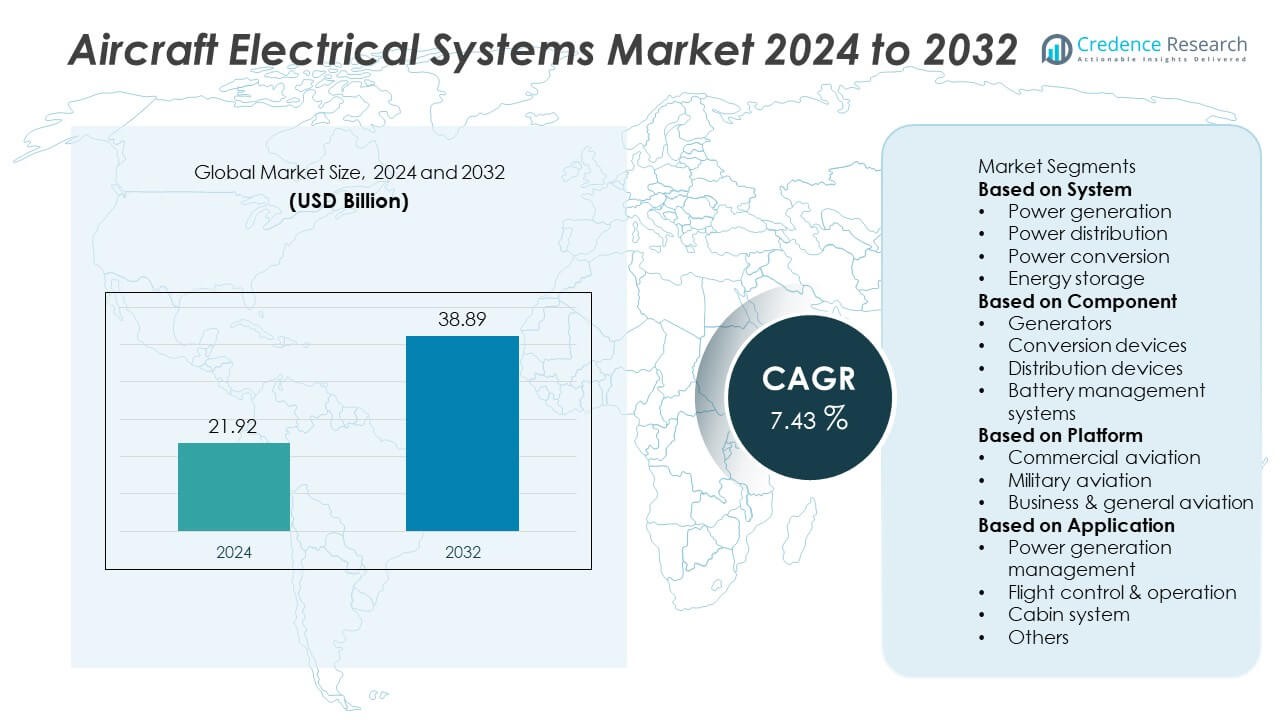
The Aircraft Electrical Systems market reached USD 21.92 billion in 2024 and is projected to reach USD 38.89 billion by 2032, expanding at a 7.43% CAGR during the forecast period.
| REPORT ATTRIBUTE | DETAILS |
|---|---|
| Historical Period | 2020-2023 |
| Base Year | 2024 |
| Forecast Period | 2025-2032 |
| Aircraft Electrical Systems Market Size 2024 | USD 21.92 Billion |
| Aircraft Electrical Systems Market, CAGR | 7.43% |
| Aircraft Electrical Systems Market Size 2032 | USD 38.89 Billion |
Top players in the Aircraft Electrical Systems market include GE Aviation, Astronics, Amphenol, Nabtesco, Honeywell, BAE Systems, Meggitt, Ametek, Crane Aerospace & Electronics, and Avionic Instruments. These companies drive industry growth by supplying advanced power generation units, high-voltage distribution systems, conversion devices, and energy storage solutions for modern commercial, military, and business aircraft. Their focus on lightweight architectures, digital power management, and improved thermal efficiency supports the global shift toward more-electric and hybrid-electric platforms. Regionally, North America leads the market with a 37% share due to strong aircraft production and defense investments. Europe follows with a 29% share, supported by major OEM presence, while Asia-Pacific holds 26%, driven by expanding fleets and rising air travel demand.
Market Insights
- The Aircraft Electrical Systems market reached USD 21.92 billion in 2024 and will grow to USD 38.89 billion by 2032 at a 7.43% CAGR, supported by rising electrification across modern aircraft.
- Demand strengthens as power-generation systems, which hold a 41% segment share, support higher electrical loads driven by advanced avionics, digital cockpits, and onboard electronics.
- Trends center on high-voltage DC systems, smart power-distribution units, lightweight converters, and enhanced energy-storage technologies aligned with more-electric and hybrid-electric aircraft programs.
- Competition intensifies as major players focus on thermal-management innovation, modular electrical architectures, and certification-ready designs to meet increasing reliability and efficiency needs.
- Regionally, North America leads with 37%, followed by Europe at 29%, Asia-Pacific at 26%, Latin America at 5%, and the Middle East & Africa at 3%, reflecting strong global adoption across commercial, military, and general aviation fleets.
Market Segmentation Analysis:
By System
Power generation leads this segment with a 41% market share, driven by rising demand for advanced electrical power generation units in modern aircraft. The shift toward more-electric architectures increases the need for efficient generators that support avionics, flight controls, environmental systems, and onboard electronics. Airlines adopt high-capacity generation systems to reduce reliance on hydraulic and pneumatic systems, improving fuel efficiency and lowering maintenance needs. Power distribution grows steadily as aircraft integrate complex wiring networks and digital control units, while power conversion and energy storage gain traction with the development of hybrid-electric and next-generation aircraft platforms.
- For instance, Safran Electrical & Power developed the GENeUS™ 300 generator platform, which has a power output of 300 kW (approximately 375 kVA at 0.8 power factor), enabling higher electrical load support for large commercial jets and meeting new-generation power demands.
By Component
Generators dominate this segment with a 38% market share, supported by their essential role in supplying stable electrical power for propulsion, avionics, and cabin systems. Modern aircraft require high-output, lightweight, and reliable generators to meet rising electrical loads. Distribution devices grow with increased installation of smart power management units, circuit breakers, and digital monitoring systems. Power conversion devices gain traction as aircraft adopt variable frequency and high-voltage DC systems. Battery management systems expand as electric aircraft prototypes and auxiliary power upgrades drive demand for advanced energy storage technologies.
- For instance, GE Aviation’s variable-frequency starter-generator delivers 250 kVA output and reduces system weight by nearly 90 kg compared to legacy designs, enabling improved operational efficiency in advanced commercial aircraft.
By Platform
Commercial aviation holds a 54% market share, driven by high aircraft production rates, expanding passenger traffic, and continuous upgrades in electrical and avionics systems. Airlines prioritize efficient electrical architectures to reduce fuel consumption, support advanced cockpit technologies, and improve cabin comfort. Military aviation follows with advanced power systems used in combat aircraft, UAVs, and mission-critical platforms requiring high reliability and rugged performance. Business and general aviation show steady growth as modern jets integrate sophisticated electrical systems and lightweight power solutions to enhance safety, efficiency, and operational flexibility.
Key Growth Drivers
Rising Adoption of More-Electric and Hybrid-Electric Aircraft
The shift toward more-electric and hybrid-electric aircraft drives major growth in the Aircraft Electrical Systems market. Airlines and OEMs replace hydraulic and pneumatic systems with electrically powered components to improve fuel efficiency, reduce emissions, and lower maintenance costs. Modern aircraft require high-capacity generators, intelligent power distribution units, and lightweight conversion systems to support advanced avionics and flight-control functions. Growing interest in sustainable aviation and electrified propulsion accelerates technological upgrades. As manufacturers invest in next-generation aircraft programs, demand for reliable, high-output electrical architectures continues to rise worldwide.
- For instance, Airbus’ E-Fan X demonstrator featured a 2 MW electric motor and a 3,000 VDC electrical backbone, proving the feasibility of high-voltage propulsion systems for future hybrid-electric aircraft.
Increasing Demand for Advanced Avionics and Onboard Electronics
Rising use of digital cockpit systems, connectivity solutions, and passenger comfort electronics strengthens demand for high-performance electrical systems. Modern aircraft integrate sophisticated navigation, communication, and surveillance tools that require constant and stable electrical power. Airlines also add inflight entertainment, Wi-Fi, and power-supply ports, increasing electrical load requirements. Power generation and distribution systems become vital in maintaining aircraft safety and operational efficiency. Continuous upgrades in avionics for both commercial and military fleets further boost the need for advanced electrical components and architectures.
- For instance, Honeywell's Primus Epic avionics suite uses a software-based modular architecture within its Modular Avionics Units, requiring advanced electrical integration to maintain stable performance on commercial and defense aircraft.
Growing Aircraft Production and Fleet Modernization Programs
Fleet expansion in commercial aviation and modernization of aging aircraft drive strong demand for upgraded electrical systems. Airlines replace older aircraft with fuel-efficient models that rely heavily on digital power management. Military aviation also invests in next-generation fighter jets, UAVs, and surveillance aircraft requiring high-capacity electrical units. OEMs increase production rates to meet rising passenger traffic, especially in Asia-Pacific and the Middle East. These factors create sustained demand for generators, distribution equipment, conversion devices, and advanced energy storage systems across global fleets.
Key Trends & Opportunities
Shift Toward High-Voltage DC and Smart Power Distribution Systems
Aircraft increasingly adopt high-voltage DC systems to support higher electrical loads, reduce wiring complexity, and improve overall system efficiency. Smart power distribution units equipped with digital monitoring, fault detection, and automated load management gain strong traction. These systems enhance aircraft reliability and reduce maintenance downtime by identifying failures in real time. As electric propulsion technologies advance, opportunities emerge for integrating intelligent converters, solid-state circuit breakers, and lightweight wiring. This trend opens new paths for innovation across both commercial and defense aircraft programs.
- For instance, Collins Aerospace developed a 270 VDC power distribution system with solid-state switching capable of handling 15 kW per channel, enabling faster fault isolation and significantly improving load management for high-voltage aircraft architectures.
Advancements in Battery Technologies and Energy Storage Solutions
Energy storage becomes a key opportunity as aviation moves toward electric taxiing, emergency backup systems, and hybrid-electric propulsion. Lightweight lithium-ion, solid-state, and high-density battery systems gain attention for their ability to improve power availability and reduce fuel consumption. Improved battery management systems enhance safety, thermal performance, and energy efficiency. Manufacturers invest in advanced storage solutions that support future electric aircraft concepts. Growing R&D activity in aviation batteries creates long-term innovation opportunities for electrical system suppliers.
- For instance, Saft introduced a new aviation-grade lithium-ion battery pack with more than double the energy density of lead-acid counterparts and an integrated electronic management system designed to deliver stable performance across extreme temperature conditions for next-generation electric and hybrid aircraft platforms.
Key Challenges
High Integration Costs and Complex Certification Requirements
Aircraft electrical systems involve complex integration with avionics, propulsion, and safety-critical components, driving high development and installation costs. Strict aviation certification standards require extensive testing and validation, slowing adoption of new technologies. Retrofitting older aircraft with modern electrical architectures further increases cost and engineering challenges. OEMs and operators face financial burdens when upgrading systems, especially for large commercial fleets. These factors limit rapid modernization and affect adoption rates in cost-sensitive markets.
Thermal Management Issues and Increased Electrical Load
Rising electrical load from advanced avionics, entertainment systems, and electrified components increases heat generation, creating thermal management challenges. Overheating risks can impact system reliability and aircraft safety. High-density electrical units require enhanced cooling technologies, robust insulation, and heat-resistant materials, increasing design complexity. Managing power spikes, preventing electrical faults, and ensuring stable performance in extreme conditions remain critical issues. These challenges require continuous innovation in cooling systems, protective components, and power-management architectures.
Regional Analysis
North America
North America holds a 37% market share, driven by strong aircraft production, extensive fleet modernization programs, and widespread adoption of advanced avionics. Major OEMs and Tier-1 suppliers invest heavily in next-generation electrical architectures, including high-voltage systems and smart power distribution units. Commercial airlines upgrade electrical components to support connectivity, inflight entertainment, and enhanced cockpit systems. The U.S. military also accelerates procurement of advanced fighter jets and UAVs, boosting demand for high-performance electrical systems. Strong R&D spending, robust supply chains, and technological innovation continue to position the region as a leading market.
Europe
Europe accounts for a 29% market share, supported by the presence of major aircraft manufacturers, ongoing sustainability initiatives, and rising investment in more-electric aircraft programs. Airbus and regional aerospace suppliers prioritize lightweight electrical components and energy-efficient architectures across new models. European defense agencies enhance fleets with modern electrical systems for surveillance, transport, and combat aircraft. Strict environmental policies accelerate development of hybrid-electric and high-efficiency power systems. Growing demand for advanced avionics and digital cockpit upgrades further strengthens the market across Germany, France, the U.K., and Italy.
Asia-Pacific
Asia-Pacific holds a 26% market share, driven by rising air passenger traffic, expanding commercial fleets, and increasing investment in domestic aircraft production. China, India, Japan, and South Korea upgrade fleets with modern electrical systems to improve efficiency and meet safety standards. Regional carriers expand capacity, fueling demand for next-generation power generation, distribution, and conversion systems. Rapid urbanization and airport development support further growth. Defense modernization programs add to demand, particularly in combat aircraft and unmanned platforms. Strong manufacturing expansion and technology adoption continue to boost the regional market.
Latin America
Latin America captures a 5% market share, supported by steady growth in commercial aviation and increasing interest in fleet renewal programs. Airlines modernize electrical systems to improve efficiency, reduce operating costs, and support new avionics. Brazil and Mexico lead demand due to active participation in aerospace manufacturing and maintenance sectors. Budget constraints slow large-scale upgrades, yet regional carriers continue adopting advanced power systems for safety and performance improvements. Gradual defense investments in patrol and transport aircraft also contribute to market growth.
Middle East & Africa
The Middle East & Africa hold a 3% market share, driven by ongoing fleet expansion, rising air travel demand, and strong investments in premium aircraft by regional airlines. Gulf carriers prioritize advanced electrical systems to support connectivity, high-end cabin features, and fuel-efficient operations. Defense modernization programs in the UAE, Saudi Arabia, and South Africa boost adoption of high-capacity power systems. Growing airport infrastructure and new aviation projects contribute to market expansion. Despite economic challenges in parts of Africa, gradual improvements in aviation infrastructure support long-term growth.
Market Segmentations:
By System
- Power generation
- Power distribution
- Power conversion
- Energy storage
By Component
- Generators
- Conversion devices
- Distribution devices
- Battery management systems
By Platform
- Commercial aviation
- Military aviation
- Business & general aviation
By Application
- Power generation management
- Flight control & operation
- Cabin system
- Others
By Geography
- North America
- U.S.
- Canada
- Mexico
- Europe
- Germany
- France
- U.K.
- Italy
- Spain
- Rest of Europe
- Asia Pacific
- China
- Japan
- India
- South Korea
- South-east Asia
- Rest of Asia Pacific
- Latin America
- Brazil
- Argentina
- Rest of Latin America
- Middle East & Africa
- GCC Countries
- South Africa
- Rest of the Middle East and Africa
Competitive Landscape
Competitive landscape in the Aircraft Electrical Systems market features key players such as GE Aviation, Astronics, Amphenol, Nabtesco, Honeywell, BAE Systems, Meggitt, Ametek, Crane Aerospace & Electronics, and Avionic Instruments. These companies compete by developing advanced power generation units, smart distribution systems, high-efficiency converters, and reliable energy storage solutions tailored for modern aircraft platforms. The market emphasizes lightweight materials, higher voltage architectures, and enhanced thermal management to meet increasing electrical load demands. Vendors invest heavily in R&D to support more-electric and hybrid-electric aircraft programs. Strategic partnerships with OEMs and Tier-1 suppliers strengthen integration across commercial, military, and business aviation segments. Companies also focus on digital monitoring, predictive maintenance, and modular electrical components to improve aircraft reliability and reduce operational costs. As electrification accelerates, competition intensifies around innovation, certification compliance, and long-term support capabilities.
Key Player Analysis
- GE Aviation
- Astronics
- Amphenol
- Nabtesco
- Honeywell
- BAE Systems
- Meggitt
- Ametek
- Crane Aerospace & Electronics
- Avionic Instruments
Recent Developments
- In June 2025, BAE Systems plc published its vision for aircraft electrification, including integrated control systems and power conversion architectures supporting more-electric and hybrid-electric aircraft.
- In April 2024, Safran Electrical & Power launched GENeUSCONNECT, a new series of high-power electrical harnesses. These harnesses complement the company's existing electrical systems for next-generation all-electric and hybrid aircraft.
- In August 2023, Astronics Corporation accepted purchase orders from ten eVTOL aircraft OEMs for electrical power-distribution, conversion and vehicle charge-control systems for emerging urban air mobility.
Report Coverage
The research report offers an in-depth analysis based on System, Component, Platform, Application and Geography. It details leading market players, providing an overview of their business, product offerings, investments, revenue streams, and key applications. Additionally, the report includes insights into the competitive environment, SWOT analysis, current market trends, as well as the primary drivers and constraints. Furthermore, it discusses various factors that have driven market expansion in recent years. The report also explores market dynamics, regulatory scenarios, and technological advancements that are shaping the industry. It assesses the impact of external factors and global economic changes on market growth. Lastly, it provides strategic recommendations for new entrants and established companies to navigate the complexities of the market.
Future Outlook
- More-electric and hybrid-electric aircraft will accelerate demand for high-capacity electrical architectures.
- High-voltage DC systems will gain wider adoption to support increased onboard electrical loads.
- Lightweight generators and smart power-distribution units will become standard in new aircraft platforms.
- Advanced battery technologies will expand use in electric taxiing, backup power, and hybrid propulsion.
- Digital power-management systems will enhance efficiency, reliability, and predictive maintenance.
- Thermal-management innovations will improve safety and durability of high-density electrical components.
- UAVs and next-generation military aircraft will drive demand for rugged, high-performance electrical systems.
- Retrofit programs will rise as airlines upgrade aging fleets with modern electrical components.
- OEM partnerships will strengthen to support integrated electrical architectures across aircraft families.
- Sustainability goals will push manufacturers to adopt cleaner, lighter, and more efficient electrical technologies.

Request a Free Sample
Fill in your details and we'll send you a free sample report.
- Sample data tables & charts
- Research methodology
Market Dynamics
Rising Adoption of More-Electric and Hybrid-Electric Aircraft
The transition from hydraulic and pneumatic systems to electrically powered components in modern aircraft is driving demand for advanced electrical systems. This shift improves fuel efficiency, reduces emissions, and lowers maintenance costs, requiring high-capacity generators, intelligent power distribution, and lightweight conversion systems.
Increasing Demand for Advanced Avionics and Onboard Electronics
Modern aircraft are integrating sophisticated avionics, digital cockpits, and passenger electronics, all of which require stable and high-output electrical systems. The need to support connectivity, inflight entertainment, and advanced navigation tools is boosting the market for reliable power generation and distribution solutions.
Growing Aircraft Production and Fleet Modernization Programs
Expanding commercial fleets and the replacement of aging aircraft with newer, more efficient models are fueling demand for upgraded electrical systems. Both commercial and military sectors are investing in next-generation aircraft that rely heavily on digital power management and advanced electrical architectures.
Shift Toward High-Voltage DC and Smart Power Distribution Systems
The adoption of high-voltage DC systems and smart power distribution units is increasing to handle higher electrical loads and improve system efficiency. These innovations reduce wiring complexity, enhance fault detection, and support the electrification of propulsion and critical aircraft systems.
Advancements in Battery Technologies and Energy Storage Solutions
As aviation moves toward electric taxiing, hybrid propulsion, and enhanced backup systems, there is growing demand for lightweight, high-density batteries and advanced energy storage. Improved battery management systems are enabling safer, more efficient, and reliable electrical architectures for next-generation aircraft.
Need a Custom Version of This Report?
Tailor the scope, geography, or segments to your exact requirements.
- Custom geography or segment scope
- Direct access to our analyst team
Frequently Asked Questions
What is the current market size for Aircraft Electrical Systems market, and what is its projected size in 2032?
At what Compound Annual Growth Rate is the Aircraft Electrical Systems market projected to grow between 2025 and 2032?
Which Aircraft Electrical Systems market segment held the largest share in 2024?
What are the primary factors fueling the growth of the Aircraft Electrical Systems market?
Who are the leading companies in the Aircraft Electrical Systems market?
Which region commanded the largest share of the Aircraft Electrical Systems market in 2024?
Table of Content
Chapter 1 Market Segmentation
- 1.1 Segmentation Framework
- 1.1.1 Product and Service Classification
- 1.1.2 Application and End-Use Classification
- 1.1.3 Technology and Solution Classification
- 1.1.4 Customer and Distribution Channel Classification
- 1.1.5 Geographic Segmentation
- 1.1.6 Market Segment Definitions and Boundaries
- 1.2 By System
- 1.2.1 Power generation
- 1.2.2 Power distribution
- 1.2.3 Power conversion
- 1.2.4 Energy storage
- 1.3 By Platform
- 1.3.1 Commercial aviation
- 1.3.2 Military aviation
- 1.3.3 Business & general aviation
- 1.4 By Component
- 1.4.1 Generators
- 1.4.2 Conversion devices
- 1.4.3 Distribution devices
- 1.4.4 Battery management systems
- 1.5 By Application
- 1.5.1 Power generation management
- 1.5.2 Flight control & operation
- 1.5.3 Cabin system
- 1.5.4 Others
Chapter 2 Introduction
- 2.1 Report Objectives and Scope
- 2.2 Product Definition and Industry Terminology
- 2.3 Market Inclusions and Exclusions
- 2.4 Research Process
- 2.4.1 Primary Research and Expert Interviews
- 2.4.2 Secondary Research and Source Review
- 2.4.3 Top-Down and Bottom-Up Estimation
- 2.4.4 Data Triangulation and Verification
- 2.5 Market Size Measurement Basis
- 2.5.1 2024: USD 21.92 billion → 2032: USD 38.89 billion
- 2.6 Historical and Forecast Reference Periods
- 2.6.1 Base Year: 2024
- 2.6.2 Forecast Period: 2024-2032
- 2.7 Research Assumptions and Limitations
Chapter 3 Executive Summary
- 3.1 Market Snapshot and Key Findings
- 3.2 Base-Year Market Size, 2024
- 3.3 Forecast Market Size, 2032
- 3.4 Revenue and Volume Growth Outlook
- 3.5 Key Demand and Supply Indicators
- 3.6 Leading Market Segments
- 3.7 Fastest-Growing Market Opportunities
- 3.8 Regional Performance Highlights
- 3.9 Technology and Industry Transformation
- 3.10 Competitive Landscape Summary
- 3.11 Analyst View and Strategic Implications
Chapter 4 Global Aircraft Electrical Systems Market Trends and Developments
- 4.1 Historical Industry Development
- 4.2 Recent Market Trends and Developments
- 4.3 Demand and Customer Behavior Trends
- 4.4 Technology and Product Innovation
- 4.5 Artificial Intelligence, Automation and Digitalization
- 4.6 Local Manufacturing and Supply Chain Realignment
- 4.7 Industry Partnerships, Mergers and Acquisitions
- 4.8 Sustainability and Circular Economy Developments
- 4.9 Government and Private Sector Investment Trends
- 4.10 Emerging Business Models and Commercialization
- 4.11 Industry Developments and Announcements
Chapter 5 Global Aircraft Electrical Systems Market Production, Supply and Demand Analysis
- 5.1 Demand Trend and Consumption Analysis
- 5.2 Demand Forecast, 2024-2032
- 5.3 Production and Output Trend
- 5.4 Production and Output Forecast, 2024-2032
- 5.5 Installed Capacity and Capacity Utilization
- 5.6 Company-Wise Production Plants and Statistics
- 5.6.1 Installed Production Capacity
- 5.6.2 Actual Production
- 5.6.3 Planned Capacity and Expansion Targets
- 5.7 Supply Chain Structure and Procurement Trends
- 5.8 Supply-Demand Gap and Bottlenecks
- 5.9 Import Dependence and Sourcing Structure
- 5.10 Contract Manufacturing and Outsourcing
- 5.11 Regional Supply and Demand Concentration
Chapter 6 Global Aircraft Electrical Systems Market Pricing Analysis
- 6.1 Pricing Structure and Measurement
- 6.2 Historical Pricing Trends
- 6.3 Pricing Outlook, 2024-2032
- 6.4 Average Selling Price and Unit Economics
- 6.5 Pricing by Product and Market Segment
- 6.6 Geographic Pricing Differences
- 6.7 Key Input, Energy, Labor and Logistics Costs
- 6.8 Contract Pricing and Purchasing Models
- 6.9 Pricing Sensitivity and Competitive Positioning
- 6.10 Price, Margin and Profitability Implications
Chapter 7 Global Aircraft Electrical Systems Market Dynamics
- 7.1 Market Growth Drivers
- 7.1.1 Demand-Side Drivers
- 7.1.2 Technology and Innovation Drivers
- 7.1.3 Infrastructure and Investment Drivers
- 7.1.4 Regulatory and Policy Drivers
- 7.2 Market Restraints
- 7.2.1 Cost and Affordability Constraints
- 7.2.2 Technology and Adoption Barriers
- 7.2.3 Supply Chain and Operational Constraints
- 7.3 Market Challenges
- 7.3.1 Competitive Pressure and Margin Erosion
- 7.3.2 Skills, Infrastructure and Implementation Gaps
- 7.4 Emerging Market Opportunities
- 7.5 Market Dynamics Impact and Time-Horizon Assessment
Chapter 8 Global Aircraft Electrical Systems Value Chain Analysis
- 8.1 Industry Value Chain Overview
- 8.2 Upstream Suppliers and Critical Inputs
- 8.3 Technology and Component Providers
- 8.4 Manufacturing or Service Delivery
- 8.5 Distribution, Channel Partners and Integrators
- 8.6 Downstream Applications and End Users
- 8.7 Value Addition and Profit Pools
- 8.8 Vertical Integration and Outsourcing
- 8.9 Supplier Concentration and Risk
- 8.10 Supply Chain Localization and Resilience
Chapter 9 Global Aircraft Electrical Systems Market Regulations and Policies
- 9.1 Relevant Laws, Standards and Compliance Frameworks
- 9.2 Product, Service, Safety and Quality Requirements
- 9.3 Government Policies, Incentives and Subsidies
- 9.4 Imports, Exports and Trade Barriers
- 9.5 Public Procurement and Local Content Requirements
- 9.6 Environmental and Sustainability Compliance
- 9.7 Upcoming Policy Changes and Market Implications
Chapter 10 Global Aircraft Electrical Systems Market Hotspots and Opportunities
- 10.1 Market Opportunity Mapping and Growth Hotspots
- 10.2 High-Growth Applications and Customer Groups
- 10.3 Underserved Markets and White-Space Opportunities
- 10.4 Emerging Technology and Product Opportunities
- 10.5 New Capacity and Investment Hotspots
- 10.6 Market Entry and Expansion Opportunities
- 10.7 Distribution and Partnership Opportunities
- 10.8 Near-Term and Long-Term Commercial Potential
- 10.9 Opportunity Attractiveness and Execution Risks
Chapter 11 Global Aircraft Electrical Systems Market Outlook, 2024-2032
- 11.1 Market Size and Analysis
- 11.1.1 Revenue (Market Measurement: 2024: USD 21.92 billion → 2032: USD 38.89 billion)
- 11.1.2 Market Volume and Quantity Sold
- 11.1.3 Historical Market Size
- 11.1.4 Base-Year Market Size, 2024
- 11.2 Market Forecast, 2024-2032
- 11.2.1 Revenue Forecast to 2032
- 11.2.2 Volume Forecast to 2032
- 11.2.3 CAGR and Year-on-Year Growth
- 11.2.4 Incremental Revenue Opportunity
- 11.3 Forecast Assumptions and Scenario Analysis
- 11.3.1 Base-Case Forecast
- 11.3.2 Optimistic and Conservative Scenarios
- 11.3.3 Technology, Pricing and Policy Sensitivities
- 11.4 Market Attractiveness and Growth Outlook
Chapter 12 Global Aircraft Electrical Systems Market Segmentation and Outlook
- 12.1 Segmentation Summary and Market Shares, 2024
- 12.2 Largest and Fastest-Growing Segments
- 12.3 By System - Market Size and Forecast, 2024-2032
- 12.3.1 Segment Definition and Scope
- 12.3.2 Historical Market Size
- 12.3.3 Revenue Forecast, 2024-2032
- 12.3.4 Volume Forecast, 2024-2032
- 12.3.5 Base-Year Market Share, 2024
- 12.3.6 Segment CAGR and Growth Drivers
- 12.3.7 Subsegment Market Size and Forecast
- 12.3.7.1 Power generation
- 12.3.7.2 Power distribution
- 12.3.7.3 Power conversion
- 12.3.7.4 Energy storage
- 12.3.8 Subsegment Pricing and Adoption Trends
- 12.3.9 Leading Suppliers and Competition
- 12.3.10 Regional Demand and Opportunities
- 12.4 By Platform - Market Size and Forecast, 2024-2032
- 12.4.1 Segment Definition and Scope
- 12.4.2 Historical Market Size
- 12.4.3 Revenue Forecast, 2024-2032
- 12.4.4 Volume Forecast, 2024-2032
- 12.4.5 Base-Year Market Share, 2024
- 12.4.6 Segment CAGR and Growth Drivers
- 12.4.7 Subsegment Market Size and Forecast
- 12.4.7.1 Commercial aviation
- 12.4.7.2 Military aviation
- 12.4.7.3 Business & general aviation
- 12.4.8 Subsegment Pricing and Adoption Trends
- 12.4.9 Leading Suppliers and Competition
- 12.4.10 Regional Demand and Opportunities
- 12.5 By Component - Market Size and Forecast, 2024-2032
- 12.5.1 Segment Definition and Scope
- 12.5.2 Historical Market Size
- 12.5.3 Revenue Forecast, 2024-2032
- 12.5.4 Volume Forecast, 2024-2032
- 12.5.5 Base-Year Market Share, 2024
- 12.5.6 Segment CAGR and Growth Drivers
- 12.5.7 Subsegment Market Size and Forecast
- 12.5.7.1 Generators
- 12.5.7.2 Conversion devices
- 12.5.7.3 Distribution devices
- 12.5.7.4 Battery management systems
- 12.5.8 Subsegment Pricing and Adoption Trends
- 12.5.9 Leading Suppliers and Competition
- 12.5.10 Regional Demand and Opportunities
- 12.6 By Application - Market Size and Forecast, 2024-2032
- 12.6.1 Segment Definition and Scope
- 12.6.2 Historical Market Size
- 12.6.3 Revenue Forecast, 2024-2032
- 12.6.4 Volume Forecast, 2024-2032
- 12.6.5 Base-Year Market Share, 2024
- 12.6.6 Segment CAGR and Growth Drivers
- 12.6.7 Subsegment Market Size and Forecast
- 12.6.7.1 Power generation management
- 12.6.7.2 Flight control & operation
- 12.6.7.3 Cabin system
- 12.6.7.4 Others
- 12.6.8 Subsegment Pricing and Adoption Trends
- 12.6.9 Leading Suppliers and Competition
- 12.6.10 Regional Demand and Opportunities
- 12.7 Segment Growth Comparison
- 12.8 Segment Attractiveness and Priority Matrix
Chapter 13 Global Aircraft Electrical Systems End-Use and Application Market Outlook
- 13.1 End-Use Industry and Customer Demand Structure
- 13.2 Leading Applications and Customer Groups
- 13.3 End-Use Market Size, Share and Forecast
- 13.4 Major End-Use Industry Deep Dives
- 13.4.1 Customer Requirements and Use Cases
- 13.4.2 Demand and Replacement Cycles
- 13.4.3 Technical and Regulatory Considerations
- 13.4.4 Purchasing and Procurement Models
- 13.4.5 Leading Vendors and Distribution Channels
- 13.4.6 Forecast and Commercial Opportunities
- 13.5 Emerging Applications and Cross-Segment Demand
- 13.6 End-Use Industry Investment Priorities
Chapter 14 Global Aircraft Electrical Systems Geographic Market Outlook, 2024-2032
- 14.1 Regional Market Size and Share, 2024
- 14.2 Regional Market Forecast, 2024-2032
- 14.3 Regional Pricing, Production and Demand Differences
- 14.4 North America
- 14.4.1 United States
- 14.4.2 Canada
- 14.4.3 Mexico
- 14.5 Europe
- 14.5.1 Germany
- 14.5.2 France
- 14.5.3 Italy
- 14.5.4 United Kingdom
- 14.5.5 Spain
- 14.5.6 Poland
- 14.5.7 Russia
- 14.5.8 Netherlands
- 14.5.9 Belgium
- 14.5.10 Sweden
- 14.5.11 Denmark
- 14.5.12 Norway
- 14.5.13 Rest of Europe
- 14.6 Asia Pacific
- 14.6.1 China
- 14.6.2 India
- 14.6.3 Japan
- 14.6.4 South Korea
- 14.6.5 Thailand
- 14.6.6 Indonesia
- 14.6.7 Vietnam
- 14.6.8 Malaysia
- 14.6.9 Australia
- 14.6.10 Rest of Asia Pacific
- 14.7 Latin America
- 14.7.1 Brazil
- 14.7.2 Argentina
- 14.7.3 Colombia
- 14.7.4 Chile
- 14.7.5 Rest of Latin America
- 14.8 Middle East
- 14.8.1 Saudi Arabia
- 14.8.2 United Arab Emirates
- 14.8.3 Turkey
- 14.8.4 Israel
- 14.8.5 Iran
- 14.8.6 Rest of the Middle East
- 14.9 Africa
- 14.9.1 South Africa
- 14.9.2 Egypt
- 14.9.3 Nigeria
- 14.9.4 Morocco
- 14.9.5 Rest of Africa
- 14.10 Regional Investment, Policy and Supply Chain Differences
- 14.11 Regional Competitive Landscape
- 14.12 Geographic Growth Hotspots
Chapter 15 Global Aircraft Electrical Systems Technology, Innovation and Sustainability Outlook
- 15.1 Technology Landscape and Maturity
- 15.2 Product, Process and Service Innovation
- 15.3 AI, Automation and Digital Tools in the Industry
- 15.4 Technology Adoption and Performance Benchmarking
- 15.5 Innovation Pipeline and R&D Investment
- 15.6 Patent and Intellectual Property Trends
- 15.7 Energy Efficiency and Resource Management
- 15.8 Sustainability, Recycling and Circularity
- 15.9 Technology Roadmap, 2024-2032
- 15.10 Risks of Obsolescence and Technology Substitution
Chapter 16 Global Aircraft Electrical Systems Market Key Strategic Imperatives
- 16.1 Growth and Market Entry Priorities
- 16.2 High-Return Products and Segments
- 16.3 Pricing, Profitability and Cost Optimization
- 16.4 Technology Investment and Product Differentiation
- 16.5 Supply Chain Localization and Resilience
- 16.6 Distribution and Customer Acquisition
- 16.7 Partnership, Acquisition and Capacity Strategy
- 16.8 Regional Expansion Priorities
- 16.9 Short-, Medium- and Long-Term Actions
Chapter 17 Competition Outlook
- 17.1 Industry Competition Characteristics
- 17.2 Market Structure and Concentration
- 17.3 Market Share and Competitive Positioning, 2024
- 17.4 Company-Wise Revenue and Product Benchmarking
- 17.5 Production and Service Capacity Benchmarking
- 17.6 Technology, Pricing and Differentiation
- 17.7 Regional Footprint and Distribution Strength
- 17.8 Mergers, Acquisitions and Strategic Alliances
- 17.9 New Entrants and Competitive Threats
- 17.10 Porter's Five Forces and Industry Attractiveness
- 17.11 Competitive Outlook, 2024-2032
Chapter 18 Company Profiles
- 18.1 Company Coverage and Selection Criteria
- 18.2 GE Aviation
- 18.2.1 Business Description
- 18.2.2 Company Ownership and Geographic Presence
- 18.2.3 Product and Service Portfolio
- 18.2.4 Manufacturing and Operating Footprint
- 18.2.5 Production Capacity and Expansion Plans
- 18.2.6 Financial Performance and Investment
- 18.2.7 Market Share and Competitive Position
- 18.2.8 Technology and Innovation Capabilities
- 18.2.9 Strategic Alliances or Partnerships
- 18.2.10 Recent Developments
- 18.2.11 Growth Strategy and Outlook
- 18.3 Astronics
- 18.4 Amphenol
- 18.5 Nabtesco
- 18.6 Honeywell
- 18.7 BAE Systems
- 18.8 Meggitt
- 18.9 Ametek
- 18.10 Crane Aerospace & Electronics
- 18.11 Avionic Instruments
- 18.12 Other Relevant Market Participants
Note: Every listed company is profiled on the structure shown under the first company. The company list is preliminary and may change based on research findings, market developments, data availability and client requirements.
Chapter 19 Disclaimer
- 19.1 Research and Forecast Disclaimer
- 19.2 Data Source and Estimation Limitations
Note: The depth of individual sections depends on data availability for this market. Volume, capacity, trade and other unit-based metrics are included where applicable.