| REPORT ATTRIBUTE | DETAILS |
|---|---|
| Historical Period | 2019-2022 |
| Base Year | 2023 |
| Forecast Period | 2024-2032 |
| Airline Reservation Software Market Size 2024 | USD 5225 million |
| Airline Reservation Software Market, CAGR | 9.9% |
| Airline Reservation Software Market Size 2032 | USD 11119.05 million |
Market Overview:
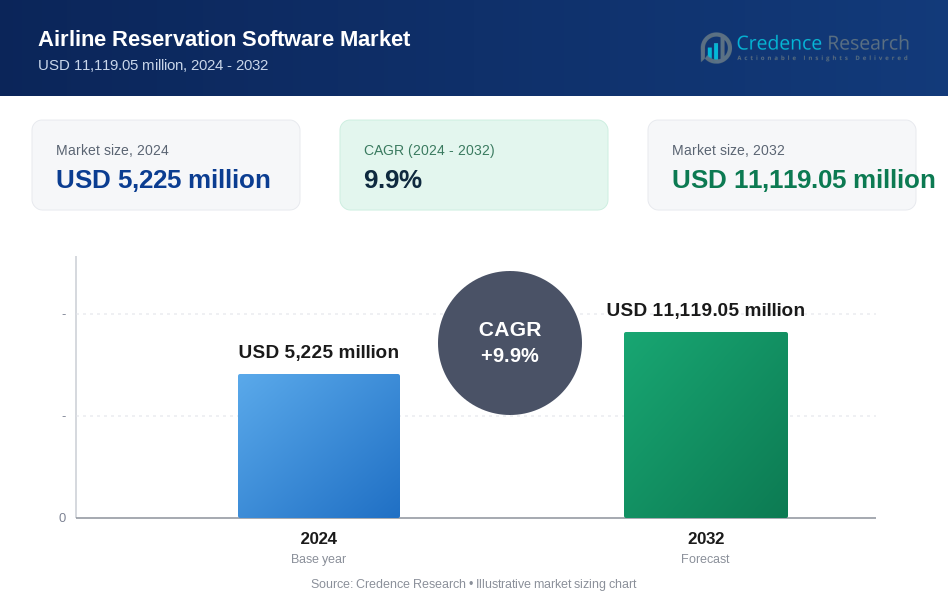
The Airline Reservation Software Market is projected to grow from USD 5225 million in 2024 to an estimated USD 11119.05 million by 2032, with a compound annual growth rate (CAGR) of 9.9% from 2024 to 2032.
Key market drivers include the increasing demand for personalized travel experiences and the integration of artificial intelligence (AI) and machine learning (ML) into reservation systems. Airlines are leveraging these technologies to analyze customer preferences, offer tailored services, and improve operational efficiency. Additionally, the rise of low-cost carriers (LCCs) has led to a surge in passenger volume, prompting airlines to adopt scalable and efficient reservation software. The shift toward mobile and online booking platforms is another significant driver, as customers increasingly prefer digital channels for their travel planning and ticketing needs. Enhanced security measures and payment integrations within these systems are also boosting their adoption across the industry.
In terms of regional analysis, North America dominates the market, accounting for a significant share due to the presence of leading airlines and advanced technological infrastructure. The region's well-established aviation industry and focus on enhancing customer experiences further support its leadership. The Asia-Pacific region is the fastest-growing market, driven by an expanding middle-class population, rising air passenger traffic, and increasing airline penetration in countries like China, India, and Southeast Asian nations. Rapid digitalization and government initiatives to improve aviation infrastructure also contribute to the region's growth. Europe holds a substantial share of the market, underpinned by the region's mature aviation sector and high adoption of innovative technologies. Key countries such as Germany, the UK, and France are at the forefront of adopting advanced reservation software to optimize operations and enhance traveler satisfaction. Meanwhile, Latin America and the Middle East & Africa are experiencing gradual growth. In Latin America, improving economic conditions, expanding regional air networks, and increasing digital connectivity are driving demand. The Middle East & Africa benefit from the region's burgeoning tourism industry, the development of major airline hubs, and the growing preference for air travel, positioning these regions as emerging contributors to market expansion.
Market Insights:
- The airline reservation software market is projected to grow from USD 5,225 million in 2024 to USD 11,119.05 million by 2032, reflecting a robust CAGR of 9.9%.
- Integration of artificial intelligence (AI) and machine learning (ML) into reservation systems is enabling airlines to deliver personalized travel experiences and enhance operational efficiency.
- The rise of low-cost carriers (LCCs), particularly in emerging economies, has led to increased passenger volumes, driving demand for scalable and efficient reservation solutions.
- The shift to mobile and online booking platforms continues to reshape the market, with travelers prioritizing convenience, real-time updates, and secure transactions.
- North America leads the market with a 35% share, driven by technological advancements and the presence of leading airlines, while Asia-Pacific, with a 30% share, is the fastest-growing region.
- Key challenges, such as cybersecurity risks, high implementation costs, and integration with legacy systems, underscore the need for robust, future-ready solutions.
- Emerging technologies like blockchain and cloud-based systems are driving innovation, offering cost-effective and secure solutions for airlines to enhance their booking systems.
Market Drivers:
Rising Demand for Personalized Travel Experiences
The increasing demand for personalized travel experiences is a major driver of the airline reservation software market. Modern travelers expect tailored services that cater to their specific needs, preferences, and budgets. Airlines are leveraging advanced reservation software integrated with artificial intelligence (AI) and data analytics to analyze customer behavior and provide customized options. For instance, British Airways implemented a centralized personalization system that processes over 400 million customer interactions annually, enabling tailored offers and services. These include seat preferences, meal choices, loyalty rewards, and targeted offers, enhancing passenger satisfaction and loyalty. The ability to deliver such personalized experiences efficiently has become a competitive differentiator, pushing airlines to invest in robust reservation systems.
Expansion of Low-Cost Carriers and Rising Passenger Volume
The proliferation of low-cost carriers (LCCs) has significantly increased the volume of air travelers worldwide, especially in emerging economies. LCCs rely heavily on efficient and scalable reservation software to manage high passenger volumes, streamline booking processes, and minimize operational costs. For instance, Southwest Airlines operates over 800 aircraft and serves 100 destinations, demonstrating the efficiency of its reservation system in handling high passenger volumes. As these carriers expand their routes and services, the need for reliable reservation solutions grows correspondingly. Additionally, the global rise in disposable income, coupled with increased affordability of air travel, has made flying accessible to a larger segment of the population. This surge in passenger numbers continues to fuel the demand for advanced airline reservation software.
Shift Toward Mobile and Online Booking Platforms
The shift from traditional booking methods to mobile and online platforms has revolutionized the way airline reservations are managed. Today’s travelers prioritize convenience and speed, favoring digital channels for their travel planning and ticketing needs. Modern reservation systems are designed to offer seamless integration with mobile applications and online portals, enabling users to search, book, and manage their itineraries effortlessly. Features such as real-time flight updates, flexible payment options, and secure transactions further enhance the appeal of these platforms. For instance, Etihad Airways introduced AI-powered booking features in its BOTIM app, allowing customers to complete reservations directly through chat-based interactions. The rapid growth of smartphone penetration and internet accessibility worldwide is expected to sustain this trend, driving the adoption of digital reservation software.
Integration of Advanced Technologies
The integration of cutting-edge technologies such as AI, machine learning (ML), and blockchain is transforming the airline reservation software landscape. AI-powered systems can predict customer preferences, optimize pricing strategies, and automate repetitive tasks, improving efficiency and decision-making. Blockchain technology is being adopted to enhance data security and streamline processes such as ticket verification and loyalty program management. For instance, Lufthansa employs AI-powered weather forecasting tools that have enhanced wind pattern prediction accuracy by 40%, optimizing flight schedules and reducing delays. Additionally, the use of cloud-based solutions allows airlines to scale their reservation systems dynamically, catering to fluctuating demand while reducing infrastructure costs. These technological advancements are enabling airlines to modernize their operations, attract tech-savvy customers, and remain competitive in a rapidly evolving industry.
Market Trends:
Increasing Adoption of Cloud-Based Solutions
The airline reservation software market is witnessing a significant shift toward cloud-based solutions, driven by their scalability, cost-effectiveness, and enhanced flexibility. Airlines are increasingly adopting cloud-based reservation platforms to manage fluctuating passenger volumes, improve data accessibility, and reduce infrastructure costs. These systems enable seamless integration with other airline operations, such as customer relationship management (CRM) and revenue management, providing a unified approach to operations. For instance, American Airlines migrated its reservation systems to the IBM Cloud, enabling real-time updates, improved scalability, and faster deployment of applications like Dynamic Rebooking, reducing setup time significantly. Cloud-based solutions also support real-time updates and data sharing, which are critical for enhancing passenger experiences and optimizing flight schedules. This trend is particularly prominent among small and medium-sized carriers seeking affordable and efficient technology solutions.
Growth in Multi-Channel Distribution Strategies
Airlines are diversifying their distribution channels to reach a broader customer base and enhance visibility. The integration of reservation software with online travel agencies (OTAs), global distribution systems (GDS), and airline websites ensures a streamlined booking process for customers across various platforms. Additionally, social media channels and mobile apps are becoming prominent avenues for direct customer engagement and ticket sales. For instance, Malaysia Airlines implemented a chatbot via Facebook Messenger using Google Cloud and Amadeus, allowing customers to book and pay for flights directly, enhancing digital sales. By leveraging these multi-channel strategies, airlines can target specific customer segments, improve conversion rates, and maximize revenue. This trend highlights the evolving nature of airline distribution networks and the importance of robust, adaptable reservation software.
Rise of Ancillary Revenue Streams
The focus on generating ancillary revenue is transforming the way airlines use reservation software. Airlines are leveraging advanced reservation systems to upsell and cross-sell additional services, such as baggage fees, seat selection, in-flight meals, and travel insurance. These systems are designed to identify customer preferences and present tailored offers during the booking process, boosting revenue per passenger. For instance, WNS Ancillary Revenue Optimizer Suite increased ancillary revenue by up to 10% by offering personalized services like baggage upgrades during booking. As the airline industry faces pressures to improve profitability amid fluctuating fuel prices and operational costs, ancillary revenue has become a critical component of financial strategies. The ability to integrate these revenue streams into reservation platforms is a growing trend that enhances both customer convenience and airline profitability.
Emphasis on Sustainability and Green Technologies
Sustainability has become a central theme in the aviation industry, influencing the development of airline reservation software. Airlines are incorporating eco-friendly features into their systems, such as carbon offset options and environmental impact tracking, to align with customer values and regulatory requirements. Reservation software also supports operational efficiency by optimizing flight loads and reducing fuel consumption through better planning. For instance, Alaska Airlines, using Flyways AI, saved 480,000 gallons of fuel and avoided 4,600 tons of CO2 emissions in six months by optimizing flight routes. This growing emphasis on sustainability is reshaping customer interactions, as environmentally conscious travelers increasingly seek airlines that demonstrate a commitment to green practices. These trends underscore the role of technology in fostering a more sustainable aviation ecosystem.
Market Challenges Analysis:
High Implementation Costs
One of the primary restraints in the airline reservation software market is the significant cost associated with implementing advanced systems. Airlines, particularly small and low-cost carriers, often face budget constraints that make adopting modern reservation software a financial challenge. The expenses involved in system customization, integration with existing infrastructure, and staff training add to the overall costs. These financial barriers can delay or limit the adoption of new technologies, particularly in regions with developing aviation markets.
Cybersecurity and Data Privacy Concerns
The increasing reliance on digital platforms for airline reservations exposes the market to cybersecurity risks and data privacy challenges. The sensitive nature of passenger data, including personal and financial information, makes airline reservation systems attractive targets for cyberattacks. Ensuring robust security measures, such as encryption and multi-factor authentication, requires significant investment and ongoing updates. Failure to address these concerns can lead to data breaches, loss of customer trust, and potential legal and financial repercussions for airlines.
Dependence on Internet Connectivity
The functionality of modern airline reservation systems heavily depends on stable and reliable internet connectivity. In regions with underdeveloped or inconsistent digital infrastructure, this reliance poses a significant challenge. Poor connectivity can disrupt real-time operations, delay updates, and hinder customer interactions, impacting both operational efficiency and passenger experiences. This limitation is particularly prominent in emerging markets, where digital infrastructure development may lag behind growing demand.
Complexity of Integration with Legacy Systems
Airlines often face difficulties integrating modern reservation software with legacy systems that are still in use for various operations. Compatibility issues, data migration challenges, and potential disruptions during the integration process can create operational inefficiencies. The complexity of maintaining seamless communication between old and new systems further complicates the transition, requiring significant technical expertise and resources.
Market Opportunities:
The airline reservation software market presents substantial opportunities, driven by the rapid digitization of the aviation industry and the increasing adoption of advanced technologies. As airlines strive to enhance customer experiences and streamline operations, there is a growing demand for sophisticated reservation systems that integrate emerging technologies such as artificial intelligence (AI), machine learning (ML), and blockchain. These technologies enable airlines to deliver personalized services, optimize pricing strategies, and ensure secure transactions, creating opportunities for software providers to innovate and cater to these evolving needs. Additionally, the expansion of cloud-based solutions provides scalability and cost-efficiency, making them particularly appealing to low-cost carriers (LCCs) and regional airlines looking to modernize their reservation platforms.
Geographically, emerging markets in Asia-Pacific, Latin America, and the Middle East & Africa offer significant growth potential. Rapidly increasing air passenger traffic, expanding low-cost carrier networks, and rising disposable incomes are driving the need for robust reservation software in these regions. Governments in these areas are also investing heavily in aviation infrastructure and digital transformation, further supporting market expansion. Meanwhile, sustainability trends, such as integrating carbon offset options into booking systems, present additional avenues for growth as environmentally conscious travelers seek greener solutions. These factors underscore the market’s opportunity to expand globally, particularly in regions where the aviation sector is experiencing dynamic growth and technological advancements.
Market Segmentation Analysis:
The airline reservation software market is segmented into type, system type, functionality, application, and region, reflecting its broad scope and diverse applications.
By Type, the market is divided into B2B travel portals and B2C booking engines. B2C booking engines dominate the segment due to the increasing preference for direct booking platforms by customers, while B2B portals cater to travel agencies and corporate clients requiring advanced customization and integration features.
By System Type, the market includes Passenger Service Systems (PSS), Airline Inventory Systems, and Departure Control Systems (DCS). PSS leads this segment, offering integrated solutions for passenger management, ticketing, and scheduling. Inventory systems focus on real-time management of seat availability, while DCS ensures smooth flight departures through streamlined boarding processes.
By Functionality, the market encompasses inventory management, ticketing & booking, customer relationship management (CRM), and revenue management. Ticketing & booking hold the largest share due to their critical role in enabling seamless reservations. CRM is gaining traction as airlines focus on enhancing customer satisfaction and loyalty through personalized interactions.
By Application, the market serves commercial airlines, charter airlines, cargo airlines, and others. Commercial airlines account for the majority share, driven by high passenger volumes and the need for sophisticated reservation systems to manage operations efficiently.
Segmentation:
By Type:
- B2B Travel Portal
- B2C booking engine
By System Type
- Passenger Service System (PSS)
- Airline Inventory System
- Departure Control System (DCS)
By Functionality
- Inventory Management
- Ticketing & Booking
- Customer Relationship Management (CRM)
- Revenue Management
By Application
- Commercial Airlines
- Charter Airlines
- Cargo Airlines
- Others
By Region:
- North America
- U.S.
- Canada
- Mexico
- Europe
- Germany
- France
- U.K.
- Italy
- Spain
- Rest of Europe
- Asia Pacific
- China
- Japan
- India
- South Korea
- South-east Asia
- Rest of Asia Pacific
- Latin America
- Brazil
- Argentina
- Rest of Latin America
- Middle East & Africa
- GCC Countries
- South Africa
- Rest of the Middle East and Africa
Regional Analysis:
The airline reservation software market exhibits varied growth dynamics across different regions, driven by the adoption of advanced technologies, regional passenger volumes, and the state of aviation infrastructure. The market is segmented into North America, Asia-Pacific, Europe, Latin America, and the Middle East & Africa, each contributing uniquely to the global market landscape.
North America
North America dominates the airline reservation software market, holding approximately 35% of the global market share in 2024. The region’s leadership is driven by the presence of major airlines, advanced technological infrastructure, and a high rate of adoption of cloud-based and AI-powered systems. Airlines in the U.S. and Canada are increasingly leveraging innovative reservation software to enhance passenger experiences, manage high passenger volumes, and optimize operations. The growing demand for seamless booking experiences and the widespread use of mobile and online platforms further bolster North America’s market position.
Asia-Pacific
Asia-Pacific is the fastest-growing region, accounting for around 30% of the global market share. This rapid growth is fueled by increasing air passenger traffic, expanding middle-class populations, and rising disposable incomes in countries such as China, India, and Southeast Asia. The region’s aviation industry is witnessing significant investments in digital infrastructure, with airlines adopting advanced reservation systems to cater to the growing demand for air travel. The proliferation of low-cost carriers (LCCs) and government initiatives to improve aviation infrastructure are also key contributors to market expansion in Asia-Pacific.
Europe
Europe holds approximately 20% of the market share, supported by its mature aviation industry and a strong focus on technological innovation. Leading countries such as Germany, the UK, and France are at the forefront of adopting advanced reservation systems to improve operational efficiency and passenger satisfaction. The region’s emphasis on sustainability and the integration of green technologies into airline operations also aligns with the capabilities of modern reservation software, further driving adoption.
Latin America and the Middle East & Africa
Latin America and the Middle East & Africa collectively account for around 15% of the global market share, with Latin America contributing slightly more. In Latin America, improving economic conditions, expanding regional air networks, and increasing digital connectivity are driving growth. In the Middle East & Africa, the development of major airline hubs, rising tourism, and the adoption of cost-efficient solutions are key drivers. However, challenges such as limited digital infrastructure in certain areas may hinder faster growth in these regions.
Key Player Analysis:
- Airmax Systems
- Amadeus IT Group
- Hahn Air
- Hitit Computer Services
- IBS Software
- InteliSys Aviation Systems
- Navitaire
- Provoke Technologies
- Radixx International, Inc.
- Res Software
- Sabre Corporation
- SITA
- Travelport Worldwide
- Trawex Technologies
Competitive Analysis:
The airline reservation software market is highly competitive, dominated by leading players such as Amadeus IT Group, Sabre Corporation, and Travelport Worldwide. These companies hold a significant share of the market due to their robust product portfolios, global presence, and long-standing partnerships with major airlines. They continue to innovate by integrating cutting-edge technologies like artificial intelligence (AI), blockchain, and machine learning (ML) into their solutions, enhancing operational efficiency and customer experience. New entrants and regional players are intensifying competition by offering cost-effective and customizable solutions tailored to the needs of small and low-cost carriers (LCCs). Additionally, the increasing adoption of cloud-based platforms and mobile applications has prompted vendors to diversify their offerings to remain competitive. This dynamic landscape is fostering continuous innovation, with companies focusing on improving scalability, enhancing data security, and delivering personalized services to sustain their market positions.
Recent Developments:
- In January 2024, Chr. Hansen Holding successfully completed its combination with Novozymes, creating a new global biosolutions powerhouse named Novonesis, which is poised to innovate in multiple areas, including fermented dairy ingredients
- In August 2024, Corbion provided an update on its new lactic acid facility in Thailand, emphasizing the project’s ongoing progress and its potential to bolster the company’s offerings in fermented dairy ingredient solutions
- In 2024, Epi Ingredients introduced an additive-free butter powder designed to deliver clean-label functionality in applications such as baked goods, sauces, and other formulations reliant on premium dairy-based ingredients
Market Concentration & Characteristics:
The airline reservation software market is moderately concentrated, with a few key players, such as Amadeus IT Group, Sabre Corporation, and Travelport Worldwide, dominating a significant share of the market. These industry leaders maintain their positions through robust technological capabilities, extensive global networks, and strong collaborations with major airlines. Their comprehensive offerings cater to both full-service carriers and low-cost carriers (LCCs), ensuring a wide customer base. Despite the dominance of these players, the market exhibits dynamic characteristics due to the presence of regional vendors and new entrants targeting niche segments. These companies often focus on providing cost-effective, customizable solutions to cater to the specific needs of emerging markets and smaller airlines. The industry is marked by rapid technological innovation, driven by the integration of artificial intelligence, machine learning, and blockchain, which are reshaping the market. Overall, the market balances concentration with opportunities for new players and innovation.
Report Coverage:
The research report offers an in-depth analysis based on By Type, By System Type, By Functionality and By Application. It details leading market players, providing an overview of their business, product offerings, investments, revenue streams, and key applications. Additionally, the report includes insights into the competitive environment, SWOT analysis, current market trends, as well as the primary drivers and constraints. Furthermore, it discusses various factors that have driven market expansion in recent years. The report also explores market dynamics, regulatory scenarios, and technological advancements that are shaping the industry. It assesses the impact of external factors and global economic changes on market growth. Lastly, it provides strategic recommendations for new entrants and established companies to navigate the complexities of the market.
Future Outlook:
- Increasing adoption of cloud-based reservation systems will enhance scalability and operational flexibility for airlines.
- Integration of artificial intelligence and machine learning will enable personalized services and predictive analytics for improved customer experiences.
- The rise of mobile-first and digital booking platforms will continue to drive demand for user-friendly and secure reservation software.
- Expanding low-cost carrier networks in emerging markets will create opportunities for cost-efficient and scalable software solutions.
- Growing air passenger traffic in regions like Asia-Pacific and the Middle East will fuel investments in advanced reservation technologies.
- Sustainability initiatives, such as carbon offset integration, will shape the development of eco-friendly features in reservation systems.
- Enhanced data security and blockchain adoption will address cybersecurity concerns and ensure seamless transactions.
- Partnerships between airlines and software providers will foster innovation and create tailored solutions for diverse operational needs.
- Multi-channel distribution strategies will expand market reach and enhance customer accessibility.
- Continuous advancements in technology will drive the evolution of reservation software, meeting the dynamic needs of the aviation industry.
Request a Free Sample
Fill in your details and we'll send you a free sample report.
- Sample data tables & charts
- Research methodology
Market Dynamics
Integration of AI and Machine Learning
Airlines are increasingly adopting AI and machine learning in reservation software to analyze customer preferences, automate processes, and deliver personalized travel experiences, which enhances customer satisfaction and operational efficiency.
Expansion of Low-Cost Carriers (LCCs)
The proliferation of LCCs, especially in emerging markets, is driving demand for scalable and efficient reservation software capable of handling high passenger volumes and supporting rapid route expansion.
Shift to Mobile and Online Booking Platforms
The growing preference for digital channels among travelers is pushing airlines to invest in reservation software that supports seamless mobile and online booking, real-time updates, and secure payment integrations.
Adoption of Cloud-Based Solutions
Cloud-based reservation systems offer airlines greater scalability, cost savings, and flexibility, enabling them to manage fluctuating passenger volumes and integrate with other operational systems more efficiently.
Focus on Ancillary Revenue Streams
Airlines are leveraging advanced reservation software to upsell and cross-sell services such as baggage, seat selection, and travel insurance, increasing overall revenue per passenger and enhancing the customer journey.
Need a Custom Version of This Report?
Tailor the scope, geography, or segments to your exact requirements.
- Custom geography or segment scope
- Direct access to our analyst team
Frequently Asked Questions
What is the projected growth of the airline reservation software market?
What are the key drivers of market growth?
Which region leads the airline reservation software market?
What are the key challenges in this market?
Table of Content
Chapter 1 Market Segmentation
- 1.1 Segmentation Framework
- 1.1.1 Product and Service Classification
- 1.1.2 Application and End-Use Classification
- 1.1.3 Technology and Solution Classification
- 1.1.4 Customer and Distribution Channel Classification
- 1.1.5 Geographic Segmentation
- 1.1.6 Market Segment Definitions and Boundaries
- 1.2 By Type
- 1.2.1 B2B Travel Portal
- 1.2.2 B2C Booking Engine
- 1.3 By Application
- 1.3.1 Commercial Airlines
- 1.3.2 Charter Airlines
- 1.3.3 Cargo Airlines
- 1.3.4 Others
- 1.4 By System Type
- 1.4.1 Passenger Service System (PSS)
- 1.4.2 Airline Inventory System
- 1.4.3 Departure Control System (DCS)
- 1.5 By Functionality
- 1.5.1 Inventory Management
- 1.5.2 Ticketing & Booking
- 1.5.3 Customer Relationship Management (CRM)
- 1.5.4 Revenue Management
Chapter 2 Introduction
- 2.1 Report Objectives and Scope
- 2.2 Product Definition and Industry Terminology
- 2.3 Market Inclusions and Exclusions
- 2.4 Research Process
- 2.4.1 Primary Research and Expert Interviews
- 2.4.2 Secondary Research and Source Review
- 2.4.3 Top-Down and Bottom-Up Estimation
- 2.4.4 Data Triangulation and Verification
- 2.5 Market Size Measurement Basis
- 2.5.1 2024: USD 5,225 million → 2032: USD 11,119.05 million
- 2.6 Historical and Forecast Reference Periods
- 2.6.1 Base Year: 2024
- 2.6.2 Forecast Period: 2024-2032
- 2.7 Research Assumptions and Limitations
Chapter 3 Executive Summary
- 3.1 Market Snapshot and Key Findings
- 3.2 Base-Year Market Size, 2024
- 3.3 Forecast Market Size, 2032
- 3.4 Revenue and Volume Growth Outlook
- 3.5 Key Demand and Supply Indicators
- 3.6 Leading Market Segments
- 3.7 Fastest-Growing Market Opportunities
- 3.8 Regional Performance Highlights
- 3.9 Technology and Industry Transformation
- 3.10 Competitive Landscape Summary
- 3.11 Analyst View and Strategic Implications
Chapter 4 Global Airline Reservation Software Market Trends and Developments
- 4.1 Historical Industry Development
- 4.2 Recent Market Trends and Developments
- 4.3 Demand and Customer Behavior Trends
- 4.4 Technology and Product Innovation
- 4.5 Artificial Intelligence, Automation and Digitalization
- 4.6 Local Manufacturing and Supply Chain Realignment
- 4.7 Industry Partnerships, Mergers and Acquisitions
- 4.8 Sustainability and Circular Economy Developments
- 4.9 Government and Private Sector Investment Trends
- 4.10 Emerging Business Models and Commercialization
- 4.11 Industry Developments and Announcements
Chapter 5 Global Airline Reservation Software Market Supply and Demand Analysis
- 5.1 Demand Trend and Consumption Analysis
- 5.2 Demand Forecast, 2024-2032
- 5.3 Supply Chain Structure and Procurement Trends
- 5.4 Supply-Demand Gap and Bottlenecks
- 5.5 Import Dependence and Sourcing Structure
- 5.6 Regional Supply and Demand Concentration
Chapter 6 Global Airline Reservation Software Market Pricing Analysis
- 6.1 Pricing Structure and Measurement
- 6.2 Historical Pricing Trends
- 6.3 Pricing Outlook, 2024-2032
- 6.4 Pricing by Product and Market Segment
- 6.5 Geographic Pricing Differences
- 6.6 Key Input, Energy, Labor and Logistics Costs
- 6.7 Contract Pricing and Purchasing Models
- 6.8 Pricing Sensitivity and Competitive Positioning
- 6.9 Price, Margin and Profitability Implications
Chapter 7 Global Airline Reservation Software Market Dynamics
- 7.1 Market Growth Drivers
- 7.1.1 Demand-Side Drivers
- 7.1.2 Technology and Innovation Drivers
- 7.1.3 Infrastructure and Investment Drivers
- 7.1.4 Regulatory and Policy Drivers
- 7.2 Market Restraints
- 7.2.1 Cost and Affordability Constraints
- 7.2.2 Technology and Adoption Barriers
- 7.2.3 Supply Chain and Operational Constraints
- 7.3 Market Challenges
- 7.3.1 Competitive Pressure and Margin Erosion
- 7.3.2 Skills, Infrastructure and Implementation Gaps
- 7.4 Emerging Market Opportunities
- 7.5 Market Dynamics Impact and Time-Horizon Assessment
Chapter 8 Global Airline Reservation Software Value Chain Analysis
- 8.1 Industry Value Chain Overview
- 8.2 Upstream Suppliers and Critical Inputs
- 8.3 Technology and Component Providers
- 8.4 Manufacturing or Service Delivery
- 8.5 Distribution, Channel Partners and Integrators
- 8.6 Downstream Applications and End Users
- 8.7 Value Addition and Profit Pools
- 8.8 Vertical Integration and Outsourcing
- 8.9 Supplier Concentration and Risk
- 8.10 Supply Chain Localization and Resilience
Chapter 9 Global Airline Reservation Software Market Regulations and Policies
- 9.1 Relevant Laws, Standards and Compliance Frameworks
- 9.2 Product, Service, Safety and Quality Requirements
- 9.3 Government Policies, Incentives and Subsidies
- 9.4 Imports, Exports and Trade Barriers
- 9.5 Public Procurement and Local Content Requirements
- 9.6 Data Protection, AI and Cybersecurity Compliance
- 9.7 Upcoming Policy Changes and Market Implications
Chapter 10 Global Airline Reservation Software Market Hotspots and Opportunities
- 10.1 Market Opportunity Mapping and Growth Hotspots
- 10.2 High-Growth Applications and Customer Groups
- 10.3 Underserved Markets and White-Space Opportunities
- 10.4 Emerging Technology and Product Opportunities
- 10.5 New Capacity and Investment Hotspots
- 10.6 Market Entry and Expansion Opportunities
- 10.7 Distribution and Partnership Opportunities
- 10.8 Near-Term and Long-Term Commercial Potential
- 10.9 Opportunity Attractiveness and Execution Risks
Chapter 11 Global Airline Reservation Software Market Outlook, 2024-2032
- 11.1 Market Size and Analysis
- 11.1.1 Revenue (Market Measurement: 2024: USD 5,225 million → 2032: USD 11,119.05 million)
- 11.1.2 Historical Market Size
- 11.1.3 Base-Year Market Size, 2024
- 11.2 Market Forecast, 2024-2032
- 11.2.1 Revenue Forecast to 2032
- 11.2.2 CAGR and Year-on-Year Growth
- 11.2.3 Incremental Revenue Opportunity
- 11.3 Forecast Assumptions and Scenario Analysis
- 11.3.1 Base-Case Forecast
- 11.3.2 Optimistic and Conservative Scenarios
- 11.3.3 Technology, Pricing and Policy Sensitivities
- 11.4 Market Attractiveness and Growth Outlook
Chapter 12 Global Airline Reservation Software Market Segmentation and Outlook
- 12.1 Segmentation Summary and Market Shares, 2024
- 12.2 Largest and Fastest-Growing Segments
- 12.3 By Type - Market Size and Forecast, 2024-2032
- 12.3.1 Segment Definition and Scope
- 12.3.2 Historical Market Size
- 12.3.3 Revenue Forecast, 2024-2032
- 12.3.4 Base-Year Market Share, 2024
- 12.3.5 Segment CAGR and Growth Drivers
- 12.3.6 Subsegment Market Size and Forecast
- 12.3.6.1 B2B Travel Portal
- 12.3.6.2 B2C Booking Engine
- 12.3.7 Subsegment Pricing and Adoption Trends
- 12.3.8 Leading Suppliers and Competition
- 12.3.9 Regional Demand and Opportunities
- 12.4 By Application - Market Size and Forecast, 2024-2032
- 12.4.1 Segment Definition and Scope
- 12.4.2 Historical Market Size
- 12.4.3 Revenue Forecast, 2024-2032
- 12.4.4 Base-Year Market Share, 2024
- 12.4.5 Segment CAGR and Growth Drivers
- 12.4.6 Subsegment Market Size and Forecast
- 12.4.6.1 Commercial Airlines
- 12.4.6.2 Charter Airlines
- 12.4.6.3 Cargo Airlines
- 12.4.6.4 Others
- 12.4.7 Subsegment Pricing and Adoption Trends
- 12.4.8 Leading Suppliers and Competition
- 12.4.9 Regional Demand and Opportunities
- 12.5 By System Type - Market Size and Forecast, 2024-2032
- 12.5.1 Segment Definition and Scope
- 12.5.2 Historical Market Size
- 12.5.3 Revenue Forecast, 2024-2032
- 12.5.4 Base-Year Market Share, 2024
- 12.5.5 Segment CAGR and Growth Drivers
- 12.5.6 Subsegment Market Size and Forecast
- 12.5.6.1 Passenger Service System (PSS)
- 12.5.6.2 Airline Inventory System
- 12.5.6.3 Departure Control System (DCS)
- 12.5.7 Subsegment Pricing and Adoption Trends
- 12.5.8 Leading Suppliers and Competition
- 12.5.9 Regional Demand and Opportunities
- 12.6 By Functionality - Market Size and Forecast, 2024-2032
- 12.6.1 Segment Definition and Scope
- 12.6.2 Historical Market Size
- 12.6.3 Revenue Forecast, 2024-2032
- 12.6.4 Base-Year Market Share, 2024
- 12.6.5 Segment CAGR and Growth Drivers
- 12.6.6 Subsegment Market Size and Forecast
- 12.6.6.1 Inventory Management
- 12.6.6.2 Ticketing & Booking
- 12.6.6.3 Customer Relationship Management (CRM)
- 12.6.6.4 Revenue Management
- 12.6.7 Subsegment Pricing and Adoption Trends
- 12.6.8 Leading Suppliers and Competition
- 12.6.9 Regional Demand and Opportunities
- 12.7 Segment Growth Comparison
- 12.8 Segment Attractiveness and Priority Matrix
Chapter 13 Global Airline Reservation Software End-Use and Application Market Outlook
- 13.1 End-Use Industry and Customer Demand Structure
- 13.2 Leading Applications and Customer Groups
- 13.3 End-Use Market Size, Share and Forecast
- 13.4 Major End-Use Industry Deep Dives
- 13.4.1 Customer Requirements and Use Cases
- 13.4.2 Demand and Replacement Cycles
- 13.4.3 Technical and Regulatory Considerations
- 13.4.4 Purchasing and Procurement Models
- 13.4.5 Leading Vendors and Distribution Channels
- 13.4.6 Forecast and Commercial Opportunities
- 13.5 Emerging Applications and Cross-Segment Demand
- 13.6 End-Use Industry Investment Priorities
Chapter 14 Global Airline Reservation Software Geographic Market Outlook, 2024-2032
- 14.1 Regional Market Size and Share, 2024
- 14.2 Regional Market Forecast, 2024-2032
- 14.3 Regional Pricing, Production and Demand Differences
- 14.4 North America
- 14.4.1 United States
- 14.4.2 Canada
- 14.4.3 Mexico
- 14.5 Europe
- 14.5.1 Germany
- 14.5.2 France
- 14.5.3 Italy
- 14.5.4 United Kingdom
- 14.5.5 Spain
- 14.5.6 Poland
- 14.5.7 Russia
- 14.5.8 Netherlands
- 14.5.9 Belgium
- 14.5.10 Sweden
- 14.5.11 Denmark
- 14.5.12 Norway
- 14.5.13 Rest of Europe
- 14.6 Asia Pacific
- 14.6.1 China
- 14.6.2 India
- 14.6.3 Japan
- 14.6.4 South Korea
- 14.6.5 Thailand
- 14.6.6 Indonesia
- 14.6.7 Vietnam
- 14.6.8 Malaysia
- 14.6.9 Australia
- 14.6.10 Rest of Asia Pacific
- 14.7 Latin America
- 14.7.1 Brazil
- 14.7.2 Argentina
- 14.7.3 Colombia
- 14.7.4 Chile
- 14.7.5 Rest of Latin America
- 14.8 Middle East
- 14.8.1 Saudi Arabia
- 14.8.2 United Arab Emirates
- 14.8.3 Turkey
- 14.8.4 Israel
- 14.8.5 Iran
- 14.8.6 Rest of the Middle East
- 14.9 Africa
- 14.9.1 South Africa
- 14.9.2 Egypt
- 14.9.3 Nigeria
- 14.9.4 Morocco
- 14.9.5 Rest of Africa
- 14.10 Regional Investment, Policy and Supply Chain Differences
- 14.11 Regional Competitive Landscape
- 14.12 Geographic Growth Hotspots
Chapter 15 Global Airline Reservation Software Technology, Innovation and Sustainability Outlook
- 15.1 Technology Landscape and Maturity
- 15.2 Product, Process and Service Innovation
- 15.3 AI, Automation and Digital Tools in the Industry
- 15.4 Technology Adoption and Performance Benchmarking
- 15.5 Innovation Pipeline and R&D Investment
- 15.6 Patent and Intellectual Property Trends
- 15.7 Energy Efficiency and Resource Management
- 15.8 Sustainability, Recycling and Circularity
- 15.9 Technology Roadmap, 2024-2032
- 15.10 Risks of Obsolescence and Technology Substitution
Chapter 16 Global Airline Reservation Software Market Key Strategic Imperatives
- 16.1 Growth and Market Entry Priorities
- 16.2 High-Return Products and Segments
- 16.3 Pricing, Profitability and Cost Optimization
- 16.4 Technology Investment and Product Differentiation
- 16.5 Supply Chain Localization and Resilience
- 16.6 Distribution and Customer Acquisition
- 16.7 Partnership, Acquisition and Capacity Strategy
- 16.8 Regional Expansion Priorities
- 16.9 Short-, Medium- and Long-Term Actions
Chapter 17 Competition Outlook
- 17.1 Industry Competition Characteristics
- 17.2 Market Structure and Concentration
- 17.3 Market Share and Competitive Positioning, 2024
- 17.4 Company-Wise Revenue and Product Benchmarking
- 17.5 Production and Service Capacity Benchmarking
- 17.6 Technology, Pricing and Differentiation
- 17.7 Regional Footprint and Distribution Strength
- 17.8 Mergers, Acquisitions and Strategic Alliances
- 17.9 New Entrants and Competitive Threats
- 17.10 Porter's Five Forces and Industry Attractiveness
- 17.11 Competitive Outlook, 2024-2032
Chapter 18 Company Profiles
- 18.1 Company Coverage and Selection Criteria
- 18.2 Amadeus IT Group
- 18.2.1 Business Description
- 18.2.2 Company Ownership and Geographic Presence
- 18.2.3 Product and Service Portfolio
- 18.2.4 Manufacturing and Operating Footprint
- 18.2.5 Financial Performance and Investment
- 18.2.6 Market Share and Competitive Position
- 18.2.7 Technology and Innovation Capabilities
- 18.2.8 Strategic Alliances or Partnerships
- 18.2.9 Recent Developments
- 18.2.10 Growth Strategy and Outlook
- 18.3 Sabre Corporation
- 18.4 Travelport Worldwide
- 18.5 SITA
- 18.6 Navitaire
- 18.7 Radixx International, Inc.
- 18.8 IBS Software
- 18.9 Hitit Computer Services
- 18.10 InteliSys Aviation Systems
- 18.11 Airmax Systems
- 18.12 Other Relevant Market Participants
Note: Every listed company is profiled on the structure shown under the first company. The company list is preliminary and may change based on research findings, market developments, data availability and client requirements.
Chapter 19 Disclaimer
- 19.1 Research and Forecast Disclaimer
- 19.2 Data Source and Estimation Limitations
Note: The depth of individual sections depends on data availability for this market. Volume, capacity, trade and other unit-based metrics are included where applicable.