
Carbonated Beverage Market Overview:
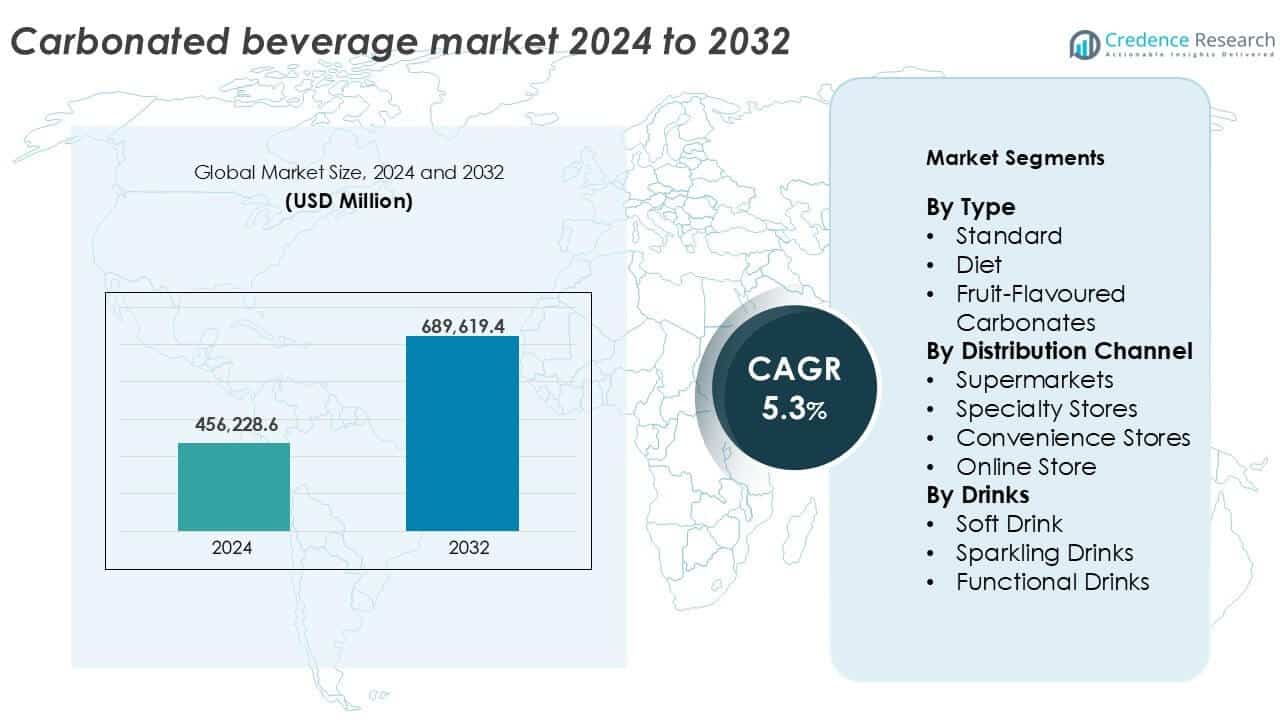
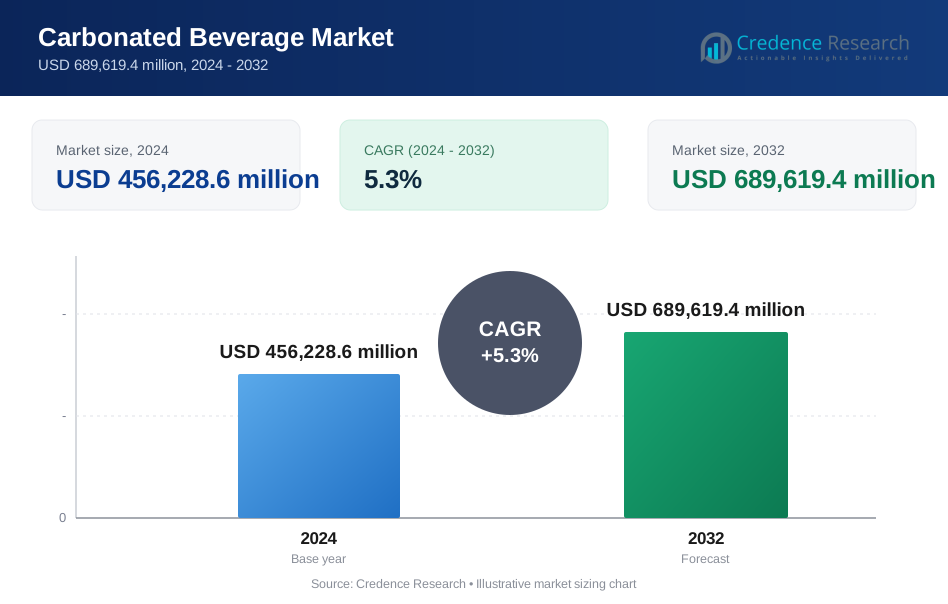
The carbonated beverage market size was valued at USD 456,228.6 million in 2024 and is anticipated to reach USD 689,619.4 million by 2032, at a CAGR of 5.3% during the forecast period.
| REPORT ATTRIBUTE | DETAILS |
|---|---|
| Historical Period | 2020-2023 |
| Base Year | 2024 |
| Forecast Period | 2025-2032 |
| Carbonated Beverage Market Size 2024 | USD 456,228.6 million |
| Carbonated Beverage Market, CAGR | 5.3% |
| Carbonated Beverage Market Size 2032 | USD 689,619.4 million |
The carbonated beverage market is led by global giants such as The Coca-Cola Company, PepsiCo Inc., and Keurig Dr Pepper Inc., supported by key players like Nestlé S.A., Suntory Holdings Limited, and Britvic PLC. These companies command strong brand portfolios, extensive bottling networks, and high consumer loyalty. The Coca-Cola Company remains the market leader in volume and value terms, with a wide range of classic and low-calorie offerings. North America leads regionally, holding 33.5% of the global market share in 2024, driven by high consumption rates, diversified retail channels, and continuous product innovation.
Carbonated Beverage Market Insights
- The carbonated beverage market was valued at USD 456,228.6 million in 2024 and is projected to reach USD 689,619.4 million by 2032, growing at a CAGR of 5.3%.
- Demand is driven by urbanization, rising disposable income, and lifestyle shifts favoring ready-to-drink options across developed and emerging regions.
- Consumer preference is shifting toward low-calorie, sugar-free, and functional beverages, with brands expanding offerings to meet health-conscious trends.
- The market is dominated by players like The Coca-Cola Company, PepsiCo Inc., and Keurig Dr Pepper Inc., focusing on innovation, regional flavor launches, and sustainability.
- North America leads with a 33.5% share, followed by Europe at 27.6% and Asia-Pacific at 22.9%; standard carbonated drinks hold over 60% share, while supermarkets remain the top distribution channel with more than 45% share.
Carbonated Beverage Market Segmentation Analysis:
By Type
The standard carbonated beverages segment holds the dominant share, accounting for over 60% of the total market in 2024. Its wide appeal, long-standing consumer loyalty, and strong brand recognition from key players like Coca-Cola and PepsiCo drive its leadership. High consumption in emerging and developed markets sustains this dominance. While the diet segment is gaining attention from health-conscious consumers, especially in North America and Europe, its market penetration remains comparatively lower. Fruit-flavoured carbonates continue to attract younger demographics due to taste innovation, but standard variants retain scale advantages in both retail and foodservice channels.
- For instance, The Coca‑Cola Company’s brands such as Coca‑Cola Classic, Sprite, and Fanta remain top sellers in supermarkets and convenience stores worldwide, cementing widespread familiarity and appeal.
By Distribution Channel
Supermarkets lead the distribution channel segment with over 45% market share, supported by their wide reach, bulk pricing, and strong shelf visibility. Consumers prefer supermarkets for multi-brand availability and promotional offers. Specialty stores also cater to premium and health-conscious consumers, especially in urban areas. Convenience stores play a critical role in impulse buying, particularly in Asia-Pacific and Latin America. Online stores are the fastest-growing sub-segment, driven by growing e-commerce platforms, mobile shopping apps, and direct-to-consumer brand initiatives. However, trust in freshness and delivery logistics remain barriers in some regions.
- For instance, major retailers stock a wide range of fizzy drinks from brands such as Coca‑Cola and Pepsi, helping maintain strong supermarket
By Drinks
Soft drinks dominate the drinks segment with more than 50% share in 2024, fueled by their mass-market appeal, affordable pricing, and broad availability across all age groups. Global fast-food expansion and seasonal promotions continue to support this sub-segment’s growth. Sparkling drinks are expanding steadily, especially among adults seeking an alternative to alcohol or sugary beverages. Meanwhile, functional carbonated drinks show the highest growth momentum, gaining traction for added benefits like vitamins, energy-boosting ingredients, and digestive support. Functional beverages are especially popular among Gen Z and millennial consumers in North America, Europe, and Asia.
Carbonated Beverage Market Key Growth Drivers
Global Urbanization and Lifestyle Shifts
Rising urbanization drives lifestyle changes, leading to increased consumption of convenience beverages. Rapidly growing middle-class populations in Asia-Pacific, Latin America, and Africa are adopting Western food and drink habits. The demand for ready-to-drink carbonated products fits well into busy urban schedules. Youth populations in countries like India, Indonesia, and Brazil contribute significantly to volume growth. Increasing social events, outdoor gatherings, and casual dining boost soft drink purchases. Brand visibility through aggressive retail shelf placements and digital marketing campaigns reinforces consumer recall. These changes help maintain a steady demand base and support innovation pipelines for global beverage giants.
- For instance, the Asia‑Pacific soft drinks market’s growth is driven by rapid urbanization and changing consumer preferences toward ready‑to‑drink beverages.
Aggressive Marketing and Sponsorship Campaigns
Major beverage companies invest heavily in sports sponsorships, celebrity endorsements, and digital advertising. This marketing approach strengthens brand loyalty and widens consumer outreach. Coca-Cola, for instance, leverages its long-standing association with global events like the FIFA World Cup and the Olympics to enhance visibility. Seasonal campaigns, limited-edition packaging, and influencer partnerships attract new demographics. Regional campaigns targeting health, sustainability, or flavor trends improve brand differentiation. The emotional connection created through storytelling and social media engagement drives higher repeat purchases, especially among younger consumers in key urban markets.
- For instance, The Coca‑Cola Company has sponsored the Olympic Games since 1928 and the FIFA World Cup since 1978, giving Coke global exposure at major events.
Product Diversification and Functional Innovations
Innovation in flavor, packaging, and health-focused ingredients fuels market expansion. Functional carbonated drinks enriched with vitamins, probiotics, and herbal extracts appeal to health-conscious consumers. Companies are launching sugar-reduced and caffeine-infused variants to target specific lifestyle needs. For example, PepsiCo’s Bubly and Coca-Cola’s AHA offer calorie-free sparkling waters with unique flavor profiles. Slim cans, resealable bottles, and eco-friendly packaging formats also enhance consumer convenience and brand sustainability image. These innovations allow players to cater to both indulgent and wellness-focused segments without cannibalizing core offerings.
Carbonated Beverage Market Key Trends and Opportunities
Rising Demand for Low-Calorie and Sugar-Free Alternatives
Health awareness is reshaping consumer preferences across developed and emerging markets. There is growing demand for sugar-free, low-calorie, and zero-calorie carbonated beverages. Governments in regions such as Europe and parts of Asia have implemented sugar taxes, pushing manufacturers to reformulate traditional recipes. Brands like Diet Coke, Sprite Zero, and Zevia are expanding their product lines with natural sweeteners like stevia or monk fruit. This trend also aligns with clean-label demands, with consumers checking ingredient lists more frequently. The low-calorie beverage segment presents long-term growth opportunities, particularly in metro cities and health-conscious communities.
- For instance, Varun Beverages the Indian PepsiCo bottler reported that 55% of its sales volume in the first half of 2025 came from low‑sugar or no‑added‑sugar carbonated drinks.
Surge in E-commerce and Direct-to-Consumer Sales
The digital transformation of retail has opened new sales channels for carbonated beverage brands. Online grocery platforms and quick-commerce apps offer consumers on-demand access to a wide variety of drinks. Brands are now using subscription models, digital bundles, and exclusive online launches to boost engagement. During the COVID-19 period, online beverage sales surged, and this shift remains in motion. D2C channels enable companies to collect customer data, personalize offerings, and promote limited-edition products directly. Growth in this channel is especially notable in North America, China, and parts of Europe, offering scalable opportunities for global and regional players.
Carbonated Beverage Market Key Challenges
Growing Health Concerns and Regulatory Scrutiny
Public health campaigns and government regulations pose significant challenges to carbonated beverage growth. Rising concerns about obesity, diabetes, and dental health have led to restrictions on advertising sugary drinks, especially to children. In many countries, mandatory labeling, sugar taxes, and school bans have been introduced. These actions can reduce consumer demand and add compliance burdens. Beverage companies must invest in R&D to meet evolving regulatory standards while maintaining product appeal. Failure to address health-related concerns could result in brand devaluation and declining sales in key markets.
Sustainability Pressure and Packaging Waste Issues
Environmental sustainability has become a critical concern across the food and beverage industry. The carbonated beverage sector faces scrutiny over plastic waste, water usage, and carbon emissions. Regulatory bodies and consumers demand sustainable sourcing, recyclable packaging, and reduced environmental footprints. Brands like PepsiCo and Coca-Cola are responding with initiatives like returnable bottles, biodegradable packaging, and reduced PET usage. However, transitioning to fully sustainable supply chains involves high capital expenditure and logistical hurdles. Companies unable to meet sustainability benchmarks risk losing eco-conscious consumers and facing operational penalties.
Carbonated Beverage Market Regional Analysis
North America
North America held the largest share in the carbonated beverage market, accounting for 33.5% in 2024. Strong brand presence, high per capita consumption, and a well-established retail ecosystem drive demand. The U.S. leads due to rising product innovations in low-calorie and functional drinks. Health-conscious consumers support growth in diet and sugar-free variants. Marketing through sports, music, and e-commerce further fuels engagement. Canada also contributes steadily through urban retail chains and a growing demand for premium beverages. Sustainability and recyclable packaging formats enhance brand image among environmentally aware consumers, supporting long-term market stability in this region.
Europe
Europe captured 27.6% of the global carbonated beverage market in 2024. Countries like the UK, Germany, France, and Italy lead due to strong demand for flavored, functional, and low-sugar drinks. Strict regulations on sugar content have pushed reformulations, driving growth in healthier carbonated options. Premiumization trends are prominent, with craft sodas and sparkling waters gaining traction. Sustainability-focused packaging and clean-label claims influence purchasing decisions. Distribution through supermarkets and convenience chains remains strong, while online platforms are seeing rising adoption. Consumer preferences shift toward regional flavors and ethical sourcing, giving opportunities for niche and organic carbonated beverage brands.
Asia-Pacific
Asia-Pacific accounted for 22.9% of the market in 2024 and is the fastest-growing region. Rapid urbanization, growing disposable income, and Western influence fuel rising consumption. China, India, Japan, and Indonesia are key contributors. The younger population drives demand for new flavors, functional benefits, and on-the-go packaging. Multinational brands expand their footprint while local players offer affordable alternatives. The online retail boom and aggressive in-store promotions support high volume sales. Convenience stores and quick-service restaurants boost demand in metro areas. Increasing interest in diet and sparkling fruit drinks among health-conscious millennials also contributes to accelerating regional growth.
Latin America
Latin America held 7.8% of the global market in 2024. Brazil and Mexico dominate regional demand due to cultural consumption habits and strong brand presence. Growth remains steady, supported by expanding retail infrastructure and the rising popularity of flavored carbonates. Urbanization, fast-food penetration, and affordability drive consumption. However, regulatory pressures around sugar taxes, particularly in Mexico, encourage a shift toward low-calorie and natural variants. Promotional pricing and bundled offers influence buying patterns. Domestic manufacturers increasingly innovate with tropical flavors and sustainable packaging to compete with global brands. E-commerce remains nascent but is gradually expanding in major cities.
Middle East & Africa (MEA)
The Middle East & Africa region accounted for 4.9% of the carbonated beverage market in 2024. Gulf countries like Saudi Arabia and the UAE drive growth through high consumption in foodservice and hospitality sectors. Youth population and rising tourism support demand for on-the-go and premium soft drinks. Increased western-style retail and fast-food chains contribute to high urban sales. Africa presents untapped potential, with Nigeria and South Africa emerging as key markets due to improving distribution and affordability. Still, challenges such as infrastructure gaps and economic instability in certain areas limit market penetration. Religious and cultural preferences also shape product formulations.
Carbonated Beverage Market Segmentations:
By Type
- Standard
- Diet
- Fruit-Flavoured Carbonates
By Distribution Channel
- Supermarkets
- Specialty Stores
- Convenience Stores
- Online Store
By Drinks
- Soft Drink
- Sparkling Drinks
- Functional Drinks
By Geography
- North America
- U.S.
- Canada
- Mexico
- Europe
- Germany
- France
- U.K.
- Italy
- Spain
- Rest of Europe
- Asia Pacific
- China
- Japan
- India
- South Korea
- South-east Asia
- Rest of Asia Pacific
- Latin America
- Brazil
- Argentina
- Rest of Latin America
- Middle East & Africa
- GCC Countries
- South Africa
- Rest of the Middle East and Africa
Carbonated Beverage Market Competitive Landscape
The competitive landscape of the carbonated beverage market remains highly consolidated and brand driven. The Coca-Cola Company and PepsiCo Inc. dominate through global distribution strength, scale economies, and strong brand equity. Both companies focus on portfolio diversification, including low-sugar, zero-calorie, and functional carbonated drinks. Keurig Dr Pepper Inc. and Suntory Holdings Limited strengthen positions through regional dominance and flavor innovation. Private-label players compete on price in supermarkets, especially in Europe and North America. Companies invest heavily in marketing, sponsorships, and digital engagement to protect market share. Packaging innovation and sustainability commitments also shape competition. Strategic partnerships, bottler network expansion, and local flavor launches help players defend volumes in emerging markets. Intense rivalry limits pricing flexibility but drives continuous product innovation.
Key Player Analysis
- PepsiCo Inc.
- The Coca-Cola Company
- Nestlé S.A.
- Keurig Dr Pepper Inc.
- Suntory Holdings Limited
- Britvic PLC
- National Beverage Corp.
- Cott Corporation
- The Coca-Cola Bottling Co. Consolidated
- The Dr Pepper Snapple Group
Recent Developments
- In March 2025, Evocus, one of the innovative brands renowned for redefining beverage experiences, launched the world's first Black Soda. Black Soda redefines indulgence with its exceptional quality and unique appeal, making every occasion extraordinary.
- In January 2025, Molson Coors Beverage Company expanded its U.S. non-alcoholic portfolio through a new strategic partnership with Fevertree Drinks plc, the world's leading supplier of premium carbonated drinks and mixers.
- In January 2025, Reliance Consumer Products (RCPL), the fast-moving consumer goods arm of Reliance Industries, launched Raskik Gluco Energy, stepping into the hydration category. The company plans to expand the portfolio by launching more ‘still' or non-carbonated beverages in the future.
Report Coverage
The research report offers an in-depth analysis based on Type, Distribution Channel, Drinks and Geography. It details leading market players, providing an overview of their business, product offerings, investments, revenue streams, and key applications. Additionally, the report includes insights into the competitive environment, SWOT analysis, current market trends, as well as the primary drivers and constraints. Furthermore, it discusses various factors that have driven market expansion in recent years. The report also explores market dynamics, regulatory scenarios, and technological advancements that are shaping the industry. It assesses the impact of external factors and global economic changes on market growth. Lastly, it provides strategic recommendations for new entrants and established companies to navigate the complexities of the market.
Future Outlook
- Demand for low-calorie and sugar-free beverages will continue rising across health-conscious consumers.
- Functional carbonated drinks with added vitamins and probiotics will gain wider market adoption.
- Premium and craft soda segments will attract niche consumers seeking unique flavors.
- E-commerce and direct-to-consumer channels will grow rapidly, especially in urban regions.
- Sustainable packaging innovations will influence brand preferences and buying decisions.
- Emerging markets in Asia-Pacific and Africa will offer high-volume growth opportunities.
- Established players will expand portfolios with natural sweeteners and clean-label ingredients.
- Strategic partnerships and acquisitions will shape competitive positioning and market entry.
- Regulations around sugar content and advertising will push reformulation and transparency.
- Marketing strategies will increasingly focus on personalization, social media, and influencer engagement.
Request a Free Sample
Fill in your details and we'll send you a free sample report.
- Sample data tables & charts
- Research methodology
Need a Custom Version of This Report?
Tailor the scope, geography, or segments to your exact requirements.
- Custom geography or segment scope
- Direct access to our analyst team
Frequently Asked Questions
What is the current market size for the carbonated beverage market, and what is its projected size in 2032?
At what Compound Annual Growth Rate is the carbonated beverage market projected to grow between 2024 and 2032?
Which carbonated beverage market segment held the largest share in 2024?
What are the primary factors fueling the growth of the carbonated beverage market?
Who are the leading companies in the carbonated beverage market?
Which region commanded the largest share of the carbonated beverage market in 2024?
Table of Content
Chapter 1. Report Introduction
- 1.1 Report Description & Purpose
- 1.1.1 Report Title & Market Definition
- 1.1.2 Unique Selling Propositions (USP) & Key Differentiators
- 1.1.3 Value Proposition for Stakeholders
- 1.2 Research Objectives
- 1.2.1 Market Sizing Objectives (Volume & Revenue)
- 1.2.2 Segmentation Objectives
- 1.2.3 Competitive Intelligence Objectives
- 1.2.4 Forecast & Scenario Objectives
- 1.3 Report Scope
- 1.3.1 Carbonated Beverage Scope – Types & Subtypes Covered
- 1.3.2 Geographic Scope – Regions & Countries Covered
- 1.3.3 Historical Period, Base Year & Forecast Period (2024; forecast to 2032)
- 1.3.4 Inclusions & Exclusions
- 1.4 HS Code & Classification Framework
- 1.5 Currency, Units & Pricing Basis
- 1.6 Target Stakeholders
- 1.7 Limitations & Assumptions
Chapter 2. Executive Summary
- 2.1 Global Carbonated Beverage Market Snapshot
- 2.1.1 Market Size – Historical (2024) & Forecast (2024-2032) (2024: USD 456,228.6 million → 2032: USD 689,619.4 million)
- 2.1.2 Volume & Revenue – Global Totals
- 2.1.3 Key Market Highlights – Top Five Facts
- 2.2 Carbonated Beverage Market Segmentation Snapshot
- 2.2.1 Market Split by Region – 2024 vs. 2032
- 2.3 Competitive Snapshot
- 2.3.1 Top 10 Players by Revenue Share – 2024
- 2.3.2 Top 10 Players by Volume Share – 2024
- 2.3.3 Recent Strategic Developments (18-Month Summary)
- 2.4 Key Investment Highlights & Strategic Conclusions
Chapter 3. Carbonated Beverage Market Dynamics & Industry Analysis
- 3.1 Market Overview & Context
- 3.1.1 Carbonated Beverage Market Position in the Broader Automotive Value Chain
- 3.1.2 OEM vs. Replacement Market Dynamics
- 3.1.3 Market Maturity & Development Stage by Region
- 3.2 Carbonated Beverage Market Drivers
- 3.3 Carbonated Beverage Market Restraints & Challenges
- 3.4 Carbonated Beverage Market Opportunities
- 3.5 Porter's Five Forces Analysis
- 3.5.1 Threat of New Entrants
- 3.5.2 Bargaining Power of Suppliers
- 3.5.3 Bargaining Power of Buyers
- 3.5.4 Threat of Substitutes
- 3.5.5 Competitive Rivalry – Intensity Assessment
- 3.6 Carbonated Beverage Value Chain Analysis
- 3.6.1 Upstream – Raw Material/Input Suppliers
- 3.6.1.1 Raw Material/Input 1
- 3.6.1.2 Raw Material/Input 2
- 3.6.1.3 Raw Material/Input 3
- 3.6.2 Midstream – Production/Manufacturing/Service Delivery
- 3.6.2.1 Production/Process Overview
- 3.6.2.2 Key Facility Locations & Capacity by Manufacturer
- 3.6.3 Downstream – Distribution & End Consumer
- 3.6.3.1 Primary Channel – B2B/OEM
- 3.6.3.2 Secondary Channels – Dealer, Retail, Online, Direct
- 3.6.4 Value Chain Profitability Analysis
- 3.6.1 Upstream – Raw Material/Input Suppliers
- 3.7 PESTEL Analysis
- 3.7.1 Political Factors
- 3.7.2 Economic Factors
- 3.7.3 Social Factors
- 3.7.4 Technological Factors
- 3.7.5 Environmental Factors
- 3.7.6 Legal Factors
- 3.8 Carbonated Beverage Supply Chain Analysis
- 3.8.1 Raw Material/Input Supply Risk Assessment
- 3.8.2 Manufacturing Concentration Risk (Geographic Exposure)
- 3.8.3 Trade Disruption Impact Analysis
- 3.9 Regulatory & Policy Landscape
Note: The regulatory and policy landscape section covers regulations based on their applicability to the market, Carbonated Beverage category, geography, and scope of the study. Only regulatory frameworks with a material impact on operations, compliance, trade, sustainability, or market access are analyzed in detail.
Chapter 4. Key Investment Pockets & Opportunity Analysis
- 4.1 Carbonated Beverage Market Attractiveness Analysis
- 4.1.1 By Region – Investment Attractiveness Matrix (Volume × CAGR)
- 4.2 Absolute Revenue Growth Opportunity
- 4.2.1 By Region – Absolute USD Growth Through 2032
- 4.3 Incremental Volume Opportunity
- 4.3.1 By Region – Incremental Volume Through 2032
- 4.3.2 Segment – Incremental Volume
- 4.4 Emerging Submarket Opportunity Deep Dive (Subject to Applicability)
- 4.5 Emerging Market Opportunity Scorecards
- 4.5.1 United States
- 4.5.2 Europe
- 4.5.3 Asia
- 4.5.4 Middle East & Africa
Note: Emerging Market Opportunity Scorecards will be included based on relevance and strategic importance. Regions listed are indicative and may vary depending on data availability and market dynamics.
Chapter 5. Carbonated Beverage Import-Export Analysis & Trade Flows
- 5.1 Global Trade Overview
- 5.1.1 Global Export Value by Country (2024)
- 5.1.2 Global Export Volume by Country (2024)
- 5.1.3 Global Import Value by Country (2024)
- 5.1.4 Global Import Volume by Country (2024)
- 5.1.5 Net Trade Balance by Country (2024)
- 5.2 Export Analysis – Segment
- 5.2.1 Type 1 (HS Code)
- 5.2.2 Type 2 (HS Code)
- 5.2.3 Type 3 (HS Code)
- 5.2.4 Type 4 (HS Code)
- 5.2.5 Type 5 (HS Code)
- 5.3 Import Analysis – Segment
- 5.3.1 Type 1 (HS Code)
- 5.3.2 Type 2 (HS Code)
- 5.3.3 Type 3 (HS Code)
- 5.3.4 Type 4 (HS Code)
- 5.3.5 Type 5 (HS Code)
- 5.4 Average Unit Trade Prices
- 5.4.1 Average Export Price – Segment & Country
- 5.4.2 Average Import Price – Segment & Source Country
- 5.4.3 Price Trends (2024)
- 5.5 Key Trade Route Analysis
- 5.5.1 Trade Route 1
- 5.5.2 Trade Route 2
- 5.5.3 Trade Route 3
- 5.5.4 Trade Route 4
- 5.5.5 Trade Route 5
- 5.6 Trade Policy Impact Assessment
- 5.6.1 US Anti-Dumping & Section 301 Tariffs
- 5.6.2 EU Customs Union Impact
- 5.6.3 Major Free Trade Agreements
- 5.6.4 USMCA Rules of Origin
Note: Trade policy analysis will be included only where relevant to the Carbonated Beverage market.
Chapter 6. Competitive Landscape & Company Benchmarking
- 6.1 Carbonated Beverage Market Concentration & Structure
- 6.1.1 Herfindahl-Hirschman Index (HHI) – vs. 2024
- 6.1.2 Tier 1, Tier 2 & Tier 3 Market Structure
- 6.1.3 Global, Regional & Local Player Dynamics
- 6.2 Carbonated Beverage Market Share Analysis – 2024
- 6.2.1 Global Revenue Share by Company
- 6.2.2 Global Volume Share by Company
- 6.2.3 Regional Revenue Share
- 6.2.4 Market Share Evolution ( vs. 2024)
- 6.2.5 OEM Segment Share by Company
- 6.2.6 Replacement Segment Share by Company
- 6.3 Production/Delivery Capacity & Facility Analysis
- 6.3.1 Global Installed Capacity
- 6.3.2 Capacity Utilization Rates
- 6.3.3 Production/Output Volume
- 6.3.4 Facility Locations & Capacity Map
- 6.3.5 Planned Capacity Additions
- 6.4 Carbonated Beverage Competitive Benchmarking Matrix
- 6.4.1 Revenue, Volume, CAGR & Profitability Comparison
- 6.4.2 Channel Revenue Mix
- 6.4.3 Geographic Revenue Exposure
- 6.4.4 R&D Intensity
- 6.4.5 Sustainability Maturity
- 6.5 Strategic Developments in Carbonated Beverage (Last 24 Months)
- 6.5.1 Mergers, Acquisitions & Divestments
- 6.5.2 New Carbonated Beverage Launches
- 6.5.3 Facility Expansions
- 6.5.4 Strategic Alliances, Joint Ventures & Partnerships
- 6.5.5 Distribution Expansion & Market Entry
- 6.5.6 Sustainability & ESG Initiatives
- 6.6 Competitive Strategy Mapping
- 6.6.1 Leader, Challenger, Follower & Niche Classification
- 6.6.2 Pricing Strategy Comparison
- 6.6.3 Channel Strategy Matrix
Note: Strategic developments are included based on their materiality and the availability of reliable information.
Chapter 7. Global Carbonated Beverage Market – By Distribution Channel
- 7.1 Segment Overview
- 7.1.1 Volume & Revenue Split by Channel (2024 & 2032)
- 7.1.2 Channel Mix Evolution (2024-2032)
Chapter 8. Regional Market Analysis – Global Overview
- 8.1 Global Regional Overview
- 8.1.1 Regional Volume Share
- 8.1.2 Regional Revenue Share
- 8.1.3 Regional Volume by Region
- 8.1.4 Regional Revenue by Region
- 8.1.5 Regional Forecast Through 2032
- 8.2 Cross-Regional Segment Analysis
- 8.2.1 By Distribution Channel
- 8.2.2 By Brand/Price Tier
Chapter 9. North America Carbonated Beverage Market
- 9.1 United States
- 9.2 Canada
- 9.3 Mexico
Chapter 10. Europe Carbonated Beverage Market
- 10.1 Germany
- 10.2 France
- 10.3 Italy
- 10.4 United Kingdom
- 10.5 Spain
- 10.6 Poland
- 10.7 Russia
- 10.8 Netherlands
- 10.9 Belgium
- 10.10 Sweden
- 10.11 Denmark
- 10.12 Norway
- 10.13 Rest of Europe
Chapter 11. Asia Pacific Carbonated Beverage Market
- 11.1 China
- 11.2 India
- 11.3 Japan
- 11.4 South Korea
- 11.5 Thailand
- 11.6 Indonesia
- 11.7 Vietnam
- 11.8 Malaysia
- 11.9 Australia
- 11.10 Rest of Asia Pacific
Chapter 12. Latin America Carbonated Beverage Market
- 12.1 Brazil
- 12.2 Argentina
- 12.3 Colombia
- 12.4 Chile
- 12.5 Rest of Latin America
Chapter 13. Middle East Carbonated Beverage Market
- 13.1 Saudi Arabia
- 13.2 United Arab Emirates
- 13.3 Turkey
- 13.4 Israel
- 13.5 Iran
- 13.6 Rest of the Middle East
Chapter 14. Africa Carbonated Beverage Market
- 14.1 South Africa
- 14.2 Egypt
- 14.3 Nigeria
- 14.4 Morocco
- 14.5 Rest of Africa
Chapter 15. Carbonated Beverage Company Profiles
- 15.1 [Company 01]
- 15.1.1 Company Overview
- 15.1.2 Key Management Personnel
- 15.1.3 Products & Services Portfolio
- 15.1.4 Financial Performance
- 15.1.5 Key Market Focus & Geographic Presence
- 15.1.6 Recent Developments & Strategic Initiatives
Note: The company profile list is preliminary and may change based on research findings, market developments, data availability, and client requirements.
Chapter 16. Appendices
- Appendix A – List of Abbreviations & Acronyms
- Appendix B – Industry Classification Code Reference – Full Series
- Appendix C – Production & Capacity Data Tables
- Appendix D – End-Use & Demand Base Tables
- Appendix E – Consumption & Replacement Rate Assumptions
- Appendix F – ASP Reference Tables
- Appendix G – Manufacturing & Facility Database
- Appendix H – Import-Export Data Tables
- Appendix I – Regulatory Summary Tables
- Appendix J – Primary Research Participant List (Anonymized)
- Appendix K – Primary Research Questionnaire Framework
- Appendix L – Data Sources & Bibliography
- Appendix M – Market Size Divergence & Source Comparison
Chapter 17. Research Methodology
- 17.1 Research Framework & Philosophy
- 17.2 Secondary Research – Sources, Hierarchy & Data Extraction
- 17.3 Data Modeling – Bottom-Up & Top-Down Market Sizing
- 17.4 Primary Research – Stakeholder Framework, LOI & Sample Sizes
- 17.5 Forecast Methodology – Regression, Scenario & Sensitivity Analysis
- 17.6 Quality Control – Four-Layer Validation Framework
- 17.7 Limitations & Standard Assumptions
- 17.8 Disclaimer
