
AI In Food And Beverages Market Overview:
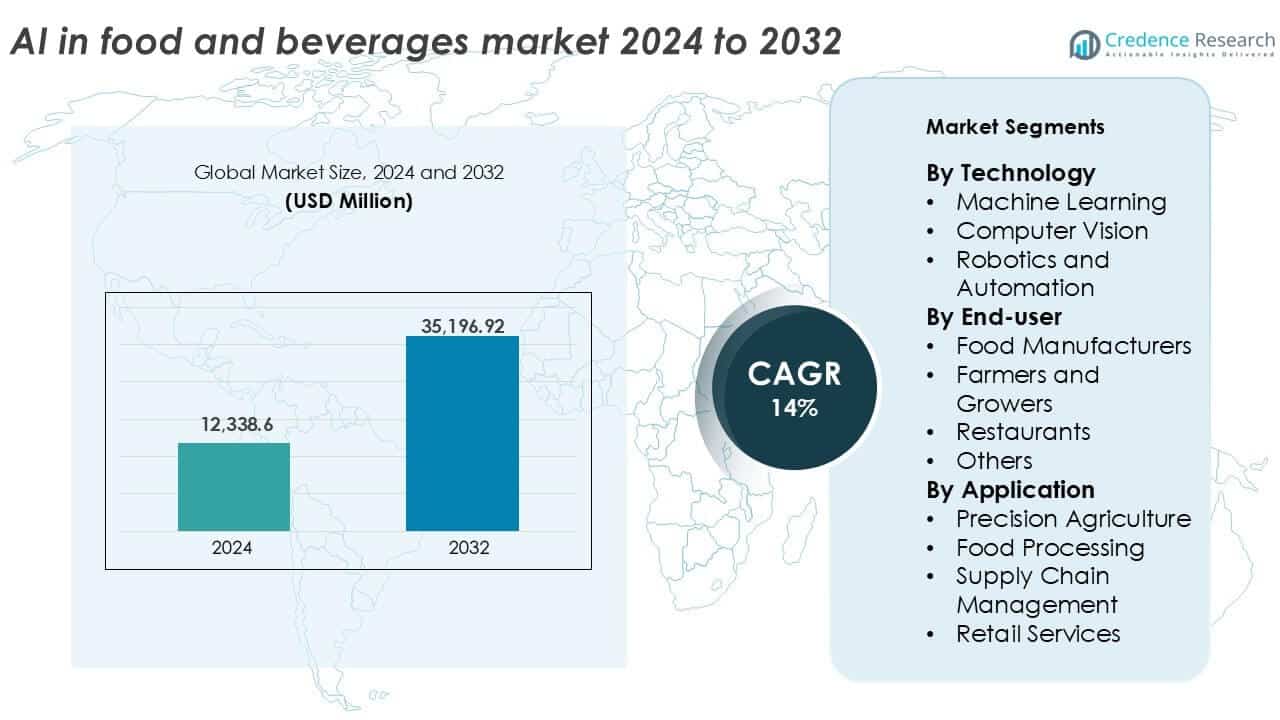
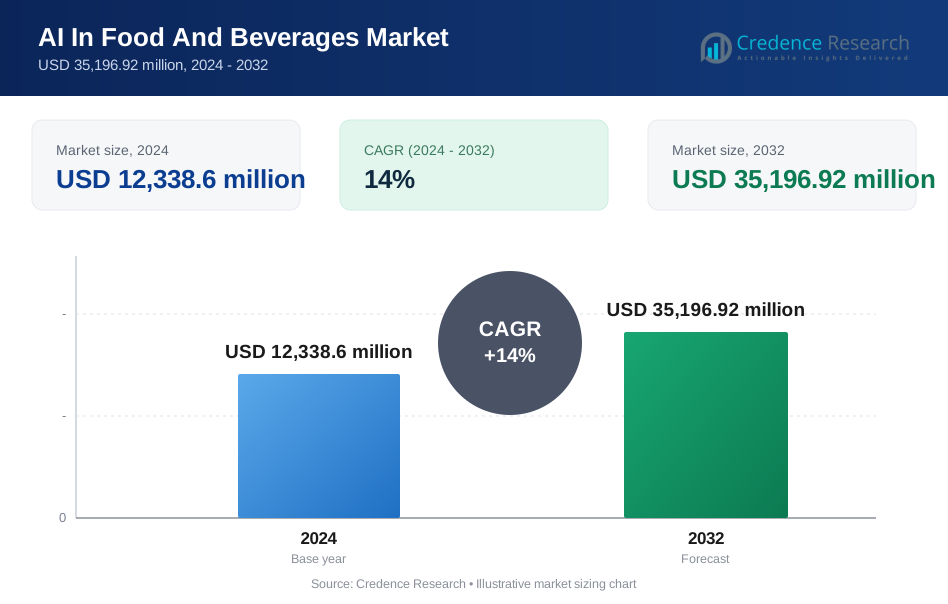
The AI in Food and Beverages Market size was valued at USD 12,338.6 million in 2024 and is anticipated to reach USD 35,196.92 million by 2032, growing at a CAGR of 14% during the forecast period.
| REPORT ATTRIBUTE | DETAILS |
|---|---|
| Historical Period | 2020-2023 |
| Base Year | 2024 |
| Forecast Period | 2025-2032 |
| AI In Food And Beverages Market Size 2024 | USD 12,338.6 million |
| AI In Food And Beverages Market, CAGR | 14% |
| AI In Food And Beverages Market Size 2032 | USD 35,196.92 million |
The AI in food and beverages market is led by key players including IBM Corporation, Microsoft Corporation, Google LLC, SAP SE, NVIDIA Corporation, Rockwell Automation Inc., ABB Ltd., and Honeywell International Inc. These companies dominate due to their advanced AI platforms, strong global presence, and strategic partnerships with food manufacturers. Specialized firms such as TOMRA Sorting Solutions AS, Key Technology Inc., and Impact Vision enhance the ecosystem with AI-based quality control and inspection solutions. North America holds the largest market share at 35% in 2024, driven by early technology adoption, robust infrastructure, and strong presence of AI providers. Europe follows with 25%, supported by investments in food safety and traceability. Asia Pacific shows fast growth with a 22% share, fueled by digital transformation in agriculture and food logistics. These regions drive innovation, while competitive dynamics intensify through mergers, AI-as-a-service models, and expanded end-use applications across the supply chain.
AI In Food And Beverages Market Insights
- The AI in food and beverages market was valued at USD 12,338.6 million in 2024 and is projected to reach USD 35,196.92 million by 2032, expanding at a CAGR of 14% during the forecast period.
- Increasing demand for automation, quality control, and operational efficiency drives AI adoption across food manufacturing, retail, and supply chains.
- Machine learning leads the technology segment with over 40% share, while food processing dominates applications with a 38% market share in 2024.
- Major players include IBM, Microsoft, Google, SAP, and Honeywell, focusing on strategic partnerships, real-time analytics, and AI-as-a-service platforms to expand market presence.
- North America leads the market with 35% share, followed by Europe at 25% and Asia Pacific at 22%, while high implementation costs and data privacy concerns continue to restrain broader adoption in developing regions.
AI In Food And Beverages Market Segmentation Analysis:
By Technology
Machine learning holds the dominant position in the AI in food and beverages market, accounting for over 40% of the market share in 2024. Its wide application across predictive maintenance, quality control, and demand forecasting drives its adoption. Food manufacturers use machine learning to optimize recipes, reduce waste, and personalize offerings. Robotics and automation follow closely, gaining momentum in repetitive tasks like sorting, packaging, and cooking. Computer vision sees rising usage in quality inspection and contamination detection. Increasing demand for operational efficiency and real-time insights fuels the overall segment growth.
- For instance, Coca‑Cola uses AI models to inspect product lines, detecting defects in real time to reduce waste and recalls (AI computer vision use cases).
By End-User
Food manufacturers emerged as the leading end-user in 2024, contributing nearly 45% of the market revenue. AI enables them to enhance production efficiency, ensure food safety, and accelerate innovation cycles. Automation in processing lines and AI-based quality checks support cost control and product consistency. Restaurants adopt AI for smart menu engineering, dynamic pricing, and customer behavior analysis. Farmers and growers leverage AI in crop monitoring and predictive analytics. The 'Others' category, including food delivery platforms, sees rising use of AI in logistics and personalized recommendations.
- For instance, AI vision in restaurants automates food inspection tasks to reduce waste and improve consistency (restaurant computer vision applications).
By Application
Food processing leads the application segment with more than 38% market share in 2024. AI enhances real-time monitoring, anomaly detection, and equipment automation in processing facilities. It ensures consistent product quality while reducing human intervention and operational costs. Precision agriculture is gaining traction among growers using AI for yield prediction, pest detection, and irrigation management. Supply chain management applications are growing due to the need for real-time tracking, inventory optimization, and predictive logistics. AI adoption in retail services supports personalized shopping experiences and targeted promotions.
AI In Food And Beverages Market Key Growth Drivers
Rising Demand for Automation and Operational Efficiency
AI adoption in the food and beverages market accelerates due to the growing need for automation and efficiency. Companies seek to streamline production, reduce waste, and lower labor costs. Machine learning and robotics enable real-time monitoring, predictive maintenance, and automated decision-making across supply chains. Food processors use AI to optimize batch production and manage inventory, reducing downtime and errors. In fast-paced environments like restaurants and packaging lines, AI-powered robots perform repetitive tasks with higher precision and speed. The pressure to meet consumer demand without compromising quality makes AI integration a strategic priority. Efficiency gains also contribute to sustainability goals by minimizing resource use and waste. As margins tighten and operational complexity grows, businesses turn to AI to maintain competitiveness and improve productivity. The return on investment from automation continues to drive strong market interest, especially among large-scale food manufacturers and logistics operators.
- For instance, Tyson Foods invested over $1.3 billion in robotics and automation to modernize meat processing, cutting manual errors and improving throughput
Growing Use of AI in Quality Control and Food Safety
Ensuring food safety and consistent quality drives AI deployment across production and packaging stages. Computer vision systems identify defects, contamination, and labeling errors with high accuracy. Machine learning algorithms analyze sensory data to maintain product standards and predict quality deviations. Real-time data from sensors supports faster decisions and immediate corrective actions, reducing recall risks. AI supports regulatory compliance by automating documentation and traceability throughout the value chain. For example, food manufacturers apply AI to monitor temperature, humidity, and storage conditions to preserve freshness and safety. AI-enabled inspection tools outperform human checks in speed and reliability. As regulatory bodies impose stricter food safety norms, companies rely on AI for continuous monitoring and reporting. This capability builds consumer trust, protects brand reputation, and reduces costs linked to product failure or health risks. The critical need for food integrity continues to push AI adoption deeper into quality control systems.
- For instance, LandingLens AI systems detect anomalies in bulk products like rice or sugar, improving food inspection accuracy.
Personalization and Smart Consumer Insights
AI empowers food companies and retailers to understand evolving consumer preferences and personalize experiences. Algorithms analyze purchase history, dietary habits, and feedback to deliver tailored recommendations and offers. Restaurants use AI to customize menus, forecast demand, and manage dynamic pricing. Smart retail systems predict shopper behavior and enhance engagement with AI-driven promotions and in-store layouts. For food brands, AI tools enable targeted product development by identifying emerging trends from social media and market data. Personalization increases customer loyalty and boosts sales through better alignment with individual needs. In e-commerce platforms, AI assists in guiding meal planning, portion control, and health-focused choices. Growing consumer interest in functional foods, sustainability, and convenience adds further value to personalized solutions. The ability to generate deep consumer insights with minimal human input reshapes marketing and product strategies. As competition intensifies, personalization powered by AI becomes a key differentiator in the market.
AI In Food And Beverages Market Key Trends & Opportunities
Integration of AI with IoT and Blockchain
The convergence of AI with IoT and blockchain creates new possibilities across the food and beverages industry. IoT devices generate real-time data on temperature, storage, and transit conditions. AI analyzes this data to predict spoilage, optimize supply chains, and improve asset utilization. When combined with blockchain, this system provides end-to-end visibility and traceability, enhancing transparency and food safety compliance. Producers and retailers can track the full journey of ingredients from farm to shelf. AI identifies patterns and flags anomalies in blockchain-secured records, preventing fraud and ensuring quality. These technologies also aid in demand forecasting, inventory control, and energy efficiency. As consumers demand clearer information on sourcing and sustainability, such integrations offer trust and accountability. This trend supports value-added services for premium brands and health-conscious buyers. Forward-looking companies that adopt this triad gain a competitive edge through enhanced reliability, agility, and consumer confidence.
- For instance, Walmart deploys millions of IoT sensors across pallets and stores to collect real‑time data on location, temperature, and humidity, enhancing visibility across its supply chain (current deployments in progress).
Expansion of AI-Driven Precision Agriculture
AI-powered precision agriculture is gaining traction as farmers seek to improve yield and reduce input costs. AI systems analyze satellite images, soil health data, and weather forecasts to guide decisions on sowing, irrigation, and fertilization. These insights enable resource optimization and early detection of pests or diseases. Machine learning models improve over time, offering more accurate predictions and recommendations. Drones equipped with AI cameras scan large farmland for real-time crop monitoring and anomaly detection. Automation in agriculture reduces dependence on manual labor while improving consistency. This trend supports sustainable farming by minimizing chemical usage and conserving water. AI-driven platforms also assist small-scale farmers in accessing expert insights through mobile tools. Governments and agri-tech startups invest in AI to support food security and rural development. As climate change increases unpredictability in farming, precision agriculture presents a timely and scalable solution for resilient and productive food systems.
AI In Food And Beverages Market Key Challenges
High Implementation Costs and Technical Complexity
The adoption of AI in the food and beverages sector faces barriers due to high upfront costs and system complexity. Small and mid-sized enterprises often lack the budget and expertise to deploy advanced AI tools. Infrastructure upgrades, sensor installations, and staff training require substantial investment. Customizing AI models for specific operations adds to the cost. The lack of standardization in data formats and interoperability further complicates integration across legacy systems. Technical skill gaps also limit adoption, particularly in rural or underdeveloped regions. Even large firms may face delays in achieving ROI due to steep learning curves and operational disruptions during the transition. Concerns over cybersecurity, data privacy, and system reliability create hesitation in adopting AI at scale. Without clear guidance and cost-effective solutions, many businesses delay or limit AI implementation. Addressing these challenges requires vendor support, public-private partnerships, and scalable AI-as-a-service models.
Data Quality and Regulatory Concerns
AI systems depend heavily on large volumes of high-quality data to function effectively. In the food and beverages sector, inconsistent data collection practices reduce AI accuracy and reliability. Variations in raw material inputs, storage environments, and consumer behavior create fragmented datasets. Poor data governance results in gaps, duplication, or mislabeling, which affect decision-making and model training. Compliance with data protection regulations, such as GDPR, adds another layer of complexity, especially when handling consumer or supply chain data. Regulatory uncertainty around AI ethics, liability, and transparency hinders full-scale deployment. Companies must ensure their AI processes align with safety, privacy, and ethical standards. Building trust in AI outcomes also remains a challenge due to the “black box” nature of some algorithms. To overcome this, organizations need clear protocols for data quality, documentation, and accountability. Strong regulatory frameworks and industry collaboration are critical to foster responsible and effective AI adoption.
AI In Food And Beverages Market Regional Analysis
North America
North America led the AI in food and beverages market in 2024, accounting for over 35% of global revenue. The U.S. drives this dominance with widespread AI adoption across food manufacturing, QSR chains, and retail. Strong investment in food tech, supportive digital infrastructure, and early AI integration contribute to the region’s lead. Companies use AI to streamline operations, automate quality control, and enhance customer engagement. Leading players such as IBM, Microsoft, and Google partner with food producers for AI-powered platforms. Favorable regulatory frameworks and growing demand for personalized food services continue to strengthen market momentum across North America.
Europe
Europe captured around 25% of the global AI in food and beverages market in 2024, driven by innovation in food safety, traceability, and sustainability. Countries like Germany, France, and the Netherlands invest in AI for smart agriculture, supply chain visibility, and food waste reduction. The region promotes ethical AI use and compliance with data privacy regulations, encouraging transparency. EU-based companies integrate AI with blockchain and IoT for food origin tracking and safety compliance. Rising demand for plant-based, organic, and personalized food products also supports AI deployment. Government support for agri-tech and food automation further boosts adoption across Europe.
Asia Pacific
Asia Pacific held approximately 22% market share in 2024, with rapid growth led by China, Japan, and India. The region benefits from rising demand for food automation, urbanization, and digital transformation in agriculture. China’s large-scale food producers and tech firms integrate AI to meet efficiency and safety demands. India sees increasing use of AI in supply chains and smart farming, supported by agri-tech startups. Japan focuses on robotics in food processing and AI-enabled retail. Population growth, food security needs, and government support for AI innovation drive strong market expansion across Asia Pacific’s diverse economies and food sectors.
Latin America
Latin America accounted for close to 10% of the global AI in food and beverages market in 2024. Brazil and Mexico lead adoption, particularly in food processing and logistics. Regional companies implement AI for demand forecasting, inventory optimization, and predictive maintenance. Agriculture-focused AI applications gain traction in coffee, soy, and fruit production. Challenges include limited digital infrastructure and funding for small and mid-sized firms. However, improving mobile connectivity and government agri-digital initiatives create growth opportunities. Food exporters in the region adopt AI to meet international quality standards and enhance traceability. The market shows steady growth as AI solutions become more accessible.
Middle East and Africa (MEA)
The Middle East and Africa held a modest 8% market share in 2024, but the region is witnessing growing interest in AI for food safety and smart farming. Gulf countries invest in AI to support food security and reduce import reliance. The UAE and Saudi Arabia integrate AI in vertical farming, food logistics, and retail analytics. In Africa, AI-enabled solutions assist in pest detection, soil monitoring, and weather prediction, especially in Kenya and South Africa. Challenges such as infrastructure gaps and skill shortages limit large-scale deployment. However, increasing investments and pilot programs indicate long-term growth potential in MEA.
AI In Food And Beverages Market Segmentations:
By Technology
- Machine Learning
- Computer Vision
- Robotics and Automation
By End-user
- Food Manufacturers
- Farmers and Growers
- Restaurants
- Others
By Application
- Precision Agriculture
- Food Processing
- Supply Chain Management
- Retail Services
By Geography
- North America
- U.S.
- Canada
- Mexico
- Europe
- Germany
- France
- U.K.
- Italy
- Spain
- Rest of Europe
- Asia Pacific
- China
- Japan
- India
- South Korea
- South-east Asia
- Rest of Asia Pacific
- Latin America
- Brazil
- Argentina
- Rest of Latin America
- Middle East & Africa
- GCC Countries
- South Africa
- Rest of the Middle East and Africa
AI In Food And Beverages Market Competitive Landscape
The competitive landscape in the AI in food and beverages market features a mix of global technology leaders, specialized food-tech firms, and automation solution providers. Key players such as IBM Corporation, Microsoft Corporation, Google LLC, SAP SE, and NVIDIA Corporation offer AI platforms that support predictive analytics, computer vision, and machine learning across the food value chain. Companies like Rockwell Automation Inc., ABB Ltd., and Honeywell International Inc. focus on AI-driven automation in processing and packaging operations. Food-specific innovators such as TOMRA Sorting Solutions AS, Key Technology Inc., and Impact Vision provide vision systems for quality inspection and sorting. Emerging firms including Sight Machine Inc. and INTELLIGENT Brewing Co. bring niche AI solutions tailored to production optimization and beverage innovation. Strategic partnerships, acquisitions, and R&D investments drive competition. Companies focus on enhancing AI accuracy, reducing deployment costs, and expanding real-time analytics capabilities to maintain market share and strengthen client engagement in this fast-evolving space.
Key Player Analysis
- ABB Ltd.
- Buhler Group
- Google LLC
- Honeywell International Inc.
- IBM Corporation
- Impact Vision
- INTELLIGENT Brewing Co.
- Key Technology Inc.
- Microsoft Corporation
- Milltec Clarfai, Inc.
- NVIDIA Corporation
- Raytec Vision SpA
- Rockwell Automation Inc.
- SAP SE
- Sight Machine Inc.
- TOMRA Sorting Solutions AS
Recent Developments
- In April 2025, GrubMarket acquired Delta Fresh Produce, extending its AI-powered supply-chain platform into Mexico.
- In January 2024, YELP introduced more than 20 new updates in the AI-powered services, which will help in developing AI-powered business summaries for quickly finding businesses based on preferences, a visually appealing home feed for rapidly finding new favorite restaurants, AI-powered smart budgets and many more features.
- In January 2024, A multi-day trade event, CES 2024, was a huge event in which AI-powered appliances, chef-like robots, and different high-tech kitchen gadgets were showcased. Such events are highly useful in hosting AI integration in the food and beverage industry.
Report Coverage
The research report offers an in-depth analysis based on Technology, End-User, Application and Geography. It details leading market players, providing an overview of their business, product offerings, investments, revenue streams, and key applications. Additionally, the report includes insights into the competitive environment, SWOT analysis, current market trends, as well as the primary drivers and constraints. Furthermore, it discusses various factors that have driven market expansion in recent years. The report also explores market dynamics, regulatory scenarios, and technological advancements that are shaping the industry. It assesses the impact of external factors and global economic changes on market growth. Lastly, it provides strategic recommendations for new entrants and established companies to navigate the complexities of the market.
Future Outlook
- AI adoption will accelerate across food processing and packaging for real-time quality control.
- Food manufacturers will integrate AI with IoT to enhance predictive maintenance and reduce downtime.
- Restaurants will use AI to personalize menus and improve dynamic pricing strategies.
- AI-powered supply chain systems will support demand forecasting and reduce food waste.
- Retailers will deploy AI for consumer behavior analysis and personalized shopping experiences.
- Precision agriculture will grow with AI-driven crop monitoring and yield optimization tools.
- Startups will offer cloud-based AI solutions tailored for small and mid-sized food businesses.
- Investments will increase in AI-based food safety, traceability, and regulatory compliance tools.
- Partnerships between tech firms and food producers will expand AI application across value chains.
- AI solutions will become more accessible as costs decline and regulatory clarity improves.
Request a Free Sample
Fill in your details and we'll send you a free sample report.
- Sample data tables & charts
- Research methodology
Need a Custom Version of This Report?
Tailor the scope, geography, or segments to your exact requirements.
- Custom geography or segment scope
- Direct access to our analyst team
Frequently Asked Questions
What is the current market size for AI in food and beverages market, and what is its projected size in 2032?
At what Compound Annual Growth Rate is the AI in food and beverages market projected to grow between 2024 and 2032?
Which AI in food and beverages market segment held the largest share in 2024?
What are the primary factors fueling the growth of the AI in food and beverages market?
Who are the leading companies in the AI in food and beverages market?
Which region commanded the largest share of the AI in food and beverages market in 2024?
Table of Content
Chapter 1. Report Introduction
- 1.1 Report Description & Purpose
- 1.1.1 Report Title & Market Definition
- 1.1.2 Unique Selling Propositions (USP) & Key Differentiators
- 1.1.3 Value Proposition for Stakeholders
- 1.2 Research Objectives
- 1.2.1 Market Sizing Objectives (Volume & Revenue)
- 1.2.2 Segmentation Objectives
- 1.2.3 Competitive Intelligence Objectives
- 1.2.4 Forecast & Scenario Objectives
- 1.3 Report Scope
- 1.3.1 AI In Food And Beverages Scope – Types & Subtypes Covered
- 1.3.2 Geographic Scope – Regions & Countries Covered
- 1.3.3 Historical Period, Base Year & Forecast Period (2024; forecast to 2032)
- 1.3.4 Inclusions & Exclusions
- 1.4 HS Code & Classification Framework
- 1.5 Currency, Units & Pricing Basis
- 1.6 Target Stakeholders
- 1.7 Limitations & Assumptions
Chapter 2. Executive Summary
- 2.1 Global AI In Food And Beverages Market Snapshot
- 2.1.1 Market Size – Historical (2024) & Forecast (2024-2032) (2024: USD 12,338.6 million → 2032: USD 35,196.92 million)
- 2.1.2 Volume & Revenue – Global Totals
- 2.1.3 Key Market Highlights – Top Five Facts
- 2.2 AI In Food And Beverages Market Segmentation Snapshot
- 2.2.1 Market Split by Region – 2024 vs. 2032
- 2.3 Competitive Snapshot
- 2.3.1 Top 10 Players by Revenue Share – 2024
- 2.3.2 Top 10 Players by Volume Share – 2024
- 2.3.3 Recent Strategic Developments (18-Month Summary)
- 2.4 Key Investment Highlights & Strategic Conclusions
Chapter 3. AI In Food And Beverages Market Dynamics & Industry Analysis
- 3.1 Market Overview & Context
- 3.1.1 AI In Food And Beverages Market Position in the Broader Automotive Value Chain
- 3.1.2 OEM vs. Replacement Market Dynamics
- 3.1.3 Market Maturity & Development Stage by Region
- 3.2 AI In Food And Beverages Market Drivers
- 3.3 AI In Food And Beverages Market Restraints & Challenges
- 3.4 AI In Food And Beverages Market Opportunities
- 3.5 Porter's Five Forces Analysis
- 3.5.1 Threat of New Entrants
- 3.5.2 Bargaining Power of Suppliers
- 3.5.3 Bargaining Power of Buyers
- 3.5.4 Threat of Substitutes
- 3.5.5 Competitive Rivalry – Intensity Assessment
- 3.6 AI In Food And Beverages Value Chain Analysis
- 3.6.1 Upstream – Raw Material/Input Suppliers
- 3.6.1.1 Raw Material/Input 1
- 3.6.1.2 Raw Material/Input 2
- 3.6.1.3 Raw Material/Input 3
- 3.6.2 Midstream – Production/Manufacturing/Service Delivery
- 3.6.2.1 Production/Process Overview
- 3.6.2.2 Key Facility Locations & Capacity by Manufacturer
- 3.6.3 Downstream – Distribution & End Consumer
- 3.6.3.1 Primary Channel – B2B/OEM
- 3.6.3.2 Secondary Channels – Dealer, Retail, Online, Direct
- 3.6.4 Value Chain Profitability Analysis
- 3.6.1 Upstream – Raw Material/Input Suppliers
- 3.7 PESTEL Analysis
- 3.7.1 Political Factors
- 3.7.2 Economic Factors
- 3.7.3 Social Factors
- 3.7.4 Technological Factors
- 3.7.5 Environmental Factors
- 3.7.6 Legal Factors
- 3.8 AI In Food And Beverages Supply Chain Analysis
- 3.8.1 Raw Material/Input Supply Risk Assessment
- 3.8.2 Manufacturing Concentration Risk (Geographic Exposure)
- 3.8.3 Trade Disruption Impact Analysis
- 3.9 Regulatory & Policy Landscape
Note: The regulatory and policy landscape section covers regulations based on their applicability to the market, AI In Food And Beverages category, geography, and scope of the study. Only regulatory frameworks with a material impact on operations, compliance, trade, sustainability, or market access are analyzed in detail.
Chapter 4. Key Investment Pockets & Opportunity Analysis
- 4.1 AI In Food And Beverages Market Attractiveness Analysis
- 4.1.1 By Region – Investment Attractiveness Matrix (Volume × CAGR)
- 4.2 Absolute Revenue Growth Opportunity
- 4.2.1 By Region – Absolute USD Growth Through 2032
- 4.3 Incremental Volume Opportunity
- 4.3.1 By Region – Incremental Volume Through 2032
- 4.3.2 Segment – Incremental Volume
- 4.4 Emerging Submarket Opportunity Deep Dive (Subject to Applicability)
- 4.5 Emerging Market Opportunity Scorecards
- 4.5.1 United States
- 4.5.2 Europe
- 4.5.3 Asia
- 4.5.4 Middle East & Africa
Note: Emerging Market Opportunity Scorecards will be included based on relevance and strategic importance. Regions listed are indicative and may vary depending on data availability and market dynamics.
Chapter 5. AI In Food And Beverages Import-Export Analysis & Trade Flows
- 5.1 Global Trade Overview
- 5.1.1 Global Export Value by Country (2024)
- 5.1.2 Global Export Volume by Country (2024)
- 5.1.3 Global Import Value by Country (2024)
- 5.1.4 Global Import Volume by Country (2024)
- 5.1.5 Net Trade Balance by Country (2024)
- 5.2 Export Analysis – Segment
- 5.2.1 Type 1 (HS Code)
- 5.2.2 Type 2 (HS Code)
- 5.2.3 Type 3 (HS Code)
- 5.2.4 Type 4 (HS Code)
- 5.2.5 Type 5 (HS Code)
- 5.3 Import Analysis – Segment
- 5.3.1 Type 1 (HS Code)
- 5.3.2 Type 2 (HS Code)
- 5.3.3 Type 3 (HS Code)
- 5.3.4 Type 4 (HS Code)
- 5.3.5 Type 5 (HS Code)
- 5.4 Average Unit Trade Prices
- 5.4.1 Average Export Price – Segment & Country
- 5.4.2 Average Import Price – Segment & Source Country
- 5.4.3 Price Trends (2024)
- 5.5 Key Trade Route Analysis
- 5.5.1 Trade Route 1
- 5.5.2 Trade Route 2
- 5.5.3 Trade Route 3
- 5.5.4 Trade Route 4
- 5.5.5 Trade Route 5
- 5.6 Trade Policy Impact Assessment
- 5.6.1 US Anti-Dumping & Section 301 Tariffs
- 5.6.2 EU Customs Union Impact
- 5.6.3 Major Free Trade Agreements
- 5.6.4 USMCA Rules of Origin
Note: Trade policy analysis will be included only where relevant to the AI In Food And Beverages market.
Chapter 6. Competitive Landscape & Company Benchmarking
- 6.1 AI In Food And Beverages Market Concentration & Structure
- 6.1.1 Herfindahl-Hirschman Index (HHI) – vs. 2024
- 6.1.2 Tier 1, Tier 2 & Tier 3 Market Structure
- 6.1.3 Global, Regional & Local Player Dynamics
- 6.2 AI In Food And Beverages Market Share Analysis – 2024
- 6.2.1 Global Revenue Share by Company
- 6.2.2 Global Volume Share by Company
- 6.2.3 Regional Revenue Share
- 6.2.4 Market Share Evolution ( vs. 2024)
- 6.2.5 OEM Segment Share by Company
- 6.2.6 Replacement Segment Share by Company
- 6.3 Production/Delivery Capacity & Facility Analysis
- 6.3.1 Global Installed Capacity
- 6.3.2 Capacity Utilization Rates
- 6.3.3 Production/Output Volume
- 6.3.4 Facility Locations & Capacity Map
- 6.3.5 Planned Capacity Additions
- 6.4 AI In Food And Beverages Competitive Benchmarking Matrix
- 6.4.1 Revenue, Volume, CAGR & Profitability Comparison
- 6.4.2 Channel Revenue Mix
- 6.4.3 Geographic Revenue Exposure
- 6.4.4 R&D Intensity
- 6.4.5 Sustainability Maturity
- 6.5 Strategic Developments in AI In Food And Beverages (Last 24 Months)
- 6.5.1 Mergers, Acquisitions & Divestments
- 6.5.2 New AI In Food And Beverages Launches
- 6.5.3 Facility Expansions
- 6.5.4 Strategic Alliances, Joint Ventures & Partnerships
- 6.5.5 Distribution Expansion & Market Entry
- 6.5.6 Sustainability & ESG Initiatives
- 6.6 Competitive Strategy Mapping
- 6.6.1 Leader, Challenger, Follower & Niche Classification
- 6.6.2 Pricing Strategy Comparison
- 6.6.3 Channel Strategy Matrix
Note: Strategic developments are included based on their materiality and the availability of reliable information.
Chapter 7. Global AI In Food And Beverages Market – By Distribution Channel
- 7.1 Segment Overview
- 7.1.1 Volume & Revenue Split by Channel (2024 & 2032)
- 7.1.2 Channel Mix Evolution (2024-2032)
Chapter 8. Regional Market Analysis – Global Overview
- 8.1 Global Regional Overview
- 8.1.1 Regional Volume Share
- 8.1.2 Regional Revenue Share
- 8.1.3 Regional Volume by Region
- 8.1.4 Regional Revenue by Region
- 8.1.5 Regional Forecast Through 2032
- 8.2 Cross-Regional Segment Analysis
- 8.2.1 By Distribution Channel
- 8.2.2 By Brand/Price Tier
Chapter 9. North America AI In Food And Beverages Market
- 9.1 United States
- 9.2 Canada
- 9.3 Mexico
Chapter 10. Europe AI In Food And Beverages Market
- 10.1 Germany
- 10.2 France
- 10.3 Italy
- 10.4 United Kingdom
- 10.5 Spain
- 10.6 Poland
- 10.7 Russia
- 10.8 Netherlands
- 10.9 Belgium
- 10.10 Sweden
- 10.11 Denmark
- 10.12 Norway
- 10.13 Rest of Europe
Chapter 11. Asia Pacific AI In Food And Beverages Market
- 11.1 China
- 11.2 India
- 11.3 Japan
- 11.4 South Korea
- 11.5 Thailand
- 11.6 Indonesia
- 11.7 Vietnam
- 11.8 Malaysia
- 11.9 Australia
- 11.10 Rest of Asia Pacific
Chapter 12. Latin America AI In Food And Beverages Market
- 12.1 Brazil
- 12.2 Argentina
- 12.3 Colombia
- 12.4 Chile
- 12.5 Rest of Latin America
Chapter 13. Middle East AI In Food And Beverages Market
- 13.1 Saudi Arabia
- 13.2 United Arab Emirates
- 13.3 Turkey
- 13.4 Israel
- 13.5 Iran
- 13.6 Rest of the Middle East
Chapter 14. Africa AI In Food And Beverages Market
- 14.1 South Africa
- 14.2 Egypt
- 14.3 Nigeria
- 14.4 Morocco
- 14.5 Rest of Africa
Chapter 15. AI In Food And Beverages Company Profiles
- 15.1 [Company 01]
- 15.1.1 Company Overview
- 15.1.2 Key Management Personnel
- 15.1.3 Products & Services Portfolio
- 15.1.4 Financial Performance
- 15.1.5 Key Market Focus & Geographic Presence
- 15.1.6 Recent Developments & Strategic Initiatives
Note: The company profile list is preliminary and may change based on research findings, market developments, data availability, and client requirements.
Chapter 16. Appendices
- Appendix A – List of Abbreviations & Acronyms
- Appendix B – Industry Classification Code Reference – Full Series
- Appendix C – Production & Capacity Data Tables
- Appendix D – End-Use & Demand Base Tables
- Appendix E – Consumption & Replacement Rate Assumptions
- Appendix F – ASP Reference Tables
- Appendix G – Manufacturing & Facility Database
- Appendix H – Import-Export Data Tables
- Appendix I – Regulatory Summary Tables
- Appendix J – Primary Research Participant List (Anonymized)
- Appendix K – Primary Research Questionnaire Framework
- Appendix L – Data Sources & Bibliography
- Appendix M – Market Size Divergence & Source Comparison
Chapter 17. Research Methodology
- 17.1 Research Framework & Philosophy
- 17.2 Secondary Research – Sources, Hierarchy & Data Extraction
- 17.3 Data Modeling – Bottom-Up & Top-Down Market Sizing
- 17.4 Primary Research – Stakeholder Framework, LOI & Sample Sizes
- 17.5 Forecast Methodology – Regression, Scenario & Sensitivity Analysis
- 17.6 Quality Control – Four-Layer Validation Framework
- 17.7 Limitations & Standard Assumptions
- 17.8 Disclaimer
