
Market Overview:
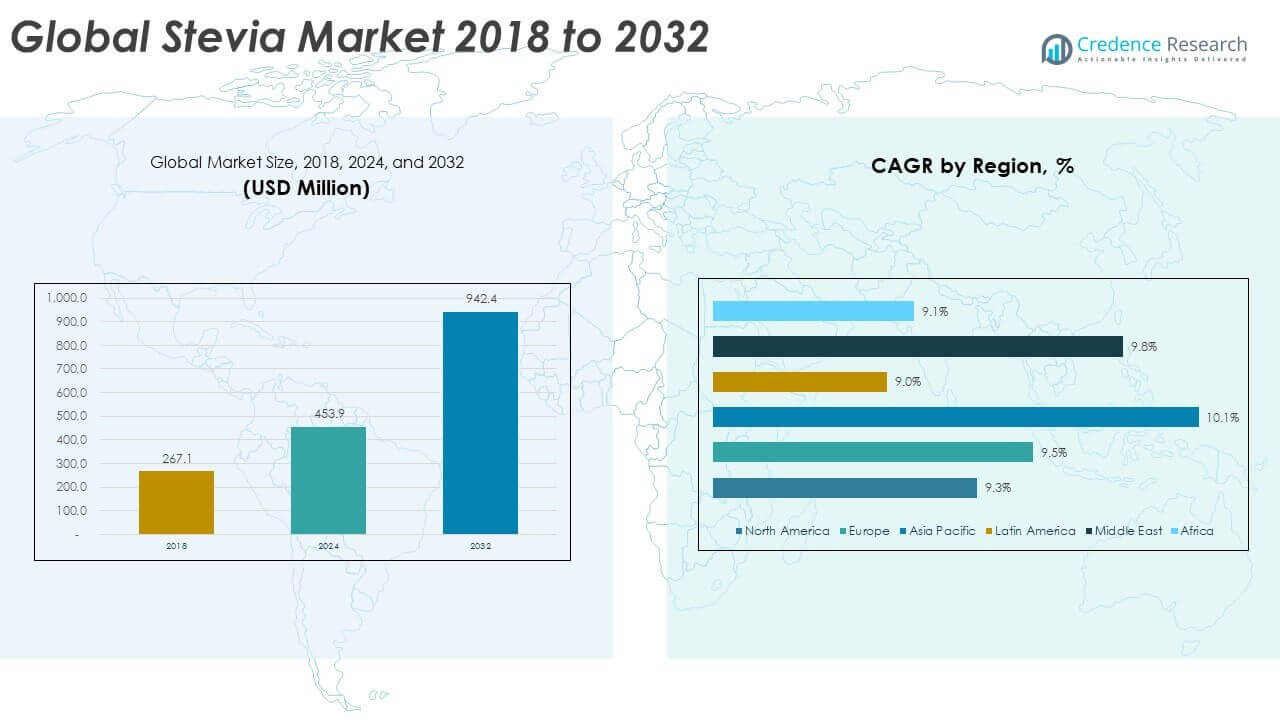
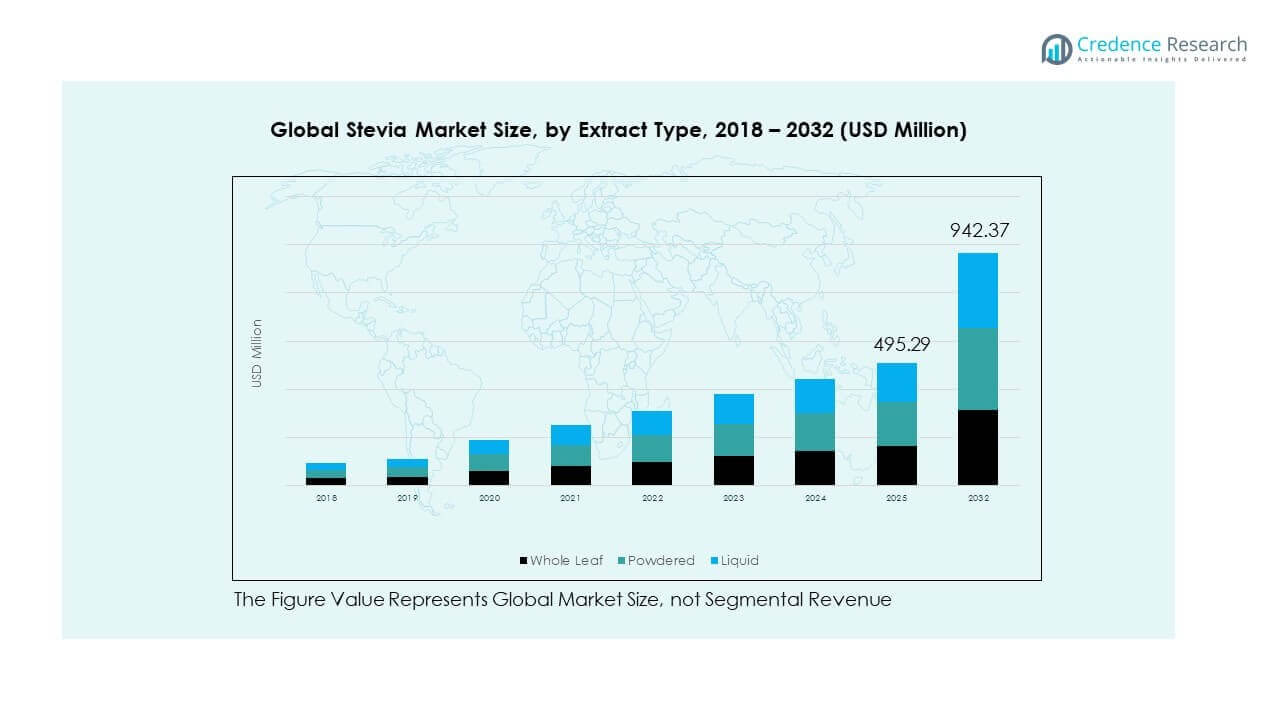
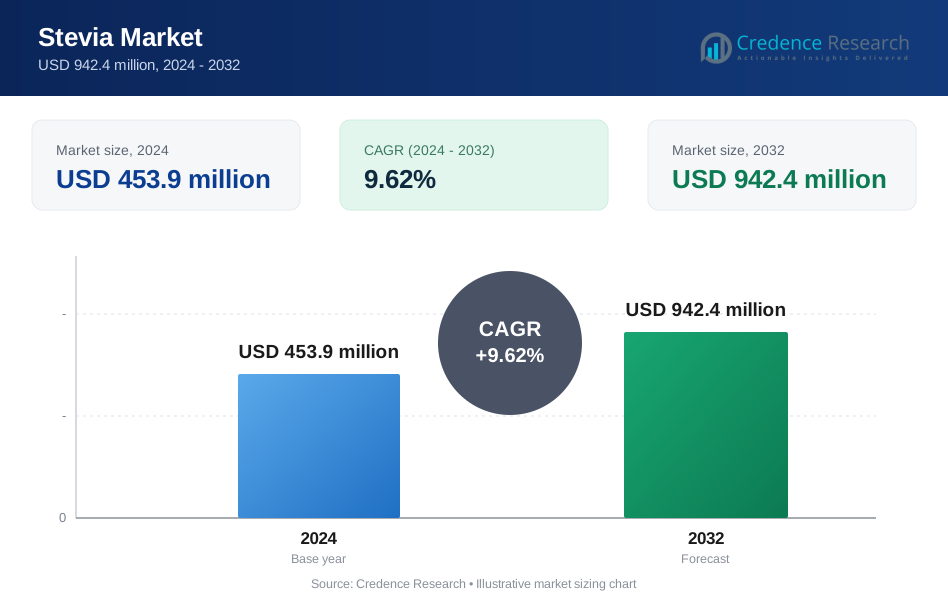
The Global Stevia Market size was valued at USD 267.1 million in 2018 to USD 453.9 million in 2024 and is anticipated to reach USD 942.4 million by 2032, at a CAGR of 9.62% during the forecast period.
| REPORT ATTRIBUTE | DETAILS |
|---|---|
| Historical Period | 2020-2023 |
| Base Year | 2024 |
| Forecast Period | 2025-2032 |
| Stevia Market Size 2024 | USD 453.9 million |
| Stevia Market, CAGR | 9.62% |
| Stevia Market Size 2032 | USD 942.4 million |
The market is gaining momentum due to increased health awareness and a shift away from artificial sweeteners. Food and beverage manufacturers are reformulating products to meet clean-label trends and reduce calorie content. Stevia’s zero-calorie, plant-based origin makes it attractive for diabetic and weight-conscious consumers. Regulatory support across major regions supports large-scale adoption. High-purity Reb M and D extracts now offer better taste, widening stevia’s appeal across mainstream segments. Innovation in extraction techniques and blending helps address earlier taste limitations. Demand continues to grow in snacks, dairy, and carbonated beverages. Consumers now seek natural sweeteners in daily-use products.
Asia Pacific leads the Global Stevia Market, supported by strong production capacity in China and growing domestic use in Japan, India, and Southeast Asia. North America shows high consumer preference for clean-label and non-GMO sweeteners, particularly in beverages and wellness snacks. Europe is adopting stevia due to sugar taxes and demand for organic alternatives. Latin America and the Middle East are emerging due to rising health concerns and growing urban populations. Africa shows early-stage development with growing interest in diabetic-friendly foods. Regional growth depends on affordability, consumer education, and retail access. Leading companies target these areas through tailored formulations and distribution partnerships.
Market Insights:
- The Global Stevia Market was valued at USD 267.1 million in 2018, reached USD 453.9 million in 2024, and is projected to hit USD 942.4 million by 2032, growing at a CAGR of 9.62%.
- Asia Pacific leads with 35.6% market share in 2024 due to large-scale cultivation, local demand, and favorable regulations; North America follows at 20.9% with strong clean-label trends, and Europe at 22.0% supported by sugar tax compliance and organic demand.
- Asia Pacific is the fastest-growing region with a CAGR of 10.1%, driven by expansion in China, Japan, and India, supported by rising health awareness and industrial investment.
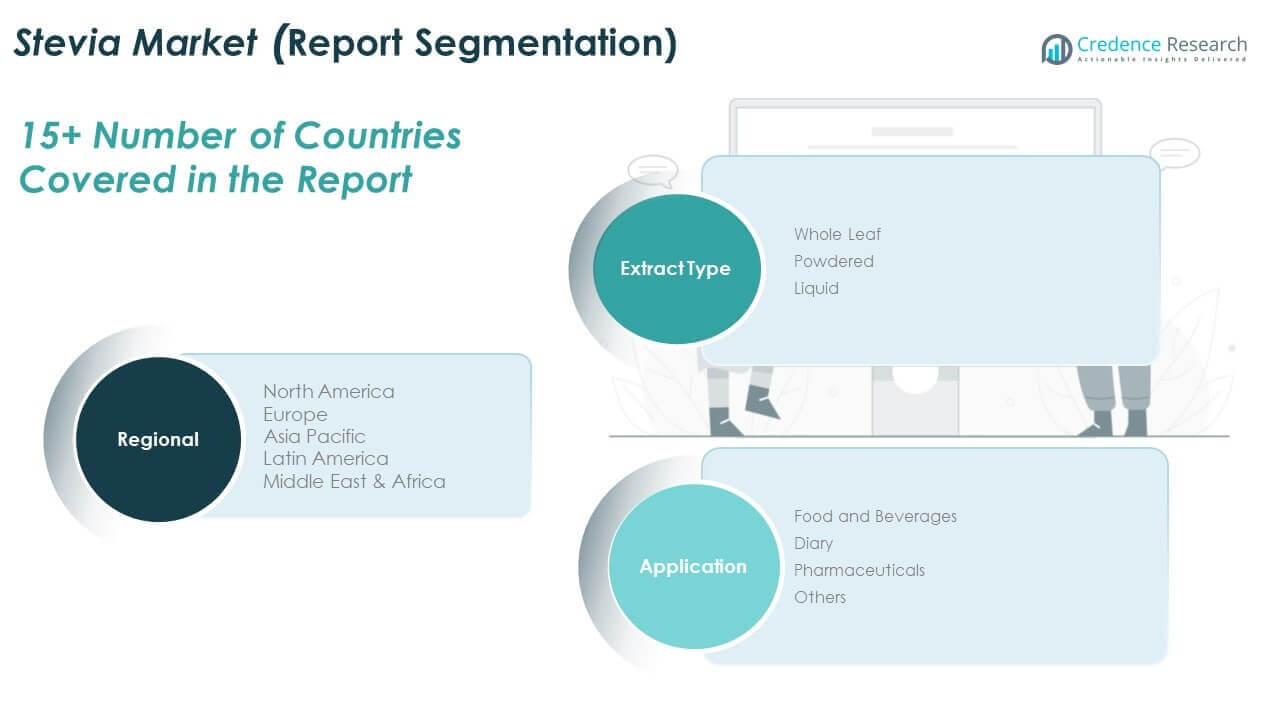
- By extract type, powdered stevia accounts for the largest segment at 52.5% in 2024, owing to its wide use in packaged beverages, dairy, and tabletop sweeteners.
- Liquid stevia holds approximately 26.5% share, gaining traction for its solubility, ease of use, and adoption in functional drinks and health-focused applications.
Market Drivers
Rising Consumer Awareness of Sugar-Linked Health Issues and Preference for Natural Sweeteners
Consumers worldwide are avoiding high-calorie and artificial sweeteners due to rising diabetes and obesity cases. The shift toward plant-based diets supports demand for natural sugar alternatives. The Global Stevia Market benefits from this preference for clean-label, plant-derived products. Stevia appeals to health-conscious buyers seeking calorie reduction without compromising taste. It also suits diabetic individuals due to its non-glycemic nature. This health-centric shift influences food manufacturers to reformulate products. Beverages, snacks, and dairy products now often include stevia-based blends. Brands are leveraging this shift to promote wellness-oriented product lines.
- For instance, Truvia, developed by Coca‑Cola and Cargill in 2008, is a stevia leaf extract–based sweetener blended with erythritol and marketed as America’s stevia-based sweetener in retail sales.
Growing Demand for Sugar Substitutes in the Beverage and Packaged Food Industries
Food and beverage companies face pressure to reduce sugar content without sacrificing flavor. Stevia serves this need due to its high sweetness intensity and natural origin. The Global Stevia Market sees strong interest from carbonated drink and flavored water manufacturers. Companies seek alternatives that comply with sugar taxes in various countries. Stevia enables them to meet reformulation goals without synthetic additives. Ready-to-drink teas, energy drinks, and flavored yogurts widely adopt stevia. Its stability under heat and pH variation expands usage across food formats. Manufacturers highlight its natural profile to gain consumer trust.
- For instance, Zevia produces a full line of zero‑calorie beverages sweetened exclusively with stevia leaf extract and, by 2016, became the first major U.S. brand to use only stevia across its entire product portfolio, with availability in over 35,000 retail locations.
Supportive Regulatory Approvals Across Key Markets Fuel Adoption in Packaged Goods
Stevia has received approval from major regulatory bodies such as FDA, EFSA, and JECFA. These approvals enhance trust and allow safe incorporation in processed food and beverages. The Global Stevia Market benefits from this recognition, which simplifies global product launches. With regulatory clarity, companies introduce new offerings without reformulation risks. Foodservice chains also integrate stevia in low-calorie menu options. Regulatory frameworks protect consumers and reduce adoption hesitancy among manufacturers. This also encourages investment in stevia cultivation and extraction infrastructure. Regions with clear rules witness faster commercial uptake.
Innovation in Stevia Extraction and Blending Technology Enhancing Taste and Functionality
Taste has long been a barrier to wider adoption of stevia in mainstream food applications. Recent innovations in glycoside isolation and enzymatic processing now improve flavor profiles. The Global Stevia Market now includes rebaudioside M and D extracts that reduce bitterness. These high-purity blends offer a clean finish, better resembling sugar. Manufacturers are developing custom stevia-sugar blends to meet regional taste preferences. Technology enables better solubility and stability, extending shelf life. Stevia is now easier to use across confectionery and bakery categories. Taste-masking techniques enhance acceptance across broader consumer groups.
Market Trends
Expansion of Stevia Use in Sports Nutrition and Functional Health Products
Brands increasingly use stevia in protein powders, electrolyte drinks, and energy bars. These products target athletes and fitness-conscious consumers avoiding added sugars. The Global Stevia Market gains from its compatibility with high-performance nutrition formats. Clean-label claims in sports nutrition align well with natural sweeteners. Formulators adopt stevia for both sweetening and supporting a low-carb profile. With a rise in home workouts and active lifestyles, demand for these products has increased. Functional beverages now blend stevia with caffeine, adaptogens, and electrolytes. Consumer preference for healthy indulgence continues to drive this trend.
- For instance, Huel’s Black Edition meal replacement and nutrition products use stevia extract for sweetness in its plant‑based formula, replacing artificial sweeteners and addressing consumer demand for cleaner ingredients.
Integration of Stevia in Bakery and Confectionery as New Formulations Improve Flavor Profile
Manufacturers now develop cookies, pastries, and candies sweetened with stevia. Past concerns around taste and aftertaste are addressed through advanced formulations. The Global Stevia Market finds new demand in sugar-free and reduced-calorie baked goods. These offerings serve diabetic, keto, and wellness-oriented consumers. Bakers use stevia blends to replicate sugar’s sweetness and moisture functions. Improved bulking agents support consistent textures and better mouthfeel. The confectionery segment adapts through chocolate, gum, and lozenges with stevia. Shelf-stable, low-sugar products are gaining traction in mass retail.
- For instance, GLG Life Tech’s BakeZeroCal™ stevia‑erythritol blend is formulated for bakery and confectionery applications, offering sucrose‑like sweetness and zero calories in baked goods, desserts, and fillings.
Stevia Adoption in Emerging Economies Driven by Urbanization and Retail Penetration
Urban centers in Latin America, Asia, and Africa are adopting healthier dietary patterns. Stevia-based drinks and foods are reaching wider demographics through modern retail. The Global Stevia Market benefits from rising incomes and brand exposure in these regions. Multinational companies launch stevia-based products through established FMCG channels. Local players adapt recipes to regional palettes using stevia blends. Government awareness programs on sugar control aid market entry. Distribution via e-commerce and quick commerce platforms further expands accessibility. Packaged goods with stevia are becoming more visible across supermarkets and hypermarkets.
Steady Growth in Organic and Non-GMO Certified Stevia Products Across Markets
Organic and non-GMO product lines see strong consumer loyalty in developed regions. These certifications add value in markets with ingredient transparency preferences. The Global Stevia Market includes growing portfolios of certified offerings by leading suppliers. Retailers support these by adding dedicated health and wellness product shelves. Ingredient traceability improves through blockchain-backed supply chains. Organic stevia is used in premium applications such as infant food and beverages. Consumers view such products as safer and more sustainable. Companies differentiate themselves with ethical sourcing and certification-backed branding.
Market Challenges Analysis
High Production and Processing Costs Limit Profitability and Mass Market Penetration
Extraction of steviol glycosides involves complex processes that require specialized equipment. Purifying high-intensity sweeteners like Reb M or Reb D raises operational costs. The Global Stevia Market faces challenges in achieving cost parity with synthetic sweeteners. This pricing gap slows adoption in cost-sensitive segments like foodservice. Cultivation also depends on specific climate conditions, impacting year-round yield. Farmers require technical support and reliable buyers to maintain output consistency. Investments in research and scaling are needed to reduce per-unit costs. Without price competitiveness, stevia remains limited to premium product lines.
Taste Acceptance and Functional Constraints in Specific Food Categories Still Persist
Despite advancements, stevia’s bitter aftertaste remains a concern for some applications. It underperforms in high-sugar recipes where texture, bulk, and caramelization matter. The Global Stevia Market still needs better masking agents and bulking innovations. In some dairy and bakery items, stevia alters product consistency or finish. Consumers often compare it to sugar, expecting a perfect match in flavor. Taste trials often require multiple iterations before full formulation success. Some food scientists prefer sugar blends over pure stevia to meet sensory targets. Taste familiarity still dominates purchasing behavior in many cultures.
Market Opportunities
Expansion into Pharmaceuticals, Oral Care, and Animal Feed Sectors Opens New Demand Channels
Stevia's safe profile makes it suitable for health-related use cases beyond food. The Global Stevia Market finds potential in oral care products like toothpaste and mouthwash. Pharmaceutical syrups and nutraceuticals benefit from its non-cariogenic properties. Animal feed formulations seek stevia for improved palatability and metabolic control. These segments create year-round demand with less seasonal fluctuation. Brands can tap into specialized B2B distribution networks. Diversification into such industries helps stabilize market risks from food pricing cycles.
Strategic Collaborations with FMCG Brands and Contract Manufacturers to Accelerate Adoption
Collaborations between ingredient suppliers and CPG firms enhance product development. The Global Stevia Market benefits from co-branded launches across regions. Suppliers can offer tailored extracts aligned with brand positioning needs. Joint ventures help localize formulations for target demographics. These partnerships also speed up regulatory compliance and reduce launch time. R&D sharing lowers innovation costs and expands application possibilities. Contract manufacturing agreements ensure production scalability during peak demand.
Market Segmentation Analysis:
By Extract Type
The Global Stevia Market is segmented into whole leaf, powdered, and liquid extracts. Powdered stevia leads the market due to its ease of handling, shelf stability, and suitability in packaged foods and beverages. Liquid stevia is gaining traction in health drinks, personal care, and pharmaceutical formulations because of its solubility and precise dosing. Whole leaf stevia sees use in traditional applications and local health-based remedies. The choice of extract depends on processing needs, target applications, and regional consumer preferences. Manufacturers optimize extraction methods to enhance taste and purity. High-purity rebaudioside extracts in powdered and liquid forms dominate commercial formulations. Whole leaf usage is more common in emerging markets with limited processing infrastructure.
- For instance, products like NOW Foods Better Stevia Zero‑Calorie Liquid Sweetener offer certified organic liquid stevia extracts that dissolve easily in drinks, smoothies, and syrups, providing natural sweetness with zero calories and precise dosing for beverages and recipes.
By Application
The Global Stevia Market serves food and beverages, dairy, pharmaceuticals, and other sectors. Food and beverages hold the dominant share due to the demand for sugar-free drinks, snacks, and confectionery. Stevia helps reduce calories while maintaining sweetness in soft drinks, energy beverages, and flavored waters. In dairy, it replaces sugar in yogurt, flavored milk, and ice creams, especially for health-focused consumers. The pharmaceutical segment uses stevia in syrups and chewables to mask bitterness without raising glucose levels. Other uses include personal care, tabletop sweeteners, and nutraceuticals. Versatility in applications supports its integration across diverse product categories. Manufacturers adapt blends based on function, texture, and regulatory approval per segment.
- For instance, Stevial® Pharma is a pharmaceutical-grade stevia extract developed by Cristalco for use as a sweetener in oral drug formulations, including pediatric syrups, offering sugar-free taste-masking without affecting blood glucose levels.
Segmentation:
By Extract Type
- Whole Leaf
- Powdered
- Liquid
By Application
- Food and Beverages
- Dairy
- Pharmaceuticals
- Others
By Geography
- North America: U.S., Canada, Mexico
- Europe: UK, France, Germany, Italy, Spain, Russia, Rest of Europe
- Asia Pacific: China, Japan, South Korea, India, Australia, Southeast Asia, Rest of Asia Pacific
- Latin America: Brazil, Argentina, Rest of Latin America
- Middle East: GCC Countries, Israel, Turkey, Rest of Middle East
- Africa: South Africa, Egypt, Rest of Africa
Regional Analysis:
North America
The North America Global Stevia Market size was valued at USD 69.73 million in 2018 to USD 116.54 million in 2024 and is anticipated to reach USD 236.53 million by 2032, at a CAGR of 9.3% during the forecast period. North America accounts for approximately 20.9% of the Global Stevia Market share in 2024. Strong demand for natural sweeteners across health-focused product lines drives regional growth. The U.S. dominates the market, supported by advanced food processing, high obesity rates, and government pressure to reduce sugar consumption. Key beverage and snack brands use stevia in low-calorie variants. The region benefits from clean-label trends and regulatory approvals supporting broad product launches. Canada and Mexico show growth in flavored dairy and confectionery categories. Consumer education and retail availability continue to strengthen market adoption. Leading companies invest in stevia-sugar blends to enhance taste appeal.
Europe
The Europe Global Stevia Market size was valued at USD 59.05 million in 2018 to USD 99.71 million in 2024 and is anticipated to reach USD 205.25 million by 2032, at a CAGR of 9.5% during the forecast period. Europe contributes nearly 22.0% of the Global Stevia Market share in 2024. Rising demand for sugar reformulation in packaged food supports regional adoption. Countries like the UK, France, and Germany lead stevia use in beverages, bakery, and meal replacements. EU sugar taxes and EFSA approvals encourage product diversification. Dairy processors increasingly use stevia in yogurts and flavored milks. European consumers value organic, GMO-free, and plant-based attributes. Premium stevia products gain traction in functional foods and sports nutrition. Regional supply chains emphasize traceability and clean-label certification. Food manufacturers adapt stevia extracts to align with local flavor preferences.
Asia Pacific
The Asia Pacific Global Stevia Market size was valued at USD 92.59 million in 2018 to USD 161.46 million in 2024 and is anticipated to reach USD 346.60 million by 2032, at a CAGR of 10.1% during the forecast period. Asia Pacific holds the largest share at 35.6% of the Global Stevia Market in 2024. China leads both production and consumption due to local cultivation advantages and domestic use in food and pharma. Japan and South Korea show mature demand in low-calorie drinks and tabletop sweeteners. India and Southeast Asia are emerging markets with rising diabetic populations and growing FMCG penetration. Local food companies integrate stevia to support sugar-reduction goals. Government efforts to curb sugar intake and growing health awareness boost growth. Regional manufacturers invest in extraction and purification to support export capacity. Regulatory frameworks remain favorable to stevia-based product expansion.
Latin America
The Latin America Global Stevia Market size was valued at USD 23.39 million in 2018 to USD 38.48 million in 2024 and is anticipated to reach USD 76.33 million by 2032, at a CAGR of 9.0% during the forecast period. Latin America contributes about 8.5% to the Global Stevia Market share in 2024. Brazil and Argentina lead regional consumption supported by health-conscious food and beverage reformulations. Cultural reliance on natural remedies and herbal ingredients supports stevia acceptance. Beverage companies use stevia to reformulate carbonated and fruit-based drinks. Regional companies offer stevia in flavored teas, functional waters, and tabletop formats. Market penetration increases through supermarkets and e-commerce platforms. Governments promote reduced-sugar policies to address rising obesity rates. Local production potential supports cost efficiency. Product localization strategies focus on taste adaptation and affordability.
Middle East
The Middle East Global Stevia Market size was valued at USD 12.77 million in 2018 to USD 21.93 million in 2024 and is anticipated to reach USD 46.18 million by 2032, at a CAGR of 9.8% during the forecast period. The region holds around 4.8% of the Global Stevia Market share in 2024. Growing concerns around diabetes and lifestyle diseases drive demand for low-sugar products. Gulf countries lead adoption through flavored beverages, dairy alternatives, and confectionery. Multinational brands introduce reformulated SKUs with stevia in the UAE and Saudi Arabia. Regulatory bodies encourage sugar reduction in packaged foods. Stevia aligns with halal and clean-label product development goals. Imports from Asia Pacific meet industrial demand. Domestic production is limited but sees interest from agritech investors. Awareness campaigns support early-stage consumer uptake.
Africa
The Africa Global Stevia Market size was valued at USD 9.53 million in 2018 to USD 15.76 million in 2024 and is anticipated to reach USD 31.48 million by 2032, at a CAGR of 9.1% during the forecast period. Africa holds a 3.5% share of the Global Stevia Market in 2024. South Africa leads adoption in food and beverage reformulation across modern retail. Nigeria, Egypt, and Kenya show early-stage interest driven by rising NCD risks. Multinational players introduce stevia-sweetened beverages to replace sugary options. Availability through supermarkets, pharmacies, and health stores improves regional reach. Affordability remains a barrier in rural areas. Regional governments promote reduced-sugar consumption through health policy reforms. Awareness around herbal sweeteners expands through NGOs and wellness influencers. Long-term growth depends on distribution, education, and domestic production support.
Key Player Analysis:
- Ingredion
- Tate & Lyle
- Archer Daniels Midland Company
- Cargill Incorporated
- Evolva Holding SA
- Stevia First Corporation
- Jianlong Biotechnology Co., Ltd
- Morita Kagaku Kogyo Co., Ltd
- HOWTIAN
- Other Key Players
Competitive Analysis:
The competitive landscape in the Global Stevia Market features a mix of global agribusiness giants and specialized natural sweetener firms. Key players such as Ingredion, Tate & Lyle, Archer Daniels Midland Company, and Cargill Incorporated lead through wide distribution networks and strong product portfolios. It emphasizes innovation in high-purity extracts to improve taste and broaden food and beverage applications. Smaller specialists like Evolva Holding SA, Stevia First Corporation, Jianlong Biotechnology, Morita Kagaku Kogyo, and HOWTIAN focus on niche segments and tailored solutions. Companies pursue product launches, strategic partnerships, and regional expansion to gain market share. Mergers and acquisitions help expand geographical reach and portfolio depth. Price competition remains moderate due to quality and certification demands. Firms invest in quality, traceability, and sustainability credentials to differentiate. Competitive intensity grows with rising demand in emerging regions and broader use cases across dairy, pharmaceuticals, and functional foods.
Recent Developments:
- In July 2025, Layn Natural Ingredients introduced SteviUp M2 a Reb M stevia extract using natural processes for enhanced taste in drinks, baked goods, and dairy.
- In March 2025, Arzeda expanded production of its ProSweet Reb M™ stevia to over 250 metric tons annually enabling sugar replacement equivalent to 18.75 billion servings with a high-purity, zero-calorie option.
Report Coverage:
The research report offers an in-depth analysis based on Extract Type, Application, and Geography. It details leading market players, providing an overview of their business, product offerings, investments, revenue streams, and key applications. Additionally, the report includes insights into the competitive environment, SWOT analysis, current market trends, as well as the primary drivers and constraints. Furthermore, it discusses various factors that have driven market expansion in recent years. The report also explores market dynamics, regulatory scenarios, and technological advancements that are shaping the industry. It assesses the impact of external factors and global economic changes on market growth. Lastly, it provides strategic recommendations for new entrants and established companies to navigate the complexities of the market.
Future Outlook:
- Global demand will expand across food, beverage, dairy, and pharmaceutical industries driven by sugar reduction goals.
- Innovation in glycoside extraction will improve taste and support wider use in bakery and dairy products.
- Asia Pacific will maintain leadership due to cultivation strength, growing exports, and fast consumer adoption.
- Stevia blends with sugar and other natural sweeteners will dominate new product development strategies.
- Companies will pursue partnerships to tailor stevia-based formulations for regional flavor preferences.
- Regulatory support and sugar tax policies will accelerate reformulation across packaged goods.
- Clean-label, non-GMO, and organic stevia categories will grow faster in North America and Europe.
- Online retail and DTC platforms will expand consumer access to stevia-based tabletop sweeteners.
- Investment in R&D and sustainable farming practices will become essential for supplier competitiveness.
- Use of stevia will rise in nutraceuticals, oral care, and animal feed, opening new demand segments.
Request a Free Sample
Fill in your details and we'll send you a free sample report.
- Sample data tables & charts
- Research methodology
Need a Custom Version of This Report?
Tailor the scope, geography, or segments to your exact requirements.
- Custom geography or segment scope
- Direct access to our analyst team
Frequently Asked Questions
What is the current market size for Global Stevia Market, and what is its projected size in 2032?
At what Compound Annual Growth Rate is the Global Stevia Market projected to grow between 2024 and 2032?
Which Global Stevia Market segment held the largest share in 2024?
What are the primary factors fueling the growth of the Global Stevia Market?
Who are the leading companies in the Global Stevia Market?
Which region commanded the largest share of the Global Stevia Market in 2024?
Table of Content
Chapter 1. Report Introduction
- 1.1 Report Description & Purpose
- 1.1.1 Report Title & Market Definition
- 1.1.2 Unique Selling Propositions (USP) & Key Differentiators
- 1.1.3 Value Proposition for Stakeholders
- 1.2 Research Objectives
- 1.2.1 Market Sizing Objectives (Volume & Revenue)
- 1.2.2 Segmentation Objectives
- 1.2.3 Competitive Intelligence Objectives
- 1.2.4 Forecast & Scenario Objectives
- 1.3 Report Scope
- 1.3.1 Stevia Scope – Types & Subtypes Covered
- 1.3.2 Geographic Scope – Regions & Countries Covered
- 1.3.3 Historical Period, Base Year & Forecast Period (2024; forecast to 2032)
- 1.3.4 Inclusions & Exclusions
- 1.4 HS Code & Classification Framework
- 1.5 Currency, Units & Pricing Basis
- 1.6 Target Stakeholders
- 1.7 Limitations & Assumptions
Chapter 2. Executive Summary
- 2.1 Global Stevia Market Snapshot
- 2.1.1 Market Size – Historical (2024) & Forecast (2024-2032) (2024: USD 453.9 million → 2032: USD 942.4 million)
- 2.1.2 Volume & Revenue – Global Totals
- 2.1.3 Key Market Highlights – Top Five Facts
- 2.2 Stevia Market Segmentation Snapshot
- 2.2.1 Market Split by Region – 2024 vs. 2032
- 2.3 Competitive Snapshot
- 2.3.1 Top 10 Players by Revenue Share – 2024
- 2.3.2 Top 10 Players by Volume Share – 2024
- 2.3.3 Recent Strategic Developments (18-Month Summary)
- 2.4 Key Investment Highlights & Strategic Conclusions
Chapter 3. Stevia Market Dynamics & Industry Analysis
- 3.1 Market Overview & Context
- 3.1.1 Stevia Market Position in the Broader Automotive Value Chain
- 3.1.2 OEM vs. Replacement Market Dynamics
- 3.1.3 Market Maturity & Development Stage by Region
- 3.2 Stevia Market Drivers
- 3.3 Stevia Market Restraints & Challenges
- 3.4 Stevia Market Opportunities
- 3.5 Porter's Five Forces Analysis
- 3.5.1 Threat of New Entrants
- 3.5.2 Bargaining Power of Suppliers
- 3.5.3 Bargaining Power of Buyers
- 3.5.4 Threat of Substitutes
- 3.5.5 Competitive Rivalry – Intensity Assessment
- 3.6 Stevia Value Chain Analysis
- 3.6.1 Upstream – Raw Material/Input Suppliers
- 3.6.1.1 Raw Material/Input 1
- 3.6.1.2 Raw Material/Input 2
- 3.6.1.3 Raw Material/Input 3
- 3.6.2 Midstream – Production/Manufacturing/Service Delivery
- 3.6.2.1 Production/Process Overview
- 3.6.2.2 Key Facility Locations & Capacity by Manufacturer
- 3.6.3 Downstream – Distribution & End Consumer
- 3.6.3.1 Primary Channel – B2B/OEM
- 3.6.3.2 Secondary Channels – Dealer, Retail, Online, Direct
- 3.6.4 Value Chain Profitability Analysis
- 3.6.1 Upstream – Raw Material/Input Suppliers
- 3.7 PESTEL Analysis
- 3.7.1 Political Factors
- 3.7.2 Economic Factors
- 3.7.3 Social Factors
- 3.7.4 Technological Factors
- 3.7.5 Environmental Factors
- 3.7.6 Legal Factors
- 3.8 Stevia Supply Chain Analysis
- 3.8.1 Raw Material/Input Supply Risk Assessment
- 3.8.2 Manufacturing Concentration Risk (Geographic Exposure)
- 3.8.3 Trade Disruption Impact Analysis
- 3.9 Regulatory & Policy Landscape
Note: The regulatory and policy landscape section covers regulations based on their applicability to the market, Stevia category, geography, and scope of the study. Only regulatory frameworks with a material impact on operations, compliance, trade, sustainability, or market access are analyzed in detail.
Chapter 4. Key Investment Pockets & Opportunity Analysis
- 4.1 Stevia Market Attractiveness Analysis
- 4.1.1 By Region – Investment Attractiveness Matrix (Volume × CAGR)
- 4.2 Absolute Revenue Growth Opportunity
- 4.2.1 By Region – Absolute USD Growth Through 2032
- 4.3 Incremental Volume Opportunity
- 4.3.1 By Region – Incremental Volume Through 2032
- 4.3.2 Segment – Incremental Volume
- 4.4 Emerging Submarket Opportunity Deep Dive (Subject to Applicability)
- 4.5 Emerging Market Opportunity Scorecards
- 4.5.1 United States
- 4.5.2 Europe
- 4.5.3 Asia
- 4.5.4 Middle East & Africa
Note: Emerging Market Opportunity Scorecards will be included based on relevance and strategic importance. Regions listed are indicative and may vary depending on data availability and market dynamics.
Chapter 5. Stevia Import-Export Analysis & Trade Flows
- 5.1 Global Trade Overview
- 5.1.1 Global Export Value by Country (2024)
- 5.1.2 Global Export Volume by Country (2024)
- 5.1.3 Global Import Value by Country (2024)
- 5.1.4 Global Import Volume by Country (2024)
- 5.1.5 Net Trade Balance by Country (2024)
- 5.2 Export Analysis – Segment
- 5.2.1 Type 1 (HS Code)
- 5.2.2 Type 2 (HS Code)
- 5.2.3 Type 3 (HS Code)
- 5.2.4 Type 4 (HS Code)
- 5.2.5 Type 5 (HS Code)
- 5.3 Import Analysis – Segment
- 5.3.1 Type 1 (HS Code)
- 5.3.2 Type 2 (HS Code)
- 5.3.3 Type 3 (HS Code)
- 5.3.4 Type 4 (HS Code)
- 5.3.5 Type 5 (HS Code)
- 5.4 Average Unit Trade Prices
- 5.4.1 Average Export Price – Segment & Country
- 5.4.2 Average Import Price – Segment & Source Country
- 5.4.3 Price Trends (2024)
- 5.5 Key Trade Route Analysis
- 5.5.1 Trade Route 1
- 5.5.2 Trade Route 2
- 5.5.3 Trade Route 3
- 5.5.4 Trade Route 4
- 5.5.5 Trade Route 5
- 5.6 Trade Policy Impact Assessment
- 5.6.1 US Anti-Dumping & Section 301 Tariffs
- 5.6.2 EU Customs Union Impact
- 5.6.3 Major Free Trade Agreements
- 5.6.4 USMCA Rules of Origin
Note: Trade policy analysis will be included only where relevant to the Stevia market.
Chapter 6. Competitive Landscape & Company Benchmarking
- 6.1 Stevia Market Concentration & Structure
- 6.1.1 Herfindahl-Hirschman Index (HHI) – vs. 2024
- 6.1.2 Tier 1, Tier 2 & Tier 3 Market Structure
- 6.1.3 Global, Regional & Local Player Dynamics
- 6.2 Stevia Market Share Analysis – 2024
- 6.2.1 Global Revenue Share by Company
- 6.2.2 Global Volume Share by Company
- 6.2.3 Regional Revenue Share
- 6.2.4 Market Share Evolution ( vs. 2024)
- 6.2.5 OEM Segment Share by Company
- 6.2.6 Replacement Segment Share by Company
- 6.3 Production/Delivery Capacity & Facility Analysis
- 6.3.1 Global Installed Capacity
- 6.3.2 Capacity Utilization Rates
- 6.3.3 Production/Output Volume
- 6.3.4 Facility Locations & Capacity Map
- 6.3.5 Planned Capacity Additions
- 6.4 Stevia Competitive Benchmarking Matrix
- 6.4.1 Revenue, Volume, CAGR & Profitability Comparison
- 6.4.2 Channel Revenue Mix
- 6.4.3 Geographic Revenue Exposure
- 6.4.4 R&D Intensity
- 6.4.5 Sustainability Maturity
- 6.5 Strategic Developments in Stevia (Last 24 Months)
- 6.5.1 Mergers, Acquisitions & Divestments
- 6.5.2 New Stevia Launches
- 6.5.3 Facility Expansions
- 6.5.4 Strategic Alliances, Joint Ventures & Partnerships
- 6.5.5 Distribution Expansion & Market Entry
- 6.5.6 Sustainability & ESG Initiatives
- 6.6 Competitive Strategy Mapping
- 6.6.1 Leader, Challenger, Follower & Niche Classification
- 6.6.2 Pricing Strategy Comparison
- 6.6.3 Channel Strategy Matrix
Note: Strategic developments are included based on their materiality and the availability of reliable information.
Chapter 7. Global Stevia Market – By Distribution Channel
- 7.1 Segment Overview
- 7.1.1 Volume & Revenue Split by Channel (2024 & 2032)
- 7.1.2 Channel Mix Evolution (2024-2032)
Chapter 8. Regional Market Analysis – Global Overview
- 8.1 Global Regional Overview
- 8.1.1 Regional Volume Share
- 8.1.2 Regional Revenue Share
- 8.1.3 Regional Volume by Region
- 8.1.4 Regional Revenue by Region
- 8.1.5 Regional Forecast Through 2032
- 8.2 Cross-Regional Segment Analysis
- 8.2.1 By Distribution Channel
- 8.2.2 By Brand/Price Tier
Chapter 9. North America Stevia Market
- 9.1 United States
- 9.2 Canada
- 9.3 Mexico
Chapter 10. Europe Stevia Market
- 10.1 Germany
- 10.2 France
- 10.3 Italy
- 10.4 United Kingdom
- 10.5 Spain
- 10.6 Poland
- 10.7 Russia
- 10.8 Netherlands
- 10.9 Belgium
- 10.10 Sweden
- 10.11 Denmark
- 10.12 Norway
- 10.13 Rest of Europe
Chapter 11. Asia Pacific Stevia Market
- 11.1 China
- 11.2 India
- 11.3 Japan
- 11.4 South Korea
- 11.5 Thailand
- 11.6 Indonesia
- 11.7 Vietnam
- 11.8 Malaysia
- 11.9 Australia
- 11.10 Rest of Asia Pacific
Chapter 12. Latin America Stevia Market
- 12.1 Brazil
- 12.2 Argentina
- 12.3 Colombia
- 12.4 Chile
- 12.5 Rest of Latin America
Chapter 13. Middle East Stevia Market
- 13.1 Saudi Arabia
- 13.2 United Arab Emirates
- 13.3 Turkey
- 13.4 Israel
- 13.5 Iran
- 13.6 Rest of the Middle East
Chapter 14. Africa Stevia Market
- 14.1 South Africa
- 14.2 Egypt
- 14.3 Nigeria
- 14.4 Morocco
- 14.5 Rest of Africa
Chapter 15. Stevia Company Profiles
- 15.1 [Company 01]
- 15.1.1 Company Overview
- 15.1.2 Key Management Personnel
- 15.1.3 Products & Services Portfolio
- 15.1.4 Financial Performance
- 15.1.5 Key Market Focus & Geographic Presence
- 15.1.6 Recent Developments & Strategic Initiatives
Note: The company profile list is preliminary and may change based on research findings, market developments, data availability, and client requirements.
Chapter 16. Appendices
- Appendix A – List of Abbreviations & Acronyms
- Appendix B – Industry Classification Code Reference – Full Series
- Appendix C – Production & Capacity Data Tables
- Appendix D – End-Use & Demand Base Tables
- Appendix E – Consumption & Replacement Rate Assumptions
- Appendix F – ASP Reference Tables
- Appendix G – Manufacturing & Facility Database
- Appendix H – Import-Export Data Tables
- Appendix I – Regulatory Summary Tables
- Appendix J – Primary Research Participant List (Anonymized)
- Appendix K – Primary Research Questionnaire Framework
- Appendix L – Data Sources & Bibliography
- Appendix M – Market Size Divergence & Source Comparison
Chapter 17. Research Methodology
- 17.1 Research Framework & Philosophy
- 17.2 Secondary Research – Sources, Hierarchy & Data Extraction
- 17.3 Data Modeling – Bottom-Up & Top-Down Market Sizing
- 17.4 Primary Research – Stakeholder Framework, LOI & Sample Sizes
- 17.5 Forecast Methodology – Regression, Scenario & Sensitivity Analysis
- 17.6 Quality Control – Four-Layer Validation Framework
- 17.7 Limitations & Standard Assumptions
- 17.8 Disclaimer
