
Cocoa Butter Market Overview:
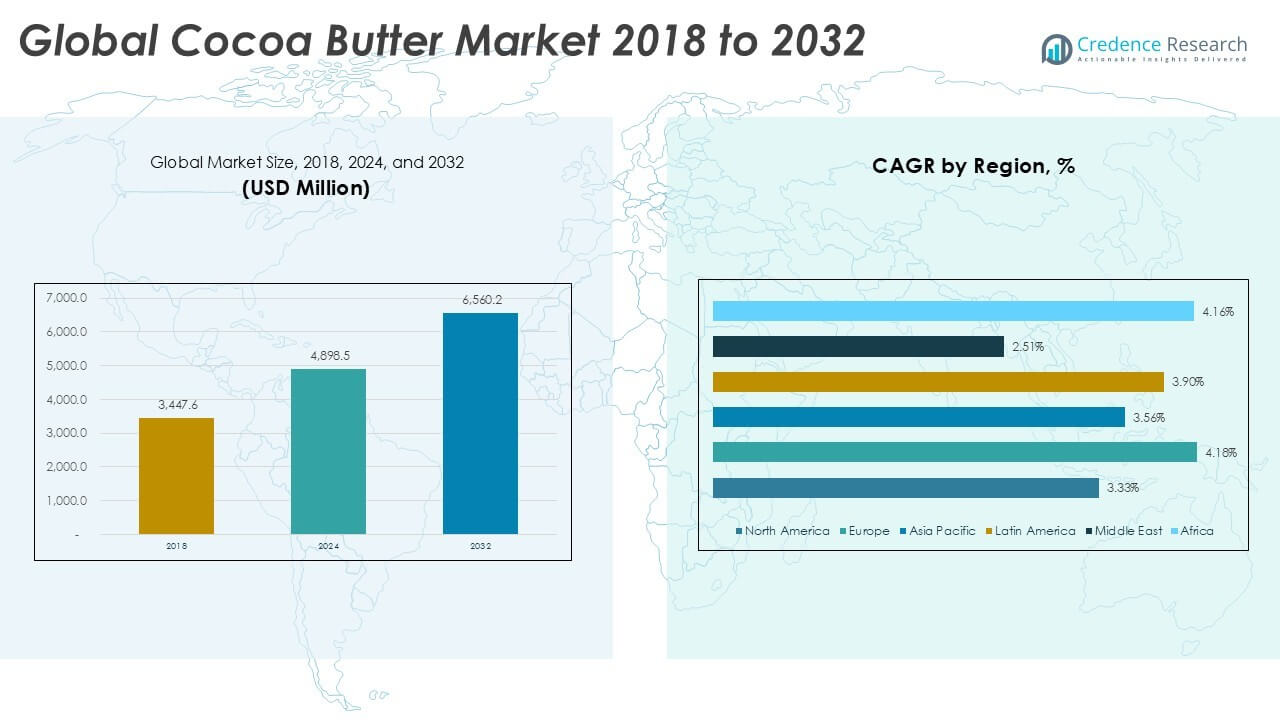
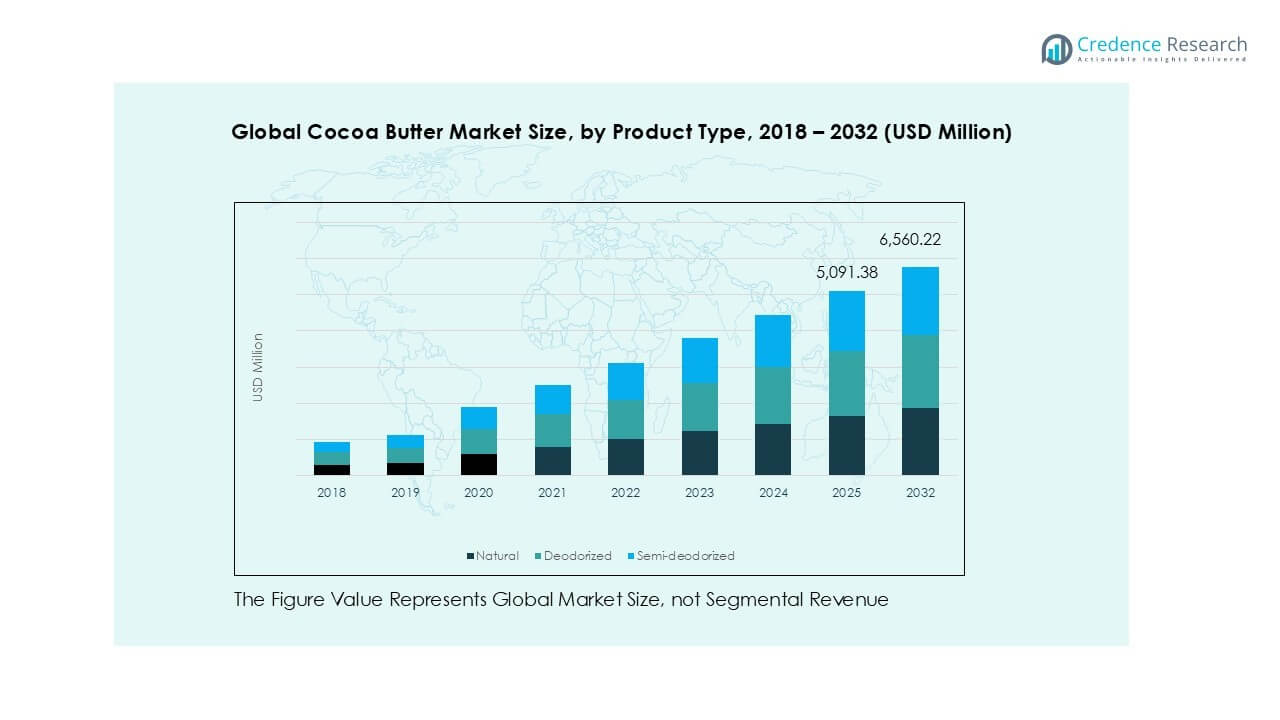
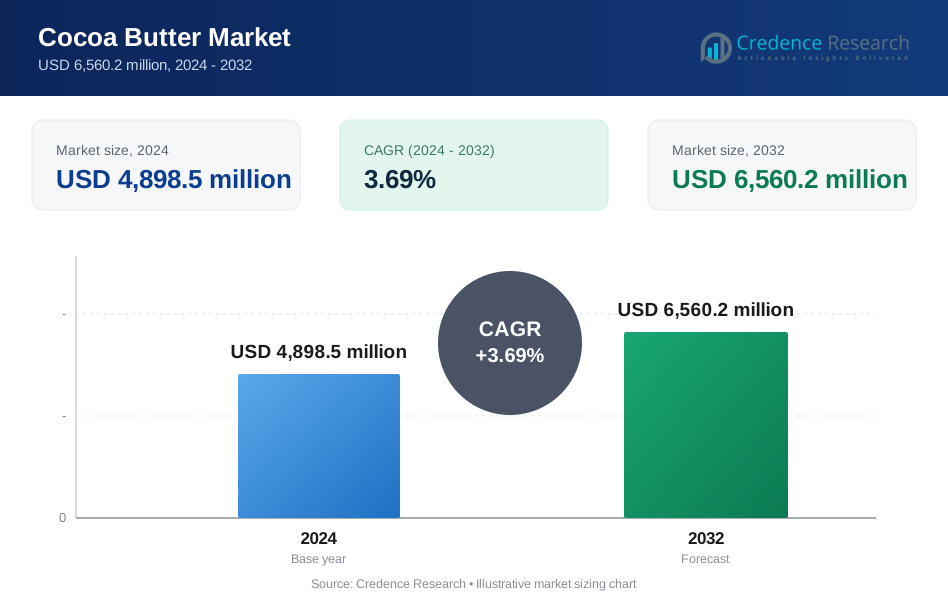
The global cocoa butter market size was valued at USD 3,447.6 million in 2018 and increased to USD 4,898.5 million in 2024. It is anticipated to reach USD 6,560.2 million by 2032, growing at a CAGR of 3.69% during the forecast period.
| REPORT ATTRIBUTE | DETAILS |
|---|---|
| Historical Period | 2020-2023 |
| Base Year | 2024 |
| Forecast Period | 2025-2032 |
| Solid Bleached Board Market Size 2024 | USD 12525 million |
| Solid Bleached Board Market, CAGR | 5.7% |
| Solid Bleached Board Market Size 2032 | USD 19515 million |
Leading players in the global cocoa butter market include Callebaut AG, Cargill Incorporated, Olam International Limited, JB Foods Ltd, and United Cocoa Processor, Inc. These companies dominate through strong global supply chains, advanced refining technologies, and diversified product offerings tailored for food, cosmetics, and pharmaceutical industries. Europe stands as the leading regional market, accounting for 27.8% of the global share in 2024, driven by its robust chocolate manufacturing sector and high consumer demand for premium confectionery. Asia Pacific follows with a 33% share, fueled by rising consumption and industrial growth in countries like China, India, and Japan.
Cocoa Butter Market Insights
- The global cocoa butter market was valued at USD 4,898.5 million in 2024 and is projected to reach USD 6,560.2 million by 2032, growing at a CAGR of 3.69%.
- Growth is driven by rising demand in chocolate, bakery, and personal care industries, supported by consumer preference for natural and organic ingredients.
- A key trend includes increased use of hybrid fat systems and cocoa butter alternatives to manage cost and improve shelf stability in diverse applications.
- Europe holds the largest regional share at 27.8%, followed by Asia Pacific at 33%, while natural cocoa butter dominates the product type segment due to clean-label demand.
- Market restraints include volatile cocoa prices, supply chain disruptions, and quality control challenges, particularly in emerging supplier regions with limited processing infrastructure.
Cocoa Butter Market Segmentation Analysis:
By Product Type:
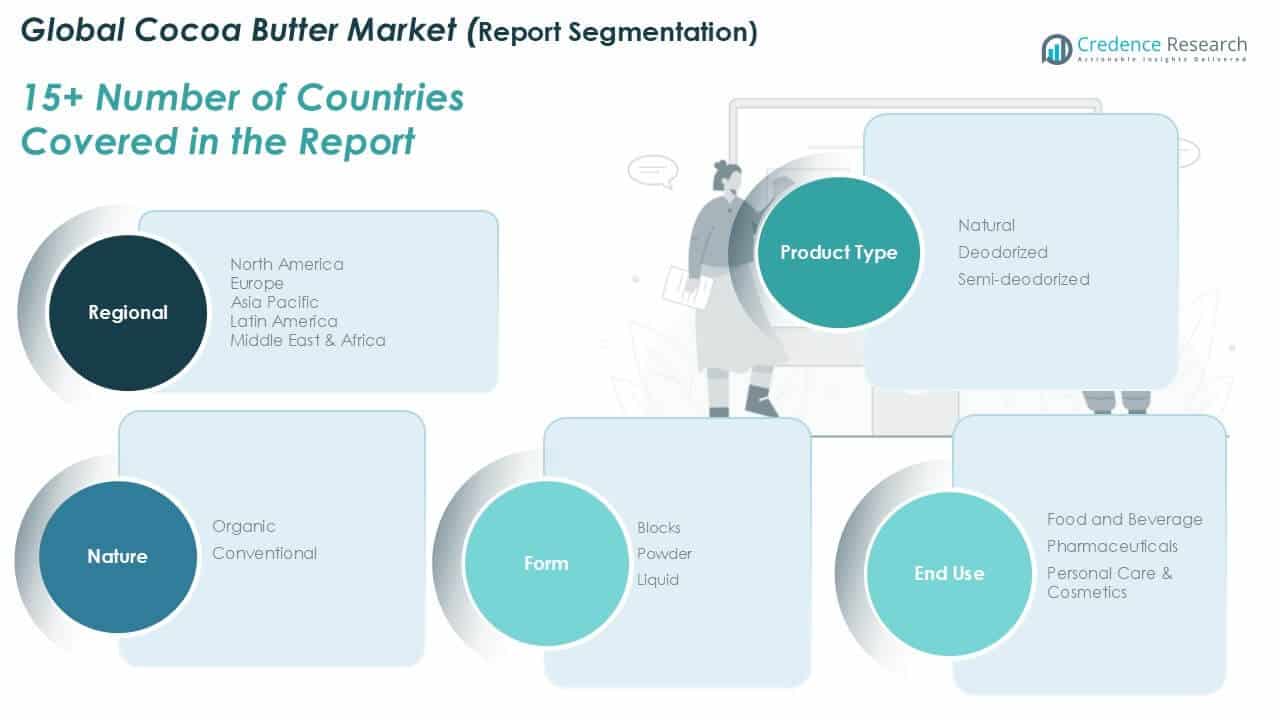
Natural cocoa butter dominates the product type segment with the largest market share, driven by strong demand from premium chocolate makers and clean-label cosmetic producers. Its unrefined form retains natural aroma and nutrients, making it preferred in organic and artisanal applications. The deodorized segment is expanding steadily due to its neutral scent, enabling wider use in skincare and pharmaceuticals. Semi-deodorized cocoa butter serves niche formulations, offering a balance between mild fragrance and functionality. Manufacturers invest in refining technologies to meet tailored customer needs across food and personal care sectors.
- For instance, Barry Callebaut produces natural and deodorized cocoa butter for food and cosmetics. The company operates cocoa processing facilities in over 30 countries.
By Nature:
Conventional cocoa butter holds the majority market share in the nature segment, primarily due to its cost efficiency and widespread availability. It is favored by large-scale food processors and cosmetics manufacturers, particularly in price-sensitive markets. However, the organic sub-segment is witnessing faster growth, supported by rising consumer preference for sustainable and chemical-free products. Clean beauty trends and ethical sourcing concerns are encouraging brands to shift toward certified organic options. Regions with strict labeling regulations and eco-conscious buyers are key demand zones for organic cocoa butter.
- For instance, Olam Food Ingredients supplies both conventional and certified organic cocoa butter. The company sources cocoa from more than 500,000 farming households globally.
By Form:
Blocks account for the dominant share in the form segment, mainly due to their long shelf life, ease of bulk transport, and compatibility with food and personal care production lines. Powdered cocoa butter is gaining traction in bakery and instant mix products due to its solubility and ease of blending. The liquid form is expanding in high-throughput cosmetic formulations and pharmaceuticals, enabling precise dosing and fast absorption. Liquid cocoa butter also appeals to formulators working on emulsions and sprays. Equipment compatibility and melting efficiency influence form preferences among end users.
Cocoa Butter Market Key Growth Drivers
Rising Demand from the Confectionery and Bakery Industries
The global cocoa butter market benefits significantly from rising demand in the confectionery and bakery sectors. Cocoa butter serves as a core fat ingredient in chocolate, lending a smooth texture, rich mouthfeel, and high gloss. Global chocolate consumption continues to expand, especially in emerging economies like India, China, and Brazil. Premium chocolate brands focus on using high-quality natural cocoa butter to enhance product appeal. In bakery applications, cocoa butter improves texture and shelf life in cakes, pastries, and frostings. Seasonal consumption spikes during holidays and festivals further support sales. Western markets maintain consistent demand, while Asia-Pacific and Latin America register rapid growth in processed sweet goods. Brand innovation with artisanal and health-focused offerings, including vegan and organic chocolates, also drives cocoa butter usage. This sustained and geographically diverse demand base positions confectionery and bakery as pivotal contributors to the long-term growth of the cocoa butter market.
- For instance, Barry Callebaut processes more than 2.125 million metric tons of cocoa beans annually across global facilities. The company supplies cocoa butter with controlled melting ranges between 32 °C and 35 °C for chocolate molding.
Growing Preference for Natural and Organic Ingredients
Consumer behavior is shifting toward clean-label and chemical-free products, driving demand for natural and organic cocoa butter. In personal care, natural cocoa butter is widely used in moisturizers, lip balms, and lotions for its emollient and antioxidant properties. Organic-certified cocoa butter aligns with rising sustainability concerns, appealing to ethically driven and health-conscious buyers. This shift is further reinforced by stringent cosmetic safety regulations in Europe and increasing awareness of synthetic ingredient risks. In food, natural cocoa butter is favored for artisanal and specialty chocolates, where transparency and ingredient origin matter. Consumers seek products free from GMOs, pesticides, and synthetic preservatives, prompting brands to reformulate with certified organic options. Global beauty and wellness trends, along with a growing demand for plant-based fats in functional foods, support steady expansion. As natural and organic segments command premium pricing, they offer both volume and value growth potential across end-use markets.
- For instance, Olam Food Ingredients supplies certified organic cocoa butter under EU and USDA standards. The company sources cocoa from over 500,000 registered farmers with traceability systems.
Expanding Personal Care and Cosmetics Applications
The cosmetics industry is a fast-growing consumer of cocoa butter due to its skin-nourishing and antioxidant-rich profile. Cocoa butter acts as a natural moisturizer, widely adopted in body lotions, lip balms, stretch mark creams, and sun care products. Its stability at room temperature and smooth application make it suitable for both solid and liquid formulations. Rising consumer demand for natural skincare and cruelty-free personal care boosts its inclusion in clean beauty lines. Global brands are investing in cocoa butter-based product innovations to cater to sensitive skin, anti-aging, and wellness-focused users. Asia-Pacific, especially South Korea and Japan, is seeing an uptick in cocoa butter usage in K-beauty and organic cosmetics. E-commerce platforms further support this demand by promoting ingredient transparency and product reviews. The shift from synthetic emollients to plant-based fats creates consistent traction for cocoa butter in both mass-market and premium personal care segments.
Cocoa Butter Market Key Trends & Opportunities
Increased Use of Cocoa Butter Alternatives and Blends
Manufacturers are increasingly exploring cocoa butter equivalents (CBEs), replacers (CBRs), and improvers (CBIs) due to fluctuating cocoa prices and supply chain volatility. However, rather than full substitution, there’s a trend toward hybrid formulations combining cocoa butter with palm kernel oil, shea butter, or mango butter. This approach allows brands to manage cost, improve shelf stability, and customize texture while maintaining quality. In personal care, blends with plant-based oils create multifunctional moisturizers suited for diverse climates and skin types. In confectionery, controlled blending enables desired melt profiles for tropical markets. Regulatory allowances vary by country, but consumer acceptance of hybrid fats is improving, especially in markets where price sensitivity drives decisions. This trend opens opportunities for R&D investments in functional fat systems that retain cocoa butter’s properties while enhancing stability, making cocoa butter–based innovations more competitive across global markets.
- For instance, AAK develops cocoa butter equivalents and blended fat systems for chocolate and confectionery AAK operates more than 20 application labs globally to customize fat functionality.
Sustainable and Ethical Sourcing Initiatives
Sustainability has become a central theme in the cocoa butter market, with manufacturers and retailers aligning with ethical sourcing programs. Certification schemes like Fairtrade, Rainforest Alliance, and UTZ drive transparency in cocoa sourcing, particularly in West Africa, where much of the global cocoa supply originates. Brands increasingly highlight traceability, farmer welfare, and deforestation-free practices on product labels. This creates trust with consumers and meets ESG commitments. Investment in sustainable supply chains also helps mitigate reputational risks and ensures long-term raw material security. Companies adopting blockchain-based traceability or direct trade models gain competitive advantage through differentiated sourcing stories. Demand for ethically sourced cocoa butter is rising not only in premium food and cosmetics but also in mainstream retail channels. These initiatives are not just reputational tools they drive consumer loyalty, enable access to conscious markets, and fulfill compliance with evolving global sustainability regulations.
Cocoa Butter Market Key Challenges
Volatility in Cocoa Supply and Pricing
The cocoa butter market faces significant challenges from raw material price fluctuations, often driven by climatic shocks, geopolitical instability, and disease outbreaks in key cocoa-growing regions such as Ivory Coast and Ghana. Poor yields, aging plantations, and inadequate infrastructure worsen the situation, making supply inconsistent. Price spikes lead to margin pressures for chocolate and cosmetic manufacturers, especially those that rely solely on pure cocoa butter. Hedging strategies and long-term contracts only offer partial relief, while smaller firms often struggle with cost forecasting. This volatility restricts long-term planning, innovation, and price stability in downstream segments. Buyers sometimes turn to cocoa butter alternatives to manage cost, but this can affect product quality and consumer perception. Addressing this challenge requires strategic investment in sustainable farming, productivity improvements, and diversified sourcing to ensure resilience in supply and pricing across the cocoa butter value chain.
Quality Control and Standardization Issues
Maintaining consistent quality in cocoa butter across regions and suppliers poses a serious challenge, especially as demand rises in high-precision sectors like pharmaceuticals and premium skincare. Variations in extraction methods, storage conditions, and processing technologies affect key parameters such as fatty acid profile, aroma, melting point, and microbial load. Inadequate standardization leads to formulation issues, shelf life inconsistencies, and regulatory compliance risks. Global brands often face supply rejections or must implement costly quality audits to ensure supplier reliability. In personal care, inconsistent quality impacts texture, absorption, and stability of end products. Traceability and certifications help mitigate the issue, but small-scale producers in origin countries often lack access to advanced testing facilities. Strengthening global quality benchmarks, expanding lab infrastructure in producing regions, and enforcing strict supplier agreements are necessary to overcome these barriers and meet quality expectations in diverse cocoa butter applications.
Cocoa Butter Market Regional Analysis
North America
In 2018, the North America cocoa butter market was valued at USD 831.21 million and reached USD 1,157.73 million by 2024. It is projected to grow to USD 1,508.85 million by 2032, at a CAGR of 3.33%. The region accounted for approximately 23.6% of the global market in 2024. Growth is supported by the presence of major chocolate and cosmetics manufacturers, coupled with consumer preference for natural and organic products. High consumption of premium chocolates and clean-label cosmetics drives regional demand. The U.S. remains the dominant contributor due to its large food and personal care sectors.
Europe
Europe held the largest share of the cocoa butter market in 2024, accounting for 27.8%. Valued at USD 930.84 million in 2018, it grew to USD 1,362.48 million in 2024 and is expected to reach USD 1,895.90 million by 2032, growing at a CAGR of 4.18%. The region benefits from well-established chocolate manufacturing, strong demand for organic cosmetics, and a consumer base focused on quality and ethical sourcing. Countries such as Germany, Switzerland, and Belgium lead in chocolate production and export, driving consistent cocoa butter consumption across food and personal care industries.
Asia Pacific
Asia Pacific contributed the second-largest market share of 33% in 2024, with its value rising from USD 1,145.63 million in 2018 to USD 1,616.02 million in 2024. It is expected to reach USD 2,143.22 million by 2032 at a CAGR of 3.56%. Rising middle-class populations, increased spending on chocolates, and growth in personal care industries are key factors fueling demand. Japan, China, and India are major growth centers, with expanding production and consumption. The growing awareness of skincare, alongside rapid urbanization and premium food trends, supports sustained regional growth.
Latin America
Latin America represented 7.5% of the global cocoa butter market in 2024, with market size increasing from USD 256.84 million in 2018 to USD 369.56 million in 2024. It is forecast to reach USD 503.17 million by 2032, at a CAGR of 3.90%. The region’s cocoa production base, particularly in Brazil and Ecuador, supports local processing and export. Growth in domestic chocolate consumption, evolving beauty trends, and rising demand for natural ingredients are key drivers. Expansion in food processing and increased focus on value-added exports also support regional market expansion.
Middle East
The cocoa butter market in the Middle East reached USD 219.87 million in 2024, up from USD 164.79 million in 2018. It is projected to reach USD 268.97 million by 2032, growing at a slower CAGR of 2.51%. The region held a 4.5% market share in 2024. Demand is concentrated in the UAE and Saudi Arabia, supported by premium chocolate imports and increasing awareness of personal care products. However, limited domestic cocoa processing and dependency on imports restrain broader market penetration. Growth opportunities remain tied to tourism, hospitality, and health-conscious consumer segments.
Africa
Africa’s cocoa butter market stood at USD 172.85 million in 2024, rising from USD 118.25 million in 2018 and is expected to reach USD 240.10 million by 2032 at a CAGR of 4.16%. With a 3.5% market share in 2024, the region shows strong growth potential due to its vast cocoa production base, particularly in Ivory Coast and Ghana. However, most of the cocoa is exported raw. Increasing investments in local value addition and regional chocolate consumption support long-term growth. Infrastructure development and government initiatives to boost processing industries are key enablers.
Cocoa Butter Market Segmentations:
By Product Type:
- Natural
- Deodorized
- Semi-deodorized
By Nature:
- Organic
- Conventional
By Form:
- Blocks
- Powder
- Liquid
By End Use:
- Food and Beverage
- Pharmaceuticals
- Personal Care & Cosmetics
By Geography
- North America
- U.S.
- Canada
- Mexico
- Europe
- Germany
- France
- U.K.
- Italy
- Spain
- Rest of Europe
- Asia Pacific
- China
- Japan
- India
- South Korea
- South-east Asia
- Rest of Asia Pacific
- Latin America
- Brazil
- Argentina
- Rest of Latin America
- Middle East & Africa
- GCC Countries
- South Africa
- Rest of the Middle East and Africa
Competitive Landscape
The global cocoa butter market features a moderately consolidated competitive landscape, dominated by multinational players with vertically integrated operations and broad product portfolios. Key companies such as Callebaut AG, Cargill Incorporated, and Olam International Limited control significant global supply through cocoa sourcing, processing, and downstream value chains. These firms invest in advanced refining technologies, sustainability programs, and capacity expansions to maintain competitive advantage. Regional players like JB Foods Ltd and United Cocoa Processor, Inc. cater to niche markets with specialized offerings in premium, organic, or deodorized cocoa butter. Companies differentiate through certifications such as Fairtrade, organic, and UTZ to meet rising consumer demand for ethical sourcing. Strategic partnerships, acquisitions, and innovation in blends and packaging formats support market expansion. Competition also intensifies from emerging firms in West Africa and Latin America aiming to add value to local cocoa through processing. Price competitiveness, product consistency, and traceability remain key factors influencing buyer preferences across sectors.
Key Player Analysis
- Callebaut AG
- Cargill Incorporated
- Olam International Limited
- JB Foods Ltd
- United Cocoa Processor, Inc.
- EFKO Group
- Mallinath Group
- Natra S.A.
- Bolmay Cocoa
- Other Key Players
Recent Developments
- In July 2025, Manorama published product materials/group brochure listing Cocoa Butter Equivalent (CBE) and exotic specialty fats (Milcoa line).
- In June 2025, ISF signed a joint-venture agreement with Petchsrivichai Enterprise (PCE) to form a Thai specialty oils & fats JV (market expansion into Thai vegetable oil / high-value fats, relevant to regional CBE supply).
- In March 2025, ISF published an updated public plan/target relevant to traceability and sustainable sourcing of feedstocks for specialty fats/CBE products.
Report Coverage
The research report offers an in-depth analysis based on Product Type, Product Type, Form, End Use and Geography. It details leading market players, providing an overview of their business, product offerings, investments, revenue streams, and key applications. Additionally, the report includes insights into the competitive environment, SWOT analysis, current market trends, as well as the primary drivers and constraints. Furthermore, it discusses various factors that have driven market expansion in recent years. The report also explores market dynamics, regulatory scenarios, and technological advancements that are shaping the industry. It assesses the impact of external factors and global economic changes on market growth. Lastly, it provides strategic recommendations for new entrants and established companies to navigate the complexities of the market.
Future Outlook
- Demand for cocoa butter will grow steadily across confectionery, bakery, and skincare industries.
- Organic and fair-trade cocoa butter will gain traction among ethical and health-conscious consumers.
- Europe will remain the leading market, while Asia Pacific will see the fastest growth.
- Technological advancements in processing will improve yield and quality consistency.
- Hybrid blends with cocoa butter alternatives will expand to manage cost and stability.
- Personal care brands will increase usage of cocoa butter in clean-label product lines.
- Regulatory focus on sustainable sourcing will shape procurement and certification practices.
- Cocoa butter block form will maintain dominance due to storage and processing benefits.
- Mergers and acquisitions will rise as players seek to strengthen global supply chains.
- Price volatility and climate challenges in key producing countries will impact market planning.
Request a Free Sample
Fill in your details and we'll send you a free sample report.
- Sample data tables & charts
- Research methodology
Need a Custom Version of This Report?
Tailor the scope, geography, or segments to your exact requirements.
- Custom geography or segment scope
- Direct access to our analyst team
Frequently Asked Questions
What is the current market size for the Global Cocoa Butter market, and what is its projected size in 2032?
At what Compound Annual Growth Rate is the Global Cocoa Butter market projected to grow between 2024 and 2032?
Which Global Cocoa Butter market segment held the largest share in 2024?
What are the primary factors fueling the growth of the Global Cocoa Butter market?
Who are the leading companies in the Global Cocoa Butter market?
Which region commanded the largest share of the Global Cocoa Butter market in 2024?
Table of Content
Chapter 1. Report Introduction
- 1.1 Report Description & Purpose
- 1.1.1 Report Title & Market Definition
- 1.1.2 Unique Selling Propositions (USP) & Key Differentiators
- 1.1.3 Value Proposition for Stakeholders
- 1.2 Research Objectives
- 1.2.1 Market Sizing Objectives (Volume & Revenue)
- 1.2.2 Segmentation Objectives
- 1.2.3 Competitive Intelligence Objectives
- 1.2.4 Forecast & Scenario Objectives
- 1.3 Report Scope
- 1.3.1 Cocoa Butter Scope – Types & Subtypes Covered
- 1.3.2 Geographic Scope – Regions & Countries Covered
- 1.3.3 Historical Period, Base Year & Forecast Period (2024; forecast to 2032)
- 1.3.4 Inclusions & Exclusions
- 1.4 HS Code & Classification Framework
- 1.5 Currency, Units & Pricing Basis
- 1.6 Target Stakeholders
- 1.7 Limitations & Assumptions
Chapter 2. Executive Summary
- 2.1 Global Cocoa Butter Market Snapshot
- 2.1.1 Market Size – Historical (2024) & Forecast (2024-2032) (2024: USD 4,898.5 million → 2032: USD 6,560.2 million)
- 2.1.2 Volume & Revenue – Global Totals
- 2.1.3 Key Market Highlights – Top Five Facts
- 2.2 Cocoa Butter Market Segmentation Snapshot
- 2.2.1 Market Split by Region – 2024 vs. 2032
- 2.3 Competitive Snapshot
- 2.3.1 Top 10 Players by Revenue Share – 2024
- 2.3.2 Top 10 Players by Volume Share – 2024
- 2.3.3 Recent Strategic Developments (18-Month Summary)
- 2.4 Key Investment Highlights & Strategic Conclusions
Chapter 3. Cocoa Butter Market Dynamics & Industry Analysis
- 3.1 Market Overview & Context
- 3.1.1 Cocoa Butter Market Position in the Broader Automotive Value Chain
- 3.1.2 OEM vs. Replacement Market Dynamics
- 3.1.3 Market Maturity & Development Stage by Region
- 3.2 Cocoa Butter Market Drivers
- 3.3 Cocoa Butter Market Restraints & Challenges
- 3.4 Cocoa Butter Market Opportunities
- 3.5 Porter's Five Forces Analysis
- 3.5.1 Threat of New Entrants
- 3.5.2 Bargaining Power of Suppliers
- 3.5.3 Bargaining Power of Buyers
- 3.5.4 Threat of Substitutes
- 3.5.5 Competitive Rivalry – Intensity Assessment
- 3.6 Cocoa Butter Value Chain Analysis
- 3.6.1 Upstream – Raw Material/Input Suppliers
- 3.6.1.1 Raw Material/Input 1
- 3.6.1.2 Raw Material/Input 2
- 3.6.1.3 Raw Material/Input 3
- 3.6.2 Midstream – Production/Manufacturing/Service Delivery
- 3.6.2.1 Production/Process Overview
- 3.6.2.2 Key Facility Locations & Capacity by Manufacturer
- 3.6.3 Downstream – Distribution & End Consumer
- 3.6.3.1 Primary Channel – B2B/OEM
- 3.6.3.2 Secondary Channels – Dealer, Retail, Online, Direct
- 3.6.4 Value Chain Profitability Analysis
- 3.6.1 Upstream – Raw Material/Input Suppliers
- 3.7 PESTEL Analysis
- 3.7.1 Political Factors
- 3.7.2 Economic Factors
- 3.7.3 Social Factors
- 3.7.4 Technological Factors
- 3.7.5 Environmental Factors
- 3.7.6 Legal Factors
- 3.8 Cocoa Butter Supply Chain Analysis
- 3.8.1 Raw Material/Input Supply Risk Assessment
- 3.8.2 Manufacturing Concentration Risk (Geographic Exposure)
- 3.8.3 Trade Disruption Impact Analysis
- 3.9 Regulatory & Policy Landscape
Note: The regulatory and policy landscape section covers regulations based on their applicability to the market, Cocoa Butter category, geography, and scope of the study. Only regulatory frameworks with a material impact on operations, compliance, trade, sustainability, or market access are analyzed in detail.
Chapter 4. Key Investment Pockets & Opportunity Analysis
- 4.1 Cocoa Butter Market Attractiveness Analysis
- 4.1.1 By Region – Investment Attractiveness Matrix (Volume × CAGR)
- 4.2 Absolute Revenue Growth Opportunity
- 4.2.1 By Region – Absolute USD Growth Through 2032
- 4.3 Incremental Volume Opportunity
- 4.3.1 By Region – Incremental Volume Through 2032
- 4.3.2 Segment – Incremental Volume
- 4.4 Emerging Submarket Opportunity Deep Dive (Subject to Applicability)
- 4.5 Emerging Market Opportunity Scorecards
- 4.5.1 United States
- 4.5.2 Europe
- 4.5.3 Asia
- 4.5.4 Middle East & Africa
Note: Emerging Market Opportunity Scorecards will be included based on relevance and strategic importance. Regions listed are indicative and may vary depending on data availability and market dynamics.
Chapter 5. Cocoa Butter Import-Export Analysis & Trade Flows
- 5.1 Global Trade Overview
- 5.1.1 Global Export Value by Country (2024)
- 5.1.2 Global Export Volume by Country (2024)
- 5.1.3 Global Import Value by Country (2024)
- 5.1.4 Global Import Volume by Country (2024)
- 5.1.5 Net Trade Balance by Country (2024)
- 5.2 Export Analysis – Segment
- 5.2.1 Type 1 (HS Code)
- 5.2.2 Type 2 (HS Code)
- 5.2.3 Type 3 (HS Code)
- 5.2.4 Type 4 (HS Code)
- 5.2.5 Type 5 (HS Code)
- 5.3 Import Analysis – Segment
- 5.3.1 Type 1 (HS Code)
- 5.3.2 Type 2 (HS Code)
- 5.3.3 Type 3 (HS Code)
- 5.3.4 Type 4 (HS Code)
- 5.3.5 Type 5 (HS Code)
- 5.4 Average Unit Trade Prices
- 5.4.1 Average Export Price – Segment & Country
- 5.4.2 Average Import Price – Segment & Source Country
- 5.4.3 Price Trends (2024)
- 5.5 Key Trade Route Analysis
- 5.5.1 Trade Route 1
- 5.5.2 Trade Route 2
- 5.5.3 Trade Route 3
- 5.5.4 Trade Route 4
- 5.5.5 Trade Route 5
- 5.6 Trade Policy Impact Assessment
- 5.6.1 US Anti-Dumping & Section 301 Tariffs
- 5.6.2 EU Customs Union Impact
- 5.6.3 Major Free Trade Agreements
- 5.6.4 USMCA Rules of Origin
Note: Trade policy analysis will be included only where relevant to the Cocoa Butter market.
Chapter 6. Competitive Landscape & Company Benchmarking
- 6.1 Cocoa Butter Market Concentration & Structure
- 6.1.1 Herfindahl-Hirschman Index (HHI) – vs. 2024
- 6.1.2 Tier 1, Tier 2 & Tier 3 Market Structure
- 6.1.3 Global, Regional & Local Player Dynamics
- 6.2 Cocoa Butter Market Share Analysis – 2024
- 6.2.1 Global Revenue Share by Company
- 6.2.2 Global Volume Share by Company
- 6.2.3 Regional Revenue Share
- 6.2.4 Market Share Evolution ( vs. 2024)
- 6.2.5 OEM Segment Share by Company
- 6.2.6 Replacement Segment Share by Company
- 6.3 Production/Delivery Capacity & Facility Analysis
- 6.3.1 Global Installed Capacity
- 6.3.2 Capacity Utilization Rates
- 6.3.3 Production/Output Volume
- 6.3.4 Facility Locations & Capacity Map
- 6.3.5 Planned Capacity Additions
- 6.4 Cocoa Butter Competitive Benchmarking Matrix
- 6.4.1 Revenue, Volume, CAGR & Profitability Comparison
- 6.4.2 Channel Revenue Mix
- 6.4.3 Geographic Revenue Exposure
- 6.4.4 R&D Intensity
- 6.4.5 Sustainability Maturity
- 6.5 Strategic Developments in Cocoa Butter (Last 24 Months)
- 6.5.1 Mergers, Acquisitions & Divestments
- 6.5.2 New Cocoa Butter Launches
- 6.5.3 Facility Expansions
- 6.5.4 Strategic Alliances, Joint Ventures & Partnerships
- 6.5.5 Distribution Expansion & Market Entry
- 6.5.6 Sustainability & ESG Initiatives
- 6.6 Competitive Strategy Mapping
- 6.6.1 Leader, Challenger, Follower & Niche Classification
- 6.6.2 Pricing Strategy Comparison
- 6.6.3 Channel Strategy Matrix
Note: Strategic developments are included based on their materiality and the availability of reliable information.
Chapter 7. Global Cocoa Butter Market – By Distribution Channel
- 7.1 Segment Overview
- 7.1.1 Volume & Revenue Split by Channel (2024 & 2032)
- 7.1.2 Channel Mix Evolution (2024-2032)
Chapter 8. Regional Market Analysis – Global Overview
- 8.1 Global Regional Overview
- 8.1.1 Regional Volume Share
- 8.1.2 Regional Revenue Share
- 8.1.3 Regional Volume by Region
- 8.1.4 Regional Revenue by Region
- 8.1.5 Regional Forecast Through 2032
- 8.2 Cross-Regional Segment Analysis
- 8.2.1 By Distribution Channel
- 8.2.2 By Brand/Price Tier
Chapter 9. North America Cocoa Butter Market
- 9.1 United States
- 9.2 Canada
- 9.3 Mexico
Chapter 10. Europe Cocoa Butter Market
- 10.1 Germany
- 10.2 France
- 10.3 Italy
- 10.4 United Kingdom
- 10.5 Spain
- 10.6 Poland
- 10.7 Russia
- 10.8 Netherlands
- 10.9 Belgium
- 10.10 Sweden
- 10.11 Denmark
- 10.12 Norway
- 10.13 Rest of Europe
Chapter 11. Asia Pacific Cocoa Butter Market
- 11.1 China
- 11.2 India
- 11.3 Japan
- 11.4 South Korea
- 11.5 Thailand
- 11.6 Indonesia
- 11.7 Vietnam
- 11.8 Malaysia
- 11.9 Australia
- 11.10 Rest of Asia Pacific
Chapter 12. Latin America Cocoa Butter Market
- 12.1 Brazil
- 12.2 Argentina
- 12.3 Colombia
- 12.4 Chile
- 12.5 Rest of Latin America
Chapter 13. Middle East Cocoa Butter Market
- 13.1 Saudi Arabia
- 13.2 United Arab Emirates
- 13.3 Turkey
- 13.4 Israel
- 13.5 Iran
- 13.6 Rest of the Middle East
Chapter 14. Africa Cocoa Butter Market
- 14.1 South Africa
- 14.2 Egypt
- 14.3 Nigeria
- 14.4 Morocco
- 14.5 Rest of Africa
Chapter 15. Cocoa Butter Company Profiles
- 15.1 [Company 01]
- 15.1.1 Company Overview
- 15.1.2 Key Management Personnel
- 15.1.3 Products & Services Portfolio
- 15.1.4 Financial Performance
- 15.1.5 Key Market Focus & Geographic Presence
- 15.1.6 Recent Developments & Strategic Initiatives
Note: The company profile list is preliminary and may change based on research findings, market developments, data availability, and client requirements.
Chapter 16. Appendices
- Appendix A – List of Abbreviations & Acronyms
- Appendix B – Industry Classification Code Reference – Full Series
- Appendix C – Production & Capacity Data Tables
- Appendix D – End-Use & Demand Base Tables
- Appendix E – Consumption & Replacement Rate Assumptions
- Appendix F – ASP Reference Tables
- Appendix G – Manufacturing & Facility Database
- Appendix H – Import-Export Data Tables
- Appendix I – Regulatory Summary Tables
- Appendix J – Primary Research Participant List (Anonymized)
- Appendix K – Primary Research Questionnaire Framework
- Appendix L – Data Sources & Bibliography
- Appendix M – Market Size Divergence & Source Comparison
Chapter 17. Research Methodology
- 17.1 Research Framework & Philosophy
- 17.2 Secondary Research – Sources, Hierarchy & Data Extraction
- 17.3 Data Modeling – Bottom-Up & Top-Down Market Sizing
- 17.4 Primary Research – Stakeholder Framework, LOI & Sample Sizes
- 17.5 Forecast Methodology – Regression, Scenario & Sensitivity Analysis
- 17.6 Quality Control – Four-Layer Validation Framework
- 17.7 Limitations & Standard Assumptions
- 17.8 Disclaimer
