
Plant-Based Food Emulsifiers Market Overview:
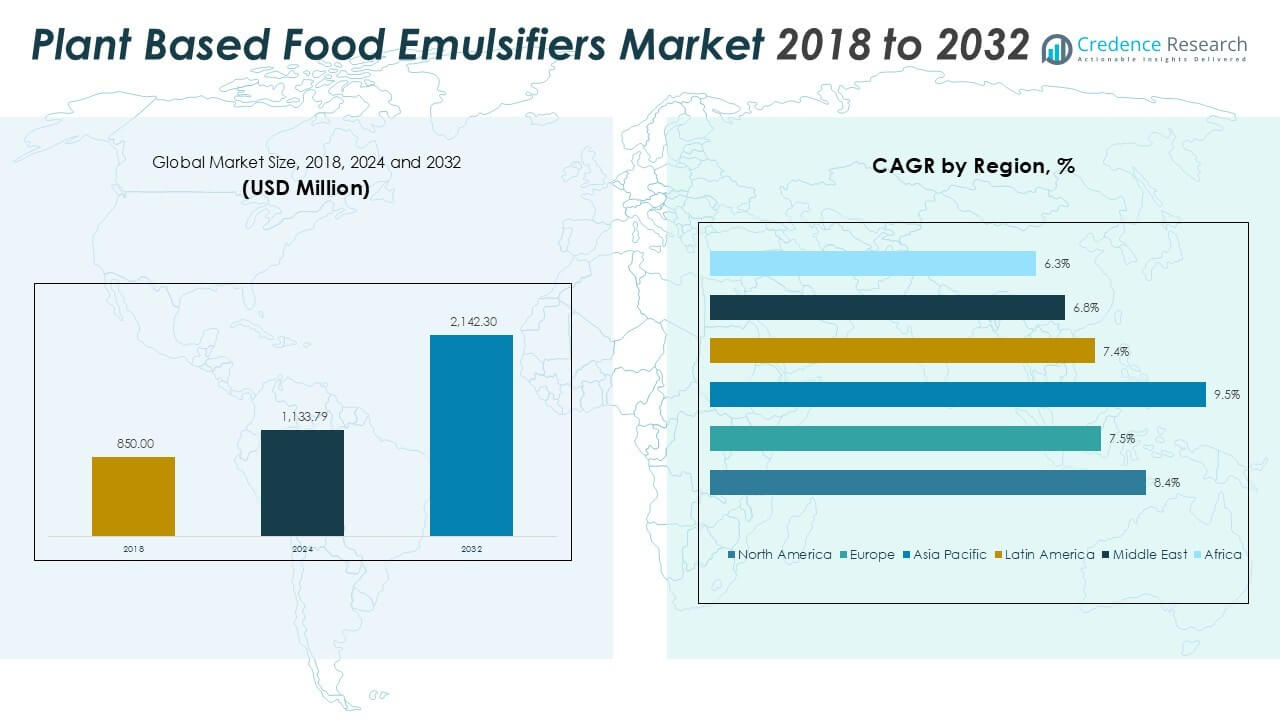
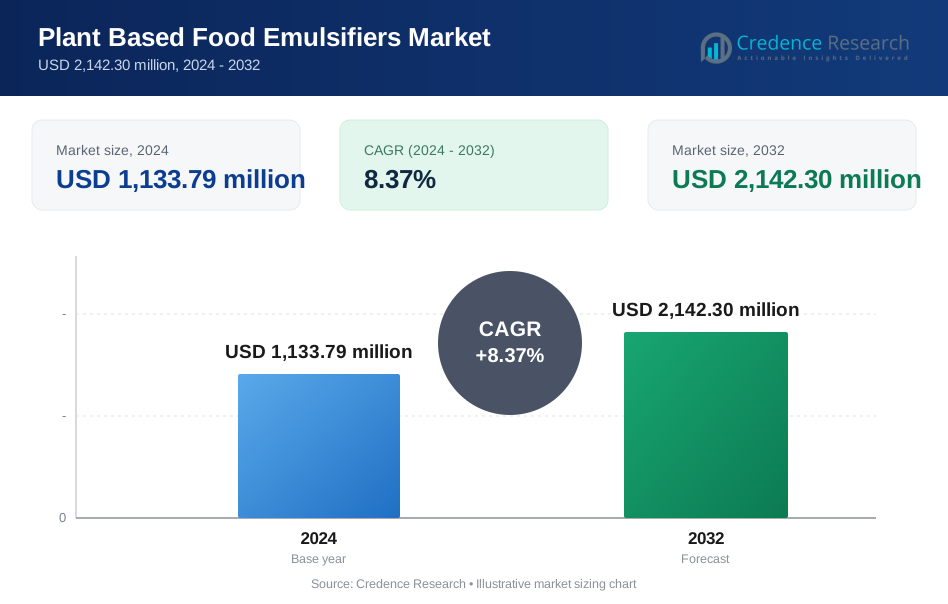
The Plant-Based Food Emulsifiers Market size was valued at USD 850.00 million in 2018, reached USD 1,133.79 million in 2024, and is anticipated to reach USD 2,142.30 million by 2032, growing at a CAGR of 8.37% during the forecast period.
| REPORT ATTRIBUTE | DETAILS |
|---|---|
| Historical Period | 2020-2023 |
| Base Year | 2024 |
| Forecast Period | 2025-2032 |
| Plant-Based Food Emulsifiers Market Size 2024 | USD 1,133.79 million |
| Plant-Based Food Emulsifiers Market, CAGR | 8.37% |
| Plant-Based Food Emulsifiers Market Size 2032 | USD 2,142.30 million |
Top players in the Plant-Based Food Emulsifiers market include Cargill, Archer Daniels Midland Company, Ingredion Incorporated, Kerry Group, and DuPont de Nemours, Inc. These companies lead through diversified plant-sourced emulsifier portfolios, strong global supply chains, and continued investment in R&D for clean-label formulations. Cargill and ADM hold significant influence due to integrated sourcing and distribution networks, while Ingredion and Kerry focus on functional product customization. In 2024, North America emerged as the leading region, commanding 35.3% of the global market share, supported by high consumer awareness, advanced food processing infrastructure, and demand for plant-based alternatives. Europe and Asia Pacific follow closely in market presence.
Plant-Based Food Emulsifiers Market Insights
- The Plant Based Food Emulsifiers market was valued at USD 850.00 million in 2018, reached USD 1,133.79 million in 2024, and is projected to reach USD 2,142.30 million by 2032, growing at a CAGR of 8.37% during the forecast period.
- Market growth is driven by rising demand for clean-label, vegan, and plant-based food products, with food manufacturers replacing synthetic emulsifiers to meet health-focused consumer preferences.
- Key trends include higher adoption of sunflower and pea-based emulsifiers, strong innovation in plant-based dairy and meat alternatives, and increasing use in cosmetics and personal care applications.
- The competitive landscape features global leaders such as Cargill, ADM, Ingredion, and Kerry Group, competing through product innovation, sustainable sourcing, and customized formulation solutions.
- Regionally, North America leads with 35.3% market share, followed by Asia Pacific at 29.4% and Europe at 22.4%, while soy-based emulsifiers hold over 40% share and food & beverages account for more than 60% of total demand.
Plant-Based Food Emulsifiers Market Segmentation Analysis:
By Source
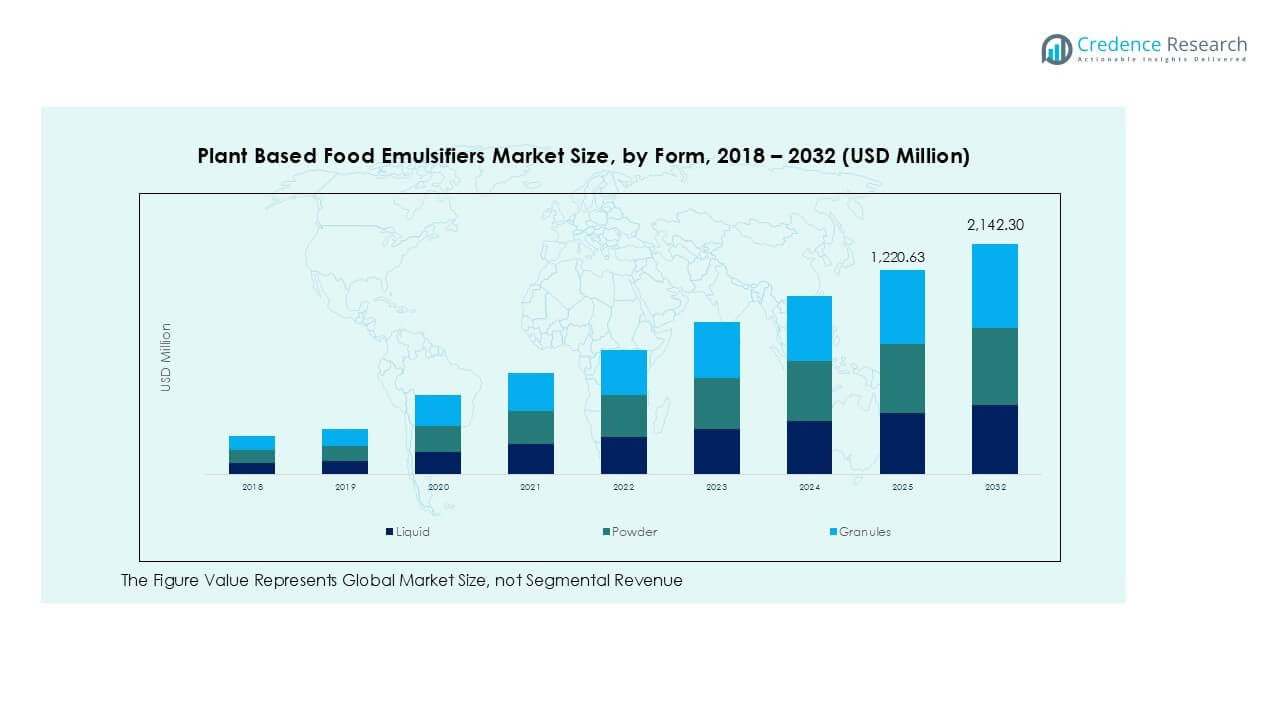
Soy dominates the plant-based food emulsifiers market by source, accounting for over 40% of the revenue share in 2024. Its wide availability, strong emulsifying properties, and cost-effectiveness make it the preferred choice across industries. The sunflower segment follows, gaining traction due to allergen-free positioning and consumer shift toward clean-label ingredients. Pea-based emulsifiers see growing adoption in allergen-conscious and gluten-free applications. The “Others” category, including lecithin derived from canola and rapeseed, contributes a smaller but steadily rising share as producers explore diverse, sustainable options to meet functional and dietary requirements.
- For instance, ADM produces soy lecithin at multiple global sites, including major facilities in the United States, India, and Europe, where it leverages its extensive soybean crushing network to maintain its position as a leading global supplier. While individual plant capacities for lecithin a byproduct representing roughly 1.5% to 3% of soybean oil are significantly lower than 200,000 metric tons, ADM utilizes its multi-million-ton annual soybean processing capacity to ensure a consistent global supply.
By Application
The food & beverages segment leads the application category with more than 60% of the market share in 2024. Demand is driven by increased use in bakery, confectionery, dairy alternatives, and plant-based meat products. Emulsifiers enhance product texture, shelf life, and stability, making them critical in processed food manufacturing. Cosmetics & personal care holds the second-largest share due to the growing demand for natural emulsifiers in lotions and creams. Pharmaceuticals use emulsifiers in drug delivery systems, while the “Others” segment covers emerging uses in nutraceuticals and dietary supplements.
- For instance, Cargill supplies lecithin solutions to food manufacturers in over 70 countries, supporting large-scale processed food production.
By Form
Liquid emulsifiers dominate the market by form, holding approximately 48% of the revenue share in 2024. Their ease of blending, consistent dispersion in formulations, and compatibility with automated systems support their strong adoption across food and cosmetic manufacturing lines. Powdered emulsifiers follow, preferred for their extended shelf life and suitability in dry mix applications. Granules represent the smallest segment but offer advantages in controlled-release and custom-blend applications. Each form serves unique operational and functional requirements, allowing manufacturers to tailor solutions for end-product consistency and performance.
Plant-Based Food Emulsifiers Market Key Growth Drivers
Rising Demand for Clean Label and Plant-Based Ingredients
Consumers are increasingly seeking clean label products with natural, plant-derived ingredients. This shift is strongly influencing food formulation trends across bakery, dairy, and processed food segments. Plant-based food emulsifiers such as soy or sunflower lecithin serve as natural alternatives to synthetic emulsifiers, aligning with consumer expectations for transparency and sustainability. Food producers are reformulating products to replace synthetic additives with natural solutions that still ensure texture, stability, and shelf life. The demand for vegan and allergen-free products further supports this trend. With plant-based diets gaining widespread acceptance, manufacturers are investing in plant-derived emulsification systems to meet evolving dietary preferences, especially in developed markets like North America and Europe. These emulsifiers also support clean-label certification, boosting their appeal among health-conscious buyers.
- For instance, ADM operates global lecithin production facilities processing millions of metric tons of oilseeds annually, supporting plant-derived emulsifier demand in North America and Europe.
Expansion of Plant-Based Food & Beverage Market
The global surge in plant-based food and beverage consumption directly drives demand for functional ingredients like emulsifiers. Plant-based emulsifiers play a critical role in improving product mouthfeel, consistency, and storage stability, particularly in dairy alternatives, meat substitutes, and ready-to-eat meals. Companies in the alt-protein space rely heavily on emulsification to mimic the sensory experience of animal-based foods. For instance, plant-based milk alternatives require stable emulsifier systems to prevent fat separation. With increased product launches and innovation in plant-based snacks, beverages, and functional foods, the application landscape for plant-based emulsifiers is expanding. This macro trend opens new growth avenues for ingredient manufacturers focused on developing versatile and scalable emulsifier solutions.
- For instance, Roquette processes over 250,000 metric tons of peas per year, supplying functional ingredients used in plant-based beverages and foods.
Technological Advancements in Extraction and Formulation
Technological improvements in plant-based emulsifier production especially enzyme-assisted extraction, fractionation, and fermentation are enhancing functionality and cost-efficiency. These innovations allow producers to develop emulsifiers with higher purity, better heat stability, and broader application compatibility. Enzyme-based extraction also reduces environmental impact, supporting sustainability goals. R&D efforts are enabling customization of emulsifier properties for specific end-uses, such as low-pH tolerance for acidic beverages or high-oil stabilization for plant-based spreads. The ability to modify plant protein or lecithin profiles through bioprocessing further broadens application potential. These advancements not only improve product performance but also reduce formulation costs for food and personal care brands, boosting adoption.
Plant-Based Food Emulsifiers Market Key Trends & Opportunities
Shift Toward Sustainable and Allergen-Free Emulsifiers
The market is witnessing a transition from soy-based emulsifiers to alternatives like sunflower, pea, and canola due to allergy concerns and the growing demand for non-GMO, sustainable ingredients. This shift is opening opportunities for suppliers offering clean-label, allergen-free emulsifiers suitable for sensitive consumer segments. Sunflower-based emulsifiers are gaining popularity in Europe and North America due to regulatory compliance and better consumer perception. Sustainability metrics, including lower carbon footprints and water usage during extraction, also play a vital role in influencing buyer choices. Brands that integrate such claims into their packaging can leverage this trend to boost consumer loyalty and brand differentiation.
- For instance, ADM sources sunflower lecithin from traceable supply chains linked to oilseed processing volumes exceeding several million metric tons per year.
Growing Application in Personal Care and Pharmaceuticals
Although food and beverage remain the largest end-use segment, plant-based emulsifiers are seeing increasing use in personal care and pharmaceutical products. The cosmetics industry favors plant-derived emulsifiers for use in creams, lotions, and serums, especially as consumer demand for vegan and cruelty-free beauty products grows. Their biocompatibility, moisturizing effect, and biodegradability offer advantages over petroleum-based emulsifiers. In pharmaceuticals, these ingredients help improve the solubility and bioavailability of active compounds, making them valuable in oral and topical formulations. This diversification of application is creating new business streams for ingredient suppliers and reducing dependency on the food sector alone.
Key Challenges
Functional Limitations Compared to Synthetic Alternatives
One of the key challenges facing plant-based food emulsifiers is their lower functional range compared to synthetic emulsifiers. Natural options may not offer the same stability, shelf life, or emulsifying strength under high-temperature or high-shear conditions. This can limit their effectiveness in complex formulations like high-fat spreads, whipped toppings, or fortified beverages. As a result, manufacturers may require higher dosages or additional stabilizers, increasing costs. Overcoming these limitations without compromising clean-label claims requires intensive R&D and reformulation efforts, which may delay product launches or reduce profit margins, especially for smaller food companies.
Volatility in Raw Material Prices and Supply Chain Constraints
The availability and pricing of raw materials like soy, sunflower, or pea are subject to agricultural fluctuations, trade regulations, and geopolitical tensions. For example, crop failures or export restrictions in key producing countries can lead to supply shortages or sharp price hikes. These uncertainties pose significant risks to ingredient manufacturers and their downstream partners. Long lead times and transportation challenges also affect the consistent availability of high-quality emulsifiers. To mitigate these risks, companies need to diversify sourcing, invest in local processing, or enter long-term contracts, all of which may increase operational complexity and costs.
Plant-Based Food Emulsifiers Market Regional Analysis
North America
North America led the global plant-based food emulsifiers market in 2024 with a market value of USD 400.90 million, rising from USD 304.30 million in 2018. It is projected to reach USD 756.45 million by 2032, growing at a CAGR of 8.4%. The region accounted for approximately 35.3% of the global market in 2024, driven by strong demand for clean-label ingredients in the U.S. and Canada. High consumer awareness of plant-based diets, coupled with food innovation and well-established retail channels, supports sustained growth. The dominance is further backed by large-scale application in dairy alternatives and plant-based meat products.
Europe
Europe held a 22.4% share of the global plant-based food emulsifiers market in 2024, with revenue reaching USD 253.82 million, up from USD 198.99 million in 2018. It is forecast to reach USD 449.57 million by 2032, expanding at a CAGR of 7.5%. Consumer preference for allergen-free, non-GMO, and sustainable ingredients supports steady market penetration across Western and Central Europe. Regulatory emphasis on clean-label and plant-based formulations drives product reformulations in the region. The food processing industry’s shift to natural emulsifiers in bakery, confectionery, and ready meals is contributing to stable growth across key EU economies.
Asia Pacific
Asia Pacific emerged as the fastest-growing region in the plant-based food emulsifiers market, with a CAGR of 9.5%. The market grew from USD 241.40 million in 2018 to USD 334.29 million in 2024 and is expected to reach USD 688.32 million by 2032. It held a 29.4% share in 2024. Growth is driven by rising health awareness, increased plant-based food consumption, and expanding urban populations in China, India, Japan, and Southeast Asia. Local and international food manufacturers are scaling production of plant-based snacks, beverages, and frozen foods, fueling ingredient demand. The region's improving retail access and e-commerce penetration support further expansion.
Latin America
Latin America recorded a market size of USD 71.87 million in 2024, rising from USD 54.40 million in 2018, and is projected to reach USD 126.12 million by 2032 at a CAGR of 7.4%. The region contributed 6.3% to the global market share in 2024. Brazil and Mexico lead the adoption of plant-based food emulsifiers due to growing vegan and flexitarian trends. The expansion of clean-label packaged foods and increasing investment from multinational food brands support market visibility. While overall consumer income varies, urban centers show rising demand for natural ingredients in processed food and beverages.
Middle East
The Middle East plant-based food emulsifiers market stood at USD 35.82 million in 2024, growing from USD 28.90 million in 2018, and is expected to reach USD 60.21 million by 2032. It registered a CAGR of 6.8% and captured a 3.2% share of the global market in 2024. The demand is rising in Gulf countries due to increasing health-conscious consumer behavior and greater availability of imported plant-based food products. Local food processors are integrating plant-derived emulsifiers in bakery and convenience food segments. Halal-certified, clean-label ingredients also see increasing uptake across Saudi Arabia, UAE, and other key markets.
Africa
Africa’s plant-based food emulsifiers market reached USD 37.08 million in 2024, up from USD 22.02 million in 2018, and is projected to reach USD 61.63 million by 2032, growing at a CAGR of 6.3%. The region accounted for 3.3% of the global market share in 2024. Urbanization, shifting food habits, and increased plant-based product availability are supporting adoption across South Africa, Nigeria, and Kenya. However, limited consumer awareness and affordability pose challenges. International brands and NGOs promoting nutrition improvement are helping expand access to clean-label food products, which in turn supports gradual growth in emulsifier demand.
Plant-Based Food Emulsifiers Market Segmentations:
By Source
- Soy
- Sunflower
- Pea
- Others
By Application
- Food & Beverages
- Cosmetics & Personal Care
- Pharmaceuticals
- Others
By Form
- Liquid
- Powder
- Granules
By Distribution Channel
- Online Stores
- Supermarkets/Hypermarkets
- Specialty Stores
- Others
By Geography
- North America
- U.S.
- Canada
- Mexico
- Europe
- Germany
- France
- U.K.
- Italy
- Spain
- Rest of Europe
- Asia Pacific
- China
- Japan
- India
- South Korea
- South-east Asia
- Rest of Asia Pacific
- Latin America
- Brazil
- Argentina
- Rest of Latin America
- Middle East & Africa
- GCC Countries
- South Africa
- Rest of the Middle East and Africa
Competitive Landscape
The competitive landscape of the Plant-Based Food Emulsifiers market is characterized by a mix of global ingredient manufacturers and specialized firms focused on clean-label and plant-derived solutions. Leading players such as Cargill, Archer Daniels Midland Company, and Ingredion Incorporated dominate through their extensive product portfolios, global distribution networks, and ongoing investments in sustainable sourcing and innovation. Companies like Kerry Group and Corbion N.V. focus on functional formulation expertise and customized solutions for food, personal care, and pharmaceutical applications. Strategic partnerships, acquisitions, and R&D initiatives are common as firms aim to enhance plant-based emulsifier performance and expand their application range. Players are increasingly prioritizing non-GMO, allergen-free, and environmentally friendly sourcing, aligning with shifting consumer and regulatory expectations. Market competitiveness is further intensified by emerging regional players and startups offering niche emulsifier variants. Product innovation, cost efficiency, and sustainability credentials remain key factors influencing company positioning in this evolving and opportunity-rich market.
Key Player Analysis
- Cargill, Incorporated
- Archer Daniels Midland Company
- Ingredion Incorporated
- Kerry Group plc
- DuPont de Nemours, Inc.
- BASF SE
- Corbion N.V.
- Tate & Lyle PLC
- Koninklijke DSM N.V.
- Lonza Group Ltd.
- Lubrizol Corporation
- FMC Corporation
- Ashland Global Holdings Inc.
- DowDuPont Inc.
Recent Developments
- In March 2025, Antarctica Equipment, a leader in temperature-controlled food display solutions, in collaboration with Valmar has launched Valmix 20. It is an advanced emulsifier which is of high-quality texture, which is used for gelato, ice cream, sorbets, sauces, high viscosity preparations, and toppings. it also has superior stability, texture, and efficiency.
- In February 2025, LBB Specialties (LBBS), a leader in specialty chemicals and ingredient distribution in North America, announced a new partnership with Kerry Group, a world-leading taste and nutrition partner for the food, beverage, and pharmaceutical markets with innovative, sustainable specialty ingredients for the Personal Care industry. This is especially for its new line of emollients, emulsifiers, and fermentation-derived actives specifically designed for skin care, personal care, and cosmetics.
Report Coverage
The research report offers an in-depth analysis based on Source, Application, Form, Distribution Channel Geography. It details leading market players, providing an overview of their business, product offerings, investments, revenue streams, and key applications. Additionally, the report includes insights into the competitive environment, SWOT analysis, current market trends, as well as the primary drivers and constraints. Furthermore, it discusses various factors that have driven market expansion in recent years. The report also explores market dynamics, regulatory scenarios, and technological advancements that are shaping the industry. It assesses the impact of external factors and global economic changes on market growth. Lastly, it provides strategic recommendations for new entrants and established companies to navigate the complexities of the market.
Future Outlook
- The market will continue expanding with increasing demand for natural emulsifiers in food and personal care.
- Clean-label, vegan, and allergen-free product trends will fuel strong interest in plant-based emulsifier solutions.
- Sunflower and pea-derived emulsifiers will gain more share due to soy allergen concerns.
- Manufacturers will invest in sustainable sourcing and improve processing efficiency through advanced extraction methods.
- North America will remain dominant, while Asia Pacific will be the fastest-growing region with strong adoption.
- The food and beverage segment will lead usage, supported by growth in dairy alternatives and plant-based meats.
- Liquid form emulsifiers will retain the largest share due to easy handling and blending in large facilities.
- Challenges may arise from limited performance of plant-based emulsifiers under extreme processing conditions.
- Raw material price fluctuations and supply chain instability will pressure cost margins for producers.
- Ongoing innovation in bio-based emulsifier development will create new opportunities across emerging regions.
Request a Free Sample
Fill in your details and we'll send you a free sample report.
- Sample data tables & charts
- Research methodology
Need a Custom Version of This Report?
Tailor the scope, geography, or segments to your exact requirements.
- Custom geography or segment scope
- Direct access to our analyst team
Frequently Asked Questions
What is the current market size for the Plant Based Food Emulsifiers market, and what is its projected size in 2032?
At what Compound Annual Growth Rate is the Plant Based Food Emulsifiers market projected to grow between 2024 and 2032?
Which Plant Based Food Emulsifiers market segment held the largest share in 2024?
What are the primary factors fueling the growth of the Plant Based Food Emulsifiers market?
Who are the leading companies in the Plant Based Food Emulsifiers market?
Which region commanded the largest share of the Plant Based Food Emulsifiers market in 2024?
Table of Content
Chapter 1. Report Introduction
- 1.1 Report Description & Purpose
- 1.1.1 Report Title & Market Definition
- 1.1.2 Unique Selling Propositions (USP) & Key Differentiators
- 1.1.3 Value Proposition for Stakeholders
- 1.2 Research Objectives
- 1.2.1 Market Sizing Objectives (Volume & Revenue)
- 1.2.2 Segmentation Objectives
- 1.2.3 Competitive Intelligence Objectives
- 1.2.4 Forecast & Scenario Objectives
- 1.3 Report Scope
- 1.3.1 Plant Based Food Emulsifiers Scope – Types & Subtypes Covered
- 1.3.2 Geographic Scope – Regions & Countries Covered
- 1.3.3 Historical Period, Base Year & Forecast Period (2024; forecast to 2032)
- 1.3.4 Inclusions & Exclusions
- 1.4 HS Code & Classification Framework
- 1.5 Currency, Units & Pricing Basis
- 1.6 Target Stakeholders
- 1.7 Limitations & Assumptions
Chapter 2. Executive Summary
- 2.1 Global Plant Based Food Emulsifiers Market Snapshot
- 2.1.1 Market Size – Historical (2024) & Forecast (2024-2032) (2024: USD 1,133.79 million → 2032: USD 2,142.30 million)
- 2.1.2 Volume & Revenue – Global Totals
- 2.1.3 Key Market Highlights – Top Five Facts
- 2.2 Plant Based Food Emulsifiers Market Segmentation Snapshot
- 2.2.1 Market Split by Region – 2024 vs. 2032
- 2.3 Competitive Snapshot
- 2.3.1 Top 10 Players by Revenue Share – 2024
- 2.3.2 Top 10 Players by Volume Share – 2024
- 2.3.3 Recent Strategic Developments (18-Month Summary)
- 2.4 Key Investment Highlights & Strategic Conclusions
Chapter 3. Plant Based Food Emulsifiers Market Dynamics & Industry Analysis
- 3.1 Market Overview & Context
- 3.1.1 Plant Based Food Emulsifiers Market Position in the Broader Automotive Value Chain
- 3.1.2 OEM vs. Replacement Market Dynamics
- 3.1.3 Market Maturity & Development Stage by Region
- 3.2 Plant Based Food Emulsifiers Market Drivers
- 3.3 Plant Based Food Emulsifiers Market Restraints & Challenges
- 3.4 Plant Based Food Emulsifiers Market Opportunities
- 3.5 Porter's Five Forces Analysis
- 3.5.1 Threat of New Entrants
- 3.5.2 Bargaining Power of Suppliers
- 3.5.3 Bargaining Power of Buyers
- 3.5.4 Threat of Substitutes
- 3.5.5 Competitive Rivalry – Intensity Assessment
- 3.6 Plant Based Food Emulsifiers Value Chain Analysis
- 3.6.1 Upstream – Raw Material/Input Suppliers
- 3.6.1.1 Raw Material/Input 1
- 3.6.1.2 Raw Material/Input 2
- 3.6.1.3 Raw Material/Input 3
- 3.6.2 Midstream – Production/Manufacturing/Service Delivery
- 3.6.2.1 Production/Process Overview
- 3.6.2.2 Key Facility Locations & Capacity by Manufacturer
- 3.6.3 Downstream – Distribution & End Consumer
- 3.6.3.1 Primary Channel – B2B/OEM
- 3.6.3.2 Secondary Channels – Dealer, Retail, Online, Direct
- 3.6.4 Value Chain Profitability Analysis
- 3.6.1 Upstream – Raw Material/Input Suppliers
- 3.7 PESTEL Analysis
- 3.7.1 Political Factors
- 3.7.2 Economic Factors
- 3.7.3 Social Factors
- 3.7.4 Technological Factors
- 3.7.5 Environmental Factors
- 3.7.6 Legal Factors
- 3.8 Plant Based Food Emulsifiers Supply Chain Analysis
- 3.8.1 Raw Material/Input Supply Risk Assessment
- 3.8.2 Manufacturing Concentration Risk (Geographic Exposure)
- 3.8.3 Trade Disruption Impact Analysis
- 3.9 Regulatory & Policy Landscape
Note: The regulatory and policy landscape section covers regulations based on their applicability to the market, Plant Based Food Emulsifiers category, geography, and scope of the study. Only regulatory frameworks with a material impact on operations, compliance, trade, sustainability, or market access are analyzed in detail.
Chapter 4. Key Investment Pockets & Opportunity Analysis
- 4.1 Plant Based Food Emulsifiers Market Attractiveness Analysis
- 4.1.1 By Region – Investment Attractiveness Matrix (Volume × CAGR)
- 4.2 Absolute Revenue Growth Opportunity
- 4.2.1 By Region – Absolute USD Growth Through 2032
- 4.3 Incremental Volume Opportunity
- 4.3.1 By Region – Incremental Volume Through 2032
- 4.3.2 Segment – Incremental Volume
- 4.4 Emerging Submarket Opportunity Deep Dive (Subject to Applicability)
- 4.5 Emerging Market Opportunity Scorecards
- 4.5.1 United States
- 4.5.2 Europe
- 4.5.3 Asia
- 4.5.4 Middle East & Africa
Note: Emerging Market Opportunity Scorecards will be included based on relevance and strategic importance. Regions listed are indicative and may vary depending on data availability and market dynamics.
Chapter 5. Plant Based Food Emulsifiers Import-Export Analysis & Trade Flows
- 5.1 Global Trade Overview
- 5.1.1 Global Export Value by Country (2024)
- 5.1.2 Global Export Volume by Country (2024)
- 5.1.3 Global Import Value by Country (2024)
- 5.1.4 Global Import Volume by Country (2024)
- 5.1.5 Net Trade Balance by Country (2024)
- 5.2 Export Analysis – Segment
- 5.2.1 Type 1 (HS Code)
- 5.2.2 Type 2 (HS Code)
- 5.2.3 Type 3 (HS Code)
- 5.2.4 Type 4 (HS Code)
- 5.2.5 Type 5 (HS Code)
- 5.3 Import Analysis – Segment
- 5.3.1 Type 1 (HS Code)
- 5.3.2 Type 2 (HS Code)
- 5.3.3 Type 3 (HS Code)
- 5.3.4 Type 4 (HS Code)
- 5.3.5 Type 5 (HS Code)
- 5.4 Average Unit Trade Prices
- 5.4.1 Average Export Price – Segment & Country
- 5.4.2 Average Import Price – Segment & Source Country
- 5.4.3 Price Trends (2024)
- 5.5 Key Trade Route Analysis
- 5.5.1 Trade Route 1
- 5.5.2 Trade Route 2
- 5.5.3 Trade Route 3
- 5.5.4 Trade Route 4
- 5.5.5 Trade Route 5
- 5.6 Trade Policy Impact Assessment
- 5.6.1 US Anti-Dumping & Section 301 Tariffs
- 5.6.2 EU Customs Union Impact
- 5.6.3 Major Free Trade Agreements
- 5.6.4 USMCA Rules of Origin
Note: Trade policy analysis will be included only where relevant to the Plant Based Food Emulsifiers market.
Chapter 6. Competitive Landscape & Company Benchmarking
- 6.1 Plant Based Food Emulsifiers Market Concentration & Structure
- 6.1.1 Herfindahl-Hirschman Index (HHI) – vs. 2024
- 6.1.2 Tier 1, Tier 2 & Tier 3 Market Structure
- 6.1.3 Global, Regional & Local Player Dynamics
- 6.2 Plant Based Food Emulsifiers Market Share Analysis – 2024
- 6.2.1 Global Revenue Share by Company
- 6.2.2 Global Volume Share by Company
- 6.2.3 Regional Revenue Share
- 6.2.4 Market Share Evolution ( vs. 2024)
- 6.2.5 OEM Segment Share by Company
- 6.2.6 Replacement Segment Share by Company
- 6.3 Production/Delivery Capacity & Facility Analysis
- 6.3.1 Global Installed Capacity
- 6.3.2 Capacity Utilization Rates
- 6.3.3 Production/Output Volume
- 6.3.4 Facility Locations & Capacity Map
- 6.3.5 Planned Capacity Additions
- 6.4 Plant Based Food Emulsifiers Competitive Benchmarking Matrix
- 6.4.1 Revenue, Volume, CAGR & Profitability Comparison
- 6.4.2 Channel Revenue Mix
- 6.4.3 Geographic Revenue Exposure
- 6.4.4 R&D Intensity
- 6.4.5 Sustainability Maturity
- 6.5 Strategic Developments in Plant Based Food Emulsifiers (Last 24 Months)
- 6.5.1 Mergers, Acquisitions & Divestments
- 6.5.2 New Plant Based Food Emulsifiers Launches
- 6.5.3 Facility Expansions
- 6.5.4 Strategic Alliances, Joint Ventures & Partnerships
- 6.5.5 Distribution Expansion & Market Entry
- 6.5.6 Sustainability & ESG Initiatives
- 6.6 Competitive Strategy Mapping
- 6.6.1 Leader, Challenger, Follower & Niche Classification
- 6.6.2 Pricing Strategy Comparison
- 6.6.3 Channel Strategy Matrix
Note: Strategic developments are included based on their materiality and the availability of reliable information.
Chapter 7. Global Plant Based Food Emulsifiers Market – By Distribution Channel
- 7.1 Segment Overview
- 7.1.1 Volume & Revenue Split by Channel (2024 & 2032)
- 7.1.2 Channel Mix Evolution (2024-2032)
Chapter 8. Regional Market Analysis – Global Overview
- 8.1 Global Regional Overview
- 8.1.1 Regional Volume Share
- 8.1.2 Regional Revenue Share
- 8.1.3 Regional Volume by Region
- 8.1.4 Regional Revenue by Region
- 8.1.5 Regional Forecast Through 2032
- 8.2 Cross-Regional Segment Analysis
- 8.2.1 By Distribution Channel
- 8.2.2 By Brand/Price Tier
Chapter 9. North America Plant Based Food Emulsifiers Market
- 9.1 United States
- 9.2 Canada
- 9.3 Mexico
Chapter 10. Europe Plant Based Food Emulsifiers Market
- 10.1 Germany
- 10.2 France
- 10.3 Italy
- 10.4 United Kingdom
- 10.5 Spain
- 10.6 Poland
- 10.7 Russia
- 10.8 Netherlands
- 10.9 Belgium
- 10.10 Sweden
- 10.11 Denmark
- 10.12 Norway
- 10.13 Rest of Europe
Chapter 11. Asia Pacific Plant Based Food Emulsifiers Market
- 11.1 China
- 11.2 India
- 11.3 Japan
- 11.4 South Korea
- 11.5 Thailand
- 11.6 Indonesia
- 11.7 Vietnam
- 11.8 Malaysia
- 11.9 Australia
- 11.10 Rest of Asia Pacific
Chapter 12. Latin America Plant Based Food Emulsifiers Market
- 12.1 Brazil
- 12.2 Argentina
- 12.3 Colombia
- 12.4 Chile
- 12.5 Rest of Latin America
Chapter 13. Middle East Plant Based Food Emulsifiers Market
- 13.1 Saudi Arabia
- 13.2 United Arab Emirates
- 13.3 Turkey
- 13.4 Israel
- 13.5 Iran
- 13.6 Rest of the Middle East
Chapter 14. Africa Plant Based Food Emulsifiers Market
- 14.1 South Africa
- 14.2 Egypt
- 14.3 Nigeria
- 14.4 Morocco
- 14.5 Rest of Africa
Chapter 15. Plant Based Food Emulsifiers Company Profiles
- 15.1 [Company 01]
- 15.1.1 Company Overview
- 15.1.2 Key Management Personnel
- 15.1.3 Products & Services Portfolio
- 15.1.4 Financial Performance
- 15.1.5 Key Market Focus & Geographic Presence
- 15.1.6 Recent Developments & Strategic Initiatives
Note: The company profile list is preliminary and may change based on research findings, market developments, data availability, and client requirements.
Chapter 16. Appendices
- Appendix A – List of Abbreviations & Acronyms
- Appendix B – Industry Classification Code Reference – Full Series
- Appendix C – Production & Capacity Data Tables
- Appendix D – End-Use & Demand Base Tables
- Appendix E – Consumption & Replacement Rate Assumptions
- Appendix F – ASP Reference Tables
- Appendix G – Manufacturing & Facility Database
- Appendix H – Import-Export Data Tables
- Appendix I – Regulatory Summary Tables
- Appendix J – Primary Research Participant List (Anonymized)
- Appendix K – Primary Research Questionnaire Framework
- Appendix L – Data Sources & Bibliography
- Appendix M – Market Size Divergence & Source Comparison
Chapter 17. Research Methodology
- 17.1 Research Framework & Philosophy
- 17.2 Secondary Research – Sources, Hierarchy & Data Extraction
- 17.3 Data Modeling – Bottom-Up & Top-Down Market Sizing
- 17.4 Primary Research – Stakeholder Framework, LOI & Sample Sizes
- 17.5 Forecast Methodology – Regression, Scenario & Sensitivity Analysis
- 17.6 Quality Control – Four-Layer Validation Framework
- 17.7 Limitations & Standard Assumptions
- 17.8 Disclaimer
