
Spice Oils And Oleoresin Market Overview:
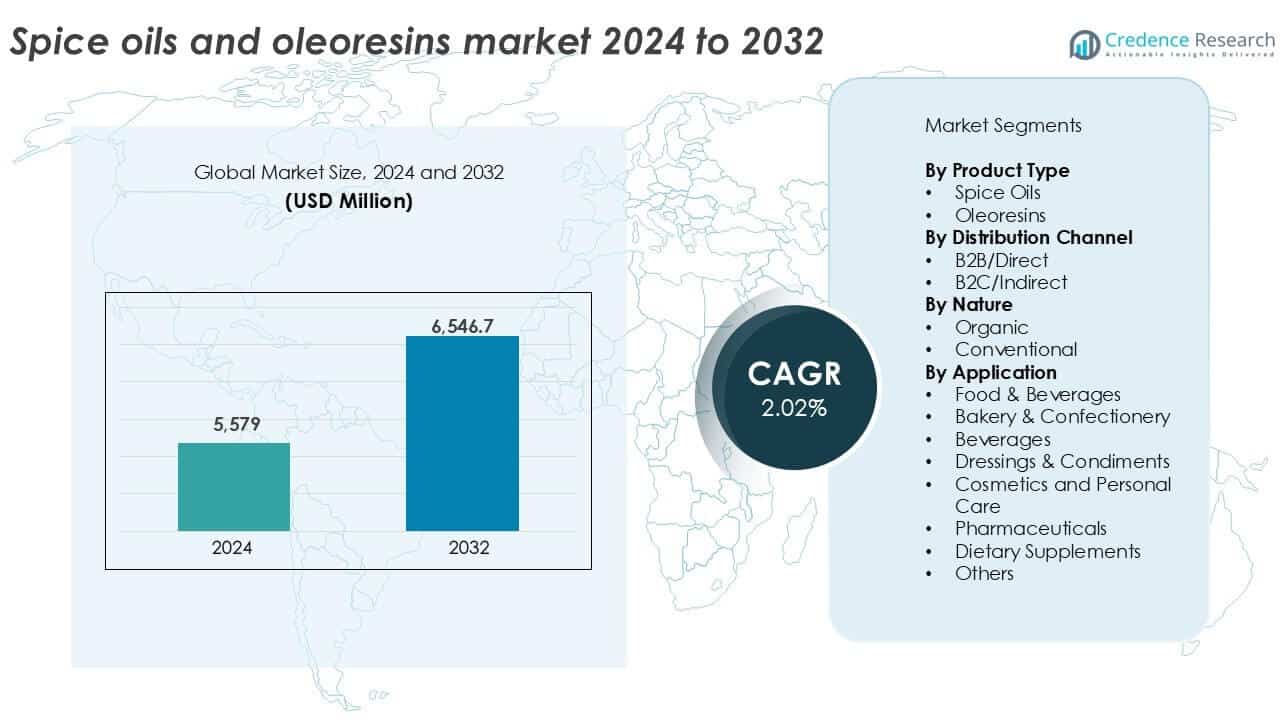
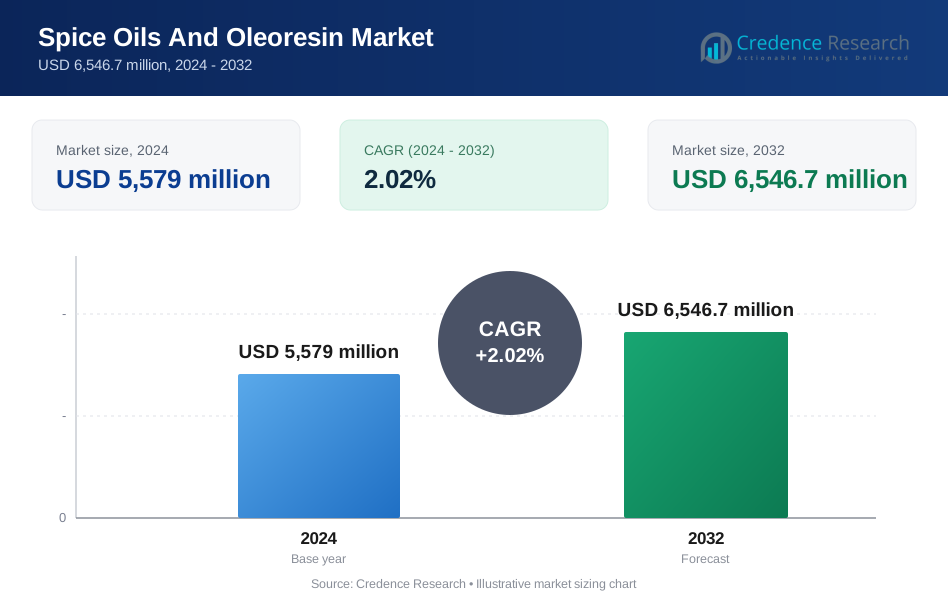
The spice oils and oleoresins market size was valued at USD 5,579 million in 2024 and is anticipated to reach USD 6,546.7 million by 2032, at a CAGR of 2.02% during the forecast period.
| REPORT ATTRIBUTE | DETAILS |
|---|---|
| Historical Period | 2020-2023 |
| Base Year | 2024 |
| Forecast Period | 2025-2032 |
| Spice Oils And Oleoresin Market Size 2024 | USD 5,579 million |
| Spice Oils And Oleoresin Market, CAGR | 2.02% |
| Spice Oils And Oleoresin Market Size 2032 | USD 6,546.7 million |
Top players in the spice oils and oleoresins market include Synthite Industries Ltd., Givaudan AG, Symrise AG, McCormick & Company, and Kalsec Inc. These companies maintain competitive advantages through advanced extraction technologies, diverse product portfolios, and strong global supply chains. Emerging firms like Greenleaf Extractions Pvt. Ltd. and Universal Oleoresins Pvt. Ltd. are expanding their international footprint by offering organic-certified and traceable extracts. As of 2024, Asia-Pacific dominates the global market with a 34% share, led by India’s strong production base and export capacity. North America and Europe follow with 28% and 25% shares, respectively, driven by demand from processed food and wellness sectors.
Spice Oils And Oleoresin Market Insights
- The spice oils and oleoresins market was valued at USD 5,579 million in 2024 and is projected to reach USD 6,546.7 million by 2032, growing at a CAGR of 2.02%.
- Growth is driven by rising demand from the food processing industry, where oleoresins are preferred for their longer shelf life and uniform flavor.
- Organic and sustainable product trends are gaining momentum, with increased usage of clean-label ingredients in food, personal care, and wellness sectors.
- Leading players such as Synthite Industries Ltd., McCormick & Company, and Givaudan AG dominate through product innovation, global sourcing, and strategic partnerships.
- Asia-Pacific holds 34% of the global share, followed by North America (28%) and Europe (25%); oleoresins account for over 60% of the product segment share, while B2B distribution leads with 70% market share, though raw material price volatility remains a key challenge.
Spice Oils And Oleoresin Market Segmentation Analysis:
By Product Type
In 2024, oleoresins dominated the spice oils and oleoresins market, accounting for over 60% share. Oleoresins are preferred in the food and beverage industry due to their high concentration, longer shelf life, and consistent flavor profiles. Manufacturers favor oleoresins for applications in sauces, marinades, snacks, and seasonings, where precise dosing and heat stability are essential. The pharmaceutical and nutraceutical sectors also increasingly use oleoresins for their bioactive properties. This demand is further supported by the rising shift toward clean-label, plant-based ingredients in both developed and emerging regions.
- For instance, oleoresins deliver high flavor intensity up to 5–20 times that of corresponding whole spices making them preferred for sauces, seasonings, snacks, and marinades in large‑scale food production.
By Distribution Channel
The B2B or direct sales channel held the largest share of over 70% in 2024, driven by bulk purchasing from food processors, cosmetic companies, and pharmaceutical manufacturers. Direct sales help ensure traceability, supply consistency, and better pricing for industrial buyers. B2B demand is strong due to customized product formulations, timely delivery, and long-term supplier relationships. On the other hand, the B2C or indirect segment grows steadily with rising online retail, health-conscious consumers, and the growing popularity of home-based food and wellness products using spice extracts.
- For instance, the B2C or indirect segment grows with rising online retail and home cooking trends, as consumers purchase spice extracts and small‑pack oleoresin products via ecommerce and specialty food stores.
By Nature
Conventional spice oils and oleoresins remained the dominant category in 2024, contributing more than 80% of the market share. This dominance is linked to widespread commercial production, cost advantages, and established supply chains. Large-scale food processing and flavoring industries favor conventional products for their affordability and predictable availability. However, the organic segment is gaining traction, especially in premium food, personal care, and herbal medicine sectors. Rising consumer interest in chemical-free and eco-friendly ingredients drives organic segment growth, particularly across North America and parts of Europe.
Spice Oils And Oleoresin Market Key Growth Drivers
Rising Demand from the Processed Food Industry
The expanding processed food industry significantly drives demand for spice oils and oleoresins. These concentrated extracts offer high flavor intensity, long shelf life, and consistent quality, making them ideal for ready-to-eat meals, snacks, soups, sauces, and marinades. Manufacturers prefer oleoresins over raw spices due to their lower dosage requirements and better dispersion properties in food matrices. Global shifts toward convenience foods, especially in urban markets across Asia-Pacific and North America, further boost consumption. Major food producers increasingly adopt these ingredients to ensure standardized taste and regulatory compliance across production batches. With consumers seeking bolder and ethnic flavors, companies are leveraging oleoresins for regional spice blends.
- For instance, oleoresins allow manufacturers to use smaller quantities than whole spices while achieving consistent taste and aroma, aiding standardized production across batches.
Growing Preference for Natural Ingredients in Health and Wellness Products
The shift toward natural, plant-based ingredients in personal care, pharmaceutical, and wellness products strongly supports the spice oils and oleoresins market. These extracts are widely used in herbal medicines, aromatherapy, and skincare due to their anti-inflammatory, antimicrobial, and antioxidant properties. Rising consumer distrust of synthetic additives and chemicals has prompted manufacturers to reformulate products using clean-label and natural alternatives. Essential oils derived from spices like clove, cinnamon, and turmeric have gained traction in pain relief balms, toothpaste, supplements, and immunity boosters. This trend is particularly evident in Europe and North America, where regulatory frameworks encourage botanical extracts and transparency in labeling. The pandemic accelerated interest in natural immunity and stress relief solutions, further pushing demand for these oils.
- For instance, Europe and North America emphasize premium, therapeutic, and clean‑label essential oils, reflecting regulatory and consumer preferences for botanical transparency and natural wellness solutions.
Expanding Application Across Industrial Sectors
Spice oils and oleoresins have found increasing applications beyond food, including in pet food, textiles, agriculture, and household cleaning products. Their antimicrobial and aromatic qualities make them valuable for natural preservatives, pest repellents, and eco-friendly cleaning formulations. In the pet food industry, natural flavor enhancers are being used to improve palatability without synthetic additives. Agricultural applications include plant-based pesticides and growth enhancers derived from chili, pepper, and turmeric oleoresins. In textiles, turmeric-based oleoresins are used for their antibacterial and anti-odor properties. Moreover, the clean-label movement across all sectors has encouraged R&D investments in natural ingredient innovation. Multinational firms are diversifying into new application areas, capitalizing on growing sustainability trends and consumer demand for chemical-free alternatives. This cross-sector integration significantly expands the addressable market, providing a long-term growth engine for spice oils and oleoresins.
Spice Oils And Oleoresin Market Key Trends & Opportunities
Surge in Organic and Sustainable Product Adoption
Organic and sustainably sourced spice oils and oleoresins are emerging as a major trend, especially in high-income markets. Consumers increasingly seek products that align with ethical sourcing, environmental responsibility, and personal health. This shift is opening opportunities for certified organic extracts and fair-trade spice initiatives. Retailers and private labels are now positioning organic spice oils in premium health and personal care categories. Small and mid-sized producers from India, Sri Lanka, and Southeast Asia are tapping into this demand through sustainable farming and traceable supply chains. Regulatory incentives and eco-labeling standards in Europe and North America further support organic product uptake. As awareness grows, even mainstream food and cosmetic companies are integrating sustainably sourced oleoresins into their products to boost brand value and meet ESG targets. This creates significant scope for suppliers to command higher margins and enter premium global markets.
- For instance, regulatory support for organic certification and environmental standards in Europe and North America reinforces adoption of sustainably sourced spice extracts.
Innovation in Extraction Technology and Value-Added Blends
Technological innovation is transforming the spice oils and oleoresins industry, especially in extraction processes. Supercritical CO₂ extraction, for instance, enables higher purity, improved bioactive retention, and solvent-free yields. These advancements reduce environmental impact and meet strict international food and pharma safety standards. Manufacturers are also focusing on developing customized spice blends and value-added extracts for specific functional applications such as anti-inflammatory food additives or immunity-enhancing supplements. Blending spice oils with essential oils or botanical extracts is creating hybrid products for niche markets like vegan health products or green cleaning solutions. AI-based formulation tools and automation in extraction lines are enhancing product consistency and scalability. These innovations not only improve profit margins but also enable product differentiation, giving manufacturers a competitive edge in developed markets. The trend also helps penetrate smaller consumer segments demanding multifunctional natural ingredients.
Spice Oils And Oleoresin Market Key Challenges
Price Volatility and Raw Material Supply Disruptions
The spice oils and oleoresins market faces frequent challenges due to volatile prices and supply chain instability of raw spices. Climate variability, crop diseases, and geopolitical tensions affect the yield and availability of key spices such as pepper, turmeric, and paprika. This leads to fluctuations in procurement costs and inconsistent supply cycles for extract manufacturers. For instance, erratic monsoons in India or export restrictions in producing nations can sharply reduce availability and raise prices, affecting downstream industries. Additionally, the dependence on smallholder farmers for sourcing makes quality and consistency harder to maintain. These issues increase operational risks for manufacturers and affect pricing strategies, especially in export-heavy regions. Long-term contracts, traceable sourcing, and sustainable farming practices are being adopted to mitigate these risks, but challenges remain, particularly for smaller or mid-scale processors.
Regulatory Complexity and Compliance Burden
Meeting global regulatory standards poses a significant challenge for players in the spice oils and oleoresins market. Different countries enforce varying rules regarding food safety, organic certification, permissible solvent residues, and labeling. Compliance with agencies such as the FDA, EFSA, FSSAI, and REACH involves detailed documentation, testing, and traceability. Manufacturers exporting to multiple markets must navigate a complex web of quality benchmarks, which increases costs and delays product launches. The absence of unified standards for oleoresins and spice oils across jurisdictions adds to the compliance burden. Regulatory audits, residue monitoring, and recall risks also pressure quality assurance systems. Smaller companies, in particular, face difficulties in scaling operations due to limited resources for compliance management. This restricts market entry and expansion for many regional suppliers despite growing demand for natural spice extracts.
Spice Oils And Oleoresin Market Regional Analysis
North America
North America accounted for around 28% of the global spice oils and oleoresins market in 2024, driven by demand from processed food, nutraceuticals, and personal care industries. The U.S. dominates regional consumption, fueled by clean-label product trends and rising use of natural flavoring agents in snacks and sauces. Growing interest in herbal wellness products further supports market penetration. Food manufacturers in Canada and Mexico are adopting oleoresins for consistency and cost efficiency. Regulatory support for natural ingredients and widespread retail availability boost consumer access. The region continues to attract product innovation in organic and functional extract segments.
Europe
Europe held approximately 25% share of the global market in 2024, supported by strong demand in the food, cosmetics, and pharmaceutical sectors. Germany, France, and the U.K. lead usage, driven by clean-label trends, organic food adoption, and sustainable sourcing practices. EU regulations encourage natural and plant-based ingredient use across industries. High awareness of spice extract health benefits supports their use in supplements and nutraceuticals. Oleoresins are also preferred for their lower microbial risk compared to raw spices. Retail brands and contract manufacturers increasingly incorporate certified organic and fair-trade oleoresins into product formulations to meet sustainability targets.
Asia-Pacific
Asia-Pacific led the global market with a 34% share in 2024, driven by strong production and consumption in India, China, and Southeast Asia. India dominates as both the largest producer and exporter of spice oils and oleoresins, supported by favorable agro-climatic conditions and extensive spice cultivation. Domestic demand is growing with rising processed food consumption and herbal product usage. China’s expanding food processing and traditional medicine sectors further accelerate uptake. ASEAN nations are witnessing increased export-oriented production and R&D investments. Regional growth is fueled by expanding industrial applications and shifting preferences toward natural ingredients across urban markets.
Latin America
Latin America accounted for 7% of the global market share in 2024, led by Brazil and Mexico. The region benefits from abundant spice cultivation, especially paprika, chili, and oregano, supporting regional oleoresin production. Demand from the food processing industry is rising, particularly in sauces, seasonings, and ready meals. Growing awareness of herbal remedies and wellness products contributes to uptake in personal care and pharmaceutical sectors. Export opportunities are increasing as Latin American processors meet international quality standards. However, infrastructure limitations and raw material variability affect consistent supply, requiring investments in post-harvest processing and quality control systems.
Middle East & Africa (MEA)
The Middle East & Africa region held a 6% share in 2024, with growing demand from the foodservice, flavor, and traditional medicine sectors. The Gulf Cooperation Council (GCC) countries show strong interest in imported spice extracts for ethnic and halal food products. In Africa, countries like South Africa and Nigeria are expanding processed food output, driving interest in oleoresins for shelf-stable applications. Rising use in perfumery, aromatherapy, and herbal formulations adds new revenue streams. While local production remains limited, import demand continues to grow. Government support for agribusiness and herbal industries is expected to aid market expansion in select areas.
Spice Oils And Oleoresin Market Segmentations:
By Product Type
- Spice Oils
- Oleoresins
By Distribution Channel
- B2B/Direct
- B2C/Indirect
By Nature
- Organic
- Conventional
By Application
- Food & Beverages
- Bakery & Confectionery
- Beverages
- Dressings & Condiments
- Cosmetics and Personal Care
- Pharmaceuticals
- Dietary Supplements
- Others
By Geography
- North America
- U.S.
- Canada
- Mexico
- Europe
- Germany
- France
- U.K.
- Italy
- Spain
- Rest of Europe
- Asia Pacific
- China
- Japan
- India
- South Korea
- South-east Asia
- Rest of Asia Pacific
- Latin America
- Brazil
- Argentina
- Rest of Latin America
- Middle East & Africa
- GCC Countries
- South Africa
- Rest of the Middle East and Africa
Competitive Landscape
The spice oils and oleoresins market features a moderately consolidated landscape, with a mix of global giants and regional specialists competing on product quality, extraction innovation, and customized solutions. Leading companies such as Synthite Industries Ltd., Givaudan AG, and McCormick & Company maintain strong global presence through vertically integrated operations, robust R&D, and diverse product portfolios. Players like Symrise AG, Kalsec Inc., and Young Living Essential Oils Ltd. focus on clean-label, organic, and functional extract offerings to cater to food, wellness, and cosmetic sectors. Indian firms such as Universal Oleoresins Pvt. Ltd., Greenleaf Extractions Pvt. Ltd., and Indian Spice Oil Industries leverage proximity to raw materials and cost competitiveness to strengthen export capabilities. Mergers, sustainable sourcing initiatives, and technological advancements in supercritical CO₂ and solvent-free extraction are shaping market competition. Custom blends, traceability, and certification (e.g., organic, halal, kosher) are key strategies to differentiate and capture high-margin segments.
Key Player Analysis
- Universal Oleoresins Pvt. Ltd.
- Givaudan AG
- Indian Spice Oil Industries
- Symrise AG
- Reckitt Benckiser Group Plc
- Kalsec Inc.
- Synthite Industries Ltd.
- McCormick & Company
- Greenleaf Extractions Pvt. Ltd.
- Young Living Essential Oils Ltd.
Recent Developments
- In 2022, Divi's and Algalif collaborated to develop concentrated beadlets of sustainable natural astaxanthin. It is utilized in renewable energy sources to extract astaxanthin oleoresin from microalgae in a naturally derived manner.
- In January 2022, Givaudan announced its acquisition of a 48% stake in Nanovetores Group. The stake was acquired from The Criatec Fund, a Brazilian investment fund that focuses on innovative, early-stage companies. This acquisition demonstrates Givaudan's strategic interest in expanding its presence in the beauty products business and capabilities in the market.
Report Coverage
The research report offers an in-depth analysis based on Product Type, Distribution Channel, Nature, Application and Geography. It details leading market players, providing an overview of their business, product offerings, investments, revenue streams, and key applications. Additionally, the report includes insights into the competitive environment, SWOT analysis, current market trends, as well as the primary drivers and constraints. Furthermore, it discusses various factors that have driven market expansion in recent years. The report also explores market dynamics, regulatory scenarios, and technological advancements that are shaping the industry. It assesses the impact of external factors and global economic changes on market growth. Lastly, it provides strategic recommendations for new entrants and established companies to navigate the complexities of the market.
Future Outlook
- Demand will grow steadily due to rising use in processed and convenience food products.
- Adoption of clean-label and plant-based ingredients will expand across food, cosmetic, and health sectors.
- Oleoresins will continue to dominate due to their concentrated flavor and long shelf life.
- Organic and sustainably sourced products will gain market share in premium consumer segments.
- Asia-Pacific will maintain leadership, supported by raw material availability and export growth.
- Technological advancements in extraction methods will improve product purity and efficiency.
- B2B channels will remain dominant, with increasing customization for industrial clients.
- Regulatory compliance and quality certifications will become essential for global market access.
- Innovation in functional blends and hybrid applications will open new commercial opportunities.
- Supply chain stability and climate-resilient sourcing will be key focus areas for manufacturers.
Request a Free Sample
Fill in your details and we'll send you a free sample report.
- Sample data tables & charts
- Research methodology
Need a Custom Version of This Report?
Tailor the scope, geography, or segments to your exact requirements.
- Custom geography or segment scope
- Direct access to our analyst team
Frequently Asked Questions
What is the current market size for the spice oils and oleoresins market, and what is its projected size in 2032?
At what Compound Annual Growth Rate is the spice oils and oleoresins market projected to grow between 2024 and 2032?
Which spice oils and oleoresins market segment held the largest share in 2024?
What are the primary factors fueling the growth of the spice oils and oleoresins market?
Who are the leading companies in the spice oils and oleoresins market?
Which region commanded the largest share of the spice oils and oleoresins market in 2024?
Table of Content
Chapter 1. Report Introduction
- 1.1 Report Description & Purpose
- 1.1.1 Report Title & Market Definition
- 1.1.2 Unique Selling Propositions (USP) & Key Differentiators
- 1.1.3 Value Proposition for Stakeholders
- 1.2 Research Objectives
- 1.2.1 Market Sizing Objectives (Volume & Revenue)
- 1.2.2 Segmentation Objectives
- 1.2.3 Competitive Intelligence Objectives
- 1.2.4 Forecast & Scenario Objectives
- 1.3 Report Scope
- 1.3.1 Spice Oils And Oleoresin Scope – Types & Subtypes Covered
- 1.3.2 Geographic Scope – Regions & Countries Covered
- 1.3.3 Historical Period, Base Year & Forecast Period (2024; forecast to 2032)
- 1.3.4 Inclusions & Exclusions
- 1.4 HS Code & Classification Framework
- 1.5 Currency, Units & Pricing Basis
- 1.6 Target Stakeholders
- 1.7 Limitations & Assumptions
Chapter 2. Executive Summary
- 2.1 Global Spice Oils And Oleoresin Market Snapshot
- 2.1.1 Market Size – Historical (2024) & Forecast (2024-2032) (2024: USD 5,579 million → 2032: USD 6,546.7 million)
- 2.1.2 Volume & Revenue – Global Totals
- 2.1.3 Key Market Highlights – Top Five Facts
- 2.2 Spice Oils And Oleoresin Market Segmentation Snapshot
- 2.2.1 Market Split by Region – 2024 vs. 2032
- 2.3 Competitive Snapshot
- 2.3.1 Top 10 Players by Revenue Share – 2024
- 2.3.2 Top 10 Players by Volume Share – 2024
- 2.3.3 Recent Strategic Developments (18-Month Summary)
- 2.4 Key Investment Highlights & Strategic Conclusions
Chapter 3. Spice Oils And Oleoresin Market Dynamics & Industry Analysis
- 3.1 Market Overview & Context
- 3.1.1 Spice Oils And Oleoresin Market Position in the Broader Automotive Value Chain
- 3.1.2 OEM vs. Replacement Market Dynamics
- 3.1.3 Market Maturity & Development Stage by Region
- 3.2 Spice Oils And Oleoresin Market Drivers
- 3.3 Spice Oils And Oleoresin Market Restraints & Challenges
- 3.4 Spice Oils And Oleoresin Market Opportunities
- 3.5 Porter's Five Forces Analysis
- 3.5.1 Threat of New Entrants
- 3.5.2 Bargaining Power of Suppliers
- 3.5.3 Bargaining Power of Buyers
- 3.5.4 Threat of Substitutes
- 3.5.5 Competitive Rivalry – Intensity Assessment
- 3.6 Spice Oils And Oleoresin Value Chain Analysis
- 3.6.1 Upstream – Raw Material/Input Suppliers
- 3.6.1.1 Raw Material/Input 1
- 3.6.1.2 Raw Material/Input 2
- 3.6.1.3 Raw Material/Input 3
- 3.6.2 Midstream – Production/Manufacturing/Service Delivery
- 3.6.2.1 Production/Process Overview
- 3.6.2.2 Key Facility Locations & Capacity by Manufacturer
- 3.6.3 Downstream – Distribution & End Consumer
- 3.6.3.1 Primary Channel – B2B/OEM
- 3.6.3.2 Secondary Channels – Dealer, Retail, Online, Direct
- 3.6.4 Value Chain Profitability Analysis
- 3.6.1 Upstream – Raw Material/Input Suppliers
- 3.7 PESTEL Analysis
- 3.7.1 Political Factors
- 3.7.2 Economic Factors
- 3.7.3 Social Factors
- 3.7.4 Technological Factors
- 3.7.5 Environmental Factors
- 3.7.6 Legal Factors
- 3.8 Spice Oils And Oleoresin Supply Chain Analysis
- 3.8.1 Raw Material/Input Supply Risk Assessment
- 3.8.2 Manufacturing Concentration Risk (Geographic Exposure)
- 3.8.3 Trade Disruption Impact Analysis
- 3.9 Regulatory & Policy Landscape
Note: The regulatory and policy landscape section covers regulations based on their applicability to the market, Spice Oils And Oleoresin category, geography, and scope of the study. Only regulatory frameworks with a material impact on operations, compliance, trade, sustainability, or market access are analyzed in detail.
Chapter 4. Key Investment Pockets & Opportunity Analysis
- 4.1 Spice Oils And Oleoresin Market Attractiveness Analysis
- 4.1.1 By Region – Investment Attractiveness Matrix (Volume × CAGR)
- 4.2 Absolute Revenue Growth Opportunity
- 4.2.1 By Region – Absolute USD Growth Through 2032
- 4.3 Incremental Volume Opportunity
- 4.3.1 By Region – Incremental Volume Through 2032
- 4.3.2 Segment – Incremental Volume
- 4.4 Emerging Submarket Opportunity Deep Dive (Subject to Applicability)
- 4.5 Emerging Market Opportunity Scorecards
- 4.5.1 United States
- 4.5.2 Europe
- 4.5.3 Asia
- 4.5.4 Middle East & Africa
Note: Emerging Market Opportunity Scorecards will be included based on relevance and strategic importance. Regions listed are indicative and may vary depending on data availability and market dynamics.
Chapter 5. Spice Oils And Oleoresin Import-Export Analysis & Trade Flows
- 5.1 Global Trade Overview
- 5.1.1 Global Export Value by Country (2024)
- 5.1.2 Global Export Volume by Country (2024)
- 5.1.3 Global Import Value by Country (2024)
- 5.1.4 Global Import Volume by Country (2024)
- 5.1.5 Net Trade Balance by Country (2024)
- 5.2 Export Analysis – Segment
- 5.2.1 Type 1 (HS Code)
- 5.2.2 Type 2 (HS Code)
- 5.2.3 Type 3 (HS Code)
- 5.2.4 Type 4 (HS Code)
- 5.2.5 Type 5 (HS Code)
- 5.3 Import Analysis – Segment
- 5.3.1 Type 1 (HS Code)
- 5.3.2 Type 2 (HS Code)
- 5.3.3 Type 3 (HS Code)
- 5.3.4 Type 4 (HS Code)
- 5.3.5 Type 5 (HS Code)
- 5.4 Average Unit Trade Prices
- 5.4.1 Average Export Price – Segment & Country
- 5.4.2 Average Import Price – Segment & Source Country
- 5.4.3 Price Trends (2024)
- 5.5 Key Trade Route Analysis
- 5.5.1 Trade Route 1
- 5.5.2 Trade Route 2
- 5.5.3 Trade Route 3
- 5.5.4 Trade Route 4
- 5.5.5 Trade Route 5
- 5.6 Trade Policy Impact Assessment
- 5.6.1 US Anti-Dumping & Section 301 Tariffs
- 5.6.2 EU Customs Union Impact
- 5.6.3 Major Free Trade Agreements
- 5.6.4 USMCA Rules of Origin
Note: Trade policy analysis will be included only where relevant to the Spice Oils And Oleoresin market.
Chapter 6. Competitive Landscape & Company Benchmarking
- 6.1 Spice Oils And Oleoresin Market Concentration & Structure
- 6.1.1 Herfindahl-Hirschman Index (HHI) – vs. 2024
- 6.1.2 Tier 1, Tier 2 & Tier 3 Market Structure
- 6.1.3 Global, Regional & Local Player Dynamics
- 6.2 Spice Oils And Oleoresin Market Share Analysis – 2024
- 6.2.1 Global Revenue Share by Company
- 6.2.2 Global Volume Share by Company
- 6.2.3 Regional Revenue Share
- 6.2.4 Market Share Evolution ( vs. 2024)
- 6.2.5 OEM Segment Share by Company
- 6.2.6 Replacement Segment Share by Company
- 6.3 Production/Delivery Capacity & Facility Analysis
- 6.3.1 Global Installed Capacity
- 6.3.2 Capacity Utilization Rates
- 6.3.3 Production/Output Volume
- 6.3.4 Facility Locations & Capacity Map
- 6.3.5 Planned Capacity Additions
- 6.4 Spice Oils And Oleoresin Competitive Benchmarking Matrix
- 6.4.1 Revenue, Volume, CAGR & Profitability Comparison
- 6.4.2 Channel Revenue Mix
- 6.4.3 Geographic Revenue Exposure
- 6.4.4 R&D Intensity
- 6.4.5 Sustainability Maturity
- 6.5 Strategic Developments in Spice Oils And Oleoresin (Last 24 Months)
- 6.5.1 Mergers, Acquisitions & Divestments
- 6.5.2 New Spice Oils And Oleoresin Launches
- 6.5.3 Facility Expansions
- 6.5.4 Strategic Alliances, Joint Ventures & Partnerships
- 6.5.5 Distribution Expansion & Market Entry
- 6.5.6 Sustainability & ESG Initiatives
- 6.6 Competitive Strategy Mapping
- 6.6.1 Leader, Challenger, Follower & Niche Classification
- 6.6.2 Pricing Strategy Comparison
- 6.6.3 Channel Strategy Matrix
Note: Strategic developments are included based on their materiality and the availability of reliable information.
Chapter 7. Global Spice Oils And Oleoresin Market – By Distribution Channel
- 7.1 Segment Overview
- 7.1.1 Volume & Revenue Split by Channel (2024 & 2032)
- 7.1.2 Channel Mix Evolution (2024-2032)
Chapter 8. Regional Market Analysis – Global Overview
- 8.1 Global Regional Overview
- 8.1.1 Regional Volume Share
- 8.1.2 Regional Revenue Share
- 8.1.3 Regional Volume by Region
- 8.1.4 Regional Revenue by Region
- 8.1.5 Regional Forecast Through 2032
- 8.2 Cross-Regional Segment Analysis
- 8.2.1 By Distribution Channel
- 8.2.2 By Brand/Price Tier
Chapter 9. North America Spice Oils And Oleoresin Market
- 9.1 United States
- 9.2 Canada
- 9.3 Mexico
Chapter 10. Europe Spice Oils And Oleoresin Market
- 10.1 Germany
- 10.2 France
- 10.3 Italy
- 10.4 United Kingdom
- 10.5 Spain
- 10.6 Poland
- 10.7 Russia
- 10.8 Netherlands
- 10.9 Belgium
- 10.10 Sweden
- 10.11 Denmark
- 10.12 Norway
- 10.13 Rest of Europe
Chapter 11. Asia Pacific Spice Oils And Oleoresin Market
- 11.1 China
- 11.2 India
- 11.3 Japan
- 11.4 South Korea
- 11.5 Thailand
- 11.6 Indonesia
- 11.7 Vietnam
- 11.8 Malaysia
- 11.9 Australia
- 11.10 Rest of Asia Pacific
Chapter 12. Latin America Spice Oils And Oleoresin Market
- 12.1 Brazil
- 12.2 Argentina
- 12.3 Colombia
- 12.4 Chile
- 12.5 Rest of Latin America
Chapter 13. Middle East Spice Oils And Oleoresin Market
- 13.1 Saudi Arabia
- 13.2 United Arab Emirates
- 13.3 Turkey
- 13.4 Israel
- 13.5 Iran
- 13.6 Rest of the Middle East
Chapter 14. Africa Spice Oils And Oleoresin Market
- 14.1 South Africa
- 14.2 Egypt
- 14.3 Nigeria
- 14.4 Morocco
- 14.5 Rest of Africa
Chapter 15. Spice Oils And Oleoresin Company Profiles
- 15.1 [Company 01]
- 15.1.1 Company Overview
- 15.1.2 Key Management Personnel
- 15.1.3 Products & Services Portfolio
- 15.1.4 Financial Performance
- 15.1.5 Key Market Focus & Geographic Presence
- 15.1.6 Recent Developments & Strategic Initiatives
Note: The company profile list is preliminary and may change based on research findings, market developments, data availability, and client requirements.
Chapter 16. Appendices
- Appendix A – List of Abbreviations & Acronyms
- Appendix B – Industry Classification Code Reference – Full Series
- Appendix C – Production & Capacity Data Tables
- Appendix D – End-Use & Demand Base Tables
- Appendix E – Consumption & Replacement Rate Assumptions
- Appendix F – ASP Reference Tables
- Appendix G – Manufacturing & Facility Database
- Appendix H – Import-Export Data Tables
- Appendix I – Regulatory Summary Tables
- Appendix J – Primary Research Participant List (Anonymized)
- Appendix K – Primary Research Questionnaire Framework
- Appendix L – Data Sources & Bibliography
- Appendix M – Market Size Divergence & Source Comparison
Chapter 17. Research Methodology
- 17.1 Research Framework & Philosophy
- 17.2 Secondary Research – Sources, Hierarchy & Data Extraction
- 17.3 Data Modeling – Bottom-Up & Top-Down Market Sizing
- 17.4 Primary Research – Stakeholder Framework, LOI & Sample Sizes
- 17.5 Forecast Methodology – Regression, Scenario & Sensitivity Analysis
- 17.6 Quality Control – Four-Layer Validation Framework
- 17.7 Limitations & Standard Assumptions
- 17.8 Disclaimer
