
Market Overview
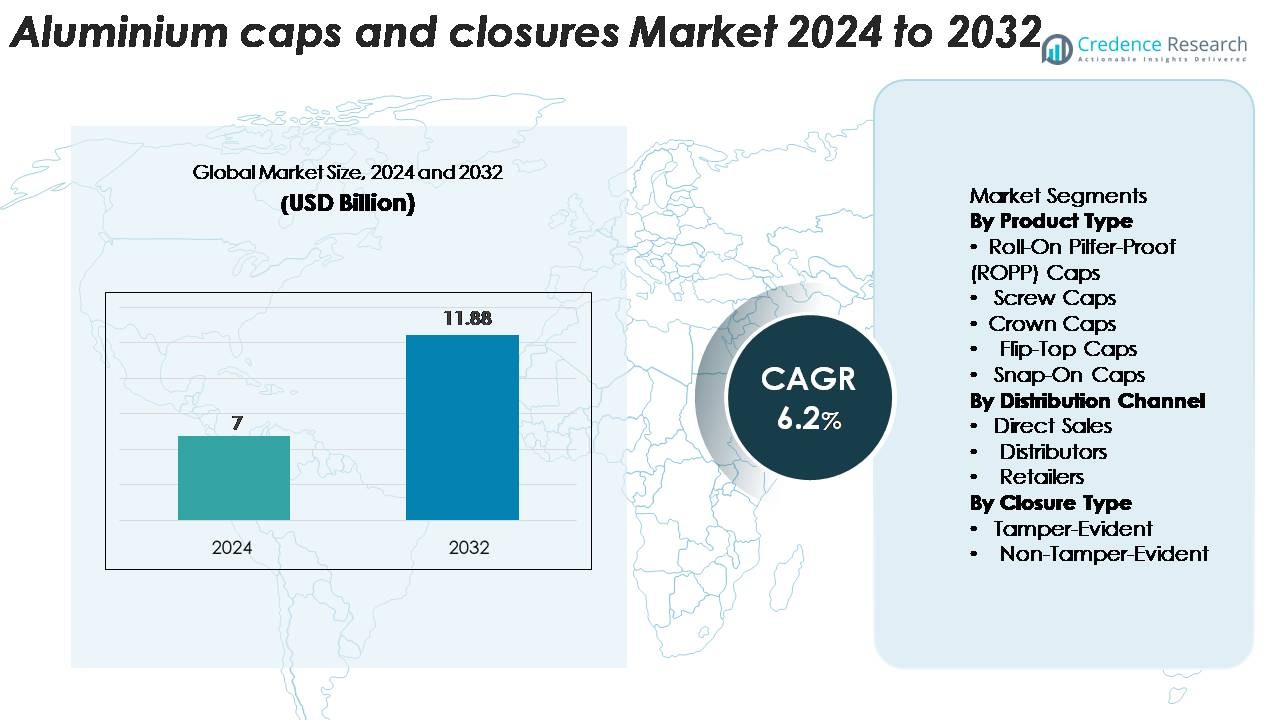
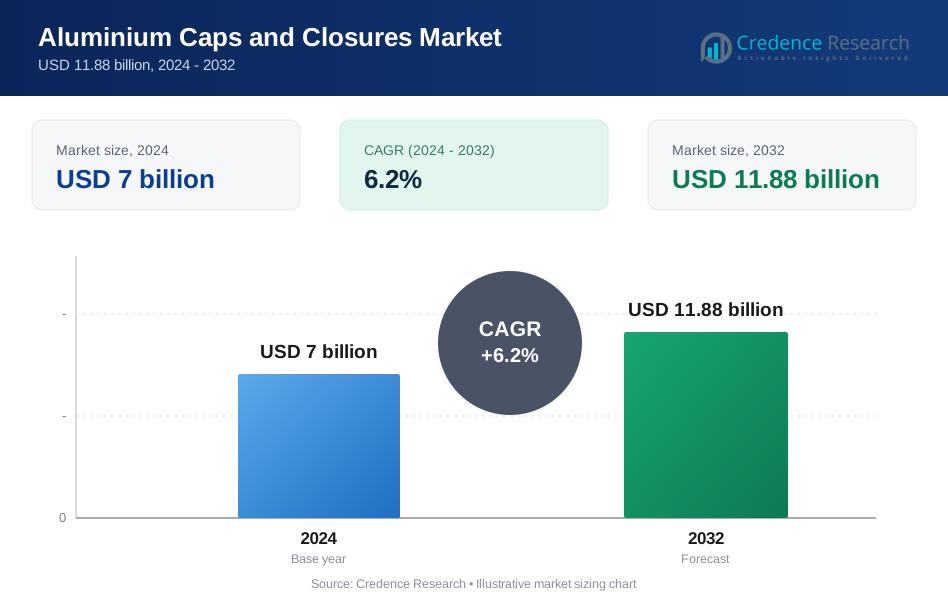
The aluminium caps and closures market was valued at USD 7 billion in 2024 and is projected to reach USD 11.88 billion by 2032, expanding at a CAGR of 6.2% during the forecast period.
| REPORT ATTRIBUTE | DETAILS |
|---|---|
| Historical Period | 2020-2023 |
| Base Year | 2024 |
| Forecast Period | 2025-2032 |
| Aluminium Caps and Closures Market Size 2024 | USD 7 Billion |
| Aluminium Caps and Closures Market, CAGR | 6.2% |
| Aluminium Caps and Closures Market Size 2032 | USD 11.88 Billion |
The aluminium caps and closures market is shaped by leading players such as Crown Holdings, Silgan Holdings, Guala Closures Group, Amcor, Closure Systems International, and Bericap, each competing through innovations in tamper-evident designs, lightweight alloys, and premium decorative finishes. These companies serve major beverage, pharmaceutical, food, and cosmetics brands through extensive global manufacturing networks and long-term supply partnerships. North America leads the market with a 32% share, driven by strong bottled water, spirits, and healthcare demand, while Asia-Pacific follows closely with 30%, supported by expanding beverage production and healthcare infrastructure. Europe accounts for nearly 28%, anchored by its advanced recycling ecosystem and high adoption of sustainable aluminium packaging.
Market Insights
- The aluminium caps and closures market was valued at USD 7 billion in 2024 and is expected to reach USD 11.88 billion by 2032, registering a CAGR of 6.2%.
- Market growth is driven by rising demand from the beverages and pharmaceutical sectors, with ROPP caps holding the largest share at around 38%, supported by strong adoption in spirits, wine, and medicinal packaging.
- Key trends include the shift toward recyclable aluminium solutions, premium decorative closures, and advanced tamper-evident technologies that enhance product safety and consumer trust.
- The competitive landscape features major players such as Crown Holdings, Guala Closures Group, Silgan Holdings, and Bericap, all investing in automation, lightweight alloys, and design customization to maintain market leadership.
- Regionally, North America leads with 32%, followed by Asia-Pacific at 30% and Europe at 28%, while Latin America and the Middle East & Africa collectively account for the remaining share, supported by expanding beverage and healthcare markets.
Market Segmentation Analysis:
By Product Type:
Roll-On Pilfer-Proof (ROPP) caps dominate the aluminium caps and closures market with an estimated 38% share, driven by their strong adoption in spirits, wine, pharmaceuticals, and premium beverages. Their tamper-evident sealing, compatibility with high-speed bottling lines, and ability to maintain product integrity make them the preferred choice for manufacturers. Screw caps follow closely, supported by rising usage in edible oils and household products. Crown caps remain relevant in carbonated drinks, while flip-top and snap-on caps gain traction in personal care and convenience-driven packaging formats.
- For instance, Bapco Closures' snap-on cap systems are manufactured using high-precision injection molding processes, a standard industry method for producing high-value, precise closures, enabling consistent hinge performance for personal care packaging
By Distribution Channel:
Direct sales account for the largest share at approximately 45%, supported by long-term supply contracts between closure manufacturers and beverage, pharmaceutical, and food processing companies. This channel ensures consistent quality, bulk pricing advantages, and uninterrupted supply for high-volume production lines. Distributors play a crucial role for medium-scale FMCG and regional bottlers, offering flexible order quantities and local availability. Retailers hold a smaller share, largely catering to small businesses and craft beverage producers that procure limited volumes.
- For instance, Crown Holdings directly supplies aluminium closures to major beverage clients using its fully automated production lines capable of manufacturing up to 5 billion closures annually across its global plants, ensuring contract stability and high-volume fulfilment.
By Closure Type:
Tamper-evident closures lead the segment with around 62% market share, driven by stringent regulatory requirements in beverages, pharmaceuticals, and packaged foods. Their ability to provide visible proof of product safety, prevent adulteration, and build consumer trust fuels strong adoption across global markets. Industries such as alcohol, carbonated beverages, and over-the-counter medicines increasingly mandate tamper-evident aluminium caps for compliance and brand protection. Non-tamper-evident closures serve applications where ease of opening, frequent use, and cost efficiency are prioritized, particularly in household and personal care products.
Key Growth Drivers
Rising Consumption of Packaged Beverages
The rapid expansion of the global packaged beverage industry significantly drives demand for aluminium caps and closures. Growth in carbonated drinks, alcoholic beverages, bottled water, ready-to-drink teas, and functional beverages has accelerated the need for high-performance closure solutions. Aluminium ROPP and crown caps remain preferred due to their superior sealing, tamper-evidence, recyclability, and compatibility with high-speed filling lines. Premium beverage categories, including craft spirits, wine, and energy drinks, increasingly adopt aluminium closures to enhance product safety and aesthetics. In emerging markets, rising disposable incomes and urbanization are boosting per-capita beverage consumption, which expands large-scale procurement of aluminium caps by bottlers. Additionally, beverage manufacturers prioritize sustainability, and aluminium’s infinite recyclability strengthens its adoption over plastic alternatives. Together, these factors create consistent, long-term growth momentum for aluminium closure manufacturers.
- For instance, Closure Systems International (CSI) supplies more than 50 billion closures annually to beverage manufacturers, including major operations in India, Brazil, and Southeast Asia, matching the rising beverage output in these regions.
Strong Adoption in Pharmaceuticals and Healthcare Packaging
Pharmaceutical companies rely heavily on aluminium closures due to their sterility, compatibility with sensitive formulations, and strong tamper-evident properties. Aluminium caps are widely used for vials, syrups, injectables, and OTC medicines, supporting strict regulatory compliance across global markets. The growth of chronic diseases, expansion of vaccine production, and rising output of liquid formulations contribute to sustained demand from pharmaceutical fillers. Aluminium closures also offer superior barrier protection against moisture, oxygen, and contamination—critical for maintaining drug stability during transport and storage. Moreover, governments and regulatory agencies increasingly enforce tamper-evident packaging guidelines, leading to widespread adoption of aluminium seals and flip-off caps. As healthcare infrastructure expands in Asia-Pacific, Latin America, and Africa, pharmaceutical manufacturing capacity increases, resulting in strong procurement of aluminium caps for high-volume packaging applications.
- For instance, West Pharmaceutical Services’ Flip-Off® CCS seals undergo 100% camera-based visual inspection and meet ISO 8362-7 specifications, ensuring tamper-evident performance for vaccine and biologic packaging.
Sustainability Push and Shift Toward Recyclable Packaging
Increasing global emphasis on sustainability is accelerating the transition from plastic closures to aluminium alternatives. Aluminium’s recyclability—where nearly 75% of all aluminium ever produced remains in circulation—positions it as a preferred material for brands pursuing circular economy goals. Growing regulatory pressure, including bans on single-use plastics and extended producer responsibility schemes, encourages manufacturers to adopt aluminium caps that offer both high performance and environmental advantages. Beverage brands, particularly in premium segments, highlight aluminium closures as part of their eco-friendly packaging strategies. The lightweight nature of aluminium also supports carbon-reduction goals in logistics and transportation. As consumers prioritize sustainable packaging, manufacturers invest in new alloy grades, downgauged profiles, and energy-efficient production processes to strengthen the competitive appeal of aluminium caps. This shift creates strong long-term growth opportunities across beverages, cosmetics, pharmaceuticals, and household products.
Key Trends & Opportunities
Growth of Premiumization and Enhanced Aesthetic Packaging
Premiumization across alcohol, cosmetics, and specialty beverages is creating strong demand for aluminium closures with enhanced visual appeal, intricate embossing, and high-quality printing. Brands increasingly use customized aluminium caps to differentiate products on crowded retail shelves. Advances in surface treatment technologies, digital printing, and multi-color lacquering allow manufacturers to offer sophisticated designs and brand storytelling elements through closures. Luxury spirits, craft beverages, and boutique skincare brands particularly favor aluminium caps for their durability and premium tactile feel. As consumer preferences shift toward high-end and giftable packaging, aluminium closure producers have a significant opportunity to expand portfolios with value-added decorative options, including matte finishes, anodized coatings, and engraved designs. This trend supports higher margins and strengthens collaborations between closure manufacturers and brand owners seeking innovative packaging aesthetics.
- For instance, Amcor utilizes anodized aluminium technologies that deliver surface hardness levels of up to 500 HV (Vickers Hardness), ensuring scratch-resistant finishes for premium cosmetic closures.
Technological Advancements in Tamper-Evident and Smart Closures
Innovation in tamper-evident mechanisms and digital-enabled packaging presents major opportunities for aluminium closure manufacturers. Technologies such as laser-scored bands, breakaway seals, and enhanced pilfer-proof mechanisms strengthen consumer trust and regulatory compliance across pharmaceuticals and beverages. At the same time, the industry is exploring integration of smart features such as QR codes, NFC tags, and authentication markers directly onto aluminium caps. These features enable supply chain traceability, anti-counterfeiting measures, and customer engagement through digital content. High-growth segments like premium alcohol, nutraceuticals, and specialty foods benefit significantly from such advanced closures. Manufacturers investing in automated production, precision molding, and improved alloy compositions are well-positioned to capture emerging demand for intelligent and safety-enhanced closures. The rise of connected packaging further amplifies long-term growth potential.
- For instance, Closure Systems International (CSI) operates high-speed molding lines capable of producing over 50 billiontamper-evident and other closures annually across its various global sites, supporting safety-critical applications in beverages, healthcare, and other industries.
Expansion of E-Commerce and Small-Format Packaging
The global rise of e-commerce has reshaped packaging demand, increasing the need for durable, leak-proof, and tamper-evident aluminium closures suitable for long-distance shipping. Products such as cosmetics, household cleaners, and specialty foods increasingly require closures that maintain integrity under transportation stress. Aluminium caps are gaining traction in small-format, travel-size, and subscription-based packaging formats popular in online retail. These caps provide stability, compatibility with diverse bottle materials, and high resistance to deformation. As e-commerce penetration grows, there is a growing opportunity for manufacturers to design impact-resistant, lightweight closures optimized for fulfilment centers and direct-to-consumer models. This trend also encourages development of resealable and user-friendly aluminium closure formats.
Key Challenges
High Raw Material Costs and Price Volatility
Aluminium caps and closures manufacturers face significant challenges due to fluctuations in aluminium prices, which are influenced by energy costs, mining output, and geopolitical instability. Aluminium production is energy-intensive, and rising electricity prices directly impact operational costs, making it difficult for closure manufacturers to maintain pricing stability. Smaller converters are particularly affected, as they lack the procurement leverage of large packaging companies. Volatility disrupts long-term supply contracts with beverage and pharmaceutical fillers, while cost-sensitive customers may shift toward plastic alternatives in certain segments. Managing cost inflation while maintaining product quality and sustainability commitments remains a critical challenge for the industry. Manufacturers increasingly rely on recycled aluminium, efficiency upgrades, and strategic sourcing to mitigate these risks, but volatility continues to pressure profit margins.
Competition from Plastic Closures in Cost-Sensitive Markets
Although aluminium offers superior durability, recyclability, and visual appeal, plastic closures remain strong competitors, especially in cost-sensitive markets such as mass beverages, household chemicals, and low-value FMCG products. Plastic caps are cheaper, easier to mold into complex shapes, and widely used across segments that prioritize cost efficiency over premium performance. Innovations in lightweight plastic closures and improved recyclability further strengthen their market position. For manufacturers of aluminium caps, competing purely on price becomes challenging, especially in regions with limited recycling infrastructure. To maintain market relevance, aluminium closure producers must focus on premium applications, sustainability value propositions, advanced tamper-evidence features, and high-impact design differentiation.
Regional Analysis
North America
North America holds around 32% of the aluminium caps and closures market, driven by strong demand from the beverages, pharmaceuticals, and personal care industries. The region benefits from advanced manufacturing capabilities, stringent safety regulations, and high adoption of tamper-evident and premium closure formats. The U.S. leads consumption due to its large bottled water, spirits, and nutraceutical markets, while Canada contributes steady demand from the healthcare and craft beverage sectors. Sustainability initiatives and high recycling rates further support aluminium closure adoption, as brands prioritize recyclable packaging materials to meet environmental compliance and consumer expectations.
Europe
Europe accounts for roughly 28% of global market share, supported by mature beverage, cosmetics, and pharmaceutical industries that widely adopt aluminium closures for quality, safety, and sustainability. The region’s strong emphasis on circular economy principles drives demand for recyclable aluminium caps across both premium and mainstream product lines. Germany, Italy, France, and the U.K. are key contributors, with extensive bottling operations and advanced recycling systems. Premium wine and spirits brands continue to shift toward ROPP and decorative aluminium caps to enhance product differentiation. Regulatory alignment across the EU accelerates standardization of tamper-evident packaging formats.
Asia-Pacific
Asia-Pacific represents approximately 30% of the market and is the fastest-growing region, driven by rapid urbanization, rising disposable incomes, and expanding beverage and pharmaceutical production. China and India dominate regional demand, supported by large-scale bottling facilities, growing consumption of packaged drinks, and increasing investment in healthcare infrastructure. Japan and South Korea contribute through high-quality cosmetic and personal care packaging. The region also benefits from strong manufacturing capabilities and cost-efficient aluminium processing. As sustainability awareness grows, brands increasingly adopt aluminium closures as recyclable alternatives, accelerating market penetration across both premium and mass-market segments.
Latin America
Latin America holds nearly 6% of the market, supported by growth in the alcoholic beverages, carbonated drinks, and household product segments. Countries such as Brazil, Mexico, and Argentina are major contributors due to their expanding beverage industries and rising demand for tamper-evident packaging. Regional bottlers increasingly adopt aluminium closures for enhanced product safety and compliance with evolving quality standards. While price sensitivity remains a challenge, the shift toward sustainable packaging is creating new demand for aluminium alternatives to plastic caps. Investments in local manufacturing and growing export activities further support market expansion.
Middle East & Africa
The Middle East & Africa region accounts for around 4% of the market, driven by expanding bottled water, juices, and pharmaceutical segments. The Gulf countries, particularly the UAE and Saudi Arabia, lead adoption due to rising consumption of packaged beverages and strong investments in healthcare supply chains. African markets, including South Africa and Nigeria, show increasing demand driven by urbanization and the growth of small-scale beverage producers. However, limited recycling infrastructure and higher import dependence challenge market growth. Nonetheless, rising focus on food safety, tamper-evident closures, and premium beverage packaging continues to create steady opportunities.
Market Segmentations
By Product Type
- Roll-On Pilfer-Proof (ROPP) Caps
- Screw Caps
- Crown Caps
- Flip-Top Caps
- Snap-On Caps
By Distribution Channel
- Direct Sales
- Distributors
- Retailers
By Closure Type
- Tamper-Evident
- Non-Tamper-Evident
By Geography
- North America
- U.S.
- Canada
- Mexico
- Europe
- Germany
- France
- U.K.
- Italy
- Spain
- Rest of Europe
- Asia Pacific
- China
- Japan
- India
- South Korea
- South-east Asia
- Rest of Asia Pacific
- Latin America
- Brazil
- Argentina
- Rest of Latin America
- Middle East & Africa
- GCC Countries
- South Africa
- Rest of the Middle East and Africa
Competitive Landscape
The competitive landscape of the aluminium caps and closures market is characterized by a mix of global packaging leaders and specialized regional manufacturers competing on product quality, innovation, and sustainability. Key players focus on expanding their portfolios of ROPP caps, crown caps, tamper-evident closures, and premium decorative variants to meet the diverse needs of beverage, pharmaceutical, food, and personal care sectors. Companies increasingly invest in advanced printing, embossing, and laser-scoring technologies to enhance product differentiation and brand appeal. Strategic priorities include improving recyclability, reducing material usage through downgauging, and strengthening supply chains to support high-volume bottling operations. Partnerships with beverage and pharmaceutical companies, along with regional capacity expansions, remain central to maintaining competitive advantage. Additionally, manufacturers adopt automation and energy-efficient production systems to improve cost competitiveness amid fluctuating aluminium prices. The industry continues to consolidate, with mergers and acquisitions enabling broader geographic reach and enhanced technological capabilities.
Key Player Analysis
- Amcor Limited
- Bapco Closures
- Cap & Seal Pvt. Ltd.
- Crown Holdings Inc.
- G. Finneran Associates, Inc.
- Nippon Closures Co., Ltd.
- Phoenix Closures, Inc.
- Silgan Holdings Inc.
Recent Developments
- In September 2025, Amcor showcased its latest beverage closure designs at Drinktec 2025 in Munich, highlighting flat and sports caps for returnable glass and PET bottles.
- In July 2025, Amcor introduced its Secure Flip 26 mm tamper-evident sports cap for children’s drinks in Austria, combining ergonomic design and enhanced recyclability.
- In July 2023, Crown expanded its Aluminium Stewardship Initiative (ASI) certifications to its Asia-Pacific closures operations (Thailand), reinforcing its responsible sourcing credentials.
Report Coverage
The research report offers an in-depth analysis based on Product type, Distribution channel, Closure type and Geography. It details leading market players, providing an overview of their business, product offerings, investments, revenue streams, and key applications. Additionally, the report includes insights into the competitive environment, SWOT analysis, current market trends, as well as the primary drivers and constraints. Furthermore, it discusses various factors that have driven market expansion in recent years. The report also explores market dynamics, regulatory scenarios, and technological advancements that are shaping the industry. It assesses the impact of external factors and global economic changes on market growth. Lastly, it provides strategic recommendations for new entrants and established companies to navigate the complexities of the market.
Future Outlook
- The market will continue expanding as beverage, pharmaceutical, and personal care industries increase their reliance on secure and lightweight aluminium closures.
- Demand for tamper-evident and safety-enhanced closure designs will rise across regulated sectors.
- Sustainability initiatives will accelerate the shift toward recyclable aluminium solutions over plastic alternatives.
- Premiumization in spirits, cosmetics, and specialty beverages will boost adoption of decorative and custom-designed aluminium caps.
- Advancements in digital printing and laser-etching technologies will enable greater branding flexibility.
- Manufacturers will invest in automation and energy-efficient production systems to improve cost competitiveness.
- Lightweight alloy development will support downgauging efforts without compromising performance.
- Smart closure technologies, including QR codes and authentication markers, will gain traction in anti-counterfeiting applications.
- Emerging markets will drive growth through increasing packaged beverage consumption and expanding pharmaceutical infrastructure.
- Global players will focus on strategic partnerships and capacity expansions to strengthen regional supply networks.
Request a Free Sample
Fill in your details and we'll send you a free sample report.
- Sample data tables & charts
- Research methodology
Need a Custom Version of This Report?
Tailor the scope, geography, or segments to your exact requirements.
- Custom geography or segment scope
- Direct access to our analyst team
Frequently Asked Questions
What is the current market size for the Aluminium Caps and Closures market, and what is its projected size in 2032?
At what Compound Annual Growth Rate is the Aluminium Caps and Closures market projected to grow between 2025 and 2032?
Which Aluminium Caps and Closures segment held the largest share in 2024?
What are the primary factors fueling the growth of the Aluminium Caps and Closures market?
Who are the leading companies in the Aluminium Caps and Closures market?
Which region commanded the largest share of the Aluminium Caps and Closures market in 2024?
Table of Content
Chapter 1. Report Introduction
- 1.1 Report Description & Purpose
- 1.1.1 Report Title & Market Definition
- 1.1.2 Unique Selling Propositions (USP) & Key Differentiators
- 1.1.3 Value Proposition for Stakeholders
- 1.2 Research Objectives
- 1.2.1 Market Sizing Objectives (Volume & Revenue)
- 1.2.2 Segmentation Objectives
- 1.2.3 Competitive Intelligence Objectives
- 1.2.4 Forecast & Scenario Objectives
- 1.3 Report Scope
- 1.3.1 Aluminium Caps and Closures Scope – Types & Subtypes Covered
- 1.3.2 Geographic Scope – Regions & Countries Covered
- 1.3.3 Historical Period, Base Year & Forecast Period (2024; forecast to 2032)
- 1.3.4 Inclusions & Exclusions
- 1.4 HS Code & Classification Framework
- 1.5 Currency, Units & Pricing Basis
- 1.6 Target Stakeholders
- 1.7 Limitations & Assumptions
Chapter 2. Executive Summary
- 2.1 Global Aluminium Caps and Closures Market Snapshot
- 2.1.1 Market Size – Historical (2024) & Forecast (2024-2032) (2024: USD 7 billion → 2032: USD 11.88 billion)
- 2.1.2 Volume & Revenue – Global Totals
- 2.1.3 Key Market Highlights – Top Five Facts
- 2.2 Aluminium Caps and Closures Market Segmentation Snapshot
- 2.2.1 Market Split by Region – 2024 vs. 2032
- 2.3 Competitive Snapshot
- 2.3.1 Top 10 Players by Revenue Share – 2024
- 2.3.2 Top 10 Players by Volume Share – 2024
- 2.3.3 Recent Strategic Developments (18-Month Summary)
- 2.4 Key Investment Highlights & Strategic Conclusions
Chapter 3. Aluminium Caps and Closures Market Dynamics & Industry Analysis
- 3.1 Market Overview & Context
- 3.1.1 Aluminium Caps and Closures Market Position in the Broader Automotive Value Chain
- 3.1.2 OEM vs. Replacement Market Dynamics
- 3.1.3 Market Maturity & Development Stage by Region
- 3.2 Aluminium Caps and Closures Market Drivers
- 3.3 Aluminium Caps and Closures Market Restraints & Challenges
- 3.4 Aluminium Caps and Closures Market Opportunities
- 3.5 Porter's Five Forces Analysis
- 3.5.1 Threat of New Entrants
- 3.5.2 Bargaining Power of Suppliers
- 3.5.3 Bargaining Power of Buyers
- 3.5.4 Threat of Substitutes
- 3.5.5 Competitive Rivalry – Intensity Assessment
- 3.6 Aluminium Caps and Closures Value Chain Analysis
- 3.6.1 Upstream – Raw Material/Input Suppliers
- 3.6.1.1 Raw Material/Input 1
- 3.6.1.2 Raw Material/Input 2
- 3.6.1.3 Raw Material/Input 3
- 3.6.2 Midstream – Production/Manufacturing/Service Delivery
- 3.6.2.1 Production/Process Overview
- 3.6.2.2 Key Facility Locations & Capacity by Manufacturer
- 3.6.3 Downstream – Distribution & End Consumer
- 3.6.3.1 Primary Channel – B2B/OEM
- 3.6.3.2 Secondary Channels – Dealer, Retail, Online, Direct
- 3.6.4 Value Chain Profitability Analysis
- 3.6.1 Upstream – Raw Material/Input Suppliers
- 3.7 PESTEL Analysis
- 3.7.1 Political Factors
- 3.7.2 Economic Factors
- 3.7.3 Social Factors
- 3.7.4 Technological Factors
- 3.7.5 Environmental Factors
- 3.7.6 Legal Factors
- 3.8 Aluminium Caps and Closures Supply Chain Analysis
- 3.8.1 Raw Material/Input Supply Risk Assessment
- 3.8.2 Manufacturing Concentration Risk (Geographic Exposure)
- 3.8.3 Trade Disruption Impact Analysis
- 3.9 Regulatory & Policy Landscape
Note: The regulatory and policy landscape section covers regulations based on their applicability to the market, Aluminium Caps and Closures category, geography, and scope of the study. Only regulatory frameworks with a material impact on operations, compliance, trade, sustainability, or market access are analyzed in detail.
Chapter 4. Key Investment Pockets & Opportunity Analysis
- 4.1 Aluminium Caps and Closures Market Attractiveness Analysis
- 4.1.1 By Region – Investment Attractiveness Matrix (Volume × CAGR)
- 4.2 Absolute Revenue Growth Opportunity
- 4.2.1 By Region – Absolute USD Growth Through 2032
- 4.3 Incremental Volume Opportunity
- 4.3.1 By Region – Incremental Volume Through 2032
- 4.3.2 Segment – Incremental Volume
- 4.4 Emerging Submarket Opportunity Deep Dive (Subject to Applicability)
- 4.5 Emerging Market Opportunity Scorecards
- 4.5.1 United States
- 4.5.2 Europe
- 4.5.3 Asia
- 4.5.4 Middle East & Africa
Note: Emerging Market Opportunity Scorecards will be included based on relevance and strategic importance. Regions listed are indicative and may vary depending on data availability and market dynamics.
Chapter 5. Aluminium Caps and Closures Import-Export Analysis & Trade Flows
- 5.1 Global Trade Overview
- 5.1.1 Global Export Value by Country (2024)
- 5.1.2 Global Export Volume by Country (2024)
- 5.1.3 Global Import Value by Country (2024)
- 5.1.4 Global Import Volume by Country (2024)
- 5.1.5 Net Trade Balance by Country (2024)
- 5.2 Export Analysis – Segment
- 5.2.1 Type 1 (HS Code)
- 5.2.2 Type 2 (HS Code)
- 5.2.3 Type 3 (HS Code)
- 5.2.4 Type 4 (HS Code)
- 5.2.5 Type 5 (HS Code)
- 5.3 Import Analysis – Segment
- 5.3.1 Type 1 (HS Code)
- 5.3.2 Type 2 (HS Code)
- 5.3.3 Type 3 (HS Code)
- 5.3.4 Type 4 (HS Code)
- 5.3.5 Type 5 (HS Code)
- 5.4 Average Unit Trade Prices
- 5.4.1 Average Export Price – Segment & Country
- 5.4.2 Average Import Price – Segment & Source Country
- 5.4.3 Price Trends (2024)
- 5.5 Key Trade Route Analysis
- 5.5.1 Trade Route 1
- 5.5.2 Trade Route 2
- 5.5.3 Trade Route 3
- 5.5.4 Trade Route 4
- 5.5.5 Trade Route 5
- 5.6 Trade Policy Impact Assessment
- 5.6.1 US Anti-Dumping & Section 301 Tariffs
- 5.6.2 EU Customs Union Impact
- 5.6.3 Major Free Trade Agreements
- 5.6.4 USMCA Rules of Origin
Note: Trade policy analysis will be included only where relevant to the Aluminium Caps and Closures market.
Chapter 6. Competitive Landscape & Company Benchmarking
- 6.1 Aluminium Caps and Closures Market Concentration & Structure
- 6.1.1 Herfindahl-Hirschman Index (HHI) – vs. 2024
- 6.1.2 Tier 1, Tier 2 & Tier 3 Market Structure
- 6.1.3 Global, Regional & Local Player Dynamics
- 6.2 Aluminium Caps and Closures Market Share Analysis – 2024
- 6.2.1 Global Revenue Share by Company
- 6.2.2 Global Volume Share by Company
- 6.2.3 Regional Revenue Share
- 6.2.4 Market Share Evolution ( vs. 2024)
- 6.2.5 OEM Segment Share by Company
- 6.2.6 Replacement Segment Share by Company
- 6.3 Production/Delivery Capacity & Facility Analysis
- 6.3.1 Global Installed Capacity
- 6.3.2 Capacity Utilization Rates
- 6.3.3 Production/Output Volume
- 6.3.4 Facility Locations & Capacity Map
- 6.3.5 Planned Capacity Additions
- 6.4 Aluminium Caps and Closures Competitive Benchmarking Matrix
- 6.4.1 Revenue, Volume, CAGR & Profitability Comparison
- 6.4.2 Channel Revenue Mix
- 6.4.3 Geographic Revenue Exposure
- 6.4.4 R&D Intensity
- 6.4.5 Sustainability Maturity
- 6.5 Strategic Developments in Aluminium Caps and Closures (Last 24 Months)
- 6.5.1 Mergers, Acquisitions & Divestments
- 6.5.2 New Aluminium Caps and Closures Launches
- 6.5.3 Facility Expansions
- 6.5.4 Strategic Alliances, Joint Ventures & Partnerships
- 6.5.5 Distribution Expansion & Market Entry
- 6.5.6 Sustainability & ESG Initiatives
- 6.6 Competitive Strategy Mapping
- 6.6.1 Leader, Challenger, Follower & Niche Classification
- 6.6.2 Pricing Strategy Comparison
- 6.6.3 Channel Strategy Matrix
Note: Strategic developments are included based on their materiality and the availability of reliable information.
Chapter 7. Global Aluminium Caps and Closures Market – By Distribution Channel
- 7.1 Segment Overview
- 7.1.1 Volume & Revenue Split by Channel (2024 & 2032)
- 7.1.2 Channel Mix Evolution (2024-2032)
Chapter 8. Regional Market Analysis – Global Overview
- 8.1 Global Regional Overview
- 8.1.1 Regional Volume Share
- 8.1.2 Regional Revenue Share
- 8.1.3 Regional Volume by Region
- 8.1.4 Regional Revenue by Region
- 8.1.5 Regional Forecast Through 2032
- 8.2 Cross-Regional Segment Analysis
- 8.2.1 By Distribution Channel
- 8.2.2 By Brand/Price Tier
Chapter 9. North America Aluminium Caps and Closures Market
- 9.1 United States
- 9.2 Canada
- 9.3 Mexico
Chapter 10. Europe Aluminium Caps and Closures Market
- 10.1 Germany
- 10.2 France
- 10.3 Italy
- 10.4 United Kingdom
- 10.5 Spain
- 10.6 Poland
- 10.7 Russia
- 10.8 Netherlands
- 10.9 Belgium
- 10.10 Sweden
- 10.11 Denmark
- 10.12 Norway
- 10.13 Rest of Europe
Chapter 11. Asia Pacific Aluminium Caps and Closures Market
- 11.1 China
- 11.2 India
- 11.3 Japan
- 11.4 South Korea
- 11.5 Thailand
- 11.6 Indonesia
- 11.7 Vietnam
- 11.8 Malaysia
- 11.9 Australia
- 11.10 Rest of Asia Pacific
Chapter 12. Latin America Aluminium Caps and Closures Market
- 12.1 Brazil
- 12.2 Argentina
- 12.3 Colombia
- 12.4 Chile
- 12.5 Rest of Latin America
Chapter 13. Middle East Aluminium Caps and Closures Market
- 13.1 Saudi Arabia
- 13.2 United Arab Emirates
- 13.3 Turkey
- 13.4 Israel
- 13.5 Iran
- 13.6 Rest of the Middle East
Chapter 14. Africa Aluminium Caps and Closures Market
- 14.1 South Africa
- 14.2 Egypt
- 14.3 Nigeria
- 14.4 Morocco
- 14.5 Rest of Africa
Chapter 15. Aluminium Caps and Closures Company Profiles
- 15.1 [Company 01]
- 15.1.1 Company Overview
- 15.1.2 Key Management Personnel
- 15.1.3 Products & Services Portfolio
- 15.1.4 Financial Performance
- 15.1.5 Key Market Focus & Geographic Presence
- 15.1.6 Recent Developments & Strategic Initiatives
Note: The company profile list is preliminary and may change based on research findings, market developments, data availability, and client requirements.
Chapter 16. Appendices
- Appendix A – List of Abbreviations & Acronyms
- Appendix B – Industry Classification Code Reference – Full Series
- Appendix C – Production & Capacity Data Tables
- Appendix D – End-Use & Demand Base Tables
- Appendix E – Consumption & Replacement Rate Assumptions
- Appendix F – ASP Reference Tables
- Appendix G – Manufacturing & Facility Database
- Appendix H – Import-Export Data Tables
- Appendix I – Regulatory Summary Tables
- Appendix J – Primary Research Participant List (Anonymized)
- Appendix K – Primary Research Questionnaire Framework
- Appendix L – Data Sources & Bibliography
- Appendix M – Market Size Divergence & Source Comparison
Chapter 17. Research Methodology
- 17.1 Research Framework & Philosophy
- 17.2 Secondary Research – Sources, Hierarchy & Data Extraction
- 17.3 Data Modeling – Bottom-Up & Top-Down Market Sizing
- 17.4 Primary Research – Stakeholder Framework, LOI & Sample Sizes
- 17.5 Forecast Methodology – Regression, Scenario & Sensitivity Analysis
- 17.6 Quality Control – Four-Layer Validation Framework
- 17.7 Limitations & Standard Assumptions
- 17.8 Disclaimer
