
Market Overview:
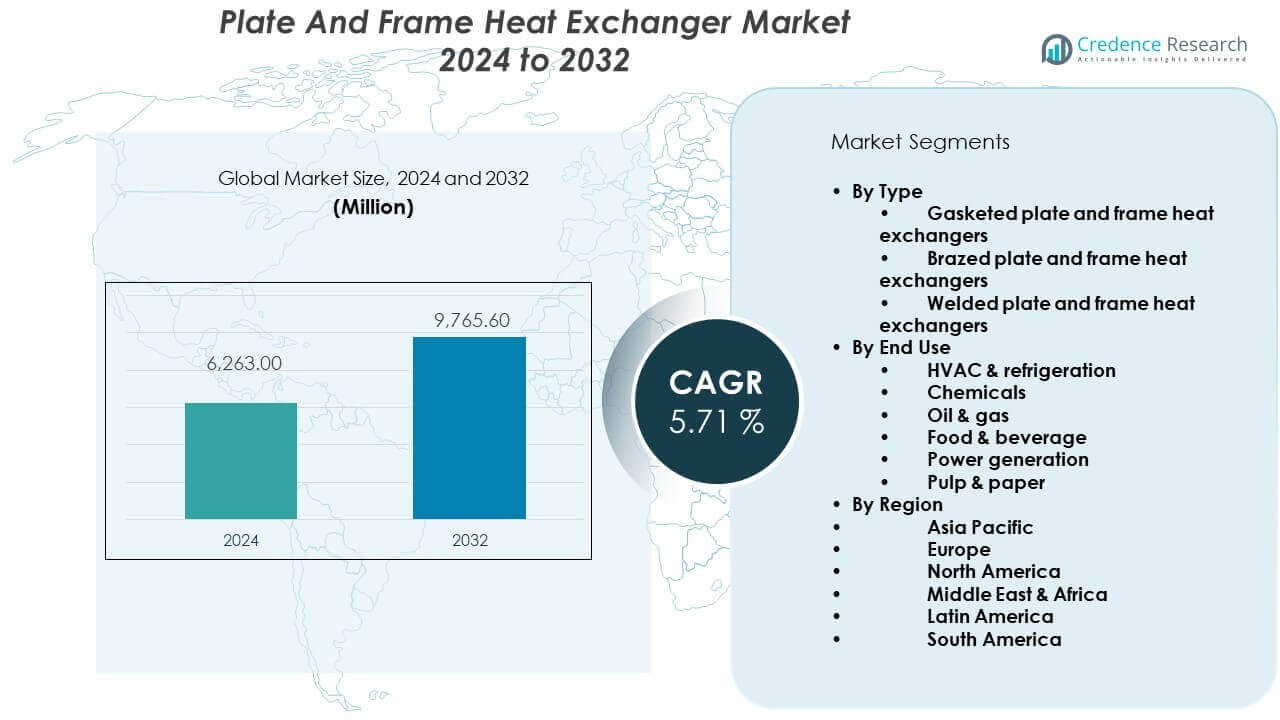
The Plate and frame heat exchanger market is projected to grow from USD 6,263 million in 2024 to an estimated USD 9,765.6 million by 2032, at a compound annual growth rate of 5.71% from 2024 to 2032.
| REPORT ATTRIBUTE | DETAILS |
|---|---|
| Historical Period | 2020-2023 |
| Base Year | 2024 |
| Forecast Period | 2025-2032 |
| Plate And Frame Heat Exchanger Market Size 2024 | USD 6,263 million |
| Plate And Frame Heat Exchanger Market, CAGR | 5.71% |
| Plate And Frame Heat Exchanger Market Size 2032 | USD 9,765.6 million |
Market growth is driven by rising demand for energy-efficient thermal systems across industries. Manufacturing plants aim to reduce energy losses and operating expenses. Food and beverage processors rely on hygienic and easy-to-clean exchanger designs. Chemical and pharmaceutical industries require accurate temperature control for stable processes. HVAC systems use plate and frame exchangers to optimize space and efficiency. District heating networks adopt these systems for reliable heat transfer. Modular construction supports quick upgrades and reduced downtime.
Europe leads the market due to strict energy efficiency and emission regulations. Countries such as Germany and France invest heavily in district heating modernization. North America shows stable demand from HVAC, food processing, and industrial retrofitting. The United States supports replacement of aging heat exchange systems. Asia Pacific emerges as a high-growth region due to rapid industrial expansion. China and India increase investments in chemicals, power, and manufacturing. Southeast Asia gains demand from expanding food processing and export industries.
Market Insights:
- The Plate and frame heat exchanger market is projected to grow from USD 6,263 million in 2024 to USD 9,765.6 million by 2032, registering a CAGR of 5.71%, supported by compact design, high heat transfer efficiency, and easy maintenance.
- Europe (32–35%), Asia Pacific (30–33%), and North America (22–25%) dominate the market due to strict energy regulations, rapid industrial expansion, and strong HVAC and retrofit demand, respectively.
- Asia Pacific, with a 30–33% share, is the fastest-growing region, driven by industrialization in China and India, expanding manufacturing capacity, and rising adoption of energy-efficient thermal systems.
- By type, gasketed plate and frame heat exchangers account for about 45–48%, driven by flexibility, ease of cleaning, and suitability for process industries requiring frequent maintenance.
- By end use, HVAC & refrigeration hold nearly 35–38% share, supported by urban construction growth, commercial building upgrades, and increasing demand for space-efficient thermal solutions.
Market Drivers:
Rising Industrial Demand for Compact and Efficient Thermal Systems Across Core Process Industries
Industries seek compact heat transfer systems that fit space-limited facilities. Plate and frame units support high thermal efficiency with small footprints. Chemical plants rely on precise temperature control for stable reactions. Food processors prefer hygienic designs with fast cleaning cycles. Power utilities use these systems for consistent heat duties. Maintenance teams value easy plate access and fast servicing. The Plate and frame heat exchanger market benefits from these operational needs. Reliable performance supports long production cycles.
- For instance, Alfa Laval reports that its gasketed plate heat exchangers achieve heat transfer coefficients above 5,000 W/m²K in industrial process duties, supporting compact layouts and stable thermal control. Reliable performance supports long production cycles.
Growing Emphasis on Operational Cost Control and Energy Performance Targets
Energy cost pressure drives demand for efficient heat exchange systems. Companies track energy losses across thermal processes. Lower pressure drops help reduce pumping power needs. The Plate and frame heat exchanger market supports cost-focused system upgrades. Plants aim to meet internal energy benchmarks. Stable heat transfer improves output consistency. Predictable operation helps budget planning. Cost control strengthens long-term adoption.
- For instance, Danfoss states that its brazed plate heat exchangers reduce pumping energy by up to 30% compared with traditional shell designs due to optimized flow channels.
Expansion of HVAC and District Heating Infrastructure in Urban Developments
Urban construction expands demand for efficient heating systems. Commercial buildings require compact mechanical layouts. HVAC designers select plate systems for layout flexibility. The Plate and frame heat exchanger market supports district heating networks. Municipal projects value modular expansion capability. Reliable heat distribution improves network stability. Urban density increases system replacement activity. Infrastructure growth sustains steady demand.
Process Reliability Requirements in Continuous Manufacturing Operations
Continuous production requires stable thermal control. Unplanned shutdowns raise financial risk. Operators prefer equipment that allows quick maintenance. The Plate and frame heat exchanger market meets uptime requirements. Modular plates enable partial servicing. Consistent heat transfer protects product quality. Reliability supports long asset life. Process stability drives investment decisions.
Market Trends:
Shift Toward Modular and Scalable Heat Exchange Configurations
End users favor scalable thermal systems. Modular plate designs support phased capacity expansion. Facilities avoid full system replacement. The Plate and frame heat exchanger market aligns with flexible plant planning. Standardized components reduce engineering effort. Faster installation shortens project schedules. Scalability supports capital discipline. Layouts adapt to process changes.
- For instance, Kelvion Holding GmbH highlights that capacity in its gasketed plate units can be expanded by adding plates without altering frame size, allowing output increases of over 50% within the same footprint in industrial plants.
Increasing Use of Advanced Plate Materials and Surface Designs
Manufacturers improve plate geometry for better efficiency. Advanced alloys enhance corrosion resistance. Optimized surfaces increase turbulence at lower pressure. The Plate and frame heat exchanger market reflects material progress. Industries handle aggressive fluids more safely. Longer service life reduces replacement cycles. Performance stability improves reliability. Design upgrades support efficiency gains.
Integration of Heat Exchangers in Waste Heat Recovery Systems
Industries focus on recovering unused process heat. Waste heat supports secondary heating needs. Compact exchangers fit recovery modules easily. The Plate and frame heat exchanger market supports recovery integration. Plants improve overall energy balance. Reduced fuel use lowers operating costs. Thermal reuse aligns with sustainability goals. Efficiency gains add long-term value.
Rising Preference for Easy-to-Clean Systems in Regulated Industries
Regulated sectors demand strict hygiene standards. Food and pharma plants require frequent cleaning. Plate systems allow fast disassembly. The Plate and frame heat exchanger market suits regulated operations. Reduced cleaning time improves uptime. Inspection access supports compliance audits. Cleanability protects product safety. Regulations sustain replacement demand.
Market Challenges Analysis:
High Sensitivity to Fouling and Fluid Quality in Certain Applications
Fouling reduces thermal efficiency over time. Poor fluid quality increases cleaning frequency. Some processes face scaling risks. The Plate and frame heat exchanger market faces performance variation. Operators must manage filtration carefully. Frequent maintenance raises labor effort. Downtime risk affects productivity. Application-specific design becomes critical.
Pressure and Temperature Limitations Compared to Alternative Technologies
Extreme conditions limit plate exchanger use. High-pressure processes prefer other designs. Some applications require thicker equipment walls. The Plate and frame heat exchanger market faces technical constraints. Engineers assess operating limits carefully. Special designs increase equipment cost. Incorrect selection risks failure. Technical evaluation adds complexity.
Market Opportunities:
Growth Potential From Industrial Retrofits and Energy Upgrade Projects
Aging facilities pursue efficiency upgrades. Retrofit projects favor compact equipment. Space limits restrict bulky systems. The Plate and frame heat exchanger market benefits from retrofit demand. Energy audits drive replacement decisions. Modern units reduce heat losses. Improved control boosts efficiency. Upgrades support long-term savings.
Emerging Demand From New Process Industries in Developing Regions
Industrial expansion creates new equipment demand. New plants adopt modern thermal designs. Developing regions invest in manufacturing capacity. The Plate and frame heat exchanger market aligns with greenfield projects. Engineers favor standardized solutions. Local production improves supply access. Reliable heat control supports operations. Expansion sustains future growth.
Market Segmentation Analysis:
By Type
Gasketed plate and frame heat exchangers hold strong demand due to flexibility and easy maintenance. These systems suit applications that require frequent cleaning and capacity adjustment. Brazed plate and frame heat exchangers serve compact systems with high thermal efficiency. HVAC and refrigeration systems favor brazed units for sealed construction and space savings. Welded plate and frame heat exchangers address high-pressure and high-temperature duties. Chemical and oil processing plants rely on welded designs for leak resistance and durability. The Plate and frame heat exchanger market benefits from this clear type-based fit across operating conditions. It supports broad adoption across light and heavy industrial use.
- For instance, API Heat Transfer specifies that its SIGMAWIG all-welded plate exchangers are rated for pressures up to 35 bar (580 psig), while its SIGMASHELL plate-and-shell units can handle operating pressures as high as 150 bar (2,176 psig), satisfying the rigorous requirements of the oil and gas industry.
By End Use
HVAC and refrigeration represent a major end-use segment due to urban construction growth. Commercial buildings require efficient heat transfer in limited mechanical spaces. Chemical plants depend on stable thermal control for process reliability. Oil and gas facilities use plate systems in auxiliary heating and cooling duties. Food and beverage producers value hygienic designs and fast cleaning cycles. Power generation applications rely on heat exchangers for auxiliary and balance-of-plant systems. Pulp and paper mills demand robust equipment for continuous operation. End-use diversity supports stable demand across industrial cycles.
- For instance, Xylem notes that its plate heat exchangers are deployed in district cooling and HVAC networks handling flow rates above 1,000 m³/h, supporting large commercial and utility-scale operations.
Segmentation:
By Type- Gasketed plate and frame heat exchangers
- Brazed plate and frame heat exchangers
- Welded plate and frame heat exchangers
- HVAC & refrigeration
- Chemicals
- Oil & gas
- Food & beverage
- Power generation
- Pulp & paper
- North America
- U.S.
- Canada
- Mexico
- Europe
- Germany
- France
- U.K.
- Italy
- Spain
- Rest of Europe
- Asia Pacific
- China
- Japan
- India
- South Korea
- South-east Asia
- Rest of Asia Pacific
- Latin America
- Brazil
- Argentina
- Rest of Latin America
- Middle East & Africa
- GCC Countries
- South Africa
- Rest of the Middle East and Africa
Regional Analysis:
Europe: Mature Industrial Base and Strong Energy Efficiency Focus
Europe holds a leading share of the global market, accounting for around 32–35% of total demand. The region benefits from strict energy efficiency and emission regulations. Industrial retrofitting supports steady replacement demand. District heating networks rely on efficient heat transfer systems. Food, chemical, and power industries sustain consistent equipment purchases. The Plate and frame heat exchanger market in Europe gains from strong engineering standards. It benefits from long-term investment in sustainable infrastructure.
Asia Pacific: Rapid Industrial Expansion and Infrastructure Growth
Asia Pacific represents the fastest-growing region with an estimated 30–33% market share. Industrialization in China and India drives strong equipment demand. Manufacturing hubs expand chemical, power, and food processing capacity. Urban construction supports HVAC and refrigeration applications. Cost-sensitive buyers prefer compact and efficient heat exchangers. The Plate and frame heat exchanger market benefits from large-scale greenfield projects. It gains momentum from rising energy efficiency awareness.
North America, Middle East & Africa, and Latin America: Stable and Emerging Demand
North America accounts for nearly 22–25% of the market due to HVAC upgrades and industrial retrofits. The United States leads demand across commercial and process industries. Middle East & Africa hold around 6–7% share, supported by oil, gas, and district cooling projects. Latin America contributes approximately 5–6%, driven by food processing and power investments. Industrial modernization supports gradual growth across these regions. The Plate and frame heat exchanger market gains stability from diversified regional demand. It benefits from ongoing infrastructure development and replacement cycles.
Key Player Analysis:
- Alfa Laval
- Danfoss
- Kelvion Holding GmbH
- SPX Flow
- Xylem
- API Heat Transfer
Competitive Analysis:
The Plate and frame heat exchanger market shows moderate consolidation with global and regional players competing on efficiency and reliability. Leading companies focus on product performance, lifecycle cost control, and service reach. Innovation centers on compact designs and advanced plate materials. Global players leverage strong distribution networks and installed base advantage. Regional firms compete through price and localized service. Customers favor suppliers with proven industrial references. The Plate and frame heat exchanger market rewards vendors with strong engineering support. It remains competitive through differentiation rather than price alone.
Recent Developments:
- Danfoss completed its strategic acquisition of Hydro Holding Spa on December 11, 2025, a significant milestone for its Fluid Conveyance division. The Italian-based manufacturer, which generated EUR 60 million in annual turnover with 350 employees, provides Danfoss with a robust local fittings production base in Italy and the Czech Republic. Hydro Holding, established through a strategic buildup beginning in 2015, brings together carbon steel and stainless steel fittings expertise, strengthening Danfoss's position as a leading European player in hose and fitting solutions. The integration into Danfoss Power Solutions creates a comprehensive hose and fitting powerhouse, enabling the company to realize significant commercial and manufacturing synergies while meeting the evolving needs of European OEMs and distributors.
- In November 2025, Alfa Laval extended its strategic partnership with Électricité de France (EDF) to accelerate next-generation nuclear energy projects in France. Under this collaboration, Alfa Laval's advanced gasketed and semi-welded plate heat exchanger technology will be deployed across EDF's EPR2 reactor construction sites in Penly, Gravelines, and Bugey, supporting the development of six new reactors. The partnership emphasizes a standardized, modular approach to optimize capital expenditure and accelerate implementation. Additionally, Alfa Laval Korea signed a Memorandum of Understanding with Hanwha Ocean Ecotech in November 2025 to collaborate on ammonia fuel system solutions for dual-fuel vessels. This partnership leverages Alfa Laval's expertise in ammonia fuel systems and mitigation technologies with Hanwha's capabilities in marine system engineering, aiming to deliver pilot installations and drive the decarbonization of global shipping.
- In April 2025, Alfa Laval unveiled the TS25 semi-welded heat exchanger, a significant addition to its semi-welded plate heat exchanger portfolio. The TS25 is specifically engineered for applications limited by pressure drop, such as electrolyser cooling, sulphuric acid production, and industrial heat pump systems. Featuring a compact design that maximizes thermal performance, the exchanger delivers exceptional efficiency and safety in clean energy production and process industries. The company previously demonstrated its commitment to energy efficiency at Chillventa 2024 (September 2024), where it launched energy-efficient heat exchangers for heat pumps, including the largest-capacity ammonia heat pump condenser and the SE range of brazed heat exchangers, all designed to harness waste heat from wastewater, seawater, and industrial processes.
Report Coverage:
The research report offers an in-depth analysis based on By Type and By End Use segments. It details leading market players, providing an overview of their business, product offerings, investments, revenue streams, and key applications. Additionally, the report includes insights into the competitive environment, SWOT analysis, current market trends, as well as the primary drivers and constraints. Furthermore, it discusses various factors that have driven market expansion in recent years. The report also explores market dynamics, regulatory scenarios, and technological advancements that are shaping the industry. It assesses the impact of external factors and global economic changes on market growth. Lastly, it provides strategic recommendations for new entrants and established companies to navigate the complexities of the market.
Future Outlook:
- Industrial facilities will increase adoption of compact thermal systems to address space constraints.
- Energy efficiency targets will continue to influence heat exchanger replacement decisions.
- Modular plate designs will support phased capacity expansion in process industries.
- Advanced plate materials will improve durability in corrosive operating environments.
- HVAC modernization will sustain steady demand from commercial buildings.
- District heating and cooling projects will expand the use of plate systems.
- Maintenance-focused designs will reduce downtime across continuous operations.
- Emerging industrial hubs will adopt standardized heat exchange solutions.
Request a Free Sample
Fill in your details and we'll send you a free sample report.
- Sample data tables & charts
- Research methodology
Need a Custom Version of This Report?
Tailor the scope, geography, or segments to your exact requirements.
- Custom geography or segment scope
- Direct access to our analyst team
Frequently Asked Questions
What is the current market size for Plate and frame heat exchanger market, and what is its projected size in 2032?
Which Plate and frame heat exchanger market segment held the largest share in 2024?
What are the primary factors fueling the growth of the Plate and frame heat exchanger market?
Who are the leading companies in the Plate and frame heat exchanger market?
Which region commanded the largest share of the Plate and frame heat exchanger market in 2024?
Table of Content
Chapter 1. Report Introduction
- 1.1 Report Description & Purpose
- 1.1.1 Report Title & Market Definition
- 1.1.2 Unique Selling Propositions (USP) & Key Differentiators
- 1.1.3 Value Proposition for Stakeholders
- 1.2 Research Objectives
- 1.2.1 Market Sizing Objectives (Volume & Revenue)
- 1.2.2 Segmentation Objectives
- 1.2.3 Competitive Intelligence Objectives
- 1.2.4 Forecast & Scenario Objectives
- 1.3 Report Scope
- 1.3.1 Plate And Frame Heat Exchanger Scope – Types & Subtypes Covered
- 1.3.2 Geographic Scope – Regions & Countries Covered
- 1.3.3 Historical Period, Base Year & Forecast Period (2024; forecast to 2032)
- 1.3.4 Inclusions & Exclusions
- 1.4 HS Code & Classification Framework
- 1.5 Currency, Units & Pricing Basis
- 1.6 Target Stakeholders
- 1.7 Limitations & Assumptions
Chapter 2. Executive Summary
- 2.1 Global Plate And Frame Heat Exchanger Market Snapshot
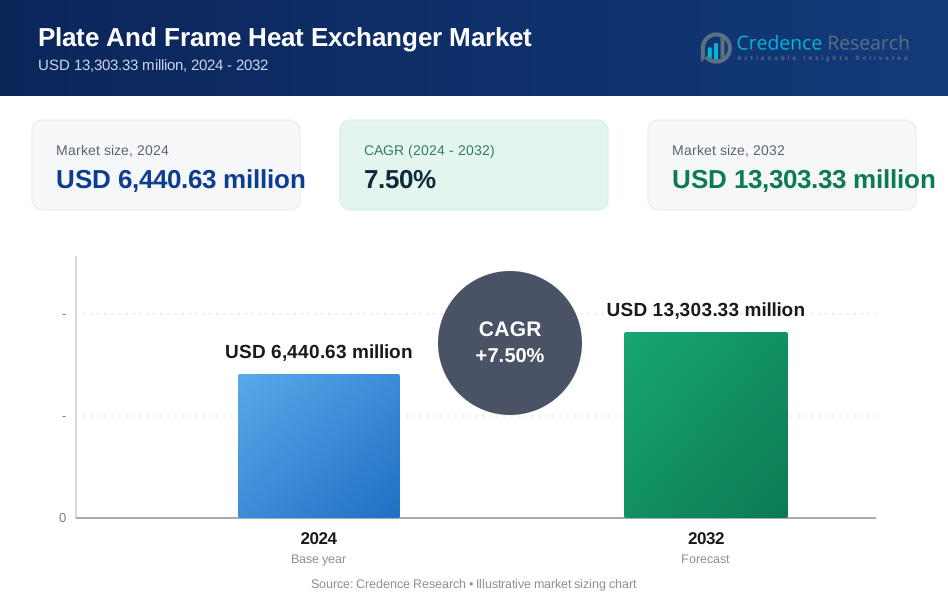
- 2.1.1 Market Size – Historical (2024) & Forecast (2024-2032) (2024: USD 6,440.63 million → 2032: USD 13,303.33 million)
- 2.1.2 Volume & Revenue – Global Totals
- 2.1.3 Key Market Highlights – Top Five Facts
- 2.2 Plate And Frame Heat Exchanger Market Segmentation Snapshot
- 2.2.1 Market Split by Region – 2024 vs. 2032
- 2.3 Competitive Snapshot
- 2.3.1 Top 10 Players by Revenue Share – 2024
- 2.3.2 Top 10 Players by Volume Share – 2024
- 2.3.3 Recent Strategic Developments (18-Month Summary)
- 2.4 Key Investment Highlights & Strategic Conclusions
Chapter 3. Plate And Frame Heat Exchanger Market Dynamics & Industry Analysis
- 3.1 Market Overview & Context
- 3.1.1 Plate And Frame Heat Exchanger Market Position in the Broader Automotive Value Chain
- 3.1.2 OEM vs. Replacement Market Dynamics
- 3.1.3 Market Maturity & Development Stage by Region
- 3.2 Plate And Frame Heat Exchanger Market Drivers
- 3.3 Plate And Frame Heat Exchanger Market Restraints & Challenges
- 3.4 Plate And Frame Heat Exchanger Market Opportunities
- 3.5 Porter's Five Forces Analysis
- 3.5.1 Threat of New Entrants
- 3.5.2 Bargaining Power of Suppliers
- 3.5.3 Bargaining Power of Buyers
- 3.5.4 Threat of Substitutes
- 3.5.5 Competitive Rivalry – Intensity Assessment
- 3.6 Plate And Frame Heat Exchanger Value Chain Analysis
- 3.6.1 Upstream – Raw Material/Input Suppliers
- 3.6.1.1 Raw Material/Input 1
- 3.6.1.2 Raw Material/Input 2
- 3.6.1.3 Raw Material/Input 3
- 3.6.2 Midstream – Production/Manufacturing/Service Delivery
- 3.6.2.1 Production/Process Overview
- 3.6.2.2 Key Facility Locations & Capacity by Manufacturer
- 3.6.3 Downstream – Distribution & End Consumer
- 3.6.3.1 Primary Channel – B2B/OEM
- 3.6.3.2 Secondary Channels – Dealer, Retail, Online, Direct
- 3.6.4 Value Chain Profitability Analysis
- 3.6.1 Upstream – Raw Material/Input Suppliers
- 3.7 PESTEL Analysis
- 3.7.1 Political Factors
- 3.7.2 Economic Factors
- 3.7.3 Social Factors
- 3.7.4 Technological Factors
- 3.7.5 Environmental Factors
- 3.7.6 Legal Factors
- 3.8 Plate And Frame Heat Exchanger Supply Chain Analysis
- 3.8.1 Raw Material/Input Supply Risk Assessment
- 3.8.2 Manufacturing Concentration Risk (Geographic Exposure)
- 3.8.3 Trade Disruption Impact Analysis
- 3.9 Regulatory & Policy Landscape
Note: The regulatory and policy landscape section covers regulations based on their applicability to the market, Plate And Frame Heat Exchanger category, geography, and scope of the study. Only regulatory frameworks with a material impact on operations, compliance, trade, sustainability, or market access are analyzed in detail.
Chapter 4. Key Investment Pockets & Opportunity Analysis
- 4.1 Plate And Frame Heat Exchanger Market Attractiveness Analysis
- 4.1.1 By Region – Investment Attractiveness Matrix (Volume × CAGR)
- 4.2 Absolute Revenue Growth Opportunity
- 4.2.1 By Region – Absolute USD Growth Through 2032
- 4.3 Incremental Volume Opportunity
- 4.3.1 By Region – Incremental Volume Through 2032
- 4.3.2 Segment – Incremental Volume
- 4.4 Emerging Submarket Opportunity Deep Dive (Subject to Applicability)
- 4.5 Emerging Market Opportunity Scorecards
- 4.5.1 United States
- 4.5.2 Europe
- 4.5.3 Asia
- 4.5.4 Middle East & Africa
Note: Emerging Market Opportunity Scorecards will be included based on relevance and strategic importance. Regions listed are indicative and may vary depending on data availability and market dynamics.
Chapter 5. Plate And Frame Heat Exchanger Import-Export Analysis & Trade Flows
- 5.1 Global Trade Overview
- 5.1.1 Global Export Value by Country (2024)
- 5.1.2 Global Export Volume by Country (2024)
- 5.1.3 Global Import Value by Country (2024)
- 5.1.4 Global Import Volume by Country (2024)
- 5.1.5 Net Trade Balance by Country (2024)
- 5.2 Export Analysis – Segment
- 5.2.1 Type 1 (HS Code)
- 5.2.2 Type 2 (HS Code)
- 5.2.3 Type 3 (HS Code)
- 5.2.4 Type 4 (HS Code)
- 5.2.5 Type 5 (HS Code)
- 5.3 Import Analysis – Segment
- 5.3.1 Type 1 (HS Code)
- 5.3.2 Type 2 (HS Code)
- 5.3.3 Type 3 (HS Code)
- 5.3.4 Type 4 (HS Code)
- 5.3.5 Type 5 (HS Code)
- 5.4 Average Unit Trade Prices
- 5.4.1 Average Export Price – Segment & Country
- 5.4.2 Average Import Price – Segment & Source Country
- 5.4.3 Price Trends (2024)
- 5.5 Key Trade Route Analysis
- 5.5.1 Trade Route 1
- 5.5.2 Trade Route 2
- 5.5.3 Trade Route 3
- 5.5.4 Trade Route 4
- 5.5.5 Trade Route 5
- 5.6 Trade Policy Impact Assessment
- 5.6.1 US Anti-Dumping & Section 301 Tariffs
- 5.6.2 EU Customs Union Impact
- 5.6.3 Major Free Trade Agreements
- 5.6.4 USMCA Rules of Origin
Note: Trade policy analysis will be included only where relevant to the Plate And Frame Heat Exchanger market.
Chapter 6. Competitive Landscape & Company Benchmarking
- 6.1 Plate And Frame Heat Exchanger Market Concentration & Structure
- 6.1.1 Herfindahl-Hirschman Index (HHI) – vs. 2024
- 6.1.2 Tier 1, Tier 2 & Tier 3 Market Structure
- 6.1.3 Global, Regional & Local Player Dynamics
- 6.2 Plate And Frame Heat Exchanger Market Share Analysis – 2024
- 6.2.1 Global Revenue Share by Company
- 6.2.2 Global Volume Share by Company
- 6.2.3 Regional Revenue Share
- 6.2.4 Market Share Evolution ( vs. 2024)
- 6.2.5 OEM Segment Share by Company
- 6.2.6 Replacement Segment Share by Company
- 6.3 Production/Delivery Capacity & Facility Analysis
- 6.3.1 Global Installed Capacity
- 6.3.2 Capacity Utilization Rates
- 6.3.3 Production/Output Volume
- 6.3.4 Facility Locations & Capacity Map
- 6.3.5 Planned Capacity Additions
- 6.4 Plate And Frame Heat Exchanger Competitive Benchmarking Matrix
- 6.4.1 Revenue, Volume, CAGR & Profitability Comparison
- 6.4.2 Channel Revenue Mix
- 6.4.3 Geographic Revenue Exposure
- 6.4.4 R&D Intensity
- 6.4.5 Sustainability Maturity
- 6.5 Strategic Developments in Plate And Frame Heat Exchanger (Last 24 Months)
- 6.5.1 Mergers, Acquisitions & Divestments
- 6.5.2 New Plate And Frame Heat Exchanger Launches
- 6.5.3 Facility Expansions
- 6.5.4 Strategic Alliances, Joint Ventures & Partnerships
- 6.5.5 Distribution Expansion & Market Entry
- 6.5.6 Sustainability & ESG Initiatives
- 6.6 Competitive Strategy Mapping
- 6.6.1 Leader, Challenger, Follower & Niche Classification
- 6.6.2 Pricing Strategy Comparison
- 6.6.3 Channel Strategy Matrix
Note: Strategic developments are included based on their materiality and the availability of reliable information.
Chapter 7. Global Plate And Frame Heat Exchanger Market – By Distribution Channel
- 7.1 Segment Overview
- 7.1.1 Volume & Revenue Split by Channel (2024 & 2032)
- 7.1.2 Channel Mix Evolution (2024-2032)
Chapter 8. Regional Market Analysis – Global Overview
- 8.1 Global Regional Overview
- 8.1.1 Regional Volume Share
- 8.1.2 Regional Revenue Share
- 8.1.3 Regional Volume by Region
- 8.1.4 Regional Revenue by Region
- 8.1.5 Regional Forecast Through 2032
- 8.2 Cross-Regional Segment Analysis
- 8.2.1 By Distribution Channel
- 8.2.2 By Brand/Price Tier
Chapter 9. North America Plate And Frame Heat Exchanger Market
- 9.1 United States
- 9.2 Canada
- 9.3 Mexico
Chapter 10. Europe Plate And Frame Heat Exchanger Market
- 10.1 Germany
- 10.2 France
- 10.3 Italy
- 10.4 United Kingdom
- 10.5 Spain
- 10.6 Poland
- 10.7 Russia
- 10.8 Netherlands
- 10.9 Belgium
- 10.10 Sweden
- 10.11 Denmark
- 10.12 Norway
- 10.13 Rest of Europe
Chapter 11. Asia Pacific Plate And Frame Heat Exchanger Market
- 11.1 China
- 11.2 India
- 11.3 Japan
- 11.4 South Korea
- 11.5 Thailand
- 11.6 Indonesia
- 11.7 Vietnam
- 11.8 Malaysia
- 11.9 Australia
- 11.10 Rest of Asia Pacific
Chapter 12. Latin America Plate And Frame Heat Exchanger Market
- 12.1 Brazil
- 12.2 Argentina
- 12.3 Colombia
- 12.4 Chile
- 12.5 Rest of Latin America
Chapter 13. Middle East Plate And Frame Heat Exchanger Market
- 13.1 Saudi Arabia
- 13.2 United Arab Emirates
- 13.3 Turkey
- 13.4 Israel
- 13.5 Iran
- 13.6 Rest of the Middle East
Chapter 14. Africa Plate And Frame Heat Exchanger Market
- 14.1 South Africa
- 14.2 Egypt
- 14.3 Nigeria
- 14.4 Morocco
- 14.5 Rest of Africa
Chapter 15. Plate And Frame Heat Exchanger Company Profiles
- 15.1 [Company 01]
- 15.1.1 Company Overview
- 15.1.2 Key Management Personnel
- 15.1.3 Products & Services Portfolio
- 15.1.4 Financial Performance
- 15.1.5 Key Market Focus & Geographic Presence
- 15.1.6 Recent Developments & Strategic Initiatives
Note: The company profile list is preliminary and may change based on research findings, market developments, data availability, and client requirements.
Chapter 16. Appendices
- Appendix A – List of Abbreviations & Acronyms
- Appendix B – Industry Classification Code Reference – Full Series
- Appendix C – Production & Capacity Data Tables
- Appendix D – End-Use & Demand Base Tables
- Appendix E – Consumption & Replacement Rate Assumptions
- Appendix F – ASP Reference Tables
- Appendix G – Manufacturing & Facility Database
- Appendix H – Import-Export Data Tables
- Appendix I – Regulatory Summary Tables
- Appendix J – Primary Research Participant List (Anonymized)
- Appendix K – Primary Research Questionnaire Framework
- Appendix L – Data Sources & Bibliography
- Appendix M – Market Size Divergence & Source Comparison
Chapter 17. Research Methodology
- 17.1 Research Framework & Philosophy
- 17.2 Secondary Research – Sources, Hierarchy & Data Extraction
- 17.3 Data Modeling – Bottom-Up & Top-Down Market Sizing
- 17.4 Primary Research – Stakeholder Framework, LOI & Sample Sizes
- 17.5 Forecast Methodology – Regression, Scenario & Sensitivity Analysis
- 17.6 Quality Control – Four-Layer Validation Framework
- 17.7 Limitations & Standard Assumptions
- 17.8 Disclaimer
