Market Overviews
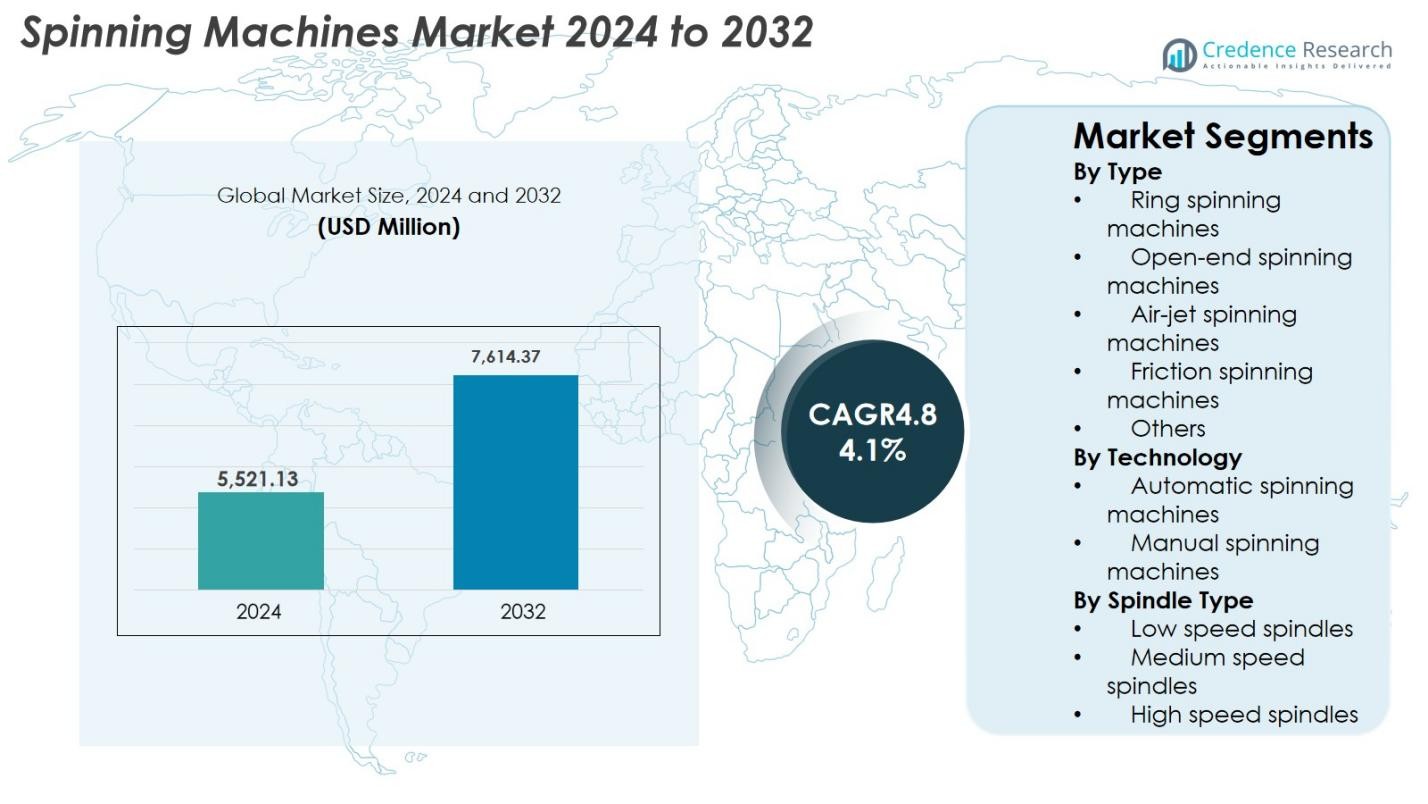
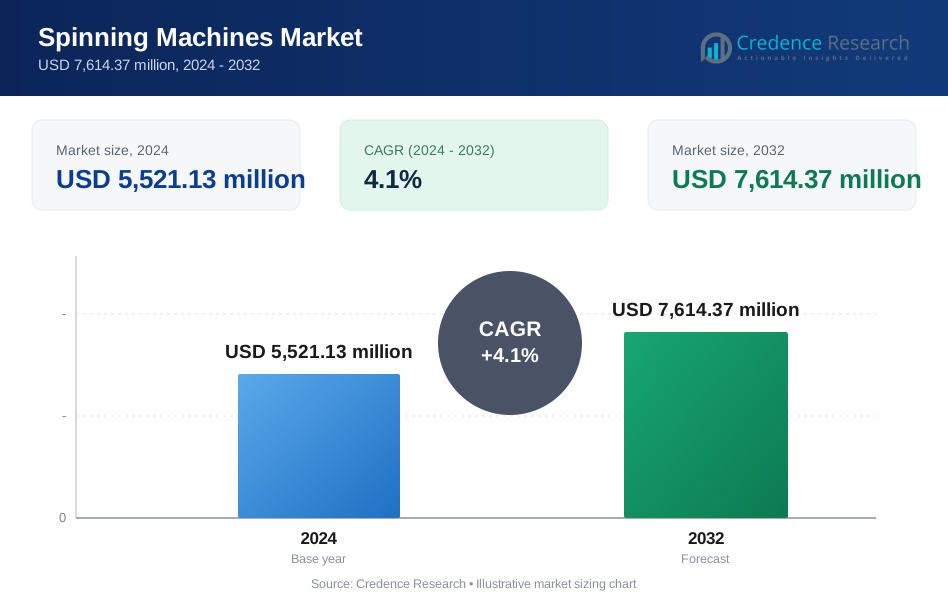
Spinning Machines Market size was valued at USD 5,521.13 Million in 2024 and is anticipated to reach USD 7,614.37 Million by 2032, at a CAGR of 4.1% during the forecast period.
| REPORT ATTRIBUTE | DETAILS |
|---|---|
| Historical Period | 2020-2023 |
| Base Year | 2024 |
| Forecast Period | 2025-2032 |
| Spinning Machines Market Size 2024 | USD 5,521.13 Million |
| Spinning Machines Market, CAGR | 4.1% |
| Spinning Machines Market Size 2032 | USD 7,614.37 Million |
Spinning Machines Market is driven by the strong presence of global manufacturers offering advanced, high-efficiency spinning technologies. Key players such as Rieter, Saurer, Muratec, Lakshmi Machine Works, Jingwei Textile Machinery, Picanol, Juki, Savio Macchine Tessili, Schlafhorst, and Marzoli Machines Textile lead the industry with comprehensive product portfolios and automation-focused solutions that enhance yarn quality and production speed. Their continuous investments in digitalization, high-speed spindles, and energy-efficient machinery strengthen market competitiveness. Regionally, Asia-Pacific dominates the global landscape with over 52.4% market share in 2024, supported by large-scale textile manufacturing clusters in China, India, Bangladesh, and Vietnam, making it the primary hub for spinning machinery demand and expansion.
Market Insights
- The Spinning Machines Market was valued at USD 5,521.13 million in 2024 and is projected to reach USD 7,614.37 million by 2032, growing at a CAGR of 4.1%.
- Rising textile and apparel demand, along with modernization of spinning mills, drives adoption of advanced ring spinning machines, which held the largest segment share of 46.8% in 2024.
- Automation, AI-enabled monitoring, and energy-efficient high-speed spindles are key trends, reshaping productivity and improving yarn consistency across global mills.
- Leading companies such as Rieter, Saurer, Muratec, Lakshmi Machine Works, Savio, and Jingwei focus on innovation, speed optimization, and lifecycle service models, though high capital costs remain a restraint for smaller mills.
- Asia-Pacific dominated the market with over 52.4% share in 2024, followed by Europe at 18.9% and North America at 14.6%, supported by strong textile clusters and increasing investments in automated spinning technologies.
Market Segmentation Analysis:
By Type
The Spinning Machines Market by type is dominated by ring spinning machines, which accounted for 46.8% market share in 2024 due to their superior yarn quality, flexibility across fiber types, and widespread use in cotton and blended yarn production. Open-end spinning machines follow, driven by increasing demand for high-volume, cost-efficient yarn manufacturing. Air-jet and friction spinning machines continue to gain traction as mills adopt high-speed, energy-efficient technologies. Rising textile automation, expanding apparel demand, and modernization of spinning mills in Asia-Pacific further strengthen the dominance of ring spinning systems.
- For instance, open-end spinning machines are widely used in mills that prioritise volume and efficiency: such machines significantly reduce labour requirements and production costs compared with ring spinning.
By Technology
In the technology segment, automatic spinning machines held the dominant share of 62.4% in 2024, supported by the rapid digitalization of textile mills and the growing need for consistent yarn quality with minimal labor intervention. Automatic systems integrate robotics, real-time monitoring, and AI-based quality control, enabling higher productivity and reduced operational costs. Manual spinning machines remain relevant in small-scale mills but continue to lose share as manufacturers prioritize efficiency, precision, and reduced downtime. The push toward Industry 4.0 and rising labor costs in emerging economies further accelerate the adoption of automated spinning technologies.
- For instance, Rieter’s Autocoro and related automated platforms have been documented to reduce manual piecing and deliver continuous quality monitoring, enabling mills to run higher spindle speeds with fewer operators. Real-time sensor feedback improves yarn uniformity and reduces waste.
By Spindle Type
High-speed spindles led the spindle-type segment with a market share of 54.2% in 2024, driven by large manufacturers seeking greater output, enhanced yarn uniformity, and lower energy consumption per kilogram of yarn. Medium-speed spindles remain significant in mills balancing efficiency with machine longevity, while low-speed spindles cater to specialized or legacy operations. The dominance of high-speed spindles is fueled by rising global textile demand, increasing investments in high-capacity spinning frames, and innovations in spindle design that reduce vibration, enhance durability, and support high-quality yarn spinning across diverse fiber categories.
Key Growth Drivers
Rising Global Textile and Apparel Consumption
The steady increase in global textile and apparel consumption remains a major driver for the Spinning Machines Market, as expanding fashion retail, fast fashion cycles, and rising per-capita clothing expenditure stimulate demand for high-quality yarn production. Emerging economies such as China, India, Bangladesh, and Vietnam are significantly scaling textile manufacturing capacities, prompting mills to invest in advanced spinning machinery to boost productivity. Additionally, the growing preference for blended yarns and performance fabrics is encouraging manufacturers to upgrade to more versatile spinning technologies. This sustained consumption trend directly amplifies demand for efficient, high-output spinning systems.
- For instance, India’s textile sector expansion, supported by production-linked incentive (PLI) schemes, has led to documented mill upgrades and new installations of advanced spinning lines to meet the rising demand for cotton and synthetic-blend yarns in domestic and export markets.
Shift Toward Automation and Industry 4.0
Automation is transforming spinning operations, positioning automated spinning machines as a central growth engine for the market. Mills increasingly adopt robotics, automated doffing, digital monitoring, and AI-enabled quality control to reduce labor dependency, improve consistency, and lower operational costs. The integration of IoT sensors enables predictive maintenance, minimizing downtime and extending machinery lifespan. As labor shortages intensify in key textile hubs, automation becomes a crucial strategic priority. The push toward smart factories, coupled with government incentives for industrial modernization, further accelerates the adoption of intelligent spinning machinery across global textile clusters.
- For instance, Rieter’s automated doffing and real-time monitoring technologies, integrated into systems like the Autocoro and ring-spinning platforms, enable autonomous bobbin handling and self-adjusting controls, helping mills maintain stable yarn quality while reducing operator workload.
Rising Investments in High-Speed and Energy-Efficient Spinning Solutions
Growing emphasis on energy savings, reduced wastage, and higher throughput drives investments in high-speed and energy-efficient spinning machines. Manufacturers seek systems that optimize yarn production while lowering electricity consumption, given that energy costs constitute a major share of textile mill expenses. Technological advancements in spindle design, motor efficiency, and lightweight components enable machines to achieve higher rotation speeds without compromising quality. Additionally, sustainability goals and carbon-reduction commitments are prompting mills to replace legacy equipment with eco-efficient models. These upgrades enhance competitiveness and align with global efficiency benchmarks in modern spinning operations.
Key Trends & Opportunities
Adoption of Smart, Connected, and AI-Driven Spinning Machinery
A major trend reshaping the Spinning Machines Market is the integration of smart technologies that enhance operational transparency, predictive maintenance, and real-time decision-making. AI-driven systems analyze yarn quality, detect defects instantly, and optimize spinning parameters based on fiber characteristics, significantly improving consistency and reducing material waste. IoT-enabled platforms allow mills to monitor machine performance remotely, track energy consumption, and automate workflows across large production lines. This digital transformation unlocks opportunities for manufacturers to deliver value-added features such as remote diagnostics, cloud-based analytics, and machine-learning-driven optimization. As textile mills accelerate their shift toward smart manufacturing, the demand for digitally enabled spinning equipment is expected to rise sharply.
- For instance, Savio’s Smart Factory solutions, built around IoT sensors and remote diagnostics, allow mills to monitor winding performance, receive predictive maintenance alerts, and execute digital workflow automation to reduce downtime across production lines.
Growing Demand for Sustainable, Eco-Efficient Spinning Technologies
Sustainability is emerging as a high-priority opportunity, pushing spinning machine manufacturers to develop solutions that reduce resource consumption and environmental impact. Innovations such as low-energy motors, optimized air systems, reduced lint pollution, and recyclable machine components align with global green manufacturing goals. Additionally, the rising use of recycled fibers and bio-based materials requires sophisticated spinning systems capable of handling diverse fiber properties while maintaining yarn quality. Mills adopting sustainable solutions benefit from lower operating costs, improved compliance with environmental regulations, and enhanced brand value. This increasing focus on eco-efficiency-and the pressure on textile supply chains to reduce carbon footprints-creates strong long-term growth prospects for next-generation spinning technologies.
- For instance, Rieter has documented energy-efficient upgrades such as optimized suction systems and low-power drive motors across its modern ring-spinning platforms, enabling mills to reduce electricity consumption while maintaining consistent yarn output.
Key Challenges
High Capital Investment Requirements
One of the most significant challenges in the Spinning Machines Market is the high upfront capital required for procurement, installation, and modernization. Advanced automated spinning systems and high-speed spindles demand substantial financial commitment, making adoption difficult for small and mid-sized mills with limited budgets. Additionally, fluctuating raw material costs and tight profit margins in the textile industry discourage aggressive capital spending. Financing constraints and long payback periods further hinder large-scale modernization initiatives. As a result, many manufacturers continue operating older machinery, slowing overall market penetration of advanced spinning technologies.
Shortage of Skilled Workforce for Advanced Machinery
The increasing adoption of automated and digitally enabled spinning technologies highlights a critical shortage of skilled operators capable of managing sophisticated systems. Many textile clusters face gaps in technical expertise related to machine programming, digital monitoring, and predictive maintenance. This lack of skilled labor leads to operational inefficiencies, reduced machine performance, and higher maintenance costs. Training new workers requires time and investment, adding further constraints for mills transitioning toward advanced systems. As spinning machinery becomes more technologically complex, bridging the workforce skill gap remains a persistent challenge for industry growth.
Regional Analysis
North America
North America held 14.6% of the Spinning Machines Market share in 2024, supported by steady demand for high-quality yarn in technical textiles, home furnishings, and performance apparel. The region shows increasing adoption of advanced automated spinning systems as manufacturers focus on reshoring textile operations and improving productivity through digitalization. Investments in sustainability-driven textile production and innovations in fiber blending further enhance market growth. Although the region operates fewer spinning mills compared to Asia, its emphasis on high-value yarn, energy-efficient machinery, and precision manufacturing continues to stimulate stable adoption of modern spinning technologies.
Europe
Europe accounted for 18.9% market share in 2024, driven by strong demand for premium yarns used in fashion, automotive, and industrial applications. The region leads in modernization initiatives, with mills investing heavily in high-speed, automated, and eco-efficient spinning machines to comply with strict energy and emission regulations. Germany, Italy, and Turkey are key contributors, supported by advancements in machinery technology and growing interest in recycled fiber processing. Europe’s focus on sustainable textile production and quality-driven output continues to shape machinery upgrades, strengthening its position as a technologically progressive market within the global spinning machinery landscape.
Asia-Pacific
Asia-Pacific dominated the global market with over 52.4% share in 2024, making it the largest and fastest-growing region for spinning machinery. China, India, Bangladesh, and Vietnam continue to expand their textile and apparel production capacities, creating strong demand for high-speed, automated spinning systems. The region benefits from abundant labor, large-scale manufacturing ecosystems, and government support for textile modernization. Rising exports, increasing domestic consumption of apparel, and continuous mill expansions drive sustained investments in advanced spinning technologies. Asia-Pacific’s leadership is further reinforced by rapid adoption of energy-efficient machines to improve productivity and reduce operational costs.
Latin America
Latin America captured 7.8% of the market share in 2024, supported by growing textile production in Brazil, Mexico, and Peru. The region is witnessing increased demand for spinning machines as manufacturers shift toward localized yarn production, reducing import dependence. Investments in modernizing outdated spinning facilities and expanding capacity for denim, cotton, and blended yarns are fueling machinery adoption. Although the region faces challenges related to energy costs and infrastructure, rising export opportunities, supportive industrial policies, and the gradual shift to automated systems are enabling steady growth in the spinning machinery sector.
Middle East & Africa
The Middle East & Africa region accounted for 6.3% market share in 2024, driven by expanding textile manufacturing hubs in Turkey, Egypt, Ethiopia, and the UAE. Growing investments in industrial zones, low labor costs, and rising interest from global brands in regional sourcing are boosting demand for spinning machinery. The region continues to upgrade its textile infrastructure with high-speed spindles and automated spinning equipment to improve competitiveness. While adoption levels remain lower than other regions, increasing government support, export-oriented production strategies, and mill modernization efforts position MEA as an emerging growth market for spinning machines.
Market Segmentations:
By Type
- Ring spinning machines
- Open-end spinning machines
- Air-jet spinning machines
- Friction spinning machines
- Others
By Technology
- Automatic spinning machines
- Manual spinning machines
By Spindle Type
- Low speed spindles
- Medium speed spindles
- High speed spindles
By Geography
- North America
- U.S.
- Canada
- Mexico
- Europe
- Germany
- France
- U.K.
- Italy
- Spain
- Rest of Europe
- Asia Pacific
- China
- Japan
- India
- South Korea
- South-east Asia
- Rest of Asia Pacific
- Latin America
- Brazil
- Argentina
- Rest of Latin America
- Middle East & Africa
- GCC Countries
- South Africa
- Rest of the Middle East and Africa
Competitive Landscape
The competitive landscape of the Spinning Machines Market is characterized by strong participation from global machinery manufacturers focused on innovation, automation, and energy-efficient technologies. Leading players such as Rieter, Saurer, Muratec, Lakshmi Machine Works, Jingwei Textile Machinery, Picanol, Juki, Savio Macchine Tessili, Schlafhorst, and Marzoli Machines Textile dominate the market through extensive product portfolios and advanced spinning solutions tailored for large-scale textile operations. These companies emphasize high-speed spindles, automated monitoring systems, and digitalized spinning platforms to enhance productivity and yarn quality. Strategic initiatives-including capacity expansions, technology collaborations, after-sales service strengthening, and regional market penetration-remain central growth strategies. In emerging markets like Asia-Pacific, manufacturers compete by offering cost-effective, energy-efficient machines aligned with mill modernization programs. Established players also invest heavily in R&D to develop eco-efficient technologies capable of handling recycled fibers and new material blends. As textile manufacturers pursue higher efficiency and consistent output, competition intensifies around automation, innovation, and lifecycle service excellence.
Key Player Analysis
- Savio Macchine Tessili
- Muratec
- Juki
- Rieter
- Schlafhorst
- Lakshmi Machine Works
- Saurer
- Picanol
- Jingwei Textile Machinery
- Marzoli Machines Textile
Recent Developments
- In October 2025, Lakshmi Machine Works Ltd. (LMW) unveiled the concept of a “Smart Spinning Mill” showcasing its latest spinning-machinery innovations at ITMA ASIA + CITME 2025.
- In May 2025, Alok Industries Ltd. (India) selected Rieter’s compact-spinning system to upgrade its yarn production operations a sign of rising demand for modern spinning technology.
Report Coverage
The research report offers an in-depth analysis based on Type, Technology, Spindle Type and Geography. It details leading market players, providing an overview of their business, product offerings, investments, revenue streams, and key applications. Additionally, the report includes insights into the competitive environment, SWOT analysis, current market trends, as well as the primary drivers and constraints. Furthermore, it discusses various factors that have driven market expansion in recent years. The report also explores market dynamics, regulatory scenarios, and technological advancements that are shaping the industry. It assesses the impact of external factors and global economic changes on market growth. Lastly, it provides strategic recommendations for new entrants and established companies to navigate the complexities of the market.
Future Outlook
- The market will experience steady expansion as textile mills increasingly adopt automated and digitalized spinning technologies.
- High-speed and energy-efficient spindle systems will gain stronger demand to improve productivity and reduce operational costs.
- AI-driven quality monitoring and predictive maintenance will become standard features across new spinning installations.
- The shift toward sustainable manufacturing will accelerate investments in eco-efficient spinning machines.
- Rising use of recycled and specialty fibers will drive demand for advanced spinning systems capable of handling diverse material properties.
- Modernization programs in Asia-Pacific will continue to position the region as the global hub for spinning machinery growth.
- Manufacturers will strengthen service-led business models, including remote diagnostics and performance optimization.
- Compact, flexible, and multi-material spinning solutions will gain traction in mid-sized and emerging mills.
- Digital twins and smart factory integration will reshape operational planning and real-time performance control.
- Strategic collaborations between machinery makers and textile producers will increase to accelerate innovation and customized solutions.
Request a Free Sample
Fill in your details and we'll send you a free sample report.
- Sample data tables & charts
- Research methodology
Need a Custom Version of This Report?
Tailor the scope, geography, or segments to your exact requirements.
- Custom geography or segment scope
- Direct access to our analyst team
Frequently Asked Questions
What is the current market size for the Spinning Machines Market, and what is its projected size in 2032?
At what Compound Annual Growth Rate is the Spinning Machines Market projected to grow between 2024 and 2032?
Which Spinning Machines Market segment held the largest share in 2024?
What are the primary factors fueling the growth of the Spinning Machines Market?
Who are the leading companies in the Spinning Machines Market?
Which region commanded the largest share of the Spinning Machines Market in 2024?
Table of Content
Chapter 1 Market Segmentation
- 1.1 Segmentation Framework
- 1.1.1 Product and Service Classification
- 1.1.2 Application and End-Use Classification
- 1.1.3 Technology and Solution Classification
- 1.1.4 Customer and Distribution Channel Classification
- 1.1.5 Geographic Segmentation
- 1.1.6 Market Segment Definitions and Boundaries
Chapter 2 Introduction
- 2.1 Report Objectives and Scope
- 2.2 Product Definition and Industry Terminology
- 2.3 Market Inclusions and Exclusions
- 2.4 Research Process
- 2.4.1 Primary Research and Expert Interviews
- 2.4.2 Secondary Research and Source Review
- 2.4.3 Top-Down and Bottom-Up Estimation
- 2.4.4 Data Triangulation and Verification
- 2.5 Market Size Measurement Basis
- 2.5.1 2024: USD 5,521.13 million → 2032: USD 7,614.37 million
- 2.6 Historical and Forecast Reference Periods
- 2.6.1 Base Year: 2024
- 2.6.2 Forecast Period: 2024-2032
- 2.7 Research Assumptions and Limitations
Chapter 3 Executive Summary
- 3.1 Market Snapshot and Key Findings
- 3.2 Base-Year Market Size, 2024
- 3.3 Forecast Market Size, 2032
- 3.4 Revenue and Volume Growth Outlook
- 3.5 Key Demand and Supply Indicators
- 3.6 Leading Market Segments
- 3.7 Fastest-Growing Market Opportunities
- 3.8 Regional Performance Highlights
- 3.9 Technology and Industry Transformation
- 3.10 Competitive Landscape Summary
- 3.11 Analyst View and Strategic Implications
Chapter 4 Global Spinning Machines Market Trends and Developments
- 4.1 Historical Industry Development
- 4.2 Recent Market Trends and Developments
- 4.3 Demand and Customer Behavior Trends
- 4.4 Technology and Product Innovation
- 4.5 Artificial Intelligence, Automation and Digitalization
- 4.6 Local Manufacturing and Supply Chain Realignment
- 4.7 Industry Partnerships, Mergers and Acquisitions
- 4.8 Sustainability and Circular Economy Developments
- 4.9 Government and Private Sector Investment Trends
- 4.10 Emerging Business Models and Commercialization
- 4.11 Industry Developments and Announcements
Chapter 5 Global Spinning Machines Market Production, Supply and Demand Analysis
- 5.1 Demand Trend and Consumption Analysis
- 5.2 Demand Forecast, 2024-2032
- 5.3 Production and Output Trend
- 5.4 Production and Output Forecast, 2024-2032
- 5.5 Installed Capacity and Capacity Utilization
- 5.6 Company-Wise Production Plants and Statistics
- 5.6.1 Installed Production Capacity
- 5.6.2 Actual Production
- 5.6.3 Planned Capacity and Expansion Targets
- 5.7 Supply Chain Structure and Procurement Trends
- 5.8 Supply-Demand Gap and Bottlenecks
- 5.9 Import Dependence and Sourcing Structure
- 5.10 Contract Manufacturing and Outsourcing
- 5.11 Regional Supply and Demand Concentration
Chapter 6 Global Spinning Machines Market Pricing Analysis
- 6.1 Pricing Structure and Measurement
- 6.2 Historical Pricing Trends
- 6.3 Pricing Outlook, 2024-2032
- 6.4 Average Selling Price and Unit Economics
- 6.5 Pricing by Product and Market Segment
- 6.6 Geographic Pricing Differences
- 6.7 Key Input, Energy, Labor and Logistics Costs
- 6.8 Contract Pricing and Purchasing Models
- 6.9 Pricing Sensitivity and Competitive Positioning
- 6.10 Price, Margin and Profitability Implications
Chapter 7 Global Spinning Machines Market Dynamics
- 7.1 Market Growth Drivers
- 7.1.1 Demand-Side Drivers
- 7.1.2 Technology and Innovation Drivers
- 7.1.3 Infrastructure and Investment Drivers
- 7.1.4 Regulatory and Policy Drivers
- 7.2 Market Restraints
- 7.2.1 Cost and Affordability Constraints
- 7.2.2 Technology and Adoption Barriers
- 7.2.3 Supply Chain and Operational Constraints
- 7.3 Market Challenges
- 7.3.1 Competitive Pressure and Margin Erosion
- 7.3.2 Skills, Infrastructure and Implementation Gaps
- 7.4 Emerging Market Opportunities
- 7.5 Market Dynamics Impact and Time-Horizon Assessment
Chapter 8 Global Spinning Machines Value Chain Analysis
- 8.1 Industry Value Chain Overview
- 8.2 Upstream Suppliers and Critical Inputs
- 8.3 Technology and Component Providers
- 8.4 Manufacturing or Service Delivery
- 8.5 Distribution, Channel Partners and Integrators
- 8.6 Downstream Applications and End Users
- 8.7 Value Addition and Profit Pools
- 8.8 Vertical Integration and Outsourcing
- 8.9 Supplier Concentration and Risk
- 8.10 Supply Chain Localization and Resilience
Chapter 9 Global Spinning Machines Market Regulations and Policies
- 9.1 Relevant Laws, Standards and Compliance Frameworks
- 9.2 Product, Service, Safety and Quality Requirements
- 9.3 Government Policies, Incentives and Subsidies
- 9.4 Imports, Exports and Trade Barriers
- 9.5 Public Procurement and Local Content Requirements
- 9.6 Environmental and Sustainability Compliance
- 9.7 Upcoming Policy Changes and Market Implications
Chapter 10 Global Spinning Machines Market Hotspots and Opportunities
- 10.1 Market Opportunity Mapping and Growth Hotspots
- 10.2 High-Growth Applications and Customer Groups
- 10.3 Underserved Markets and White-Space Opportunities
- 10.4 Emerging Technology and Product Opportunities
- 10.5 New Capacity and Investment Hotspots
- 10.6 Market Entry and Expansion Opportunities
- 10.7 Distribution and Partnership Opportunities
- 10.8 Near-Term and Long-Term Commercial Potential
- 10.9 Opportunity Attractiveness and Execution Risks
Chapter 11 Global Spinning Machines Market Outlook, 2024-2032
- 11.1 Market Size and Analysis
- 11.1.1 Revenue (Market Measurement: 2024: USD 5,521.13 million → 2032: USD 7,614.37 million)
- 11.1.2 Market Volume and Quantity Sold
- 11.1.3 Historical Market Size
- 11.1.4 Base-Year Market Size, 2024
- 11.2 Market Forecast, 2024-2032
- 11.2.1 Revenue Forecast to 2032
- 11.2.2 Volume Forecast to 2032
- 11.2.3 CAGR and Year-on-Year Growth
- 11.2.4 Incremental Revenue Opportunity
- 11.3 Forecast Assumptions and Scenario Analysis
- 11.3.1 Base-Case Forecast
- 11.3.2 Optimistic and Conservative Scenarios
- 11.3.3 Technology, Pricing and Policy Sensitivities
- 11.4 Market Attractiveness and Growth Outlook
Chapter 12 Global Spinning Machines Market Segmentation and Outlook
- 12.1 Segmentation Summary and Market Shares, 2024
- 12.2 Largest and Fastest-Growing Segments
- 12.3 Segment Growth Comparison
- 12.4 Segment Attractiveness and Priority Matrix
Chapter 13 Global Spinning Machines Geographic Market Outlook, 2024-2032
- 13.1 Regional Market Size and Share, 2024
- 13.2 Regional Market Forecast, 2024-2032
- 13.3 Regional Pricing, Production and Demand Differences
- 13.4 North America
- 13.4.1 United States
- 13.4.2 Canada
- 13.4.3 Mexico
- 13.5 Europe
- 13.5.1 Germany
- 13.5.2 France
- 13.5.3 Italy
- 13.5.4 United Kingdom
- 13.5.5 Spain
- 13.5.6 Poland
- 13.5.7 Russia
- 13.5.8 Netherlands
- 13.5.9 Belgium
- 13.5.10 Sweden
- 13.5.11 Denmark
- 13.5.12 Norway
- 13.5.13 Rest of Europe
- 13.6 Asia Pacific
- 13.6.1 China
- 13.6.2 India
- 13.6.3 Japan
- 13.6.4 South Korea
- 13.6.5 Thailand
- 13.6.6 Indonesia
- 13.6.7 Vietnam
- 13.6.8 Malaysia
- 13.6.9 Australia
- 13.6.10 Rest of Asia Pacific
- 13.7 Latin America
- 13.7.1 Brazil
- 13.7.2 Argentina
- 13.7.3 Colombia
- 13.7.4 Chile
- 13.7.5 Rest of Latin America
- 13.8 Middle East
- 13.8.1 Saudi Arabia
- 13.8.2 United Arab Emirates
- 13.8.3 Turkey
- 13.8.4 Israel
- 13.8.5 Iran
- 13.8.6 Rest of the Middle East
- 13.9 Africa
- 13.9.1 South Africa
- 13.9.2 Egypt
- 13.9.3 Nigeria
- 13.9.4 Morocco
- 13.9.5 Rest of Africa
- 13.10 Regional Investment, Policy and Supply Chain Differences
- 13.11 Regional Competitive Landscape
- 13.12 Geographic Growth Hotspots
Chapter 14 Global Spinning Machines Technology, Innovation and Sustainability Outlook
- 14.1 Technology Landscape and Maturity
- 14.2 Product, Process and Service Innovation
- 14.3 AI, Automation and Digital Tools in the Industry
- 14.4 Technology Adoption and Performance Benchmarking
- 14.5 Innovation Pipeline and R&D Investment
- 14.6 Patent and Intellectual Property Trends
- 14.7 Energy Efficiency and Resource Management
- 14.8 Sustainability, Recycling and Circularity
- 14.9 Technology Roadmap, 2024-2032
- 14.10 Risks of Obsolescence and Technology Substitution
Chapter 15 Global Spinning Machines Market Key Strategic Imperatives
- 15.1 Growth and Market Entry Priorities
- 15.2 High-Return Products and Segments
- 15.3 Pricing, Profitability and Cost Optimization
- 15.4 Technology Investment and Product Differentiation
- 15.5 Supply Chain Localization and Resilience
- 15.6 Distribution and Customer Acquisition
- 15.7 Partnership, Acquisition and Capacity Strategy
- 15.8 Regional Expansion Priorities
- 15.9 Short-, Medium- and Long-Term Actions
Chapter 16 Competition Outlook
- 16.1 Industry Competition Characteristics
- 16.2 Market Structure and Concentration
- 16.3 Market Share and Competitive Positioning, 2024
- 16.4 Company-Wise Revenue and Product Benchmarking
- 16.5 Production and Service Capacity Benchmarking
- 16.6 Technology, Pricing and Differentiation
- 16.7 Regional Footprint and Distribution Strength
- 16.8 Mergers, Acquisitions and Strategic Alliances
- 16.9 New Entrants and Competitive Threats
- 16.10 Porter's Five Forces and Industry Attractiveness
- 16.11 Competitive Outlook, 2024-2032
Chapter 17 Company Profiles
- 17.1 Company Coverage and Selection Criteria
- 17.2 Leading Market Participants – Standard Profile Structure
- 17.2.1 Business Description
- 17.2.2 Company Ownership and Geographic Presence
- 17.2.3 Product and Service Portfolio
- 17.2.4 Manufacturing and Operating Footprint
- 17.2.5 Production Capacity and Expansion Plans
- 17.2.6 Financial Performance and Investment
- 17.2.7 Market Share and Competitive Position
- 17.2.8 Technology and Innovation Capabilities
- 17.2.9 Strategic Alliances or Partnerships
- 17.2.10 Recent Developments
- 17.2.11 Growth Strategy and Outlook
- 17.3 Other Relevant Market Participants
Note: Every listed company is profiled on the structure shown under the first company. The company list is preliminary and may change based on research findings, market developments, data availability and client requirements.
Chapter 18 Disclaimer
- 18.1 Research and Forecast Disclaimer
- 18.2 Data Source and Estimation Limitations
Note: The depth of individual sections depends on data availability for this market. Volume, capacity, trade and other unit-based metrics are included where applicable.