
Market Overview:
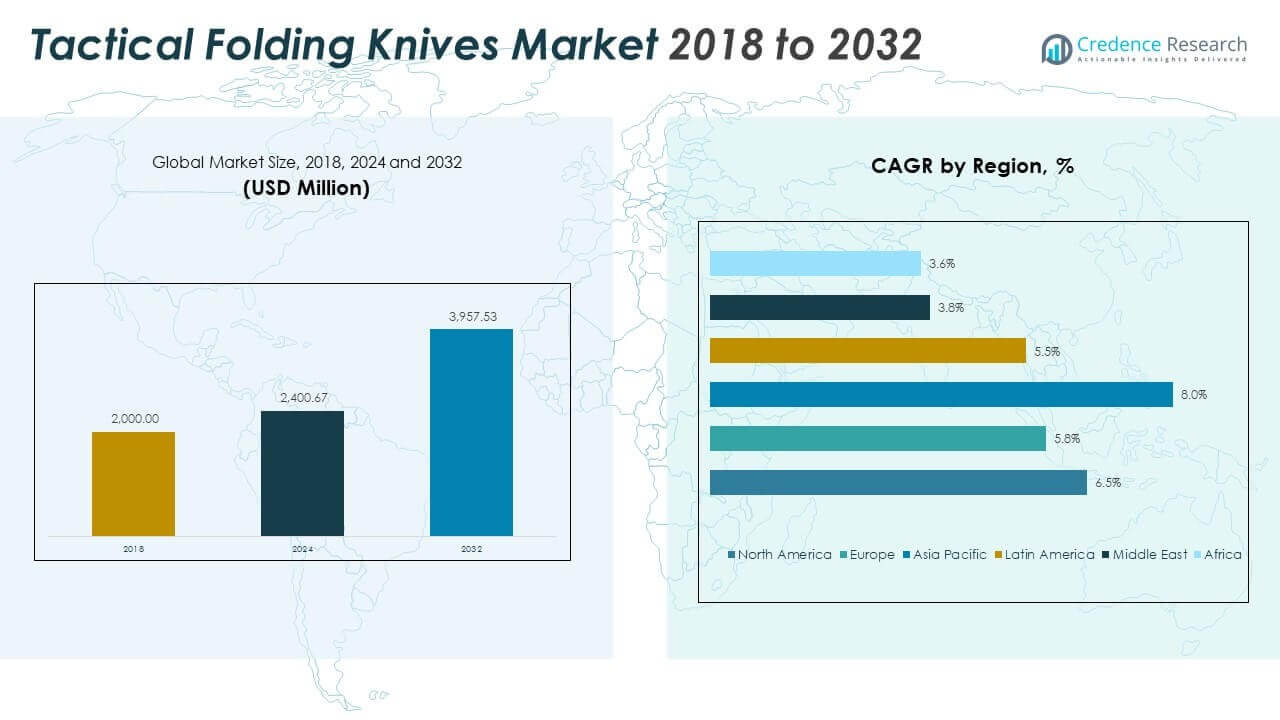
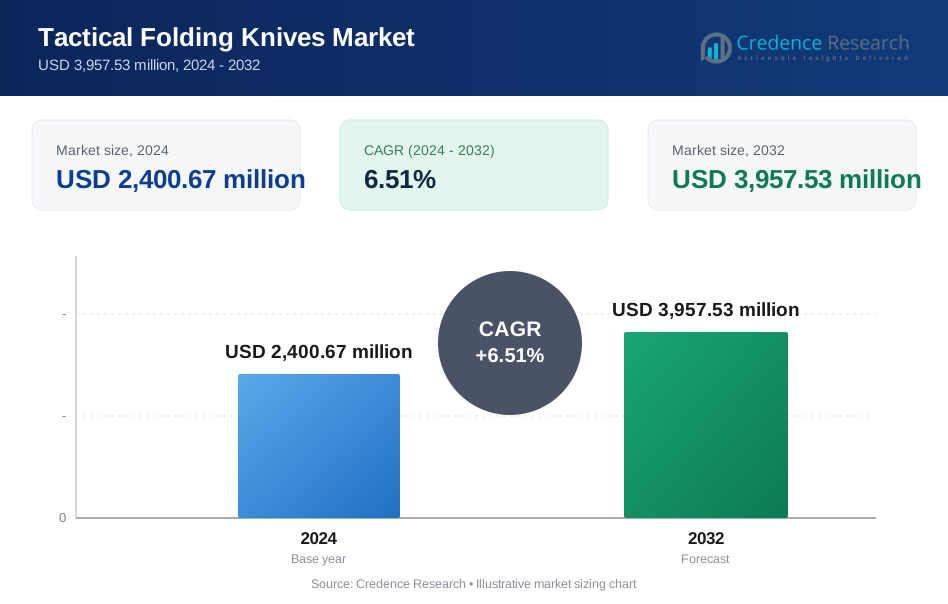
The Tactical Folding Knives Market size was valued at USD 2,000.00 million in 2018 to USD 2,400.67 million in 2024 and is anticipated to reach USD 3,957.53 million by 2032, at a CAGR of 6.51% during the forecast period.
| REPORT ATTRIBUTE | DETAILS |
|---|---|
| Historical Period | 2020-2023 |
| Base Year | 2024 |
| Forecast Period | 2025-2032 |
| Tactical Folding Knives Market Size 2024 | USD 2,400.67 Million |
| Tactical Folding Knives Market, CAGR | 6.51% |
| Tactical Folding Knives Market Size 2032 | USD 3,957.53 Million |
The market is gaining momentum due to rising demand from outdoor sports, military operations, and personal utility applications. Tactical folding knives offer portability, fast deployment, and multi-functionality, making them valuable for both professionals and general users. Military and law enforcement procurement drives steady demand, while civilian buyers seek compact tools for safety and everyday use. Manufacturers focus on lightweight materials, advanced locking systems, and ergonomic designs to attract a wider user base. The growing popularity of survival training, self-defense awareness, and product customization further strengthens market expansion across user segments.
North America leads the market, driven by high defense spending and strong consumer interest in tactical gear. Europe holds a strong position due to demand from law enforcement and outdoor enthusiasts across countries like Germany and France. Asia Pacific is emerging as a high-growth region, fueled by rising disposable incomes and expanding military forces in China, India, and Southeast Asia. Latin America and the Middle East witness gradual growth through expanding retail access and growing tactical equipment procurement. Africa shows steady uptake driven by law enforcement modernization and outdoor activity trends.
Market Insights:
- The Tactical Folding Knives Market was valued at USD 2,000.00 million in 2018, grew to USD 2,400.67 million in 2024, and is projected to reach USD 3,957.53 million by 2032, expanding at a CAGR of 6.51%.
- North America leads with 41.1% of the 2024 market share, followed by Europe (26.6%) and Asia Pacific (22.2%), driven by strong defense demand, outdoor gear adoption, and growing consumer utility needs.
- Asia Pacific, with a CAGR of 8.0%, is the fastest-growing region due to increasing outdoor activities, tactical gear interest, and expanding defense budgets in countries like China and India.
- Blade type segmentation is led by Straight Edge Blades, favored for precision and general-purpose use, accounting for a dominant portion of product demand.
- Stainless Steel remains the most widely used material segment, valued for its corrosion resistance, strength, and cost-efficiency across both premium and entry-level tactical knives.
Market Drivers
Rising Demand from Outdoor Recreation and Adventure Enthusiasts Across Global Regions
Consumers participating in hiking, hunting, camping, and survival sports continue to grow worldwide. This shift boosts demand for versatile, durable, and compact gear like tactical folding knives. The Tactical Folding Knives Market benefits from this rise in interest among younger and middle-aged outdoor consumers. Gear preference shifts toward lightweight, quick-deploy tools that combine safety and strength. Brands develop models with better grip, rust resistance, and blade lock systems to meet user expectations. Many knives now support multi-functionality, attracting broader utility across recreation and daily use. Rising awareness through survival-themed media and influencers fuels further growth. The market sees strong traction from repeat purchases and gear upgrades.
- For instance, Benchmade's 535 Bugout features a CPM-S30V steel blade at 58-60 HRC with a Grivory handle weighing 1.85 ounces.
Increasing Use in Military, Law Enforcement, And Tactical Security Operations
Military and police units require compact, reliable cutting tools for various field operations. Tactical folding knives meet requirements for utility, self-defense, and survival functions in hostile environments. Governments procure these knives in bulk for troop deployment kits and field missions. The Tactical Folding Knives Market benefits from ongoing defense modernization programs in the U.S., China, India, and Europe. Agencies prefer ergonomic, corrosion-resistant blades with one-hand opening and secure locking. Customizable tactical features further enhance operational compatibility across different missions. Demand remains steady due to high equipment replacement cycles. The market grows from active procurement pipelines and expanding personnel forces.
- For instance, Gerber Gear's StrongArm uses a 420HC steel blade at 56-58 HRC with a glass-filled nylon handle weighing 7.2 ounces.
Wider Consumer Adoption for Everyday Utility, Home Safety, And Personal Preparedness
Urban and suburban consumers increasingly buy tactical folding knives for general utility and safety. People use them for package opening, minor repairs, gardening, and food prep outdoors. The Tactical Folding Knives Market expands with growing consumer focus on self-reliance and emergency readiness. Compact folding knives fit easily in pockets, bags, and vehicle compartments. Manufacturers market sleek designs with improved safety locks and child-safe features. E-commerce platforms help brands reach new audiences through online customization and reviews. Legal acceptance of folding knives with non-aggressive designs boosts urban adoption. Household purchases now make up a significant share of overall sales.
Product Innovation With Advanced Materials And Mechanisms Improves User Appeal
Leading brands invest in advanced steels, ergonomic handles, and smart locking mechanisms. The Tactical Folding Knives Market benefits from innovation in lightweight materials like titanium and carbon composites. New designs offer better strength-to-weight ratios and corrosion resistance for all-weather use. Assisted opening systems and flipper tabs improve one-hand usability. Some brands introduce modular add-ons like fire starters, belt cutters, and glass breakers. Continuous R&D raises durability standards, improving brand trust among repeat buyers. Competitive pricing strategies expand reach beyond hobbyists to mainstream users. Retailers promote limited editions and co-branded collections to tap premium segments.
Market Trends
Rise of Collectible and Limited-Edition Tactical Folding Knives Among Enthusiasts
Knife enthusiasts seek collectible, custom, and limited-edition models with unique engravings or collaborations. This growing trend reshapes how brands position their premium tactical offerings. The Tactical Folding Knives Market taps into the emotional appeal of owning rare and customized pieces. Collectors value knives with historical themes, rare steel blends, or brand collaborations. Social media communities amplify demand through unboxing videos and reviews. Brands launch seasonal or numbered editions to maintain excitement. Sales of collector knives often happen through specialized online portals and forums. It helps brands build loyalty and long-term repeat purchases. Demand remains resilient in premium hobbyist segments.
- For instance, Benchmade's Griptilian 550-S30V by Mel Pardue features a 3.45-inch CPM-S30V blade at 58-60 HRC hardness and 0.115-inch thickness for precise control.
Growth of Direct-To-Consumer Sales Channels and Customization Through E-Commerce Platforms
Direct online sales models reduce reliance on third-party retailers and widen customer access. E-commerce enables personalized blade shapes, handles, and engraving features. The Tactical Folding Knives Market benefits from better margins and brand control in this model. Brands use augmented reality tools and 3D previews to attract tech-savvy users. Platforms offer advanced filtering tools to help users compare features and materials. Customer reviews and ratings play a large role in product selection. Global reach improves visibility for smaller boutique brands. Consumers respond positively to fast delivery and customization flexibility in online orders.
Influence of Social Media, Video Content, And Survival Influencers On Product Popularity
Outdoor gear creators and influencers highlight tactical folding knives in content across YouTube, Instagram, and TikTok. These channels educate users on safe use, care, and practical applications. The Tactical Folding Knives Market sees strong visibility through gear reviews and comparison videos. Brands partner with influencers for product launches and tutorials. Short videos showing quick-deployment or rescue functions capture viewer interest. Content creators often feature knives during adventure or survival challenges. Viral clips and knife test videos drive spontaneous purchase behavior. Social proof drives higher brand recall and product credibility.
- For instance, Zero Tolerance's 0450 features a 3.25-inch CPM-20CV steel blade hardened to 60–62 HRC, with a KVT ball-bearing flipper for smooth manual deployment. It is widely recognized in the Tactical Folding Knives Market as a premium everyday carry knife with a slim, precision-built profile.
Eco-Friendly Materials and Recycled Packaging Gaining Ground In Tactical Knife Manufacturing
Consumers now expect sustainable options even in gear purchases. Some brands now offer recycled handle materials and eco-safe lubricants. The Tactical Folding Knives Market gradually adopts recycled steel and low-emission production processes. Eco-conscious consumers choose products that balance durability with sustainability. Companies showcase green credentials through certifications and transparent supply chains. Recyclable or minimal packaging appeals to both urban and outdoor users. Retailers highlight eco-tagged models in both online and offline catalogs. It pushes larger brands to align innovation with sustainability targets.
Market Challenges Analysis
Stringent Legal Restrictions On Knife Ownership, Carrying, And Blade Length Limits Across Countries
Many countries and cities enforce strict laws limiting blade length or knife carrying in public. Variations in regional laws create confusion for both consumers and sellers. The Tactical Folding Knives Market faces distribution hurdles in jurisdictions with aggressive weapon control policies. Retailers must ensure compliance with complex customs and import/export regulations. Inconsistent enforcement adds legal risk for users. Online sellers often struggle to ship products internationally without facing bans. These restrictions limit consumer reach in high-density urban regions. It also raises product return rates and legal disputes across global markets.
Low-Cost Imitation Products Impact Brand Value, Customer Safety, And After-Sales Support
Unregulated manufacturers flood the market with poor-quality replicas that mimic top brands. These knives lack tested locking systems, corrosion resistance, and safe blade edges. The Tactical Folding Knives Market suffers from brand dilution and consumer trust issues. Customers buying lookalike models often experience breakage or performance failure. Limited after-sales service in counterfeit markets affects user satisfaction. Retail platforms struggle to filter genuine listings from unreliable sellers. It discourages new buyers and weakens premium segment growth. Authentic brands must invest more in certifications and awareness campaigns.
Market Opportunities
Expansion Into Emerging Economies With Growing Middle-Class Demand For Outdoor Utility Gear
Urbanization and rising disposable incomes in Asia, Latin America, and Africa open new sales avenues. The Tactical Folding Knives Market can grow by targeting first-time buyers in these regions. Local retail partnerships and region-specific designs will improve penetration. Brands can offer starter-level knives with essential features at affordable price points. Rising tourism, camping, and hiking activities drive gear sales in these countries. Online education about safe usage builds long-term customer bases. Public safety agencies also present opportunities for entry-level tactical gear contracts.
Innovation In Safety-Integrated Smart Knives And Tactical Gear Pairing For Niche Users
New opportunities lie in integrating folding knives with digital or multi-tool ecosystems. The Tactical Folding Knives Market may benefit from smart safety locks, NFC tagging, and hybrid tools. Tactical knives can pair with rescue kits, wearables, or outdoor tracking devices. First responders, EMTs, and adventure racers value tools that integrate into gear systems. Product bundling with tactical flashlights, survival kits, or EDC gear boosts ticket size. Specialty retail channels can focus on professional users who need multi-function precision.
Market Segmentation Analysis:
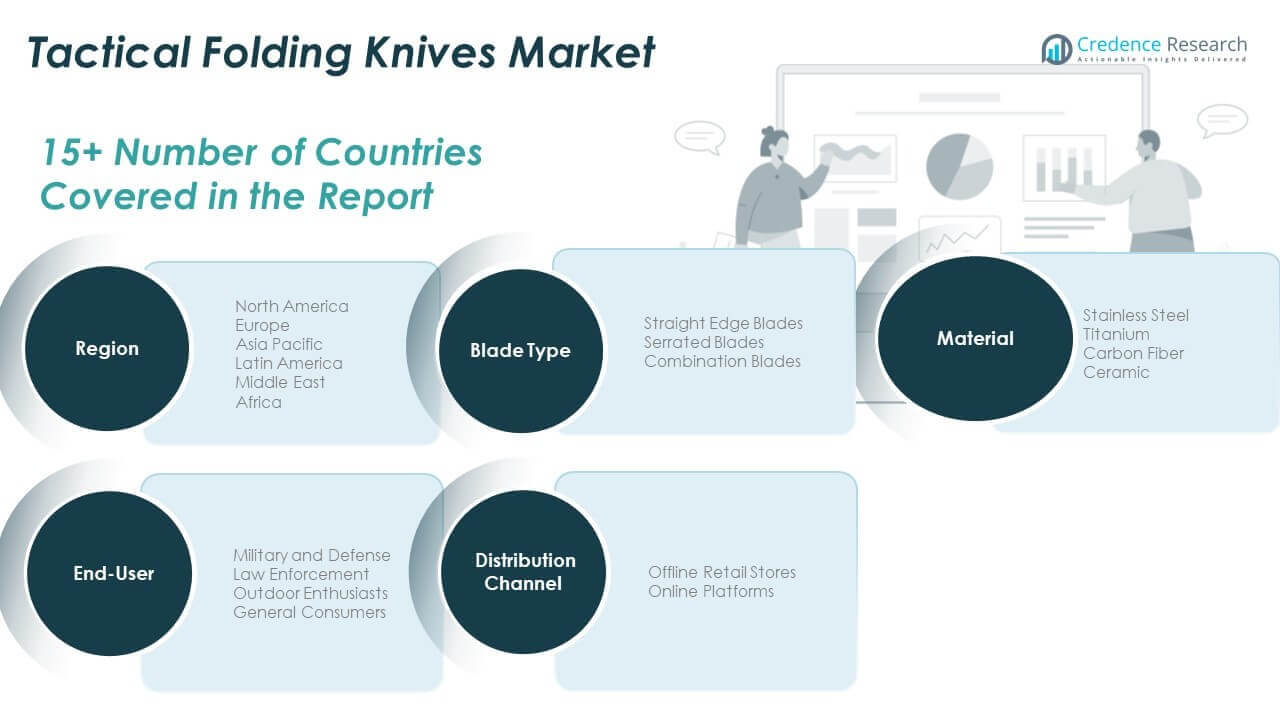
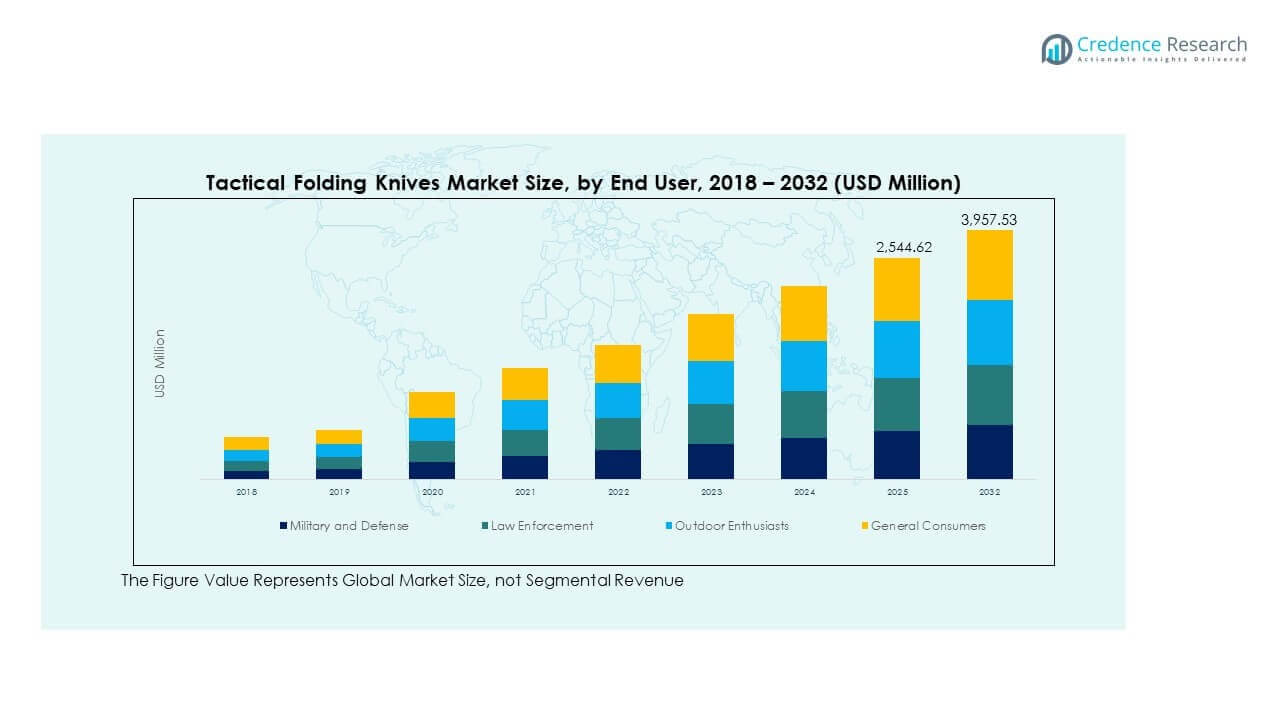
By blade type, straight edge blades dominate due to their precision and ease of sharpening. They appeal to users seeking clean cuts and control in survival, utility, or outdoor use. Serrated blades serve better in cutting ropes, fabrics, and tougher materials, making them ideal for emergency responders and tactical missions. Combination blades offer versatility, gaining traction among multi-purpose users across both civilian and professional segments. The Tactical Folding Knives Market sees balanced demand across these blade categories, driven by application-specific preferences and ergonomic advancements.
- For instance, Kershaw’s Launch 4 features a 1.9-inch spear point blade made from CPM-154 steel, hardened to 58–60 HRC. It is designed to comply with California's sub-2-inch blade laws and offers rapid push-button automatic deployment, making it a standout compact model in the Tactical Folding Knives Market.
By material, stainless steel leads due to its affordability, corrosion resistance, and strength. It caters to mass-market consumers and defense agencies alike. Titanium blades follow for their lightweight structure and high durability, attracting premium users and field professionals. Carbon fiber sees rising interest for its aesthetic appeal and enhanced grip, often used in high-end custom knives. Ceramic blades cater to niche segments that require rust-free, ultra-sharp edges, though they remain less common due to brittleness concerns.
- For instance, Zero Tolerance's 0452CF features a 4.1-inch CPM-20CV stainless steel blade hardened to 60–62 HRC, offering excellent edge retention and corrosion resistance. Its sleek carbon fiber handle and long blade profile make it a high-performance option in the Tactical Folding Knives Market, favored for durability and precision in demanding use cases.
By end-user, the military and defense sector remains the core buyer group, valuing reliability under extreme conditions. Law enforcement agencies prioritize compact, secure tools for daily field use. Outdoor enthusiasts prefer versatile blades that handle diverse survival tasks. General consumers increasingly purchase folding knives for utility, emergency readiness, or personal safety, expanding the market base.
By distribution channel, offline retail stores continue to dominate through physical product testing and direct consultation. Online platforms grow rapidly, offering broader variety, customization options, and convenient access, especially in emerging and urban markets.
Segmentation:
By Blade Type
- Straight Edge Blades
- Serrated Blades
- Combination Blades
By Material
- Stainless Steel
- Titanium
- Carbon Fiber
- Ceramic
By End-User
- Military and Defense
- Law Enforcement
- Outdoor Enthusiasts
- General Consumers
By Distribution Channel
- Offline Retail Stores
- Online Platforms
By Region
- North America
- U.S.
- Canada
- Mexico
- Europe
- Germany
- France
- U.K.
- Italy
- Spain
- Rest of Europe
- Asia Pacific
- China
- Japan
- India
- South Korea
- South-east Asia
- Rest of Asia Pacific
- Latin America
- Brazil
- Argentina
- Rest of Latin America
- Middle East & Africa
- GCC Countries
- South Africa
- Rest of the Middle East and Africa
Regional Analysis:
North America
The North America Tactical Folding Knives Market size was valued at USD 830.00 million in 2018 to USD 985.70 million in 2024 and is anticipated to reach USD 1,622.99 million by 2032, at a CAGR of 6.5% during the forecast period. North America accounts for approximately 38.2% of the global market share in 2024. It leads the market due to strong military spending, widespread gun and knife ownership, and an active outdoor lifestyle. The U.S. remains the dominant contributor, supported by large-scale procurement from defense and law enforcement agencies. Consumer interest in tactical and everyday carry (EDC) knives remains high. Leading brands headquartered in the region drive product innovation and premium design. Retail penetration is deep, with both specialty and general stores stocking tactical gear. Online sales continue to rise, expanding access across urban and rural areas. Regulatory clarity around folding knives supports broader civilian adoption.
Europe
The Europe Tactical Folding Knives Market size was valued at USD 553.60 million in 2018 to USD 639.95 million in 2024 and is anticipated to reach USD 999.49 million by 2032, at a CAGR of 5.8% during the forecast period. Europe holds around 24.8% of the global market share in 2024. The market benefits from moderate defense demand and a growing outdoor sports community. Countries like Germany, France, and the UK lead regional consumption. Tactical folding knives are popular among hobbyists, collectors, and emergency responders. Legal limitations on blade length and carrying restrict consumer use in some countries. E-commerce channels drive niche product exposure. European manufacturers focus on design quality and compliance to maintain trust. Traditional knife-making regions such as Italy also support steady premium product output.
Asia Pacific
The Asia Pacific Tactical Folding Knives Market size was valued at USD 422.00 million in 2018 to USD 532.58 million in 2024 and is anticipated to reach USD 982.66 million by 2032, at a CAGR of 8.0% during the forecast period. Asia Pacific contributes approximately 20.6% of the global market share in 2024. It remains the fastest-growing region due to rising outdoor recreation and increasing defense budgets in China, India, and Southeast Asia. Tactical gear sees higher demand from military modernization and public safety programs. Online platforms help smaller brands enter cost-sensitive markets. Youth interest in camping, trekking, and survival training fuels general consumer purchases. Domestic manufacturers scale up to meet low- to mid-tier demand. Product affordability and availability through local retail boost market expansion. Countries like Japan emphasize precision-crafted tools for niche users.
Latin America
The Latin America Tactical Folding Knives Market size was valued at USD 118.00 million in 2018 to USD 140.17 million in 2024 and is anticipated to reach USD 213.19 million by 2032, at a CAGR of 5.5% during the forecast period. Latin America represents about 5.4% of the global market share in 2024. Growth is supported by law enforcement upgrades and rising civilian self-defense needs. Brazil and Mexico are key contributors due to urban security concerns and cultural acceptance of knives. Tactical gear sales expand through specialty stores and military surplus outlets. Imports dominate the market, with U.S. and European brands leading. Limited domestic production constrains local market control. Middle-income consumers adopt folding knives for camping, fishing, and emergency use. Economic fluctuations influence consumer spending patterns. E-commerce remains underdeveloped in rural areas but gains pace in cities.
Middle East
The Middle East Tactical Folding Knives Market size was valued at USD 42.00 million in 2018 to USD 44.64 million in 2024 and is anticipated to reach USD 59.78 million by 2032, at a CAGR of 3.8% during the forecast period. The region accounts for roughly 1.7% of the global market share in 2024. Demand stems primarily from defense forces and internal security agencies. Tactical folding knives are part of gear issued in border and desert operations. The UAE and Israel lead regional procurement with advanced import preferences. Hobbyist and collector communities are small but growing. Religious and legal restrictions influence product design and sales channels. Retail access remains limited in many markets. Knife laws vary widely across countries, affecting uniform adoption. Brands must align with region-specific regulations to expand presence.
Africa
The Africa Tactical Folding Knives Market size was valued at USD 34.40 million in 2018 to USD 57.63 million in 2024 and is anticipated to reach USD 79.42 million by 2032, at a CAGR of 3.6% during the forecast period. Africa contributes nearly 2.2% of the global market share in 2024. Growth is steady, led by security forces, rangers, and outdoor users. South Africa dominates regional demand due to well-established tactical gear supply chains. Other countries show sporadic growth based on defense funding and tourism. General awareness about knife safety and functionality remains low. Distribution faces challenges due to weak logistics and high import dependence. Price sensitivity defines buying behavior, favoring durable entry-level products. Tactical gear use is rising in conservation and anti-poaching efforts. Market expansion requires better education and local channel development.
Key Player Analysis:
- Benchmade Knife Company
- Spyderco, Inc.
- Zero Tolerance Knives
- Gerber Gear
- Cold Steel Knives
- KA-BAR Knives, Inc.
- Buck Knives, Inc.
- SOG Specialty Knives
- CRKT (Columbia River Knife and Tool)
- Leatherman Tool Group
Competitive Analysis:
The Tactical Folding Knives Market features a mix of established players and specialized brands focused on high-quality and performance-driven products. Key companies include Benchmade Knife Company, Spyderco Inc., Zero Tolerance Knives, and Gerber Gear. These brands maintain strong market visibility through consistent innovation, premium craftsmanship, and active engagement with military and outdoor communities. It remains highly competitive, driven by product differentiation in materials, locking mechanisms, and blade styles. Players focus on ergonomic design, precision manufacturing, and compliance with regional regulations. Partnerships with defense agencies and online retailers expand their global reach. Smaller players and regional manufacturers compete on pricing and niche customization. The rise of e-commerce enables direct-to-consumer strategies, increasing competition for shelf space and digital presence. Market leaders invest in product quality, distribution, and brand loyalty to retain share.
Recent Developments:
- In January 2025, Benchmade Knife Company launched a series of must-have tactical folding knives at SHOT Show, including lightweight EDC options and rugged models with OTF deployment for quick tactical access.
Report Coverage:
The research report offers an in-depth analysis based on Blade Type, Material, End-User and Distribution Channel. It details leading market players, providing an overview of their business, product offerings, investments, revenue streams, and key applications. Additionally, the report includes insights into the competitive environment, SWOT analysis, current market trends, as well as the primary drivers and constraints. Furthermore, it discusses various factors that have driven market expansion in recent years. The report also explores market dynamics, regulatory scenarios, and technological advancements that are shaping the industry. It assesses the impact of external factors and global economic changes on market growth. Lastly, it provides strategic recommendations for new entrants and established companies to navigate the complexities of the market.
Future Outlook:
- Demand for tactical folding knives will rise due to increased outdoor recreation and urban utility use.
- Military and law enforcement procurement will remain a stable and high-volume demand driver.
- Online sales channels will gain further traction, enabling global reach for both large and niche brands.
- Product innovation using lightweight and corrosion-resistant materials will create new customer value.
- Customization features and limited-edition models will attract collectors and enthusiasts.
- Regulatory clarity and legal standardization will expand civilian adoption in emerging markets.
- Growth in Asia Pacific will outpace other regions due to rising disposable incomes and defense investments.
- Tactical folding knives with multi-functionality will appeal to a broader set of end-users.
- Brand partnerships with influencers and survival content creators will shape marketing strategies.
- Sustainability efforts in materials and packaging will influence purchasing preferences across regions.
Request a Free Sample
Fill in your details and we'll send you a free sample report.
- Sample data tables & charts
- Research methodology
Need a Custom Version of This Report?
Tailor the scope, geography, or segments to your exact requirements.
- Custom geography or segment scope
- Direct access to our analyst team
Frequently Asked Questions
What is the current market size for Tactical Folding Knives Market, and what is its projected size in 2032?
At what Compound Annual Growth Rate is the Tactical Folding Knives Market projected to grow between 2024 and 2032?
Which Tactical Folding Knives Market segment held the largest share in 2024?
What are the primary factors fueling the growth of the Tactical Folding Knives Market?
Who are the leading companies in the Tactical Folding Knives Market?
Which region commanded the largest share of the Tactical Folding Knives Market in 2024?
Table of Content
Chapter 1. Report Introduction
- 1.1 Report Description & Purpose
- 1.1.1 Report Title & Market Definition
- 1.1.2 Unique Selling Propositions (USP) & Key Differentiators
- 1.1.3 Value Proposition for Stakeholders
- 1.2 Research Objectives
- 1.2.1 Market Sizing Objectives (Volume & Revenue)
- 1.2.2 Segmentation Objectives
- 1.2.3 Competitive Intelligence Objectives
- 1.2.4 Forecast & Scenario Objectives
- 1.3 Report Scope
- 1.3.1 Tactical Folding Knives Scope – Types & Subtypes Covered
- 1.3.2 Geographic Scope – Regions & Countries Covered
- 1.3.3 Historical Period, Base Year & Forecast Period (2024; forecast to 2032)
- 1.3.4 Inclusions & Exclusions
- 1.4 HS Code & Classification Framework
- 1.5 Currency, Units & Pricing Basis
- 1.6 Target Stakeholders
- 1.7 Limitations & Assumptions
Chapter 2. Executive Summary
- 2.1 Global Tactical Folding Knives Market Snapshot
- 2.1.1 Market Size – Historical (2024) & Forecast (2024-2032) (2024: USD 2,400.67 million → 2032: USD 3,957.53 million)
- 2.1.2 Volume & Revenue – Global Totals
- 2.1.3 Key Market Highlights – Top Five Facts
- 2.2 Tactical Folding Knives Market Segmentation Snapshot
- 2.2.1 Market Split by Region – 2024 vs. 2032
- 2.3 Competitive Snapshot
- 2.3.1 Top 10 Players by Revenue Share – 2024
- 2.3.2 Top 10 Players by Volume Share – 2024
- 2.3.3 Recent Strategic Developments (18-Month Summary)
- 2.4 Key Investment Highlights & Strategic Conclusions
Chapter 3. Tactical Folding Knives Market Dynamics & Industry Analysis
- 3.1 Market Overview & Context
- 3.1.1 Tactical Folding Knives Market Position in the Broader Automotive Value Chain
- 3.1.2 OEM vs. Replacement Market Dynamics
- 3.1.3 Market Maturity & Development Stage by Region
- 3.2 Tactical Folding Knives Market Drivers
- 3.3 Tactical Folding Knives Market Restraints & Challenges
- 3.4 Tactical Folding Knives Market Opportunities
- 3.5 Porter's Five Forces Analysis
- 3.5.1 Threat of New Entrants
- 3.5.2 Bargaining Power of Suppliers
- 3.5.3 Bargaining Power of Buyers
- 3.5.4 Threat of Substitutes
- 3.5.5 Competitive Rivalry – Intensity Assessment
- 3.6 Tactical Folding Knives Value Chain Analysis
- 3.6.1 Upstream – Raw Material/Input Suppliers
- 3.6.1.1 Raw Material/Input 1
- 3.6.1.2 Raw Material/Input 2
- 3.6.1.3 Raw Material/Input 3
- 3.6.2 Midstream – Production/Manufacturing/Service Delivery
- 3.6.2.1 Production/Process Overview
- 3.6.2.2 Key Facility Locations & Capacity by Manufacturer
- 3.6.3 Downstream – Distribution & End Consumer
- 3.6.3.1 Primary Channel – B2B/OEM
- 3.6.3.2 Secondary Channels – Dealer, Retail, Online, Direct
- 3.6.4 Value Chain Profitability Analysis
- 3.6.1 Upstream – Raw Material/Input Suppliers
- 3.7 PESTEL Analysis
- 3.7.1 Political Factors
- 3.7.2 Economic Factors
- 3.7.3 Social Factors
- 3.7.4 Technological Factors
- 3.7.5 Environmental Factors
- 3.7.6 Legal Factors
- 3.8 Tactical Folding Knives Supply Chain Analysis
- 3.8.1 Raw Material/Input Supply Risk Assessment
- 3.8.2 Manufacturing Concentration Risk (Geographic Exposure)
- 3.8.3 Trade Disruption Impact Analysis
- 3.9 Regulatory & Policy Landscape
Note: The regulatory and policy landscape section covers regulations based on their applicability to the market, Tactical Folding Knives category, geography, and scope of the study. Only regulatory frameworks with a material impact on operations, compliance, trade, sustainability, or market access are analyzed in detail.
Chapter 4. Key Investment Pockets & Opportunity Analysis
- 4.1 Tactical Folding Knives Market Attractiveness Analysis
- 4.1.1 By Region – Investment Attractiveness Matrix (Volume × CAGR)
- 4.2 Absolute Revenue Growth Opportunity
- 4.2.1 By Region – Absolute USD Growth Through 2032
- 4.3 Incremental Volume Opportunity
- 4.3.1 By Region – Incremental Volume Through 2032
- 4.3.2 Segment – Incremental Volume
- 4.4 Emerging Submarket Opportunity Deep Dive (Subject to Applicability)
- 4.5 Emerging Market Opportunity Scorecards
- 4.5.1 United States
- 4.5.2 Europe
- 4.5.3 Asia
- 4.5.4 Middle East & Africa
Note: Emerging Market Opportunity Scorecards will be included based on relevance and strategic importance. Regions listed are indicative and may vary depending on data availability and market dynamics.
Chapter 5. Tactical Folding Knives Import-Export Analysis & Trade Flows
- 5.1 Global Trade Overview
- 5.1.1 Global Export Value by Country (2024)
- 5.1.2 Global Export Volume by Country (2024)
- 5.1.3 Global Import Value by Country (2024)
- 5.1.4 Global Import Volume by Country (2024)
- 5.1.5 Net Trade Balance by Country (2024)
- 5.2 Export Analysis – Segment
- 5.2.1 Type 1 (HS Code)
- 5.2.2 Type 2 (HS Code)
- 5.2.3 Type 3 (HS Code)
- 5.2.4 Type 4 (HS Code)
- 5.2.5 Type 5 (HS Code)
- 5.3 Import Analysis – Segment
- 5.3.1 Type 1 (HS Code)
- 5.3.2 Type 2 (HS Code)
- 5.3.3 Type 3 (HS Code)
- 5.3.4 Type 4 (HS Code)
- 5.3.5 Type 5 (HS Code)
- 5.4 Average Unit Trade Prices
- 5.4.1 Average Export Price – Segment & Country
- 5.4.2 Average Import Price – Segment & Source Country
- 5.4.3 Price Trends (2024)
- 5.5 Key Trade Route Analysis
- 5.5.1 Trade Route 1
- 5.5.2 Trade Route 2
- 5.5.3 Trade Route 3
- 5.5.4 Trade Route 4
- 5.5.5 Trade Route 5
- 5.6 Trade Policy Impact Assessment
- 5.6.1 US Anti-Dumping & Section 301 Tariffs
- 5.6.2 EU Customs Union Impact
- 5.6.3 Major Free Trade Agreements
- 5.6.4 USMCA Rules of Origin
Note: Trade policy analysis will be included only where relevant to the Tactical Folding Knives market.
Chapter 6. Competitive Landscape & Company Benchmarking
- 6.1 Tactical Folding Knives Market Concentration & Structure
- 6.1.1 Herfindahl-Hirschman Index (HHI) – vs. 2024
- 6.1.2 Tier 1, Tier 2 & Tier 3 Market Structure
- 6.1.3 Global, Regional & Local Player Dynamics
- 6.2 Tactical Folding Knives Market Share Analysis – 2024
- 6.2.1 Global Revenue Share by Company
- 6.2.2 Global Volume Share by Company
- 6.2.3 Regional Revenue Share
- 6.2.4 Market Share Evolution ( vs. 2024)
- 6.2.5 OEM Segment Share by Company
- 6.2.6 Replacement Segment Share by Company
- 6.3 Production/Delivery Capacity & Facility Analysis
- 6.3.1 Global Installed Capacity
- 6.3.2 Capacity Utilization Rates
- 6.3.3 Production/Output Volume
- 6.3.4 Facility Locations & Capacity Map
- 6.3.5 Planned Capacity Additions
- 6.4 Tactical Folding Knives Competitive Benchmarking Matrix
- 6.4.1 Revenue, Volume, CAGR & Profitability Comparison
- 6.4.2 Channel Revenue Mix
- 6.4.3 Geographic Revenue Exposure
- 6.4.4 R&D Intensity
- 6.4.5 Sustainability Maturity
- 6.5 Strategic Developments in Tactical Folding Knives (Last 24 Months)
- 6.5.1 Mergers, Acquisitions & Divestments
- 6.5.2 New Tactical Folding Knives Launches
- 6.5.3 Facility Expansions
- 6.5.4 Strategic Alliances, Joint Ventures & Partnerships
- 6.5.5 Distribution Expansion & Market Entry
- 6.5.6 Sustainability & ESG Initiatives
- 6.6 Competitive Strategy Mapping
- 6.6.1 Leader, Challenger, Follower & Niche Classification
- 6.6.2 Pricing Strategy Comparison
- 6.6.3 Channel Strategy Matrix
Note: Strategic developments are included based on their materiality and the availability of reliable information.
Chapter 7. Global Tactical Folding Knives Market – By Distribution Channel
- 7.1 Segment Overview
- 7.1.1 Volume & Revenue Split by Channel (2024 & 2032)
- 7.1.2 Channel Mix Evolution (2024-2032)
Chapter 8. Regional Market Analysis – Global Overview
- 8.1 Global Regional Overview
- 8.1.1 Regional Volume Share
- 8.1.2 Regional Revenue Share
- 8.1.3 Regional Volume by Region
- 8.1.4 Regional Revenue by Region
- 8.1.5 Regional Forecast Through 2032
- 8.2 Cross-Regional Segment Analysis
- 8.2.1 By Distribution Channel
- 8.2.2 By Brand/Price Tier
Chapter 9. North America Tactical Folding Knives Market
- 9.1 United States
- 9.2 Canada
- 9.3 Mexico
Chapter 10. Europe Tactical Folding Knives Market
- 10.1 Germany
- 10.2 France
- 10.3 Italy
- 10.4 United Kingdom
- 10.5 Spain
- 10.6 Poland
- 10.7 Russia
- 10.8 Netherlands
- 10.9 Belgium
- 10.10 Sweden
- 10.11 Denmark
- 10.12 Norway
- 10.13 Rest of Europe
Chapter 11. Asia Pacific Tactical Folding Knives Market
- 11.1 China
- 11.2 India
- 11.3 Japan
- 11.4 South Korea
- 11.5 Thailand
- 11.6 Indonesia
- 11.7 Vietnam
- 11.8 Malaysia
- 11.9 Australia
- 11.10 Rest of Asia Pacific
Chapter 12. Latin America Tactical Folding Knives Market
- 12.1 Brazil
- 12.2 Argentina
- 12.3 Colombia
- 12.4 Chile
- 12.5 Rest of Latin America
Chapter 13. Middle East Tactical Folding Knives Market
- 13.1 Saudi Arabia
- 13.2 United Arab Emirates
- 13.3 Turkey
- 13.4 Israel
- 13.5 Iran
- 13.6 Rest of the Middle East
Chapter 14. Africa Tactical Folding Knives Market
- 14.1 South Africa
- 14.2 Egypt
- 14.3 Nigeria
- 14.4 Morocco
- 14.5 Rest of Africa
Chapter 15. Tactical Folding Knives Company Profiles
- 15.1 [Company 01]
- 15.1.1 Company Overview
- 15.1.2 Key Management Personnel
- 15.1.3 Products & Services Portfolio
- 15.1.4 Financial Performance
- 15.1.5 Key Market Focus & Geographic Presence
- 15.1.6 Recent Developments & Strategic Initiatives
Note: The company profile list is preliminary and may change based on research findings, market developments, data availability, and client requirements.
Chapter 16. Appendices
- Appendix A – List of Abbreviations & Acronyms
- Appendix B – Industry Classification Code Reference – Full Series
- Appendix C – Production & Capacity Data Tables
- Appendix D – End-Use & Demand Base Tables
- Appendix E – Consumption & Replacement Rate Assumptions
- Appendix F – ASP Reference Tables
- Appendix G – Manufacturing & Facility Database
- Appendix H – Import-Export Data Tables
- Appendix I – Regulatory Summary Tables
- Appendix J – Primary Research Participant List (Anonymized)
- Appendix K – Primary Research Questionnaire Framework
- Appendix L – Data Sources & Bibliography
- Appendix M – Market Size Divergence & Source Comparison
Chapter 17. Research Methodology
- 17.1 Research Framework & Philosophy
- 17.2 Secondary Research – Sources, Hierarchy & Data Extraction
- 17.3 Data Modeling – Bottom-Up & Top-Down Market Sizing
- 17.4 Primary Research – Stakeholder Framework, LOI & Sample Sizes
- 17.5 Forecast Methodology – Regression, Scenario & Sensitivity Analysis
- 17.6 Quality Control – Four-Layer Validation Framework
- 17.7 Limitations & Standard Assumptions
- 17.8 Disclaimer
