Market Overview:
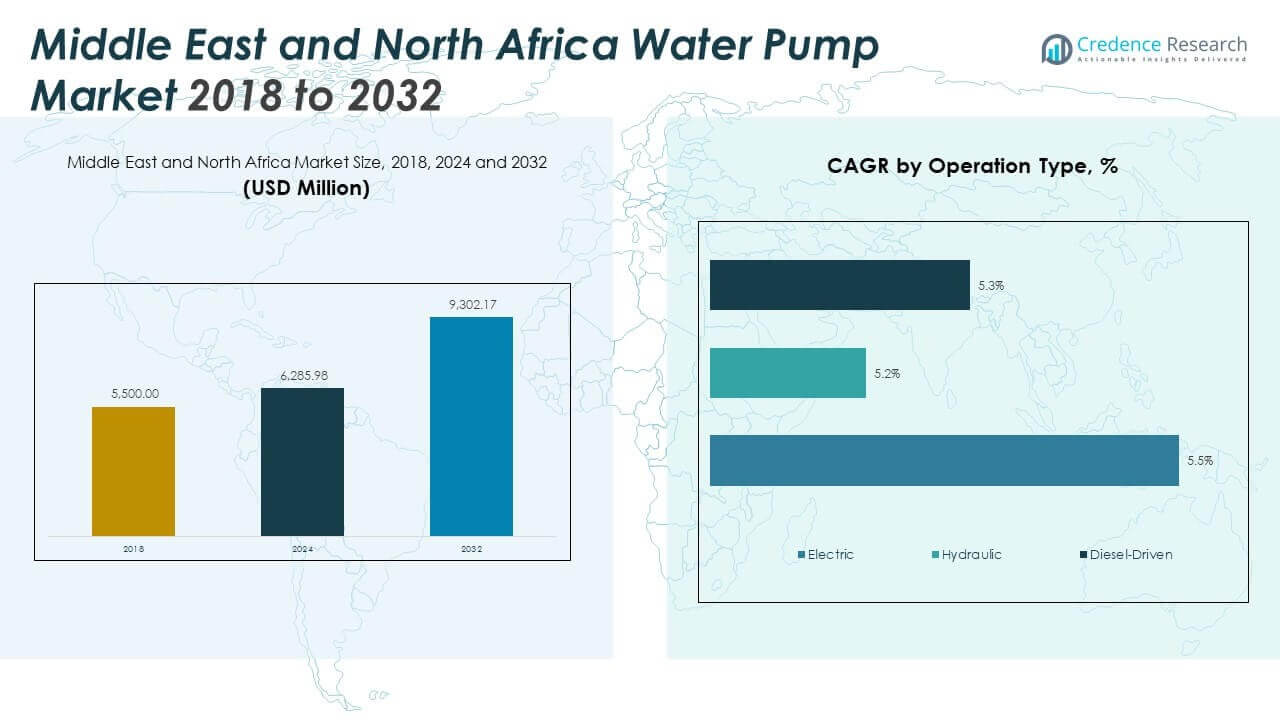
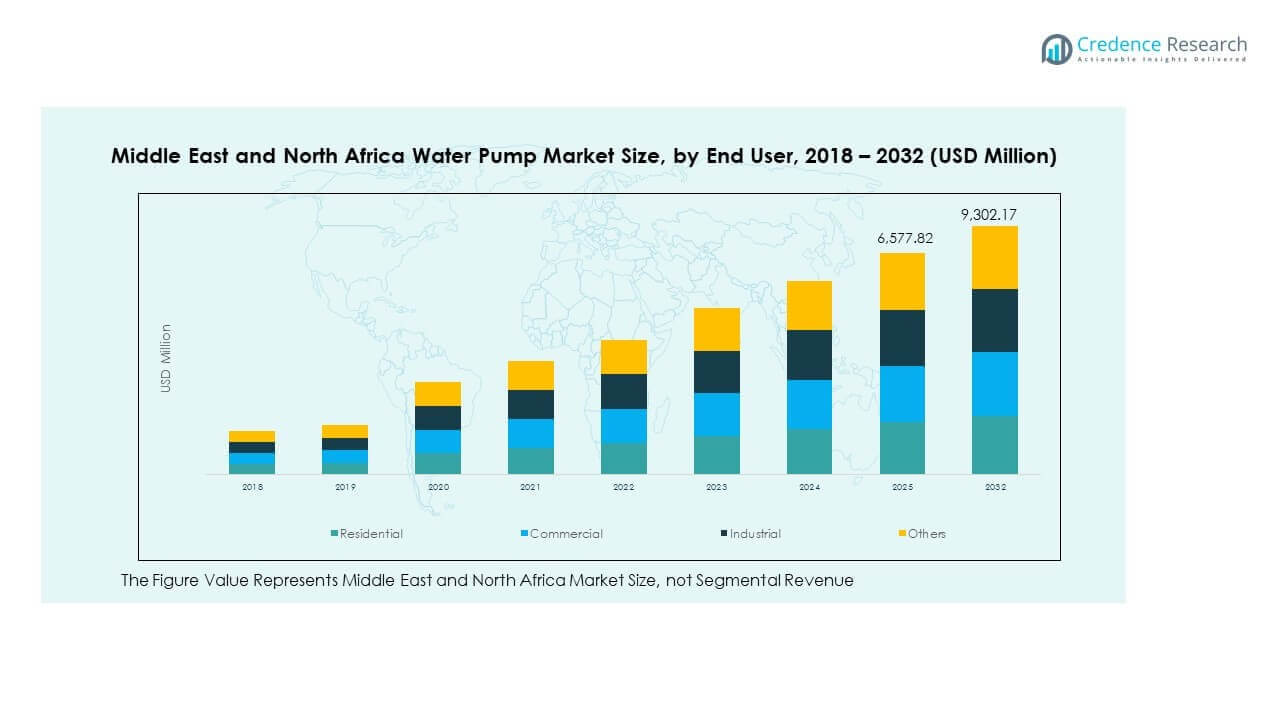
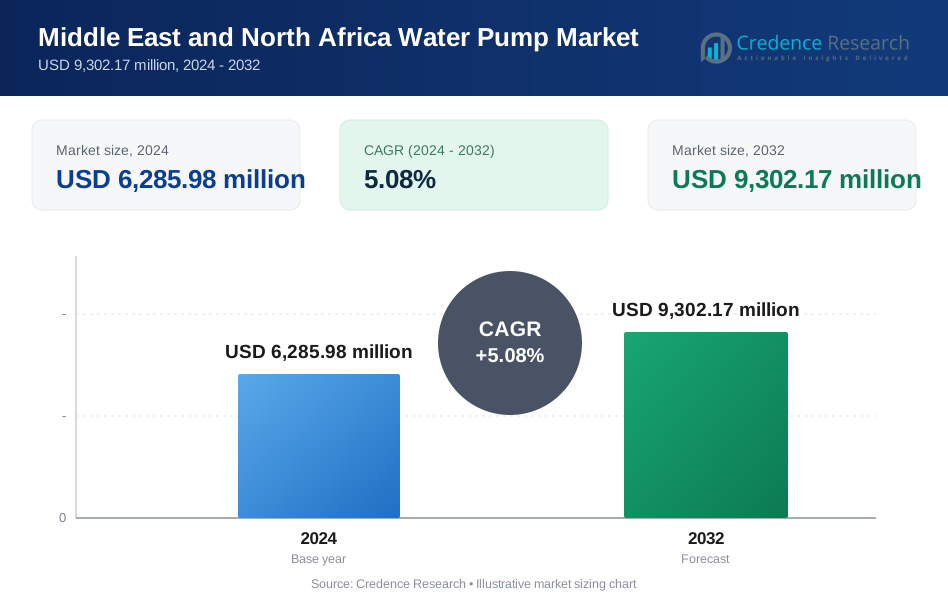
The Middle East and North Africa Water Pump Market size was valued at USD 5,500.00 million in 2018 to USD 6,285.98 million in 2024 and is anticipated to reach USD 9,302.17 million by 2032, at a CAGR of 5.08% during the forecast period.
| REPORT ATTRIBUTE | DETAILS |
|---|---|
| Historical Period | 2020-2023 |
| Base Year | 2024 |
| Forecast Period | 2025-2032 |
| Middle East and North Africa Water Pump Market Size 2024 | USD 6,285.98 million |
| Middle East and North Africa Water Pump Market, CAGR | 5.08% |
| Middle East and North Africa Water Pump Market Size 2032 | USD 9,302.17 million |
The market grows due to rising water stress across arid climates. Governments expand desalination and water transfer infrastructure. Urban population growth raises demand for reliable distribution systems. Agriculture depends on pumps to secure irrigation under rainfall uncertainty. Industrial activity increases demand for process and utility water. Energy projects require stable cooling and circulation systems. Public utilities replace aging pumping assets. Efficiency standards influence equipment selection. Long-term water security planning sustains demand.
The market shows clear regional leadership and emerging growth zones. Gulf countries lead due to strong desalination investment. Saudi Arabia and the UAE dominate large-scale infrastructure programs. These countries focus on long-term water security. North Africa shows strong demand from agriculture and municipal networks. Egypt leads through irrigation and urban water projects. Morocco and Algeria emerge with infrastructure upgrades. Coastal regions drive advanced pump adoption. Inland regions support volume demand through agriculture.
Market Insights
- The market expanded from USD 5,500.00 million in 2018 to USD 6,285.98 million in 2024 and is projected to reach USD 9,302.17 million by 2032, reflecting a CAGR of 5.08% driven by sustained water infrastructure investment.
- Gulf countries lead with about 48% share due to large desalination capacity, followed by North Africa at around 34% supported by agriculture and municipal networks, while the rest of MENA holds nearly 18% driven by gradual infrastructure upgrades.
- North Africa emerges as the fastest-growing region with nearly 34% share, supported by irrigation modernization, urban water projects, and public investment in wastewater treatment systems.
- By operation type, electric pumps show the strongest momentum with a CAGR of 5.5%, reflecting rising grid access, efficiency focus, and preference in municipal and industrial networks.
- Diesel-driven pumps grow at 5.3% CAGR while hydraulic pumps expand at 5.2%, supported by remote operations, agriculture use, and heavy-duty industrial applications.
Market Drivers:
Escalating Water Scarcity And Long-Term Dependence On Engineered Water Transfer Systems
The Middle East and North Africa Water Pump Market grows due to chronic freshwater scarcity. Natural water sources remain uneven and limited across countries. Governments rely on engineered transfer systems for supply continuity. Urban centers depend on pumps for long-distance water movement. It supports pressure balance across dense population zones. Rural communities also rely on pumping for basic access. Climate volatility raises dependence on controlled water flow. National water security programs prioritize mechanical reliability. Infrastructure authorities emphasize uninterrupted system performance.
- For instance, the Ras Al-Khair desalination plant in Saudi Arabia uses high-capacity intake pumps to handle 1,036,000 cubic meters per day from the Persian Gulf.
Expansion Of Desalination And Treated Water Reuse Infrastructure Across Coastal And Inland Regions
The Middle East and North Africa Water Pump Market benefits from large desalination programs. Coastal nations invest heavily in seawater treatment facilities. High-capacity pumps manage intake and discharge operations. Treated wastewater reuse expands across cities and industries. It supports non-potable supply for landscaping and utilities. Policy frameworks encourage reuse adoption at scale. Pumps ensure process stability and efficiency. Corrosion resistance becomes a core requirement. Long project durations sustain replacement demand.
Sustained Agricultural Irrigation Demand Under Food Security And Water Efficiency Policies
The Middle East and North Africa Water Pump Market remains tied to irrigation needs. Agriculture holds strategic importance for food supply stability. Farms depend on pumps for groundwater and canal distribution. It enables controlled irrigation under rainfall uncertainty. Governments support irrigation upgrades through rural programs. Farmers adopt systems that improve water efficiency. Pressure control helps reduce field losses. Crop yield stability drives equipment use. Agricultural resilience plans reinforce demand.
Industrial And Energy Sector Infrastructure Expansion Requiring Reliable Utility Water Systems
The Middle East and North Africa Water Pump Market aligns with industrial growth. Manufacturing facilities require stable water circulation. Energy projects depend on pumps for cooling and utilities. It ensures operational continuity under high load conditions. Industrial clusters expand near urban zones. Infrastructure planners specify high-duty pump systems. Reliability standards influence supplier selection. Energy diversification supports auxiliary water demand. Industrial modernization sustains long-term usage.
- For instance, the Ras Al-Khair industrial complex in Saudi Arabia operates large-scale seawater cooling and intake pump systems to supply reliable cooling water to power generation and associated industrial facilities.
Market Trends:
Rising Preference For Energy-Efficient Pump Designs To Control Operating Costs
The Middle East and North Africa Water Pump Market shows rising efficiency focus. Utilities seek reduced electricity consumption. Energy-efficient motors gain procurement priority. It supports lower lifecycle operating costs. Public tenders include efficiency benchmarks. Equipment upgrades follow energy audit outcomes. Suppliers highlight performance per unit of power. Cost transparency shapes buying decisions. Efficiency metrics influence replacement cycles.
Integration Of Digital Control And Remote Monitoring Across Large Water Networks
The Middle East and North Africa Water Pump Market reflects digital adoption. Operators deploy sensors for flow and pressure control. It improves fault detection accuracy. Remote access reduces manual intervention needs. Centralized dashboards support network oversight. Large utilities favor data-enabled systems. Maintenance planning becomes more predictive. Service continuity improves through alerts. Digital readiness shapes supplier value.
- For instance, UAE’s DEWA deployed SCADA-based remote monitoring across its water pump networks in Dubai, enabling faster fault detection, centralized control, and reduced reliance on manual field intervention.
Material Innovation To Address High Salinity, Heat, And Abrasive Operating Conditions
The Middle East and North Africa Water Pump Market adapts to harsh environments. Saline water stresses conventional materials. Extreme heat accelerates component wear. It drives use of specialized alloys and coatings. Stainless steel use expands in coastal assets. Composite materials gain attention for durability. Buyers assess corrosion resistance carefully. Longevity outweighs initial cost. Material performance defines brand trust.
- For instance, KSB deploys Amarex submersible pumps at desalination facilities in Qatar, using duplex stainless steel impellers designed to withstand high salinity conditions and support long-term operational reliability.
Growth Of Regional Assembly And Localization To Improve Supply Reliability
The Middle East and North Africa Water Pump Market supports localization trends. Governments encourage domestic industrial capability. Regional assembly shortens delivery timelines. It improves aftersales responsiveness. Local presence supports tender eligibility. Spare part access becomes easier. Skilled labor availability improves maintenance outcomes. Supply chain risk reduces. Localization reshapes competition dynamics.
Market Challenges Analysis:
Capital Cost Pressure And Budget Constraints Across Public And Utility Buyers
The Middle East and North Africa Water Pump Market faces pricing sensitivity. Public utilities operate under strict budget limits. High-capacity pumps require large capital outlay. It delays replacement of aging systems. Approval processes extend procurement timelines. Cost focus restricts technology upgrades. Low-price imports intensify competition. Lifecycle evaluation varies across buyers. Financial planning shapes purchase decisions.
Operational Stress From Climate Extremes And Uneven Maintenance Infrastructure
The Middle East and North Africa Water Pump Market operates under harsh conditions. Extreme temperatures strain mechanical components. Sand and dust affect seals and bearings. It raises maintenance frequency and cost. Water quality variation impacts material life. Skilled technicians remain unevenly available. Remote sites complicate service access. Downtime risk concerns asset owners. Environmental exposure tests system resilience.
Market Opportunities:
Smart City Development And Integrated Urban Water Management Programs
The Middle East and North Africa Water Pump Market gains opportunity from smart cities. Urban projects embed digital water systems early. It creates demand for advanced pumps. Automated control supports efficient distribution. City planners favor scalable infrastructure. Data integration improves system visibility. Long project horizons ensure steady demand. Technology alignment benefits premium suppliers.
Decentralized Rural Water Systems And Off-Grid Infrastructure Expansion
The Middle East and North Africa Water Pump Market benefits from rural programs. Governments target improved access in remote areas. Decentralized systems rely on compact pump units. It supports community supply and agriculture. Solar-compatible pumps attract policy support. Development funding aids deployment. Local service models improve adoption. Rural expansion broadens market reach.
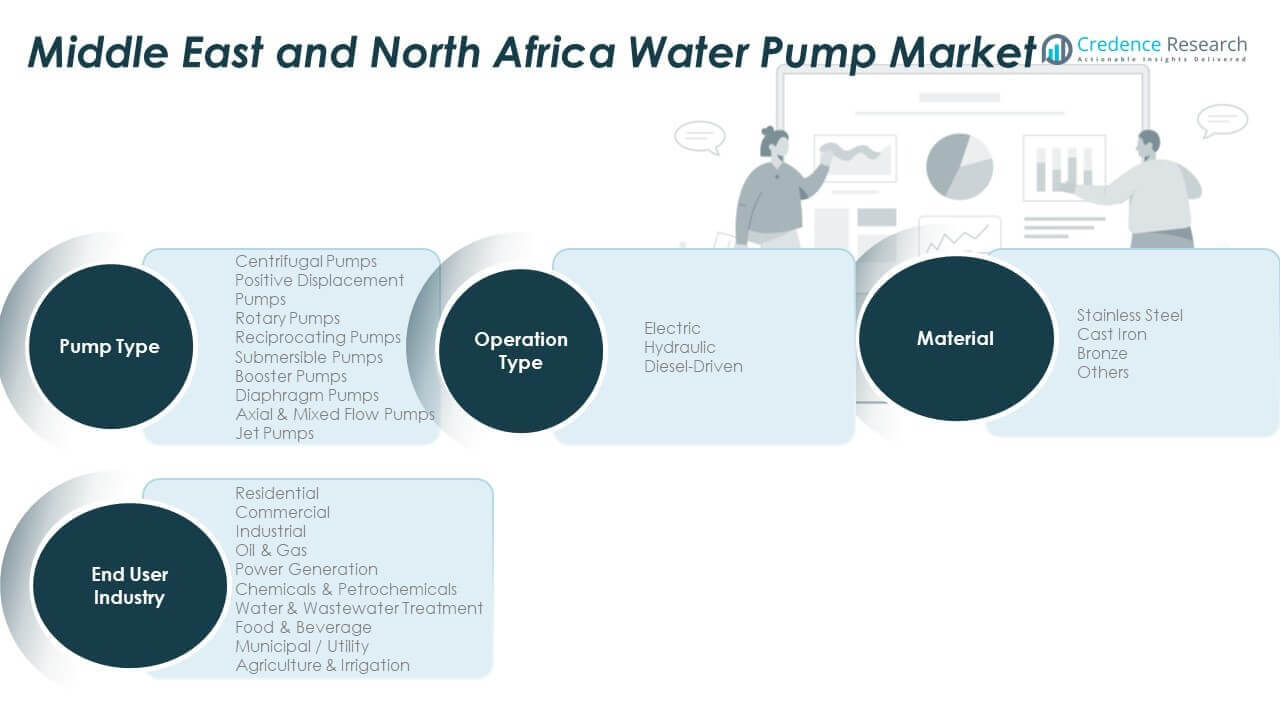
Market Segmentation Analysis
By Pump Type
The Middle East and North Africa Water Pump Market shows wide adoption across pump types based on application needs. Centrifugal pumps dominate due to simple design and suitability for large water volumes. Positive displacement and rotary pumps serve applications requiring steady flow and pressure control. Reciprocating pumps support high-pressure duties in industrial settings. Submersible pumps see strong demand in groundwater extraction. Booster pumps support pressure stabilization in urban networks. Diaphragm pumps handle corrosive and sensitive fluids. Axial, mixed flow, and jet pumps address high-flow and lift-specific requirements.
- For instance, Kirloskar Brothers Limited’s Lifter series supports agricultural and utility applications with head capability up to 38 meters, discharge reaching 5,115 liters per hour, and suction lift capacity of up to 8.5 meters.
By Operation Type
The Middle East and North Africa Water Pump Market reflects strong preference for electric operation. Electric pumps suit municipal, residential, and industrial networks with grid access. Hydraulic pumps support heavy-duty and specialized industrial use. Diesel-driven pumps remain relevant in remote locations. Agriculture and construction rely on diesel systems where power access stays limited. Emergency water transfer also favors diesel-driven units. Fuel cost and emissions influence gradual shifts toward electric systems.
By Material
The Middle East and North Africa Water Pump Market shows material selection driven by operating conditions. Stainless steel leads in desalination and wastewater applications. Cast iron remains common in municipal and agricultural systems. Bronze serves niche uses requiring corrosion resistance in marine environments. Other materials include engineered plastics and alloys. Material choice affects lifecycle cost and maintenance frequency. Harsh climates elevate demand for durable material options.
By End User Industry
The Middle East and North Africa Water Pump Market serves diverse end users. Municipal and utility sectors lead demand due to water distribution needs. Agriculture and irrigation rely on pumps for food security. Residential and commercial buildings use pumps for supply and pressure control. Industrial users require pumps for process water. Oil and gas and power generation depend on pumps for utilities. Water and wastewater treatment drives consistent infrastructure demand. Food, beverage, and chemical sectors require controlled and hygienic pumping systems.
- For instance, Alkhorayef Water and Power Technologies secured a contract linked to the expansion of a sewage treatment facility in Dammam, where pump system upgrades support higher treatment capacity and operational efficiency.
Segmentation
By Pump Type
- Centrifugal Pumps
- Positive Displacement Pumps
- Rotary Pumps
- Reciprocating Pumps
- Submersible Pumps
- Booster Pumps
- Diaphragm Pumps
- Axial & Mixed Flow Pumps
- Jet Pumps
By Operation Type
- Electric
- Hydraulic
- Diesel-Driven
By Material
- Stainless Steel
- Cast Iron
- Bronze
- Others
By End User Industry
- Residential
- Commercial
- Industrial
- Oil & Gas
- Power Generation
- Chemicals & Petrochemicals
- Water & Wastewater Treatment
- Food & Beverage
- Municipal / Utility
- Agriculture & Irrigation
Regional Analysis
The Middle East and North Africa Water Pump Market features a competitive structure shaped by global manufacturers and strong regional suppliers. Multinational companies lead through broad product portfolios and established brand trust. These players compete on performance reliability, energy efficiency, and long service life. Regional firms strengthen presence through localized manufacturing and faster service support. It benefits buyers who seek shorter delivery cycles and local compliance. Price competitiveness remains important in public infrastructure tenders. Global firms often secure large-scale projects through technical credentials and long-term references.
Product differentiation plays a central role in competition across the Middle East and North Africa Water Pump Market. Leading companies focus on high-efficiency motors, corrosion-resistant materials, and digital monitoring features. It enables suppliers to address harsh climate conditions and high-duty cycles. Standardization across product lines helps manage cost control. Custom engineering capabilities strengthen bids for desalination and industrial projects. Technology integration supports lifecycle value positioning. Suppliers align offerings with regional water and energy policies.
Service capability strongly influences competitive standing in the Middle East and North Africa Water Pump Market. Companies invest in regional service centers and trained technical teams. It improves maintenance response and uptime assurance. Long-term service contracts support recurring revenue. Partnerships with local distributors expand market reach. Public and industrial buyers favor vendors with proven aftersales strength. Competitive intensity remains moderate to high, driven by infrastructure investment scale. Strategic localization and technical reliability define long-term success.
Key Player Analysis
- Grundfos
- Xylem Inc.
- KSB Group
- Sulzer Ltd.
- Wilo SE
Competitive Analysis
The Middle East and North Africa Water Pump Market shows strong competition between global manufacturers and established regional suppliers. International companies lead through broad product portfolios, proven engineering standards, and long project references. These firms compete on reliability, efficiency, and durability under harsh climate conditions. Regional players strengthen position through cost control, local manufacturing, and faster response times. It allows closer alignment with public utility requirements and tender norms. Price sensitivity remains high, especially in government-funded infrastructure projects. Technology capability shapes differentiation, with emphasis on energy-efficient motors and corrosion-resistant designs. Digital monitoring features support premium positioning in large systems. Service reach plays a critical role in supplier selection. Vendors invest in regional service hubs and spare part availability. Long-term service contracts improve customer retention and uptime assurance. Local partnerships support distribution and regulatory compliance. Buyers favor suppliers with strong aftersales capability and technical support. Competition stays intense in municipal, agricultural, and utility segments.
Recent Developments
- In January 2025. Wilo SE completed the doubling of its Dubai manufacturing facility capacity. This expansion positions the company to better serve growing regional demand and establishes an export hub for Middle East and Africa markets.
Report Coverage
The research report offers an in-depth analysis based on Pump Type, Operation Type, Material and End User Industry. It details leading market players, providing an overview of their business, product offerings, investments, revenue streams, and key applications. Additionally, the report includes insights into the competitive environment, SWOT analysis, current market trends, as well as the primary drivers and constraints. Furthermore, it discusses various factors that have driven market expansion in recent years. The report also explores market dynamics, regulatory scenarios, and technological advancements that are shaping the industry. It assesses the impact of external factors and global economic changes on market growth. Lastly, it provides strategic recommendations for new entrants and established companies to navigate the complexities of the market.
Future Outlook
- Infrastructure investment will sustain steady demand across municipal, industrial, and utility water systems.
- Desalination and wastewater reuse projects will remain long-term demand anchors for pumping solutions.
- Urban expansion will increase pressure management and water distribution requirements across cities.
- Agricultural modernization will support adoption of efficient irrigation-focused pump systems.
- Energy efficiency expectations will shape product design and procurement preferences.
- Digital monitoring and control integration will gain importance in large-scale networks.
- Localization of manufacturing and assembly will improve supply security and service reach.
- Harsh climate conditions will drive demand for durable and corrosion-resistant materials.
- Public tenders will continue to favor suppliers with strong aftersales and service capability.
- Policy focus on water security will keep pumps central to regional infrastructure planning.
Request a Free Sample
Fill in your details and we'll send you a free sample report.
- Sample data tables & charts
- Research methodology
Need a Custom Version of This Report?
Tailor the scope, geography, or segments to your exact requirements.
- Custom geography or segment scope
- Direct access to our analyst team
Frequently Asked Questions
What is the current market size for Middle East and North Africa Water Pump Market, and what is its projected size in 2032?
At what Compound Annual Growth Rate is the Middle East and North Africa Water Pump Market projected to grow between 2024 and 2032?
Which Middle East and North Africa Water Pump Market segment held the largest share in 2024?
What are the primary factors fueling the growth of the Middle East and North Africa Water Pump Market?
Who are the leading companies in the Middle East and North Africa Water Pump Market?
Which region commanded the largest share of the Middle East and North Africa Water Pump Market in 2024?
Table of Content
Chapter 1 Market Segmentation
- 1.1 Segmentation Framework
- 1.1.1 Product and Service Classification
- 1.1.2 Application and End-Use Classification
- 1.1.3 Technology and Solution Classification
- 1.1.4 Customer and Distribution Channel Classification
- 1.1.5 Geographic Segmentation
- 1.1.6 Market Segment Definitions and Boundaries
Chapter 2 Introduction
- 2.1 Report Objectives and Scope
- 2.2 Product Definition and Industry Terminology
- 2.3 Market Inclusions and Exclusions
- 2.4 Research Process
- 2.4.1 Primary Research and Expert Interviews
- 2.4.2 Secondary Research and Source Review
- 2.4.3 Top-Down and Bottom-Up Estimation
- 2.4.4 Data Triangulation and Verification
- 2.5 Market Size Measurement Basis
- 2.5.1 2024: USD 6,285.98 million → 2032: USD 9,302.17 million
- 2.6 Historical and Forecast Reference Periods
- 2.6.1 Base Year: 2024
- 2.6.2 Forecast Period: 2024-2032
- 2.7 Research Assumptions and Limitations
Chapter 3 Executive Summary
- 3.1 Market Snapshot and Key Findings
- 3.2 Base-Year Market Size, 2024
- 3.3 Forecast Market Size, 2032
- 3.4 Revenue and Volume Growth Outlook
- 3.5 Key Demand and Supply Indicators
- 3.6 Leading Market Segments
- 3.7 Fastest-Growing Market Opportunities
- 3.8 Regional Performance Highlights
- 3.9 Technology and Industry Transformation
- 3.10 Competitive Landscape Summary
- 3.11 Analyst View and Strategic Implications
Chapter 4 Middle East and North Africa Water Pump Market Trends and Developments
- 4.1 Historical Industry Development
- 4.2 Recent Market Trends and Developments
- 4.3 Demand and Customer Behavior Trends
- 4.4 Technology and Product Innovation
- 4.5 Artificial Intelligence, Automation and Digitalization
- 4.6 Local Manufacturing and Supply Chain Realignment
- 4.7 Industry Partnerships, Mergers and Acquisitions
- 4.8 Sustainability and Circular Economy Developments
- 4.9 Government and Private Sector Investment Trends
- 4.10 Emerging Business Models and Commercialization
- 4.11 Industry Developments and Announcements
Chapter 5 Middle East and North Africa Water Pump Market Production, Supply and Demand Analysis
- 5.1 Demand Trend and Consumption Analysis
- 5.2 Demand Forecast, 2024-2032
- 5.3 Production and Output Trend
- 5.4 Production and Output Forecast, 2024-2032
- 5.5 Installed Capacity and Capacity Utilization
- 5.6 Company-Wise Production Plants and Statistics
- 5.6.1 Installed Production Capacity
- 5.6.2 Actual Production
- 5.6.3 Planned Capacity and Expansion Targets
- 5.7 Supply Chain Structure and Procurement Trends
- 5.8 Supply-Demand Gap and Bottlenecks
- 5.9 Import Dependence and Sourcing Structure
- 5.10 Contract Manufacturing and Outsourcing
- 5.11 Regional Supply and Demand Concentration
Chapter 6 Middle East and North Africa Water Pump Market Pricing Analysis
- 6.1 Pricing Structure and Measurement
- 6.2 Historical Pricing Trends
- 6.3 Pricing Outlook, 2024-2032
- 6.4 Average Selling Price and Unit Economics
- 6.5 Pricing by Product and Market Segment
- 6.6 Geographic Pricing Differences
- 6.7 Key Input, Energy, Labor and Logistics Costs
- 6.8 Contract Pricing and Purchasing Models
- 6.9 Pricing Sensitivity and Competitive Positioning
- 6.10 Price, Margin and Profitability Implications
Chapter 7 Middle East and North Africa Water Pump Market Dynamics
- 7.1 Market Growth Drivers
- 7.1.1 Demand-Side Drivers
- 7.1.2 Technology and Innovation Drivers
- 7.1.3 Infrastructure and Investment Drivers
- 7.1.4 Regulatory and Policy Drivers
- 7.2 Market Restraints
- 7.2.1 Cost and Affordability Constraints
- 7.2.2 Technology and Adoption Barriers
- 7.2.3 Supply Chain and Operational Constraints
- 7.3 Market Challenges
- 7.3.1 Competitive Pressure and Margin Erosion
- 7.3.2 Skills, Infrastructure and Implementation Gaps
- 7.4 Emerging Market Opportunities
- 7.5 Market Dynamics Impact and Time-Horizon Assessment
Chapter 8 Middle East and North Africa Water Pump Value Chain Analysis
- 8.1 Industry Value Chain Overview
- 8.2 Upstream Suppliers and Critical Inputs
- 8.3 Technology and Component Providers
- 8.4 Manufacturing or Service Delivery
- 8.5 Distribution, Channel Partners and Integrators
- 8.6 Downstream Applications and End Users
- 8.7 Value Addition and Profit Pools
- 8.8 Vertical Integration and Outsourcing
- 8.9 Supplier Concentration and Risk
- 8.10 Supply Chain Localization and Resilience
Chapter 9 Middle East and North Africa Water Pump Market Regulations and Policies
- 9.1 Relevant Laws, Standards and Compliance Frameworks
- 9.2 Product, Service, Safety and Quality Requirements
- 9.3 Government Policies, Incentives and Subsidies
- 9.4 Imports, Exports and Trade Barriers
- 9.5 Public Procurement and Local Content Requirements
- 9.6 Environmental and Sustainability Compliance
- 9.7 Upcoming Policy Changes and Market Implications
Chapter 10 Middle East and North Africa Water Pump Market Hotspots and Opportunities
- 10.1 Market Opportunity Mapping and Growth Hotspots
- 10.2 High-Growth Applications and Customer Groups
- 10.3 Underserved Markets and White-Space Opportunities
- 10.4 Emerging Technology and Product Opportunities
- 10.5 New Capacity and Investment Hotspots
- 10.6 Market Entry and Expansion Opportunities
- 10.7 Distribution and Partnership Opportunities
- 10.8 Near-Term and Long-Term Commercial Potential
- 10.9 Opportunity Attractiveness and Execution Risks
Chapter 11 Middle East and North Africa Water Pump Market Outlook, 2024-2032
- 11.1 Market Size and Analysis
- 11.1.1 Revenue (Market Measurement: 2024: USD 6,285.98 million → 2032: USD 9,302.17 million)
- 11.1.2 Market Volume and Quantity Sold
- 11.1.3 Historical Market Size
- 11.1.4 Base-Year Market Size, 2024
- 11.2 Market Forecast, 2024-2032
- 11.2.1 Revenue Forecast to 2032
- 11.2.2 Volume Forecast to 2032
- 11.2.3 CAGR and Year-on-Year Growth
- 11.2.4 Incremental Revenue Opportunity
- 11.3 Forecast Assumptions and Scenario Analysis
- 11.3.1 Base-Case Forecast
- 11.3.2 Optimistic and Conservative Scenarios
- 11.3.3 Technology, Pricing and Policy Sensitivities
- 11.4 Market Attractiveness and Growth Outlook
Chapter 12 Middle East and North Africa Water Pump Market Segmentation and Outlook
- 12.1 Segmentation Summary and Market Shares, 2024
- 12.2 Largest and Fastest-Growing Segments
- 12.3 Segment Growth Comparison
- 12.4 Segment Attractiveness and Priority Matrix
Chapter 13 Middle East and North Africa Water Pump Geographic Market Outlook, 2024-2032
- 13.1 Regional Market Size and Country-Level Shares, 2024
- 13.2 Country Market Size Comparison, 2024
- 13.3 Country Market Forecasts, 2024-2032
- 13.4 Subregional Industrial and Demand Clusters
- 13.5 Intra-Regional Pricing and Cost Differences
- 13.6 Cross-Border Trade and Supply Networks
- 13.7 Regional Supply and Demand Balances
- 13.8 Country Opportunity Comparison and Prioritization
Note: Every listed country is covered on the structure shown under the first country.
Chapter 14 Middle East and North Africa Water Pump Technology, Innovation and Sustainability Outlook
- 14.1 Technology Landscape and Maturity
- 14.2 Product, Process and Service Innovation
- 14.3 AI, Automation and Digital Tools in the Industry
- 14.4 Technology Adoption and Performance Benchmarking
- 14.5 Innovation Pipeline and R&D Investment
- 14.6 Patent and Intellectual Property Trends
- 14.7 Energy Efficiency and Resource Management
- 14.8 Sustainability, Recycling and Circularity
- 14.9 Technology Roadmap, 2024-2032
- 14.10 Risks of Obsolescence and Technology Substitution
Chapter 15 Middle East and North Africa Water Pump Market Key Strategic Imperatives
- 15.1 Growth and Market Entry Priorities
- 15.2 High-Return Products and Segments
- 15.3 Pricing, Profitability and Cost Optimization
- 15.4 Technology Investment and Product Differentiation
- 15.5 Supply Chain Localization and Resilience
- 15.6 Distribution and Customer Acquisition
- 15.7 Partnership, Acquisition and Capacity Strategy
- 15.8 Regional Expansion Priorities
- 15.9 Short-, Medium- and Long-Term Actions
Chapter 16 Competition Outlook
- 16.1 Industry Competition Characteristics
- 16.2 Market Structure and Concentration
- 16.3 Market Share and Competitive Positioning, 2024
- 16.4 Company-Wise Revenue and Product Benchmarking
- 16.5 Production and Service Capacity Benchmarking
- 16.6 Technology, Pricing and Differentiation
- 16.7 Regional Footprint and Distribution Strength
- 16.8 Mergers, Acquisitions and Strategic Alliances
- 16.9 New Entrants and Competitive Threats
- 16.10 Porter's Five Forces and Industry Attractiveness
- 16.11 Competitive Outlook, 2024-2032
Chapter 17 Company Profiles
- 17.1 Company Coverage and Selection Criteria
- 17.2 Leading Market Participants – Standard Profile Structure
- 17.2.1 Business Description
- 17.2.2 Company Ownership and Geographic Presence
- 17.2.3 Product and Service Portfolio
- 17.2.4 Manufacturing and Operating Footprint
- 17.2.5 Production Capacity and Expansion Plans
- 17.2.6 Financial Performance and Investment
- 17.2.7 Market Share and Competitive Position
- 17.2.8 Technology and Innovation Capabilities
- 17.2.9 Strategic Alliances or Partnerships
- 17.2.10 Recent Developments
- 17.2.11 Growth Strategy and Outlook
- 17.3 Other Relevant Market Participants
Note: Every listed company is profiled on the structure shown under the first company. The company list is preliminary and may change based on research findings, market developments, data availability and client requirements.
Chapter 18 Disclaimer
- 18.1 Research and Forecast Disclaimer
- 18.2 Data Source and Estimation Limitations
Note: The depth of individual sections depends on data availability for this market. Volume, capacity, trade and other unit-based metrics are included where applicable.