
Animal Sedative Market Overview:
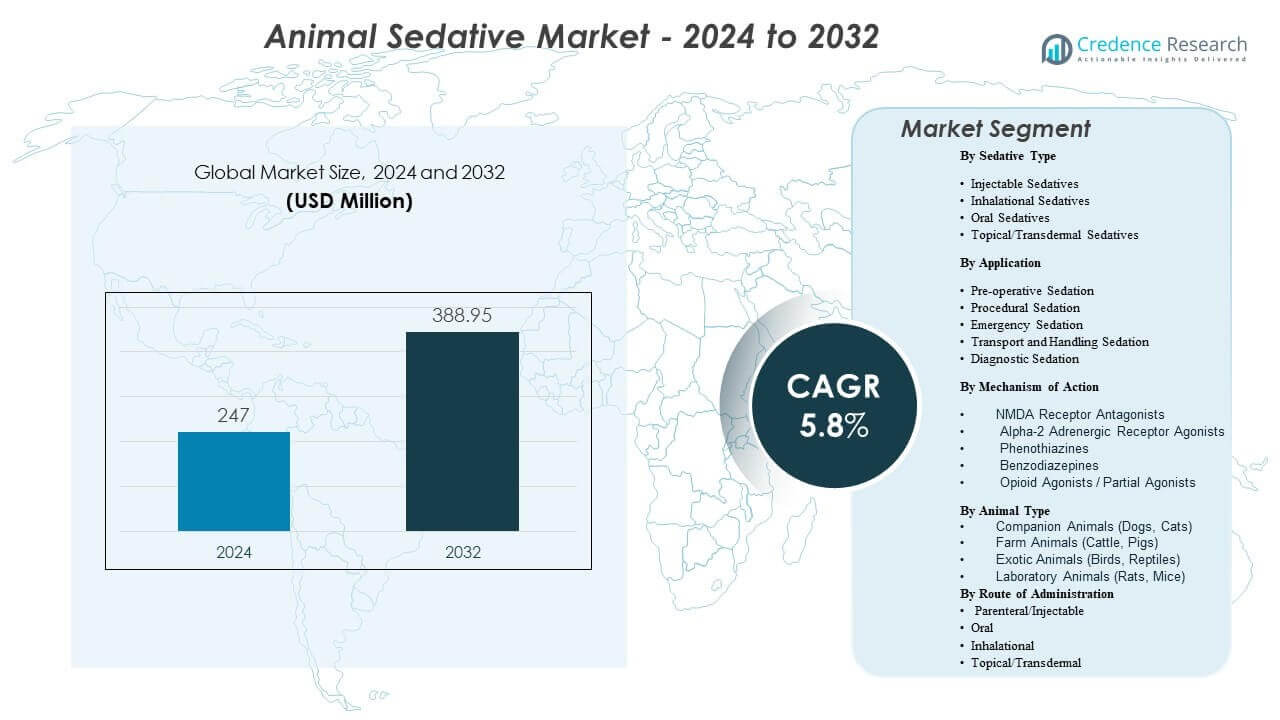
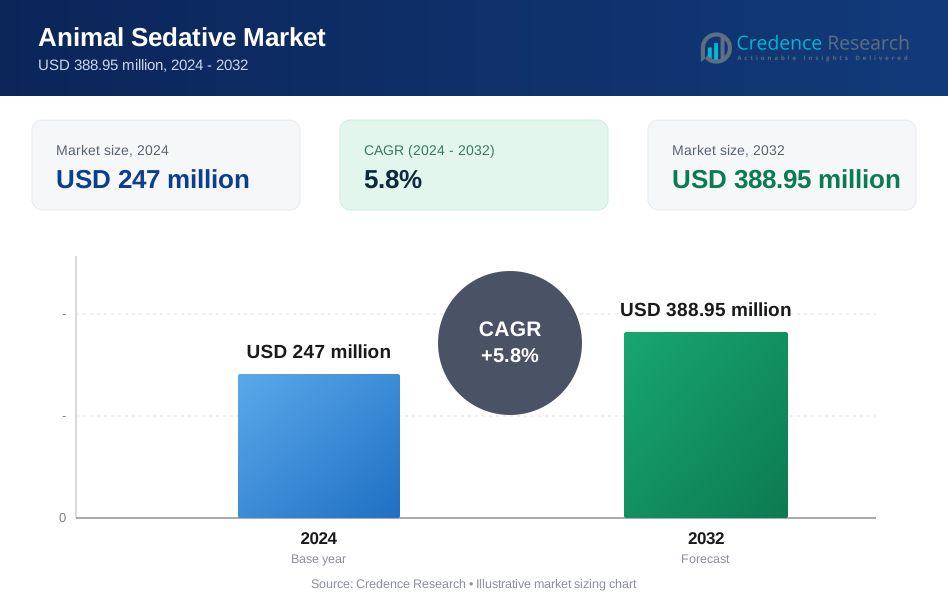
The Animal Sedative Market is projected to grow from USD 247 million in 2024 to an estimated USD 388.95 million by 2032, with a compound annual growth rate (CAGR) of 5.8% from 2024 to 2032.
| REPORT ATTRIBUTE | DETAILS |
|---|---|
| Historical Period | 2020-2023 |
| Base Year | 2024 |
| Forecast Period | 2025-2032 |
| Animal Sedative Market Size 2024 | USD 247 million |
| Animal Sedative Market, CAGR | 5.8% |
| Animal Sedative Market Size 2032 | USD 388.95 million |
Growing pet ownership and higher spending on animal healthcare drive consistent use of sedatives in clinical procedures. Veterinary hospitals perform more surgeries, imaging tests, and dental treatments that require predictable sedation. Livestock producers adopt sedatives to support humane handling, transport, and stress reduction during routine procedures. Newer formulations with improved recovery profiles gain rapid acceptance among veterinarians. The market advances through better training standards and rising demand for species-specific drugs. These drivers reinforce steady expansion across companion and farm animal care.
North America leads the Animal Sedative Market due to strong veterinary infrastructure and high utilization of sedatives in companion animal treatment. Europe follows with strict welfare standards and broad adoption of modern veterinary pharmaceuticals. Asia-Pacific emerges as a fast-growing region supported by rising pet populations, expanding veterinary networks, and improving access to advanced care. Latin America shows steady progression driven by livestock sector modernization. The Middle East and Africa continue to grow gradually as urban veterinary services strengthen. These regional dynamics shape the market’s global growth trajectory.
Animal Sedative Market Insights:
- The Animal Sedative Market is projected to grow from USD 247 million in 2024 to USD 388.95 million by 2032, registering a CAGR of 5.8% during the forecast period.
- Demand rises due to increasing veterinary surgeries, diagnostics, and routine procedures that require predictable and safe sedation across companion and farm animals.
- Growth faces restraints such as regulatory scrutiny, drug availability challenges, and limited access to trained veterinary anesthesia professionals in several regions.
- North America leads the market due to strong veterinary infrastructure and higher spending on advanced clinical care.
- Asia-Pacific shows rapid growth supported by expanding pet ownership, improving veterinary services, and rising awareness of animal welfare practices.
Animal Sedative Market Drivers
Growing Demand for Safe Sedation in Expanding Companion Animal and Livestock Healthcare Services
The Animal Sedative Market expands due to rising demand for safe and effective sedation across clinics and farms. Veterinary hospitals handle more surgeries, imaging procedures, and dental treatments each year. Clinics need predictable sedative agents that support quick recovery. Livestock handlers rely on sedation to manage stress during routine procedures. Pet owners approve advanced interventions due to better awareness. The market maintains steady growth through increased procedure volumes. It supports safer care through modern formulations. These factors strengthen long-term adoption across regions.
Rising Pet Insurance Adoption and Higher Spending on Specialty Veterinary Treatments and Interventions
Urban pet owners invest more in advanced healthcare services. Insurance coverage encourages approval of surgeries and diagnostics that require sedation. The Animal Sedative Market benefits from greater access to covered procedures. Specialty clinics expand services in oncology, cardiology, and orthopedic care. These services depend on accurate sedation control. Hospitals invest in training teams for anesthesia safety. Pet owners seek better outcomes through improved care pathways. This financial support system drives stable product demand.
- For instance, Philips Healthcare integrated its Azurion image-guided therapy platform with specialized software that has been shown to reduce procedural time by 17% and decrease radiation exposure by up to 50% during complex balloon angioplasty cases requiring deep sedation.
Increasing Livestock Industrialization and Structured Handling Protocols Supporting Sedation Use
Commercial farms adopt structured workflows for animal health. Sedation reduces injury risk during transport, tagging, and treatment. Veterinarians use sedatives to maintain calm handling conditions. Export markets enforce humane care standards. Sedation supports compliance with welfare norms. The Animal Sedative Market gains momentum from expanded livestock production. Field veterinary teams rely on fast-acting agents for daily operations. These structured processes ensure consistent product usage.
Advancement in Formulations Offering Improved Safety, Controlled Action, and Species-Specific Performance
Manufacturers develop sedatives with rapid onset and controlled duration. Clinics favor reversible agents for outpatient care. Species-specific formulations improve accuracy and reduce complications. The Animal Sedative Market strengthens due to innovation in drug delivery. Hospitals adopt products with lower cardiovascular impact. Research teams test combination therapies for balanced sedation. Dose-controlled vials improve treatment safety. These improvements raise confidence among veterinarians.
- For instance, Orion Corporation’s development of Dexdomitor (dexmedetomidine) utilizes a highly selective alpha-2 adrenoceptor agonist mechanism that is 2 times more potent than the racemic mixture medetomidine, allowing for a 50% reduction in the total dose required to achieve equipotent sedation in feline patients.
Animal Sedative Market Trends
Growing Use of Digital Anesthesia Monitoring Systems Supporting Data-Driven Sedation Protocols in Veterinary Settings
Veterinary hospitals adopt digital monitoring tools during sedation. These systems track heart rate, temperature, and oxygen levels. Clinics use collected data to refine protocols. The Animal Sedative Market gains support from integrated digital workflows. Monitoring technology improves safety for high-risk patients. Hospitals rely on consistent data to train teams. Digital tools help maintain quality standards. These trends improve accountability in clinics.
- For instance, Masimo integrated its Signal Extraction Technology (SET) into veterinary pulse oximeters, which has been shown to reduce false alarms by over 90% and accurately monitor oxygen saturation in pediatric-sized animals even during low perfusion or patient movement.
Shift Toward Minimally Invasive Veterinary Procedures That Require Controlled Sedation with Precise Dosing
Clinics perform more minimally invasive treatments each year. These procedures need short-acting sedation for smoother recovery. The Animal Sedative Market supports these techniques with accurate formulations. Hospitals prefer dosing regimens that reduce post-procedure stress. Clinics expand laparoscopic and endoscopic services. These services depend on stable sedation protocols. Better tools support safer care for smaller animals. This trend strengthens product adoption.
Expansion of Mobile Veterinary Services That Rely on Portable and Easy-to-Administer Sedative Solutions
Mobile clinics increase access to rural and urban clients. These teams need portable sedation solutions for field operations. The Animal Sedative Market grows due to wider service reach. Mobile teams handle vaccinations, wound care, and diagnostics. Sedation supports calm handling in unfamiliar environments. Portable kits improve workflow efficiency. Field veterinarians prefer fast-acting agents. This trend boosts demand outside hospital settings.
- For instance, Parnell Technologies received FDA approval for PropofolVet Multidose, the first generic propofol injectable emulsion for dogs. This formulation features a 28-day shelf life after opening and requires no refrigeration, providing a portable and cost-effective anesthetic induction solution for mobile practitioners performing short procedures in the field.
Increasing Use of Tele-Veterinary Consultations Leading to Higher Triage and Scheduled Procedures Requiring Sedation
Tele-veterinary platforms enable early diagnosis and triage. Clinics schedule more procedures following virtual consultations. The Animal Sedative Market benefits from planned surgical loads. Owners accept treatment plans with clearer guidance. Clinics prepare sedation protocols before patient visits. Digital follow-ups improve compliance with care plans. Tele-care increases awareness of complex conditions. This trend supports steady sedation usage.
Animal Sedative Market Challenges Analysis
Regulatory Constraints, Drug Shortages, and Safety Concerns Impacting Adoption and Clinical Workflow Efficiency
The Animal Sedative Market faces regulatory complexity in drug approvals. Agencies enforce strict rules for veterinary pharmaceuticals. Clinics struggle during global shortages of key sedatives. It creates delays in surgical schedules. Veterinarians manage safety risks in high-risk species. Some products carry cardiovascular side effects. Hospitals invest more in training to avoid complications. These constraints limit smooth adoption across markets.
Limited Access to Skilled Veterinary Anesthesia Professionals Along with High Costs of Modern Sedation Systems
Veterinary anesthesia requires specialized knowledge. Many regions lack trained professionals. Clinics in rural areas face greater skill gaps. The Animal Sedative Market moves slower in regions with limited training programs. Advanced monitoring systems increase operational costs. Small clinics delay purchases due to budget pressure. Owners in low-income areas avoid elective procedures. These constraints reduce product penetration.
Animal Sedative Market Opportunities
Expansion of Specialty Veterinary Centers and Growth of Pet Wellness Programs Supporting Sedation-Linked Interventions
Specialty centers invest in advanced surgery suites. These centers need reliable sedation across complex procedures. The Animal Sedative Market benefits from this expanding infrastructure. Pet wellness programs promote routine checkups and diagnostics. These programs increase sedation demand for preventive care. Clinics promote safe sedation methods to improve comfort. Owners accept these services for long-term welfare. This expansion offers strong growth potential.
Innovation in Reversible Sedatives, Targeted Delivery Systems, and Species-Specific Formulations Creating New Revenue Prospects
Manufacturers focus on reversible agents that improve recovery. Controlled-release systems support precision dosing. The Animal Sedative Market grows through these innovations. Species-specific drugs reduce complications in small and exotic animals. Clinics prefer safer products with stronger evidence. Research teams explore novel molecules for balanced sedation. These advancements improve market competitiveness. Innovation broadens opportunities across global regions.
Animal Sedative Market Segmentation Analysis:
By Sedative Type
The Animal Sedative Market expands across multiple sedative types that support diverse veterinary needs. Injectable sedatives hold strong use in clinics due to fast onset and controlled depth of sedation. Inhalational sedatives gain adoption in surgical suites where steady anesthesia maintenance is required. Oral sedatives support behavioral management and minor procedures. Topical or transdermal options provide non-invasive delivery for stress-sensitive animals. The market benefits from broad product availability and flexible usage patterns. It supports growing procedure volumes in both companion and livestock care.
- For example, in pivotal clinical trials, Zenalpha demonstrated a mean onset of sedation of 14 minutes, compared to 18 minutes for dexmedetomidine alone. Most notably, the addition of the peripheral antagonist vatinoxan allowed canine patients to maintain a mean heart rate of 75 beats per minute, significantly higher than the 41 beats per minute observed in the bradycardic control group.
By Application
The Animal Sedative Market grows across several key applications that drive product demand. Pre-operative sedation remains a core area where stable patient preparation is essential. Procedural sedation supports dental care, imaging, and wound treatments. Emergency sedation aids safe handling during trauma cases. Transport and handling sedation improves welfare during movement or restraint. Diagnostic sedation ensures stable positioning for radiology and endoscopy. Each application supports consistent use of sedatives. It strengthens market adoption in clinical and field environments.
- For instance, Zoetis Inc. markets Dormosedan Gel (detomidine hydrochloride), which clinical studies show provides successful sedation in 76% of horses within 40 minutes of sublingual administration. This oromucosal formulation enables veterinarians and owners to facilitate non-invasive procedures like farriery and clipping safely, without the need for intravenous restraint.
By Mechanism of Action
The Animal Sedative Market includes several drug classes that meet species-specific and procedure-specific needs. NMDA receptor antagonists offer strong dissociative effects for surgical settings. Alpha-2 adrenergic receptor agonists provide reliable sedation with reversible action. Phenothiazines support mild to moderate sedation for routine care. Benzodiazepines offer muscle relaxation with a favorable safety profile. Opioid agonists or partial agonists enhance analgesia during procedures. Each mechanism supports targeted sedation strategies. It improves clinical control and treatment outcomes.
By Animal Type
The Animal Sedative Market supports sedation across varied species groups. Companion animals such as dogs and cats require safe, predictable agents for surgeries and diagnostics. Farm animals including cattle and pigs depend on sedation for handling, transport, and treatment. Exotic animals such as birds and reptiles require tailored formulations to minimize stress. Laboratory animals rely on controlled sedation to maintain ethical research standards. Each group demands precise dosing and monitoring. It drives continued innovation in veterinary pharmaceuticals.
By Route of Administration
The Animal Sedative Market grows across multiple delivery routes designed for different care settings. Parenteral or injectable routes offer rapid and reliable effects for clinical and field procedures. Oral routes provide ease of administration for pre-visit calming and mild sedation. Inhalational options support controlled anesthesia in surgical environments. Topical or transdermal routes reduce handling stress for sensitive species. These routes improve flexibility in veterinary workflows. It strengthens product adoption across hospitals, farms, and research centers.
Segmentation:
By Sedative Type
- Injectable Sedatives
- Inhalational Sedatives
- Oral Sedatives
- Topical/Transdermal Sedatives
By Application
- Pre-operative Sedation
- Procedural Sedation
- Emergency Sedation
- Transport and Handling Sedation
- Diagnostic Sedation
By Mechanism of Action
- NMDA Receptor Antagonists
- Alpha-2 Adrenergic Receptor Agonists
- Phenothiazines
- Benzodiazepines
- Opioid Agonists / Partial Agonists
By Animal Type
- Companion Animals (Dogs, Cats)
- Farm Animals (Cattle, Pigs)
- Exotic Animals (Birds, Reptiles)
- Laboratory Animals (Rats, Mice)
By Route of Administration
- Parenteral/Injectable
- Oral
- Inhalational
- Topical/Transdermal
By Region
- North America
- U.S.
- Canada
- Mexico
- Europe
- Germany
- France
- U.K.
- Italy
- Spain
- Rest of Europe
- Asia Pacific
- China
- Japan
- India
- South Korea
- South-east Asia
- Rest of Asia Pacific
- Latin America
- Brazil
- Argentina
- Rest of Latin America
- Middle East & Africa
- GCC Countries
- South Africa
- Rest of the Middle East and Africa
Regional Analysis:
North America holds the largest share of the Animal Sedative Market, accounting for nearly 38–40% of global revenue. Strong veterinary infrastructure supports high adoption of advanced sedative formulations across clinics and hospitals. Pet insurance penetration increases demand for surgeries and diagnostics that require sedation. The United States leads the region with strong spending on companion animal care. Canada follows with structured livestock management and steady demand for safe handling solutions. The Animal Sedative Market strengthens its presence in this region through continuous product innovation and strong distribution networks.
Europe represents the second-largest market, capturing 27–29% of global share. The region benefits from strict animal welfare regulations that support safe sedation practices across veterinary services. Countries such as Germany, France, and the United Kingdom lead usage due to well-developed clinical systems. Demand rises in livestock-rich areas where sedation improves handling efficiency and reduces stress. The market maintains steady growth through expanding diagnostic services and specialist veterinary centers. It benefits from a broad regulatory framework that ensures reliable quality standards.
Asia-Pacific emerges as the fastest-growing region, holding 22–24% of global share. Rising pet ownership in China, India, and Southeast Asia drives significant uptake of sedative products. Expanding veterinary clinics support advanced procedures requiring controlled sedation. Growth in livestock production creates high demand for sedatives used during transport and treatment. Urbanization increases spending on companion animal care across emerging economies. The Animal Sedative Market gains strong momentum as regional access to modern veterinary pharmaceuticals expands.
Key Player Analysis:
- Zoetis Inc. / Zoetis Services LLC
- Virbac
- Ouro Fino Saude Animal Group
- Dechra / Dechra Pharmaceuticals PLC
- Merck & Co. Inc. / Merck Animal Health
- Bimeda Inc.
- Elanco / Elanco Animal Health
- Ceva / Ceva Santé Animale
- Boehringer Ingelheim / Boehringer Ingelheim Animal Health
- Vetoquinol / Vetoquinol S.A.
- Chanelle Pharma (Exponent)
- Randlab Australia Pty Ltd
- Troy Laboratories Pty Ltd
Competitive Analysis:
The competitive landscape of the Animal Sedative Market features multinational companies alongside regional veterinary pharmaceutical manufacturers. Global players such as Zoetis, Merck Animal Health, Elanco, and Boehringer Ingelheim dominate with broad sedative portfolios and established distribution channels. These companies invest in developing safer formulations with improved reversibility and species-specific dosing. Mid-tier firms such as Dechra, Virbac, and Ceva strengthen competition through targeted product lines and expansion into emerging markets. It experiences growing pressure from regional producers that offer cost-effective solutions for livestock and field veterinary use. Companies focus on regulatory approvals, strategic partnerships, and clinical evidence to enhance product acceptance. Innovation in delivery forms and improved safety profiles remains a key competitive driver.
Recent Developments:
- In December 2025, Dechra received FDA approval for Emeprev™ (maropitant citrate injectable solution), a new antiemetic product for companion animals, set for availability through major distributors in early 2026.
- In December 2024, the FDA cleared Zenalpha (medetomidine + vatinoxan), a novel α2 combination sedative developed by Vetcare Oy and licensed by Dechra Pharmaceuticals PLC, for canine sedation with onset in 14 minutes and recovery in 38 minutes while reducing cardiovascular impact.
Report Coverage:
The research report offers an in-depth analysis based on Sedative Type, Application, Mechanism of Action, Animal Type, Route of Administration and Region. It details leading market players, providing an overview of their business, product offerings, investments, revenue streams, and key applications. Additionally, the report includes insights into the competitive environment, SWOT analysis, current market trends, as well as the primary drivers and constraints. Furthermore, it discusses various factors that have driven market expansion in recent years. The report also explores market dynamics, regulatory scenarios, and technological advancements that are shaping the industry. It assesses the impact of external factors and global economic changes on market growth. Lastly, it provides strategic recommendations for new entrants and established companies to navigate the complexities of the market.
Future Outlook:
- The Animal Sedative Market is expected to grow steadily due to rising veterinary procedure volumes across companion and livestock animals.
- New formulations with improved safety and reversibility are likely to gain strong adoption in clinical and field settings.
- Expansion of advanced diagnostic and surgical services will create higher demand for controlled sedation protocols.
- Mobile veterinary units and tele-veterinary triage services will support wider sedative usage in remote and urban areas.
- Increased awareness of animal welfare standards will encourage broader integration of sedation in handling and transport.
- Growth in specialty veterinary centers will drive consistent use of multimodal sedation strategies.
- Livestock producers will rely more on sedatives to support humane handling practices and regulatory compliance.
- Digital anesthesia monitoring will strengthen clinical confidence and support safer sedation outcomes.
- Emerging markets will experience faster expansion due to improving access to veterinary pharmaceuticals.
- Innovation in species-specific sedatives will open new opportunities across exotic, wildlife, and laboratory animal care.
Request a Free Sample
Fill in your details and we'll send you a free sample report.
- Sample data tables & charts
- Research methodology
Need a Custom Version of This Report?
Tailor the scope, geography, or segments to your exact requirements.
- Custom geography or segment scope
- Direct access to our analyst team
Frequently Asked Questions
What is the current market size for the Animal Sedative Market, and what is its projected size in 2032?
At what Compound Annual Growth Rate is the Animal Sedative Market projected to grow between 2024 and 2032?
Which Animal Sedative Market segment held the largest share in 2024?
What are the primary factors fueling the growth of the Animal Sedative Market?
Who are the leading companies in the Animal Sedative Market?
Which region commanded the largest share of the Animal Sedative Market in 2024?
Table of Content
Chapter 1. Report Introduction
- 1.1 Report Description & Purpose
- 1.1.1 Report Title & Market Definition
- 1.1.2 Unique Selling Propositions (USP) & Key Differentiators
- 1.1.3 Value Proposition for Stakeholders
- 1.2 Research Objectives
- 1.2.1 Market Sizing Objectives (Volume & Revenue)
- 1.2.2 Segmentation Objectives
- 1.2.3 Competitive Intelligence Objectives
- 1.2.4 Forecast & Scenario Objectives
- 1.3 Report Scope
- 1.3.1 Animal Sedative Scope – Types & Subtypes Covered
- 1.3.2 Geographic Scope – Regions & Countries Covered
- 1.3.3 Historical Period, Base Year & Forecast Period (2024; forecast to 2032)
- 1.3.4 Inclusions & Exclusions
- 1.4 HS Code & Classification Framework
- 1.5 Currency, Units & Pricing Basis
- 1.6 Target Stakeholders
- 1.7 Limitations & Assumptions
Chapter 2. Executive Summary
- 2.1 Global Animal Sedative Market Snapshot
- 2.1.1 Market Size – Historical (2024) & Forecast (2024-2032) (2024: USD 247 million → 2032: USD 388.95 million)
- 2.1.2 Volume & Revenue – Global Totals
- 2.1.3 Key Market Highlights – Top Five Facts
- 2.2 Animal Sedative Market Segmentation Snapshot
- 2.2.1 Market Split by Region – 2024 vs. 2032
- 2.3 Competitive Snapshot
- 2.3.1 Top 10 Players by Revenue Share – 2024
- 2.3.2 Top 10 Players by Volume Share – 2024
- 2.3.3 Recent Strategic Developments (18-Month Summary)
- 2.4 Key Investment Highlights & Strategic Conclusions
Chapter 3. Animal Sedative Market Dynamics & Industry Analysis
- 3.1 Market Overview & Context
- 3.1.1 Animal Sedative Market Position in the Broader Automotive Value Chain
- 3.1.2 OEM vs. Replacement Market Dynamics
- 3.1.3 Market Maturity & Development Stage by Region
- 3.2 Animal Sedative Market Drivers
- 3.3 Animal Sedative Market Restraints & Challenges
- 3.4 Animal Sedative Market Opportunities
- 3.5 Porter's Five Forces Analysis
- 3.5.1 Threat of New Entrants
- 3.5.2 Bargaining Power of Suppliers
- 3.5.3 Bargaining Power of Buyers
- 3.5.4 Threat of Substitutes
- 3.5.5 Competitive Rivalry – Intensity Assessment
- 3.6 Animal Sedative Value Chain Analysis
- 3.6.1 Upstream – Raw Material/Input Suppliers
- 3.6.1.1 Raw Material/Input 1
- 3.6.1.2 Raw Material/Input 2
- 3.6.1.3 Raw Material/Input 3
- 3.6.2 Midstream – Production/Manufacturing/Service Delivery
- 3.6.2.1 Production/Process Overview
- 3.6.2.2 Key Facility Locations & Capacity by Manufacturer
- 3.6.3 Downstream – Distribution & End Consumer
- 3.6.3.1 Primary Channel – B2B/OEM
- 3.6.3.2 Secondary Channels – Dealer, Retail, Online, Direct
- 3.6.4 Value Chain Profitability Analysis
- 3.6.1 Upstream – Raw Material/Input Suppliers
- 3.7 PESTEL Analysis
- 3.7.1 Political Factors
- 3.7.2 Economic Factors
- 3.7.3 Social Factors
- 3.7.4 Technological Factors
- 3.7.5 Environmental Factors
- 3.7.6 Legal Factors
- 3.8 Animal Sedative Supply Chain Analysis
- 3.8.1 Raw Material/Input Supply Risk Assessment
- 3.8.2 Manufacturing Concentration Risk (Geographic Exposure)
- 3.8.3 Trade Disruption Impact Analysis
- 3.9 Regulatory & Policy Landscape
Note: The regulatory and policy landscape section covers regulations based on their applicability to the market, Animal Sedative category, geography, and scope of the study. Only regulatory frameworks with a material impact on operations, compliance, trade, sustainability, or market access are analyzed in detail.
Chapter 4. Key Investment Pockets & Opportunity Analysis
- 4.1 Animal Sedative Market Attractiveness Analysis
- 4.1.1 By Region – Investment Attractiveness Matrix (Volume × CAGR)
- 4.2 Absolute Revenue Growth Opportunity
- 4.2.1 By Region – Absolute USD Growth Through 2032
- 4.3 Incremental Volume Opportunity
- 4.3.1 By Region – Incremental Volume Through 2032
- 4.3.2 Segment – Incremental Volume
- 4.4 Emerging Submarket Opportunity Deep Dive (Subject to Applicability)
- 4.5 Emerging Market Opportunity Scorecards
- 4.5.1 United States
- 4.5.2 Europe
- 4.5.3 Asia
- 4.5.4 Middle East & Africa
Note: Emerging Market Opportunity Scorecards will be included based on relevance and strategic importance. Regions listed are indicative and may vary depending on data availability and market dynamics.
Chapter 5. Animal Sedative Import-Export Analysis & Trade Flows
- 5.1 Global Trade Overview
- 5.1.1 Global Export Value by Country (2024)
- 5.1.2 Global Export Volume by Country (2024)
- 5.1.3 Global Import Value by Country (2024)
- 5.1.4 Global Import Volume by Country (2024)
- 5.1.5 Net Trade Balance by Country (2024)
- 5.2 Export Analysis – Segment
- 5.2.1 Type 1 (HS Code)
- 5.2.2 Type 2 (HS Code)
- 5.2.3 Type 3 (HS Code)
- 5.2.4 Type 4 (HS Code)
- 5.2.5 Type 5 (HS Code)
- 5.3 Import Analysis – Segment
- 5.3.1 Type 1 (HS Code)
- 5.3.2 Type 2 (HS Code)
- 5.3.3 Type 3 (HS Code)
- 5.3.4 Type 4 (HS Code)
- 5.3.5 Type 5 (HS Code)
- 5.4 Average Unit Trade Prices
- 5.4.1 Average Export Price – Segment & Country
- 5.4.2 Average Import Price – Segment & Source Country
- 5.4.3 Price Trends (2024)
- 5.5 Key Trade Route Analysis
- 5.5.1 Trade Route 1
- 5.5.2 Trade Route 2
- 5.5.3 Trade Route 3
- 5.5.4 Trade Route 4
- 5.5.5 Trade Route 5
- 5.6 Trade Policy Impact Assessment
- 5.6.1 US Anti-Dumping & Section 301 Tariffs
- 5.6.2 EU Customs Union Impact
- 5.6.3 Major Free Trade Agreements
- 5.6.4 USMCA Rules of Origin
Note: Trade policy analysis will be included only where relevant to the Animal Sedative market.
Chapter 6. Competitive Landscape & Company Benchmarking
- 6.1 Animal Sedative Market Concentration & Structure
- 6.1.1 Herfindahl-Hirschman Index (HHI) – vs. 2024
- 6.1.2 Tier 1, Tier 2 & Tier 3 Market Structure
- 6.1.3 Global, Regional & Local Player Dynamics
- 6.2 Animal Sedative Market Share Analysis – 2024
- 6.2.1 Global Revenue Share by Company
- 6.2.2 Global Volume Share by Company
- 6.2.3 Regional Revenue Share
- 6.2.4 Market Share Evolution ( vs. 2024)
- 6.2.5 OEM Segment Share by Company
- 6.2.6 Replacement Segment Share by Company
- 6.3 Production/Delivery Capacity & Facility Analysis
- 6.3.1 Global Installed Capacity
- 6.3.2 Capacity Utilization Rates
- 6.3.3 Production/Output Volume
- 6.3.4 Facility Locations & Capacity Map
- 6.3.5 Planned Capacity Additions
- 6.4 Animal Sedative Competitive Benchmarking Matrix
- 6.4.1 Revenue, Volume, CAGR & Profitability Comparison
- 6.4.2 Channel Revenue Mix
- 6.4.3 Geographic Revenue Exposure
- 6.4.4 R&D Intensity
- 6.4.5 Sustainability Maturity
- 6.5 Strategic Developments in Animal Sedative (Last 24 Months)
- 6.5.1 Mergers, Acquisitions & Divestments
- 6.5.2 New Animal Sedative Launches
- 6.5.3 Facility Expansions
- 6.5.4 Strategic Alliances, Joint Ventures & Partnerships
- 6.5.5 Distribution Expansion & Market Entry
- 6.5.6 Sustainability & ESG Initiatives
- 6.6 Competitive Strategy Mapping
- 6.6.1 Leader, Challenger, Follower & Niche Classification
- 6.6.2 Pricing Strategy Comparison
- 6.6.3 Channel Strategy Matrix
Note: Strategic developments are included based on their materiality and the availability of reliable information.
Chapter 7. Global Animal Sedative Market – By Distribution Channel
- 7.1 Segment Overview
- 7.1.1 Volume & Revenue Split by Channel (2024 & 2032)
- 7.1.2 Channel Mix Evolution (2024-2032)
Chapter 8. Regional Market Analysis – Global Overview
- 8.1 Global Regional Overview
- 8.1.1 Regional Volume Share
- 8.1.2 Regional Revenue Share
- 8.1.3 Regional Volume by Region
- 8.1.4 Regional Revenue by Region
- 8.1.5 Regional Forecast Through 2032
- 8.2 Cross-Regional Segment Analysis
- 8.2.1 By Distribution Channel
- 8.2.2 By Brand/Price Tier
Chapter 9. North America Animal Sedative Market
- 9.1 United States
- 9.2 Canada
- 9.3 Mexico
Chapter 10. Europe Animal Sedative Market
- 10.1 Germany
- 10.2 France
- 10.3 Italy
- 10.4 United Kingdom
- 10.5 Spain
- 10.6 Poland
- 10.7 Russia
- 10.8 Netherlands
- 10.9 Belgium
- 10.10 Sweden
- 10.11 Denmark
- 10.12 Norway
- 10.13 Rest of Europe
Chapter 11. Asia Pacific Animal Sedative Market
- 11.1 China
- 11.2 India
- 11.3 Japan
- 11.4 South Korea
- 11.5 Thailand
- 11.6 Indonesia
- 11.7 Vietnam
- 11.8 Malaysia
- 11.9 Australia
- 11.10 Rest of Asia Pacific
Chapter 12. Latin America Animal Sedative Market
- 12.1 Brazil
- 12.2 Argentina
- 12.3 Colombia
- 12.4 Chile
- 12.5 Rest of Latin America
Chapter 13. Middle East Animal Sedative Market
- 13.1 Saudi Arabia
- 13.2 United Arab Emirates
- 13.3 Turkey
- 13.4 Israel
- 13.5 Iran
- 13.6 Rest of the Middle East
Chapter 14. Africa Animal Sedative Market
- 14.1 South Africa
- 14.2 Egypt
- 14.3 Nigeria
- 14.4 Morocco
- 14.5 Rest of Africa
Chapter 15. Animal Sedative Company Profiles
- 15.1 [Company 01]
- 15.1.1 Company Overview
- 15.1.2 Key Management Personnel
- 15.1.3 Products & Services Portfolio
- 15.1.4 Financial Performance
- 15.1.5 Key Market Focus & Geographic Presence
- 15.1.6 Recent Developments & Strategic Initiatives
Note: The company profile list is preliminary and may change based on research findings, market developments, data availability, and client requirements.
Chapter 16. Appendices
- Appendix A – List of Abbreviations & Acronyms
- Appendix B – Industry Classification Code Reference – Full Series
- Appendix C – Production & Capacity Data Tables
- Appendix D – End-Use & Demand Base Tables
- Appendix E – Consumption & Replacement Rate Assumptions
- Appendix F – ASP Reference Tables
- Appendix G – Manufacturing & Facility Database
- Appendix H – Import-Export Data Tables
- Appendix I – Regulatory Summary Tables
- Appendix J – Primary Research Participant List (Anonymized)
- Appendix K – Primary Research Questionnaire Framework
- Appendix L – Data Sources & Bibliography
- Appendix M – Market Size Divergence & Source Comparison
Chapter 17. Research Methodology
- 17.1 Research Framework & Philosophy
- 17.2 Secondary Research – Sources, Hierarchy & Data Extraction
- 17.3 Data Modeling – Bottom-Up & Top-Down Market Sizing
- 17.4 Primary Research – Stakeholder Framework, LOI & Sample Sizes
- 17.5 Forecast Methodology – Regression, Scenario & Sensitivity Analysis
- 17.6 Quality Control – Four-Layer Validation Framework
- 17.7 Limitations & Standard Assumptions
- 17.8 Disclaimer
